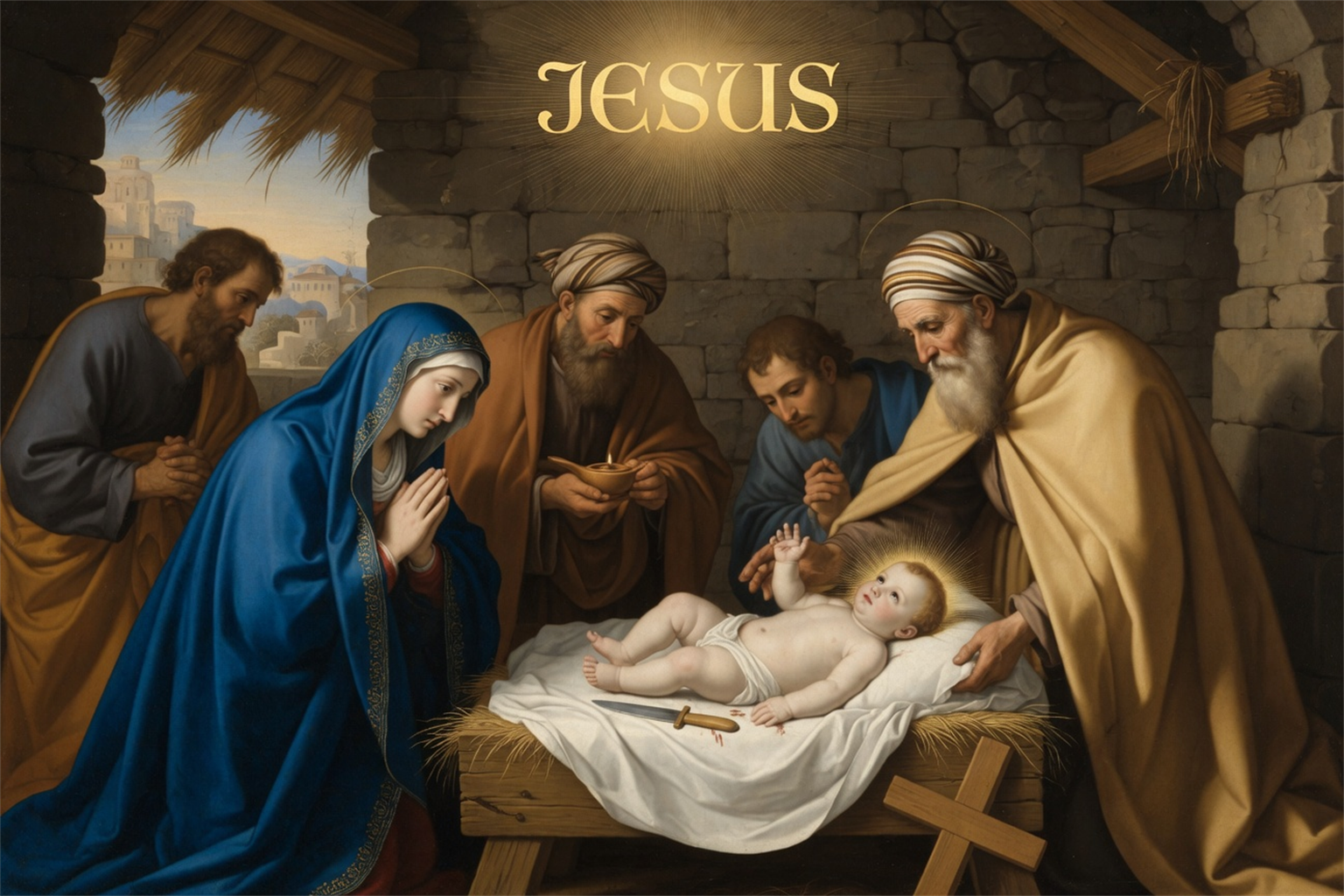
Eight days after his birth in Bethlehem, the Son of God submits to the law of Circumcision and receives the name Jesus, meaning Savior. Through this act of humility, he begins to shed his blood for the redemption of mankind. The name of Jesus, revealed by the angel, is celebrated as a source of light, nourishment, and spiritual healing.
Guided reading
9 reading sections
ON THE CIRCUMCISION OF OUR LORD JESUS CHRIST
Introduction to the two mysteries
Presentation of the Circumcision and the Name of Jesus as the first fruits of salvation and the bloody sacrifice of Christ.
AND OF THE ADORABLE NAME OF JESUS WHICH WAS GIVEN TO HIM
Year I. — Caesar Augustus, emperor.
That at the name of Jesus every knee should bow, of those that are in heaven, on earth, and under the earth.
Letter to the Philippians, II.
For there is no other name under heaven given to men, whereby we must be saved.
Acts of the Apostles, III.
I. We could not, it seems to me, better begin the month of January and the civil year than by the Circumcision of Our Lord and the most holy Name of Jesus which was given to Him on this occasion. By the Circumcision, He shed for us the first drops of His blood; by the name of Jesus, which means Savior, He was pledged to shed all the rest upon the tree of the cross for our redemption: we find therefore in these two mysteries the richest gifts, the most advantageous presents that we could wish for. Saint Luke, the only one of the Evangelists to have spoken of this feature of the Savior's life, said only a few words about it: And after eight days were accomplished, that the child should be circumcised, his name was called JESUS, which was called by the angel, before he was conceived in the womb of his Mother. But it is necessary to treat of it a little more fully.
Historical origin of the Circumcision
A reminder of the covenant between God and Abraham instituting circumcision as the distinctive sign of the chosen people.
Let us first say what Circumcision was. Four hundred and six years or thereabouts before the promulgation of the law of Moses, God, wishing to prepare for Himself a people of His own who, in the midst of the general corruption of all nations plunged into idolatry, would make a public profession of knowing, adoring, loving, and obeying His commandments, chose Abram, son of Terah, to be its root. Abram was then in his hundredth year, and Sarai, his wife, in her ninetieth. God nevertheless assured them that they would have a son whose posterity would be as numerous as the stars of the sky and the grains of sand on the seashore. In testimony of which He no longer called him Abram, but Abraham, which means father of a great mu ltitude Abraham Father of Isaac and the first of the patriarchs. ; He no longer called his wife Sarai, but Sarah, which means sovereign. And in order that this people, which He promised him, might be distinguished from all other peoples of the world, and that it might have upon its body the mark and character of its election, He made this agreement with this holy patriarch, that all male children who would be born of him in the course of time would be circumcised on the eighth day after their birth: This is, He said to him, the covenant which I make with you and with your descendants, and the pact which you must inviolably observe: every male child shall be circumcised on the eighth day. He who has not been circumcised shall be exterminated, because he will have violated My covenant. Since then, God, giving His Law on Mount Sinai to the descendants of Abraham, to the people of Israel, inserted this same commandment: The male child of eight days shall be circumcised. Thus this people has always been a very religious observer of this practice, holding it even as an ignominious thing not to be circumcised; because it was to have no part in this holy and glorious covenant with God. As the Greeks called, by contempt, barbarians the men of all other nations, so the Jews called them the uncircumcised, and would have no kind of relation with them.
Circumcision as a Sacrament
Analysis of circumcision as a remedy for original sin before the institution of Christian baptism.
God did not merely command Circumcision as a mark of His covenant; He instituted it at the same time as a Sacrament, to efface original sin, which children contract through their generation, and with which they are defiled when they come into the world. It is true that there was already a remedy for this evil: it was another sacred ceremony, by which parents, attesting their faith in the Messiah and in the redemption they awaited, procured for their children the benefit of justification and grace: and this remedy lasted until the institution of our Baptism, for girls and also for male children who were in danger of death before they could be circumcised. But it no longer applied to other male children, as soon as God had ordained Circumcision, to which alone the remission of original sin was then attached. Thus the holy Doctors, and among them Saint Gregory, Pope, say that it produced much the same ef fect as the sacramen saint Grégoire, pape Pope cited in the introduction. t of Baptism now produces; there was nevertheless a difference between the one and the other: Baptism regenerates and produces grace by its own virtue, that is to say, by a virtue that Our Lord communicated to it as to His own instrument; on the contrary, Circumcision was only a ceremony by virtue of which God, having regard to the future passion of His Son which He saw represented in advance in this profession of faith, operated by Himself and without any instrument the benefit of regeneration; therefore it was simply the sign of grace and not the efficient cause of grace. God used this ceremony of Circumcision in preference to any other: first, to warn His people continually that they must work tirelessly at their spiritual circumcision, that is to say, to repress their disordered affections, their concupiscence, and to cut off their vices, and especially that of impurity, whose domain is more violent and whose fire is more difficult to extinguish than that of others; then, to signify that, in the new covenant, one would profess a perfect circumcision, by which one would detach oneself from all things of the earth, to aspire only to the things of heaven; by which also one would die entirely to oneself, to live no longer but in God and for God.
The voluntary submission of Christ
Explanation of the reasons why Jesus, although impeccable and above the law, chose to submit to it.
It is certain that Our Lord was not subject to this law of Circumcision, and that neither the Blessed Virgin nor Saint Joseph were obliged to have him circumcised. He was undoubtedly, as a man, capable of receiving orders; for he himself assures us in the Gospel that his Father gave him commandments, and that he is very exact and very punctual in observing them, and all theology recognizes, after the Angelic Doctor, that he had, among other things, received the commandment to redeem men and to sacrifice himself for their deliverance; Saint Paul says that saint Paul Author of the Epistles emphasizing the obedience of Christ and spiritual circumcision. he became obedient unto death, and even unto the death of the cross. But as for the law of Circumcision, as well as for the whole law of Moses, it obliged him to nothing, because, having been made only to prepare criminal and captive men for the benefit of their redemption, it could not reach their own Savior and Redeemer, He who had no part in their captivity nor in their crimes. And, certainly, none of the reasons for Circumcision existed in his person. He did not need it as a mark and a character to distinguish him from the infidels and the Gentiles, since the anointing of his divinity and his natural filiation with God distinguished him absolutely from all men, and placed him in an order infinitely elevated above all creatures. He did not need it as a sacrament for the remission of original sin; for, not only had he not contracted this sin, but he was impeccable, and he had come into the world to destroy and exterminate sin. He did not need it as a continual warning to work toward spiritual circumcision; having nothing in himself but what was most holy, most perfect, and most accomplished, he had nothing that needed to be cut away or circumcised. Finally, he did not need it to prefigure the perfect Circumcision of the new law, since he was to show this circumcision in all its reality, and provide a model of it in his poor, humble, suffering life, and in his cruel and ignominious death.
However, it was very fitting that he should subject himself to this law of Circumcision for several reasons that Saint Epiphanius pointed out in his first book of Heresies: 1st, to show that he was truly man, and that his body was of the same s ubstance and n saint Épiphane Bishop of Cyprus who inspired Paula with his accounts of the monks. ature as ours; for heretics were to be born who would combat this truth: the Manichaeans, who gave him only a fantastic body; the Apollinarians, who attributed to him a body of divine substance; and the Valentinians, who attributed to him one of celestial matter; it was appropriate that he should arm his Church against them by giving it evident marks of the sensitivity of his body: 2nd, To show that he did not disapprove of Circumcision, which was the great Sacrament of the Jews and the entry into their religion, just as Baptism is the entry into the Christian Church; but that, on the contrary, he approved of it as a very religious ceremony and one of divine institution: for the same Manichaeans and other heretics were one day to condemn this observance and all the other ceremonies of the law, and say that it was not God, but the devil, who was their author. He could not better destroy these errors than by his voluntary subjection to these ceremonies; for the Son of God would not have observed a law that did not have God as its principle; 3rd, To testify that he was of the race of Abraham, and a true Israelite; Circumcision was the mark and perpetual sign of this. Indeed, it was very important, and even necessary, that he be recognized as such. The Jews knew that their Messiah was to descend from Abraham, and that he was that Son in whom God had promised the blessing of all nations; if they had not recognized the Savior as one of his descendants, they would have claimed to be legitimately dispensed from receiving him as Messiah; which would have placed a great obstacle to the propagation of the Gospel; 4th, To lead us, by this example, to obey promptly and with joy the commandments of God and the orders of our superiors, however difficult they may seem to us. Does anything preach obedience to us better than the sight of this sovereign Lord making no difficulty in submitting, although he was not obliged to, to Circumcision, a ceremony so rigorous and so infamizing? 5th, To humble and annihilate himself for us to the last extremity. It was already a great humiliation that, being God, he should have become man; that, being eternal and infinite Wisdom, he should be reduced to the state of a child; that, being Master of all riches, he should have become poor and indigent; and that, being impassible and immortal, he should be exposed to suffering and dying. But this humiliation went much further in the mystery of Circumcision, since, being the Holy of Holies, he made himself, not a sinner and criminal, for that was impossible for him; but, as a sinner and as a criminal, taking the mark of a sinner and the remedy that had been ordained for the healing of sin. By this he taught us to be humble, and confounded the pride of the children of Adam, who easily commit sin, but do not want to bear its shame and ignominy nor appear and be called sinners; 6th, To begin, from this tender age, to shed his blood for us, and to exercise in our favor his divine office of Savior and Redeemer, it was decreed in the secret counsels of divine Providence that he would not expose himself to the cruelty of whips, thorns, nails, and the lance, which were to drain his veins and take away all his blood, before having reached the age of 33, and before having preached his Gospel by word of mouth. But his love for us was too great to wait for such a long term; he wanted from the beginning to give us assured pledges of what he was preparing for us, and, by a first and slight effusion of his precious blood, to make us know the excellence of the price he destined for our ransom, in order to excite us more powerfully to love him, and so that we might say to him: *O holy Child, if you do so much for us at such a tender age, what will you do when you are at a perfect and accomplished age?*
From the flesh to the spirit
Transition toward the spiritual circumcision of the heart advocated by Saint Paul and the Church Fathers.
Finally, He had to be circumcised to blunt the knife of Circumcision in His flesh, and, by giving this carnal observance an honorable end through the kindness He showed in subjecting His body to it, to change it into a spiritual Circumcision. This is also what He successfully accomplished; for the Circumcision of the flesh died in Jesus Christ, and the Circumcision of the spirit began through Jesus Christ. The former was for the Jews who were carnal men; and the latter for Christians, children of Abraham according to the Spirit. That is why the apostle Saint Paul says: *It is we who are the true circumcised, we who serve God in spirit, who glory in Jesus Christ, and who put no confidence in the flesh*. And elsewhere: *You have been circumcised in Jesus Christ, not with a Circumcision made by the hands of men, but with the Circumcision of Jesus Christ, having been buried with Him through Baptism, and having risen with Him through faith*. Moses and Jeremiah had recommended this kind of Circumcision to the Israelites as to Christians in anticipation, telling them: *Do not be content with the Circumcision of your flesh, but work to circumcise your heart*; that is to say, to cut away from it all superfluities and all disorders. This Circumcision must extend to our entire interior and exterior; so that we suffer nothing in our spirit, nor in our will, nor in our appetite, nor in our senses and bodily faculties, that is capable of profaning them and making them criminal. Thus Saint Bernard said that "the carnal Circumcision was only of a single member;" but that the spiritual Circumcision that Jesus Christ taught us "must be of the whole man."
The Rite at Bethlehem
Traditional details regarding the place, the instruments, and the ministers (Mary and Joseph) of the Child's circumcision.
These are the great reasons why it pleased Our Lord to be circumcised, and to inspire the Blessed Virgin and Saint Joseph with the will not to exempt Him from the rigor of this ceremony. It is not known whether it was performed with a steel knife or a stone knife. We read, it is true, that Zipporah, wife of Moses, and Joshua, leader of the people of God, used, on one occasion, stone knives for the Circumcision: nevertheless, it does not appear that there existed a general commandment to use only this type of instrument; on the contrary, it is more probable that this was at the choice of those performing the ceremony, and even that it was more common to use iron and steel knives than stone knives. However, the opinion of Saint Bernard is that Our Lord was circumcised with a stone knife: which could not be practiced without causing Him a very bloody wound and causing Him much pain. This was what He desired most; and He did not ask that the law be softened for Him, but that it be applied to Him in its greatest severity. The place where this ceremony took place was the stable of Bethlehem where He was born, as we are taught by Saint Epiphanius in Book I o f the Heresies, and l'étable de Bethléem Place of the birth and anointing of David. many other holy Fathers; for they say that He was still in this stable when the Magi came to adore Him. Holy Scripture does not say by whom He was circumcised; but it is very credible that it was by His most holy Mother and by Saint Joseph, whom the Rev. Fr. Louis of Granada calls, for this subject, the ministers of the Circumcision of Jesus. Indeed, it was fitting that the innocent flesh of this spotless Lamb should be uncovered only to virgin eyes, and should be touched only by virgin and supremely pure hands, such as were those of these two seraphim of the earth. It was then that this incomparable spouse could say with truth that myrrh, that is to say the precious blood of her Son, had flowed and distilled from her hands. It was for her a more beautiful adornment than sapphires and diamonds.
Excellence of the Name of Jesus
A study of the divine origin of the name of Jesus, its meaning as Savior, and its superiority over ancient figures.
II. It is time to speak of the adorable name of Jesus which was given to the Child at His Circumcision. The alliance of the holy name of Jesus with the Circumcision was brought about only through a great mystery. It was, firstly, to show that this Child came to save us only through His blood, of which He gave the first fruits in His Circumcision; secondly, to teach us that our salvation consisted in circumcising ourselves spiritually, that is to say, in stripping off the old Adam and the vicious inclinations of the flesh to clothe ourselves with the new Adam and the holy inclinations of grace; thirdly, to efface, by the glory of so august a name, the apparent ignominy of the Circumcision, just as the opprobrium of the cross was, in a way, effaced by that magnificent inscription which was attached to it: Jesus of Nazareth, King of the Jews. Indeed, if we reflect upon it, we shall find that Divine Wisdom has almost always joined, in the mysteries of our Redemption, greatness with abasement and exaltation with humiliation. If the Son of God takes a Mother on earth, it is a virgin Mother, incomparably purer than the cherubim and seraphim. If He is born in a stable, His birth is announced by angels, recognized by shepherds, surrounded by the adorations and prostrations of the Magi, and feared by the most superb of kings. If He is forced to flee into Egypt, miracles make Him respected there while the blood of the innocents makes His birth famous throughout Judea. Finally, His very death, however infamous it may appear, is rendered most glorious by an eclipse of the sun and by the upheaval of all nature. It is therefore for the same reason that He is called Jesus at His Circumcision; I mean, so that this name may make us consider Him there, not as a sinner, but as He who takes away the sins of the world.
One may gather from the holy Doctors several excellences of this name of Jesus. The first is that it is the eternal Father who is its author; for, as Saint Cyril of Alexandria says, when the Angel announced it to the Blessed Virgin and to Saint Joseph, he did not announce it of himself, but on behalf of God who had charged him with this mission. And, certainly, to give a name to a thing, one must have some power over it, as Adam had over all creatures, and as fathers naturally have over their children. Now, there was certainly only God who had power over Jesus Christ, even considering Him only as man. It was therefore for God to give Him a name. Furthermore, to impose upon someone a name that is suitable for him, one must know him perfectly and penetrate his merit. Now, Our Lord Himself assures us that no one knows Him, except His eternal Father, just as no one but He knows His Father naturally. It was therefore from His Father that He was to receive a name. Finally, we see in the Holy Scripture that those for whom God has a particular affection, and whom He has destined for more eminent employments, have been named by Him, whether before their birth, immediately after, or in the course of their lives, as was done for Abraham, Isaac, Saint John the Baptist, and Saint Peter. It was therefore very just that it should be He who gave a name to this beloved Son who was the dear object of His complacencies and whom He had destined to be the Redeemer of the world. This, nevertheless, did not deprive Mary and Joseph of the honor of imposing this name; for the Angel had said to both of them: You shall call Him Jesus. Mary had this right because she contained within her maternity all paternal and maternal authority, and as for Joseph, although he had no part in His conception or His birth, yet he was not, says Saint John Chrysostom, to be excluded from this function, since by participating in it, he in no way derogated from the sovereign dignity of his spouse. But both did nothing other than give the name they had learned by revelation, and which the eternal Father had designated for them.
The second excellence is that this name of Jesus is the proper name of the incarnate Word. I say the proper name, not only in opposition to His metaphorical names, such as those of lion, lamb, stone, vine, path, light, and many others, which Saint Jerome reports in chapter forty-seven of Ezekiel, but also in opposition to His appellative names, such as that of Christ, and to those which are common to Him with the other divine persons, or with the most qualified among men, so that, as the name of the first man is Adam, and that of the Blessed Virgin is Mary, and that of the Apostle of the nations is Paul, so the proper name of the Savior is Jesus. There are even authors who have written that this name is so proper to Him that it has never been given to others but Him, and that the one which the Holy Scripture attributes to Jesus or Joshua, son of Nun, and to Jesus, son of Jozadak, and to Jesus, son of Sirach, was written and pronounced differently in Hebrew than that of Our Lord. Nevertheless, it is more true that these three great personages, who were the figures of Jesus Christ, as also the ancient Joseph, Othniel, Ehud, Gideon, Jephthah, and Samson, who were also called Jesus and Saviors, had the same name as to letters and pronunciation; but there was an infinite difference as to the meaning: for they had this name only by reason of the temporal salvation they brought to the people whose guidance God had entrusted to them; whereas Our Lord has this name because the salvation He procures extends to bodies and souls, to Jews and Gentiles, to the living and the dead, to time and to eternity; because He saves by His own virtue and not by a foreign virtue. Thus the Angel, explaining to Saint Joseph the power of this name, says to him: You shall call Him Jesus, because it is He who will deliver His people from their sins; His people, that is to say, all the nations of the world, according to what is written: Ask of me, and I will give you the nations for your inheritance, the ends of the earth for the place of your domain. It is in this sense that the name of Jesus is a new name. It is not so in that it simply means Savior; but it is so in that it means He who delivers from sins and death, and who gives a perfect and accomplished salvation.
The third excellence is that this name includes all the other names that the Holy Scripture gives to the Messiah, both according to His divine nature and according to His human nature, and according to the union of one and the other in one same person; so that we have, in this name, the fulfillment of these beautiful prophecies of Isaiah, Jeremiah, and Zechariah: He shall be called Emmanuel, that is to say, God with us. Name Him, He who hastens to take away the spoils. He shall be called Wonderful, Counselor, God, Strong, Father of the world to come, Prince of Peace. This is the name they will give Him: The Lord our Just; His name shall be the Orient. These names are drawn from the cause of salvation, which is the alliance of God with the nature of man; for God alone could not satisfy, and man could not satisfy infinitely. Our evils required a divine remedy where both divinity and humanity were found, that is to say, the matter of salvation, which is sin with all its consequences; the way of salvation, which is to enlighten us, to justify us, and to fill us with strength and constancy; finally, the term of salvation, which is the eternal peace and immutable happiness of this century which will never end. Now, the name of Jesus, meaning a perfect Savior, extends generally to all these things: it expresses and represents to us He who is God and Man, who destroys sin, who overcomes death, who despoils hell, who chains the demon, who fills us with light, who restores us to grace and to the dignity of children of God, who strengthens us against temptations, who gives us perseverance, who opens to us the door of the kingdom of heaven, and who leads us there happily, to reign with Him in eternity. Thus, it contains all these names of the Messiah announced by the prophets, and it is as it were their summary and abridgment. Add that it also contains the august qualities of Chief, Shepherd, Doctor, Legislator, High Priest, Victim, Consoler, and Spouse, which signify almost the same thing as these other names, and which are also the appanages of a true Savior.
The fourth excellence, which has much relation and connection with the preceding one, is that this same name brings back before our eyes all the actions and all the sufferings of Our Lord, with that great number of wonderful fruits which proceed from His incarnation, His passion, and His resurrection. Indeed, He never did or suffered anything but to fulfill His name and His office of Jesus and Savior. If He was born in a stable, if He suffered the rigor of the Circumcision, if He fled into Egypt, if He spent thirty years in an unknown and despised life, if He exposed Himself to a thousand labors and a thousand fatigues during the time of His preaching, if He delivered Himself to the infamy and cruelty of the torture of the cross, if He came out gloriously from the tomb, if He ascended to the right hand of His Father, it was only to be perfectly Jesus and Savior, and to omit nothing that could contribute to our salvation. Thus, when we call Him Jesus, we say in one word a God-Man, a poor, humiliated, despised, suffering, and dying God; we say an all-powerful advocate, who intercedes continually for us in heaven. Likewise, all the goods that have flowed from this source, and which have spread in heaven, on earth, and even to the underworld, are nothing other than graces of this Savior. The joy restored to the angelic choirs, whose celestial concerts the sin of the demons had troubled, the deliverance of the Saints who were in limbo, the vocation of the Gentiles, the faith of the nations, the justification of sinners, the renewal of the world, the constancy of the Martyrs, the light of the Doctors, the devotion of the Confessors, the austerity of the Religious, the purity of the Virgins, the firmness of the Church, the precious death of the Just, the crowning of the Saints, and the consummation of all things, are the fruits of the salvation that this divine Liberator came to effect in the world: they are expressed in the name of Jesus, and we cannot pronounce it without giving the idea of them, without representing them to the memory.
Spiritual Effects and Devotion
Description of the healing and protective virtues of the Name of Jesus according to Saint Bernard and other saints.
The fifth and final excellence is that this divine name has admirable effects in the soul of those who think of it attentively and who pronounce it with devotion. Listen to what Saint Bernard writes about it in the fifteenth sermon on the Song of Songs; he applies to the name of Jesus these words of the Bride to the Bridegroom: Your name is oil poured out; and he says: "Why is this name oil? I do not know if you know a better reason; but, for me, I believe it is because oil has three qualities, which are to enlighten, to nourish, and to anoint: it sustains the flame, it nourishes the flesh, it soothes pain. It is a light, a nourishment, and a remedy. Now, these same things befit the name of the Bridegroom; it enlightens when it is proclaimed, it nourishes when it is meditated upon, it anoints and softens evils when it is invoked. Let us examine each of these qualities in particular. — How do you think such a great and sudden light of faith burst into the world, if not by the preaching of Jesus Christ? Is it not by the splendor of this name that God has called us into his admirable light? That is why Saint Paul says: You were once darkness, but now you are light in Our Lord. How resplendent this light was, and how it dazzled the eyes of all who looked upon it, when, coming like a flash of lightning from the mouth of Peter, it strengthened the legs and feet of a lame man, and restored sight to many spiritual blind! Did it not cast flames of fire when he said: In the name of Jesus Christ of Nazareth, rise up and walk? — But the name of Jesus is not only a light, it is a nourishment. Do you not feel comforted every time you remember it? What is there that so nourishes the mind of one who thinks of it, that so well repairs exhausted strength, that makes virtues so manly, that makes one persevere with such success in good and praiseworthy habits, and that so constantly maintains chaste and honest inclinations? All nourishment of the soul is dry if it is not dipped in this oil; it is insipid if it is not seasoned with this salt. A book has no taste for me if I do not find the name of Jesus in it. A lecture or a conversation does not please me if one does not speak of Jesus there. Jesus is honey to the mouth, a melody to the ears, a song of gladness to the heart. — But it is also a remedy. Is one of us sad? Let Jesus come into his heart, let him pass from there to his mouth; this sacred name is no sooner pronounced than it produces a beautiful day that chases away boredom and brings back calm and serenity. Does someone fall into a crime? Does he even run to death through despair? At the moment he invokes this name of life, he begins to breathe and to revive. Before this saving name, who has ever persisted in his hardening, or in his laziness, or in his animosity, or in his languor? Who is he who, having lost the gift of tears, has not felt them flow from his eyes with more abundance and sweetness, as soon as he has invoked Jesus? Who, being seized with fright in the apprehension of an imminent peril, has not been delivered from all fear and has not received much assurance from the moment he invoked this all-powerful name? Who is he whose wavering and irresolute mind has not been strengthened as soon as he implored its help? Finally, who, being in distrust, and even very close to succumbing under the weight of some great adversity, has not regained new vigor at the mere sound of this helpful name? These are the languors and diseases of the soul, and it is their remedy. Nothing is more proper than this name to stop the impetuosity of anger, to lower the swelling of pride, to heal the wounds of envy, to restrain the excesses of impurity, to extinguish the fire of lust, to appease the thirst of avarice, and to banish all shameful and disordered desires." Such are the words of Saint Bernard, which mark for us so distinctly the effects of the name of Jesus, that there is nothing left for us to add. We see, by this, that this name is an oil poured out that enlightens us in our darkness, strengthens us in our battles, and makes the yoke of the Gospel sweet and easy; a ravishing perfume that rejoices our spirit and our heart, and makes us be in every place the good odor of Jesus Christ; and a heavenly manna that contains all tastes and all imaginable sweetnesses, and gives the soul a perfect contentment.
One should not be surprised if the great Apostle wants every knee to bend at the pronunciation of this name in heaven, on earth, and in hell. He carried it so deeply engraved in his soul that he does nothing but repeat it in his Epistles, without wo rrying if this le grand Apôtre Author of the Epistles emphasizing the obedience of Christ and spiritual circumcision. repetition is against the rules of elegance. And when his head was cut off, his tongue pronounced it three more times. It was perhaps also the sweetness of the same name that changed into milk the blood that was to come out of his neck when his head was taken from him. Saint Ignatius, Bishop of Antioch and martyr, had so well imprinted it on his heart that, when it was opened after his death, Jesus was found written there in letters of gold. By the virtue of this name, many Saints have performed very great miracles, for example, the Apostles, as Saint Ignace, évêque d'Antioche Disciple of the Apostles who wrote to the Christians of Tralles. we read in the Gospel and in the book of their Acts. Saint Bernardine said that we must show this holy name the same respect as to the Savior himself, not for the letters of which it is composed, nor for the voice and sound that make its pronunciation, but for the incomparable dignity of the Son of God made man that it represents to us. Let us therefore often have this adorable name on our lips; let us always have it in our heart, and may such a holy thought and such a salutary memory never leave our mind; let us use it in our dangers, in our afflictions, in our temptations, in our doubts, and in our irresolutions, saying with Saint Anselm: Jesus, be to me, Jesus; or: Jesus, show that you are Jesus; or like those poor of the Gospel: Jesus, Son of David, Jesus our master, have pity on us. Above all, let us pronounce it often at the moment of death, as a name that is formidable to demons and that will easily dissipate their pernicious designs against us.
Evolution of the Liturgical Feast
History of the January 1st celebration, transitioning from penance against paganism to Christian joy.
As for the feast of the Circumcision and the most holy Name of Jesus, it is very ancient in the Church, as proven by the homilies and sermons of the holy Fathers. But there was a difference in the manner of solemnizing it; for, in the beginning, to oppose the impieties of the pagans, who spent this day in debauchery and superstitious ceremonies, Christians fasted very rigorously and recited litanies as a mark of penance; we have illustrious testimonies of this in Saint John Chrysostom, Saint Ambrose, Saint Augustine, Saint Maximus of Turin, and Saint Peter Chrysologus, cited by Cardinal Baronius in his Commentaries on the Martyrology. The Fourth Council of Toledo, held in the year 6 36, even forbade the singin quatrième concile de Tolède Council held in 636 that legislated on the liturgy of January 1st. g of the Alleluia; and, before it, the Second Council of Tours and that of Auxerre had condemned its diabolical New Year's gifts and other remnants of paganism. But since these superstitions have been abolished, the Church has changed its countenance and has taken up its garments and songs of joy on this day, not because of the two-faced Janus, whom the idolaters worshipped, but because of Jesus Christ, God and Man, humbled by the Circumcision and exalted by the sacred name of Jesus, which is the object of its veneration and love.
Annexes & related entities
Structured data for exploration: events, miracles, quotes, places, attributes, patronages, and important entities cited in the text.
Key Events
- Birth in Bethlehem
- Circumcision on the eighth day after birth
- Naming of Jesus
- Adoration of the Magi
- Flight into Egypt
- Preaching of the Gospel
- Death on the cross
- Resurrection and Ascension
Miracles
- Healing of a lame man by Saint Peter in the name of Jesus
- Name of Jesus found written in gold letters in the heart of Saint Ignatius of Antioch
- Transformation of blood into milk during the martyrdom of Saint Paul
Quotes
-
Eight days having passed since the birth of the Child, he was circumcised and named Jesus
Saint Luke -
Your name is oil poured out
Saint Bernard (Song of Songs)