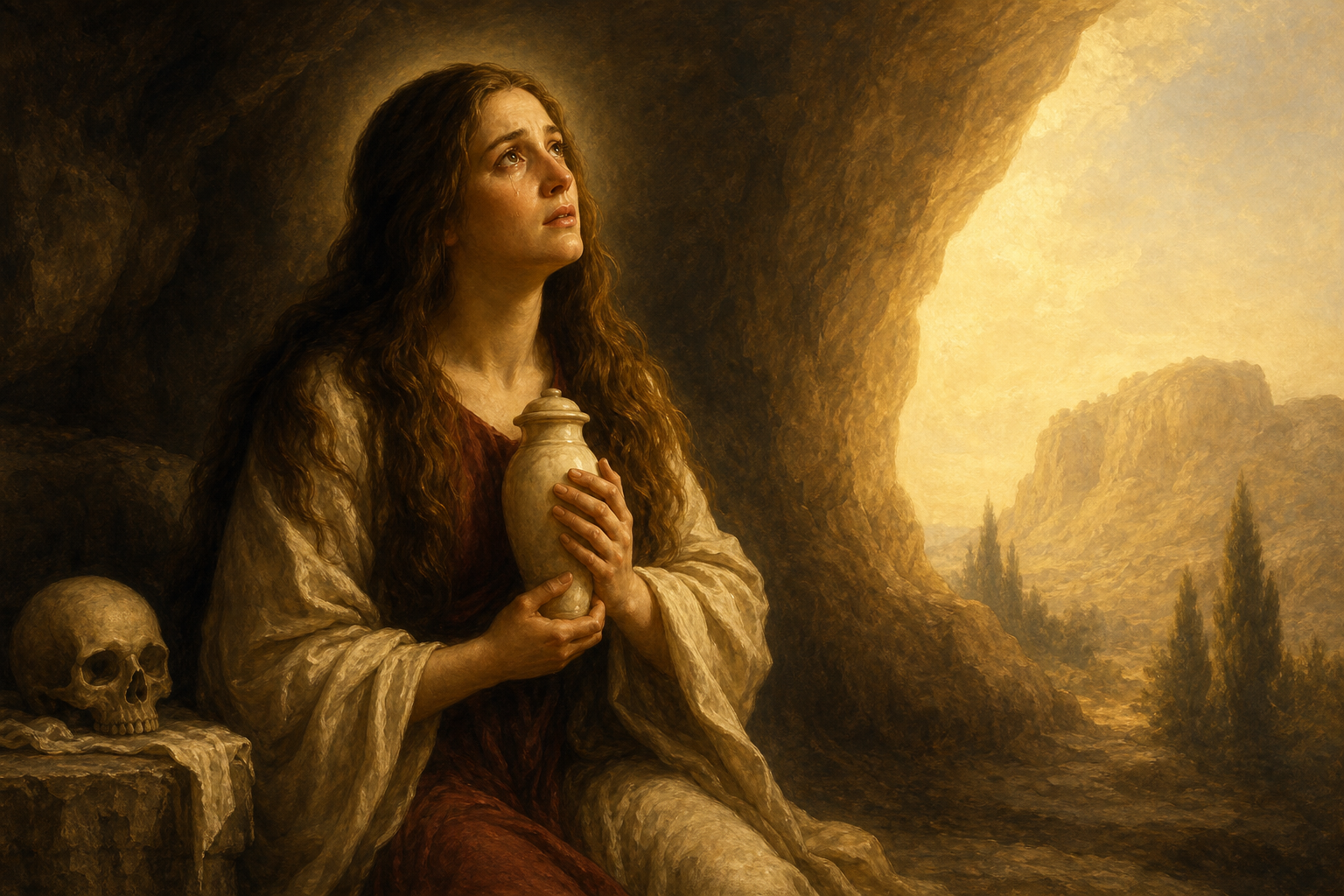
A disciple of Jesus Christ, Mary Magdalene is honored in Provence, particularly in Saint-Maximin and La Sainte-Baume. Her relics, hidden to protect them from the Saracens, were rediscovered in the 13th century and preserved through the centuries, despite the desecrations of the French Revolution. Her cult extends from the Orient to Paris, where a famous temple bears her name.
Guided reading
6 reading sections
CULT AND RELICS.
The Cult at Saint-Maximin
Description of the Dominican convent of Saint-Maximin and the saint's notable relics, particularly her head and a bone from her arm.
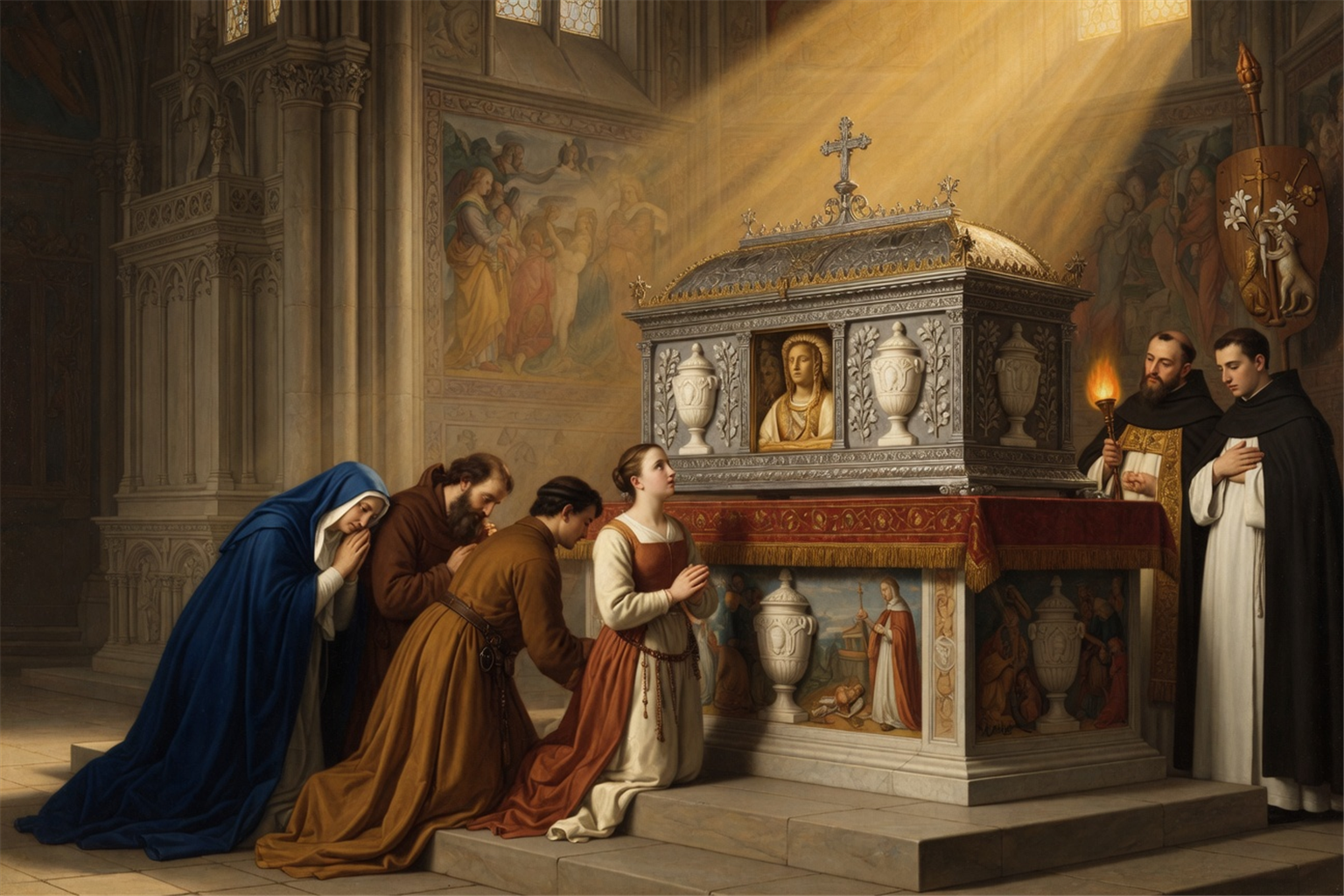
The precious remains of this holy l over and penitent have bee sainte amante et pénitente Saint to whom Zita had a great devotion. n honored at Saint-Maximin since t ime immemoria Saint-Maximin Principal site for the preservation of relics in Provence. l, but especially since Charles I I, Prince of Salerno and late Charles II, prince de Salerne King of Naples and Count of Provence who organized Delphine's marriage. r King of Naples, Sicily, Jerusalem, and Hungary, had the famous convent of the Order of Saint Dominic built there at the end of the 1 3th century, one of the Ordre de Saint-Dominique Religious order to which Magdeleine belonged. most magnificent monasteries in France. Above the high altar, one can see a porphyry tomb, a gift from Pope Urban VIII , where, in the pape Urbain VIII Pope who beatified Josaphat. year 1660, the principal bones that were in the sepulcher were transferred in the presence of Louis XIV a nd his en Louis XIV King of France during the ministry of Olier. tire court by Jean-Baptiste de Marinis, Archbishop of Avignon, of the same Order of Saint Dominic; and, in a small vault in the nave, one can see the precious head of the Saint, on the forehea le précieux chef de la Sainte Major relic preserved in Saint-Maximin. d of which a little of her flesh still appears, at the spot where it is believed that Our Lord touched her after His resurrection, saying to her: Noli me tangere. There is, in the same place, a lock of her hair; and in her chapel, which is opposite, a bone from her arm which, without any natural cause, exhales a very sweet and very pleasant odor, much like the true wood of Saint Lucy.
Controversies regarding the translation of the relics
Analysis of the divergent traditions placing the relics in Ephesus, Constantinople, or Vézelay, and a defense of the Provençal tradition.
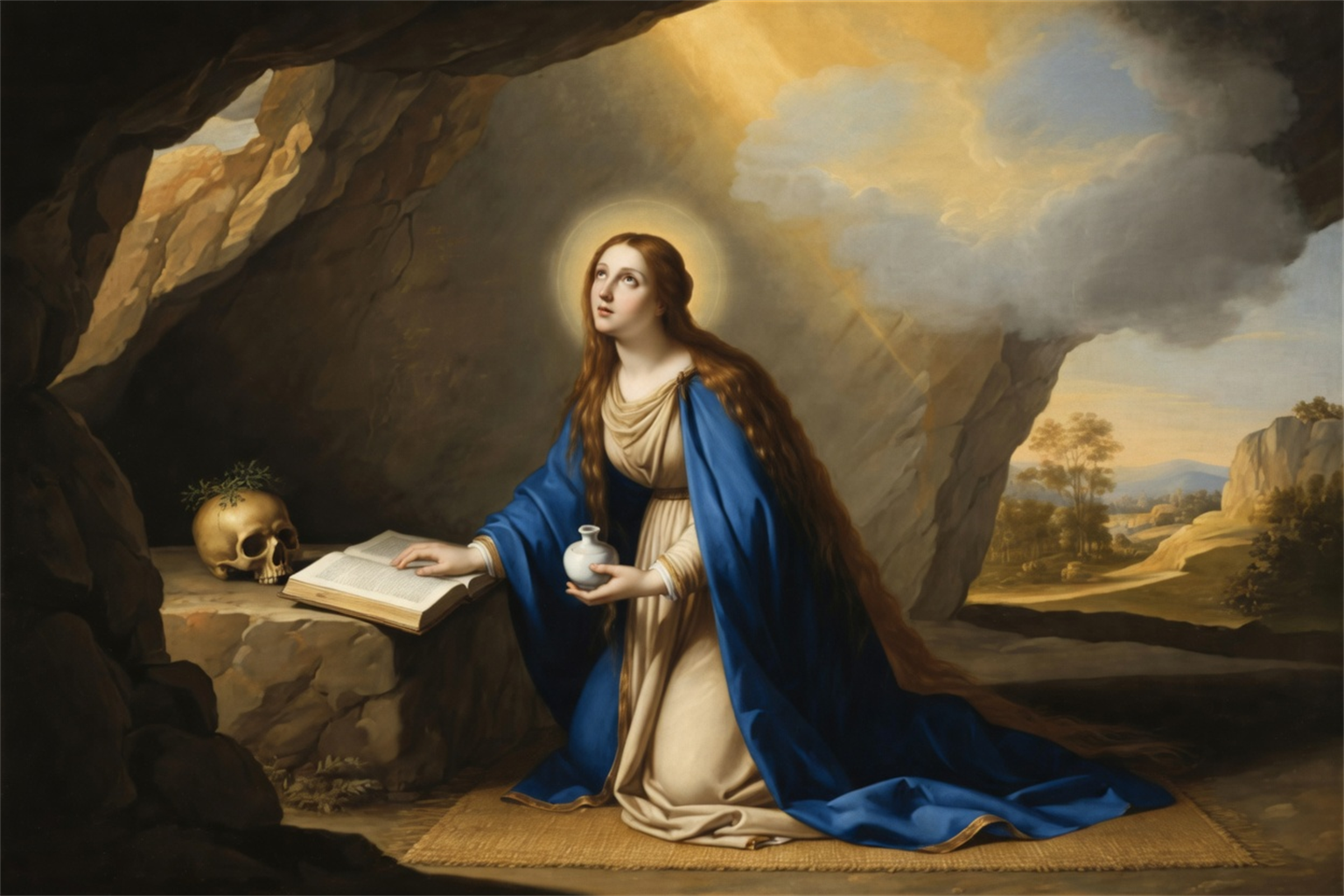
The Greeks, in their menology, as well as the historians Cedrenus, John Curopalates, and Zonaras, say that the relics of Saint Magdalene, being at Ephesus with those of Saint Lazarus, were transported to Constantinople in the year 886 by the command of Emperor Leo, which conforms to what Saint Gregory of Tours says in Book I of the Miracles, chapter 30, that in his time they were at Ephesus, having no covering above them; and further to what Richard de Vassebourg says, in Book II of the Antiquities of Gallia Belgica, that Saint Magdalveus, Bishop of Verdun, having gone to Ephesus on his pilgrimage to the Holy Land, was given two teeth and a little of the hair of Saint Magdalene. But this Magdalene, of whom the Greeks and those who followed them speak, is not our holy penitent, disciple of Jesus Christ, but some other of the same name, whom they have confused with her: this Magdalene, according to certain authors, was a virgin and martyr.
Sigebert, in his Chronicle for the year 745, says that the Saracens having sacked Provence, the body of Saint Magdalene was transported by Girault, Count of Burgundy, to the monastery of Vézelay, which he himself had built: which several other authors have written after him; but, while Sigebert speaks only with doubt, the tradition of the Churches of Provence is much more certain, since, in 1279, there was found at Saint-Maximin, in a very secret place, a marble tomb in which the body of Saint Mary Magdalene had been hidden for fear of the Saracens, with sainte Marie-Madeleine Saint to whom Zita had a great devotion. two very sacred inscriptions, one of which was even written on wax-coated tablets, which bore her name, with the reason that compelled the hiding of this great treasure. If Girault, Count of Burgundy, had a holy body transferred from Provence to Vézelay, which was not difficult for him, being lord of Avignon, it was not that of Saint Magdalene, but of some other saint whom they took for her.
The Revolution and the rescue of the remains
Account of the revolutionary profanations and the actions of Joseph Bastide and Lucien Bonaparte to preserve the relics and the church.
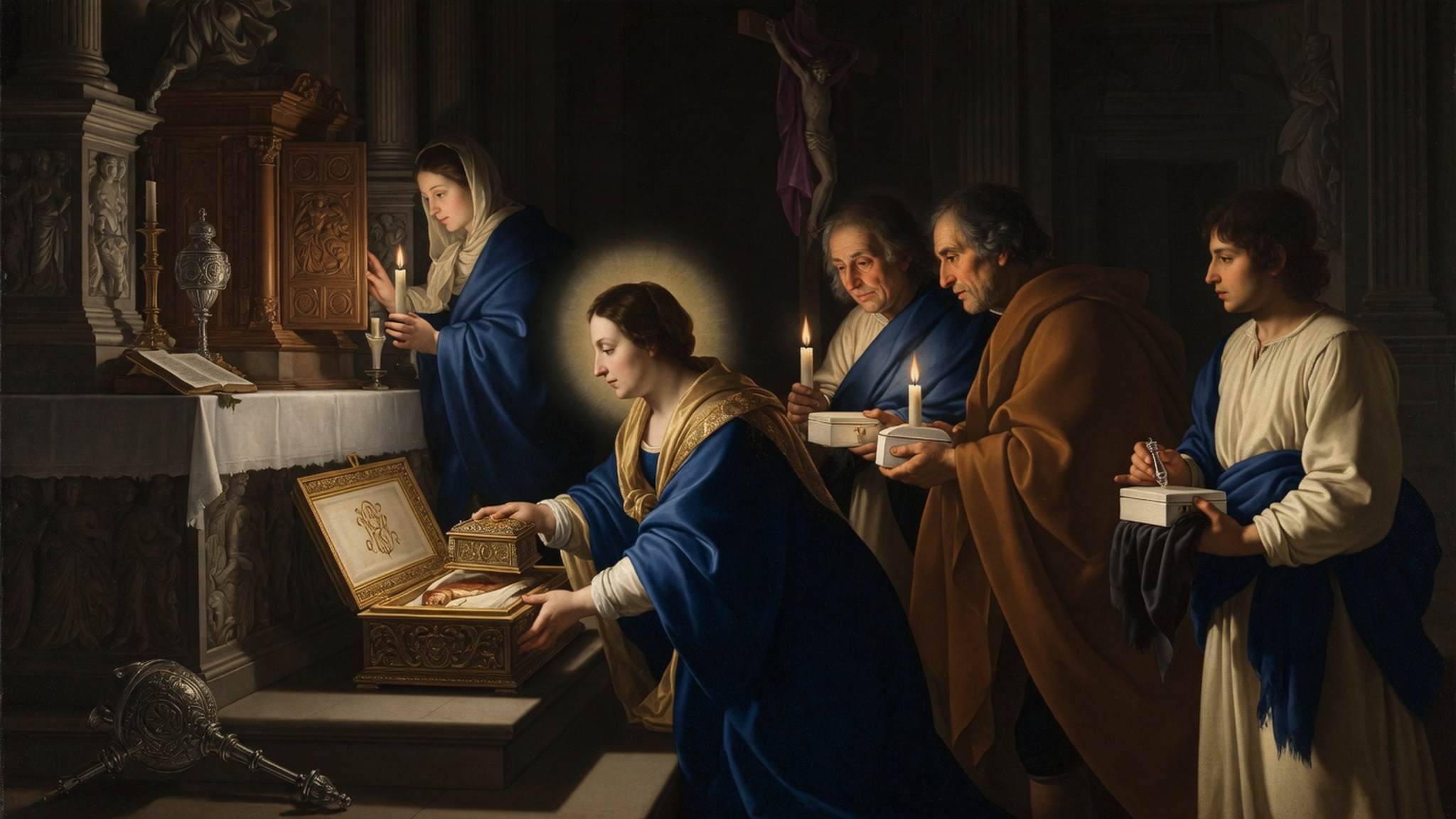
During the French Revolution, the church of Sainte-Baume was l'église de la Sainte-Baume Site of eremitic retreat in Provence. profaned and destroyed. The church of Saint-Maximin was also stripped of its treasure: the butcher Barras had the reliquary converted into currency, and the holy relics were thrown pell-mell. However, the former lay sacristan of the Dominicans, J oseph Bastide, Joseph Bastide Lay sacristan who saved the relics during the French Revolution. secretly removed the head of Saint Mary Magdalene, the crystal vial known as the Holy Ampulla, the noli me tangere with its box, and a portion of the hair and arm bones. The church of Saint-Maximin was not burned and ruined like Sainte-Baume, thanks to the wise foresight of Lucien Bonaparte, who Lucien Bonaparte Brother of Napoleon who protected the church of Saint-Maximin. had the words 'Military Supplies' written on the door. As soon as calm began to be restored, Bastide returned the head of Saint Mary Magdalene to the church of Saint-Maximin; furthermore, the holy bodies thrown pell-mell were found in the sacristy, as we have said; it was only possible to distinguish two bones of Saint Maximin, the head of Saint Sidonius, and a few others, which were placed in wooden reliquaries. The two bones that were in the ancient reliquary called the Arm of Saint Mary Magdalene, which had been neglected by the looters, were enclosed in a gilded copper reliquary in the shape of an arm.
Restorations and pilgrimages in the 19th century
Reconstruction of the Sainte-Baume under the Restoration, papal favors from Pius VII, and the resumption of major pilgrimages.
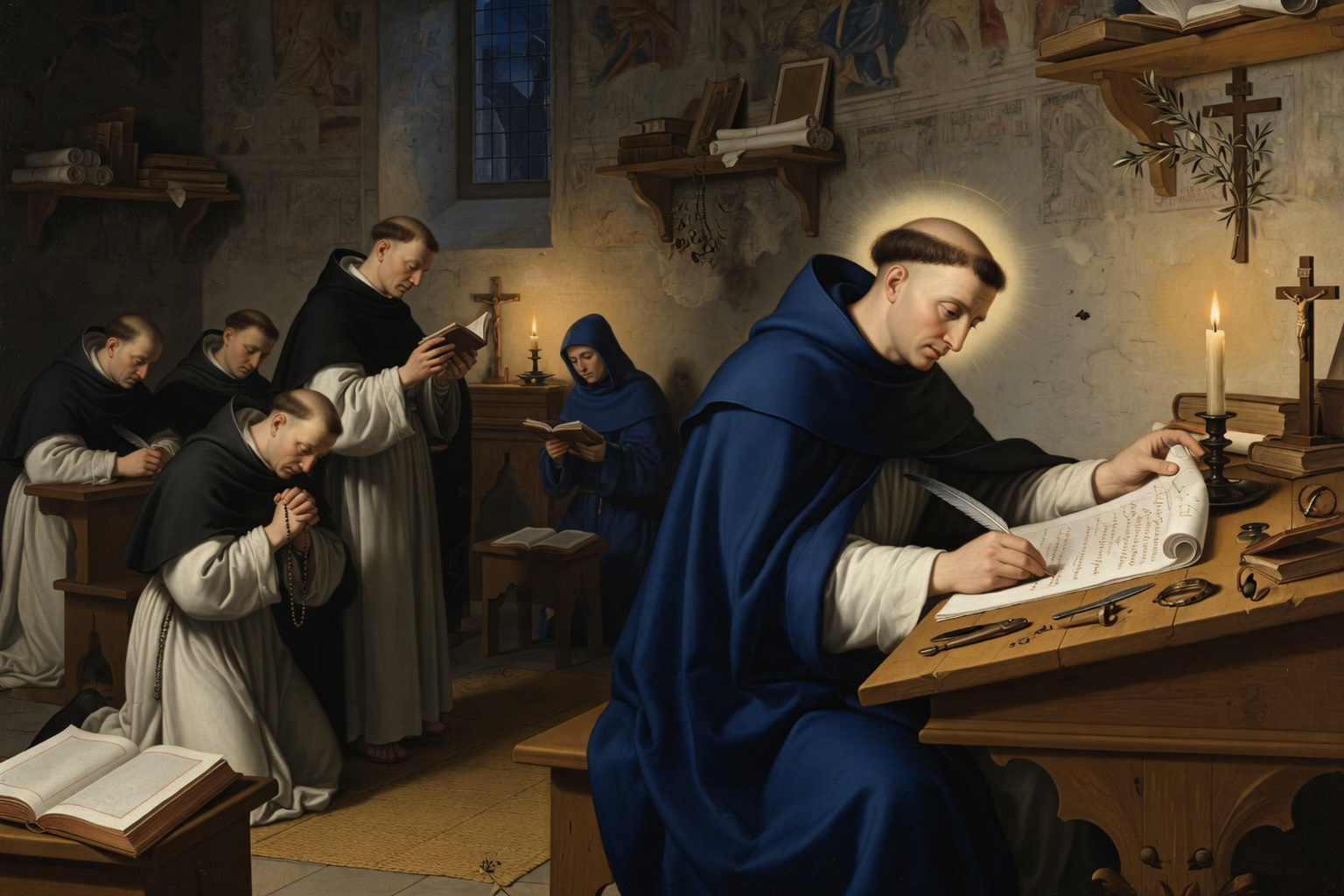
Raised from its ruins in 1814, and visited on the 5th of the same month by twenty-five or thirty thousand pilgrims, the Sainte-Baume suffered new devastations during the Hundred Days. Marshal Brune, described, it is said, by Napoleon as an intrepid depredator, renewed the horrors and impieties of '93.
On the following August 22nd, he perished miserably in Avignon, a victim of the political fury of the people; his corpse, thrown into the water, wherever the Rhône carried it to its banks, was rejected back into its current; Divine Justice deprived him of a burial that is not refused even to strangers. Since then, the piety of the Provençals and the munificence of Lo uis XVI Pie VII Pope who authorized the cult of Blessed Rainier. II restored this monument a second time. Pius VII once again granted a plenary indulgence to those who would visit the grotto of Saint Mary Magdalene on any of the surviving feast days: those of Pentecost, Saint Mary Magdalene, Saint Louis, Saint Maximin, and the Exaltation of the Holy Cross.
The Madeleine monument in Paris
The link between the relics of Parma, the will of Napoleon, and the erection of the Madeleine church in Paris as a center of devotion.
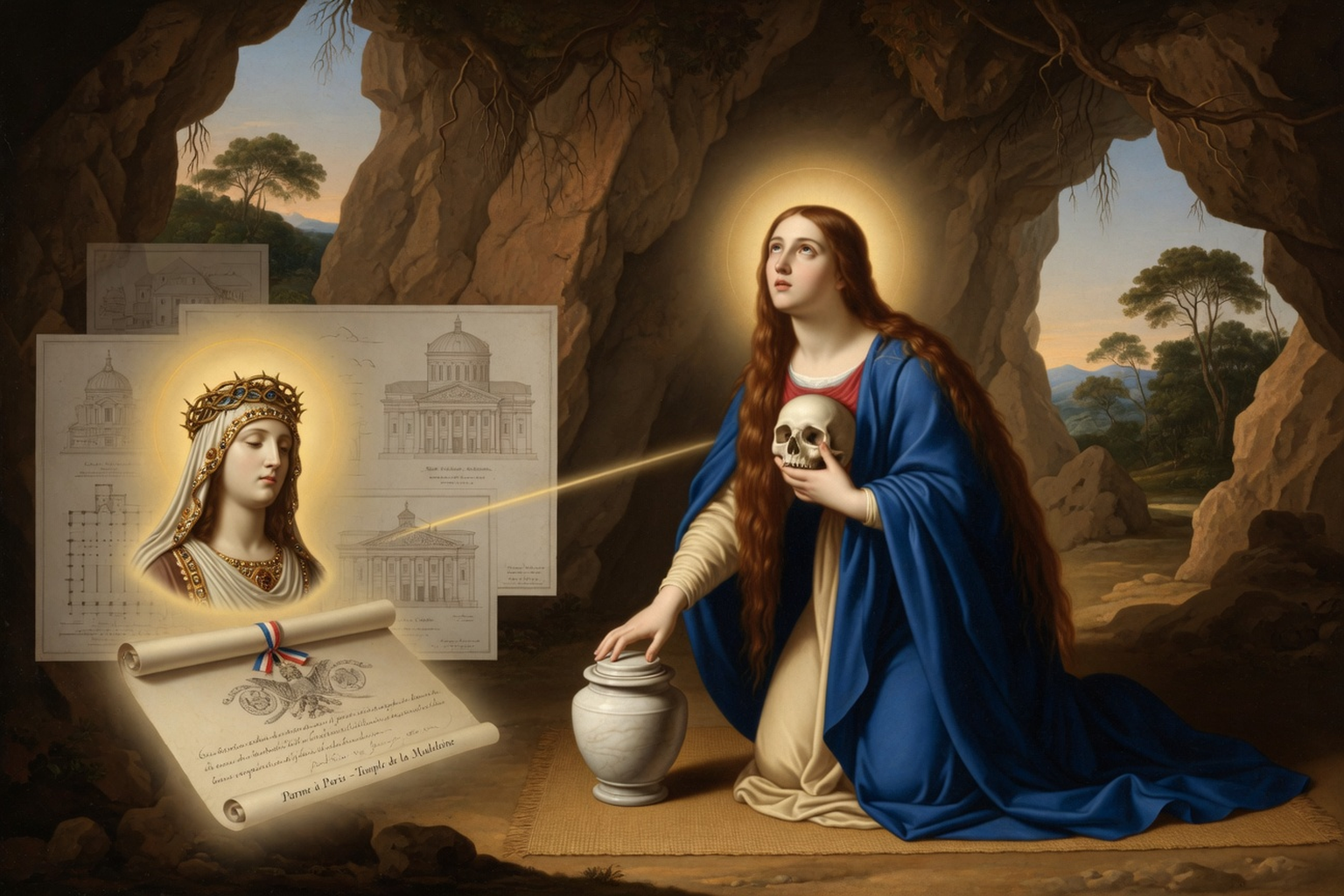
In the month of May 1822, all the works of art being completed, the altar of Saint Madeleine and that of the Blessed Virgin entirely refurbished, the Archbishop of Aix solemnly blessed the grotto; more than forty thousand pilgrims entered it successively. This was undoubtedly not enough for the fulfillment of that prediction which came from the mouth of the Savior, when Madeleine had poured her perfumes upon the Author of all gravity: "Amen, I say to you, wherever this Gospel shall be preached, in the whole world, that also which she hath done, shall be told for a memory of her." A prodigious edifice arose, whi ch Napol Napoléon Emperor of the French whose decisions affected the society of Rauzan. eon wished to make the Temple of Glory; in effect, he publishes a glory proclaimed by the best Judge, by God Himself: this temple bears the name of the Madelein ce temple porte le nom de la Madeleine Parisian monument dedicated to the saint. e. Thus, this humble woman shines in this very hearth of all celebrity, in this Paris from which renown radiates over the world. Such is the reliquary that Providence was preparing for the remains of Saint Madeleine.
In 1781, by the order of Louis XVI, the porphyry urn in which the body of Saint Madeleine was enclosed was opened for the first time, and an illustrious relic was detached from it, which w as brought to Don Ferdinand Don Ferdinand, duc de Parme Recipient of a notable relic in 1781. , Duke of Parma. God took this measure in time. Twelve years later, everything that was in the urn was dispersed: there remained no other illustrious relic of Saint Madeleine than the portion sent to the Duke of Parma and the head honored in the church of Saint-Maximin, with two bones of an arm.
Providence willed that Napoleon should send to Paris, among the spoils of the Duke of Parma which were to be covered in currency, the very reliquary that contained this precious relic; after the Restoration, this treasure, ceded in full ownership by the former Queen of Etruria, was transferred to the monument that awaited it according to the eternal decrees.
Sources and literary authorities
A census of ancient and modern authors who have treated the life and penance of Mary Magdalene.
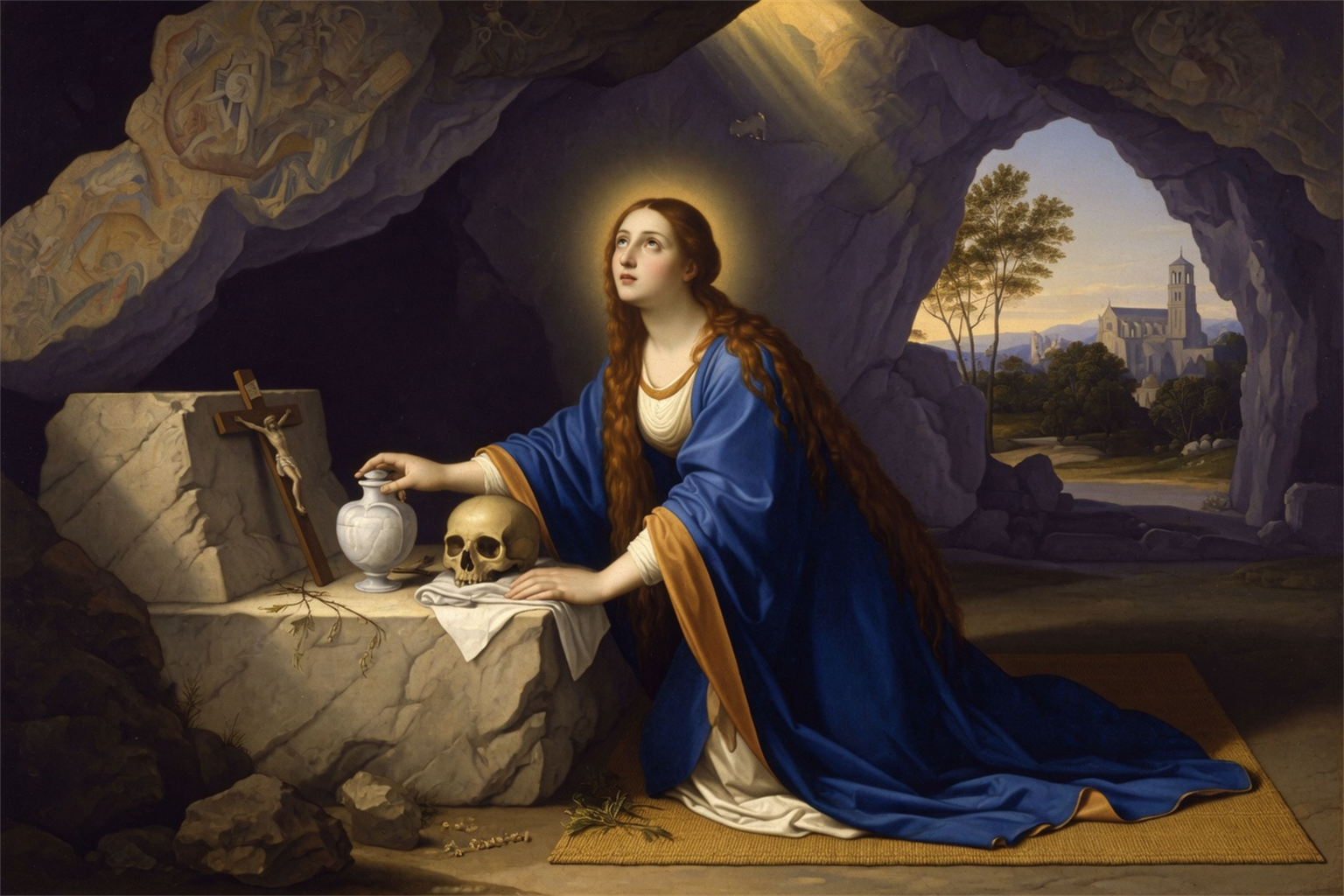
We have, in Origen, an excellent homily on her astonishment, which is believed, however, to be originally Latin and not Greek. Cardinal de Bérulle also gave to the public an admirable treatise on her excellences; and Coiffureau, Bishop of Marseille, with Godoux, Bishop of Vexau, have perfectly described her tears and her penance. Father Alexandre, a Jacobin, in the second volume of his Dissertations on the 1st Century, establishes very solidly what we have advanced in this life concerning the criticism of her history. — Cf. Unpublished Monuments of the Episcopate of Saint Magdalene, etc., by M. Faillou, of the Society of Saint-Sulpice, 2 vol. Migne; and Saint Mary Magdalene, by the Rev. Fr. Lacordaire.
Annexes & related entities
Structured data for exploration: events, miracles, quotes, places, attributes, patronages, and important entities cited in the text.
Key Events
- Anointing the Savior with perfume
- Presence at the Resurrection (Noli me tangere)
- Supposed translation to Constantinople in 886
- Discovery of the hidden body at Saint-Maximin in 1279
- Rescue of the relics during the Revolution by Joseph Bastide
- Restoration of the cult at Sainte-Baume in 1814 and 1822
Miracles
- Very sweet scent exhaled by a bone from the arm
- Preservation of a piece of flesh on the forehead (Noli me tangere)
Quotes
-
Noli me tangere
Gospel (cited in the text) -
Truly I tell you, wherever this gospel is preached throughout the world, what she has done will also be told, in memory of her.
Words of the Savior