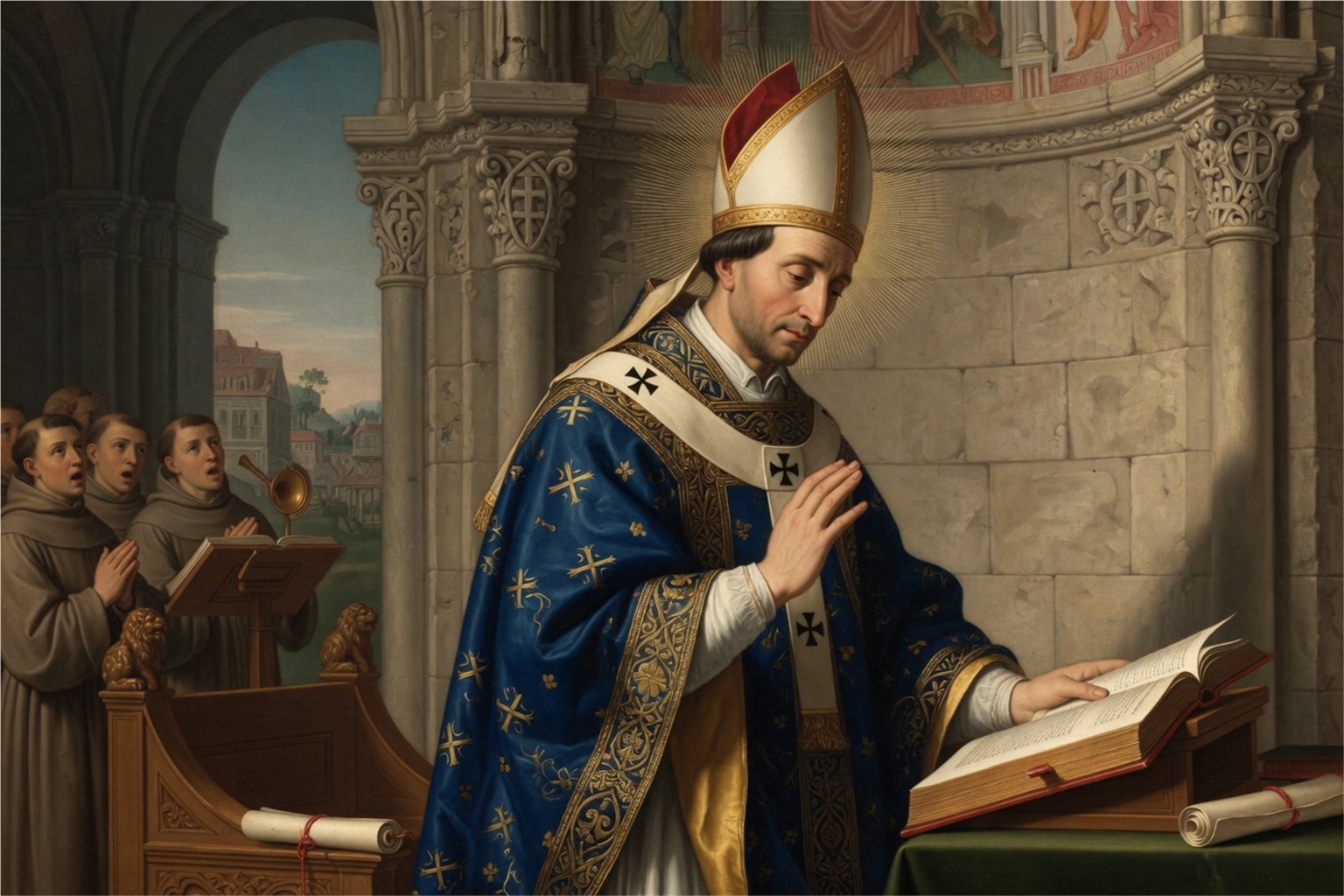
The illegitimate son of Charles Martel and brother of Pepin the Short, Remy became bishop of Rouen in 754. He reformed his diocese by introducing Gregorian chant and served as a diplomatic mediator in Italy. He died in 772 and is honored as a model of pastoral care and piety.
Guided reading
6 reading sections
SAINT REMY, TWENTY-NINTH BISHOP OF ROUEN
Origins and education
Son of Charles Martel and brother of Pepin the Short, Remy was raised in piety, likely by Saint Chrodegang of Metz, before choosing the ecclesiastical life.
Remy Remy Bishop of Rouen and son of Charles Martel. , wrongly named Giles by some historians, was the natural son of C harles Martel, Charles-Martel Mayor of the palace, possible ancestor of the saint. brother of Kin g Pep Pépin King of the Franks whose accession to the throne was supported by Burchard. in, and of the blessed Carloman, who became a monk in Italy. He was raised at court by a pious bishop whose name history has not preserved for us and who is believed to be Sain t Chrodegang, Bi saint Chrodegand Bishop of Metz, Carolingian minister, and liturgical reformer. shop of Metz.
God, by a miracle of His grace, protected him from the corruption that reigned there under the last kings of the first race. He lived in his father's palace as he might have done in the most regular school, and made the exercises of Christian piety, which he joined to those of the study of letters, his entire occupation. He was humble, gentle, modest, pious, sober, chaste, moderate in all his actions, and restrained in his speech.
When he saw himself in a position to choose the way of life he should take, he did not deliberate at all about entering the narrow path that leads to salvation, and, renouncing the vain advantages that the world offered him, he consecrated himself to the service of God in the ecclesiastical state.
He conducted himself there in a manner that perfectly corresponded to the holiness of his profession. He mortified all his senses and macerated his body with fasts, vigils, and other austerities, in order to make himself master of his passions; he distributed to the poor everything he could dispose of and cut from his table, his clothes, and his retinue everything that was not absolutely necessary, as much to have the means to provide for his charities as to practice clerical modesty.
He employed the greater part of his days and nights in prayer, and gave the rest to the study and meditation of the Holy Scriptures and ecclesiastical sciences; so that everyone, touched by his virtue, judged him worthy of the highest ranks in the house of the Lord.
Accession to the See of Rouen
In 754, following the deposition of Rainfroy, the clergy and the people of Rouen obtained from King Pepin the appointment of Remy as bishop.
The metropolitan see of the church of Rouen became vacant in the year 754, through the deposition of Bishop Rainfroy. The clergy and the people of the city immediately dep uted to K roi Pépin King of the Franks whose accession to the throne was supported by Burchard. ing Pepin to ask him for Remy, seeking the interest of their church much more in the personal merit of the subject than in the advantages of his birth and rank.
Pepin consented to it; and Remy, despite the resolution he had taken to spend his whole life in the obscurity of a private life, was obliged to allow himself to be ordained and burdened with the episcopate, which he had always dreaded since he had known its obligations. God granted him the grace to fulfill them all so worthily that he became at once the model for his people in striving for the perfection of the Gospel, and for the prelates of the Church, in the manner of well leading and feeding the flock of Jesus Christ.
Reforms and Roman influence
Remy reformed his diocese by introducing Gregorian chant and Roman customs, sending monks to be trained in Rome.
The diocese of Rouen was suffering from the poor administration of his predecessor, and there were many abuses to reform. Desiring to render to God a worship whose purity could appear even in outward observances, he substituted Gregorian chant f or that of the chant grégorien Liturgical tradition carefully maintained by the Pope. country, which did not seem to him sufficiently regulated, nor perhaps sufficiently solemn. To succeed in this, he sent monks to Rome who were to be trained there in the schools of ecclesiastical chant. It is to this end that he also employed the influence of King Pepin; and it is to be believed that these initial successes later led Charlemagne to undertake the change of the rite and customs of the Gauls to introduce those of the Roman Church.
Diplomatic missions and relics
Ambassador to King Desiderius of the Lombards on behalf of Pope Paul I, he nevertheless failed to transfer the body of Saint Benedict to Monte Cassino.
Some time before, the holy bishop had been sent as an ambassador to Italy, with Duke Autchaire, to urge Desiderius, King of the Lombards, to restore to the Roman Church the goods that he or his predecessors had usurped from it. Moreover, Pope Paul I was so s atisfied with pape Paul Ier Pope who authorized the transfer of martyrs' relics to France. Remy's negotiations that, in his favor, he granted several privileges to the church of Rouen. Pepin also showed himself generous toward his brother to recognize his services. Before sending him to Rome, he had charged him with bringing the body of Saint Benedict from the abbey of Fleury-sur-Loire to that of Monte Cassino; b ut God did Mont-Cassin Abbey reformed by Urban V, who considered himself its second founder. not permit his precious relics to leave France, and Remy obtained only fragments which Pepin had sent to the monks of Monte Cassino.
Council and passing
After attending the Council of Attigny in 763 and multiplying pious foundations, he died on January 19, 772.
In 763, he attended th e council held at the castle of Attigny-sur-l concile tenu au château d'Attigny-sur-l'Aisne Council held in 765 in which Madalvé participated. 'Aisne, where Chrodegang of Metz presided. Remy made many pious establishments, endowed and adorned various churches, besides his cathedral, and after having made his people feel the continual effects of the vigilance and charity of a true pastor, during seventeen years and some months of episcopate, he died the death of the just on January 19 of the year 772.
Cult and fate of the relics
His relics traveled between Rouen and Soissons before being partially destroyed by the Huguenots in 1562. His cult remains vibrant in Rouen and in the House of Austria.
His body was buried in the cathedral church of Notre-Dame, from where it was later removed to be transported, along with that of Saint Godard and the head of Saint Romain, to the abbey of Saint-Médard de Soissons, during the time of Louis the Pious. It remained in that place until 1090; then the greater part of his relics was brought back to Rouen, along with the head of Saint Romain and an arm of Saint Godard. These relics were placed in the abb Saint-Ouen Monastery founded at the burial site of the saint in Rouen. ey of Saint-Ouen, where they were religiously guarded until the sacrilegious pillaging carried out by the Huguenots in the year 1562.
The feast of the Saint is celebrated in Rouen on January 19th, since it was recognized that this day was the day of his death. Previously it was held on the 14th of the same month, as seen in the ancient legend of his life distributed into nine lessons for his office; the day of his feast was undoubtedly confused with the day of the death of Saint Remy of Reims, which occurred on that same day.
The name of Saint Remy of Rouen is not found in the Roman Martyrology, nor in other modern Martyrologies, not even in that of France, where he deserved a rank more justly than many others who have no cult or who are less known.
In the last century, besides the principal feast of January 19th, which, in the diocese of Rouen, was a simple office, one found that of his translation marked on May 15th, which is the one that took place from the abbey of Saint-Médard de Soissons to that of Saint-Ouen of Rouen. It is also said that this Saint is held in partic maison d'Autriche Dynasty claiming Remy among its family saints. ular veneration in the House of Austria; at least it counts him among the Saints of its family.
This Life is extracted from Baillet, more or less partially.
Annexes & related entities
Structured data for exploration: events, miracles, quotes, places, attributes, patronages, and important entities cited in the text.
Key Events
- Education at court by a pious bishop
- Election to the see of Rouen in 754
- Introduction of Gregorian chant in the diocese of Rouen
- Embassy to Italy to King Desiderius
- Attempted transfer of the body of Saint Benedict to Monte Cassino
- Participation in the Council of Attigny in 763
Miracles
- Preservation of the court from corruption through a miracle of grace