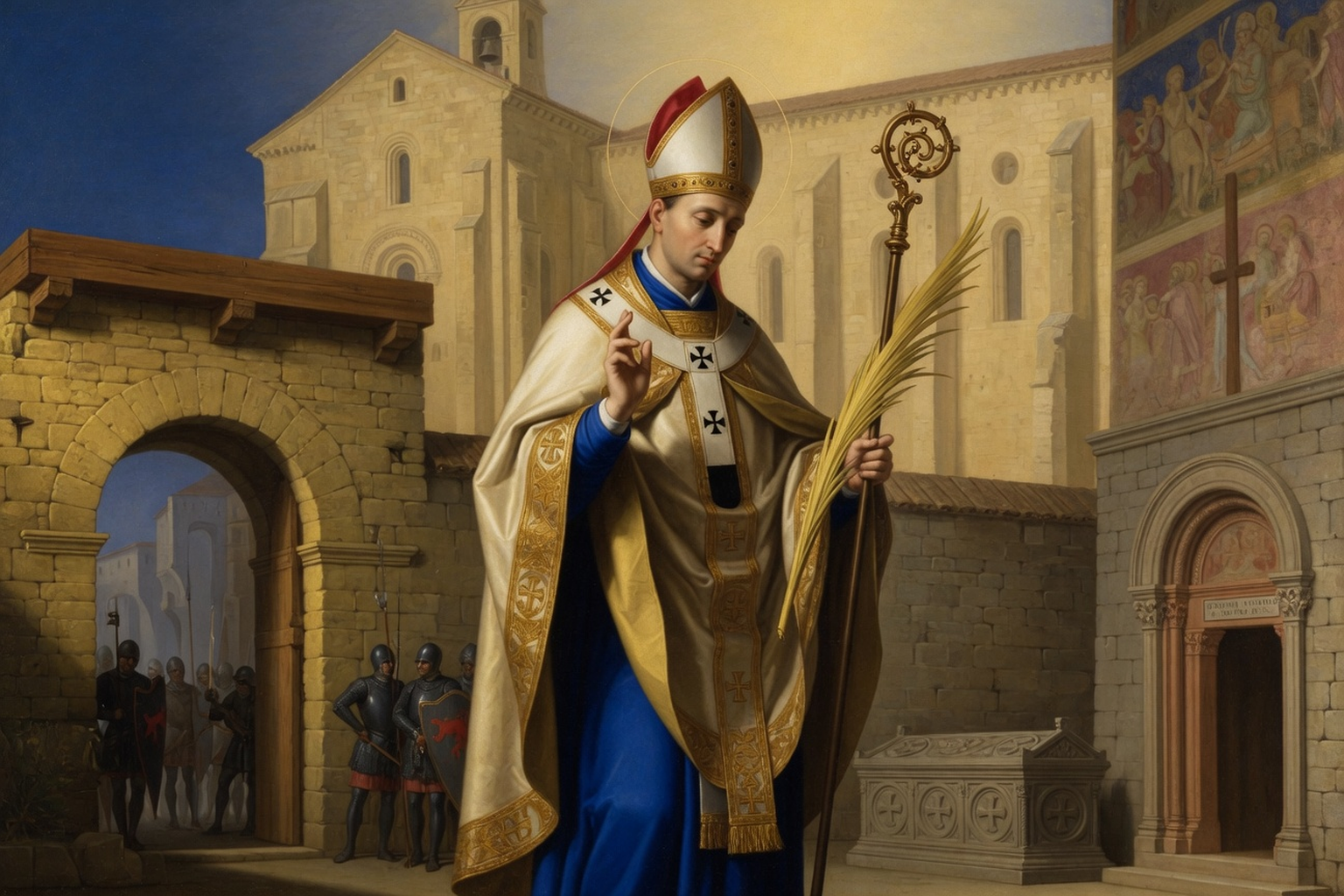
Bishop of Viviers in the 8th century, Arconce was martyred for defending the liberties of the Church against the exactions of the Frankish troops of Charles Martel. Victim of an ambush at the Porte de la Poutre, he was beheaded by foreign soldiers stationed in the city. His relics, honored by miracles, were destroyed by the Calvinists in 1563.
Guided reading
6 reading sections
SAINT ARCONCE OR ARCONS, BISHOP OF VIVIERS (circa 737-740).
Introduction and account of the martyrdom
Arconce, bishop of Viviers in the 8th century, was martyred by beheading at the Poutre gate while defending the liberties of the Church.
Arconce Arconce 8th-century Bishop of Viviers and martyr. , bishop and martyr, governed the church of Vivi Viviers Episcopal see of Saint Venantius. ers towards the middle of the 8th century. The antiquity of his cult is attested both by a chapel dedicated under his name from before the 12th century, and by an office of the Double Rite that was celebrated in his honor. An old manuscript martyrology, which is kept at the seminary of Viviers, describes the martyrdom of the holy prelate in these terms:
"On the 8th of January, the feast of the blessed Arconce, martyr, bishop of the church of Viviers, who, while he was defending the liberty of the Church and confounding his enemies, was overwhelmed with blows and treated ignominiously by some inhabitants of Viviers, and finally beheaded b porte dite de la Poutre Episcopal see of Saint Venantius. y them at the gate called the Poutre."
Cult and destruction of relics
The saint's body, associated with miracles, was kept at Viviers until its destruction by the Calvinists in 1563.
His holy body, honored by miracles, buried with honor by his clergy in the church of Viviers, next to the chapel of Saint-Martin, remained in a reliquary until the year 1563, when the unbridled rage of the Calvi nists broke Calvinistes Religious group that destroyed the relics of Aptone in 1568. it at the same time as the body of Saint Aule saint Aule Saint whose body was preserved alongside that of Saint Arconce. .
Context of the Frankish conquests
The martyrdom took place during the era of Charles Martel, marked by the exactions of Frankish troops following the expulsion of the Saracens.
To explain the martyrdom of Saint Arconce in the middle of the 8th century, one must not forget the historical environment in which this prelate moved: it was at a time when the bands of Charles Ma Charles-Martel Mayor of the palace, possible ancestor of the saint. rtel had just driven back the Sarac Sarrasins Muslim invaders responsible for the massacre of the nuns. ens and were occupying the Vivarais as advanced sentinels. The master had thought that the soldiers who had reconquered the properties of the Church could well retain a portion of them as compensation. Abandoned to the fierce impetuosity of semi-barbaric instincts, the Frankish men -at-ar Francs People and army with whom Cessator allied himself to fight. ms committed such excesses that they made people regret the Saracens themselves.
The fact is so incontestable that several churches in the South, thos e of Lyon Episcopal see of Saint Eucher. Lyon a nd Vie Vienne Episcopal see and principal city of the saint's activity. nne among others, were completely destroyed and their bishops forced to flee.
Opposition to the conquerors and ambush
The bishop publicly opposes the exactions of the soldiers from beyond the Rhine, which leads to his cowardly assassination during an ambush.
The Bishop of Viviers publicly raised his voice to condemn the scandals of the conquerors from beyond the Rhine: this race has always been the same; we had proof of it in 1870-71, where we saw the Prussian and the Bavarian, the Saxon and the compatriots of Luther at work; and it took long centuries, the climate, the customs, and the genius of Christian Gaul to civilize the Franks, brothers of the Germans. It was therefore the newcomers, the inhabitants and not the citizens of Viviers, who, trembling with rage and despairing of ever overcoming the resistance of the Pontiff, swore his death and lay in ambush at one of the city gates where they cowardly assassinated him.
Analysis of the guilty: Citizens vs. Inhabitants
The author distinguishes between native citizens and mere inhabitants (foreign soldiers), attributing the crime to the Frankish leudes rather than the local people.
This distinction between citizens (Cives) and inhabitants (Incolae) is essential to make: if the modern legend of the Viennese Breviary had made it, it would not have cast the odium of this crime upon the entire population of Viviers: it is the inhabitants, and not the citizens, that the old martyrology of Viviers designates, whose every term must be weighed. In Roman and Athenian law, as in the language of the Middle Ages, the word citizens designates the natives, the members of the city inscribed on the registers; inhabitants means people simply domiciled in the city, the *moments*, as they were later called. Roman law assigns the deep source of this distinction. 'It is origin,' it says, 'that makes citizens; and domicile, inhabitants.' In the Charters of Viviers, where it is most important to find this distinction, one never fails to encounter it and to see designated by the name of citizens those who have the right to the privileges inherent in the right of citizenship alone: bearing arms, election of magistrates, administration of public funds; — if, on the contrary, it concerns provisions that regard the generality of the inhabitants, great care is taken to designate by the name of inhabitants all the classes of which the commune is composed.
The martyrology adds that it was for having energetically defended the liberties of his church that Arco nce was Arcence 8th-century Bishop of Viviers and martyr. assassinated. This simple indication suffices to characterize the authors of the murder: these authors did not come from the ranks of the people: the latter felt well that it had no better support, no more solid guarantee of its independence than the bishops, so well named its defenders, its advocates. Outside the people, outside the citizens, where to find these oppressors of whom the martyrology speaks? It obviously only remains to look for the m among the F leudes francs People and army with whom Cessator allied himself to fight. rankish leudes whom the conquest had implanted in the country and who remained long foreign by their origin as much as by their customs.
Conclusion: the death of Saint Arconce was not the result of a general plot, of a popular riot. The martyrology gives clearly enough to understand that the courageous Pontiff was surprised and struck alone, without defense, in an infamous ambush.
Sources and references
List of historical works and medieval charters documenting the life and context of Saint Arconce.
Cf. Histoire religieuse, civile et politique du Vivarais, by M . Bouchier, M. Bouchier Historian and author of the Histoire du Vivarais. vol. 1, page 279 et seq.; Thouillide, Hist., vol. 2, p. 149; Theodosian Code, book x, title 39, law 7; Charters of Raymond I, Bishop of Viviers, 1159.
Annexes & related entities
Structured data for exploration: events, miracles, quotes, places, attributes, patronages, and important entities cited in the text.
Key Events
- Governance of the Church of Viviers in the mid-8th century
- Defense of the freedom of the Church against the Frankish conquerors
- Denunciation of the scandals of Charles Martel's soldiers
- Ambush at the Porte de la Poutre
- Decapitation by the inhabitants (incolae) of the city
- Desecration of his relics by the Calvinists in 1563
Miracles
- Body honored by miracles after his death
Quotes
-
On the 8th of January, the feast of the blessed Arconce, martyr, bishop of the church of Viviers, who, while defending the freedom of the Church and confounding his enemies, was overwhelmed with blows and treated ignominiously.
Old manuscript martyrology of the seminary of Viviers