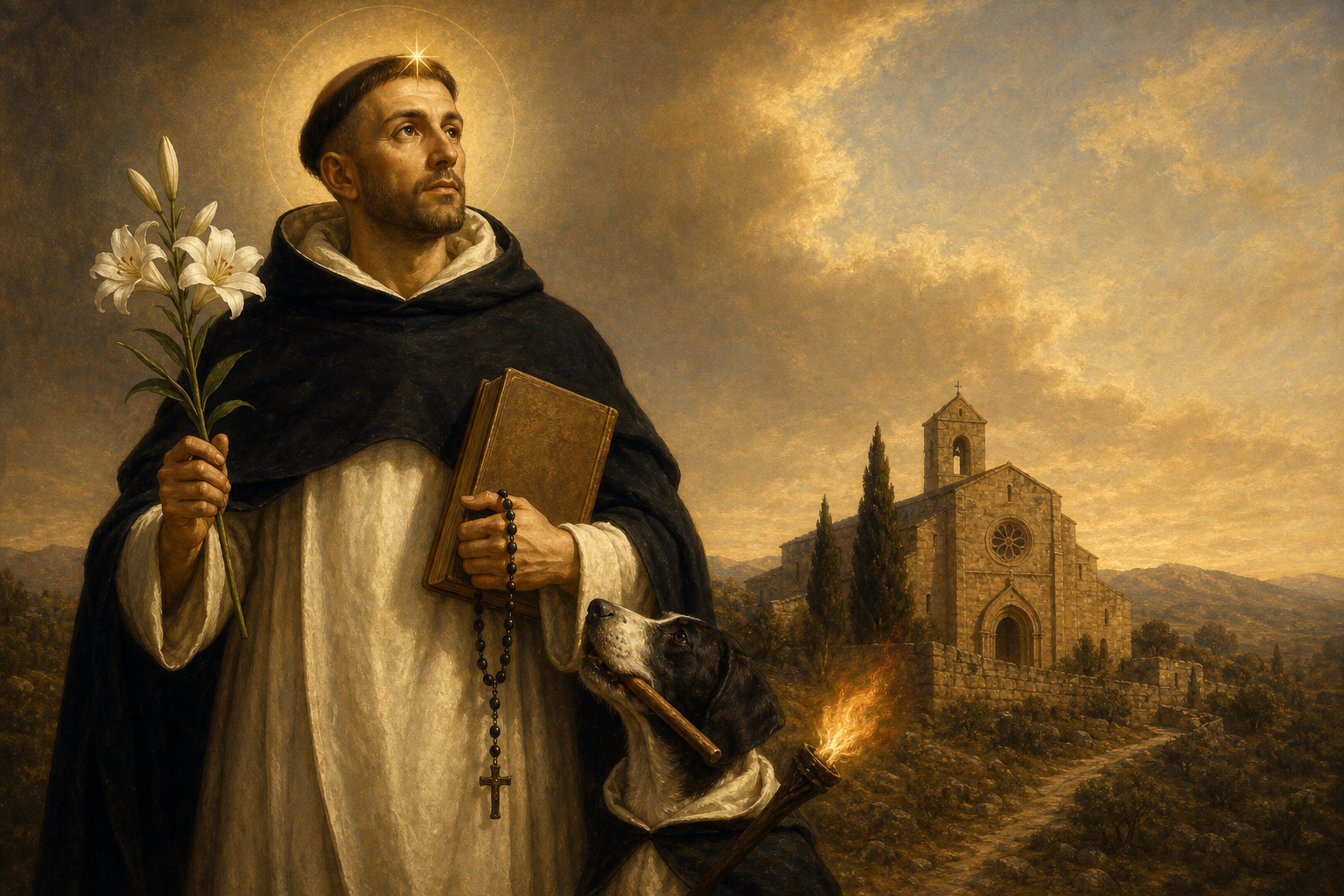
Saint Dominic of Guzman
FOUNDER OF THE ORDER OF PREACHERS
Confessor, Founder of the Order of Preachers
Born in Castile in 1170, Dominic de Guzman became the founder of the Order of Preachers. He dedicated his life to preaching, notably against the Albigensian heresy in France, and to the promotion of the Rosary. Recognized for his humility and numerous miracles, he died in Bologna in 1221.
Guided reading
9 reading sections
SAINT DOMINIC DE GUZMAN, CONFESSOR,
FOUNDER OF THE ORDER OF PREACHERS
Origins and Youth in Castile
Born in 1170 in Calahorra into the illustrious Guzman family, marked by celestial omens and a pious education in Palencia.
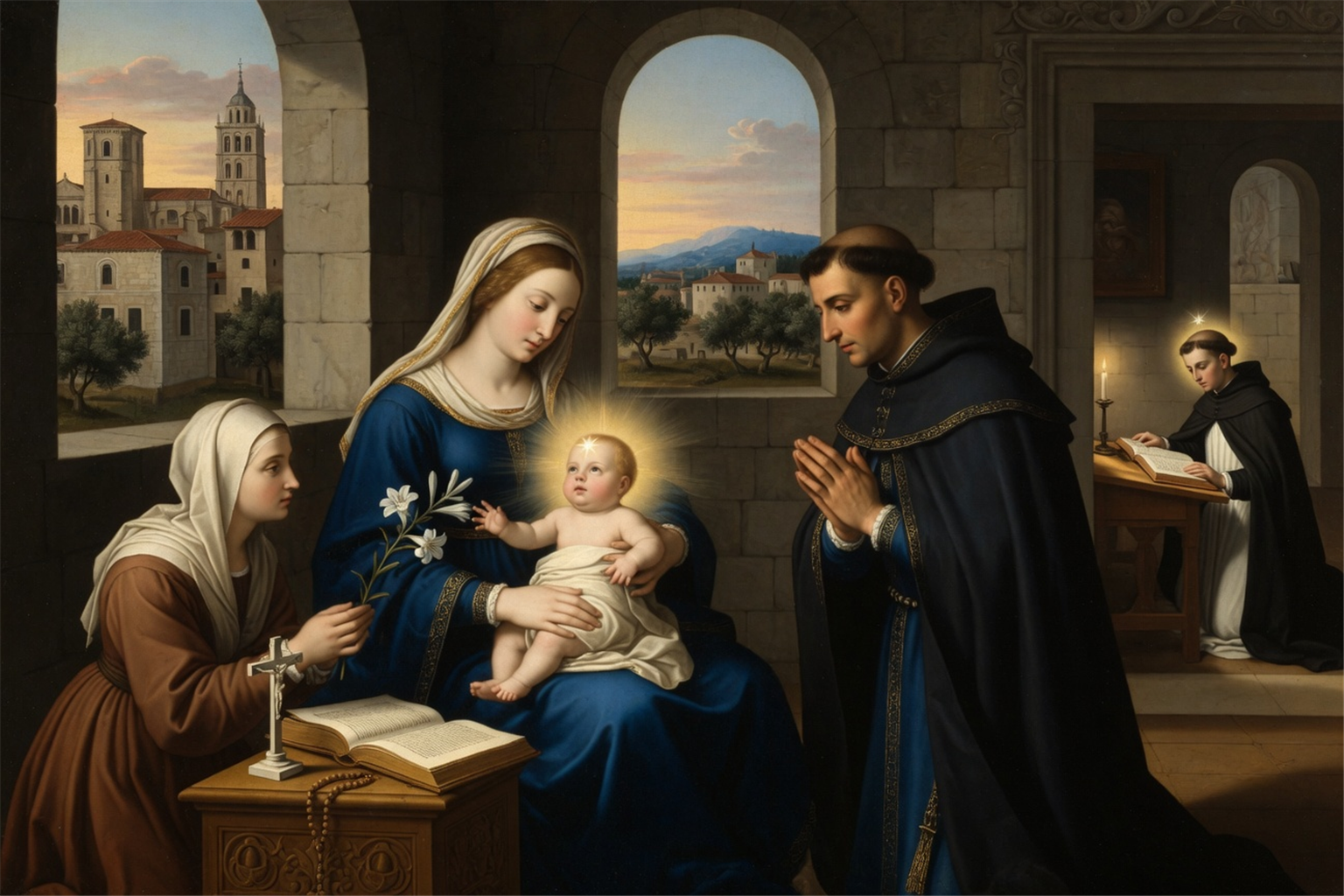
Here is an admirable man whom God brought into the world after the middle of the 12th century to be, by himself and his religious, the light of the world, the pillar of the Church, the support of the Christian religion, the reformer of morals, the scourge of heretics, the ruin of idolatry and all the sects of infidels, and the wall of brass that the Apostolic See has always opposed to all its enemies. We are all the more obliged to provide an accurate account of his life, as there are few among the faithful who do not have a close connection with him, either for having embraced one of the three Orders of which he is the father and head, or for being of the confraternity of the holy Rosary, which recognizes him as its author.
He appeared on earth during the pontificate of Alexander III and the empire of Frederick I, surnamed Barbarossa, in the year 1170, the time when Saint Thomas, Archbishop of Canterbury, was massacred in England for supporting ecclesiastical rights and immunities; as if God, in calling this powerful defender of his Spouse to Himself, had wished to reward her a hundredfold for such a great loss by giving her this holy patriarch who was to compose for her entire armies of preachers and martyrs. The place of his birth was Calahorra, a city in Old Castile. His father was Dom Felix de Guzman, of the illustrious Guzman family, which traced its origin to the Dukes of Brittany and which, in later centuries, allied itself through its daughters with the kings of Spain and Portugal. Spanish authors say that his mother was named Joan of Aza, and that she was of the family of the knights of Aza, whom their noble deeds have made commendable in the history of their country. But Father Jean de Sainte-Marie, following the blessed Alan de la Roche, informs us that she was named Joan of Brittany and that she was the daughter of a Count of Brittany with whom Felix de Guzman wished to form an alliance, being descended, through his ancestors, from the same stock. It may be, however, that she had acquired from her dowry the lordship of Aza, which is not far from Guzman and Calahorra, and that she had taken the surname of Aza from it. She was a lady of singular virtue, and on the magnificent tomb built for her at the convent of the Friars Preachers of Pennafiel, where her body was transported in the year 1318, she is called Saint Joan, wife of Dom Felix de Guzman and mother of Saint Dominic.
This holy child was not the only fruit of the chaste marriage of these illustrious persons: they had two other sons older than him. The first was Dom Antoine de Guzman, who became a priest, and, having distributed all his goods to the poor, retired to a hospital to serve Jesus Christ in his suffering members; he attained eminent holiness. It is even said that he performed several miracles after his death that keep him alive in the memory of men and are striking marks of the glory he possesses in heaven. The second was Mannes de Guzman, who, after the establishment of the Order of Friars Preachers, wished to be received into it and spent his life there with much praise in the exercises of a holy preacher and a perfect religious. As for our Saint, who was only the third, God made it known before his birth that he would be an extraordinary man from whom all of Christendom would derive signal services. His mother, while still carrying him in her womb, wished to make a novena in the church of Saint Dominic of Silos for her safe delivery. On the seventh day of her devotion, this blessed abbot appeared to her in his religious habit, but in a completely celestial splendor, and assured her that she carried in her womb a child who, by his holiness and doctrine, would be the light of the world and the consolation of the entire Church. Another time, it seemed to her that she had in her womb a little dog holding a torch in its mouth, and that after being born it set fire to the whole earth. This was a symbol marking that her son would cry out and, so to speak, bark continually against vice; that he would enlighten all kingdoms by the purity of his lights and that he would kindle the fire of charity in an infinity of hearts.
He was called Dominic at baptism, in honor of this glorious Confessor who had made such happy predictions to his mother. The baptismal font in which he was regenerated still exists, and Philip III, King of Spain, in the year 1601, had it transported from Calahorra to Valladolid to have this same sacrament conferred upon his son, the Infante of Spain, whom he had named Philip-Dominic-Victor, and who succeeded him, and upon his daughter, Anne of Austria, later the wife of Louis XIII and mother of Louis XIV, called the Great. He had, after the birth of this admirable child, new omens of what he was to be one day, for his godmother, who was a lady of quality and very virtuous, had a mysterious dream in which she saw on his forehead a star so bright that it surpassed in light all the stars in the sky and spread its rays over the whole earth; and, while he was still in the cradle, a swarm of bees was seen hovering around his face and seeming to want to make a hive of his mouth, just as the pagans recount of Pindar, Plato, and Hiero, King of Sicily, and as Ecclesiastical History teaches us much more surely of the great doctor Saint Ambrose, whose eloquence was also sweeter and more pleasant than honey. It is also said that one day, his mother having taken him to Mass at the monastery of Saint Dominic of Silos, the priest who was celebrating the sacrifice, instead of saying *Dominus vobiscum*, repeated three times while turning toward the child: "Ecce Reformator Ecclesiae"; "behold the one who will reform the morals of the faithful." This he did without thinking and by a supernatural impulse that changed the words he intended to say into this oracle of heaven.
The event soon verified such marvelous omens. Dominic had almost nothing of childhood but physical smallness and helplessness. His mind opened in a short time, and it was with such success that one could already see in him the presence and maturity of an old man. He was always modest, reserved, humble, devout, temperate, and obedient. He was not yet out of the care of a nurse when he began to perform mortifications that the most fervent persons would have difficulty undertaking at an advanced age, for he would rise at night without anyone knowing to pray and would then sleep only on the floor, without a straw mattress or blanket. When he was of an age to learn letters, his parents gave him to one of his uncles who was an archpriest of the church of Gumiel d'Yzan and who took care to instruct him and have him instructed very perfectly. The exercises of the holy child, outside of his study time, were the same as those of his master, for he attended the divine offices assiduously, where he sang with admirable fervor and devotion; he also devoted himself to mental prayer, where he received very particular lights and consolations. We even read in the blessed Alan that, from that time on, the Blessed Virgin visited him and taught him the excellent devotion of the Rosary, which he later spread throughout the world and which has been a source of spiritual and temporal graces and blessings for all the faithful. Other authors, however, place this apparition later, and some push it back to the time when our Saint was fighting for the faith against the Albigensians; but it may be that Our Lady appeared to him several times to instruct him in this devotion and that, having only marked out a few points for him in his childhood, she later revealed its secrets and mysteries to him more clearly, as we will explain exactly on October 1st, where we will provide an entire article on the institution of the holy Rosary.
At the age of fourteen, his parents sent him to the University of Palencia: he made rapid progress there in rhetoric, philosophy, and theology; he also acquired a perfect knowledge of Scripture and the Fathers. He spent about six years in these studies, but without relaxing any of his exercises of piety. He had his hours marked each day for prayer; he missed them much less than he did the sleep and meals necessary to sustain his body, and Saint Antoninus assures us that he never approached God, who is an abyss of mercy and goodness, without being immediately rapt out of himself or without receiving some extraordinary grace. He fasted almost always, never drank wine, slept very little, and had no other bed than the floor of his room. He also kept a continuous solitude, knowing almost no other path in Palencia than that of the church and that of the public schools. He avoided bad company, visits, in a word everything that could harm the virtue of chastity; and, as his tenderness for the Blessed Virgin increased more and more in his heart, he was wonderfully exact in reciting several Rosaries every day in her honor, and put such recollection into it that this vocal prayer was well worth the meditations and mental orisons of many contemplative souls.
Commitment at Osma and early missions
Dominic joins the regular canons of Osma under the influence of Bishop Diego de Acevedo and begins a life of austerity and preaching.
Even at that time, he had such compassion for afflicted people that, if he could not relieve them, he wept bitterly for their misery. During a furious famine that was depopulating almost all of Europe, in the year 1191, he was not content with giving all the money he had, but he also sold all his furniture and even all his books, that is to say, what he held most precious, to assist the poor; his example led the richest of Palencia to open their hearts, their granaries, their coffers, and their hands to an infinity of unfortunate people whom poverty put in danger of dying of hunger. He later did the same thing on another occasion. This charity attracted all kinds of needy people to him to ask for help: a poor woman begged him, with tears in her eyes, to give her some alms to redeem her brother from the hands of the Moors who had made him a slave. Dominic had by then given everything away and had nothing left with which he could help her in this extremity; but charity is both ingenious and heroic, and he said to this woman: "I have neither gold nor silver, yet do not be distressed, I know how to work. Offer me to the Moors in exchange for your brother; I want to be a slave in his place." She, astonished by such a proposal, did not dare to accept it; but Dominic nonetheless had before God the merit of the charity.
Dominic had no less compassion for the spiritual ills of his neighbor. From his youth, he performed very harsh penances and devoted himself to the rigors of divine justice for the conversion of sinners. His body, unable to bear the weight of so many austerities, fell dangerously ill, and he was in evident peril of death, had not Saint James the Greater, who appeared to him in this extremity, restored to him a health that he employed with a new courage for the salvation of souls. He was not content to work at it in secret through his mortifications and prayers; but, as God had given him a powerful eloquence, he used it to bring minds back to piety and Christian perfection. Among those he converted then, one notes a young prince who had studied with him; persuaded by the exhortations of Dominic of the vanity of the world and the happiness found in the service of God, he renounced all the pleasures and honors that his birth promised him to enter the Order of Cîteaux, where he was later elected abbot, and from there was raised to the eminent dignity of cardinal. It is said that this was Conrad Eginon, made cardinal and bishop of Porto. People were already eager to hear him. He was consulted from all sides on the most thorny matters, so much confidence did people have in his erudition and his probity. Those who had to choose a state of life asked for his advice on this choice, upon which earthly future and temporal destiny often depend. Those who groaned under the weight of their vices addressed themselves to him as to an excellent physician and begged him to indicate the remedies for them. Finally, those who had difficulties regarding theology, cases of conscience, or the understanding of the Holy Scriptures, had recourse to his lights and relied on his decisions as if he had been the oracle of the University of Palencia, where he gave public lessons on Holy Scripture.
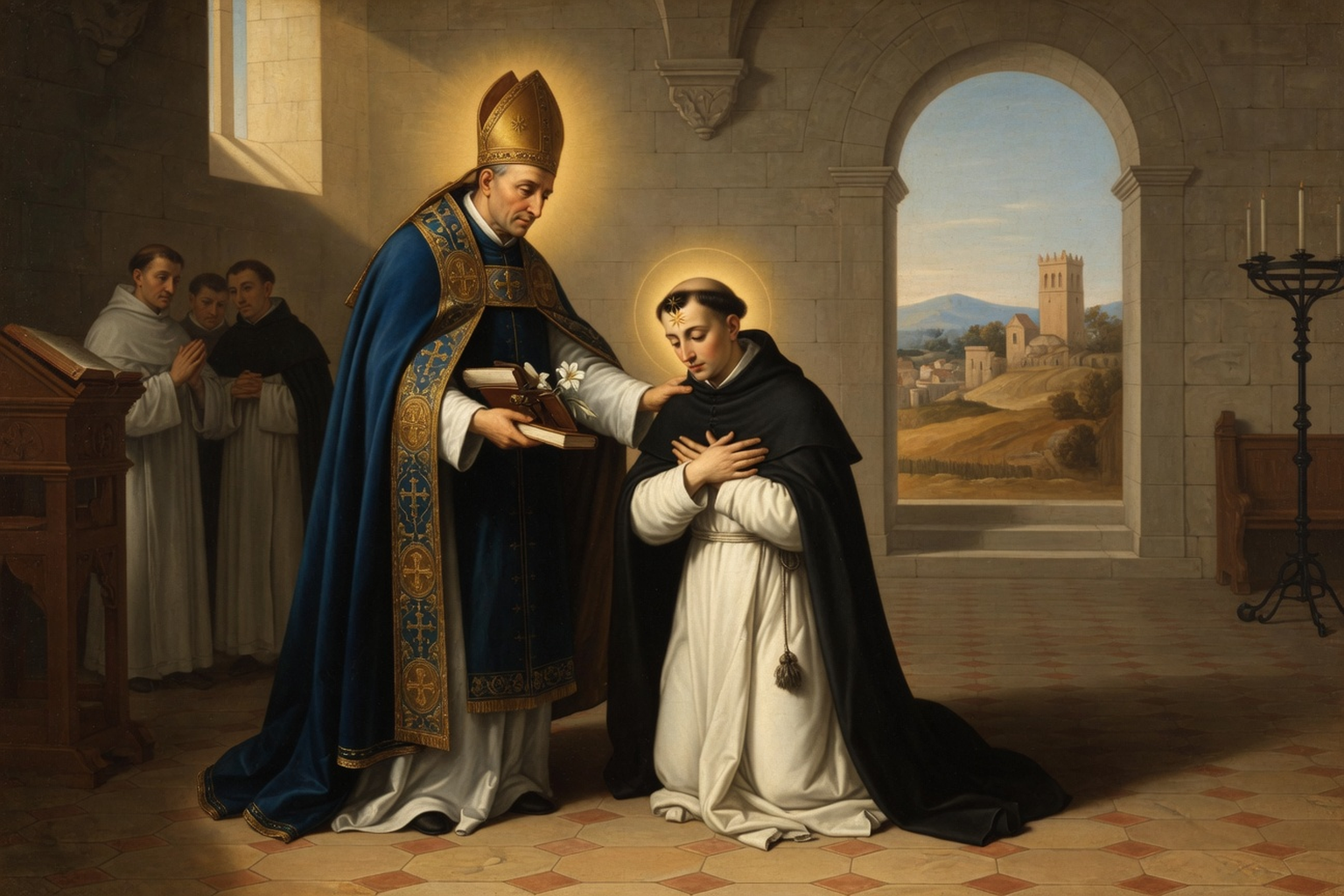
The Bishop of Osma, Martin de Bazan, having converted the Canons of his cathedral into Regular Canons, resolved to attach the young Dominic, who belonged to this diocese, to it. He entrusted this matter to Dom Diego de Acevedo, prior of the reformed chapter. Our Saint received this proposal as an order from heaven; he went to Osma, to his prelate, where he to dom Diégo de Azévédo Bishop of Osma, mentor and mission companion of Dominic. ok the religious habit at the age of twenty-five.
He regarded as nothing all that he had done until then; and, fixing his eyes, like Saint Paul, on what remained for him to do, he undertook, with a new courage, to fight against himself and to acquire Christian and religious virtues. He prolonged his vigils and his prayers, increased his fasts and his other bodily mortifications, and prescribed for himself from then on the rule of taking the discipline three times each night with iron chains. He renewed in his own person the austere and penitent life of the ancient Fathers of Egypt and the Thebaid, whose examples and maxims he meditated upon in the conferences of Abbot Cassian. However, his austerities did not prevent him from working for the conversion of sinners and the great work of the salvation of souls. The fruits of his preaching were very abundant. He confirmed the Catholics, confounded the infidels, and even converted many heretical Moors. Finally, he acquired such a reputation as an apostolic man that the vacant Churches wanted to have him as bishop, and indeed he was offered a suffragan bishopric of Compostela. But he answered then what he often answered: "God did not send me to be a bishop, but to preach"; *non me misit Dominus episcopare, sed prædicare*. Moreover, he performed all these wonders, mainly through the preaching of the Holy Rosary, whose mysteries he explained, and which he advised everyone to recite with attention and fervor.
When he had returned from this great mission, his prelate ordained him priest and made him sub-prior of his new Congregation. It was in reality the first office, since the bishop was prior. But, as this good shepherd recognized that Dominic was called by God to evangelical labors, he did not want to enclose such a light in a cloister. He sent him first to Palencia, where he had studied, to teach theology there. It was then a considerable University, and where there were many students, either from the country or from abroad; but since then it has been transferred to Salamanca. Dominic made himself admired there by the depth of his doctrine and the penetration of his mind. His discourses on piety had no less success. It is said that it was at this time that, by the virtue of the Rosary that he preached, a girl, named Alexandra, who recited it assiduously, and who was cruelly massacred without having the means to confess, resurrected five months later to receive this sacrament from him. The Bishop of Osma then permitted him to make a second mission. He therefore traveled the coasts of Galicia with another religious of his Congregation, named Brother Bernard, exciting everyone to devotion toward Our Lady, to merit the grace and mercy of her Son. One day when he was preaching on the seashore, Turkish pirates seized him and took him prisoner. But hardly was he on their vessel when a furious storm broke out: the corsairs were afraid; they invoked the true God, abjured Mohammedanism, and Saint Dominic immediately calmed the irritated sea. The vessel came to dock at a port in Brittany, where, after baptism, he established for them the Confraternity of the Rosary, which he then carried to Vannes, where he went to visit the Duke of Brittany, who was his close relative. The fruits he produced in this country through his preaching were so great that he could not suffice to hear general confessions. An infinity of people wanted to receive communion from his hand, and the bishopric of Dol being vacant, great insistence was made for him to accept it. He refused it generously, saying, as before, "that he was not sent to be a bishop, but to preach." The Duke wanted at least to retain him in his States, and even forbade all his subjects to let him leave; but the Blessed Virgin took him away from there and led him happily to the city of Osma, to his bishop, to continue his exercises as an apostolic preacher there.
It was then that this great man preached more openly, in Castile and Aragon, the devotion that this Queen of angels had taught him, and that he established the Confraternity of it on all sides. Almost incredible prodigies and quite surprising conversions are reported that he performed by this means: thus were converted Alfonso, the eighth or ninth king of Castile, who, by the assiduity in saying his Rosary holily, changed his life and conduct entirely, became a very good prince, won a signal victory over the Miramolin, who had seized his States, defeated more than two hundred thousand men of his in a single combat, and returned to the peaceful possession of his kingdom; another Alfonso, king of Leon and Galicia, who escaped the eternal damnation that his crimes had earned him, by the promise to say his Rosary devoutly every day; and many others like them, which the reader will find in the Annals and the complete Histories of the Order of Saint Dominic.
The struggle against the Albigensian heresy
On a mission in Languedoc, Dominic combats heresy through the example of apostolic poverty and miracles, notably that of the book spared by the flames.
However, this same King of Castile, of whom we have just spoken, father of Blanche, later Queen of France and mother of Saint Louis, appointed as ambassador to France Dom Diego de Azevedo, who had become Bishop of Osma in 1201, in order to negotiate the marriage of Prince Ferdinand, his son, with the Princess of Lusignan, daughter of Hugues le Brun, Count of La Marche, in Limousin. The bishop wished for Dominic to accompany him. They therefore departed together from Castile, and, taking their route through the Kingdom of Aragon and the cities of Perpignan and Narbonne, they arrived in Languedoc and the surroundings of Toulouse, where they saw with sorrow the strange r avages ca Albigeois Heretical movement in southern France opposed by Dominic. used there by the Albigensian heretics. It even happened, through an admirable conduct of divine Providence, that they lodged with a man infected by this heresy; but Saint Dominic, having entered into a conference with him, represented to him with such zeal and force the falsity of his dogmas and the impiety of his practices, that that very night he withdrew him from his blindness and brought him back into the bosom of the Church; so that, according to the remark of Vincent of Beauvais, he could address to him these words from Ecclesiasticus: *Hospitio mihi factus es frater*; "by the hospitality you have shown me, you have become my brother." These were the first fruits of the inestimable harvest that this holy Patriarch was soon to produce in this province by the entire reduction of these same Albigensians. The journey of our illustrious ambassadors was successful. They found the Count of La Marche in his castle of Gace; they made the proposal of the King of Castile to him, and they obtained from him what this king desired for the alliance of Ferdinand, his son, with the princess, his daughter. After such good words, they returned to Spain to inform Alfonso, who, wishing to consummate this affair, sent them back on their path with a large retinue and a magnificent train, to bring the future bride of Ferdinand. They therefore returned to France for this subject; but they were very surprised, when they arrived in the country of La Marche, to learn of the death of this young princess, and to find her covered with a funeral shroud instead of the precious garments that were being prepared for her wedding ceremony. They recognized in this more than ever the vanity of human grandeur, and, having sent the train they had brought back to Spain, they took the resolution to go together to Rome to obtain from the Pope permission to go and preach to the Cimmerians, who were northern peoples still idolatrous, the truths of the Gospel, or to stop in Languedoc to fight there, with the other missionaries, the abominable errors of the Albigensians. It is said that before leaving France they made a trip to Paris to pay a visit to the pious Blanche, daughter of their king, and married to Louis VIII, who was still only heir presumptive to the crown, and that Saint Dominic advised this princess to recite the Rosary assiduously, to make herself worthy of giving France a wise, devout, and generous prince, such as was her son Saint Louis, the greatest monarch who has ever worn the crown of the fleur-de-lis.
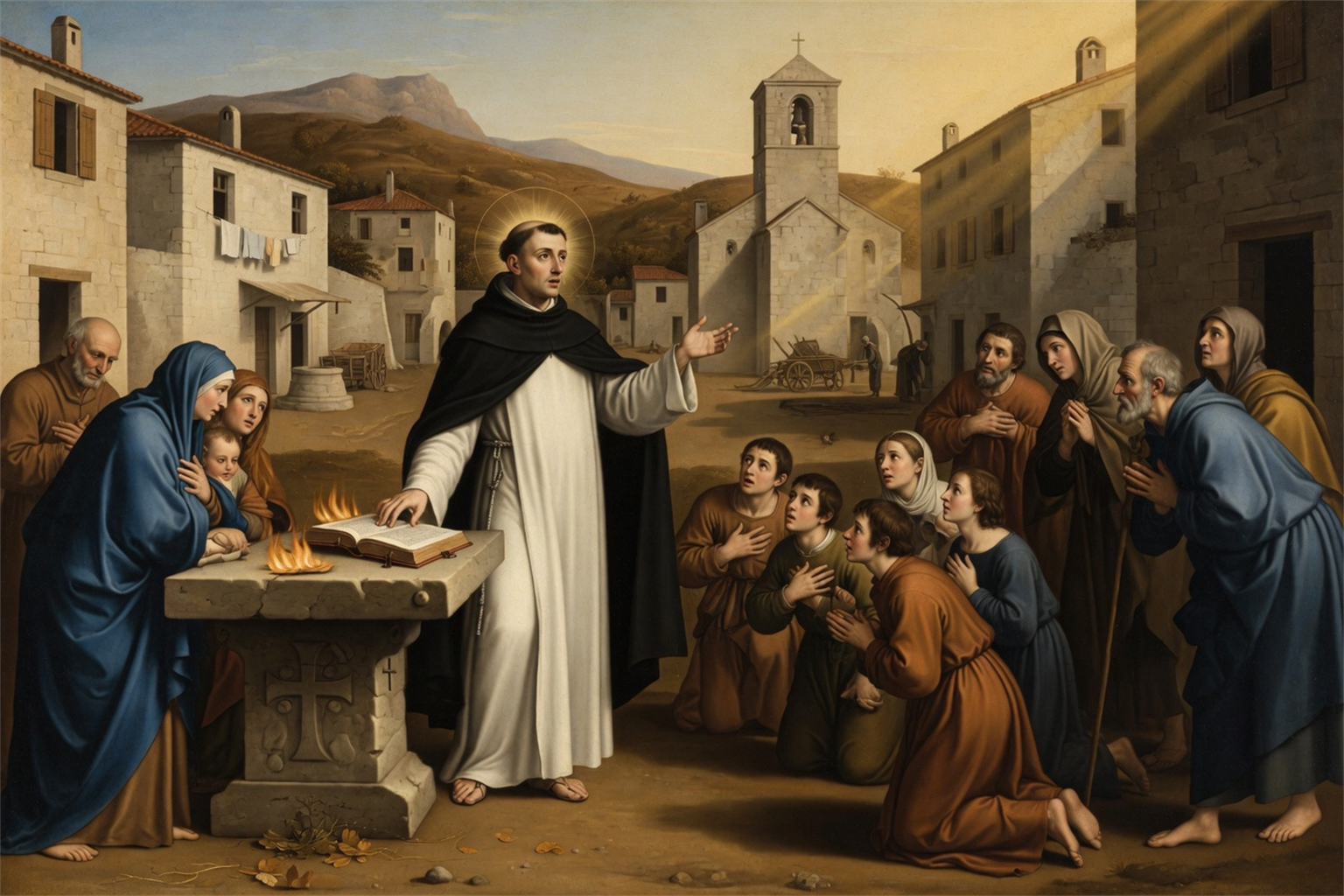
When our holy travelers had arrived in Rome, the pious bishop begged Pope Innocent III to relieve him of his bishopric, so that he might be freer to work for the reduction of the infidels and heretics. But the Pope, who knew his merits, took care not to deprive the Church of such a worthy pastor; he only permitted him to remain two years in Languedoc, to exercise his zeal there against the Albigensians, with the three legates he had already sent there, who were Dom Arnauld, sixteenth Abbot of Cîteaux; Dom Pierre de Castelnau, a religious of Froidefond; and Dom Rodolphe, also a religious of that abbey. With this permission, he resumed the road to France, always accompanied by Saint Dominic, and, before engaging in this glorious mission, he visited the Abbey of Cîteaux, whose holiness was the good odor of Jesus Christ for the whole world. He stayed there for three days, and even took by devotion the habit of this holy Order, imitating in this Saint Thomas of Canterbury, and many other prelates who had clothed themselves in these precious liveries to have a share in the merits of such a holy house. Some authors write that Saint Dominic did the same: which we find likely, since he was too zealous not to imitate his prelate in a practice of piety that was not repugnant to his state. These holy personages went from there to Montpellier, where the legates of the Holy See had assembled. They had already worked much for the reduction of the heretics; but the little progress they had made made them seek more effective means than those they had employed until then. Dominic had recourse to prayer for this; and God made him know that the true way to defeat the heretics was to take a form of apostolic life, making journeys on foot, without a train, without money, without servants, without provisions, and in a perfect abandonment to the care of divine Providence, in order to preach more by example than by words, and to confound, by this conduct, the hypocrisy of some of these heretics who, giving themselves the name of perfects, made a profession of great poverty and extreme abstinence. The Saint, having received this light, communicated it to his bishop, and this prelate proposed it in the Synod in the presence of the legates. They found difficulty in it at first, fearing that the Catholics might be scandalized by seeing their prelates and their missionaries in a state so devoid of all temporal comforts. But the bishop and Dominic encouraged them and offered to begin this way of life themselves. They therefore sent to Spain all the train and furniture they had and began to preach, as apostles, the Christian truths against the impostures of the heretics. The other missionaries followed their example, and absolutely wanted the bishop to be the head of the mission; God blessed their labors so marvelously that they made, in one day, more conquests than they had made before in several months. They preached at Caraman, a city located near Toulouse. The people were so touched by their speeches that, recognizing the truth, they drove from their walls the two main heretics of the country, called Baldwin and Thierry. The Abbot of Cîteaux was not with them then, having been obliged to make a trip to his abbey to preside over his General Chapter. The Blessed Pierre de Castelnau was also forced to take rest because of the bad treatment he received from the enemies of the Church. Thus, the mission was no longer composed of anything but the holy bishop, Rodolphe, and Dominic. The heretics opposed them with books full of impostures, blasphemies, and invectives against God and the Saints, which they repeated again in several public discussions. Dominic replied to them by word of mouth and in writing; but with such force and clarity that his seducers saw themselves in the impossibility of replying. They asked for his writing to examine it in private, promising to surrender if they found it sufficiently supported. The Saint gave it to them, knowing well that the truth would always be invincible. They read it together, examined it with all the malice that the spirit of heresy suggested to them, and strove to find answers to it; but the arguments with which it was supported seemed so strong and convincing to them that they did not believe they could destroy them. In this anxiety, one of the company said that it must be thrown into the fire, and that, if it did not burn, it was a sign that the contrary doctrine was the best and most sustainable. All agreed to this opinion, and immediately they threw Dominic's writing into the middle of the flames: it remained there for some time without burning; but God, wishing to increase the miracle, the flames rejected it from their bosom, without having done it any damage. This miracle did not soften these hardened men: they took this wonderful book and threw it a second time into the place where the brazier appeared the most ardent; but it was useless: it came out with the same integrity as it had come out before. They took it a third time, and plunged it again into the fire; but it was only for their greater confusion. For, as if it had been of a celestial material, it was neither consumed, nor even scorched or heated by this element. All this, however, was useless for converting them, and they took as their only resolution to keep secret these prodigies of which they alone were witnesses. However, there was a soldier in the company who recognized his error; and, wishing to reconcile himself with the Church, came to warn the holy missionaries of what had happened. This is how Pierre des Vaux-de-Cernay reports it in his History of the Albigensians, where he says that this happened at Montréal.
Meanwhile, our holy missionaries continued their apostolic journeys, and won signaled victories on all sides over their adversaries. Being one day at Fanjeaux, between Toulouse and Carcassonne, Saint Dominic argued publicly against one of these sectarians, and pressed him so strongly that he saw himself in the impossibility of answering. Those of his party, who, no doubt, did not know what had happened at Montréal, said that their doctrine did not consist in words, but in effects, that the notebooks of the two debaters must be thrown into the fire, and that the one whose writings did not burn would be esteemed the preacher of the truth. Saint Dominic, inspired by God and full of confidence in his goodness, accepted this offer in the name of all the Catholics. A numerous assembly of both parties was formed, judges were established, a large brazier was lit, the writings of the heretic were thrown into it, and in a moment they were consumed, without a page or a line remaining. The writings of Dominic were also thrown into it, not only once, but three different times; but, each time, the flames returned them safe and sound without having dared to touch them. The place of such a famous dispute and such a signaled miracle has since been changed into a convent of Preaching Friars, and a beam was preserved there, upon which the book of Saint Dominic flew three times while coming out of the flames, with the shape that was miraculously imprinted there in three different places.
Foundation of Prouille and support for the crusaders
Establishment of the monastery of Prouille in 1207 for converted young girls and spiritual support for Simon de Montfort during the crusade.
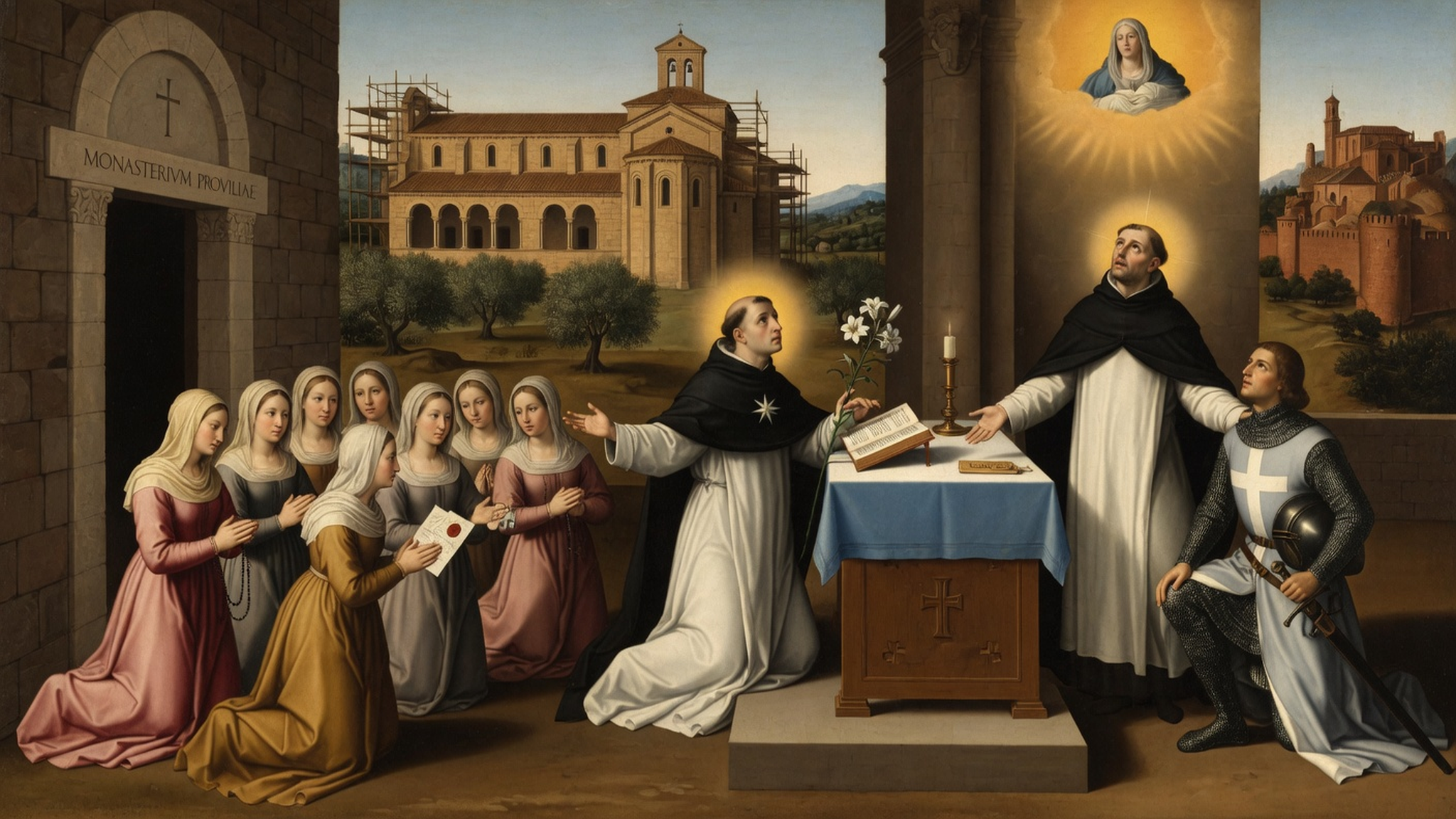
A victory so signal, raising the courage of this great man, he undertook to rescue several young girls placed by their parents—who had no means to feed them because of the great famine in the country and the ruin of their farms and castles—into the hands of the wealthiest heretics, to the great danger of their faith and eternal salvation. The Saint, says Saint Antoninus, wished to be sold himself, so that the price of his sale might serve to preserve them from such a great misfortune; but God was content with the inclinations of such heroic charity, and gave him the means, through the alms of Dom Bernard, Archbishop of Narbonne, of Fulk, Bishop of Toulouse, and of several other Catholic lords, to found for them the great and famous monastery of Prouille, near Fanjeaux, where he withdrew many of these girls, prescribing for them very wise constitutions to live in enclosure, retreat, and regularity. This priory is the first of his Order, and has been the source of many others illustrious for regular observance and holiness. This establishment is placed in the year 1207.
In this same year, our apostolic troop was increased by the return of Dom Arnauld, Abbot of Cîteaux, legate of the Holy See, who brought with him twelve abbots of his Order, firmly resolved to combat heresy by leading the evangelical life that the others were already practicing. The Bishop of Osma, whom they all recognized as their leader, distributed them in various districts of Languedoc and the County of Toulouse, in order to combat heresy in various places at the same time, and to assist on all sides the souls who were wavering in the faith, or who, having left the bosom of the Church, wished to return to it. However, the two years granted by the Pope to the holy prelate to combat the heretics having elapsed, he believed himself obliged to make a journey to his diocese, with the intention, nevertheless, of soon returning to the charge, with the permission of the Holy See. Passing through Pamiers, where he was received by the bishops of Toulouse and Conserans, and by a great number of abbots and ecclesiastics as a true apostle, he won a very signal victory over the Waldensians and Albigensians, who were very powerful there; for the Catholics and heretics having agreed to a public discussion, for which they named a judge who favored heresy, this generous Confessor spoke with such force and eloquence for the truth of the Catholic religion that he rendered the heretics mute, disarmed them entirely, and even converted the judge, who had resolved to be favorable to his adversaries. He left France with this great triumph, and arrived in a short time at his church of Osma; but while he was preparing for a new war for the defense of the Church and was even collecting alms to make a stable and perpetual establishment of missionaries in the places infected by the poison of heresy, and for the subsistence of the monastery of Prouille,
God told him that it was enough, and invited him to enjoy the rest he had earned by so many labors and conquests. He died in the same year (1207), and was buried in his cathedral, to the left of the high altar. His entire diocese, as well as the company of missionaries, wept bitterly for his death; but God consoled them marvelously by declaring his holiness through great miracles.
Shortly after the death of this great Prelate, the Abbot of Cîteaux saw himself forced to take the road back to his abbey to attend to the affairs of his Order. The Blessed Pierre de Castelnau was massacred by the heretics. Dom Rodolphe had also retired a little earlier to the abbey of Franquevaux, and had died there, overwhelmed by the fatigues of the mission. These accidents discouraged the twelve abbots who had newly arrived, and made them believe that they would gain nothing over the Albigensians, and that they would render more service to God by resuming the care of their monasteries; thus they returned, and the whole weight of the mission fell upon Dominic. This wonderful man did not lose courage, fortified on one side by a most extraordinary grace that Saint Lutgard had earned for him by a seven-year fast, and on the other by seven or eight good workers who placed themselves under his guidance and perfectly adopted his spirit, he began all over again to combat the heretics and to pursue them in all the places where they had entrenched themselves. The desire for martyrdom made him go freely everywhere, running barefoot, without money and without provisions, from city to city and from village to village; he carried the light of the Gospel everywhere. But as the enemies of the Church were supported by the counts of Toulouse and Foix, by the Archbishop of Aix, and by Rabbestin, who had been deposed from the bishopric of Toulouse for his crimes, he believed it was necessary to oppose temporal arms against these sectarians, who were ruining morality no less than piety, and who were disturbing the State as much as the Church.
Legate Arnaud having returned, a council was held on this, and the bishops of Toulouse and Conserans, persons very zealous for the Catholic faith, took it upon themselves to go to Rome to propose it to His Holiness. They represented to him the deplorable state of the provinces of France, from the Garonne to beyond the Pyrenees, the necessity of providing a remedy there, of preventing the evil from spreading everywhere, and of employing, for this, the secular arm, without which it seemed impossible to re-establish order in the provinces. They informed him at the same time of the zeal of Saint Dominic, of his penitent and apostolic life, of his great miracles, and of the wonderful fruits of his preaching. The Pope, touched by their words, named Cardinal Milon or Galon, his legate in France, to work effectively on this affair, recommending to him particularly to use the advice of Abbot Arnaud, with whom our Saint was but one spirit and one heart. He also wrote to the King of France, Philip Augustus, to exhort him to the holy war against these enemies of God, of the Church, and of all human society.
The old and the new legate gave three missions to our Saint: the first, to continue his sermons and his private and public discussions, according to the express command he had received from His Holiness; the second, to preach the crusade to assemble the Catholic lords and peoples against the heretics; the third, to search for these, to judge them, to absolve them, to condemn them, and to punish them. Dominic fulfilled these missions worthily, and to attack the enemy in his stronghold, he entered the city of Albi, where he preached controversy with incredible courage and resolution. He also published the crusade elsewhere; and it is said that he went as far as Paris, where he saw Queen Blanche for the second time.
However, he had great and extreme pain to see that the fruits did not correspond to his zeal and his work, and what gave him more sorrow was that few heretics were converting, the army of the Catholics, which was going to come, massacred a great number of them, and that thus they would be lost for all eternity. In the bitterness with which his heart was penetrated, he addressed himself to the Blessed Virgin and prayed to her urgently, with tears in his eyes, to assist him and to inspire him with the means to reduce these hardened ones. One day when he was in the greatest fervor of his prayer, in the chapel of Our Lady of Prouille, this Mother of mercy appeared to him and told him "that, as the Angelic Salutation had been the principle of the redemption of the world, it was also necessary that this Salutation be the principle of the conversion of the heretics; that thus, by preaching the Rosary which contains one hundred and fifty Hail Marys, he would see a wonderful success of his labors and the most obstinate of these sectarians convert by the thousands." Dominic obeyed this voice, and, instead of stopping, as before, at discussions and controversies, he applied himself mainly to announcing the Rosary, to explaining its fifteen mysteries, and to declaring the greatness and merits of the Blessed Virgin; he succeeded so admirably that, in a few years, he withdrew more than one hundred thousand people from hell, by making them abandon their errors. Also, it is only at this time, and not before, that most authors have placed the establishment of this famous devotion; but it is more true that our Saint had already published it in his evangelical journeys, in Aragon, in Galicia, and in Brittany, as has been recognized by sure memoirs of those times.
If Saint Dominic did so many wonders at the beginning of his preaching against the Albigensians, he made himself even more admirable when the army of the crusaders had arrived, and the generous Simon, Count of Montfort, who was created its leader, had undertaken to combat and ruin the rebels everywhere. This great captain was the Joshua who we nt at the head of the tr Simon, comte de Montfort Military leader of the Albigensian Crusade and friend of Dominic. oops of the living God, and Saint Dominic was the Moses who, by his tears, his prayers, and his austerities, obtained for him from heaven most glorious victories. He sometimes left the evangelical journeys which had no other end than the strengthening of the Catholics and the conversion of the heretics, and went into the army, to instruct the soldiers, to make them make good confessions, to form them in the devotion of the Rosary, and to animate them then to fight courageously for the cause of religion, and it is not believable how many prodigies he performed by these cares. Often Count de Montfort saw himself abandoned by the crusaders, who only obligated themselves to fight for a time, and he did not have enough soldiers left to oppose one to twenty, or thirty, or fifty of the enemy party; but the Saint encouraged him so powerfully, with Alix, wife of the same count, who also had a very martial heart, that the soldiers seemed to become stronger by this abandonment, because they placed their trust in the help of the Almighty. It was by the assistance of this great Saint and by the virtue of the Rosary, that one hundred Catholics chased three thousand Albigensians; that five hundred trampled ten thousand of these fanatics; that most of the cities of Languedoc and the County of Toulouse were taken with few men, and above all that one hundred thousand men, led by the King of Aragon and by Raymond, Count of Toulouse, having come to besiege Count Simon in Muret, were cut to pieces by two or three thousand Catholics, of whom only nine perished in the combat, while more than thirty thousand heretics left their lives there with the King of Aragon and many nobles. On this occasion, Saint Dominic was at the head of the faithful, holding in his hand a cross whose wood was pierced by many arrows, without a single one hitting the crucifix. Toulouse was then obliged to surrender to the Count of Montfort and to receive the Catholic instructions of Saint Dominic, and the other rebel cities finally followed his example.
Confirmation of the Order of Preachers
Journey to Rome to obtain the approval of Innocent III and then Honorius III, officializing the Order of Preachers in 1216.
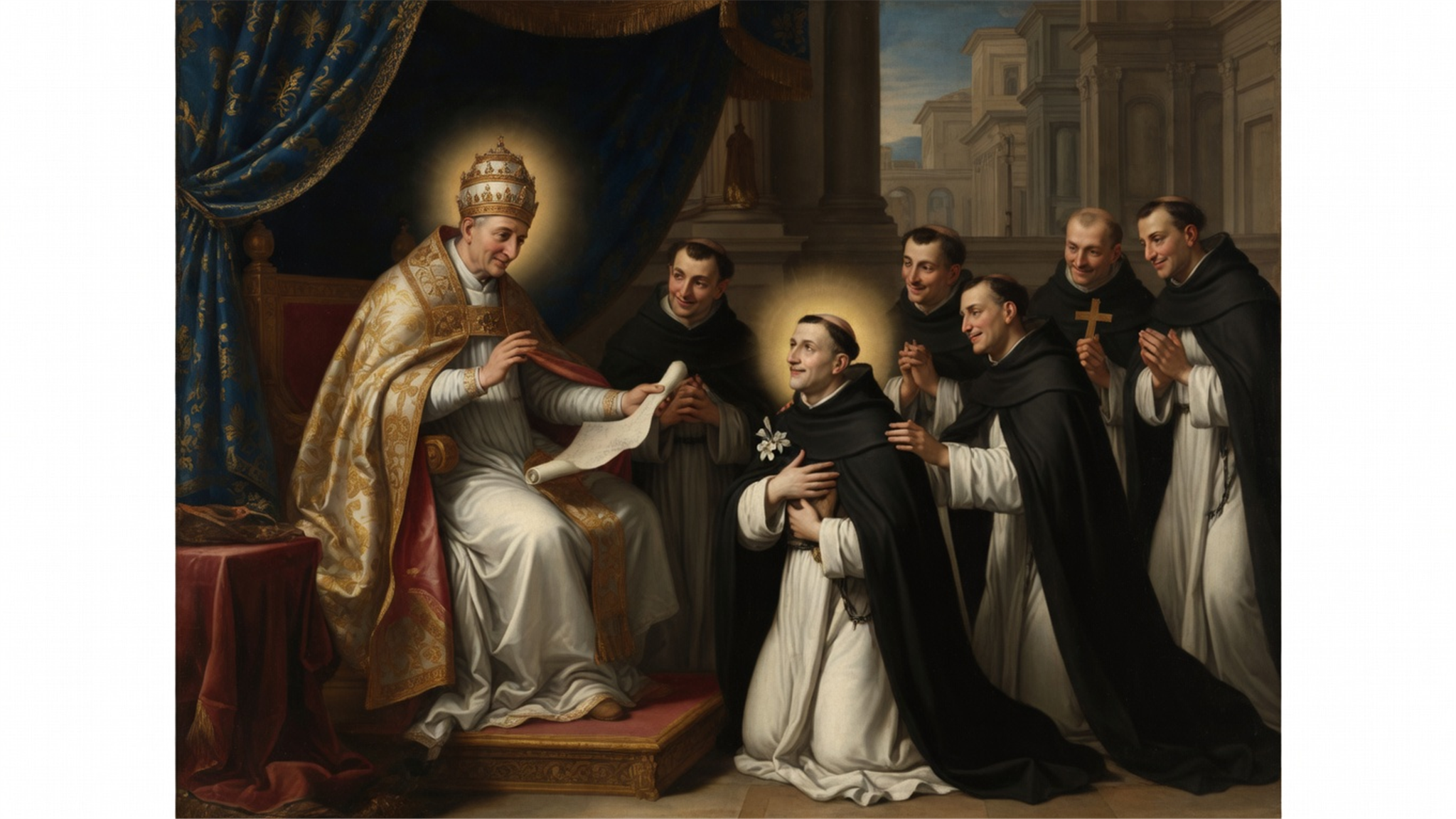
But it is time to speak of the establishment of his Order, the great work for which Providence had destined him from all eternity. He conceived the design as early as the year 1207, seeing himself often without a sufficient number of laborers to preach the Gospel and to repress the audacity and malice of the heretics. He further reflected that those who worked with him, being bound neither by state nor by any engagement of their profession, were every day on the verge of leaving the enterprise and leaving the work of God imperfect, especially because of the difficulties encountered, the fatigues that had to be overcome, the dangers that had to be conquered, and the death to which one was continually exposed. This therefore led him to take the resolution to institute a religious Order whose end would be the preaching of the Gospel, the instruction of the people, the conversion of heretics, the defense of the faith, and the propagation of Christianity. God revealed at that time to the blessed Mary of Oignies, whose life we wrote on June 27, that He wished to give this help to His Church, as is reported in her history composed by Cardinal Jacques de Vitry. Another holy religious had a similar revelation in a rapture that lasted three days. Dominic, being in this thought, communicated it to his bishop, who was still alive, and to other prelates of signal piety and very great erudition; they all confirmed him in such a high enterprise; and several even promised to assist him with their credit, their authority, and their goods. With this view, he gradually assembled sixteen companions, whom he trained in evangelical labors, and in the year 1216, seeing that evils were multiplying more and more; that the heretics, though defeated by arms, did not for that reason return to the bosom of the Church from which the spirit of lying had separated them; that the morals of the Catholics were extremely corrupted, and that in many places ecclesiastical discipline was almost entirely abolished, he went to Rome to find Pope Innocent III, to propose to him the design that God had been inspiring in him for so many years.
The Bishop of Toulouse, who had come to the General Council of the Lateran, spoke first to the Pope of a design so useful to the Church; some other bishops spoke to him of it as well and gave him great praise for this new founder; the Saint also had an audience for this. But as the council had just ordered that one should work rather on the reform of the Orders already established than receive new ones, the Pope remained constant in the refusal of the proposal made to him, until he saw, in a mysterious dream, the Church of the Lateran in ruins supported on the shoulders of Saint Dominic; he had him return, and, approving his Institute by word of mouth, he sent him back to Toulouse to confer with his companions on the Rules and Statutes to which they wished to bind themselves, promising to approve them when he had drawn them up, and exhorting him nevertheless to settle on some ancient Rules, to which he could add Constitutions proper to his design. Dominic therefore returned to Toulouse, and, having assembled his companions in the monastery of Prouille, he explained to them what the Pope had ordered him. They invoked for this the assistance of the Holy Spirit, and, after mature deliberation, they felt inspired to take the Rule of Saint Augustine, with some Statutes of the Order of Prémontré, to which they added Regulations proper to the apostolic life of which they wished to make profession. They then began to build in Toulouse the convent of Saint-Romain, which has since been changed into another more magnificent one. While they were working there, Dominic took the road to
Rome, to obtain the confirmation that had been promised to him. He learned on the way of the death of Pope Innocent III, which occurred in Perugia on July 15, 1216. This death and several other important affairs, which occupied Pope Honorius III, his successor, at the beginning, delayed a little the execution of what our Saint was asking for. He did not, however, lose courage; but, animating himself all the more as greater difficulties presented themselves, he continually solicited the divine goodness, by his prayers, by his tears, by his fasts, by his bloody disciplines, and by all the other ways that are capable of bending it, to finally accomplish the project that it had inspired in him.
Being one day in prayer in the church of Saint Peter at the Vatican, he was caught up in ecstasy; he perceived Our Lord in His glory and raised on a throne from which, holding three lances in His hand, He seemed to want to pierce all men and strike down the whole earth. He saw at the same time the Blessed Virgin throw herself at His feet, praying Him to stop His anger and to forgive those whom He had been willing to redeem with His precious blood. And as this irritated judge told her that the crimes of men had reached such an excess that He could not help but punish them with extreme rigor, she presented to Him two of His servants, one of whom was Dominic himself and the other the patriarch Saint Francis, assuring Him that by the preaching of these faithful ministers of the Gospel, and by their good examples and those of their children, such a happy change would be made in the morals of men that His justice would have reason to be satisfied: which made the lances fall from His hands and appeased Him entirely.
One cannot believe the joy that this vision gave to our Saint; he recognized by it again that his enterprise came from heaven; that it would have a very happy success; that his children would be the reformers of the world, and that, being joined to those of Saint Francis, they would make a marvelous renewal in Christianity. He also noticed the features of the face of the one whom God had given him as a companion and the form of his habit. Some time later, having met him in Rome, he recognized him without difficulty, embraced him with great testimony of joy, and bound with him a close friendship that he always kept until death.
This same vision was soon followed by the approval and authentic confirmation that he was pursuing. The Pope spoke of it to the Sacred College, and, by their advice and consent, he had the bull dispatched on December 22, 1216, giving to this new Order, by a particular movement of the Holy Spirit, the name of *Fratrum Prædicatorum*, that is to say, according to the language of that time, of Friars Preachers, which one should not change, although the word preacher for preacher is no longer in use. Then the holy pa Frères Prêcheurs Mendicant religious order founded by Saint Dominic. triarch, wishing to thank the divine goodness for so many graces, retired again to the church of the Holy Apostles, where these glorious princes appeared to him, and, presenting him one with a staff, the other with a book, said to him: "Go and preach, because you are chosen by God for this ministry." He saw at the same time in spirit his children going two by two throughout the universe and preaching the word of God with much zeal and with a truly apostolic ardor. From that time on, in memory of this favor, he usually carried, both in the cities and in the countryside, a staff in his hand and the book of the Epistles of Saint Paul, whose assiduous reading he highly recommended to all his disciples. Before leaving Rome, he made his vows in the hands of the Pope, who established him Master General of his nascent Congregation, and gave him power to receive religious to the profession, to take new houses from all sides, to establish superiors there, and generally to do everything he would judge necessary for the good government of his entire Order.
European Expansion and Miracles in Rome
The dispersion of the first friars throughout Europe and the performance of major miracles in Rome, including the resurrection of young Napoleon.
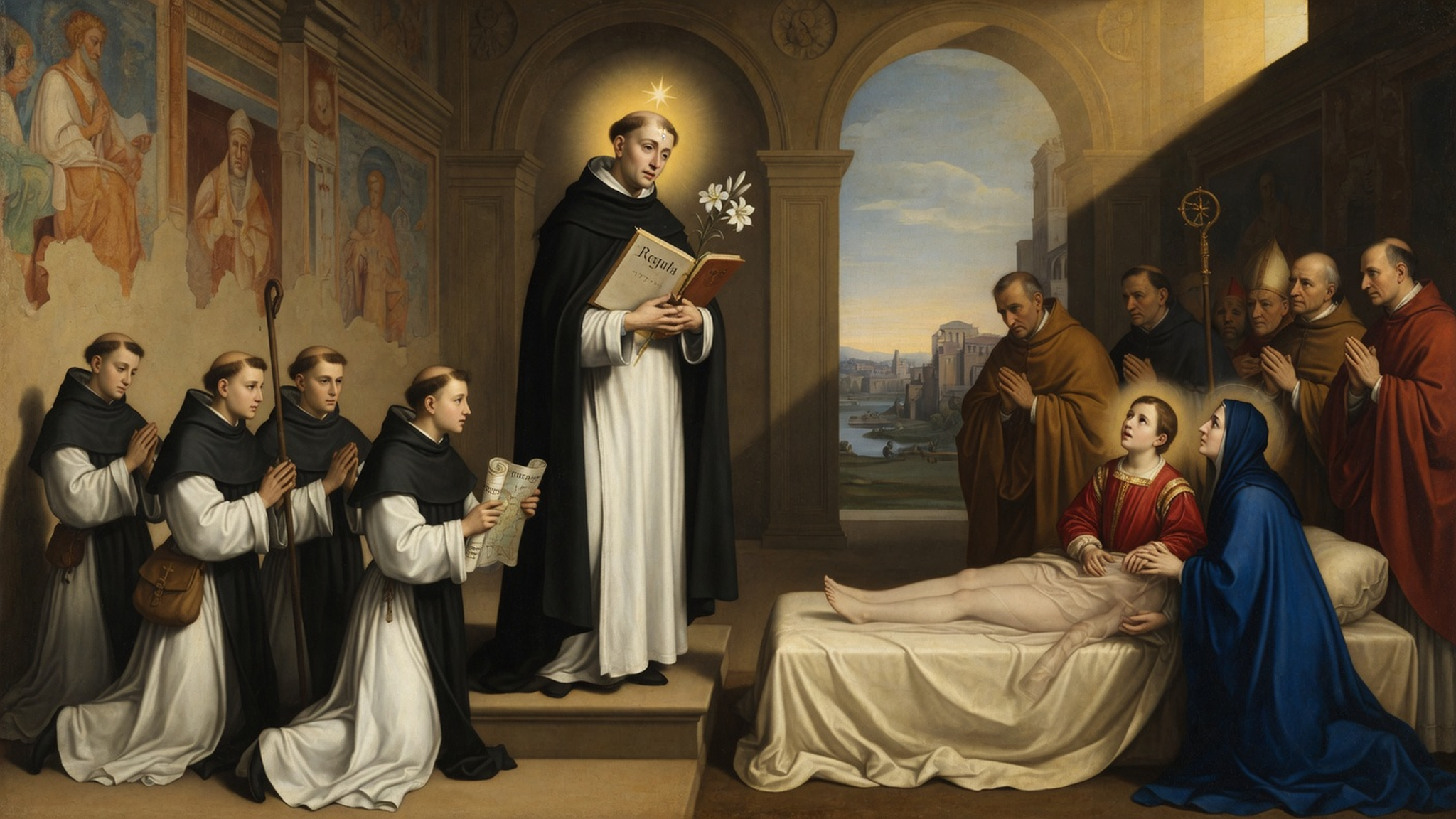
Upon his return to Toulouse, he had the consolation of seeing the convent of Saint-Romain completed through the liberality of Bishop Foulques and Simon, Count of Montfort, who held him in incredible affection. He shared with his children the happy news of the establishment of their Congregation, and prepared them for profession through all the exercises that could contribute to making them spiritual men, true religious, and excellent preachers of the word of God. As he knew that learning was essential to this congregation, which had as its end to explain, defend, and teach the truths of the faith, he did not hesitate to lead them himself to the public schools of Toulouse to hear lessons in theology and the explanation of the Holy Scriptures. God, wishing to make known to the professor the merit of these new listeners, one morning when he was only very lightly asleep, it seemed to him that he saw seven very brilliant stars enter his classroom, one of which, however, surpassed the others in beauty and splendor. He was at first anxious about the meaning of this dream, but he recognized its true sense when he saw Saint Dominic bringing his religious to his lessons; by the spirit of God, he discovered that these were the seven stars he had seen in his dream and which, indeed, would soon enlighten the whole earth with the marvelous brilliance of their light.
When Saint Dominic saw his disciples so well disposed, he received them into profession, and, without further delay, he distributed them into various countries and kingdoms to carry the torch of true doctrine everywhere. The bishops of Narbonne and Toulouse, and Count Simon, who were very troubled to see Languedoc and Guyenne deprived of such great help, at first opposed it and tried to dissuade the Saint from dismembering so soon his body which had only just been born: but he, who had the order of heaven and knew the fruits that each of his children would bear in the places where he sent them, stood firm against their opinion and executed it with a constancy worthy of a faithful servant. He therefore sent to France Father Matthew of Paris, with Fathers Bertrand of Guarrigue, a small village in the province of Narbonne; Michel de Fabra, a Spaniard; Jean de Navarre, from Biscay; and Laurent, an Englishman, in addition to Mannès de Guzman, brother of Saint Dominic, who had already entered his Order, and Odéric of Normandy, a lay brother. For Spain, he sent Father Suero Gomez, a noble Portuguese, with three Spaniards: Michel of Uzera, Pierre of Madrid, and Dominique of Segovia; he kept the others in Toulouse and Prouille to raise new religious, govern the house of the sisters, and continue the exercises of preaching and the pursuit of heretics.
The blessed Patriarch, after having converted and enrolled in the Confraternity of the Holy Rosary almost the entire city of Carcassonne, especially through the miraculous deliverance of a possessed man who had been seized by fifteen thousand demons for having blasphemed against the fifteen mysteries of the Rosary, and had often insulted the holy preacher who announced its wonders, and after having encouraged the Count of Montfort to fight generously against the Count of Toulouse, leader of the Albigensians, who had retaken that important place, left Languedoc himself to go and establish his Order in various cities of Christendom. He went first to Paris, where he saw Queen Blanche, already mother of her son Saint Louis, whom God had granted her through the virtue of the Rosary: for she had recited it with great assiduity, following the instructions of the Saint. The progress of his children in that city made him judge that his presence was not necessary there. He therefore went to Metz; several good workers having presented themselves to him, he founded a convent of his Order there, of which he established the blessed Étienne, his companion, as the first prior. Among those he clothed in his habit, he took six of the most resolute, whom he took with him to Italy. On this journey, captured by brigands and taken to a castle where the captain, with fourteen officers and five hundred soldiers, led a diabolical life, living only on plunder and defiling themselves with all the filth of which a brutal man is capable, he happily converted them all. His plan was, when he arrived in Venice, to pass into Cumania, a country enclosed within Tartary, Russia, and Scythia, on the upper Black Sea, which had not yet received the light of the Gospel; and he had, for this, had a vicar general of his Order elected, who was Father Matthew of Paris; but God made him know once again that He was satisfied, for this mission, with his good will, and that he would render Him more service by strengthening the Order of his preachers, so that there would always be some ready to go to all parts of the world, than by going himself to those distant lands to carry the Gospel. The impossibility he found in Venice of making this journey was a confirmation of this heavenly inspiration. Thus, he took the resolution to go to Rome, so that his Institute, being established there, could spread from there more easily into other cities and all other kingdoms of the earth. He nevertheless left some of his own in Venice to build a convent there, and sent others to Spalatro for the same purpose; and, while passing through Padua, he promised the inhabitants to send them some as well when he was in Rome.
As soon as our Saint was in this capital city of Christianity, he went to throw himself at the feet of Pope Honorius III, to give him an account of the happy success of the Congregation he had had the kindness to confirm. The Pope listened to him with great joy; and, so that he could do in Rome what he had done in France, he gave him the church of Saint-Sixtus and its dependencies to serve as his convent. Then he began to open his mouth in this great city, and to display there the inestimable treasures of wisdom and grace with which his soul was enriched; and his preachings were so effective that, in the same year, he saw his new convent populated with one hundred religious, who, according to the spirit of his Institute, burned with zeal for the salvation of souls, and were in the disposition to go to the ends of the habitable world to work for the conversion of infidels. The principal ones were Tancred, Otho, Gregory, Henry, and Albert, who were like the foundations and living stones of the spiritual edifice of the Order of Preachers in Italy.
The miracles that God worked through the hands of Saint Dominic also gave him credit and won him a very particular veneration. The authors of his life note especially three dead whom he resurrected: the first was the son of a holy Roman widow, named Guatonia, or Tuta de Buvaleschi; this lady, going to the sermon of the Saint, which no one missed, left this little child sick in his cradle. Upon her return, she wanted to give him some assistance, but she found him dead and without any remaining breath or respiration. In the pain with which she was penetrated, she took him in her arms, and entering the convent of Saint-Sixtus, where, because of the buildings, there was not yet any enclosure, she carried him to the feet of the Saint, who was at the door of his Chapter; she spoke to him more with her eyes than with her mouth: but she spoke enough to make him know that she was asking for the resurrection of her son. The Saint withdrew a little, prostrated himself on the ground, and made a short prayer, after which, making the sign of the cross over the dead, he restored his life and returned him alive and healthy to his mother. This prodigy, despite the prohibitions that Dominic had given him and his religious to speak of it, immediately reached the ears of the Pope. He wanted to have it published from the pulpit for the honor of the new Order and for the confirmation of the faith; but the Saint did so much with His Holiness that he changed his resolution and revoked the order he had given for this publication. However, the whole city of Rome, being informed of all that had happened, conceived such respect for the Saint that everyone considered themselves happy to be able to touch him, and many even cut the edges of his habit to make them into relics: so that sometimes it no longer reached below his knees. Those who accompanied him tried to prevent this excess; but this great man, who saw that the more they prevented it, the more people rushed to tear or cut something that belonged to him, said to them gently: "Let this people satisfy their devotion."
The second dead person he resurrected was a worker who, while working at his monastery of Saint-Sixtus, was crushed under a section of wall that fell on him. The religious, extremely afflicted by this accident, begged their holy Father to have pity on this unfortunate man. He had his body pulled from under the rubble, and, having said his prayer for him, he restored his broken limbs and returned him to the same state he was in before. This new prodigy further increased the affection of the Romans toward him. However, this did not prevent his community, which lived only on alms, from often lacking the food necessary for life; but divine Providence always provided for it in a miraculous way. Twice, angels, in human form, entered the refectory and gave each of the religious a bread of incomparable taste and whiteness. Twice the blessing of the Saint was so effective that, at the first, it made wine be found in a cask where there was none before, and, at the second, it multiplied a single piece of bread so much that there was enough to feed his whole community, and there was still much left after the meal.
The third dead person who received life through the prayers of this great wonder-worker was the young lord Napoleon, nephew of Cardinal Étienne de Fosse-neuve. This young man, riding a horse in Rome, fell so hard on the pavement that he broke his head, shattered his whole body, and died suddenly. The cardinal, his uncle, was then with Saint Dominic and two other cardinals: Ugolin, Bishop of Ostia, and Nicholas, Bishop of Frascati, who were working together on the matter the Pope had entrusted to them, to unite in a single monastery all the religious women scattered throughout Rome. The news of this death, which many circumstances made tragic and deplorable, deeply touched this good uncle. He fell into a faint and had to be put to bed. Saint Dominic, who shared in the pain of all the afflicted, also felt much sorrow. His children seized this occasion to beg him to resurrect the deceased. He did not refuse; having dressed to say Mass, he went up to the altar in the presence of three cardinals and Yves of Cracow, in Poland; of Saint Hyacinth and the blessed Ceslas, nephew of the prelate, and a large number of religious. The devotion with which he celebrated was admirable: tears flowed from his eyes in abundance, his chest heaved with an infinity of sighs, and, when he was at the elevation of the holy Mysteries, he entered into an ecstasy and a marvelous rapture, during which his body was raised from the ground by a cubit. After Mass, he went to the place where the dead man was, followed by all this illustrious company. He prayed three times for him, and, each time, he touched with his hand his broken limbs, which he had previously put back into their natural position. After this ceremony, he entered into a new transport that raised his body again above the earth, and, in this state, he cried out with a loud voice: "Napoleon, my son, in the name of Our Lord, I tell you, arise." The dead man, at this word, obeyed more promptly than if he had been alive. His bones reset, his limbs reunited, his wounds closed, and he rose full of life and health, about six hours after his death. One cannot conceive the astonishment and admiration of the spectators, nor the dispositions that such an evident and authentic action operated in the hearts of all the inhabitants of Rome, to receive with submission the advice that Saint Dominic gave them in his sermons.
One should no longer, after that, be surprised if, in the short time he stopped this time in Rome (eighteen months), he undertook and executed things that seemed to require several years. We have already spoken of a mission he had from the Pope, to gather all the religious women of the city into a single monastery. This plan was extremely useful, because God is better served, and regular observance better kept in a large monastery than in several small ones; it suffered nevertheless from many difficulties: for these religious women were accustomed, some to live with their parents, others to lodge in small separate communities, and all not to keep enclosure, but to go out with complete freedom, and their relatives did not want to be deprived of the company and conversation of these pious girls. But the Saint overcame these obstacles so skillfully and won over all minds so much that, finally, he united all these religious women, and even those of Saint Mary beyond the Tiber, into a single house, that of Saint-Sixtus, which his religious ceded to them to move into that of Saint-Sabina, which the Pope gave them with all its dependencies. He ordered them perpetual enclosure, according to the intentions of His Holiness, and, having made them take his Institute, he formed them admirably in all Christian and religious virtues: so that one saw in this convent, by the holiness of these excellent subjects, an image of the angelic life and the beautiful economy that is in each choir of the blessed spirits. Several other miracles are reported that the Saint performed to confirm them in their first resolution; but we would be too long if we stopped at all the actions of this incomparable man.
He did no less striking things in his new monastery of Saint-Sabina. It was there that, by the preaching of the Rosary, he converted a usurer who had become rich and had amassed great treasures through unjust commerce; and a courtesan called Catherine the Beautiful, who, from a public sinner, became an illustrious penitent and an excellent servant of God. It was there that he won to Jesus Christ and to religion Saint Hyacinth and Saint Ceslas, Poles and nephews of the Bishop of Cracow, who soon after carried the Order into Germany and Poland, where especially Saint Hyacinth made himself admirable by an infinity of prodigies, as we will say in his life. It was there that he received the blessed Reginald of Saint-Gilles, canon of the church of Saint-Aignan, in Orléans, after having obtained for him from the Blessed Virgin health through a signal miracle. This learned and pious ecclesiastic had come to Rome with his bishop, with the intention of visiting the stations and places consecrated by the blood of the Apostles and Martyrs; but, hearing of the exemplary life and miracles of Saint Dominic, he came to see him and asked him for the habit of his Order; the Saint promised it to him with all the more joy, as, knowing that he was very virtuous and that he joined to piety great erudition, having even taught canon law for five years in Paris, he would make a great minister of the word of God; but hardly had he given him a day to enter his monastery, when a violent illness that seized him not only delayed the fulfillment of his plan, but also put him in great danger of losing his life. Saint Dominic, not wanting to lose such a rare subject, prayed insistently for his recovery. One day, therefore, when the fever was tormenting him more cruelly, the Blessed Virgin appeared to him, and, touching him with her hand on all the limbs that the priest is accustomed to anoint when giving Extreme Unction, not only did she restore him to perfect health, but she also conferred upon him extraordinary graces opposed to the vices of which these limbs are accustomed to be the instruments, especially an angelic chastity and a perfect mortification of the tongue and all the senses. She made him see at the same time the habit he was to wear, which was not a canon's habit, as Saint Dominic and his children had worn until then, but a habit and a scapular of white serge with a black cope and hood over it. Thus the Saint, after this revelation, changed the habit of his Order by the permission of the Pope, and gave him the one whose form his good Mistress had shown to this great servant of God. He clothed him in it among the first, and he has since been a man powerful in works and words, who has rendered great services to religion. He died, in the odor of sanctity, in Paris, in the year 1220, and was buried at Notre-Dame des Champs, which was then the burial place of the Friars Preachers.
Structural Organization of the Order
Holding of the first general chapters in Bologna, division of the Order into provinces, and institution of mendicant poverty.
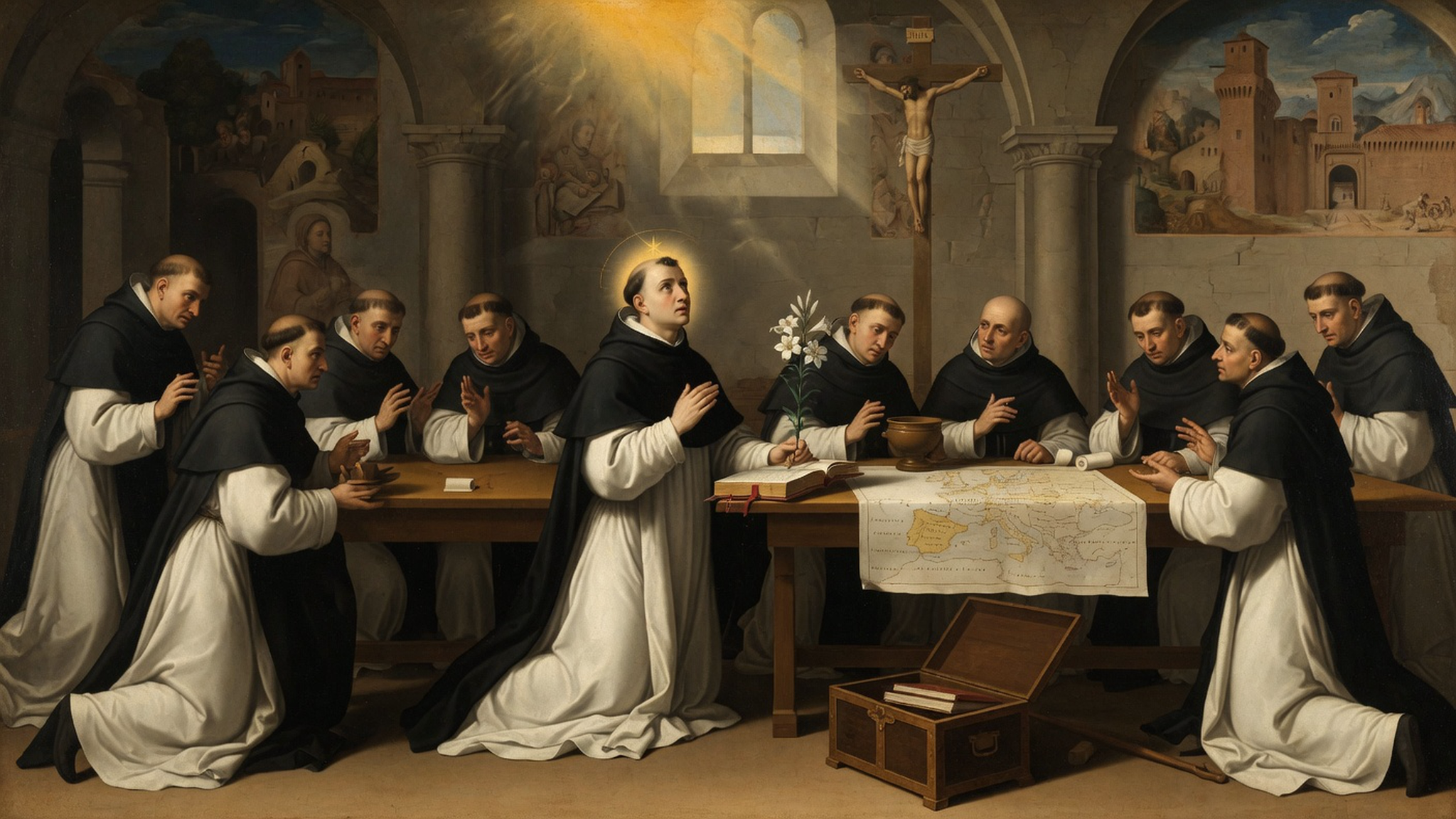
Some time later, Saint Dominic had a vision full of consolation, in which Our Lord showed him all his children hidden under the mantle of his most holy Mother. The care he had for their advancement did not prevent him from applying himself to many other things that he believed could contribute to the increase of the glory of God. In this spirit, he advised the Pope to create an officer in his palace to explain the Holy Scripture and the truths of our faith to the infinite number of people who abounded at court, and who often lost much time waiting for the dispatch of their affairs. His Holiness charged him with this employment, and he discharged it worthily for the rest of the time he was in Rome. This officer is the one called the Master of the Sacred Palace, who has since become one of the most considerable in Rome; it is always religious of Saint Dominic who hold this quality; and they hardly ever leave it except to be cardinals or Masters General of the entire Order. In this spirit, the same holy Patriarch, seeing the need the Church had for soldiers to defend it against the insults and cruelties of heretics and infidels, established, with the permission of the Pope, the Order of the Soldiers of the Militia of Jesus Christ. The necessity of being brief does not allow us to give here the obligations and statutes of this Order. We will only remark that it is through it that the Third Order, of both sexes, of Saint Dominic began, which has become so famous since his death, and which we can call a happy nursery of Saints, since it has given and gives every day such a great number of them to the Church.
After this establishment, the news arrived in Rome of the glorious death of Simon, Count of Montfort, who was killed on June 28 of the year 1218, in the ninth month of the siege he had laid before Toulouse. This accident caused the Saint to resolve to return to Languedoc, to console and strengthen the religious he had left there, and his daughters of the monastery of Prouille, and to extend there his new Order of the Militia of Jesus Christ, which was especially necessary in that country. He left Rome around the feast of All Saints, and, passing through Florence and Bologna, where he performed many miracles and received several considerable favors from heaven, he arrived in a short time in the county of Toulouse. His presence infinitely rejoiced his children, and made them conceive new resolutions to work for the perfection of their state, but he soon weaned them from it to go to Spain, where his Order was making very great progress. Preaching one day in Segovia, in Old Castile, he assured his listeners that heaven, which had not given rain for a long time, which made a great famine feared, would soon give it in abundance: which happened at the end of his sermon, although at the beginning the air was perfectly serene, and there was no appearance of a change in the weather. This favor was attributed to his prayers, and he was given a convent for the religious of his Order. He also founded one in Madrid for nuns, and he made very remarkable conversions in other places.
When he had given in Spain all the orders necessary for the preservation of what he had established, he returned to France, and came to Paris, where he found thirty religious who already had some buildings in the University, with an ancient chapel dedicated to the honor of Saint James, although the place of their burial, as we have said, was still at Notre-Dame des Champs. It is because of this chapel, which gave the name to the whole Rue Saint-Jacques, that they were called Jacobins. The Saint thanked God for these happy beginnings, and, to give them more growth, he began to preach the word of God and to publish again the devotion of the holy Rosary. One day, having been asked to preach in the cathedral church, he prepared for it by an hour of prayer. The Blessed Virgin appeared to him and marked for him as the subject of his sermon the first mystery of the Rosary, which includes the Annunciation of the Angel, her consent to the word of this heavenly Spirit, and the Incarnation of the divine Word in her womb. The fruit of his exhortation was so great that one saw afterwards most of the Parisians enrolling in this august confraternity: the most powerful contributed abundantly with their alms to the construction of a monastery. It is true that four libertines, similar to those who still want to pass for wits and free-thinkers today, mocked his sermon, but their mockery was not long without punishment, for, the very next day, fighting two against two, they killed each other and died miserably, thus verifying what the Saint had said in the pulpit, that some of his listeners, if they did not convert, would not see the end of the following day.
The stay of the Servant of God in Paris was only for a month, and nevertheless he did great things for the propagation of his Order, for, from there, he extended it not only into several other cities of the kingdom, but also into Scotland, at the instance of King Alexander, who, having come to renew the ancient alliances of his crown with that of France, asked him for his religious for the instruction and sanctification of his subjects. From Paris, the Saint resumed the road to Italy. He went first to Bologna, where he received an unspeakable consolation for the great fruits that the blessed Reginald had made there in only eight months that he had stayed there. Then he returned to Rome, where he was received with universal applause for the great prodigies he had performed on his previous trip. Nevertheless, he stayed there only a very short time, for, having strengthened his religious of Santa Sabina and his daughters of Saint Sixtus, to whom he discovered various snares that were set for them by the demon, he returned as soon as possible to Bologna, where his presence was necessary since the obedience he had given to the blessed Reginald to go to Paris.
It was in this city and at the feasts of Pentecost of the year 1220 that he held his first general chapter. We leave it to the particular historians of his Order to report in detail the ordinances he had made there, so full of wisdom and holiness that one cannot doubt that the Holy Spirit was the author of them. We will only remark that the glorious patriarch, seeing the principal members of the assembled Congregation, threw himself humbly at their feet and, protesting that he was a relaxed religious and a man without fervor and of bad example, begged them with great instance to depose him from his charge or to accept the renunciation and the free and voluntary resignation he was making of it. This act of humility delighted the whole company; but there was no one who wanted to listen to a proposal from which the whole Congregation could only suffer very great damage. Not having been able to obtain this discharge, which he regarded as a signaled favor, he exhorted his children to continue to serve God and their neighbor in a holy fervor, and insisted particularly on the establishment of a perfect poverty, without rents or possessions, nor any immovable goods in all their monasteries. He made a very pathetic speech to them on this subject and showed them effectively that there is nothing safer or more advantageous than to rely entirely on the help of divine Providence; the whole chapter united with his thought. Since that time, this great poverty has been moderated for good reasons and by the permission of the Holy See. But in the 15th century, the Reverend Father Antoine Lequien of the Blessed Sacrament, a religious of this Order, of eminent holiness and who possessed excellently the double spirit of his Father Saint Dominic, re-established it in some convents of Provence.
Saint Dominic, after this chapter, established his residence in Bologna and did not leave it again except for some trips of short duration. In the first, he went to Florence, Siena, Viterbo, Modena, Milan, Como, Bergamo, Cremona, and Brescia, either to establish new convents there or to visit those that his children had already established; and he performed conversions and miracles everywhere that made him looked upon as a man entirely heavenly and as the great wonder-worker of his century. In Viterbo, he greeted the Pope, who gave him new testimonies of affection and kindness for him and for his family. He saw in Cremona, for the last time, the seraphic Father Saint Francis, and one cannot believe how these two seraphs of the earth mutually inflamed each other with the fire of divine love and the desire to go soon to enjoy the sovereign good. In a second trip, he traveled through the principal cities that are beyond the Po and stopped mainly in Parma, Piacenza, Reggio, and Faenza, where people were eager to establish convents of his Order. In Siena, the bishop absolutely wanted him to lodge in his palace; but, as the servant of God could not help but keep a strict observance everywhere, he did not fail to get up every night with his companion to go to the church, for Matins; and God, by an effect of his providence and his goodness, sent him two Angels who led him with lighted torches, opened the doors of the bishop's residence for him, led him into the church, and then brought him back to his room in the same way he had left it; which was seen first by the bishop's servants and then by the bishop himself, who wanted to stay awake to experience it. While passing through Florence, he completed the conversion of a notorious public sinner named Benolte, whom he had already delivered twice to the bodily possession of the demon to make her feel the pitiful state of her soul, and, after having delivered her from it, he made her such an illustrious penitent that she deserved extraordinary visits and caresses from heaven and the grace to die in the ardors of a pure love of God.
Upon his return to Bologna, he held his second general chapter, where he divided his whole Order into eight provinces, which already included fifty-six convents, without counting those that were only designated. He also had eight provincials elected to govern them, and sent his children to various parts of the world, and even to the most northern countries, such as Denmark, Sweden, Norway, and even under the arctic pole. Hungary, Greece, Palestine, and the whole Orient also had a share in this great blessing; so that one could not be astonished enough how, in only five years, this mystical vine had extended so much that it was capable of covering, so to speak, the whole earth. The Saint could undoubtedly not send to all these places old men consumed in the sciences and in the practices of religious virtues, and he was often obliged to send there professed of a week and even novices; which made several beg him insistently to consider their lack of capacity for the great functions of the preaching of the Gospel and the propagation of his Order, with which he wanted to charge them; but what is quite surprising, in sending them, he made them miraculously capable of these ministries. "Go," he told them, "bear fruit on all sides, exhort everyone to penance; rebuke sinners boldly and charitably; God will bless your work, and nothing will be lacking to you." They went therefore headlong; and their obedience was followed by so many blessings that they appeared all of a sudden, not only as perfectly virtuous men and religious of exemplary holiness, but also as great theologians and apostolic preachers; their preaching being accompanied by miracles, they made prodigious changes in all the places where they announced the word of God, attracting infidels to the faith, sinners to penance, and good people to the exercises of a perfect life.
Spiritual Portrait and Virtues
An analysis of his faith, his trust in Providence, his profound humility, and his absolute devotion to the Virgin Mary through the Rosary.
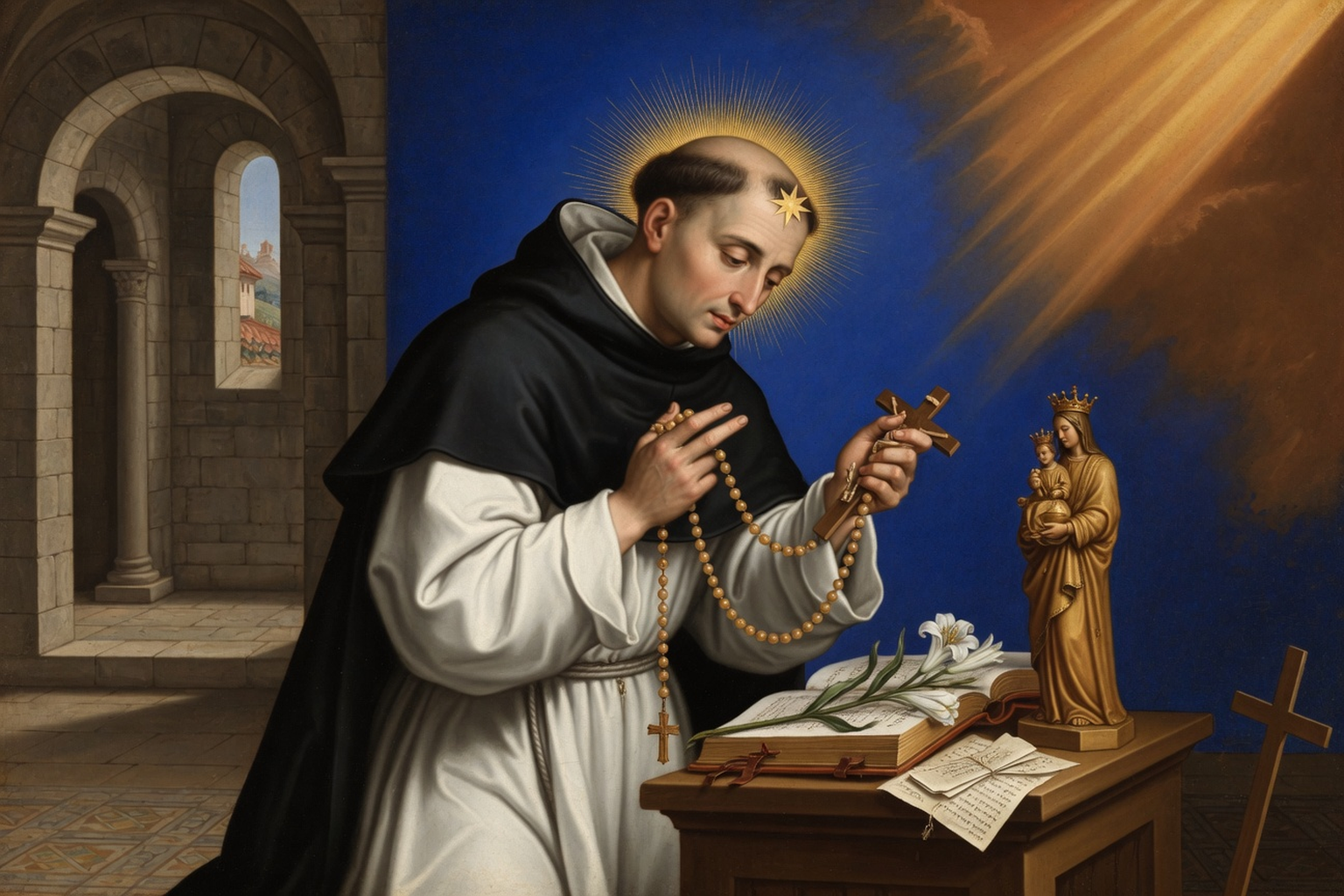
The reader may have noticed in this history heroic acts of every virtue; indeed, there is no action of our Saint in which several do not appear with great brilliance. It is nevertheless appropriate to reflect upon them for a moment for the greater edification of the faithful. First, what can be said of the faith of this admirable patriarch who fought his whole life to defend it, to support it, to plant it in the hearts of heretics, and to strengthen it in the hearts of the faithful; who preached it with such light and such zeal in the greatest cities of Europe; who wished to carry it himself into the most distant lands and to the very ends of Scythia and Tartary; who accomplished through his children what God did not permit him to exercise in person; and who, finally, exposed himself a million times to death and the most cruel torments for the truths of our holy religion? The great miracles he performed, whether when he was asked to do so or when his charity inspired him to assist those in affliction, show further that he possessed the evangelical faith capable of moving mountains from their place and casting them into the sea. He never hesitated in anything, and he was so persuaded, not only of the power of God, but also of the undoubted truth of the promises He made to His servants, that he would have undertaken the most difficult and, so to speak, the most impossible things, had he judged that they would contribute to His glory.
His trust in divine Providence was no less than his faith. No other proof is needed than his constancy in making all his journeys without money, without provisions, and without any apparent resource from the side of men; the obligation imposed upon his children to do the same in these great missions, where, according to the rules of human prudence, the most necessary things for life should have been lacking; and the poverty he established in all his monasteries, without allowing them to have any income or possession. But did he not have to possess this virtue to a very heroic degree when he had his religious sit down to table, without bread, without wine, and without any other food, not doubting that God would provide them with what was necessary once they were already seated, as indeed it never failed?
His love for Our Lord Jesus Christ was without measure: he loved Him as his Master, he loved Him as his Savior, he loved Him as his King, his Sovereign, his All, and his God. He could not bear to see Him offended; he spared nothing to win hearts for Him and to procure Him glory. His whole joy was to be with Him and to enjoy His presence and conversation. It is for this reason that, while on the road, he would ask his companions to go ahead and leave him alone, so that nothing would prevent him from speaking to Him heart to heart. It is for this reason that he loved solitude and was almost inseparable from prayer, to the point that he spent entire nights in it, and when he returned from his journeys, weary, soaked, and sometimes with his feet all raw, he would not fail to go first of all before the Blessed Sacrament, where he would remain for several hours in prayer. It is even said that he had no other room than the church, and that if bodily weakness forced him to take a moment of rest, he did so at the corner of the altar step, after having asked permission from Our Lord. His skill in occupying himself with Him during these precious nights was admirable: at times he adored Him with his face to the ground, at times he extended his hands in the form of a cross, sometimes he raised them to heaven to draw help from it; at other times he made a great number of bows and genuflections; finally, he sometimes wept so bitterly and cried out so loudly that he was heard from the dormitory, which stirred his brothers to pray and weep as he did. When he said Mass, his eyes never dried, and usually, at the Canon or the Lord's Prayer, one could see his face all soaked with tears. The Passion of this divine Master was so deeply imprinted in his heart that he never lost the memory of it. He meditated on it unceasingly and drew from it at every moment motives to love Him with all his strength. A holy penitent learned in a revelation that Our Lord, in reward for this holy assiduity in contemplating His wounds, imprinted the marks of them upon his feet, his hands, and his side, with the pains of His crowning with thorns, although in a secret and hidden manner and without anything appearing outwardly. This miracle happened, it is said, in Segovia, Spain, in a vaulted grotto he had chosen to serve as his monastery.
Nothing more would need to be added to what we have said of his respect and tenderness toward the Blessed Virgin, if this devotion had not been so marvelous that one cannot say enough about it. He had sucked it, so to speak, with his mother's milk, having drawn it from the good education his mother had given him and from the holy instructions he had received from his uncle. She always believed with him and always accompanied him until death. He could not satisfy himself with blessing this august Mistress, with reciting Rosaries in her honor. He never preached without proclaiming her greatness and the admirable effects of her mercy. His most sensitive joy would have been to die for her glory and her singular qualities as Virgin and Mother of God. He won for her during his life more than four or five million servants, having received no fewer people into the Confraternity of the Rosary, where one makes a profession of being her humble subjects. Nor can one conceive of the graces and favors he received from her kindness. How many times did she appear to him to give him testimonies of her love? How many times did she assist him in pressing needs and thorny affairs from which one dared not hope for any good success? How many times did she preserve him from the snares and evil artifices of his enemies? How many times did she miraculously heal him of the wounds that had been inflicted upon him, or that he had inflicted upon himself by the pitiless rigor of his austerity? What graces did she not grant him, both for himself and for his Order and for the persons he recommended to her? His intimacy and her benevolence toward him were even so great that she did not hesitate at times to call him her Spouse, at times to present her sacred breasts to him to make him suck the milk of paradise, at times to allow him to rest his head upon her bosom, as the beloved Disciple rested his upon the adorable chest of the Savior; at times to cover him and all his religious with her royal mantle, as a sure pledge of her protection.
The zeal for the salvation of souls was a fire that burned and consumed the heart of Dominic continually. It was for their conversion that he exposed himself to so many labors and sufferings from his youth until the end of his life; that he shed so many tears and heaved so many sobs toward heaven, and that he so often covered his body in blood, so that, by punishing himself for their sins, he might turn away from their heads the effects of divine indignation. It was to prevent their eternal loss that he offered himself several times to be sold to the infidels and to remain their slave, and that he desired to be torn with whips, to be cut into pieces, and to suffer all kinds of other torments. He never approached a city or a village without melting into tears, looking with a spirit of compassion and sorrow at the miseries and sins of those who inhabited them. *Totus in lachrymas solvebatur*, says the blessed Humbert. The Order of Preachers, which he founded to continue, throughout the whole earth and until the end of time, what he could only do himself in a small number of places and years, is still a powerful testimony of this unparalleled charity with which he was embraced. Indeed, one cannot count the thousands of infidels, heretics, and bad Catholics he converted through his children, nor the multitude of souls from all parts of the world who entered heaven through their means.
His humility corresponded to the greatness of his charity: we have already given proofs of this when we noted with what constancy he refused bishoprics and other ecclesiastical dignities that were presented to him, and with what insistence he asked to be relieved of his office of General, at an age when it seemed he could still exercise it for more than twenty years; but it appeared with even more brilliance in all his ways of acting and conferring with his brothers and with laypeople, for he always made himself the least of all; he did not hesitate to go himself to beg from door to door for the subsistence of his religious; he lowered himself to the lowest offices of the monasteries, and he avoided honor with more care than the ambitious have eagerness to procure it for themselves. Not only did he consider himself the greatest sinner in the world, but he had this thought so strongly imprinted in his soul that he feared his presence would draw the curse of God upon the places he entered. That is why, when he approached them, he would kneel, and, with tears in his eyes, he would say: "I pray to you, Lord, and I conjure you, by your most lovable kindness, to have no regard here for my sins and not to pour out your anger upon this place because I will have entered it, and not to exterminate this people among whom I will live, for the greatness of my iniquities." He did not speak thus out of ceremony, but out of a real feeling of his unworthiness and out of an actual contempt he had for himself; which is undoubtedly the highest point to which humility can be carried; since, moreover, not only had he always preserved the whiteness of virginity, which he confessed a moment before his death, but also he had never lost the grace of his baptism, and mortal sin had never entered his soul.
Penance and austerity being the faithful guardians of humility and purity, one cannot say how dear they were to our Saint. He was his own executioner all his life; and had he been in the hands of Barbarians, they would not have treated his body with as much rigor and inhumanity as he treated it himself. He began from his childhood to fast, to keep vigil, to sleep only on boards, to tear his skin with bloody flagellations. His custom, when older, was to fast every day, often to content himself with bread and water, to sleep almost not at all, and, when necessity forced him to take a moment of rest, to do so on the first bench he found, without taking off his clothes or even lying down, and to take the discipline three times every night with a heavy iron chain that caused him great wounds each time. Besides this, he always wore an iron belt on his loins that kept the wounds he had made open, and on his back a hair shirt or cilice whose hairs, entering his wounds and mixing with his blood, caused him continual pain. What is more surprising is that neither the fatigue of his journeys, nor the exercise of preaching, which requires a strong voice, a robust body, and perfect health, nor the advancement of age, ever made him diminish anything of this pitiless severity against himself; despite the pains he felt at every moment, and which would have driven anyone else to cries and tears, he was always, as his Acts say, *Vultu hilari et jucundo*, "of a cheerful, joyful face, and full of an amiable serenity." Far from using public conveniences on his journeys, he made them barefoot, with this circumstance, however, that he only took off his shoes after leaving the cities, and that he put them back on before entering them to avoid the praises of men. This rigor was the cause that he often had his feet all bloody, whether from having passed through brambles and thorns, or from having walked on sharp pebbles; then this admirable man made more conversions, and was more terrible to demons, heretics, sinners, and the enemies of his Order. Finally, historians agree that his life was so penitent that, without a continual miracle and an extraordinary assistance of the Blessed Virgin, he could not have supported it; but this amiable Mother, who looked upon him as her Agent, her Apostle, her Son, and her Spouse, sustained him in his weaknesses, and healed him when the wounds he had inflicted upon himself could have caused him some dangerous and mortal illness.
It would require a new discourse to speak worthily of the monastic virtues of this apostolic man; we mean his poverty, his chastity, his deference and submission of spirit even to his inferiors, the exactitude of his silence, and his zeal for regular observance, of which he could not suffer the slightest articles to be transgressed. It would also require a new eulogy to represent according to their merit all the gratuitous graces with which he was endowed, since there is not a single one of all those marked by the apostle Saint Paul that he did not possess to a very eminent degree. Above all, he excellently had the spirit of prophecy, the grace of healings, that of performing wonders, and the gift of discernment of spirits. He saw clearly all the enterprises of the demon against his religious; and, one day, having forced him to declare what he gained against them in the choir, in the dormitory, and in the refectory, he compelled him at the same time to admit that he lost in the chapter everything he had gained in the other places, because it was a place where, through the admonitions of his superiors and through penances received with humility, all the faults of the day were erased. He drove him out without difficulty, and as if with a sovereign and absolute empire over the bodies he possessed; he made him exit shamefully from two of his religious who had been seized by this enemy, one for having eaten meat against the constitutions, and the other for having drunk in town without permission and without making the sign of the cross over his glass.
He was such a great friend of God that he never asked Him for anything that he did not obtain. Having one day declared this simply to Dom Alacrion, prior of the Hôtel-Dieu, of the Order of Cîteaux, this holy religious, surprised by such a great grace, said to him: "Since that is so, my Reverend Father, why do you not ask God for the vocation to your Order of Doctor Conrad, that learned professor of the University of Bologna, whom your children so passionately desire to be one of yours?" — "What you propose," replied Dominic, "is very difficult; however, if you wish to spend this night in prayer with me, I hope we will obtain it from the kindness of the Almighty." — "I am very willing," said Alacrion, "although my prayers are not capable of adding any strength to yours." They therefore spent the night together in prayer, and the very next morning, which was that of the feast of the Assumption of Our Lady, Conrad, touched by a sudden grace and a vocation he did not expect, came to throw himself at the feet of our Saint while they were saying at Prime: *Jam lucis orto sidere*, and urgently asked him for the habit of his Institute. Dominic already knew he would come; he received him with open arms as an extraordinary gift from heaven, and clothed him in his livery or rather in that of Our Lady. He merited for him at the same time the spirit of his Congregation, so that he worked excellently for its establishment and was an excellent missionary and preacher of the Gospel. For the rest, one should not be astonished if God refused nothing to Dominic, since Dominic refused nothing to God; he obeyed not only all His commandments and His counsels, but also all His inspirations; he watched continually over himself, for fear that a word, a look, a movement, a desire, and a thought that displeased Him might escape him; he made himself so irreproachable in all things that one never saw anything in him that was not perfectly exemplary.
Passing and Official Recognition
Died in Bologna on August 6, 1221, followed by his canonization by Gregory IX in 1234 and the global expansion of his religious family.
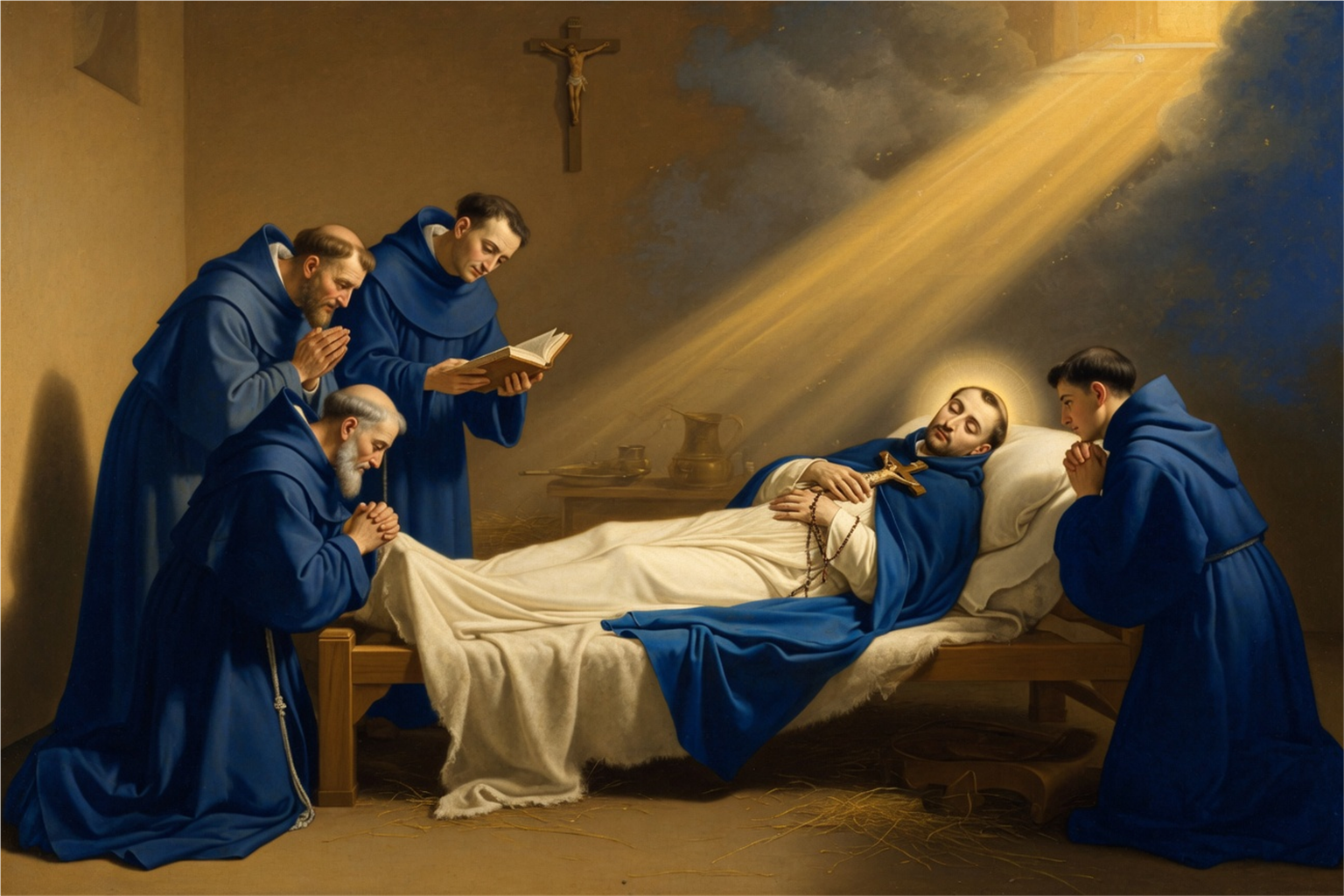
It is time to come to the end of this holy life, which we would never finish if we wanted to report everything that can praise our Saint. An angel was sent from heaven to inform him that the time for his reward had arrived. He received this news with a joy and gratitude that cannot be expressed, and he went as soon as possible to Bologna, in order to arrange the affairs of his Order before leaving its care. The fatigues of the journey not having prevented him from attending Matins, he was seized with a great headache, a continuous fever, and a cruel flux of blood, which he endured with invincible patience and a joy that filled all his children with astonishment and consolation. He first suffered them to put him on a straw mattress to satisfy them; but, finding it too soft, he would have no other bed than the earth: it was not reasonable, he said, for a great sinner to die on a bed, after our Master and Savior died on a cross. He made his general confession with as many tears as if he had committed all the sins in the world; he received the sacraments of the Eucharist and Extreme Unction with incredible devotion and fervor, and, having assembled, first, twelve of the principal members of the monastery, and then the whole Community, he gave them exhortations so full of strength and unction that Father Ventura, prior of Bologna, testified in his depositions that he had never heard such touching ones. Above all, he exhorted them to humility, to charity among themselves, to voluntary poverty, to zeal for the salvation of souls, and to the propagation of the Order, in order to be able to make more holy conquests in the world. He then gave them his blessing, assuring them, to console them, that he would be no less useful to them in heaven by his prayers than he had been to them on earth by his conduct and instructions. But it is said that he pronounced his curse against those who would corrupt or alter the constitutions of his Order, and who would introduce novelties against the purity of the observance.
After speaking to his children, he turned toward Our Lord and the Blessed Virgin, to whom he recommended his family, and all those who, in the years to follow, would embrace his Institute. He received, from their kindness, a favorable response; and the Blessed Virgin promised him to place his own under the shelter of her royal mantle, which is the amplitude of her mercy. Shortly after, the amiable Jesus and his august Mother, accompanied by an army of celestial spirits, came to visit him again to receive his blessed soul. He then told those present to begin the prayer of the Church. Subvenite sancti Dei, occurrite Angeli Domini, and, in the midst of this prayer, Dominic, lifting his hands and eyes toward heaven, and all ablaze with the flames of an ardent charity, rendered his most pure spirit to be crowned with eternal glory. This was Friday, August 6, of the year 1221, which was the 50th of his age.
There were at the same time several revelations of his glory. His sacred body was buried, as he had ordered, in his church in Bologna. Cardinal Ugolino, legate of the Holy See, who later became Pope under the name of Gregory IX, performed the burial ceremonies, accompanied by the patriarch of Aquileia and several other bishops and prelates, and an infinity of laypeople of all kinds of conditions, who flocked there to honor the dwelling of such a holy soul, and the venerable relics of a man so favored by heaven.
One sees him in his images seated with his religious at a bare table, and the angels who come to serve him. One day, someone came to warn him that there was nothing left to eat. He nevertheless had the bell rung, the religious gathered in the refectory, and, when they were seated before their tables, angels appeared. Each of them carried a bag on his shoulder and from this bag he drew a loaf of bread which he placed before each religious.
Usually, one places in the hand of Saint Dominic a lily and the book of the Rule; he also wears on his forehead a shining star, either because the noble lady who held him at baptism actually saw a beautiful star on his forehead, or because, according to Sister Cecilia, a light shone between his eyebrows and inspired men with respect and love.
Tradition depicts Saint Dominic as Joyful and Gentle. He was of medium height, Sister Cecilia tells us; his face was beautiful and a little flushed. He was always cheerful and pleasant; no one spoke to him without becoming better. His hands were long and beautiful, his voice clear, noble, and harmonious; he was never bald and he always kept his religious crown entirely, sprinkled with sparse white hairs. He was a man of prayer; this is the most prominent character of his life; he never wanted either a cell or a bed; he slept on the steps of the altar or on the flagstones. He attended the office with fervor and joy, and he insisted that all ceremonies be well performed. One of his favorite devotions was to keep his eyes fixed on a crucifix. He never spoke in public before having knelt before an image of Mary. He performed numerous miracles, but his angelic character perhaps had greater power than his miracles. Saint Catherine of Siena, in one of her visions, perceived the face of Saint Dominic resembling that of Jesus Christ himself, a sensible image of the inner and spiritual transformation that had taken place in his soul.
The Order of Saint Dominic spread after his death with extraordinary promptness, and extended, that very year, as far as Palestine. The third provincial general, the famous doctor of law Raymond of Pennafort, definitively organized the Order in 1238, and since then the rare modifications that were made to it were necessitated by the needs of the time.
Absolute poverty was, for two centuries, the invariable principle of the Order. After the Council of Basel, Pope Martin V authorized by a bull the possession of real estate.
At its most flourishing time, the Order counted forty-five provinces and twelve congregations (particular fractions of the Order), each placed under a vicar general. In Naples alone, the Order had, at one time, eighteen convents for men and ten convents for women. It was in Spain and its possessions that the Order became the most numerous and the most influential. Spanish authors have spoken of a convent in Ethiopia that contained nine thousand monks and three thousand brothers. The congregations were reforms introduced by zealous superiors in the houses of their provinces.
The first reform was introduced in Germany by the Blessed Conrad of Prussia, provincial general, around 1389, because, during the plague of 1349, discipline had singularly declined. The Blessed Bartholomew of Saint Dominic did the same in Italy. Others followed this example. One of the main reforms was that of the Blessed Sacrament, established in France by Father Antoine Quien, in 1636, in Marseille. One can consider as affiliations or derivations of the Order, less known and less numerous, and which often were of short duration, the institutions of the knights of the Militia of Christ, of the Holy Rosary, of the Cross of Christ, of Our Lady of Victory.
The great privileges that Gregory IX had granted to the Order excited jealousy and opposition against it. The Pope gave the Dominicans, as well as the Franciscans, by these extraordinary privileges, an authority and an influence that the founder had not thought of. They could preach, confess where it seemed good to them, without being obliged to ask for authorization from the parish priests or the bishops; the latter had to treat the Dominicans as apostolic men. Honorius III created for the Order the important function of Master of the Sacred Palace, so that a member of the Order would preach to the people of the Pope's household. Leo X entrusted him with the censorship of all books, of all engravings appearing in Rome, and the Master of the Sacred Palace has kept these functions to this day and continues to be a Dominican.
A greater obligation still imposed by the Pope on the Dominicans was to seek out dangerous errors, to bring them to light, and to provoke their repression. It was Gregory IX who first charged the Dominicans of Toulouse with this difficult pursuit, because the Albigensian heresy continued to stir there in the shadows. The tribunal of the Inquisition obtained an immense preponderance in Spain, and it always had a Dominican at its head.
The Order rendered the greatest services through the heroic devotion of its members, who carried the Gospel into Central Asia. A multitude of Dominicans, obeying the orders of the Popes, have faced privations, martyrdom, and death in these inhospitable regions. It was also the Dominicans who had to win the populations of America to the Christian truth, at the time of its discovery, and, if they did not succeed as one could hope, it was not for lack of zeal and prudence on their part, but as a result of the insatiable avarice and the frightful inhumanity of the first conquerors, whom the Dominicans opposed with courage, but without success.
Besides the deepest of Christian thinkers, Saint Thomas Aquinas, the Order of Saint Dominic has produced many great men, such as Albert the Great, an author even more prolific than Saint Thomas; Vincent of Beauvais, whose universal erudition astonishes the most learned; Saint
Anthony, Archbishop of Florence; Saint Vincent Ferrer, Noël Alexandre, and so many others.
The Order had given to the Church, until the beginning of the last century, four Popes, sixty cardinals, one hundred and fifty archbishops, and more than eight hundred bishops. One counts there a great number of martyrs, a quantity of canonized and beatified confessors. The Order of Saint Dominic has undoubtedly undergone the effects of the general decadence of religious institutions in the last century, but today we see it resuming a new life and vigor. France has given its most generous blood to the Order of Preachers. The restoration of this Order in all the purity of its primitive discipline walks hand in hand with the progress of the Catholic Church. Father Lacordaire reopened France to Saint Dominic; "it was important," he said, "that a little of this generous blood should flow under the old habit of Saint Dominic." Since him, French subjects abound in the religious houses of the Order; several of them are currently casting a bright light on it, and the work of its reform is being accomplished under the direction of a French Master General. Only five years after it had reappeared in France, the Third Order, re-established by the Reverend Father Lacordaire, already counted two thousand brothers, and the number has increased considerably.
But France is not appearing alone at the banquet of the holy Patriarch; everywhere the white scapular of Saint Dominic shows itself: Italy, Belgium, America, England look with admiration at the new birth of this imperishable family, which follows the fortune of the Church, and like it, never dies.
## CULT AND RELICS.
His body remained hidden for twelve years in the bosom of the earth; but finally it produced itself, as much by a sweet odor that exhaled from his tomb, as by the miracles that were performed there; it was also noticed that it sometimes rose visibly, and then lowered itself; Pope Gregory IX permitted it to be raised from the earth and transferred to a more honorable place in the church of Bologna. This was done on May 24 of the year 1233, as it is reported in the Roman Martyrology. Finally, the following year, on July 12, the same Pontiff, who had had the honor of putting him in the ground, being informed of a considerable number of miracles that had been performed and were being performed every day and in all parts of Europe, through his intercession, made the decree of his canonization, placing his feast on August 5, the eve of his death, to leave the 6th for the solemnity of the Transfiguration; and, since then, Pope Paul IV has advanced it by one more day, and placed it on the 4th, so that the 5th would be free for Our Lady of the Snows. In 1235, his precious relics were removed from the tomb where they had been deposited, and they were kept in a coffin of larch wood. In 1383, his head was detached from the body and placed separately in a silver reliquary. This translation or elevation of his head is marked in some martyrologies on February 15. In 1473, the sumptuous monument that decorates the church of the Dominicans of Bologna was erected for him.
We have used, to complete this biography, the Life of Saint Dominic, by A.-C. Chirat, priest of the Third Order of Saint Dominic, and the Encyclopedic Dictionary of Catholic Theology, by Goechler. — Cf. 1° among the Hagiographers: Surius, the B. Jordan, F. Constantine, P. Humbert, Theodoric of Puy, Bartholomew, Nicolas Trevet, P. Touron, P. Jacques Echard, the R. P. Lacordaire, etc.; — 2° among the historians: Fleury, Hist. ecclés.; Leandro Albertus, de Viris illustribus; Flaminius, de Vita fratrum Ordin. prædic.; Honorius III and Gregory IX, Bulls, Approbations of the Constit. of the Order; Herman and Hélyat, Hist. des Ordres relig.; M. de Montalembert, Étude sur le XIIIe siècle; — 3° among the panegyrists: S. Thomas Aquinas, Sermo in facto S. Dominici; Guillaume de Paris, Laselve, Biroat, Danoux, Lejeune, Senault, Du Jarry, Richard l'Avocat, Moudry, Bretteville, Texier, Nouet, Croiset, Anselme, Vivien, Laboissière, Latour.
Annexes & related entities
Structured data for exploration: events, miracles, quotes, places, attributes, patronages, and important entities cited in the text.
Key Events
- Born in Calahorra in 1170
- Studies at the University of Palencia
- Reform of the chapter of Osma
- Mission against the Albigensians in Languedoc
- Foundation of the monastery of Prouille in 1207
- Approval of the Order of Preachers by Honorius III in 1216
- First general chapter in Bologna in 1220
- Died in Bologna in 1221
Miracles
- Books thrown into the fire that do not burn in Montreal and Fanjeaux
- Resurrection of the young Napoleon in Rome
- Multiplication of bread by angels in the refectory
- Miraculous healing of Reginald by the Virgin
- Rain obtained through prayer in Segovia
Quotes
-
Non me misit Dominus episcopare, sed prædicare
Response to bishopric offers -
Ecce Reformator Ecclesiae
Prophetic words of a priest at his birth