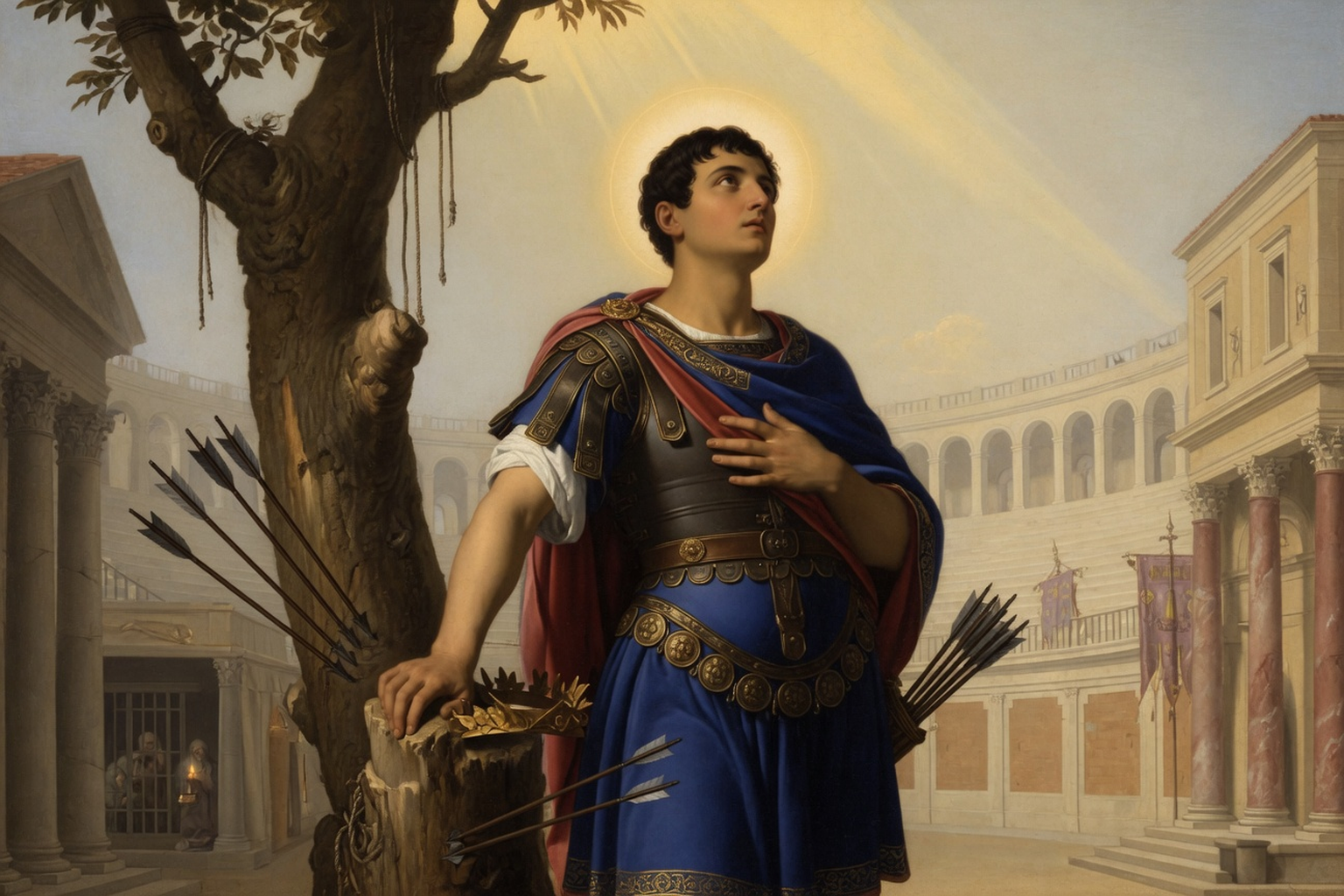
A high-ranking officer in the Praetorian Guard in Rome, Sebastian used his position to support persecuted Christians. Condemned by Diocletian, he miraculously survived an initial martyrdom by arrows before being beaten to death in the Hippodrome. He has been one of the most invoked saints against the plague since the 7th century.
Guided reading
8 reading sections
SAINT SEBASTIAN, MARTYR
SURNAMED THE DEFENDER OF THE CHURCH
Origins and military career
Sebastian, born in Narbonne and raised in Milan, becomes captain of the Praetorian Guard under Diocletian while remaining a secret Christian.
Narbonne and Milan, two very famous cities, piously dispute the honor of having seen the birth of the glorious martyr Saint Sebastia glorieux martyr saint Sébastien Martyr noted for his execution by arrows. n. But it is easy to resolve this disagreement, for this great Saint belongs to both; to Narbonne, because his father was from there, and it is there that he was born; and to Milan, because his mother was Milanese, and he was nurtured and raised in that city. Sebastian was fortunate enough to receive a Christian education. He did not forget, in the profession of arms that he had embraced under the Emperor Carus and his successors, to put into practice the lessons of faith and virtue learned in his youth. The emperors Diocletian and Maximia n honored Dioclétien Roman emperor under whom the martyrdom is said to have taken place. him with their esteem and affection, and Sebastian became captain of the first company of the Praetorian Guard, a position that was given only to great lords and very illustrious persons. When Diocletian made any stay in Rome, he took pleasure in conversing familiarly w ith Rome Birthplace of Maximian. his captain of the guards and employing him in his service. Sebastian was a Christian in heart and affection, although he did not outwardly profess Christianity, because, seeing several weak persons allow themselves to be carried away by the torrent of this persecution that Maximian had stirred up, he believed it was expedient, for the service of God, that he remain hidden, in order to be able to assist his brothers with greater ease, until it was time to reveal himself and die with them. Meanwhile, he busied himself visiting those who were prisoners for Jesus Christ, providing for their needs, giving them courage in their torments, and restraining those who were about to be broken, thus securing for the Savior the souls that the enemy was striving to snatch from Him. Among the Christians to whom Saint Sebastian preserved the life of grace through his words were two Roman knights, named Mark and Marcellian, twin brothers, children of Tranquillinus and Mar cia, persons of hi Marc et Marcellien Twin brothers and Roman knights encouraged by Sebastian. gh quality and possessing great wealth; these two brothers being held prisoner for the confession of the faith, Sebastian went to visit them in prison and represented to them that one must fear nothing, not even death, for the service of Him who is eternal life. The death sentence had been passed against them if they did not sacrifice to the gods; but as they were persons of status, their relatives, wives, and friends did so much with the judges that the execution was deferred for a few days, during which they hoped to persuade these two brothers to obey the emperor's command. They had a thirty-day delay to resolve themselves, and meanwhile, they were assigned as a prison the house of Nicostratus, first secretary of the prefecture of Rome and husband of Saint Zoe. It is impossible to imagine the diligence that was shown and the artifices that were employed to shake their courage. The other lords of the court, with whom they had formerly taken a thousand diversions, placed before their eyes the pleasures, riches, and dignities they could enjoy as men of honor, without losing their lives, their wives, and their children, without afflicting the old age of their parents with a regret capable of sending them to the grave. Their mother, Marcia, represented to them the pains she had suffered in bringing them both into the world, the trouble she had taken to nourish and raise them, and the care she had taken to marry them advantageously; she complained that in reward for so many benefits they wished to make her lose her life; for it would be difficult for her to survive if she saw them executed to death. Tranquillinus, their father, burdened with years and afflicted by the pains of gout, strove to move them not by his words, but by his tears and sobs, embracing them as his beloved children with all the transports of paternal love. To these assaults succeeded the attacks of their wives, the cries of their little children, so apt to pierce the hearts of these fathers who, noble and rich, felt their pain so sensitively that they could hardly resist so many pressing pursuits.
Support for the martyrs Mark and Marcellian
The saint encourages the twins Mark and Marcellian not to renounce their faith despite the pleas of their family.
Sebastian encountered this struggle, and, according to his custom, he kept a brave face and did not reveal who he was. Seeing the peril in which the two soldiers of Jesus Christ found themselves, attacked on all sides, he believed they were in need of help and that it was time to appear and speak, to prevent the father of lies from remaining the victor, to the shame and confusion of the Christians. He therefore turned to the two prisoners and addressed them thus: "O brave soldiers of the King of kings, Jesus Christ, stand firm in this combat, and do not let yourselves be overcome by your enemies, even though you see them in such great numbers; let the women be won over by tears, let the cowards be defeated by the apprehension of death; but let this make no impression upon you, and let your hearts not be shaken by the weeping of your parents, nor by the cries and complaints of your children; he who is resolved to obey God can receive no harm except in appearance from those who attempt his life; and whoever aspires to eternal glory and felicity despises the honor of the earth. Show all your relatives, your allies, and your friends who are here, that the true soldier of Jesus Christ easily resists, with the shield of living faith and the fire of charity, the cowardly attacks of pleasure, the harsh blows of torments, and the dreadful horror of death, when they seek to turn him away from the love he must have for the cross, and for Him who chose it for the sake of our redemption. You are reduced to the point of either losing all those who are here, or losing yourselves by losing Jesus Christ. Is it not He who has made you confess His name until now? Is it not for the love of Him and with the help of His grace that you have remained so long in prison and have endured so many torments and so many pains? What! Did you not know that your death would sadden your parents, your wives, and your children? And yet you have overcome all that for eternal glory. Would it be possible that tears could conquer at this hour what has been until now invincible to torments and pains, to give the Gentiles cause to mock your constancy, which they call obstinacy, by seeing you so cowardly defeated and perverted? No, no, the love of your own will not have the power to make you lose what you have gained at the price of your liberty and your blood." Then, turning to those present, he said to them: "Do not allow these knights to lose heaven for the sake of a life so weak and so deceptive; do not oppose the divine spirit, which makes them despise vanity. Do not grieve that they are separating from you, since it is to pave the way for you and to make you know and love the truth by which you will be united with them eternally in the paradise promised to Christians, where the inexhaustible source of the ever-happy life is revealed. Therefore, wipe away your tears and joyfully accompany the triumph of these holy Martyrs, by whose merit you may perhaps one day be enlightened."
Miracles and collective conversions
Sebastian heals Zoe of her muteness, leading to the conversion of numerous Roman families and prisoners.
While this generous servant of Jesus Christ was speaking in this manner, a brilliant light descended into the prison and filled all those present with joy and admiration. In the midst of this radiance, Our Lord appeared with seven angels who followed Him and paid Him homage; and this amiable Savior, approaching Sebastian, gave him the kiss of peace and said to him: "You shall always be with me." All this happened in the house of Nicostratus, where the two imprisoned brothers had been taken. His wife, named Zoe, who h ad Zoé Wife of Nicostratus, healed of muteness by Sebastian. become mute due to a great illness that had lasted for six years, heard very well everything that Saint Sebastian was saying, and furthermore, she saw the angels and the light that had descended for the sake of the glorious soldier of Jesus Christ, which caused her to prostrate herself at his feet, making it known to him, by signs and as best she could, that she wished to be a Christian and that she was asking him for Baptism. The Saint, having learned that Zoe had been unable to speak since her illness, said to her: "If I am a servant of Jesus Christ, if all that I say is true, may the same Lord Jesus Christ heal you, may He untie your tongue and restore your speech." Saying this, he made the sign of the cross on the mouth of the mute woman, who at that same moment began to speak, to praise Our Lord, and to thank Sebastian for the grace she had received.
By such an evident miracle, Nicostratus was converted to the faith of Jesus Christ and threw himself at the feet of these blessed brothers, begging them to be willing to withdraw each to their own home and to forgive him if he had kept them so long in his, because he was blind and did not know the truth; he assured them that, for his part, he would consider himself very happy to be taken, tormented, and put to death for having restored their freedom. Tranquillinus and Marcia, with the wives and children of Mark and Marcellian, touched by what they had heard and seen, also changed their minds and embraced the Christian religion. They were all melting into tears; but these tears came from a different heart and a different source than the first ones. And the very happy end of this spectacle was that Nicostratus and Zoe asking for baptism, Sebastian enjoined them to first bring into the room all the other prisoners who were detained for crimes, so that they might hear the word of God and that those who received it might participate in the sacred mysteries of our holy faith and in the price of our redemption.
Claudius, who was a criminal clerk, having dismissed the ministers of justice, brought the prisoners, and Nicostratus presented them all in chains to Sebastian, who proposed to them arguments so strong and proofs so convincing that, God opening their hearts by the lights of His Holy Spirit, the truth entered them: they recognized the errors of their past life and the blindness of idolatry; they converted to the faith of Jesus Christ and asked for forgiveness for their faults. There were sixty-four who thus became Christians at the word of Sebastian, namely: Tranquillinus, his wife, his daughters-in-law, his grandchildren, and their friends; Nicostratus, his wife, and his family, which was composed of thirty-three people; and sixteen evildoers who had been brought from the prison. Polycarp, a priest of Jesus Christ, baptized them all, after having fasted that day until night and offered to Our Lord a sacrifice of prayer and praise. Sebastian was the spiritual father and godfather of all these new faithful. Among those who were baptized, there were some sick people who were healed by the virtue of holy Baptism; among others, Tranquillinus, who for eleven years had been tormented by gout, and two children of the clerk Claudius, who had also converted and one of whom was dropsical and the other covered in pustules.
Conversion of Prefect Chromatius
Prefect Chromatius converts after a healing and frees his slaves, while Pope Caius organizes the community.
When the thirty days had expired, the prefect of the city, named Chromatius, sent for Tranquillinus and said to him: "Well! What have your children decided? Have you persuaded them to sacrifice to our gods and obey the emperors?" Tranquillinus replied: "My children are very happy, and so am I, ever since God made us know the truth of the Christian religion." "So you have also lost your senses," said the prefect, "and you are rambling at the end of your days?" "He is the one who is mad," said Tranquillinus, "who leaves the path of life and follows that of death." "What life, what death?" replied the prefect. "If you will listen to me with attention," answered Tranquillinus, "you will be very happy in your soul, and so will all those in your house." "Yes, I will listen to you at my leisure," said the prefect, "but take care not to say anything that you cannot prove." They discoursed together for a long time. Tranquillinus explained to Chromatius the mysteries of our holy faith and fully satisfied the doubts he proposed, so that, by the grace of God, he disposed him to convert; later, Sebastian and Polycarp completed what Tranquillinus had begun. The conversion of Chromatius, delivered like Tranquillinus from the pains of gout, was followed by that of his entire household, which included fourteen hundred slaves, to whom he gave their freedom, saying that those who had God as their father should not be slaves to men.
The persecution increased day by day, so much so that Christians could neither buy nor sell, nor find food, unless they first burned incense to the statues of the gods erected, by order of the emperor, in all the markets and public squares. The house of Chromatius had become like a temple where Pope Saint Caius celebrated the divine myst pape saint Caïus Pope who supported Christians during the persecution. eries and distributed to the neophytes the body of Jesus Christ and the bread of the evangelical word. To avoid open persecution, Chromatius, whom his status as a senator kept in Rome, requested and obtained from the emperor, under the pretext of restoring his failing health, permission to retire to his estates in Campania. The day of separation having arrived, Caius came once more to offer the holy sacrifice in that blessed house. Then, taking the floor, he said to the faithful: "Our Lord Jesus Christ, knowing human fragility, has established two degrees among those who believe in him: confessors and martyrs. Those who do not feel strong enough to bear the weight of the persecution are free to withdraw. While leaving the principal glory to the soldiers of Christ, they will at least be able to assist them in their battles. Let those, therefore, who desire it, follow Chromatius and his son Tiburtius in their retreat; let those who have the courage remain with me in the city. Distance cannot separate hearts united by the grace of Jesus Christ. If our eyes can no longer see you, you will be constantly present to the inner gaze of our soul." It was Gideon, taking for the battle only his bravest soldiers. Tiburtius cried out upon hearing these words: "I implore you, O father and bishop of bishops, do not order me to flee the persecution. My only desire is to give my life for my God. Would that I had a thousand to offer him!" Saint Caius yielded, weeping, to the entreaties of this noble young man, and the assembly dispersed. Some followed Chromatius to Campania, others remained with the Pope, exposed like lambs to the fury of the wolves. Among these victims was the invincible Sebastian, honored by the successor of Peter with the glorious title of defender of the faith. Another officer of the court, Castulus, intendant of the baths, received them in the very palace of the emperor, where Caius was safer than in the catacombs. The wife of Nicostratus, the holy and pious Zoe, who went to pray at the tombs of Saint Peter and Saint Paul on the day of their feast, was dragged before the magistrate. The latter, having been unable to force her to sacrifice to the idols, had her hung from a tree by her hair and ordered a fire of manure to be lit at her feet, which suffocated her. They then hung an enormous stone around her neck and threw her into the Tiber; "for fear," said the executioners, "that the Christians might make a goddess of her." Nicostratus, Tranquillinus, Claudius, Castor, Victorinus, and Symphorian were also arrested. The prefect Fabian had them all thrown into the Tiber. Mark and Marcellian suffered the sentence previously rendered against them; they were nailed by their feet to a post and pierced with lances. Their bodies were buried in a sand pit two miles from Rome. The generous son of Chromatius was taken through the treachery of a false brother paid by the imperial police to play the role of a spy in the assemblies of the Christians. "What," said Tiburtius to the magistrates, "because I refuse to invoke a prostitute in the person of Venus, to worship the incestuous Jupiter, a deceiver like Mercury, and Saturn the murderer of his children, I dishonor my race, I am an infamous man!" This hero of the faith had his head cut off. Castulus, the host of the Christians, victim of the same betrayal as Tiburtius, underwent the question and was finally thrown alive into a pit that was filled with sand.
The first martyrdom: the arrows
Denounced, Sebastian is pierced with arrows by Mauritanian archers but survives thanks to the care of Saint Irene.
Saint Sebastian, in the uniform of captain of the Praetorian Guard, had not ceased to visit the martyrs, to encourage them in their torments, and to collect their remains after their death. Maximian Herculius, who had ordered all these tortures, had just gone to the Gauls to fight a formidable insurrection of the Bagaudae. In his absence, Saint Sebastian was denounced to Diocletian himself, during a journey of this prince to Rome. The captain of the guard therefore appeared before the emperor, who reproached him for repaying his own benefits with ingratitude, and for drawing the wrath of the gods against his person and his empire. Sebastian replied: "Lord, I have always been faithful to my duties and I have not ceased to pray for your salvation and the prosperity of your reign, to the true God, Creator of heaven and earth, knowing that it is a great folly to worship gods of stone, wood, silver, or gold." Diocletian, irritated by this language, summoned a company of archers from Mauritania who served among his guards. They stripped Sebastian of his clothes and the archers pierced him with their arrows. So as not to offend the spirit of the soldiers whose friendship Sebastian had won through his noble character and virtue, and also to partially excuse his cruelty to the people, Diocletian had a sign hung around the martyr's neck stating that he was suffering this torment because he was a Christian. Sebastian was left for dead at his post. Irene, widow of t he ho Irène Sister of Saint Damasus. ly martyr Castulus, having come at night to bury him, found him still alive. She secretly transported him to her home in the emperor's own palace and, a few days later, Sebastian was perfectly healed.
The second martyrdom and final death
Sebastian confronts Diocletian again and dies, beaten to death in the hippodrome before being thrown into a sewer.
The Christians, having learned of this, came to see him and begged him with tears to withdraw, for fear that he might fall once more into the hands of such a cruel tyrant; but the generous soldier of Jesus Christ, who burned with the desire for martyrdom, knowing that the emperor was to go to the temple, placed himself on the grand staircase with the other courtiers lined up along his path and, addressing Diocletian, said to him in a grave and severe voice: "The pontiffs of your temples deceive you, O emperor! They invent many things against the Christians, saying that they are enemies of your empire; it is the Christians, on the contrary, who maintain it through the prayers they offer for its preservation." Diocletian was extremely frightened to hear these words from a man he believed dead, and remained for some time as if stunned; but coming to himself, he said to him: "Are you Sebastian, the one I ordered to be put to death? What? Were you not killed? How are you then still alive?" The Saint answered him: "Because my Lord Jesus Christ wished to preserve my life, to give to all the people a testimony of the truth of his faith and of your cruelty; you who persecute the Saints without cause, those who are just and without crime, do not continue to walk in this path; if you wish to live in peace and ensure long and prosperous days for your empire, shed no more the blood of the innocent." Diocletian, furious, had the martyr led immediately to the hippodrome where he was beaten to death with clubs. After his death, the executioners threw him by night into a sewer where all the filth of the city was carried; they feared that the Christians, knowing the place where he was, would render him the honors due to his merit, and that by means of the miracles he might perform, the infidels would convert to the faith of Jesus Christ. But this good Master, who wishes that those who glorify him and die for him be honored, disposed of it otherwise: for he permitted Saint Sebastian himself to appear to a holy lady, called Lucina, and reveal to her where his body was and how it had remained attached and suspended from a hook, without falling into that infectious place where they had intended to throw it. He commanded her to bury him in the catacombs, at the entrance of the underground passage, at the feet of the apostles Saint Peter and Saint Paul. This virtuous woman accomplished all that had been commanded of her, and spent thirty days in continuous prayer at the place where she had buried this holy body. When it pleased Jesus Christ to look upon the faithful with compassion and to grant them peace, she made a church of her house, and left all her goods, which were considerable, for divine service and for the subsistence of the poor Christians.
Cult and Patronage
Invoked against the plague, Saint Sebastian became the patron of archers and soldiers throughout Europe.
Such is the life and death of the blessed Saint Sebastian, whom we may call a martyr twice over, since he endured two sets of torments capable of taking his life. He is extremely venerated by all faithful peoples, because of the benefits they continually receive through his intercession, mainly in times of plague, when he shows himself favorable to those who commend themselves to him and implore his assistance. This devotion spread throughout almost all of Europe at the beginning of the 8th century. In 680, Rome was infected with the contagion: an altar was erected to Saint Sebastian by divine inspiration, and immediately the plague ceased; since then, several other cities and villages have experienced the same assistance and the same benefit on similar occasions. It is also a very ancient practice in the Church to implore the help of Saint Sebastian, Saint Maurice, and Saint George against the enemies of religion, as is stated in the Roman Ordo, and as noted by Cardinal Baronius.
The martyrdom of Saint Sebastian took place on January 20, in the year 288, the fourth of the empire of Diocletian; the Church celebrates his feast on the same day, with a double office; formerly it was a day of rest for the Catholic people in several dioceses.
The place where Saint Sebastian was buried was near the catacomb of Saint Callixtus; it took the name of the cemetery of Saint Sebastian.
Later, a beautiful basilica was erected over his tomb; a magnificent white marble statue of the Saint decorates the tomb.
Saint Sebastian is the patron of aiguillette makers or manufacturers of braid for military uniforms; of crossbowmen, archers, arquebusiers, and scrap metal merchants. He is invoked not only against the plague in general, but in Anjou, for example, recourse is had to him against epizootic disease or bovine plague.
Saint Sebastian is represented pierced with arrows and tied to a tree trunk; one sometimes sees above his head an angel holding a crown. — One also finds this Saint in military costume, holding two arrows in one hand, and in the other a crown: his features should be those of an old man.
Relics and monuments
Description of the Roman basilicas and the translation of the relics to Soissons under Louis the Pious.
## RELICS AND MONUMENTS.
The cemetery where the relics of our Saint were deposited, formerly that of Callixtus, has long borne the name of the Catacombs of Saint Sebastian. The church, built by Pope Damasus at the entrance to these catacombs, and which has been carefully repaired from time to time, is one of those visited in Rome out of devotion. The tomb of Saint Sebastian, in white marble, placed in one of the side chapels, is very beautiful. His statue, on the tomb, represents him lying down and pierced with arrows; it is the work of Giorgetto, one of the best students of Bernini.
The church of Saint Sebastian, which is very ancient, and one of the seven most illustrious in Rome and the Christian world, was built on the very spot where the Saint accomplished his martyrdom, near the cemetery of Callixtus. A precious monument of the holy martyr is his venerable image represented in mosaic, which is perfectly preserved in the titular church of Saint Eudoxia, at Saint-Pierre-ès-Liens. It is an old man with a long white beard: a warning to painters who wrongly represent him as a young man tied to a post.
Among the precious relics contained in this basilica, one can see a part of the column to which the Saint was tied for the flagellation, and also one of the arrows with which he was pierced.
Independently of this basilica, another small church was built in memory of the glorious martyr, at the very place where he was pierced with arrows. This church, rising on the Palatine, cradle of the great empire, and dominating alone the ruins of the palace of the powerful emperor of which nothing has survived, not even a little dust, this church, I say, seems to testify at the same time to both pagan impotence and the imperishable strength of the Christian religion and the memory of a saint.
On the day of the feast, these two churches are brilliantly decorated; the holy offices are celebrated there and the faithful flock there to pray at the tomb of the holy martyr, and also to visit the catacomb opened on that day.
In the church of Saint-André de la Vallée, located near the sewer where the Saint had been thrown, three links of the chain with which he had been bound are displayed on the tabernacle of the chapel dedicated to him, in a silver reliquary.
One visits with pious curiosity the semi-circular room (adjoining the sacristy), in which the first popes held the first councils; in the middle of this room one sees the well in which the Christians deposited the bodies of the Apostles Saint Peter and Saint Paul for fear that they might be stolen, and kept them there for two centuries, that is to say until the moment when they were exhumed, under Constantine, and divided. Half of each of these holy bodies currently rests in the Basilica of Saint Peter, the other halves in that of Saint Paul Outside the Walls; their heads are in the reliquary that dominates the high altar of Saint John Lateran.
The residence of the first popes was adjoining this council chamber.
A short distance from the catacomb of Saint Sebastian is the catacomb of Saint Callixtus, the most interesting along with that of Saint Agnes.
As for the relics of our Saint, the most important and most famous translation was that which took place in France under Louis the Pious. This prince ob tained from Pope Eu Louis le Débonnaire King of the Franks who made Aldric his advisor and commander of the palace. gene II the permission to have transported to Saint-Médard of Soissons wha t remained of the body o Saint-Médard de Soissons Place of deposit for the relics of Saint Sebastian in France. f Saint Sebastian outside the city of Rome, in the catacombs. This rich treasure was placed solemnly by Bishop Rothade in the famous abbey of Saint-Médard, on the second Sunday of Advent, the ninth day of the month of December, in the year 826. The Huguenots, after the capture of Soissons in 1564, threw these relics into the moats of the abbey, but some were recovered, as well as those of Saint Gregory, Pope, and Saint Médard, which were found mixed together. Before 1793, a part was kept in the church of Notre-Dame de Soissons, and the other at Saint-Médard.
The old abbey of Saint-Médard-les-Soissons was devastated and partly ruined following the Revolution of '92; what remains of it was bought by the former bishop of Soissons who turned it into an establishment for the deaf and dumb. There are relics of Saint Sebastian in the region; it is to be presumed that they come from Saint-Médard, at least in part; if any were still to be found at Saint-Médard, which is not presumable, it would be that they had been brought back there.
Notre-Dame de Moret, in the diocese of Meaux, has the good fortune to possess some of these holy relics even today. They are also kept at the cathedral, at the Carmel, at the Visitation, and at the Holy Family of Amiens; at Bourdon, Corbie, Etelfay, Mailly, Saint-Riquier, etc.
We have completed this biography with Notes and the Hagiography of Amiens, by Abbé Corblet.
Annexes & related entities
Structured data for exploration: events, miracles, quotes, places, attributes, patronages, and important entities cited in the text.
Key Events
- Military career under Emperor Carus
- Captain of the first company of the Praetorian Guard under Diocletian
- Secret support for imprisoned Christians (Marcus and Marcellian)
- Conversion of Nicostratus, Zoe, Tranquillinus, and Chromatius
- Martyrdom by arrows from the archers of Mauretania
- Healing by Irene
- Second condemnation and death by scourging (beating with clubs) in the hippodrome
Miracles
- Healing of the mute Zoé
- Healing of the gout of Tranquillinus and Chromatius
- Survival of the ordeal by arrows
- Cessation of the plague in Rome in 680
Quotes
-
You will always be with me
Words of Christ to Sebastian in prison -
The true soldier of Jesus Christ resists easily, with the shield of living faith and the fire of charity
Sebastian's speech to the prisoners