Saint Fructuosus of Tarragona
Bishop and Martyr
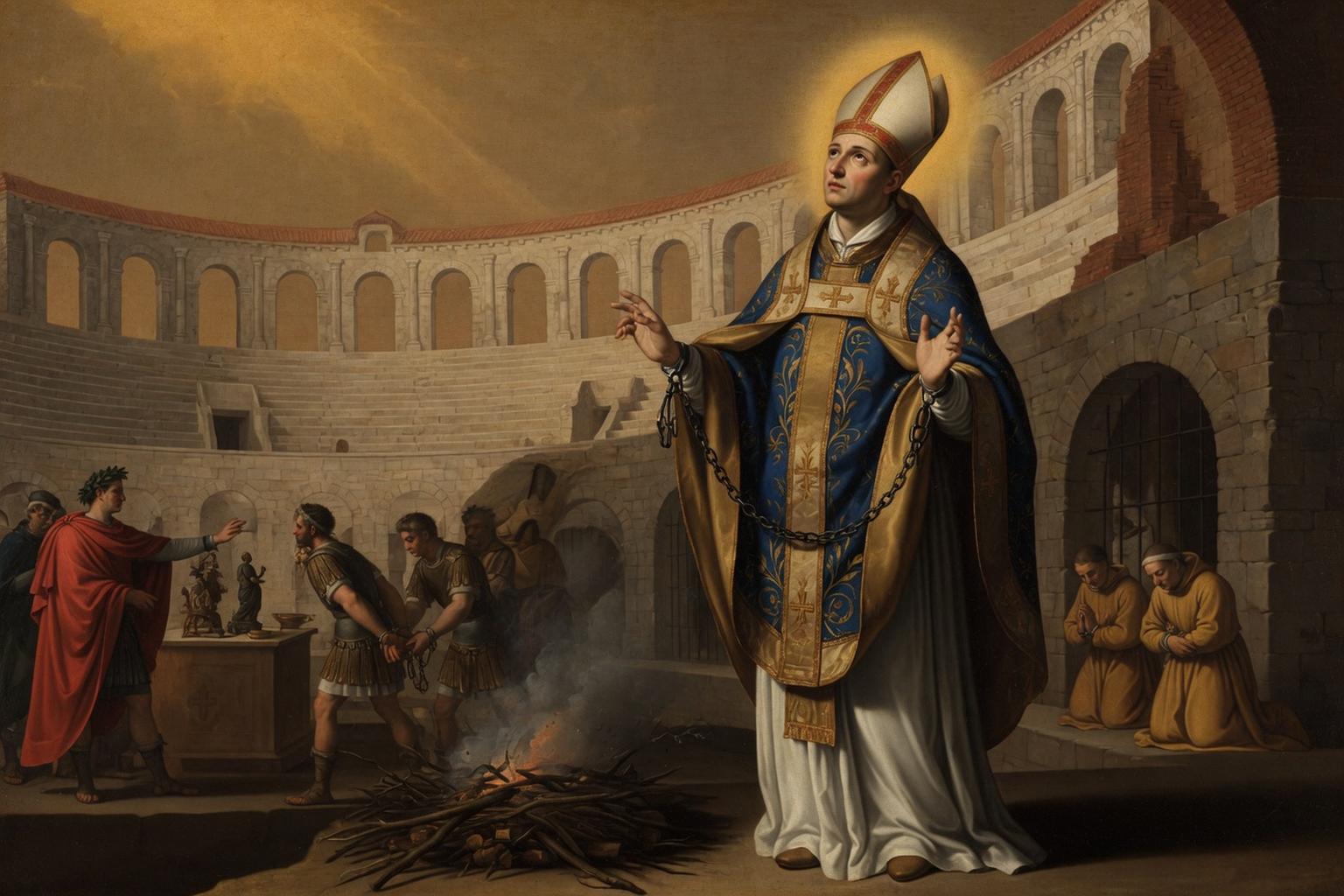
Bishop of Tarragona in the 3rd century, Fructuosus was arrested with his deacons Augurius and Eulogius under the emperors Valerian and Gallienus. Condemned by the governor Aemilianus for their refusal to sacrifice to idols, they were burned alive in the amphitheater in 259. Their acts were so respected that they were read publicly in the churches of Spain and Africa.
Guided reading
6 reading sections
SAINT FRUCTUOSUS, BISHOP OF TARRAGONA
Context of the persecution
Under the emperors Valerian and Gallienus, a violent persecution struck the Church, affecting Rome, Carthage, and Spain, where the governor Aemilianus arrived in Tarragona.
Embrace the faith and the cause of the martyrs, if you wish to obtain their crown. — St. Aug. Serm. 2.
Fructuosus, citizen and bishop of Tarragona, suffered martyrdom while the cruel persecution of Valerian and Gallienus raged against the most distinguished members of the Church of Christ. Throughout the empire, an innumerable crowd of Christians had perished, inhumanely massacred. Rome had witnessed the martyrdom of Saint Lawrence; Carthage, that of Saint Cyprian. Spain, no less than other countries, was devastated by the terrible scourge, and the governor Aemi lianus made his e président Émilien Father of Saint Cletus. ntry into Tarragona, the capital of the country.
Arrest and Interrogation
Bishop Fructuosus and his deacons Augurius and Eulogius are imprisoned and then interrogated by Aemilianus, affirming their exclusive faith in one God.
Having first had Fructuosus and his deacons Augurius and Eulogius thrown into prison, he had them appear before his tribunal after six days:
"Do you know," he said to Fructuosus, "the edict of the emperors which prescribes honoring the gods?"
"I honor," replied the pontiff, "only one God, He who created heaven and earth and all that they contain."
"AEMILIANUS. Do you not know that there are gods?"
"FRUCTUOSUS. I know nothing of them."
"AEMILIANUS. Well! You shall be taught." The Saint, at that moment, raised his eyes to heaven and began to pray within himself.
The governor continued: "Who shall be feared, who shall be adored on earth, if one despises the worship of the immortal gods and that of the emperors?" Then, turning toward Augurius, he advised him not to stop at what Fructuosus had just said. But the deacon replied to him in a few words that he also adores the almighty God. Aemilianus having finally asked Eulogius if he did not also adore Fructuosus, he received this answer: "I do not adore my bishop, but the God whom my bishop adores."
"You are therefore a bis hop?" évêque Bishop of Tarragona and 3rd-century martyr. said Aemilianus to Fructuosus. — "Yes, I am," replied the Saint. — "AEMILIANUS. Say that you have been." These last words implied that Fructuosus was about to lose his dignity along with his life. The three confessors were immediately condemned to be burned alive.
The Path to Martyrdom
Led to the amphitheater, the martyrs refuse to break their fast, and Fructuosus addresses words of comfort and universal prayer to his faithful.
The very guards could not hold back their tears when they saw them being led to the amphitheater; they loved Fructuosus for his rare virtues. As for the Christians, they followed them with a sorrow mingled with joy. The martyrs triumphed at the thought of the glorious eternity they were about to enter.
Some of the brethren offered their bishop, to strengthen him, a cup of water mixed with aromatics; but, as it was a fast day (this refers to the so-called station fast observed on Wednesdays and Fridays), the rigid Christian replied: "No, it is not yet time to break the fast"; it was then ten o'clock in the morning, and one could not break the fast until three o'clock in the afternoon: "I shall wait to break the fast with the patriarchs and the prophets."
When he arrived at the amphitheater, Augustalis, his reader, approached him in tears and begged him to allow him to remove his shoes. "My son," the Saint replied, "do not take this trouble, I shall remove them myself." At the same time, Felix, a Christian soldier, implored him to remember him in his prayers. "I must," said Fructuosus, raising his voice, "pray for the whole Church spread throughout the earth, from the East to the West." It is as if he had said, remarks Saint Augustine: "Remain always in the bosom of the Church and you shall have a s hare in my pra saint Augustin Father of the Church and author of sermons citing martyrdom. yers."
Martial having implored him to address at least a few words of consolation to his afflicted church: "My brethren," he said, turning toward the Christians, "my brethren, the Lord will not leave you without a shepherd; He is faithful to His promises. Do not grieve for my fate, an hour of sadness is soon passed."
The ordeal of the pyre
The three martyrs are burned alive in 259, praying and praising God in the midst of the flames like the Hebrew children in the furnace.
Then Fructueux, always calm and serene, climbed onto the pyre, followed by his companions, knelt there as the flame began to crackle and rise, and prepared to be offered to the Lord as a victim of pleasing odor. And the three martyrs praised God as with a single mouth, just as the three Hebrew children glorified and blessed Him in the furnace, until, tested by fire and found without stain, they rendered their very pure souls to God, in the year 259.
Celestial signs and visions
Witnesses see the martyrs ascend to heaven escorted by angels, while the governor Aemilianus remains blind to this prodigy.
The wonders by which the Most High God loves to manifest the holiness of His servants upon the earth were not lacking. Babylas and Mygdonius, who were Christians although servants of the governor, and the daughter of Aemilianus herself, saw the courageous athletes of Christ ascend to heaven, escorted by choirs of Angels and wearing crowns. Aemilianus was warned to come and see the triumph of those he had condemned. He came, but he saw nothing, his infidelity rendering him unworthy of it.
Cult and translation of the relics
The faithful collected the ashes which were later dispersed between Liguria, Manresa, and Barcelona, while the acts of their martyrdom were read throughout Christendom.
The following night, the Christians, rushing to the amphitheater, collected the ashes of the martyrs, and each took away what they could appropriate. But Saint Fructuosus, in an apparition, warned them that each should return what they had taken of the relics through a pious theft, and that care should be taken to place them in one same place where they would be honored. Subsequently, this sacred deposit was tra Ligurie Region of Italy where the relics were transported. nsported to Liguria, and it i s pre Gênes Place of the saint's death and burial. served near Genoa in a Benedictine convent, in addition to what remained in Manresa, in the churches of the provi nce of Aragon, and at N Notre-Dame de Barcelone City where he worked as a shoemaker and entered religious life. otre-Dame of Barcelona, where the holy relics are the object of the cult of the faithful. The acts of the martyrdom of Saint Fructuosus were the object of such veneration that they were once read publicly in the churches, not only of Spain, but of Africa and other places.
Annexes & related entities
Structured data for exploration: events, miracles, quotes, places, attributes, patronages, and important entities cited in the text.
Key Events
- Arrest by Governor Aemilianus
- Imprisonment for six days with his deacons
- Interrogation and refusal to honor pagan gods
- Condemned to be burned alive
- Refusal to break the station fast before the prescribed time
- Martyrdom in the amphitheater of Tarragona
Miracles
- Vision of the martyrs' ascension to heaven by Babylas, Mygdonius, and the daughter of Aemilianus
- Post-mortem apparition to request the gathering of relics
Quotes
-
I do not worship my bishop, but the God whom my bishop worships.
Eulogius (deacon) -
I must pray for the whole Church spread throughout the earth, from the East to the West.
Saint Fructuosus