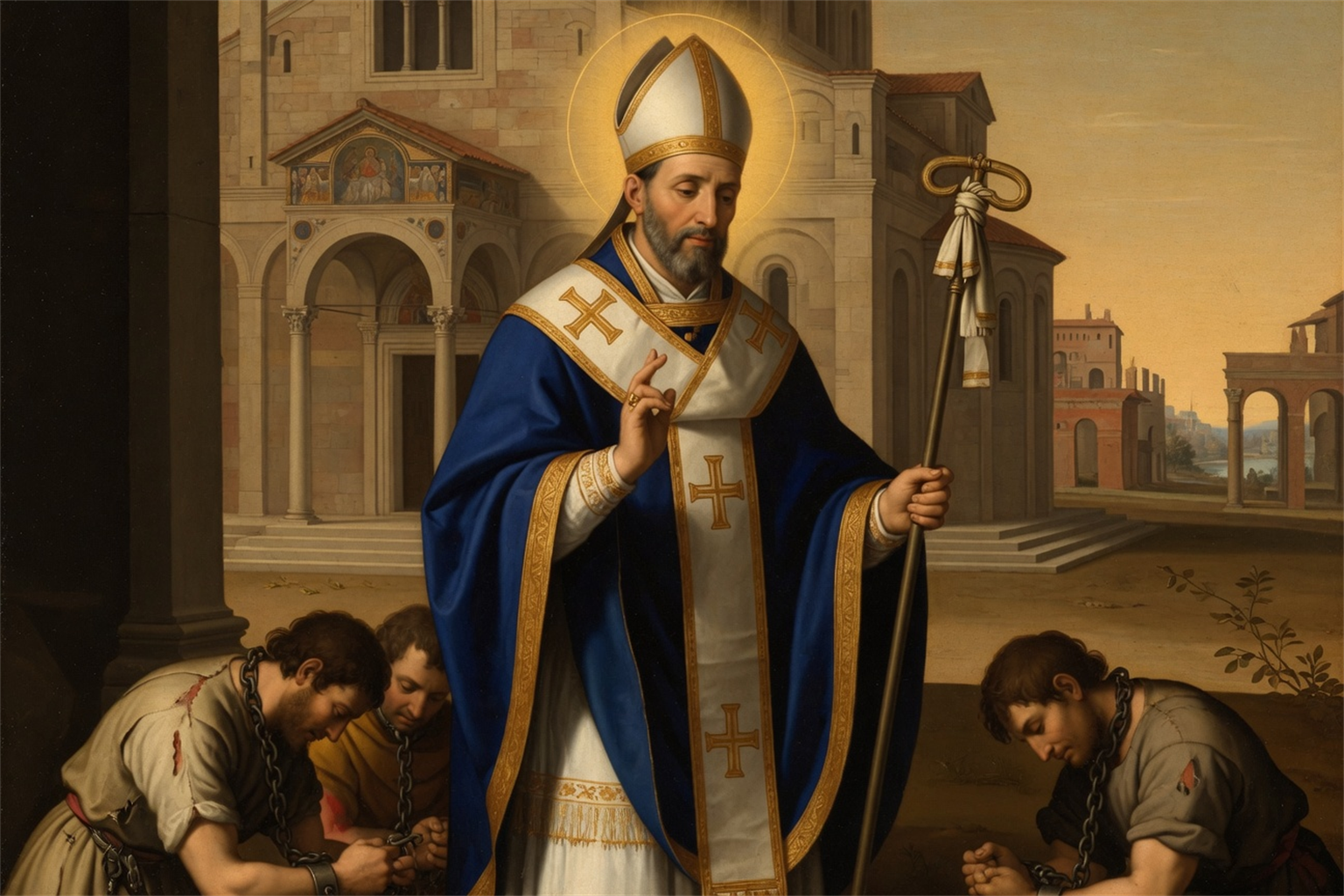
Bishop of Pavia in the 5th century, Saint Epiphanius was a tireless mediator between the last Roman emperors and the barbarian leaders. His holiness and eloquence enabled him to liberate countless captives and alleviate the suffering of Italy during the invasions. He died in 497 following a diplomatic journey undertaken for his people.
Guided reading
9 reading sections
SAINT EPIPHANIUS, BISHOP OF PAVIA
Youth and formation
Born in Pavia in 438, Epiphanius was trained by Bishop Crispin and quickly climbed the ecclesiastical ranks to the diaconate.
The episcopate is the state of active perfection. Saint Antoninus, 2 p., tit. III, ch. 5, § 3. Saint Epiphani Saint Épiphane Bishop of Pavia and a major diplomat of the 5th century. us was bor n in Pavie City in Italy, seat of the saint's bishopric and place where his relics are preserved. Pavia in the year 438. His father was named Marus or Marius, and his mother Focaria, a relative of Saint Myrocles, bishop of that city in the time of Constantine; they were two people illustrious by their birth, but even more commendable for their virtues. Over his cradle, a miraculous light had shone in the eyes of his parents, who had given him for this reason the name Epiphanius, that is to say, the revealed or the illustrious. They placed him, at the age of eight, with S saint Crispin Bishop of Pavia and mentor to Epiphanius. aint Crispin, bishop of Pavia, in order to learn piety and the human sciences in such a good school. He made such great progress there that he was ordained subdeacon at eighteen, and deacon at twenty. In both of these sacred ministries, he gave marks of his zeal for the spiritual good of the Church, by leading the people to true devotion, and for the temporal, which is the treasure of the poor, by opposing the violence of those who wished to appropriate it for themselves.
Episcopal Election
Despite his resistance, Epiphanius was elected bishop of Pavia at the age of twenty-seven and consecrated in Milan.
The holy bishop Crispin having passed away, Epiphanius was elected by a common voice by the people and the clergy to succeed him, although he resisted with all his might. The more he protested that he was unworthy, the more the desire to have him as bishop increased; so that he was led to Milan against his will, and was finally consecrated in a great ceremony, to the applause of all, even though he was only twenty-seven years old, because that maturity which he had always displayed, joined to the brilliance of his virtues, abundantly compensated for his youth (446).
Asceticism and first embassy
The saint adopts a life of rigorous asceticism before being sent to Rome to negotiate peace between Emperor Anthemius and Ricimer.
When he saw himself raised to this high dignity, he began by prescribing laws for his own conduct. He resolved to abstain from baths, to eat only once a day and sparingly, to content himself with herbs and vegetables at all times, to forgo wine as much as the weakness of his stomach would allow, to afflict his body and humble his spirit by all the means that the love of penance could suggest to him, and to always be the first at the offices, by night as well as by day. He joined to these practices the continual exercises of work and prayer. It was thus that he prepared himself for the role that Providence destined for him: in these times when leaders of peoples, foreign to one another and barbaric, were going to dispute the remnants of the Roman Empire, Epiphanius, respected by all and regarded as a prophet, was to intercede for the vanquished, for the subjects, and to soften for unfortunate Italy the contact of these diverse dominations. It was first Liguria that cast its eyes upon him to negotiate an accommodation between Anthemius, Emperor of the West, and Ricimer, a Suebi and Arian ; this perfidious man, Ricimer, Suève et arien General of Suebi origin, kingmaker of emperors. after having dipped his hands in the blood of two other emperors, had also conspired for the death of the latter, whose daughter he had received in marriage.
Having engaged the best troops of the empire in his revolt, he was about to come to blows with those who had remained faithful to the emperor, and was thus going to expose Italy to a cruel civil war. It was hoped that Epiphanius could negotiate peace; to this end, Ricimer was persuaded to send him on an embassy to the emperor who was in Rome. Epiphanius was welcomed at the gates of the capital by an immense crowd that prostrated itself at his feet; he was carried in triumph to the imperial palace, so great was the veneration that the young bishop of Pavia already inspired. Upon hearing this explosion of popular joy, Anthemius said: I recognize Ricimer and his ruses well there! Everything is calculated with him, even the choice of his ambassadors. Has he wounded someone with his offenses, he besieges him with supplications that one cannot refuse. However, I will receive the man of God: if he asks me for things that are possible, I will grant them; if he asks me for impossible things, I will ensure that he excuses me. He therefore had the Saint received with great honor, listened to him attentively, allowed himself to be touched by his arguments; and finally, however unworthy the barbarian Ricimer was of his friendship, he granted Epiphanius the grace he requested for him. The bishop of Pavia hastily took the road back to Milan to bring the happy news: but the joy was not of long duration, for Ricimer soon had another emperor elected, Olybrius, and besieged in Rome Anthemius, his father-in-law, who was massacred by his order (July 17, 472). Seized himself by a sudden illness, he expired in horrible convulsions forty days after the murder of Anthemius.
Diplomacy with the Visigoths
Under Julius Nepos, Epiphanius traveled to Toulouse to negotiate with King Euric, protecting the Church from the influence of Arianism.
Epiphanius, despite his resolution not to involve himself in temporal affairs, saw his influence with the emperors increase. Glycerius, successor to Olybrius whom Ricimer had placed in the stead of his father-in-law, held him in such high regard that, at his request, he pardoned an outrage committed against the princess his mother. Under the reign of Julius Nepos, who dispossessed Glycerius the following year, our Saint was once again the negotiator of p eace. Deputed by this prince to Eu Euric ou Evaric, roi des Wisigoths King of the Visigoths, persecutor of Catholics and Sidonius. ric or Evari Toulouse Episcopal see of Erembert. c, King of the Visigoths, in Toulouse, he removed from him all thought of hostility and settled the disputes regarding the borders of the two states. At the same time, he ensured the peace of the Church, whic h had eve arianisme Heresy opposed by Columbanus in Italy among the Lombards. rything to fear from Euric and the Visigoths, partisans of Arianism: these great successes were due to his persuasive eloquence, his reputation for holiness, and above all to God, whom he knew how to enlist in his interests, for the course of his embassies was but a succession of prayers, fasts, and all manner of penances. He occupied his journey with the chanting of psalms, and when he stopped, leaving his escort in the inns, he would withdraw to a secluded spot and often even go out to bury himself in the woods, where he spent the nights in prayer. This is how he refreshed himself from the fatigues of the journey. King Euric, Arian though he was, heaped honors and praises upon him and invited him to his table; but humility, and perhaps also the fear of scandal, did not permit the Saint to accept.
Fall of the Empire and mediation with Odoacer
During the fall of the Western Empire, Epiphanius intervened with Odoacer to protect the women of Pavia and obtain tax exemptions.
Having returned to Italy, he did not go to the emperor's court, to avoid human applause; but, contenting himself with informing him of the result of his negotiations, he returned to his dear church of Pavia. He would have liked to restrict his care to the sanctification of his diocesans and his own; but the great catastrophe that marked the year 476 did not allow him to keep his charity within those bounds. I speak of the fall of the Western Roman Empire.
The emperor Julius Nepos, stripped of power and driven out by the patrician Orestes, took refuge in Dalmatia near Glycerius, his predecessor on the throne, who had become bishop of Salona. Orestes had a son, a young child of thirteen, named Romulus; the soldiers, who loved him, called him by a diminutive, graceful then and since become sinister, Augustulus, the little Augustus. His father had him proclaimed emperor (October 29, 475). Two years earlier, Od oacer, Odoacre Barbarian leader and first King of Italy after the fall of the Empire. son of Edeko, of the Rugian tribe, had received from Saint Severinus, near Vienna, the prediction that he would one day become emperor. The young barbarian's tall stature, his intelligence, and his bravery quickly earned him the favors of power and the esteem of his companions-in-arms during the reign of Glycerius. Displeased by Orestes, he revolted with the barbarians of whom he was the leader. After a first battle near Lodi, he besieged the Roman patrician in Pavia, which was pillaged and sacked by both armies at once. People wondered where the bishop was, what had become of Epiphanius. The man of God was at Odoacer's camp, asking for the freedom of the young girls and women of Pavia whom the barbarians had reserved either for captivity or for even crueler outrages. His eloquence and the holiness of his character softened the heart of the fierce Rugian. He obtained from him what he asked. He was even granted for his fellow citizens an exemption from all kinds of taxes for five years, and although he had no money, he found the means to repair and rebuild the destroyed or burned churches, with a success inexplicable without a particular intervention of divine Providence. He also rendered immense services to other peoples of Italy, with the same Odoacer, who had a great veneration for him. If this prince distinguished himself, among those who invaded the Roman Empire, by his moderation and his respect for the laws, it must undoubtedly be attributed in large part to the influence that Epiphanius exercised over him. In Liguria, Pelagius, the praetorian prefect, trying to gather some remnants of the empire for his own benefit, made his sovereignty consist mainly of taxes double what the people were capable of paying. They had recourse to the bishop of Pavia who assisted them, according to his custom, promptly and effectively. Thus, he was regarded as the liberator of Italy.
Conflict between Theodoric and Odoacer
Epiphanius becomes a respected mediator between the rival kings Theodoric and Odoacer, protecting Pavia during the sieges and the occupation by the Rugians.
During the fleeting peace that Odoacer's rule brought to this region, the church of Pavia became very flourishing once again through the vigilance, instructions, and examples of its holy bishop. But new troubles soon came to test his constancy and make his wisdom shine with more brilliance than ever. In 489, Theodoric, kin g of the Ostrogoths, descende Théodoric, roi des Ostrogoths Breton prince responsible for the massacre of Guigner and his companions. d into Italy with two powerful armies, defeated Odoacer in two consecutive battles, and entered Milan after his second victory. Epiphanius went to meet him there.
This skillful and enlightened prince, a friend of virtue and talent, noticed such extraordinary virtues in him that he declared he had never known anyone in all the Orient who could be compared to him, and he proclaimed him the best bulwark of Pavia. Theodoric was soon forced to shut himself up in this city because the treachery of an officer had deprived him of a portion of his troops. Odoacer came to besiege him there. Never were the prudence, piety, patience, and charity of Saint Epiphanius more admired than in such a difficult situation. The esteem held for his integrity was so great that these two enemy kings had equal confidence in him, without taking any offense at the services he rendered as sincerely to one as to the other. They lived in his regard, in the midst of war, as if they were in full peace, and he was the only one whose rest was not disturbed by so many troubles. If the conduct of priests were always as disinterested, as independent, and as charitable, opposing parties would respect them; having triumphed with none, they would fall with none; they would pass through conflicts and troubles by becoming all things to all men, without their calm suffering for it.
One cannot imagine how many hardships this holy bishop endured during the three years that these troops remained in Pavia, nor how much zeal, charity, and alms he expended. He checked the violence of the soldiers, he snatched captives from them, for which his prayers alone often sufficed. It seemed that his absolute submission to the orders of Providence subjected the most rebellious hearts to him in return. For after the retreat of the Ostrogoths, his episcopal city having been occupied by the Rugians, an intractable nation accustomed to blood, carnage, and all the crimes that brutality can inspire, Epiphanius knew how to manage their spirits with such kindness that he obtained from them everything he wished: and the eminence of his virtue imprinted in their hearts so much respect and affection for him that when they withdrew, at the end of two years, one saw with astonishment tears of tenderness flowing from the eyes of these barbarians.
Mission to the Burgundians
Sent by Theodoric, the saint obtains the free release of numerous captives from the Burgundian kings Gundobad and Godegisel.
Theodoric, after a third victory over Odoacer, whom he had assassinated in the year 493, having finally remained the absolute master of all Italy, Epiphanius worked with renewed ardor to repair the breaches that so many troubles had made in the purity of religion and the integrity of Church discipline. The new king having published an edict stating that only those who had followed his party would enjoy the privileges granted to the Roman people, and that the others could neither make a will nor dispose of their property, a great number of families were in desolation, for it was their ruin. They turned to Epiphanius and implored him to use his influence to avert this misfortune. Lawrence, Bishop of Milan, joined him to go and find this prince: but, considering the skill and experience of his colleague, as well as his great talents for eloquence and persuasion, he asked him to speak. This is what Epiphanius did with the greatest success. Seeing in this holy man such capacity and such virtues, Theodoric sent him shortly after to Gundobad, King of the Burgundians, to negotiate with him for the freedom of Gondebaud, roi des Burgondes Uncle of Clotilde, King of the Burgundians, murderer of Chilperic. the captives. He was received everywhere as the angel of the Lord, and Gundobad with his entire court was so honored and so charmed by his presence and his beautiful speeches that he granted him the freedom of the prisoners free of charge. He excepted only the small number of those who, having been taken by open force, had not surrendered voluntarily. Even then, he was willing to settle for a very modest ransom for them, which was paid with the gifts that were eagerly given to our Saint. He went from Vienne and Lyon to Geneva, where Prince Godegisel, brother of King Gundobad, resided, to have him also open the prisons of the captives, and this prince was as generous as his brother. The return of our Saint, like almost the entire time of his episcopate, was illustrated by several miracles, which usually consisted of healings of the sick and the possessed. Among these miracles, one must cite the striking healing of a woman with an issue of blood in the episcopal city of Tarentaise.
Last mission and death
After a final tax negotiation in Ravenna, Epiphanius died of exhaustion in 497 at the age of fifty-eight.
Two years later, the Ligurians, burdened by taxes, implored his support: he left immediately, despite the rigors of winter, his age, and his infirmities, came to Ravenna, spoke in their favor to King Theodoric, and obtained a remission of two-thirds of their taxes. Then, without wishing to accept anything for himself from Theodoric, who offered him a thousand favors and tried to keep him by his side—a fine trait in an Arian prince—he left amidst the snow to return promptly to his Church, the object of his tender care and his only delight on earth. But this journey caused him a fatal fluxion.
The general sorrow caused by the apprehension of his death is unbelievable, because everyone considered it the ruin of the entire province. It was not the same for this blessed prelate, who sighed with great ardor for this precious moment. He finally found it, and while singing the praises of his God, he left the earth to go to heaven; he was fifty-eight years old, and had spent thirty in the episcopal ministry. (January 21, 497). The brilliant light that appeared over his body after his passing was a mark of the glory of his soul.
Posterity and relics
His relics were transferred to Hildesheim in the 10th century. He is traditionally depicted surrounded by liberated captives.
In the year 962, his holy relics were taken from the inhabitants of Pavia by order of Emperor Otto I, and transferred to H ildesheim, Hildesheim Episcopal see of Saint Godehard. in accordance with the desire of Ottwin, then bishop of that city. Several miracles occurred during this translation.
Saint Epiphanius is depicted surrounded by captives laden with chains, to whom his generosity and gentle eloquence restore their freedom.
One may see the history of the translation of our Saint's relics, as well as that of his life, written by Ennodi us, his Ennodius Successor of Epiphanius and his biographer. successor, and reported by Sullandau, in the Acts of the Sisters; Father Giry having greatly abridged it, we have deemed it necessary to complete it.
Annexes & related entities
Structured data for exploration: events, miracles, quotes, places, attributes, patronages, and important entities cited in the text.
Key Events
- Born in Pavia in 438
- Ordained subdeacon at 18 and deacon at 20
- Election and consecration as Bishop of Pavia at age 27 (466)
- Embassy to Emperor Anthemius on behalf of Ricimer (472)
- Peace negotiation between Julius Nepos and Euric in Toulouse
- Intercession with Odoacer for the captives of Pavia (476)
- Mission to Gundobad for the liberation of captives
- Obtained a tax remission for Liguria from Theodoric
Miracles
- Miraculous light shining over his cradle at his birth
- Healing of a woman with an issue of blood in Tarentaise
- Healing of the possessed
- Radiant light over his body after his death
Quotes
-
The episcopate is the state of active perfection.
Saint Antoninus