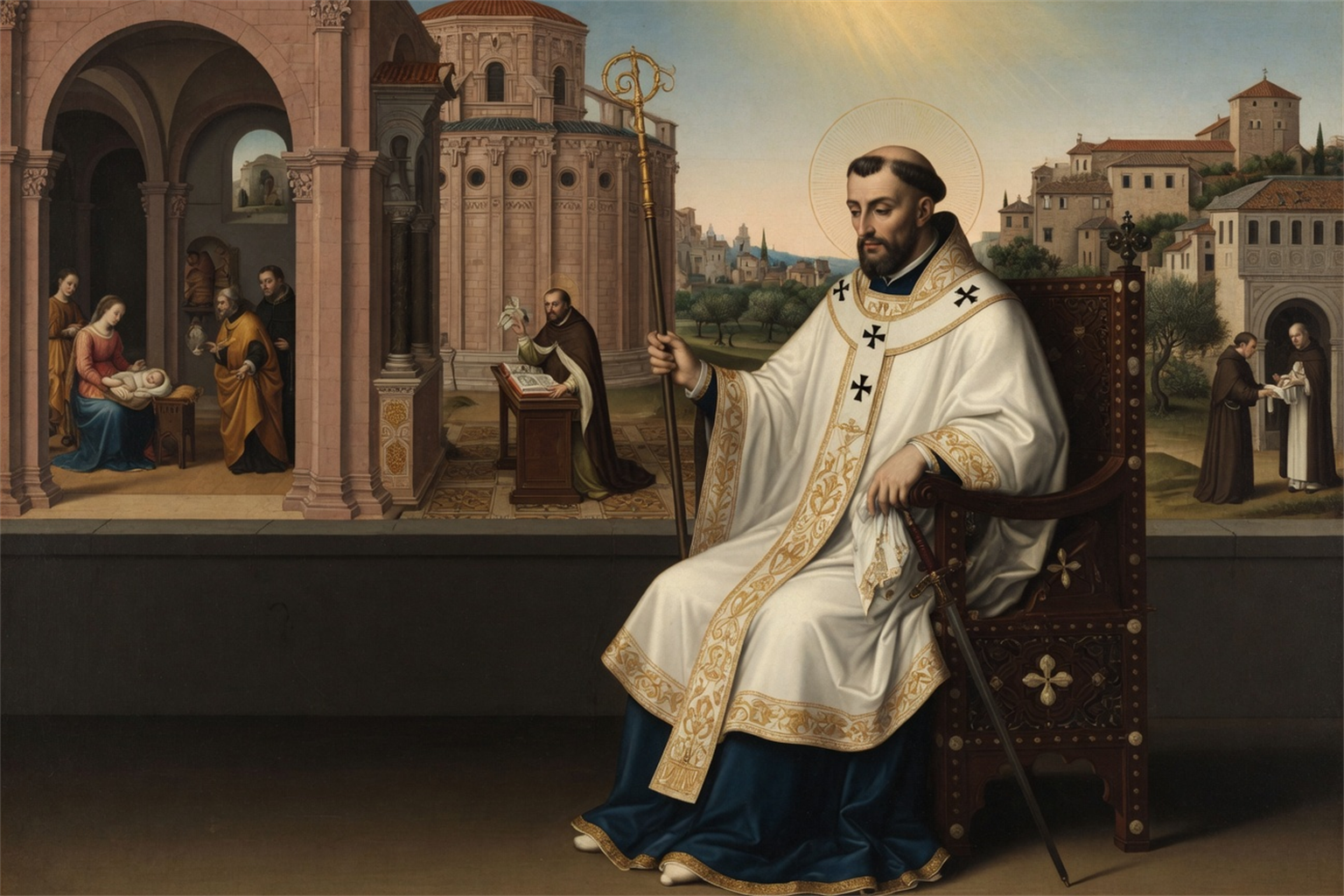
Born in Toledo in 606, Ildefonsus was a monk of Agali and the illustrious disciple of Saint Isidore before becoming Archbishop of Toledo in 657. A great defender of the perpetual virginity of Mary, he received from her a miraculous chasuble during a celestial apparition. He died in 669, leaving behind a major theological body of work and a deep devotion in Spain.
Guided reading
10 reading sections
SAINT ILDEFONSUS OR ALONZO,
ARCHBISHOP OF TOLEDO
Ildefonsus: Origins and Monastic Life
Born in Toledo in 606, Ildefonsus became a monk at the monastery of Agali after being trained by Saint Isidore of Seville.
The life of Ildefonsus and Our Lady, the good Virgin. Calende, the Virgin of the sanctuary. At the gates of Toledo, capital of the Visigothic kingdom of Spain, stood in the seventh century the monastery of Agali, a true nursery of saints and doctors. It was there that Ildefonsus became a monk, despite the violent resistance of his f Ildefonse Successor of Helladius and author of the testimony on his life. amily, whom we place with all the more happiness in our collection of the flowers of the Saints as he was most dear to Mary, the Queen of angels and men. Ildefonsus, the most illustrious of the disc iples of Saint Isidore o saint Isidore de Séville Brother of Florentina, great Doctor of the Church. f Seville, the most popular of the saints of Spain, was born in that same city of Toledo, of a family allied to royal blood, on December 8, 606, a day which has since been consecrated to the Immaculate Conception of the Blessed Virgin: and it was through the intercession of Mary that Stephen, his father, and Lucy, his mother, obtained from heaven this child of blessing. He first received lessons from Isidore in Seville for twelve years, then, having returned near his cradle, he became a monk at Agali and completed his studies there. The death of his parents having left him the free disposal of his property, he devoted it to the foundation of a monastery for nuns.
Ildefonsus: Archbishop and Marian favors
Having become Archbishop of Toledo in 657, he defended the virginity of Mary and received from her a celestial chasuble during an apparition.
Eugenius II, Archbishop of Toledo, having departed this life (657), the unanimous voice of the clergy and the people placed Ildefonsus on the metropolitan see; — and then, performing the office of the good shepherd, he illuminated, like a mystical sun, all the churches of Spain by his knowledge as much as by his virtue.
"But what earned him above all the first place in the love and memory of the Spanish people was his ardent devotion to the Blessed Virgin, whose virginity he defended against the Belvidians. The miraculous visions that testify to Mary's gratitude for the efforts of her zealous defender and the relics he left to the church of Toledo have long inflamed the devotion of the Spaniards for their great saint Alonzo." T hese d Alonzo Successor of Helladius and author of the testimony on his life. istinguished wonders deserve to be known.
On the feast day of Saint Leocadi a, this illustr sainte Léocadie Martyr of Toledo who appeared to Saint Ildefonsus. ious and famous martyr emerged from her tomb, near which Ildefonsus was praying, and also revealed to him her relics, which had long been forgotten and which the holy archbishop ardently desired to find. Then, taking him by the hand, she said to him before all those present: "Ildefonsus, through you is maintained my Sovereign who reigns in the heights of heaven," meaning that he had defended the honor of Mary against the heretics. To have a palpable token of this vision, he seized the sword of King Recceswinth, who was accompanying him, and cut a portion of the Saint's veil before she closed her tomb: this piece of the veil became a highly venerated relic, preserved in the church of Toledo. Saint Ildefonsus established, or at least celebrated and zealously propagated, the feast of the Expectation of the Childbirth of the B. V. Mary. Now, before Matins on that day, Ildefonsus rose at the hour he was accustomed to go and sing the praises of Mary. He was accompanied by his clerics and a large number of people. They carried bright wax torches in front. Upon arriving at the door, the people who made up the procession perceived in the church a brightness that their eyes could not bear: all took flight. Ildefonsus had it opened and advanced toward the altar accompanied by only a deacon and a subdeacon. He prostrated himself, and at that same instant, the Virgin Mary appeared to him, seated on the episcopal throne, surrounded by a troop of Virgins who were performing the songs of Paradise on earth. Mary signaled to her servant to approach, and fixing her divine gaze upon him, she said: "You are my chaplain and my faithful notary; receive this chasuble that my Son sends you from his treasures." Then she vested him with it with her own hands and ordered him to use it only on feasts celebrated in her honor. This apparition is so certain that a council of Toledo ordered that, to perpetuate its memory, a feast would be celebrated every year, with an office and under the double rite: it is still celebrated today on January 21 under the title of the Descent of the Blessed Virgin and her apparition to Saint Ildefonsus, and, remarkably, this same feast is solemnized in Egypt among the Copts.
Ildefonsus: Passing and Literary Legacy
After his death in 669, his remains were transferred to Zamora; he left behind a theological body of work centered on the Virgin and baptism.
These favors with which it pleased Our Lord and His holy Mother to honor their servant were a worthy prelude to the eternal bliss he went to enjoy on January 23, in the year 669. He had lived sixty-three years and had spent ten on the see of Toledo.
He was first buried in the church of Saint Leocadia; later, the fear of the Moors of Spain caused him to be transported to Zamora in the Asturias, where the translation of his relics is still celebrated.
The house where Saint Ildefonsus was born was given to the Jesuit Fathers, after having long belonged to the Counts of Orgaz. These religious had a magnificent church built on the site of this house and restored the honor of his memory, which the inhabitants of Toledo had little by little lost sight of.
In the images that have been made of Saint Ildefonsus, the Blessed Virgin clothes him in a chasuble whiter than snow; he cuts a piece of the veil of Saint Leocadia as she emerges from her tomb.
[APPENDIX: NOTICE ON THE WORKS OF SAINT ILDEFONSUS.]
In volume XCVI of M. Migne's Patrologia, we find the following works of Saint Ildefonsus:
1st. His book on the Perpetual V irginity of the august Mary, agai livre de la Virginité perpétuelle Major work by Ildefonsus defending the Marian dogma. nst three impious men, Jovinian, Helvidius, ancient heretics of the time, Saint Ambrose and Saint Jerome, whose impious errors no doubt reigned at that time in Spain, and a Jew, in whose person our Saint tries to form the mouth of the entire Jewish nation that blasphemed against the holy Mother of God.
He first attacks his enemies one by one: he shows against Jovinian that Mary, who conceived without ceasing to be a virgin, also gave birth without losing her virginity; against Helvidius, that after having given birth to Jesus Christ, she remained a virgin for the rest of her life; and, against the Jews, that she conceived without losing anything of her virginity. In fighting the latter, he strikes again at the former, whom he had already defeated separately, and overwhelms them under the testimonies of Scripture.
Our Saint is reproached for not having employed, in this treatise, a more regular, simpler, more natural style, and for having repeated each idea a hundred times using synonymous words. But one must pay attention to two things: first, that it was somewhat the taste of the century, very far removed from that of Augustus; second, that the subject and the manner in which he treats it sufficiently justify this type of style: his love for Mary goes as far as a pious delirium; his horror of heresy as far as a holy fury. These overflowing sentiments escape in a torrent of words that submerges his adversaries and relieves his heart. Here is an example of this passionate, impetuous, redundant language, impossible to translate: "O Domino meo, dominatrix mea, dominans mihi, mater Domini mei, concilio filii tui, genitrix factoris mundi, te rogo, te oro, te quæso, habeam spiritum Domini tui, habeam spiritum filii tui, habeam spiritum redemptoris mei, ut de te vera et digna sapiat, de te vera et digna loquar, de te vera et digna quæcumque dicenda sunt dicam. Tu enim es electa a Deo, assumpta a Deo, advocata a Deo, proxima Deo, adhærens Deo, conjuncta Deo, salutata ab angelo, turbata in sermone, attonita in cogitatione, stupefacta in salutatione, admirata in dictorum enuntiatione. Invenisse te apud Deum gratiam audis, et ne timeas juberis, fiducia roboraris, cognitione miraculorum instrueris ad novitatem inauditæ gloriæ proveberis..."
2nd. Book on the Knowledge of Baptism. In it, he examines all the questions that concern this sacrament, and settles them, not by his own authority, but by relying on the holy Fathers, whose sentiments on this subject he has collected. This book is therefore, strictly speaking, composed of notes that he took while reading the Fathers, and that is its title: Book of Notes on the Knowledge of Baptism. The same must be said of the opuscule that follows, which is also composed of a multitude of small chapters.
3rd. The Book of the Path through the Desert where one advances after Baptism. The waters of baptism are like those of the Red Sea which separate us from servitude; the rest of our life is a journey, like that of the Hebrews in the desert; if we let ourselves be well led by God, we will arrive at the promised land. Saint Ildefonsus speaks to us throughout this journey, if I may use the expression, suggests a thousand salutary thoughts to us, and explains mystical words. I repeat, it is more a collection of sentences than a treatise.
4th. Letters, the only ones that remain to us from Saint Ildefonsus. They are preceded by two letters from Quiricus, Bishop of Barcelona, who thanks our Saint for the good that his book on Virginity has done him. This marvelous book not only rejoiced his soul, but his old and infirm body was as if revived by it, which allowed him to resume his episcopal functions. The Archbishop of Toledo humbles himself in his responses and returns all the glory to God.
5th. The Book of Illustrious Men, to follow that of Saint Isidore, is a list of fourteen illustrious men; it begins with Saint Gregory the Great, Pope, and ends with Eugenius II, Bishop of Toledo. Ildefonsus devotes a short notice to each.
The works that follow, in M. Migne's Patrologia, and which are attributed with more or less uncertainty to our Saint, are:
An opuscule on the birth of the Virgin, which is more probably by Paschasius Radbertus, Abbot of Corbie;
Fragments on the same subject;
Fourteen sermons, of which the first seven and the ninth are on the Assumption of the Blessed Virgin, the eighth in praise of this same Virgin, the tenth on her Purification, the eleventh on her Nativity, and the others also on the Blessed Virgin;
A small book on the Crown of the Virgin Mary;
A continuation of the Chronicles of Saint Isidore;
Finally, Thirteen Epitaphs in verse.
Barnard: From the court of Charlemagne to the cloister
A noble warrior under Charlemagne, Barnard leaves worldly life after the death of his parents to embrace the religious life.
778-842. Popes: Adrian I; Gregory IV. — Kings of France: Charlemagne; Charles II, the Bald.
To become a bishop is not a surprising thing; but to live as a poor bishop, that is a great thing, an admirable thing!
Saint Barnard, Letter XXIV, to Gilbert, Bishop of London.
The Church needed apostles in the 9th century: the Saracens were surrounding it on all sides. The Barbarians, subdued by Charlemagne and converted to Christianity, retained something of their customs and superstitions. The errors of the Nestorians and Iconoclasts were invading the West. Add to this the ignorance of those times and the disorders inseparable from a weak reign like that of Louis the Pious: it was necessary to oppose much light and virtue to these shadows and vices. God, whose Providence is always attentive to the good of the Church, raised up our saintly Barnard to be its guardian angel in France.
It is believed that he was born in Izernore, then in the diocese of Lyon, in the year of Our Lord 778, to noble, wealthy, and virtuous parents. As he was the youngest of his brothers, he was the object of the tenderest care; at the age of ten, his parents sent him to a college run by holy priests who trained young people for religion and the fatherland, by placing secular sciences in their minds, and the fear of God and the love of virtue in their hearts. Barnard became the glory of their house: he succeeded in everything, but mainly in obedience and humility; his modesty already taught him the means to humble himself or at least to skillfully deflect the praises lavished upon his merit. A sad event tore him from this house at the age of eighteen: death, entering his family, struck almost all his brothers at the same time; he had to return to his parents to console them. "How happy you are," he said to his fellow students upon leaving, "how happy you are to be here, sheltered from the storms to which I am about to be exposed! Pray to the Lord to strengthen my heart against the harsh assaults that the world is going to inflict upon it." He soon inspired great fears in his parents; they saw him almost always in prayer, recollected, withdrawn into his room, fleeing worldly gatherings where he only went out of obedience, so that he drew upon himself the jokes of young people his age. One day, Barnard's father went to find his wife, quite desperate, and said to her: "It is done, we will soon be without children; death has taken the first ones from us, the cloister is going to take the only one we have left." This tender mother replied only with sobs; she almost repented of having inspired in her son from childhood this piety which threatened to take him away from her. She had him come, and embracing him with transport, she begged him not to abandon her, to be the consolation of her old age, since she had indeed been the guardian of his childhood; not to kill her by depriving her of the last object of her love. The tears with which she watered this dear son said even more than her words. He wept himself, and promised not to rush anything, to reconcile, as much as he could, the will of God with that of his parents.
It was through this sweet inclination to obedience, the only vulnerable point of his heart, that the father attacked him. He told his son that God did not perform miracles to declare His will, that He made it known naturally through the desires and orders of Christian parents. These struggles, repeated every day, and especially the remonstrances of some priests who were brought in, stopped young Barnard. They even managed to engage him in marriage, then sent him to the court of Charlemagne, in the hope that arms, honors, and delights would finally make him love the world. But his heart, enamore d of heaven Charlemagne Emperor of the Franks and uncle of Saint Folquin. , always remained insensitive to the earth. He only fulfilled the duties of his station with greater exactitude. He distinguished himself in the war against the Saxons. He was charmed by the discipline that reigned in the army, by the way in which Charlemagne made his troops observe the laws of Christianity. He admired above all the heroism with which the soldier endured privations. Often, in winter, the camp was flooded by rain and the tents all covered with snow, so that one sometimes found soldiers who had spent the night on sentry duty lying at their posts, half-dead. "Alas!" Barnard said to himself, "if only one did for God a part of what one does for men!" At other times, chatting familiarly with old officers all covered with wounds and more bent under the weight of military fatigue than under that of years: "I agree," he said, "that it is just and even glorious to march under the orders of the prince; but admit that it is still better to serve a master from whom nothing escapes and who rewards so liberally." These old warriors received the lessons of the young captain all the better because they were the effect of piety, but not of timidity; they had always seen him run to danger among the first and give marks of proven valor everywhere. We will say nothing of that here: we speak only of the virtues that heaven crowns. Our Saint spent seven years under arms, but he came almost every year, during the winter, to oversee the education of his children and be the delight of his family. He had an extreme tenderness for his wife and strove to inspire Christian sentiments in her. "It is more for heaven than for earth that we are united," he often told her; "let us ensure that all our actions correspond to the holiness of the sacrament that formed this bond. What a misfortune if, after having lived together in this world, we were separated in the other, or if we only met there together in eternal torments!"
While he was, for the seventh year, occupied with a military expedition, he received the news of his mother's death, and a few days later, that of the dangerous illness of his father, who did not survive long. He shed bitter tears over both, and found consolation only in the memory of their virtues and the hope of their eternal happiness.
Barnard: The Foundation of Ambronay
He founded the monastery of Ambronay in 803, where he led a life of austerity and charity before becoming its abbot.
He took advantage of this misfortune to leave the court and the profession of arms. Charlemagne granted him permission to do so with regret, and everyone was saddened by his departure. Scarcely had he returned to his family than he began to think of ways to renounce it for Jesus Christ. As soon as his parents guessed his intentions, they explained to him that his devotion was indiscreet, that he was only the steward and not the master of his inheritance, to share it as he was about to do between the Church, the poor, and his children to whom it entirely belonged; that the commitments of marriage could not be broken in such a way. Finally, his wife, dressed in mourning, threw herself at his feet and, presenting her children to him, begged him to have pity on them. Such a touching spectacle shook him to the depths of his soul; but grace coming to the aid of nature, he had the strength to say this beautiful speech to his wife: "A portion of my goods, which are considerable, will suffice for my dear children; they will have enough if they have integrity, and too much if they had the misfortune not to be wise; I will provide for their education and a lifestyle worthy of your station. Furthermore, I have counted more, for the execution of my design, on your piety than on my own; perhaps it is to it and to your rare examples that I owe the thought. Ah! How sweet it is to separate in this world only to be reunited more happily in the other! But, after all, since I have pledged my faith to you, be sure that I will do nothing without having taken counsel from you and consulted the rules of prudence and charity; my retreat is not irrevocable; I do not wish, therefore, to abuse your tenderness for me and tear your consent from you. Follow your inclination; let not too respectful a deference close your mouth if you have designs contrary to mine." In saying this, he was sure of success, for he knew the piety of his spouse who herself sighed for the cloister, had her maternal tenderness not made it a duty for her to remain with her children. She therefore ceased to oppose the pious desire of her husband. The latter, after having put his domestic affairs in order and founded a hospital with large revenues, embraced his wife and children, and departed, well able to say like that Saint who thus left homeland and parents, the Gospel in hand: "It is this book that has stripped me of everything." He walked without a certain route, but the Spirit of God led him. He entered the Lower Bugey, around the year of Our Lord 803, and charmed by this solitude, he sto pped at Ambronay First monastery founded by Barnard in the Bugey region. Ambronay. It was then only a small hamlet, known only by a monastery belonging to Luxeuil, and by a church of the Blessed Virgin ruined in the wars. Barnard therefore bought Ambronay from the abbot of Luxeuil, had the church rebuilt and a large monastery constructed, assigned it considerable revenues, and placed it in the hands of religious who, under the guidance of a holy abbot, gave the example of all virtues. He enclosed himself in a small cell next to the monastery. He often left it for the church where he spent the nights in prayer and tears, or else for the countryside where he meditated, seeing the vestiges of God in the heavens, in the beauties of nature. All objects reminded him of holy thoughts: at the sight of a stream rushing from a mountain toward the meadow, he said to himself: "There is the image of the agitation and brevity of life." He considered the singing of birds as a hymn to God, and he took part in it. The memory of his wife and children often returned to him; reproaching himself for not sharing with them the delights of solitude, he had them come, and they lodged next to him, and took part in his good works, especially in the care of hospitality, which he lavished on everyone. Barnard acquired such a great reputation that he became the arbiter of all disputes; as soon as any quarrel arose, people ended by saying: "Let us go find the Saint." He was not content with alms given to beggars, the most risky of all, if I dare speak thus; he went to visit the huts, from which he drove away misery and ignorance. However, he still considered himself only on the edge of happiness, not living in the interior of the cloister. He resolved to enter it. After having settled his affairs, provided for the establishment of his children, and obtained the consent of his wife who undoubtedly also retired to a monastery, he became a religious in his abbey of Ambronay. One could never make him accept a comfortable apartment; he went to lodge in a cell that one would not have dared to offer to the last of the novices. He was almost always in contemplation, slept little, prayed, and mortified himself much. "I am only consoled," he said, "because I am now sheltered from the storms of the century and in a state proper to repair the faults of my past life." Animated by this spirit of penance, he burdened himself with chains fitted with spikes, he walked all bent under the hair shirt and the cilice, he tore his body so pitilessly that, gushing under the blows of his discipline, his blood stained the floor. Then, instead of restoring his strength, he made vigils follow abstinence. He fought the temptations of the demon as much by work as by prayer, cultivating the earth, fashioning baskets and mats, like the first solitaries, also exercising himself in the lowest and most humiliating tasks; after manual labor, he applied himself to the study of the Holy Scripture and the Fathers. That is how he kept his soul in peace; one could only disturb the serenity of his face by reminding him of his birth, his virtues, or his good deeds. He went poorly dressed and affected coarse manners, so that people attracted by his reputation could not recognize him. The sight of such a great Saint and such an illustrious monastery being the admiration of all visitors: "These are those," they said, "whom the ideas of the profane world make us look upon as madmen. Alas! They perhaps surpass us as much in birth as in integrity. If they are poor, they are so by choice, like Barnard; they are in contempt because they have refused the first places, and they often hide, for the love of Jesus Christ, talents that would make our admiration and the confusion of those who despise them. We believe them useless or a burden, they who have filled libraries with their writings and enriched the century with their conquests, and who, by their tears and prayers, have a hundred times bent the anger of heaven. What ingratitude! But also how the Lord knows well how to compensate them for the injustice of our judgments. What joy! What consolation! What esteem on the part of the true sages! And what is all that in comparison to the glory and happiness that heaven prepares for them?" The abbot having died, all the monks cast their eyes on Barnard to replace him. He prayed, groaned, and protested in vain; everything was useless, he had to yield to the importunities of his brothers. He saw, moreover, in this office the faculty of being freer in his austerities and his devotion. He was always the first in the choir and at all other exercises. One recognized the abbot only by his more mortified air, by a more tender devotion, a more ardent charity. He was full of gentleness toward his monks, having as a maxim that the religious state is not a state of conquest and tyranny, but of voluntary obedience. He recommended to them principally the distancing from the world: "The world should only know the solitaries," he often said, "by the account of their virtues." God blessed such a wise administration in such a way that, in less than three years (since the year 807), the monastery grew in all ways, in regularity, in number of religious, in revenues, in buildings, and in reputation.
Barnard: The Episcopate in Vienne
Miraculously elected Archbishop of Vienne in 810, he reformed his clergy and devoted himself to the poor and the sick.
In the year 810, Volferius, Archb ishop Vienne Episcopal see and principal city of the saint's activity. of Vienne, having died, the people gathered to choose his successor; the votes were divided. Suddenly, a child of ten or twelve years old raised his voice in the middle of the assembly and cried out: "The Lord has elected Barnard, Abbot of Ambronay, as Archbishop of Vienne." At this voice, they looked at each other in silence and with admiration; soon there was but one cry to applaud this election. Deputies came to announce it to Barnard. At first, he was troubled and could not believe his ears. Then he replied to them that if they were speaking seriously, he protested that he would never accept. In vain, they threw themselves at his feet and begged him with tears to yield to their happiness. He refused. They had recourse to Charlemagne, who wrote to Barnard. He r efused. Charl pape Léon III Pope who presented the relics of Hippolytus to Charlemagne. emagne employed the authority of Pope Leo III, who dispatched an ecclesiastic named Gregory to Vienne, charged him with his power, and provided him with a letter for Barnard. Gregory gathered the bishops of the province in Vienne, summoned the Abbot of Ambronay, and signified his canonical election to him. He had to obey. He redoubled his austerities, prayers, and tears to prepare for his consecration. He was consecrated by Leidrad, Archbishop of Lyon, in the year 810, at the age of thirty-two. From then on, he was, so to speak, divided into as many cares as there were souls in his diocese. "Formerly," he said to those who made observations about his austerities, "I only had my own faults to expiate; today, I have those of an entire people." The reform of his diocese, which he undertook with zeal, began with his clergy: he forbade them games of chance, frequent or excessive feasts, and suspicious visits, saying that it is enough for a layman to be irreproachable, but that an ecclesiastic must, for the success of his ministry, be exempt from suspicion. He himself taught the catechism at the cathedral to elevate a function that should have always been held in honor, since it was consecrated by the example of Jesus Christ. He went to see hardened sinners in their homes, then, when he had gained their confidence, he explained to them with kindness the sufferings of Jesus Christ and the mercy of God, embraced them tenderly, and determined them to make their confession, during which he shed as many tears as if he were the criminal himself. He visited the sick in their beds, paid the debts of the poor, traveled across the plains despite the heat of the summer that burns them in the Dauphiné, and climbed the mountains of the Vivarais despite the snows of December. Could one not be moved with compassion when seeing this Saint, half-frozen, helping himself with his feet and hands to reach a steep rock where he often went to seek some of his flock; he lodged in their huts covered with leaves and shared their coarse meals. When the churches were too small to contain the crowd eager to see and hear him, he climbed onto a mound covered with grass and announced to them, following the example of Jesus Christ, the kingdom of heaven in a manner so touching that they all melted into tears. One day, as they were gathering for the arrival of the holy bishop, a blind man came like the others, saying that he also wanted to see him. They laughed at his simplicity. He, without worrying about these taunts, placed himself on the steps of a chapel staircase, saying to himself much like the woman in the Gospel: "If I can approach him and touch him, he will make me see as well as the others." At that moment, cries of joy announced the arrival of Barnard; the blind man ran to throw himself at his feet. The Saint, lifting his eyes to heaven, said to him: "Your faith has given you sight; give glory to God for it." And immediately the blind man saw his benefactor clearly. Turning toward the ecclesiastics who followed him, he said to them, as if to erase the impression produced by this prodigy: "The poor and the simple ravish the graces of heaven, and we, we let them escape."
Barnard: Political and Theological Role
He participated in the great debates of his time, notably regarding the Filioque, images, and the tensions between Louis the Pious and his sons.
But it is time to see another side of this holy life, and what were the actions of Barnard, outside of his diocese, in the common affairs of the Churches of France. The bishops of France, gathered in council, had judged it appropriate to add to the Creed of Constantinople that the Holy Spirit proceeds also from the Son as from the Father, in order to better combat the Greeks, who denied this procession. Charlemagne sent to Rome Adalard, abbot of Corbie; Jesse, bishop of Amiens, and according to some, Barnard, bishop of Worms; according to others, Barnard, bishop of Vienne. They had several conferences with Pope Leo III; he said to them: "It was of faith that the Holy Spirit proceeds from the Father and the Son, but that the canons forbid innovating anything; that thus it was necessary to excise the addition that the Church of France had made to the Creed of Constantinople." "Since it is of faith," replied Barnard then, "that the Holy Spirit proceeds from the Son as from the Father, it is therefore necessary to instruct the people in it." "Yes," answered Leo. "And consequently," added Barnard, "one must not make a suppression that would destroy this belief rather than establish it." The advice seemed wise and compelled the Pope to seek another compromise to reconcile on this point the Churches of France and the Roman Church. The eloquence and erudition of our Saint were no less distinguished in the part he took in the composition of the Capitularies, that collection of laws, half civil, half ecclesiastical, made by the kings of the second race, and especially by Charlemagne in general estates and councils. "Among the bishops who distinguished themselves then in these kinds of assemblies, one notes especially," says Mabillon , "Barnard, bishop of V Agobard, évêque de Lyon Bishop of Lyon in the 9th century who praised Viventiolus. ienne, and Agobard, bishop of Lyon, who supported the faith as much by the holiness of their examples as by the depth of their doctrine."
This Agobard is the same who was the occasion of a great storm that Barnard endured. Leidrade, archbishop of Lyon, having resolved to retire to the monastery of Saint-Médard of Soissons and to spend the rest of his days there in the exercise of penance, took counsel from Barnard who approved his design and proposed to him, as a subject worthy to replace him on the see of Lyon, Agobard, already chorepiscopus of that Church. The emperor applauded this choice. Some bishops to whom this ordination was communicated authorized it by their presence. Thus Agobard was consecrated archbishop of Lyon by Barnard, archbishop of Vienne. But as soon as this news spread in France, the bishops who had not been consulted made lively complaints heard; they accused Barnard of having violated the holy canons of the Apostles, which forbid placing two bishops on the same see at once. The affair was settled in the next council of Arles. Barnard defended himself there with such science, showing that the canons of the Apostles invoked against Agobard do not concern chorepiscopi, that he won his case. Agobard was not degraded nor was Leidrade restored to his see, as some authors have written. Only, to avoid such disputes in the future, it was decided that no more chorepiscopi would be ordained in the Churches of France, a custom that has come down to us without interruption. Since then, the closest friendship reigned between the bishop of Lyon and that of Vienne. They regularly went to a country house on the limits of their dioceses, and there they relaxed, they edified one another, they instructed one another. It is to these pious and learned conversations that we owe the learned works of Agobard against the heresy of Felix of Urgel and the famous Book of Jewish Superstitions that Barnard, Agobard, and Eaof, also a bishop, composed together, to prepare weapons against the Jews established in France, who were seducing the simplicity of several Christians.
They addressed it to Louis the Pious, to invite him to join royal authority to the voice of the Church. This prince had been emperor since the death of Charlemagne (January 28, 814). To engage him also to restore, by the re-establishment of discipline, its former luster to the Churches of France where grave disorders reigned, Agobard comp osed his Treatise o Traité du Sacerdoce Work by Agobard dedicated to Barnard on the dignity of the ministry. n the Priesthood, dedicated to Barnard, and made according to the conversations they had had together on this subject.
The zeal and science of Barnard received a signal reward. The Pope sent him the pallium with a very flattering letter. He soon had a new occasion to show his orthodoxy and his eloquence. The Second Council of Nicaea had condemned the Iconoclasts and regulated the type of worship that should be rendered to the images of the Saints. The French bishops, having poorly grasped the meaning of this decree, made in the Greek language, rejected it at the Council of Frankfurt (794), as if it ordered rendering to images the adoration that is due only to God. Louis the Pious, at the invitation of Pope Eugene, tried to reconcile the Churches of France with that of the East on this subject, in the Council of Paris (824). The same spirit reigned there as at Frankfurt. In vain did Barnard make his voice heard there and seek to show that they were mistaken about the terms, that the worship of images ordered by the Church of Rome and the Council of Nicaea was far inferior to that which is due only to God; he could not triumph over the prejudices, nor even win over his friend Agobard who, in a book on images, forbade equally insulting them and rendering them any worship. Our Saint remained no less attached to the thought of the Roman Church, which earned him a very affectionate letter from the Pope. He distinguished himself again in many other councils. But his conduct was unfortunate in the civil troubles that agitated France at that time. In 813, Louis the Pious had given his three sons a part of his States: to Pepin, Aquitaine; to Louis, Bavaria; to Lothair, Italy. But, having since remarried and having had a fourth son by his second wife, Charles the Bald, he wanted, to endow this prince, to revisit the first partition (823). The three children of the first marriage revolted. Gregory IV having come to France to reconcile the father and the children, the cunning Lothair kept him in his camp and thus made it believed that he approved their enterprise. Agobard and Barnard took the side of Lothair; they were among the number of bishops who, at Compiègne, pronounced the deposition of the emperor and condemned him to public penance. He was soon restored to his throne, and a new assembly of bishops at Saint-Denis condemned that of Compiègne. Ebbo, archbishop of Reims, who had presided over it, was deposed. Agobard and Barnard were also deposed at the Council of Thionville, in the Lyonnais. But Lothair obtained that no successors would be named for them; he even reconciled them with his father, and they returned to their dioceses after an absence of nearly four years.
Barnard: Foundation of Romans and end of life
He founded the abbey of Romans around 839 and retired there to die in 842 after thirty years of episcopate.
From then on, our Saint occupied himself only with the care of his salvation and his diocese. Disorder, laxity, and ignorance, the consequences of civil wars and the absence of the pastor, reigned everywhere. He evangelized this region again with such ardor that his friends feared for his health. He answered them with humility that the law of restitution obliged him to repair the evil that his absence had caused. After having re-established peace and piety in his episcopal city, he visited the countryside, where murder and fire had ravaged everything, where one could still hear the cries of those who were being stripped or mistreated. At the sight of these dire consequences of civil war, he shed continuous tears; he condemned himself to visit every hamlet, every hut. These arduous functions of the episcopate, the weight of years, and the memory of the abbey of Ambronay made him feel the need for a solitude where he could rest from time to time and finally prepare for death. He was turning this plan over in his mind when he arrived at the place where the church of Romans exists today . Char Romans Town founded by Barnard around his abbey. med by these solitudes, by this position on the banks of the Isère, he chose it. A rich widow helped him buy the field, he had the brushwood and shrubs with which it was covered pulled up, laid the foundations of the superb church that one still sees there today, and founded a monastery of Benedictines there, and around it soon was born the beautiful and great city of Romans, whose name perhaps comes from the fact that Barnard made it the daughter of Rome, and whose appearance so resembles that of Jerusalem that a Calvary was built there several centuries ago, in every way similar to that of the Holy Places. The faithful still flock there today, especially during Lent, to better meditate on the passion of the Savior. In order to give more prominence to his new establishment, Barnard assembled a large number of bishops and consecrated with much pomp and solemnity the new church in honor of Saint Peter, the other Apostles, and the three martyrs Severinus, Exuperius, and Felician, natives of Vienne. The bodies of these saints lay without honor at the gate of Vienne; by the orders of Barnard they were removed and transported solemnly to his new church. "This establishment, which was only in its perfection around the year 839, had," says Mabillon, "a particular attraction for Barnard. Constantly occupied with embellishing the new church, he willingly devoted to it all the generosity with which the princes favored him. As soon as public affairs made him fear being called out of his diocese, he would retire to his dear abbey of Romans, like the dove that takes refuge in its nest to avoid the storm." It is there also that he went to relax from the labors of the episcopate and draw new strength. He meditated there far from the world, in thick groves or on the banks of the river. He wanted the monks to treat him as one of them; he followed all their exercises and practiced on his body holy rigors that gave a celestial vigor to his soul. The more he advanced in holiness, the more he trembled seeing how terrible the account is that a bishop must render to God after his death. He sometimes imagined hearing the threatening voice of the supreme judge; then he asked for forgiveness, not only for his faults, but also for those of his flock, as if he had to answer for them. He emerged from these meditations all inflamed with zeal, praying for every soul in his diocese, instructing, exhorting, rebuking. He sought to remedy everything; he visited prisons and hospitals more often than usual; he traveled through the city and the countryside, consuming the remains of his life in charity, in zeal, in good works.
God having made him know more clearly that his end was near, he had the clergy and the people of Vienne assembled in his cathedral, addressed to them a touching speech where he exhorted them to live in peace and union, and to serve God. He then took leave of them, asking their forgiveness for the faults he had committed and assuring them of his tender friendship. "I take these precautions," he told them, "because I am about to undertake a long journey that will deprive me for a long time of the happiness of seeing you. Let us only pray to heaven to reunite us all one day." His dear diocesans understood this language, they answered with sobs. When he left for his abbey of Romans, he was surrounded on all sides: mothers brought him their children to receive his blessing one last time. All the inhabitants of Vienne accompanied him out of the city: many were weeping; he was weeping too and hastened to tear himself away from their embraces. Arrived at Romans, he locked himself in a deep cave and spent three days and three nights there in contemplation, his face prostrate against the ground. On the fourth day, he saw himself surrounded by a great light and heard a voice that said to him: "Come, you are expected." This word filled him with consolation. The religious, alarmed, sent someone who invited him to take some food and no longer continue this indiscreet fast. "You are right, my father," replied the Saint, "I need food: bring me the bread that has come down from heaven, for I must gather strength for the great journey of eternity." His religious having come, he began the Psalter which they continued, and he received Our Lord. The hour of Matins having struck, he sent his religious to the choir and kept only a few, with whom he continued to sing the praises of God. After Matins, the community returned to him, and immediately this place was filled with a great brightness and a very sweet odor. Barnard rested on a hair shirt, "the only way to die," he said, "that is suitable for such a great sinner." When the day began to appear, he gave up his spirit and entered as he said himself, "into the great day of glory and eternity." It was Sunday, January 23 of the year 842, the 64th of his age, the 31st of his episcopate. As soon as he had expired, the light of which we have spoken disappeared, but the sweet odor remained until his holy body had been put in the tomb. An immense crowd gathered to see him and to attend his funeral, which took place the very next day to avoid a larger gathering. Doctranus, bishop of Valence, arrived to pay funeral honors to his metropolitan and his friend; but he was very surprised to find the ceremony completed and the Saint buried, not in the sanctuary, but at the bottom of the church, in the place where he was accustomed to pray. He reproached the abbot for this. The latter replied that he had followed the formal orders of Barnard and wanted to avoid too great an influx. Indeed, such a considerable crowd arrived, fighting over the smallest pieces of what had belonged to the Saint, that one does not know to what excesses the people would have gone to have relics, if the body had not been buried.
1 M. Girand, former deputy of the Drôme, who published the Cartulary of Saint Barnard of Romans, establishes in a special dissertation, in accordance with the breviaries of the abbeys of Saint-Barnard and Saint-Antoine, that this name of Romans or Romans was the name of the previous owner of the land.
Barnard: Cult and Posterity
Honored as the patron of plowmen, his relics survived Calvinist and Revolutionary looting in Romans.
He was raised from the earth on April 23, 944, and placed in a reliquary enriched with gold and precious stones. Numerous miracles occurred during this translation; they have multiplied since then with the pilgrims.
Saint Barnard is the patron of plowmen. He is particularly honored in Romans.
## RELICS AND MONUMENTS.
In the 17th century, the Calvinists, having become masters of the city and the abbey of Romans, pillaged this house, broke the reliquary of Saint Barnard, and burned or threw away his relics. The faithful were able to save only a portion of the vertebrae, a kneecap, and the bone of the leg. The impious of 1792 sought to complete this sacrilegious work, but some fervent members of the Confraternity of Penitents seized the relics of Saint Barnard and hid them in the chapel known as the Blessed Sacrament; they remained in this state until the restoration of Catholic worship; then, at the request of the parish priest of Romans, Mgr. Décherel, Bishop of Valence, had the authenticity of the relic verified, and since then it has been exposed to the veneration of the faithful on the feast day of Saint Barnard, as was the custom before 1792.
The Archdiocese of Vienne has not existed since the French Revolution; but the dioceses of Grenoble, Valence, and Viviers, which have preserved the breviary of this ancient and venerable metropolis, still perform the office of Saint Barnard today. His feast is also marked on January 23 in the ritual of Belley, published in 1530-1531, by Mgr. Devie. Near Trévoux, a parish bears the name of Saint-Barnard. It is asserted that he possessed the castle of La Bruyère and considerable lands not far from there.
The Abbey of Ambronay was united to the episcopal see of Belley by a bull of January 14, 1781. It possessed a beautiful library, part of which was transported to Bourg when the government suppressed religious orders and sold their property. The vast church of Notre-Dame, one of the most beautiful monuments in the department, is today a parish church. The facade and one of the naves bear the stamp of the 9th century. The rest, having been burned, was rebuilt in a different style. The stained glass windows, the sacristy, the altar, and a spiral staircase attract the attention of visitors.
As for the buildings, they were acquired in 1792 by various persons who destroyed a part of them and transformed the rest into private dwellings.
Barnard and Agobard: Doctrine and Writings
Analysis of the treatises co-authored with Agobard on the priesthood, superstitions, and ecclesiastical discipline.
## WRITINGS OF SAINT BARNARD, AGOBARD, AND EAOF.
Our three authors demonstrate, based on the holy Fathers:
1. That clerics must be forbidden, under severe penalties, from sitting at the same table as Jews; 2. That the latter must not be permitted to walk in public squares from Holy Thursday until Easter Sunday; 3. That no Christian may remain a slave to a Jew; they must redeem themselves for twelve coins (which they call *s-Jidi*); 4. If anyone draws a Christian slave into the Jewish religion, they must be legally prosecuted and condemned; 5. Jews are forbidden from approaching Christians during the past time.
They give as the reason for this severity that faith, morals, and civilization face the greatest dangers from Jewish beliefs and rites which, at that time, were a dreadful mixture of superstition, immorality, and cruelty.
De jure sacerdotii. The author relies heavily on the holy Fathers and even more on Scripture, teaching therein:
1. That, in a broad sense, all the faithful are priests, being members of the high priest Jesus Christ; 2. But that, in a narrower sense, in the ordinary sense, the priesthood is a ministry for which one must be designated, like the tribe of Levi, without distinction between the good and the wicked; 3. Indeed, in the priest, one must see not the merit but the power of the ministry; not the person, but the dignity of the person; one must ask not whether such a one is virtuous, but whether he is ordained a priest; 4. Thus, the holiest layman could not do what the most unworthy of bishops can do, such as administering the sacrament of confirmation or conferring holy orders; 5. The sacraments of baptism, the Eucharist, etc., do not derive their value or validity from the one who administers them. The merits and demerits of a minister can neither make them better nor worse, since it is by the power of the Holy Spirit that they are accomplished. One must therefore honor the sacraments equally, whether they are administered by a bad priest or a good one.
There are four classes of priests, with whom we must conduct ourselves in a particular way:
- We must love priests who live and teach well; - Tolerate those who teach well and live badly: we must listen to them, not imitate them; - Despise those who live badly and are ignorant; - Anathematize those who teach badly.
Whatever their conduct, good or bad, one must leave these latter completely aside.
Here is the complete list of Agobard's works, as they are found in volume CIV of Migne's *Patrologia*, with the excellent notes of Baluze:
2nd The book on the insolence of the Jews. Abject in diversity, this nation becomes insolent through prosperity. The emperor having allowed them to settle in peace and freedom in France, and especially towards Lyon, they flattered the great, drew them in with the money they lent them, as if into nets; they tried to attract Christians into their synagogues; they bought slaves, although slavery was abolished in Christian kingdoms. Agobard denounced these schemes and offenses to the emperor.
3rd The three books on the superstitions of the Jews, which we mentioned above.
4th A Letter to Adalard, Wala, and other bishops whom he consults on what he should do regarding the slaves of Jews who ask for baptism: whether he should receive them or turn them away.
5th An Epistle to Nibridius, Bishop of Narbonne, where he proves that one must flee the company of Jews.
6th A Book against the law of Gundobad, King of Burgundy, which ordered judicial duels. This law, published in the 7th century, was still in force in the 9th. Saint Avitus had tried to convince Gundobad that these kinds of combats were unjust and superstitious; but he had been unable to gain anything. Agobard urged the emperor to abolish these duels which neither Scripture nor reason authorizes: "It is by witnesses," he says, "and not by the sword, that one proves one's innocence."
7th The Book of the Privileges and Rights of the Priesthood, which we analyzed above.
8th The Book on Thunder and Hail, where he combats the superstitious error of the people who attribute to sorcery phenomena that can only be caused by the laws of nature and the power of God.
9th Book against the Abbot Fredegisus, where he refutes six propositions that the latter advanced regarding Holy Scripture, the inspiration of the prophets, the human soul, God, and the body of Jesus Christ.
10th Letter to Hilduin, archchaplain of the palace, and to Wala, abbot, on the baptism that the Jews did not want to allow to be given to their slaves.
11th Letter on the illusion of certain signs, in response to Bartholomew, Archbishop of Narbonne; the latter had consulted Agobard to know what one should think of certain people, some of whom fell as if into epilepsy on the tomb of Saint Firmin, at Uzès, and others were agitated in the manner of those vulgarly called demoniacs. Agobard replies that he attributes these effects to the judgments that God exercises on the persons in question, and that he regards them as a kind of scourge quite opposed to the miraculous healings that God grants through the merits of his Saints.
12th Letter to Muffreide, one of the great men of the court, on the disorders stirred up by the Jews.
13th Letter to the Chairs and Monks of Lyon, on the manner of governing the Church.
14th Book on Images.
15th Book on the dispensation of ecclesiastical goods, where he deals with the collection of tithes, the inalienability of ecclesiastical goods, simony, etc.
16th The Book of the Judgments of God. In it, he shows the superstition and impotence of the trials by fire and water, authorized by the laws of the Burgundians. He embraces in this regard almost all of Christian ethics.
17th A Sermon on the truth of the faith.
18th A Letter to Louis the Pious on the division that this prince had made of his empire among his children.
19th Two Letters, one to the Emperor Louis the Pious, the other to the bishops of Gaul, where he compares the two powers, and concludes that the emperor must submit to the Pope and choose him as arbiter between himself and his children. He combats seven Gallican liberties that Gallic bishops had just decreed in a council.
20th An Apology for the sons of Louis the Pious who revolted against their father.
21st The Charter that he delivered to Lothair to certify, like all the members of the Council of Compiègne, that they had condemned Louis the Pious to canonical penance, and that he had submitted to it.
22nd A Book on divine Psalmody.
23rd A Book on the correction of the antiphonal.
24th Two pieces of Latin Verse.
These various works occupy fifty-one pages of volume CIV of the Patrologia.
This notice is an abridgment of the life of Saint Barnard published by Mgr Depéry in the Hagiological History of the Diocese of Belley. — See also the Hagiological History of the Diocese of Valence, by the Abbé Nadal.
Annexes & related entities
Structured data for exploration: events, miracles, quotes, places, attributes, patronages, and important entities cited in the text.
Key Events
- Born in Toledo on December 8, 606
- Studies in Seville under the direction of Saint Isidore
- Monastic profession at the monastery of Agali
- Election to the metropolitan see of Toledo in 657
- Defense of the virginity of Mary against the Belvidians
- Apparition of Saint Leocadia and discovery of her relics
- Apparition of the Virgin Mary and gift of the miraculous chasuble
Miracles
- Apparition of Saint Leocadia emerging from her tomb
- Apparition of the Virgin Mary presenting him with a celestial chasuble
- Unbearable brightness in the church during the apparition
Quotes
-
O Domino meo, dominatrix mea, dominans mihi, mater Domini mei...
Book of the Perpetual Virginity of the Blessed Mary