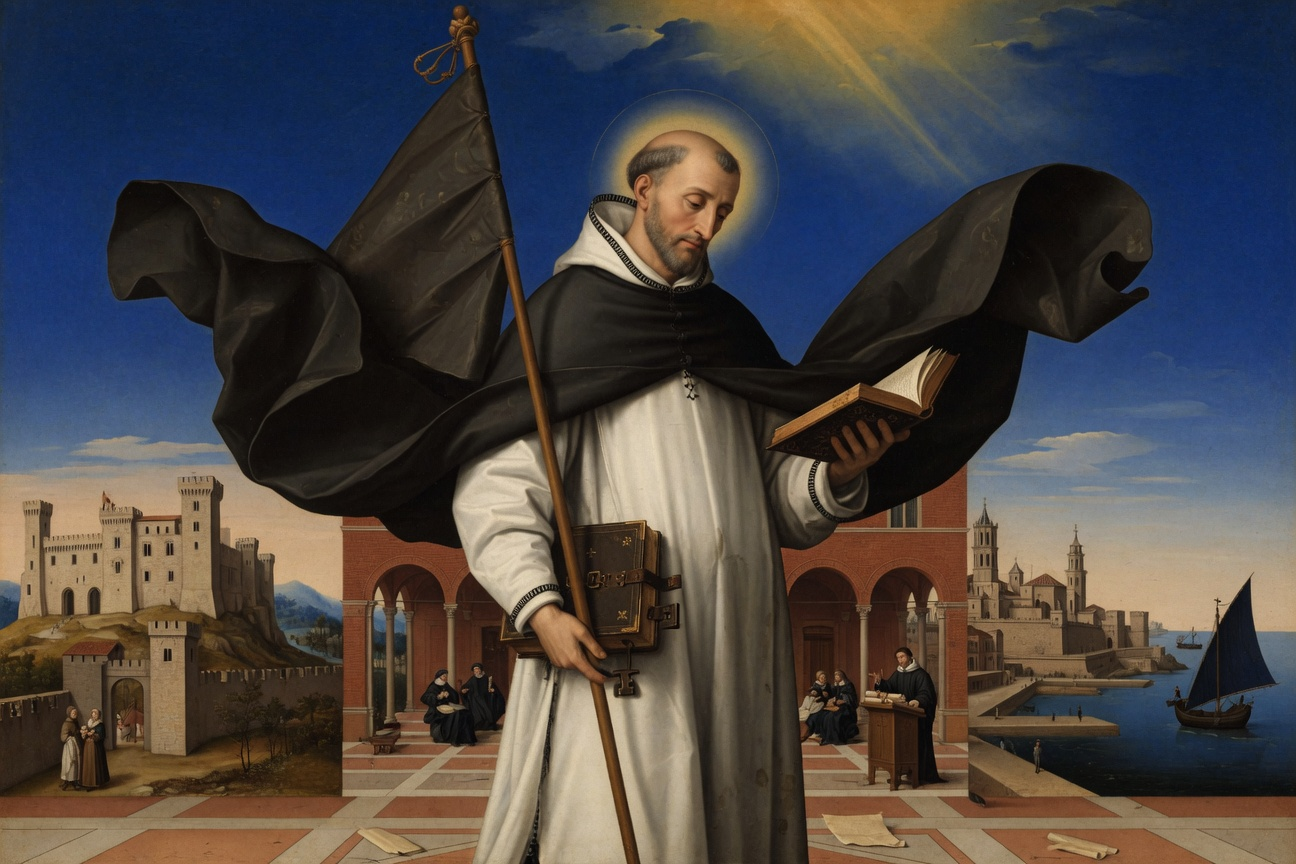
Saint Raymond of Penyafort
CONFESSOR, OF THE ORDER OF SAINT DOMINIC
Confessor, of the Order of Saint Dominic
A 13th-century Spanish Dominican, Raymond of Penyafort was a brilliant jurist, confessor to popes, and compiler of the Decretals. Co-founder of the Order of Mercy, he is famous for having crossed the sea from Majorca to Barcelona on his cloak. He died nearly a centenarian after working for the conversion of many infidels.
Guided reading
9 reading sections
SAINT RAYMOND OF PENYAFORT,
CONFESSOR, OF THE ORDER OF SAINT DOMINIC
Youth and academic formation
Born in Catalonia in 1175, Raymond shone for his intelligence in Barcelona and then in Bologna, where he became a renowned and selfless doctor of law.
1175-1275. — Popes: Alexander III; Gregory X. — Emperors of Germany: Frederick Barbarossa; Rudolph I. — Kings of France: Louis VII; Philip III, the Bold. When the Pope came to know Saint Raymond more intimately, he chose him as his confessor; for the Pope himself is obliged to confess his sins if he wishes to receive absolution. A. Svocz. Saint Raymond ca me into the w Saint Raymond Dominican friar, confessor to popes and kings, and a prominent canonist. orld in the year 1175, at the castle of Pennafort, in the province of Catalonia, from which he took his surname. From his youth, he gave proofs of his high intelligence through the great progress he made in the humanities and philosophy; at the age of twenty, he even gave a public and free course on the latter science in Barcelona . Afterwa Barcelone City where he worked as a shoemaker and entered religious life. rd, he devoted himself to the study of laws, for which he went to B ologna Bologne City of birth and return after the Blessed's conversion. in Italy; he studied both canon and civil law there. A doctor's chair having become vacant, he won it in the competition; and then, like a learned doctor of the kingdom of heaven, he began to bring forth from his treasure (to use the terms of the Gospel) things new and old; but with such great selflessness that he asked no other salary from his students than their own advancement. That is why the Bolognese, to retain such a worthy professor among them, immediately assigned him a salary from the public funds of the city; he accepted it, but it was to distribute it to the poor, after having paid the tithe to his parish priest.
Ecclesiastical career in Barcelona
Upon returning to Barcelona at the urging of Bishop Berenguer IV, he held several high ecclesiastical offices while cultivating a great Marian devotion.
Some time later, Berenguer IV, Bishop of Barcelona, returning from Rome, passed through Bologna, where he found the professor Raymond; he urged him so strongly that he compelled him to leave his chair and follow him: which he did to the great regret of the entire University. Being in Barcelona, he received a canonry there and successively the dignities of archdeacon, vicar-general, and official; this did not prevent him from always living in great seclusion and being very humble and modest in his conversation, although he was otherwise full of light and prudence. He showed himself so devoted to the most holy Virgin that he obtained that the feast of the Annunciation be celebrated with a more solemn office than it had been previously in this church of Barcelona; making for this purpose a foundation, in order to provide for the expense that would be necessary.
Religious Commitment and Summa of Cases of Conscience
In 1222, he joined the Order of Saint Dominic in a spirit of reparation and, by order of his superiors, wrote the first Summa of cases of conscience.
But, not satisfied with having given his goods for the glory of God and for the service of his holy Mother, he wished to give himself as well, detaching himself from all that is in the world to follow Jesus Christ perfectly. This is how it came about. A nephew or, according to others, a cousin of this blessed canon felt inspired to enter the Order of Saint Dominic, which was spreading a very sweet ordre de Saint-Dominique Mendicant religious order founded by Saint Dominic. odor of its holiness throughout the Church. Having communicated this plan to his uncle, he was dissuaded by some reason that Raymond put into his mind, and indeed he did not become a religious. But later, the uncle, reflecting upon himself, conceived such displeasure that he had prevented this good, that he himself, by a principle of conscience, condemned himself to enter this Order to repair the damage for which he was the cause. He therefore took the habit at the convent of Barcelona, on Good Friday, in the year 1222, being 46 or 47 years old, a few months after the death of the founder, Saint Dominic. The first cares of our holy novice were to beg the superiors to impose upon him a notable penance, in satisfaction for the faults he had committed in his secular life. To which the Provincial Father, acquiescing, commanded him to write a summa of cases of conscience that could serve confessors: which he did; this work is called the Summa of Saint Raymond, an d it is believed to be Somme de saint Raymond Reference work for confessors. the first that was composed on this subject.
Service to the Pope and codification of law
Called to Rome by Gregory IX, he became his confessor and compiled the Decretals, thus structuring medieval canon law.
Around that time, John of Abbeville, Cardinal-Bishop of Sabina, having been sent to Spain by Pope Gregory IX to pr pape Grégoire IX Pope who attested to the miracles of Bruno. oclaim a crusade against the Moors and to settle various affairs of the kingdom, made useful service of Father Raymond, whose great capacity he recognized. He would usually send him, a day or two ahead of himself, to all the towns and cities where he intended to go; the Saint would instruct the people there, announce the papal indulgence, and prepare their minds with such prudence and care that the legate would arrive to find matters in the best disposition he could wish for. This legate, upon returning to Rome, informed the Pope of the eminent qualities he had recognized in Raymond and assured him that he would be very useful to him. Therefore, the Sovereign Pontiff called him to his court where, first, he made him his chaplain (which was then the same as an auditor of causes of the apostolic palace), his penitentiary, and his confessor; and then he employed him to compile the Decretals and to dis Décrétales Major compilation of canon law compiled by Raymond. tinguish them by titles and chapters, as we see them today, just as Gregory IX himself declares in the prologue of this great work. In recognition of these good services rendered to the Church, he appointed him to the bishopric of Tarragona, which was the metropolis of the kingdom of Aragon. But the holy religious, whose spirit was extremely distant from all the grandeurs of the earth, however holy they might be, begged the Pope to relieve him of it and to put in his place William of Mongrin, of Girona, a very virtuous person who renounced this dignity a few years later without having allowed himself to be consecrated. It is said that he also refused the archbishopric of Braga, in Portugal, and several other dignities that he was solicited to accept, saying that it was a great enough dignity to be a good religious in the Order one had embraced.
Foundation of the Order of Mercy
Upon returning to Catalonia, he collaborated with Saint Peter Nolasco and King James I to found the Order of Our Lady of Mercy, dedicated to the redemption of captives.
The Blessed Raymond having fallen ill in Rome, the doctors advised him to change air and return to his native land; having received permission from the Pope, he left Rome as he had entered it, that is to say without offices, without benefice, without pension, and without the role he had played on such a great stage having in any way altered his constant humility. He made the journey by sea and disembarked in a place in Catalonia called Tossa; there, he first met a man named Barcelon du Fare who, sick to the point of death, could not confess because he had lost the use of all his senses. The Saint prayed to God for him, and through his prayer, the sick man opened his eyes, came to himself, and confessed, after which he peacefully rendered his soul to God. Following this act of charity, Raymond arrived in Barcelona where he recovered his former health. He began again to lead a life as penitent and as exemplary as if he had made his novitiate a second time. And even, in order to keep himself more in solitude, he renounced with great humility the power of Grand Penitentiary of the Pope, reserving this authority only for the religious of his Order and for those of Saint Francis, in order to preserve thereby the reciprocal charity between these two Orders. In order not to be entirely useless to the public, he gave at this same time, at the prayer of some bishops, the method that must be observed in the visitation of churches, and prescribed some rules for merchants to conduct their trade without sin and to know in which cases they are bound to restitution. It was also at this time that he worked with Saint Peter Nolasco and King Dom James on t roi Dom Jacques King of Aragon who supported and participated in the foundation of the order. he establishment of the sacred Order of Our Lady of Mercy for ordre sacré de Notre-Dame de la Merci Religious and military order dedicated to the ransom of Christian captives. the redemption of captives, following a vision that all three had in the same night, and in which were revealed to them the infinite goods that would arise from the foundation of a congregation so holily applied to charity towards one's neighbor. We shall speak of this great enterprise in the life of the same Saint Peter Nolasco.
Generalate of the Order and life of prayer
Elected Master General of the Dominicans in 1238, he visited the order on foot before resigning to devote himself to a life of rigorous asceticism.
As for his way of living in private, he ate only once a day, except on Sundays; every night he practiced the discipline, and every day he visited, with extreme reverence, all the altars of the church. His prayer was almost continuous and accompanied by many tears; it is even said that an Angel would awaken him a little before the signal for Matins was given to invite him to his prayer. He celebrated the most august sacrifice of the Mass devoutly every day, and never did so without an exact confession. And if it happened sometimes, by pressing necessity, that he could not approach the holy altar, he spent the rest of the day in regret. It is impossible to express what the tranquility and inner peace of Raymond were in this private life; but God, who had not called him for himself alone, raised up for him a new occasion to be useful to his brothers. In the year 1238, all the Fathers gathered in the city of Bologna to elect a general in the place of Father Jordan of Saxony, who had died after having held until then the place of Saint Dominic. By a movement of the Holy Spirit, all the electors agreed on the person of Father Raymond, although he was absent and in Barcelona. The news being brought to him, he was compelled to bow to the good pleasure of God; nevertheless, he soon found a way to rid himself of this charge, for two years after having governed the whole Order with admirable conduct, and visited all the provinces on foot, he had another general chapter assembled in the same city of Bologna, where he renounced the generalate under the pretext of his infirmities and his great age, which was already past 70 years. Having obtained this favor, he returned very joyful and very content to his first convent in Barcelona.
The miracle of the sea crossing
To flee the court of King James I, whose conduct he disapproved of, Raymond crossed the sea from Majorca to Barcelona by sailing on his cloak.
But when he believed himself to be most at rest, God raised up for him new tasks much more burdensome than all the affairs of his Order; for the Popes charged him with missions that properly belonged to the Holy See: such as choosing bishops, appointing abbots, examining prelates, and even deposing them if he found them incapable of their charge; excommunicating, absolving from censures, granting dispensations for irregularities, and other similar things which they placed at his disposal. Innocent IV gave him the power to appoint and provide for all the offices of the Inquisition in all the lands that the King of Aragon then possessed in Gallia Narbonensis. This prince, named the Conqueror, was very religious; he held the blessed Raymond in such high regard that he took him as his confessor, sent him once, with other ambassadors, to Pope Urban IV, and often took him with him on his travels; in this regard, I do not wish to omit what happened to him on the island of Majorca.
The Sain t noticed, on thi l'île de Majorque Primary location of his ministry as a doorkeeper. s journey, that the King was bringing in his retinue a young person for whom he had an illicit love. Unable to bear it, he very urgently begged His Majesty to see her no more and to break off this criminal affair, and told him that without this, he could no longer remain near his person nor in his service. The King promised him he would do so, but he did not keep his word; that is why Saint Raymond resolved to abandon him and to withdraw secretly. To execute this design, he went one night after Matins, with the blessing of the Father Prior, to the port of the city of Majorca to embark on a vessel that was returning to Barcelona. Seeing himself refused not only by that one, but also by all the others, because the King had forbidden, under penalty of death, all the sailors to let him embark, he said, with great confidence in God: "If a mortal king has made this prohibition, we shall see that the eternal King has ordained otherwise." Saying this, he advanced onto rocks that extended into the sea, spread his cloak upon the water, and taking his staff in his hand, he mounted with admirable assurance onto this new boat, then raising half of his cloak in the form of a sail, he attached it to the knot of his staff as if to the mast of a ship; in this way, he made the journey with the favor of a wind that pushed him in six hours to the port of Barcelona, although there are no less than fifty-three leagues of sea to cross. Having arrived, he simply put his cloak back on his shoulders, finding it not at all wet, and went, staff in hand, to the door of the convent where God added miracle upon miracle, willing that this door should open of its own accord to let the Saint enter. The report of these wonders having been spread in the city of Barcelona, there was no one who did not run to the convent of the Friars Preachers to glorify God for them, from which followed the conversion of several sinners, and among others, that of King James, who, repenting of his crime, abandoned the occasion of it, removing from his court and his company the woman who had caused so much scandal there.
Apostolic missions and intellectual influence
He promoted the conversion of the Moors and Jews by encouraging the study of languages and asked Thomas Aquinas to write the Summa contra Gentiles.
It is impossible to express all the good that this holy man did for his Order, for religion, and for his country. Having learned through revelation that several of his religious brothers were destined by Jesus Christ for the conversion of infidels, particularly the Moors and the Jews, he neglected nothing to prepare them for these apostolic labors, having them learn Hebrew and Arabic and the rules of preaching. He used for the same purpose the alms that princes and prelates gave him. These holy efforts succeeded so well that he had the satisfaction of having contributed to the conversion of more than ten thousand infidels. So that the most learned would have less difficulty in yielding to the reasoning of the preachers, he begg ed Thomas Aqui Thomas d'Aquin Major theologian cited for his doctrine on the angels. nas to write a book specifically against their errors: which this angelic doctor executed, composing the excellent treatises that we have today in his Summa contra Gentiles.
End of life and recognition by the Church
He died nearly a centenarian in 1275. His canonization in 1601 confirmed his status as the patron saint of canonists.
Our Saint spent his whole life preparing for death, but particularly the last thirty-five years that he lived since his resignation from the generalate. And he arrived there happily, at the age of 99, through a short illness that took him on the day of the Epiphany, around ten o'clock in the morning, in the year of Our Lord 1275. The kings of Castile and Aragon, who had visited him during his illness, honored his funeral with their presence, being there with the princes of their houses and a large number of prelates and lords of these two courts and all the nobility of the city. But God honored him even more through miraculous actions, which He performed at his invocation, and through graces that were obtained by the merits of his prayers; which can be seen in all the books that treat of the Blessed of the Order of Saint Dominic, where we refer the reader who is curious to learn about it. One can see in particular the life that Fr. Jean-Baptiste Feuillet gave to the public; he remarks that God made the earth in which our Saint was buried a source of miracles that are performed every day wherever it is transported, without it diminishing by the prodigious quantity that is taken from it.
He is depicted with a key in his hand to recall the office of Penitentiary that Gregory IX entrusted to him, an office that conferred upon him the right to open and close heaven; he is also represented holding a book on which one reads the title of his two most famous works; sailing on his cloak which serves as a sail and leaning on his staff which serves as a mast.
Saint Raymond of Pennafort is particularly honored in Barcelona and Toledo; — in the Dominican Order and in that of Mercy. He is the patron saint of Doctors of Canon Law.
[APPENDIX: NOTICE ON THE CORPUS JURIS CANONICI.]
It is known that the Corpus Juris Canonici consists of three volumes, in which are contained six different compilations or collections of canons, decrees, and decretals.
The first volume is by Gratian, and is called the Decree of Gratian or simply the Decree. It is an ample collection of all kinds of ecclesiastical constitutions, arranged not according to the order of Councils and Popes, but according to the order of subjects.
The second volume is that of the Decretals or responses of the Popes on questions that were proposed to them for decision. The multiplicity, the contradiction, and the obscurity of the collections of decretals made until then led Pope Gregory IX to unite them all into a new and single compilation. He entrusted this task to Saint Raymond of Pennafort who, in the composition of this work, did as Tribonian had done in the composition of the Code and the Digest, that is to say, he allowed himself to cut out everything that seemed useless or superfluous to him. Besides the Epistles of the Popes, he also included in his work the decrees of the councils, few of the ancient ones, because they were in the Decree of Gratian, but those of the third and fourth general councils of Lateran, and some decisions of the Fathers that had escaped the care of Gratian.
He divided his collection into five books. Each book is composed of several titles; the titles usually include several chapters or decretals. These chapters, which many call capitula or small chapters, because they contain only extracts of the decretals, are divided into paragraphs when they are a little long, and the paragraphs into verses.
The first book of the Decretals begins with a title on the Trinity, following the example of the Code of Justinian. The three following ones explain the various species of written and unwritten canon law. From the fifth title until that of pacts, it speaks of elections, dignities, ordinations, and qualities required in clerics. This part can be regarded as a treatise on persons.
From the title of pacts until the end of the second book, the manner of initiating, instructing, and terminating lawsuits in civil and ecclesiastical matters is exposed; and it is from there, it is said, that we have borrowed all our procedure.
The third book deals with ecclesiastical things, such as benefices, tithes, and the right of patronage.
The fourth, of betrothals, marriage, and its various impediments.
The fifth, of ecclesiastical crimes, the form of judgments in criminal matters, canonical penalties, and censures.
The third volume of the Corpus Juris Canonici includes the collections or compilations that follow: the Sext of Boniface VIII, the Clementines, the Extravagantes of John XXII, and the Extravagantes communes of the year 1434. Since that time, no more compilations have appeared, but only bulls, which simply reproduce the canons of the councils of modern times and the bulls of the Popes, without uniting them into a body of compilations. (See Theoretical and Practical Sum of all Canon Law by J.-J. André, 2 vol., at the Celestines, in Bar-le-Duc.)
We have followed the Bull of his canonization, which was made in the year 1601, by Pope Clement VIII, on the 29th of April, a day consecrated t o the memory of S pape Clément VIII Pope who approved the reform of the Trinitarians. aint Peter the Martyr, of the same Order of Preachers; and Bullandus reports it on January 7th with very doubtful remarks. Although the death of Saint Raymond occurred on the 6th of this month, as has been done, we have nevertheless moved his life to this day with the Roman Breviary, where his feast is marked with a semi-double office, by a decree of Clement X.
---
ONE OF THE FIRST SEVEN DEACONS; ONE OF THE IMMEDIATE WITNESSES OF JESUS; ONE OF HIS SEVENTY-TWO DISCIPLES; APOSTLE OF PHILIPPI, IN MACEDONIA; MARTYR OF CHRIST.
Parmenas was chosen by the Apostles from among all the disciples of Jesus, to fulfill the eminent function of deacon in the primitive church of Jerusalem, as it is reported in the Acts of the Apostles, ch. vi.
The martyrology written by Galenisius states that at Philippi the office of an apostle martyr is celebrated for Saint Parmenas. One also reads there that this deacon, elected by the Apostles themselves, fulfilled the employment they had entrusted to him with great wisdom and with much piety and zeal; that under the empire of Trajan, he courageously endured for the name of Christ various kinds of insults and torments, and that he finally won the crown of martyrdom, at Philippi of Macedonia where he was preaching the Gospel.
Saint Epiphanius, Saint Dorotheus, and Saint Hippolytus, the Greek and Oriental menologies, rank the blessed Parmenas among the seventy-two disciples who formed the company of Jesus during his public ministry, and who helped the twelve Apostles to carry the evangelical word to the ends of the earth.
Rabanus Maurus says that, at the time of the persecution of Christians in Jerusalem (around the year 42), the deacon Parmenas embarked on the Mediterranean with Saint Magdalene and Saint Martha, his sister, with Saint Lazarus and Marcella, their servant, with Saint Maximin, one of the seventy-two disciples of Jesus, headed toward the western shores, and came to the province of Vienne, in Avignon, with the disciples Sosthenes and Epaphras. — Before evangelizing Macedonia, Parmenas is said to have worked in the southern regions of Gaul with other evangelical doctors for the propagation of the reign of Christ.
This Saint, whom the Greeks count among the great martyrs, suffered under the emperor Diocletian. We read in his acts that his martyrdom was prolonged by making him endure various tortures during the space of twenty-eight years; but these facts are not supported by very solid evidence: they were only collected very late according to oral traditions. From his young age, Clement distinguished himself by his zeal and charity. Taken into holy orders, he was soon elected bishop of Ancyra. Imprisoned for the faith, he had to endure everything that the cruelty of the persecutors knew how to invent of tortures against the Christians: flogging, torches, the wheel, the rack, burning blades, and the iron bed. He finally had his head cut off on January 23, around the year 309.
The relics of Saint Clement were kept for a long time in Constantinople, where there were two churches of this name, one in the palace and the other in the suburb called today Pera. The Latins, having become masters of Constantinople in the 13th century, brought the skull of Saint Clement to Paris. Queen Anne of Austria gave it to the Val-de-Grâce abbey, which she was having rebuilt.
Annexes & related entities
Structured data for exploration: events, miracles, quotes, places, attributes, patronages, and important entities cited in the text.
Key Events
- Born at the castle of Pennafort in 1175
- Philosophy professor in Barcelona at age 20
- Law studies in Bologna and attainment of a doctoral chair
- Entered the Order of Saint Dominic on Good Friday 1222
- Writing of the Summa de casibus poenitentiae
- Compilation of the Decretals for Pope Gregory IX
- Elected Master General of the Dominican Order in 1238
- Miracle of crossing the sea on his cloak from Majorca
- Died at the age of 99 in 1275
Miracles
- Crossing the sea on his cloak in six hours
- Miraculous opening of the convent doors
- Healing and confession of Barcelon du Fare
Quotes
-
If a mortal king has made this prohibition, we shall see that the eternal King has ordained otherwise
Source text