Saint Timothy, Disciple of Saint Paul
BISHOP OF EPHESUS AND MARTYR
Bishop of Ephesus and Martyr
A privileged disciple of Saint Paul, Timothy was the first bishop of Ephesus. After accompanying the Apostle to the Gentiles on his missions and receiving two famous epistles, he died a martyr in 97, beaten to death by a pagan crowd whose disorders he denounced during a festival of idols.
Guided reading
8 reading sections
SAINT TIMOTHY, DISCIPLE OF SAINT PAUL,
BISHOP OF EPHESUS AND MARTYR
Origins and meeting with Saint Paul
Born in Lycaonia to a Jewish mother and a pagan father, Timothy was trained in the Scriptures before becoming the traveling companion of Saint Paul.
97. — Pope: Saint Evaristus. — Emperor: Nerva. Drink a little wine for the sake of your stomach's weakness. First Epistle of Saint Paul to Timothy, V, 23. Drunkards... will not enter the kingdom of heaven. 1st Epistle of Saint Paul to the Corinthians, VI, 10. Truly I say to you, cholera is a less dangerous disease than drunkenness. A. Svez. Saint Timothy, born of an ido latrous father Saint Timothée Martyr who came from the East to evangelize Reims. and a Jewish mother named Eunice, was from Lycaonia, in Asia Minor, and probably from the city of Lystra. Eunice, who is believed to have been a relative of Saint Paul, had embrace d the Chri saint Paul Apostle cited by Saint Jerome to illustrate divine decrees. stian religion, as had Lois, our Saint's grandmother; an d the Loïde Grandmother of Saint Timothy. great Apostle praises the faith of both. They raised Timothy in piety and had him study the Holy Scriptures early on: so that Saint Paul, arriving in Lycaonia during the course of his apostolic mission, found him already fully formed in virtue; and, seeing him esteemed by all the faithful of Lystra and Iconium, he chose him to be the companion of his travels and his labors in the preaching of the Gospel. He began by circumcising him: the ceremonies of the old law were no longer binding since the new law published by Jesus Christ, but it was nevertheless permitted to observe them as an indifferent matter until the ruin of Jerusalem and the temple: by this, say the ancient Fathers, the synagogue was buried with honor. Saint Paul's design was to win for his disciple the esteem of the Jews and to show them that he himself was not an enemy of their faith: beautiful traits of prudence and charity that we must admire after Saint John Chrysostom.
Vocation and Ordination
Timothy abandons everything to follow Paul, who ordains him by the laying on of hands and considers him his spiritual son and coadjutor.
One must praise not only the docility of Timothy, who submits to a painful and non-obligatory ceremony, but also, as Saint Augustine remarks, that zeal and selflessness which leads him to leave his country, his home, his father, and his mother, to follow a foreign apostle in poverty and suffering. Saint Paul entrusted him from that moment with the entire evangelical ministry, through the laying on of hands, and regarded him henceforth, young as he was, as his brother, his coadjutor, his companion in the apostolate, without ceasing to love in him tenderly a disciple and a son. Saint Chrysostom says in praise of Timothy that Paul recovered what he had just lost through the departure of Saint Barnabas. The Apostle seems to use the same language when he calls Timothy a man of God, and tells the Philippians that no one is as united with him in heart and spirit as Timothy. This great love of Paul for Timothy indicates to us how much the latter was loved by God: for such a master could only love in his disciple the eminent gifts of the grace of Jesus Christ, and the fulfillment of all the favorable predictions that had been made about him during his youth, when he was still under the guidance of his mother and his grandmother.
The Apostolic Journeys
Timothy travels through Asia, Macedonia, and Greece, serving as a messenger and mediator for Paul to the early Christian communities.
Saint Paul, having departed from Lystra, traveled with his disciple through the rest of Asia, then embarked for Macedonia in the year 52 of Jesus Christ, and preached the Gospel in Philippi, Thessalonica, and Beroea. The fury of the Jews having forced him to leave the latter city, he left Timothy there with Silas, as they were less exposed to their hatred and, moreover, very well suited to strengthen the faithful. As for himself, he took the road to Achaia. When he arrived in Athens, he sent word for Timothy to come and find him there; but having learned that the Christians of Thessalonica were suffering a cruel persecution, he sent him to them. Our Saint found this church in good condition. He strengthened the faithful in the faith, fortified them against persecutions, and then returned to find Saint Paul in Corinth. It was at that time that the Apostle wrote his first epistle to the Thessalonians, which begins thus: "Paul, Silas, and Timothy, to the church of the Thessalonians..." Saint Paul, having made a long journey from Corinth to Jerusalem, returned to preach in Ephesus, where he remained for two years. When he wished to return to Greece, he charged Timothy and Erastus to go ahead of him to Macedonia and to prepare there the alms that were to be sent to the faithful in Jerusalem. He gave orders to Timothy, in particular, to then go to Corinth to correct some abuses and remind the Christians of the doctrine he had preached to them. In the letter he wrote to the Corinthians shortly after, he recommends his dear disciple to them thus: "If Timothy comes to see you, take care that he has nothing to fear among you, since he works as I do at the work of the Lord. Let no one therefore despise him, but send him on his way in peace, so that he may come to find me, for I am waiting for him and our brothers." Timothy did indeed go to find his master in Asia, accompanied him to Macedonia and Achaia, left him at Philippi, and then rejoined him at Troas. Saint Paul, having returned to Palestine, was put in prison in Caesarea; he remained there for two years, after which he was sent to Rome. It is believed that Timothy was with him at that time, since his name is found next to that of the great Apostle at the head of the epistles to Philemon, to the Philippians, and to the Colossians, which were written in the years 61 and 62; he had already shared in the second to the Corinthians and the two addressed to the Thessalonians. Saint Paul, by joining the name of Timothy to his own at the head of his six letters, indicated that he had associated him with himself, in an inseparable manner, in the instruction of the Churches and in all the labors of the evangelical ministry. Our Saint also had the advantage of being arrested as a prisoner, one knows not where, for the cause of Jesus Christ, and of gloriously confessing the truth before that great number of witnesses of whom Saint Paul reminded him some time later.
But Saint Paul soon had the happiness of writing to the Hebrews, who loved Timothy very much: "Know that our brother Timothy has been set at liberty. If he arrives soon, I will go to see you with him."
Episcopacy in Ephesus
Established as the first bishop of Ephesus, he received the charge to govern the Church of Asia and to combat false doctrines while practicing great asceticism.
It is probable that the Apostle fulfilled his promise. What is certain is that he returned from Rome to the East in the year 64 of Jesus Christ, and that upon his return, on the point of passing into Macedonia, he gave a more particular charge to his disciple, already ordained bishop, in consequence of a prophecy and a particular order of the Holy Spirit, and who had received, by the imposition of hands, along with the grace of the sacrament and other exterior gifts of the Holy Spirit, the power to govern the Church and to perform miracles; he entrusted to him the governm église d'Éphèse Principal city of John's apostolate in Asia Minor. ent of the church of Ephesus, to oppose those who were sowing false doctrine, and to ordain priests, deacons, and even bishops; for he was also charged, according to Saint John Chrysostom, to watch over all the Churches of Asia. He has always been regarded as the first bishop of Ephesus. He was so before the arrival of Saint John in that city, who resided there not as a simple bishop, but as an apostle, exercising a general inspection superior to that of Timothy over all the Churches of Asia. Saint Paul was still in Macedonia when he wrote his first epistle to Timothy, which the Church has always regarded as an apostolic law that must regulate the life and conduct of its pastors. It teaches us that Timothy drank only water. As his great austerities had impaired his health and weakened his stomach, Saint Paul ordered him to drink a little wine. He said a little, because it is good that the flesh be strong enough to serve the spirit, but weak enough for the spirit to dominate it.
What admirable lessons!
Final Instructions and the Apocalypse
Paul addresses his final wishes to him from his prison in Rome, while Saint John, in the Apocalypse, addresses him with praise and admonitions.
Saint Paul, having returned to Rome and being confined in the prison from which he would only emerge to go to his death, felt his tenderness for his dear Timothy redouble. Burdened with chains, he wrote him his second letter, so full of vivid and touching instructions, which is regarded as the testament of this holy Apostle. These are, in effect, the final words of a father who, seeing himself near death, declared to his dearest son his last wishes, which were none other than those of Jesus Christ, for whom he was soon to die. He implored him to come to him in Rome before winter, not only so that they might have the consolation of seeing each other one last time, but also so that he might entrust to him various matters concerning the interests of the Church; he exhorts him to rekindle that spirit of courage, that fire of the Holy Spirit, with which he was filled on the day of his ordination. He gives him advice on the conduct he must maintain regarding the heretics of that time, and traces for him the character of those who would rise up later. It is probable that our Saint complied with his master's invitation and made the journey to Rome to confer with him. On the other hand, he received lessons and even admonitions that were no less useful. For it is believed that he is that angel or bishop of Ephesus to whom Saint Jo hn address Apocalypse Prophetic book written by John on Patmos. es himself in his Apocalypse: 'He who holds the seven stars in his right hand, who walks in the midst of the seven golden lampstands,' praises him first for his works, his labor, his patience; for not being able to endure the wicked, for knowing how to discern false apostles, for holding heretics in horror, and for suffering much and with patience for the name of Jesus Christ. But he reproaches him for having fallen from his first charity; he exhorts him to do penance for it, and to return to where he has fallen from.
The martyrdom during the feast of the Catagogia
In the year 97, Timothy was stoned and beaten to death by a pagan crowd while opposing the disorders of an idolatrous festival in Ephesus.
Do these complaints concern the Church more than the bishop of Ephesus? If it concerns the bishop, had he suffered some notable fall, or had he merely slowed down in the path of perfection and the service of God? It is not easy to decide. Moreover, one should not be surprised if the zeal and charity of the Saints sometimes slacken: God thereby makes them feel the continual need for His grace, they become more humble; when they rise again, it is to launch themselves with new ardor into the path of penance and virtue. Timothy soon had the opportunity to show that he was ready, as in the past, to sacrifice everything to his God. Under the reign of Nerva, on January 22 of the year Nerva Roman emperor who succeeded Domitian and liberated Saint John. 97 of Jesus Christ, the Gentiles were celebrating a certain feast, called Catagogia, because t hey carri Catayogie Pagan festival during which Timothy was killed. ed their idols in procession; and a thousand insolences and a thousand brutalities were committed there, because they were masked and armed with heavy clubs. Saint Timothy, touched by these disorders and striving to stop them, threw himself into the middle of the crowd: far from yielding to his exhortations, they beat him to death with stones and clubs. His disciples pulled him out half-dead and carried him to a nearby height, where he expired some time later, a victim of his zeal, a martyr of Jesus Christ. His body was buried in a place called Pion, near the city of Ephesus, where a church was built for him. Saint John the Evangelist consecrated John I to succeed Saint Timothy. Onesimus was the third bishop of Ephesus.
Cult and iconography
Pope Pius IX elevated his feast to a double rite; he is traditionally represented with the instruments of his martyrdom: stones and a club.
The Church celebrates on this day the feast of Saint Timothy, with a double office, by the order of Hi s Holi Pie IX Pope who canonized Josaphat in 1867. ness Pius IX, instead of the semi-double it was previously. The same decree includes Saint Polycarp and Saint Ignatius of Antioch. "It is," says His Holiness, "to render more honor to these saints who, established on the very foundation of the Apostles, organized, fortified, and enlightened the nascent Church through their holy lessons, the regulations they left it, and the very sacrifice of their lives."
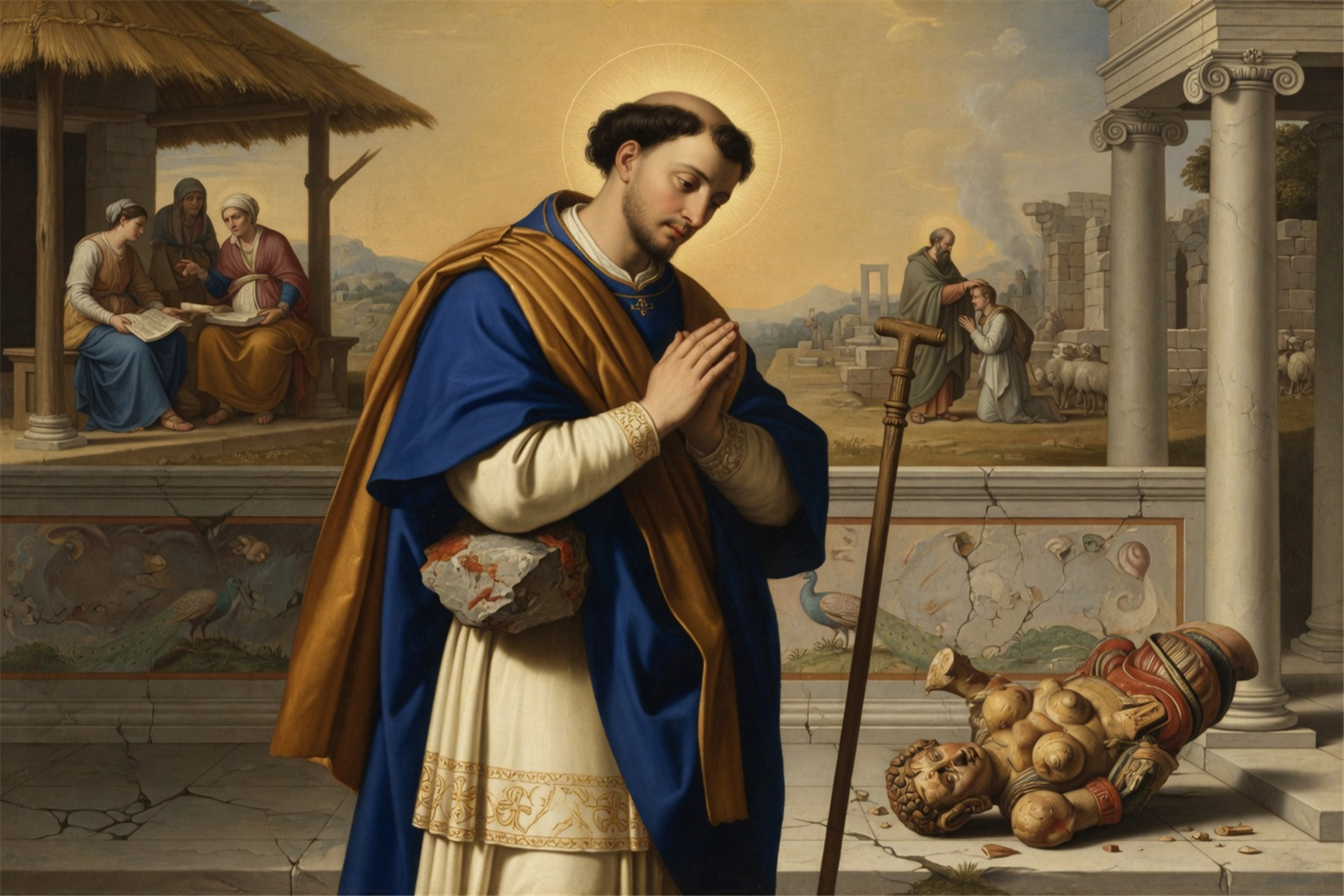
Saint Timothy is depicted: 1st with an idol of Diana overturned at his feet; 2nd with a stone in the fold of his robe; 3rd with a staff or a club in some corner of the painting: all these attributes indicate the instruments or the cause of his martyrdom.
Translation of the relics
His relics were transferred to Constantinople in 356, where they were associated with numerous miracles and the expulsion of demons.
## RELICS OF SAINT TIMOTHY.
Under the empire of Constantius, son of Constantine the Great, the relics of our Saint were transported to Con stantinople in Constantinople City where the saint exercised his ministry and patriarchate. the year 356, and Saint Paulinus informs us that this was not without numerous miracles; the following year, the bodies of Saint Andrew and Saint Luke were also brought from Achaia to Constantinople, and they were placed with that of Saint Timothy under the altar of the Church of the Apostles, where the demons, as Saint Jerome assures us, testified by their roaring how much they felt their presence. Saint Chrysostom also teaches us, in his first homily, where he offers great praise of Saint Timothy, that his relics cast out demons. Those who accompanied his body in its famous translation from Ephesus to Constantinople each received some particles of this precious treasure; and, according to Saint Paulinus, all these particles, scattered in various places on earth, acted as an effusion of graces and blessings, and performed great miracles everywhere.
Annexes & related entities
Structured data for exploration: events, miracles, quotes, places, attributes, patronages, and important entities cited in the text.
Key Events
- Christian education by his mother and grandmother
- Meeting with Saint Paul in Lystra
- Circumcision by Saint Paul to conciliate the Jews
- Traveling companion of Saint Paul in Macedonia and Achaia
- Ordination as Bishop of Ephesus
- Reception of the two epistles of Saint Paul
- Martyrdom during the pagan festival of Katagogia
Miracles
- Healings performed by his relics in Constantinople
- Expulsion of demons through the presence of his relics
Quotes
-
Drink a little wine for the sake of your stomach and your frequent ailments.
First Epistle of Saint Paul to Timothy, V, 23