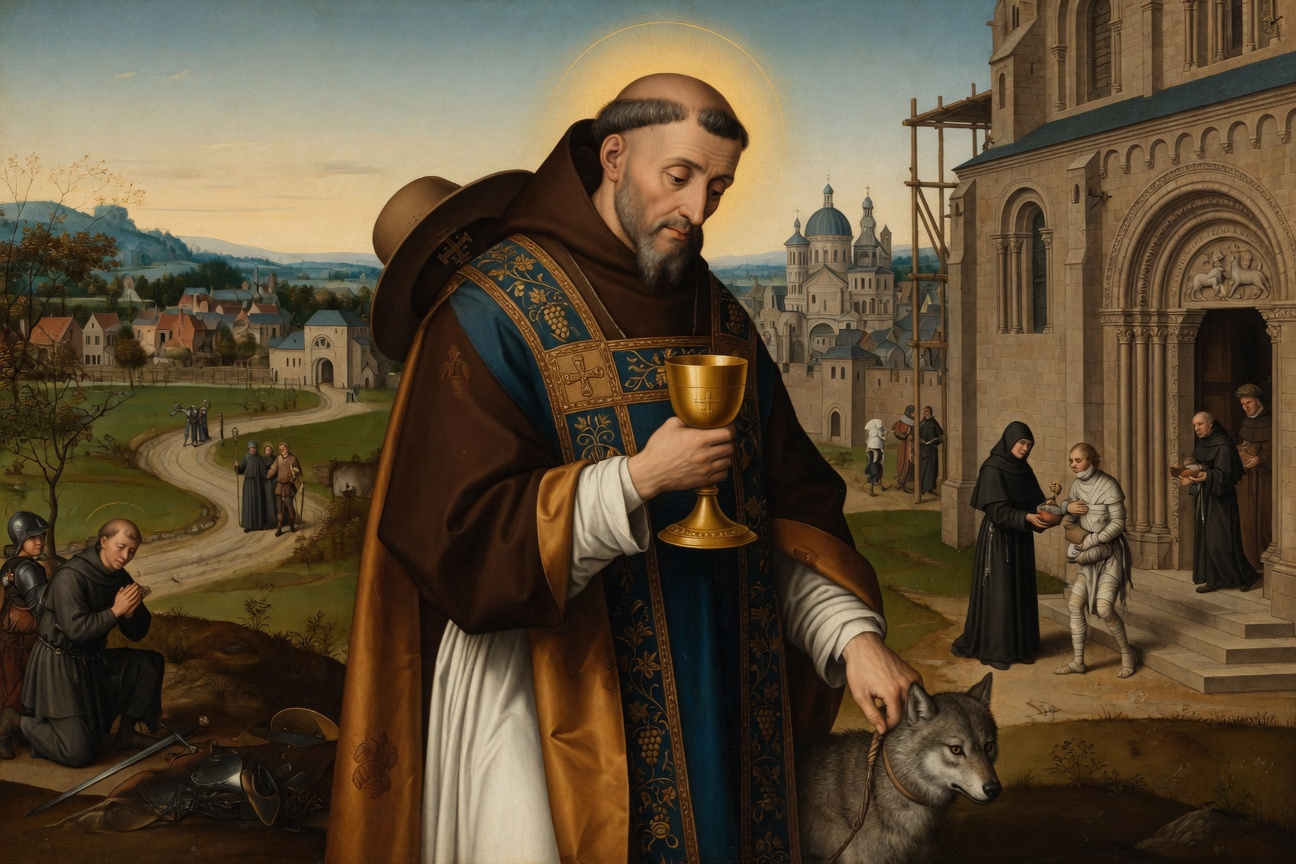
Born in Flanders in 978, Poppo abandoned a military career after pilgrimages to the Holy Land and Rome to become a monk. A great monastic reformer under the influence of Abbot Richard of Verdun, he led several abbeys including Stavelot and Malmedy. He died in 1048 after a life of miracles, diplomacy between sovereigns, and austerity.
Guided reading
8 reading sections
SAINT POPPO, ABBOT OF STAVELOT,
AND THE BLESSED ADELWISE, HIS MOTHER
Origins and military career
Born in Flanders in 978, Poppo first embraced a military career before becoming disgusted by the morals of his comrades.
978-1048. — Popes: Benedict VII; Damasus II. — Counts of Flanders: Baldwin IV; Baldwin V.
The bread of deceit is sweet to a man, but afterwards his mouth will be filled with gravel. Prov. XX, 17.
Pop po, so Poppon Abbot of Stavelot and 11th-century monastic reformer. n of Saint Adelwise, was sainte Adelwise Mother of Saint Poppo, who became a recluse in Verdun. born in Flan ders in Flandre County ruled by Charles the Good. 978, in the seventh month of his conception; his father, Tizekins, perished five weeks later in a battle in the land of Hasbains or Haspengaw, in Brabant, on the borders of the Liège region, where the counts of Flanders and Hainaut were at war. His mother, although very young, consecrated her widowhood to God from that moment on, and made the education of her son her sole concern. She inspired in him such solid sentiments of piety that he kept them intact in the midst of the career of arms, which he first embraced. The bad examples of his comrades, blasphemy, debauchery, and rapine, eventually made their company unbearable to him. He therefore laid down the sword and undertook the arduous journey to Jerusalem in a spirit of penance. He first visited the Holy Sepulcher and the other places consecrated by the stay of Jesus on earth; he brought back precious relics with which he enriched the pilgrimage of Our Lady of Deynse. He then went to Rome, in order to also pay his respects at the tomb of the Apostles, leading the most austere life with his traveling companions. Upon his return, he did not yield to the entreaties of th e Count of Flanders, Baldwin, Baudouin, surnommé Belle-Barbe Count of Flanders who fortified Bergues and built the monastery in 1090. surnamed Fair-Beard, who, wishing to keep him at his court and attach him to himself, proposed to him the hand of a very wealthy person; he was at first on the point of accepting, but the Holy Spirit, whom he consulted with all the sincerity of his heart, inspired in him other sentiments that made him renounce marriage and all other ties of the world. Animated by the examples and exhortations of the blessed Eilbert, his friend (brother of Gerard, Bishop of Cambrai), who was later Abbot of Marillac, he stripped off the marks of the old man to take the religious habit. He learned letters and studied Holy Scripture and monastic constitutions under the same Eilbert. The abbot of the monastery of Saint-Thierry, near Reims, into whose hands he made his vows, placed him in the service of the poor in the hospital of his monastery. He exercised this office with such charity that he could well say like Job: "The stranger did not remain without refuge during the night; my doors have always been open to the traveler..."; or even: "I have never eaten my bread alone, I have always shared it with the orphan." Among those to whom he lavished the most tender care of hospitality, there was one day a man covered with a leprosy so hideous that his appearance offered almost nothing of a man. This was for Poppo a motive to receive him with more affection than the others. Seeing him poorly clothed, he feared that the cold of the night would make him suffer too much, and gave him his own blanket to warm himself. The next day, the leper presented himself completely healed to his benefactor, who was very astonished and speechless at the sight of this miracle, and begged him not to speak of it.
Pilgrimages and monastic conversion
After journeys to Jerusalem and Rome, he refused a prestigious marriage to enter the monastery of Saint-Thierry under the influence of Eilbert.
However, Richard, having known the virtue and merit of Poppo, obtained him, not without difficulty, from the abbot of Saint-Thierry, and took him to his abbey of Saint-Vanne in Verdun. Our Saint did not take long to distinguish himself the re. Fol sa mère Mother of Saint Poppo, who became a recluse in Verdun. lowing his pious advice, his mother took the veil and also came to Verdun, where she lived as a recluse until her death in a cell near the church of Saint-Vanne; she gained a great reputation for her holiness and her miracles.
First miracles and reforms at Verdun and Arras
Poppo distinguishes himself by the healing of a leper and begins to reform abbeys such as Saint-Vaast in Arras under the direction of Abbot Richard.
The Count of Flanders, having driven from the abbey of Saint-Vaast in Arras the abbot Folrad, a scandalous man whose crimes and impiety had led to his excommunication, compelled Richard to take over the governance of this monastery to restore discipline there. Richard took Poppo with him to Arras and appointed him procurator of Saint-Vaast. He discharged this duty with marvelous success, recovering all the goods of the abbey that had been alienated by the disorders of war and by those of Folrad. The usurpers tried to take revenge, but God visibly preserved him from their snares. During a journey he made to the court o f the Emperor Saint empereur saint Henri Holy Roman Emperor who transferred the relics of Saint Felix. Henry, he took the opportunity to obtain from this prince the abolition of the spectacles where men fought against bears.
The miracle of the wolf
During a journey to Emperor Henry, Poppo resurrects a shepherd attacked by a wolf, an event that would influence the heraldry of Stavelot.
During a second journey he made to Emperor Henry, having stopped in a charming place to take some nourishment, he had barely sat on the grass when he saw a wolf disappear into the thickets, carrying off a shepherd. No less astonished than afflicted, his bowels were moved with compassion; he invoked the Lord, and, full of confidence in His goodness, he protested that he would not take any food before having made this ferocious beast return its victim. He immediately sent his companions in pursuit, guided by the traces of blood, through a thick and marshy area; they found the shepherd lifeless, brought him back to Poppo, who resurrected him through his prayers, and had him eat with him. The shepherd always kept on his neck the marks of the wolf's jaws; many people saw them, and it is on the word of their testimony, says the historian of our Saint, that I recount this miracle, to prove the holiness of Poppo. — It is said that it is in memory of this miracle that the town of Stavelot pl aced the wolf in ville de Stavelot Abbey where Lambert went into exile for seven years. its coat of arms.
Abbot of Stavelot and Malmedy
Appointed abbot of Stavelot by Emperor Henry despite the opposition of Richard, he also managed Malmedy and reformed Saint-Maximin of Trier.
However, Emperor Henry, increasingly charmed by his virtues, used all his authority to have him elected to replace Bertrand, abbot of Stavelot in the dio Stavelot Abbey where Lambert went into exile for seven years. cese of Liège, who had just died. Abbot Richa rd opposed thi L'abbé Richard Abbot of Saint-Vanne in Verdun and mentor to Poppo. s with all his might, saying that he needed Poppo to maintain the discipline of the monasteries under his direction. The emperor then had Saint Heribert, Archbishop of Cologne, and Saint Walbodon, Bishop of Liège, intervene: Richard had to yield. Poppo thus found himself in charge of the direction of two large abbeys; for that of Malmedy or Malmundar had long been joined to that of Stavelot; both had been founded a league from each other, in the Ardennes, by Saint Remaclus, their first abbot, who was later Bishop of Maastricht. Two years later (1022), the Abbey of Saint-Maximin of Trier having become vacant due to the resignation of Abbot Hierichon, who had undertaken a journey to the Holy Land, the emperor wanted Poppo to take over its government, for he knew no one more capable of bringing the spirit of God back into these houses. It is impossible to say how many labors he had to endure, how many obstacles to overcome, and how many persecutions to suffer to reform these three abbeys. God sustained him, defending him everywhere in a miraculous way, him and the good religious he had brought from Saint-Vanne to help him. At Stavelot, assassins, charged with this mission by the rebels, entered the choir sword in hand and rushed at the religious to slaughter them: invisible shields protected them. At Saint-Maximin, sorcery and poison were used against Poppo. The Saint took the food and drink without suspicion and suffered no harm from it. Only fatigue could make him ill: as all his children were alarmed for his health, because they loved him as a father, God let him know in a vision that he would live for another twenty years. He used them to reconcile princes, to instruct prelates, to reform abbeys, and thus ensure the peace and prosperity of the Church. There existed between Conrad, successor to Emperor Henry, and Henry, successor to the King of France, Robert, a dispute that could have worsened and troubled the world: Poppo, who had the confidence of these two princes, reconciled them. Everyone would have liked to see such a remarkable priest invested with the episcopal character; Conrad was therefore the interpreter of general opinion, pressing him to accept the bishopric of Strasbourg. Poppo, in an excess of misunderstood humility, had recourse to what we cannot help but call a lie to justify his refusal, so true is it that the holiest are always men; he made the emperor believe that his birth had an *occult* character, provided for by the canons, which did not allow him in this case to be promoted to the episcopate. Conrad, having recognized the falsity of what he had told him, reproached him justly for it. He was nonetheless edified by the intention he had had, and he charged him with reforming several more monasteries. Baldwin, Count of Flanders, also wished for him to be abbot of Saint-Vaast of Arras after the death of Abbot John. Our Saint resisted at first and ended up accepting. He was received with great demonstrations of joy by the monks who had known and loved him for a long time. It was therefore easy for him to make monastic discipline flourish in that house. He soon entrusted its government to Emmelin, because he knew that the end of his life was approaching, and went to the monastery of Marchiennes, of which he was also in charge. It was there that his fatigue, his austerities, and old age caused him to fall into a mortal illness. He had the last sacraments administered to him by Everheilm, Abbot of Hautmont, who was later Abbot of Blandenberg in Ghent, and who composed the history of his life. The Saint then had his hair shirt sp read on t Everheilm Abbot of Hautmont and biographer of Saint Poppo. he ground, stepped onto it barefoot, and, prostrating himself, he began the antiphon himself: "Saints, come to my aid; angels, come to meet me." He then recited the litany of the dying, to which those present responded, then, after various recommendations he gave to his children, he said: "Lord, if I am truly converted, give me a sign of it by calling me to you on the day of the Conversion of Saint Paul, which will be tomorrow." He was heard, and died on January 25 of the year 1048, at the age of 70.
Political influence and refusal of the episcopate
A mediator between the sovereigns Conrad and Henry, he refused the bishopric of Strasbourg out of humility, citing a fictitious canonical impediment.
Saint Poppo is usually depicted with his holy mother Adelwise. The miracle of the wolf and the healing of the leper have also provided subjects for painters.
Death and last sacraments
He died on January 25, 1048, in Marchiennes, after having asked God to die on the day of the Conversion of Saint Paul.
Saint Poppo is, along with Saint Remaclus, a patron of Stavelot.
Cult and Posterity
His body was transferred to Stavelot where numerous miracles occurred; his cult was formalized by Cardinal Baronius.
## RELICS AND CULT.
His body was transported to the monastery of Stavelot, where he had chosen his burial place. It emitted a pleasant odor, as if his soul, before leaving the body, had left it the fragrance of its virtues. He was buried in his priestly vestments, just as he was when he celebrated the holy mysteries, and a chalice and a letter that his master, Abbot Richard, had once written to him on charity were placed upon his chest. A great number of miracles occurred at his tomb. A public cult has been rendered to him since the Holy See had his name introduced into the martyrology by Cardinal Baronius. His body, raised from the earth in the year 1624 by Ferdinand of Bavaria, Archbishop of Cologne, who was also Bishop of Liège and Abbot of Stavelot, was placed in a silver reliquary, covered with gold and precious stones, and exposed two years later to the veneration of the people who flocked there from all parts, following a new translation and the establishment of a confraternity in his honor.
The history of this life was not found in the collection of Father Giry: we have composed it based on Everheilm, reproduced purely and integrally by Bellandus, vol. III, p. 251 et seq., new ed. We have also made much use of Balliet and the documents that M. Van Drival, canon and director of the major seminary of Avras, kindly provided us.
Annexes & related entities
Structured data for exploration: events, miracles, quotes, places, attributes, patronages, and important entities cited in the text.
Key Events
- Born in Flanders in 978
- Initial military career
- Pilgrimage to Jerusalem and Rome
- Entered religious life at the Abbey of Saint-Thierry near Reims
- Reform of the abbeys of Saint-Vanne, Saint-Vaast, Beaulieu, Stavelot, Malmédy, and Saint-Maximin
- Refusal of the bishopric of Strasbourg out of humility
- Reconciliation of princes Conrad and Henry
Miracles
- Instant healing of a leper to whom he had given his blanket
- Resurrection of a shepherd carried off by a wolf
- Invisible protection against assassins in the choir of Stavelot
- Immunity to poison at Saint-Maximin
- Vision predicting he would live for another twenty years
Quotes
-
The stranger did not lodge in the street, but I opened my doors to the traveler...
Job (cited by Poppo) -
Lord, if I am truly converted, give me a sign by calling me to you on the day of the Conversion of Saint Paul, which will be tomorrow
Last words of Poppo