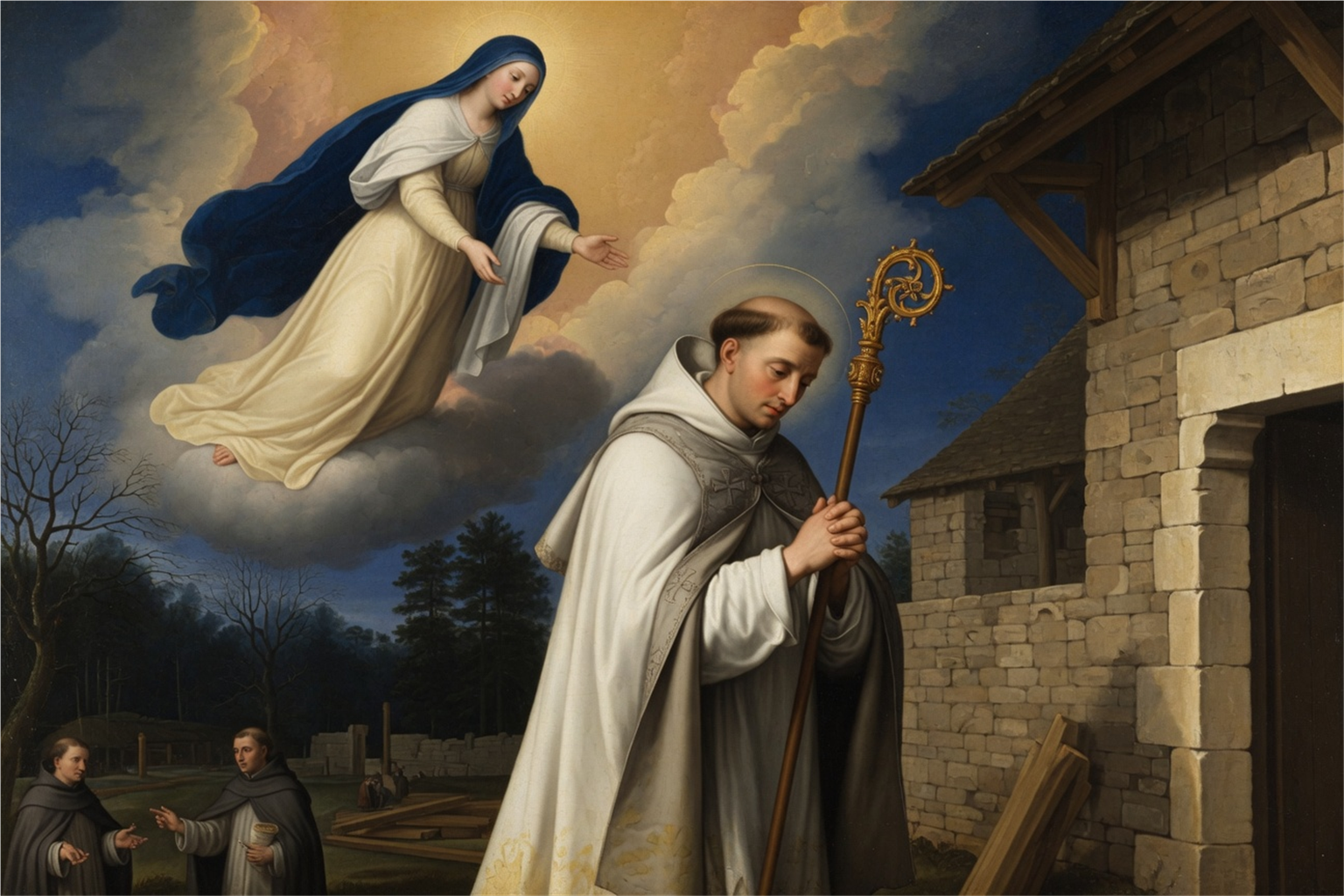
Saint Alberic was one of the three founding pillars of the Cistercian Order in the 11th century. Succeeding Saint Robert as abbot in 1099, he structured the Cistercian rule in all its rigor and obtained papal protection. Tradition attributes to him the adoption of the white habit, received miraculously from the Virgin Mary.
Guided reading
8 reading sections
SAINT ALBERIC, SECOND ABBOT OF CITEAUX
The Three Pillars of Cîteaux
Presentation of the Order of Cîteaux and its three major founders: Robert, Alberic, and Stephen.
He who is placed under the yoke of obedience will perish in a pitiful manner, instead of saving himself, if he resists his superiors.
Saint John Climacus, The Ladder, after the 26th step.
The Order of Cîteaux is so commendable in the Church, and the history of its origin is so holy and edifying, that one must omit nothing that can contribute to giving a perfect knowledge of it; and as the institution of religious Orders depends on their founder, it is not fitting to omit the life of Saint Alberic; fo r he is one o saint Albéric Second abbot of Cîteaux. f those whom God used to lay the first foundations of this great edifice, which divine Providence willed to be as if supported by three precious columns that were to sustain its entire elevation, we mean, the great Saint Robert, Saint Alberic , and Saint Stephen. le grand saint Robert Founder of the Abbey of Molesme and first abbot of Cîteaux. We shall give the l ife of the fi saint Étienne Third abbot of Cîteaux and co-founder of the Cistercian Order. rst on the 29th of the month of April, that of the third on the 17th of the same month: thus, it remains for us to give place to the second on this day, since it is that of his precious death.
Formation and trials at Molesme
Alberic joins Saint Robert at Collan and then Molesme, where he becomes prior and suffers persecution from monks who reject the reform.
The historians of the life of this great man have concerned themselves less with discovering the circumstances of his birth and his parents according to the flesh, than with the progress he made in virtue and the happiness he had in having Saint Robert as a father according to the spirit. We learn only from the Annals of the Order of Cîteaux, of which he is regarded as one of the founders, that he received an excellent education, which, joined to happy dispositions for the humanities, made him a man highly experienced in divine and human sciences; he could have enjoyed great wealth in the world, but he preferred to seek a place of retreat to live in poverty, following the counsels of Jesus Christ, who says: "Go, sell all that you possess, give the money to the poor and follow me!". In this sentiment, he resolved to go and reveal his design to Saint Robert, who was then governing the solitaries of Collan, and whose reputation spread everywhere a very sweet odor of sanctity.
He was received by this worthy superior with all the testimonies of benevolence imaginable. He showed his gratitude by immediately demonstrating to his brethren, through the holiness of his examples, that he wished to walk in the footsteps of the holiest anchorites who had preceded him.
The solitude of Collan being unhealthy, Robert led his solitaries into the forest of Molesme: it was in this place that forêt de Molesme Monastery of origin of the founders of Cîteaux. Alberic, animated and fortified by the spirit of the ancient Fathers of the desert, for whom he had always held a very high esteem, worked with his brothers, under the guidance of Saint Robert, to build an oratory and small cells in the middle of a forest, having then for all materials only tree branches and wet earth; this work, nevertheless, did not make them relax any of their ordinary exercises, holy readings, and prayer, nor cut back any of the precious time they ordinarily employed in singing the praises of God. But, a surprising thing, and one which well proves the change and weakness of the human spirit, this fervor that all the religious seemed to share soon slowed down; several lords of the country having given them, in rivalry, what was necessary for their maintenance and even beyond, the temporal income of the monastery became too considerable; these riches made them fall into great excesses. Saint Robert, unable, neither by prayers nor by remonstrances, to stop their disorders, retired to a desert called Haur, where there were solitaries who lived in great union and simplicity of heart. Alberic, whom he had made prior, governed the monastery of Molesme in his absence; he applied himself first to re-establishing the original observance, by joining powerful examples to frequent and pathetic exhortations; if he perceived that he gained nothing by the voice of gentleness, he knew how to use prudently all the authority that God had entrusted to him. Such great firmness, supported by an irreproachable life, openly condemned the disorders of those who only wanted to conduct themselves by following worldly and secular maxims; thus he soon became the object of the hatred of all those who looked upon him only as an inconvenient censor, and one saw, to use the terms of his history, disciples audaciously despising the salutary lessons of such a holy master, children rising against their father, subjects wanting to command their superior, and the guilty treating as a criminal the one who worked only to lead them on the path of perfection. They finally loaded him with opprobrium and insults; our Saint suffered all kinds of calumnies, and God, to present greater occasions of victory to his servant, permitted this persecution to be pushed so far that these bad disciples, having outraged him to excess, locked him up as a wretch worthy of the harshest punishments.
Alberic, seeing all his efforts useless, and his humility making him believe that God reserved for another the just reform he wished to introduce into this monastery, retired to a more solitary place, named by the Bollandists Vivificus, and Vinicus in Surius (Viviers), with Saint Stephen and two other religious, whose high virtue he knew, in order to practice with full liberty all that th eir piety Vivificus Episcopal see of Saint Venantius. would inspire them to do, to respond to what the spirit of grace asked of them; but God soon made it known that the instructions given by this worthy superior to the religious of Molesme had not been useless, and that this seed was to bear fruit in its time; for, scarcely had he retired, when his disciples, opening their eyes, recognized the fault they had committed; they wept for it, did penance for it, and thought only of seeking the means to bring back to Molesme, not only their prior Saint Alberic, but also Saint Robert, who had preceded him in the office of abbot, and Saint Stephen. The matter succeeded after great diligence which they used for this purpose, especially as the authority of the sovereign Pontiff and the bishop of Langres was interposed. The three great servants of God therefore returned to this solitude, where they were very well received: Saint Robert in the capacity of abbot; Saint Alberic in the capacity of prior; and Saint Stephen in the capacity of sub-prior; perfect obedience was rendered to them, and they saw, with much joy, all minds reunited and disposed at least then to a perfect observance of all the rules.
The foundation of the New Monastery
In 1098, Alberic participated in the foundation of Cîteaux and became the second abbot after Robert's forced departure for Molesme.
But at a time when all the religious believed they would never again lose such holy leaders, they were once more deprived of their presence and their help. These three illustrious figures, always hungering and thirsting for greater justice, and feeling themselves called and drawn to a higher perfection than that which was practiced at Molesme, where they were obliged to constantly exempt the less fervent from certain points of the rule, formed and executed, with the required permissions, the plan to withdraw to a very rural and very solitary place named Cîteaux, where they went under the inspiration of heaven, in order to establish a new Order there.
It was in the year 1098 that Saint Robert, Saint Alberic, and Saint Stephen, after having left all things in good order at Molesme, came to settle at Cîteaux, not far from Dijon, accompanied by several other fervent religious who followed them. But Saint Robert, having been abbot of this monastery for no more than a year and a few months, was withdrawn from it with the consent of the Sovereign Pontiff Urban II, to go a third time to govern the religious of Molesme, who had made extraordinary requests to obtain this favor; it is on the occasion of this great loss that the religious of Cîteaux canonically elected as abbot, in his place, the pious Alberic, whose life we present le pieux Albéric Second abbot of Cîteaux. here.
This election took place in the year 1099: he did everything he could to avoid accepting this dignity; but having finally recognized the order of God, he took on this burden, associating as prior and colleague in his labors Saint Stephen, who became his successor after his death, and who is recognized as the third founder of the Order, as can be seen in his life, on April 17.
Ascetic Life and Manual Labor
Description of the rigorous life of the monks, dividing their time between the divine office, manual labor, and extreme poverty.
Our Saint, therefore, considering on one hand the power he held as superior to increase the purity of this holy and strict observance for which he had always maintained a very high esteem, and having moreover the consolation of having as disciples subjects well disposed to follow all that he would inspire in them, began to express his sentiments freely, first doing much more himself than he wished of others, and supporting by his fervent exhortations, joined to a holiness of life that was entirely exemplary, the most beautiful work of piety seen in his century.
These holy solitaries yielded in nothing at that time to those of the Thebaid; they divided the night into three parts; they rested for approximately four hours; during the following four hours, they sang psalms and hymns to proclaim the praises of God, and during the other four hours, they occupied themselves with manual labor; their most ordinary work was to transport and cultivate land to grow vegetables which composed their entire diet. Following this work, or some other similar task, they engaged in pious readings and recited private prayers; so that many other similar holy practices, succeeding one another in this way, did not allow them to give themselves any respite either by day or by night.
Their garments, very poor and very simple, were composed only of very coarse fabrics that they knew how to prepare with their own hands. Some authors even say that their clothing was made only of palm leaves skillfully interwoven with one another. It was also through the care of Saint Alberic that one saw in a short time a monastery built quite regularly, and it was easy to raise such an edifice, since they sought above all else only to build a large quantity of very simple cells to house the postulants who came, and to construct a small church in honor of the Blessed Virgin, and a few other regular places absolutely necessary to be sheltered from the greatest inclemencies of the weather.
It was a thing that attracted the admiration of everyone to see the holy abbot, setting the example for the others, carrying earth and other very heavy burdens to advance these buildings; he knew how to nourish his spirit with pious sentiments that he drew from the psalms, at the same time that he occupied his body with manual labor; and although he was very aged, he did not cease to subdue his flesh through bodily mortifications, through fasts and vigils that surpassed, says his historian, all that one can imagine; for, when the religious went by necessity to take their rest, he used this time of the night to subject his body to long flagellations, and if he took any sleep at all, it was on two bare planks: this manner of taking his rest on this bed of penance gave him the ease to rise before the others; in such a way that he had ordinarily recited the entire Psalter before the other religious had risen to come to sing Matins.
Statutes and protection of Rome
Alberic obtains the protection of Pope Paschal II and drafts the first statutes imposing the strict observance of the Rule of Saint Benedict.
The reputation of the holy abbot and his illustrious disciples spread with such brilliance and flew so high everywhere, that two famous cardinals, Benedict and John, sent to France as legates by Pas chal II, Pascal II Pope reigning during the episcopate of Geoffrey. successor to Urban II, came to lodge out of devotion in their poor dwelling, where they admired, with incredible satisfaction, the life more angelic than human of these new religious. After recognizing that their design came from heaven, they persuaded them to send to the court of Rome, to ask the sovereign Pontiff for his special protection in their holy undertakings, and the confirmation of their establishment: which they executed with success; for Saint Alberic sent two of his religious, named John and Hodebert, who, provided with several letters of recommendation and instructions that had been given to them by the two legates, by their own bishop and even by the archbishop of Lyon, obtained from His Holiness everything they wished. The monastery was placed under the protection of the Holy See.
One still sees with pleasure, in the Annals of Cîteaux, all these letters and the other acts that concern the first establishment of this Order. It would be difficult to express the joy that Saint Alberic received, seeing himself authorized by the sovereign Pontiff in his designs, by the bull brought to him by the religious who returned from Rome. He composed at that time various statutes and several holy ordinances which he published and which were accepted; they had no other end than to make observed, in all rigor and to the letter, the rule of Saint Benedict, and consequently to reject several contrary customs that concerned clothing, food, the possession of goods and other similar things. It is important to attach oneself to these details to judge the part that the glorious Saint Alberic took in this work, and one should not be astonished if several authors attribute to him the quality of principal founder of the Order of Cîteaux; for, without saying, as some acts reported by Bollandus wish to insinuate, that he came, even before Saint Robert, to the desert of Cîteaux, it is still indubitable, as we have said, that the same Saint Robert only stayed about a year in this place; that when he left it and placed his abbatial staff in the hands of Gautier, bishop of Chalon-sur-Saône, all the religious were publicly declared exempt from the obligation to obey him, as they had promised before; and that it was consequently Saint Alberic, who knew how to first stop, by his gentleness, his wisdom and the strength of his examples, all these solitaries who, in the freedom they had just received, could have, under different pretexts, asked to withdraw here and there, into neighboring monasteries where one did not observe by far this great rigor of Cîteaux. Thus it seems clear enough that the Saint of whom we speak, after having sustained his brothers in regularity and fervor since the absence of Saint Robert, was elected abbot in his place, as we have already said, by the suffrages of the community, in the presence and with the consent of the bishop of Chalon, who presided over the election; it is also agreed that he was the first who perfected, who even composed in part and had received the constitutions of this beginning Order; which he executed with a fervor, a constancy and a zeal always new, for the space of nearly ten years. These regulations are qualified, in the first histories of this Order, only as institutions of the monks of Cîteaux, who came out of Molesme. The abuses they repress are furs and precious skins, the superfluities of clothing, the trimmings of beds, the diversity and abundance of meats, the use of lard, etc. Alberic resolved to have lay brothers, to take care of the farms and the cultivation of the lands, because, in accordance with the rule, the religious had to remain in the cloister to attend to prayer and divine service.
The institution of the lay brothers and the white habit
Creation of the lay brothers and the miraculous account of the change from the black habit to the white habit through the intervention of the Virgin Mary.
These lay brothers were most often simple and upright men who knew neither how to read nor to sing, but who were nonetheless worthy of the religious life. They took the same vows and enjoyed the same spiritual benefits as the choir brothers, only they were not obliged to the office and could thus devote all their time to work. Each time they heard the convent bell ring a canonical hour, they would kneel, or lean bowed on the handles of their spades, their hoes, or their scythes and recite Paters and Aves, in union with the Fathers who were singing the office, thus mingling their prayer with the hymns of the birds, the sound of the winds, and the harmonies of the heavens to adore God and salute the Virgin Mary.
The habit of these religious was at first gray or black in color, but Alberic changed it to a white habit, with a gray scapular.
Here is how tradition recounts this symbolic change: On the day of the Nones of August, while Alberic and his monks were singing Matins in the choir, the most holy Virgin suddenly appeared in their midst, and approaching the blessed abbot, she placed a robe of pure white upon his shoulders, and, at that very instant, the garments of the other religious became white, and the spotless Virgin ascended back to heaven with the Saints who formed her cortege.
The feast of this miracle was celebrated in the Order of Cîteaux, on August 5th, under this title: Descent of the blessed Virgin Mary to Cîteaux, and miraculous change of the black habit into the white habit, under the most holy abbot Alberic. The white habit was like a livery of the holy Virgin: thus all Cistercian monasteries were dedicated to Mary.
This apparition is not an isolated fact: often the Mother of Jesus showed herself to the brothers "of the desert of Cîteaux" to defend and console them. Nothing is as graceful as these poetic legends which show us the most sweet Virgin Mary visiting the monks who sing the office and inflaming them with zeal, relieving those who plow, cut wood, or carry burdens, and wiping the brows of the harvesters. Sometimes, they tell us further, she surrounds them, in the heart of the night, with a peaceful light; sometimes she presents her divine Son Jesus to their adorations, or kneels with them before him; sometimes she makes the immortal crown shine before the eyes of the dying, supports them against the terrors of death, and waits for their soul to carry it before God.
One of the brothers, whom the Annals do not name, saw the heavens opened, and, on sparkling thrones, the choirs of angels, the patriarchs, the prophets, the apostles, and the martyrs... then religious of different Orders. He looked for those of his brothers who had departed from this world and could see none of them... "What is this, then? O most holy Virgin," he cried out with dread, "I see none of my brothers!... Could it be possible that religious who are so devoted to you are excluded from paradise?..." The Queen of Heaven, seeing him troubled to the depths of his soul, answered him: "They are so dear to me, my sons of Cîteaux, that I keep them upon my heart," and, opening her mantle of marvelous breadth, she showed him the religious of her family. Transported with joy, he recounted what he had seen, and all the brothers blessed God for it.
The providential arrival of novices
After a period of dearth in vocations, the miraculous arrival of a cleric named Robert restores hope to the community.
However, a terrible trial weighed upon Alberic: death continued its work in the new monastery, and no one came to occupy the stall or take up the spade of the deceased. He was saddened by this, and however resigned he might be in his abandonment, the fear that Cîteaux might be buried with its first founders afflicted him deeply. He often complained of this to God and insistently asked for novices. When this trial had sufficed for the designs of Providence upon the blessed Alberic, it ceased, at least for a time, with the arrival of a postulant whose miraculous vocation gladdened the desolate community. He was a cleric and a student at the schools of Lyon. One day, as he was asking God for the grace to know the way to heaven, he saw in a vision a deep valley and, upon a high mountain that rose in the middle, a magnificent city... He wished to ascend it, but a wide river protected its avenues. Seeking a place where he might cross, he saw on the opposite bank twelve or fourteen poor men who were washing their tunics. One of them had a garment of dazzling whiteness, and he helped each of his companions in turn. 'Who are you?' the cleric said to them. 'These poor men are monks who do penance and purify themselves of their sins; I am Jesus Christ... This city is Paradise, where I reign with those who have washed their garments and done penance; here is the path you have been asking to know for so long.' The cleric recounted his vision to the Bishop of Chalon, who told him to become a monk and indicated the way to Cîteaux. He obeyed. At the wicker gate hung an iron hammer; he lifted it, and it was one of the poor men from his vision who came to open! He recognized all the other monks in the same way and told them how he had already seen them, which filled them with joy. This cleric, whose name was Robert, became an excellent religious and was prior.
Death of Alberic and legacy
Death of Alberic in 1109, followed by the funeral eulogy of his successor Stephen Harding and the historical sources of his life.
We would never finish if we wished to report everything we find to the glory of this holy founder in the records of his Order; it remains for us to say something of his pious death. This holy abbot, having thus happily accomplished what divine Wisdom had desired of him for the institution of one of the holiest and most famous congregations, was judged worthy to go and possess the heavenly object for which he had been seen to sigh so frequently; this reward was procured for him by a fever that was violent enough to cause the death of one who could no longer live except by the life of the Blessed. Being at the point of death and seeing his religious bathed in tears and saddened by the state of suffering in which they saw him, he consoled them and raised their courage, telling them that they should not pity him in the pains they saw him suffering, since they were going to put him in possession of a great happiness; adding that, if they knew what was the degree of glory to which God had made him know they were called, the present life would become quite tiresome to them, and they would work only for heaven. Then he recited in a very distinct voice, which marked the contentment of his heart, the Apostles' Creed; after which, he said the *Psalmodies of the Blessed Virgin*, and after these words, *Sancta Maria, ora pro nobis*, Mary, pray for us, his venerable face became radiant like a sun, and he gently rendered his beautiful soul to his God, on January 26, the year 1109. It is said that he appeared several times to his religious when they were in the choir, or at prayer, or at manual labor, exhorting them to work effectively for their sanctification.
Saint Stephen, who succeeded him, gave an admirable discourse on this subject t o his religio Saint Étienne Third abbot of Cîteaux and co-founder of the Cistercian Order. us, which has been happily preserved, and where, after having expressed, on the one hand, the sorrow with which he himself is penetrated for this common loss, he immediately animates them, telling them that they must nevertheless remember that there is nothing in the world more advantageous, for those who have long fought on earth for the glory of Jesus Christ, than to be delivered from the mortal flesh with which we are enveloped, in order to go and enjoy with more freedom the one whom one loves above all things, and that one must shed tears much rather for those who remain here below in the combat, always in doubt whether they will win the victory, than for those who, being victorious, have gone, like the holy abbot Alberic, to receive the palm due to their labors. One will be able to see this discourse at greater length in the history of the Order.
Saint Alberic can be represented in the following manner: the Blessed Virgin appears to him and gives him the white habit of the Cistercians; she appears to him again at the hour of his death; he is also associated with the three famous religious of Cîteaux, Saint Robert, Saint Stephen Harding, and Saint Bernard of Clairvaux.
We have drawn what we have said in this life from volume IV of the Annales de Cîteaux and the Acta Sanctorum. The Rev. Fr. Dom Pierre-le-Nai n, sub-prior of th Dom Pierre-le-Nain Sub-prior of La Trappe and author of an essay on Cîteaux. e Abbey of La Trappe, formerly gave to the public a work in French, which bears the title: Essai sur l'Ordre de Cîteaux; one will be able to discover there several particulars on the life of this great Saint. — See also Saints de Dijon, by Abbé Duplus.
Annexes & related entities
Structured data for exploration: events, miracles, quotes, places, attributes, patronages, and important entities cited in the text.
Key Events
- Entered the monastery of Collan under the direction of Saint Robert
- Foundation of the monastery of Molesme
- Prior of Molesme and persecution by recalcitrant monks
- Retreat in Viviers (Vivificus)
- Foundation of the Cistercian Order in 1098
- Election as second abbot of Cîteaux in 1099
- Obtained protection of the Holy See from Pope Paschal II
- Miraculous change of the black habit to a white habit
Miracles
- Miraculous change of the black habit into a white habit by the Virgin Mary
- Vision of a Lyonnais cleric showing Alberic and his monks purified by Christ
- Face radiant like the sun at the moment of his death
Quotes
-
Go, sell everything you own, give the money to the poor, and follow me!
Gospel (cited as initial motivation) -
They are so dear to me, my sons of Cîteaux, that I keep them upon my heart
Words of the Virgin Mary in a vision