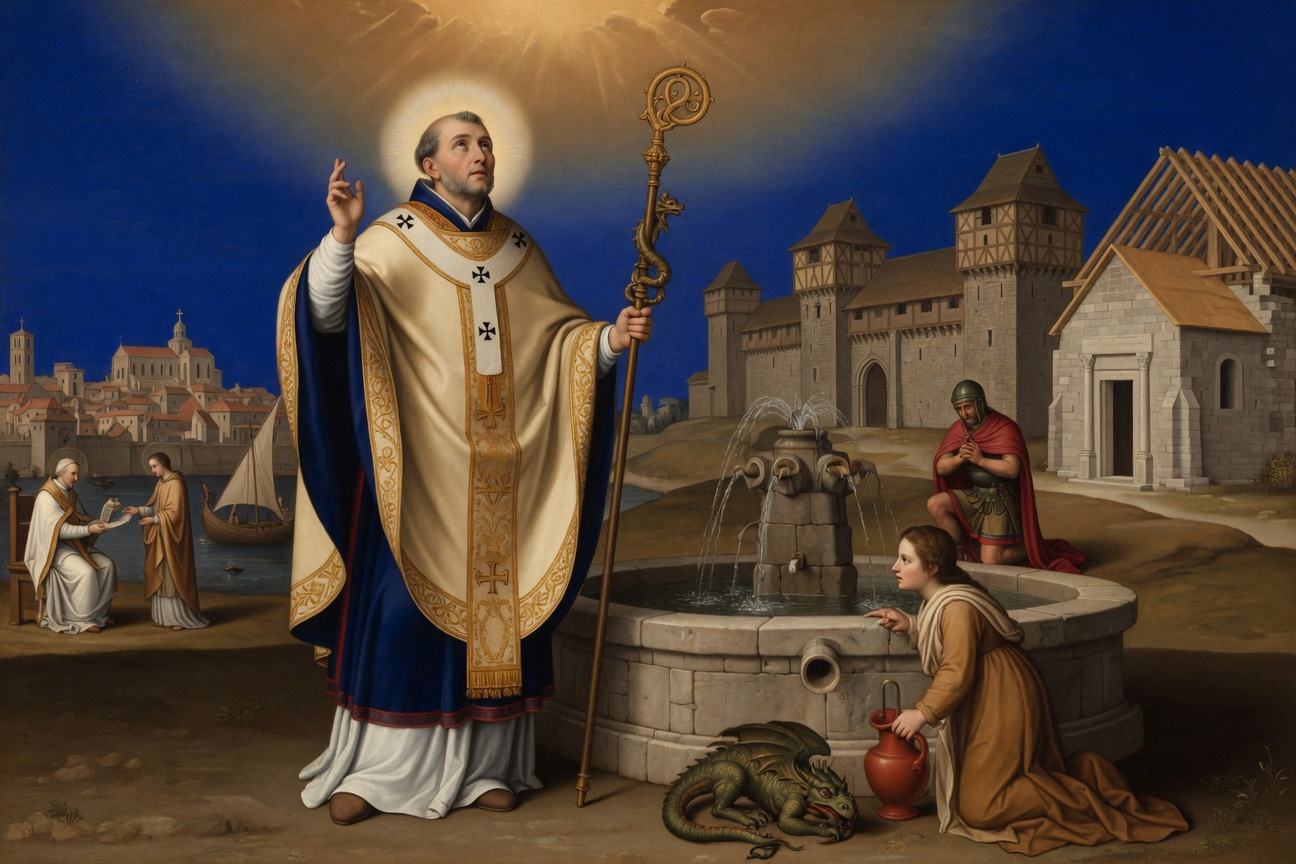
The first bishop of Le Mans sent from Rome, Saint Julian evangelized the Cenomani in the 2nd century. He performed numerous miracles, notably causing a spring to gush forth and raising the dead, thereby converting the leaders of the city. He died in peace after an episcopate of forty-three years.
Guided reading
8 reading sections
SAINT JULIAN, FIRST BISHOP OF LE MANS
Origins and Apostolic Mission
The text presents two traditions regarding the origin of Julian: either Simon the Leper sent by Saint Peter, or a Roman patrician sent by Pope Saint Clement to evangelize the Cenomani.
The only reason for miracles is the power of God who performs them. Saint Gregory the Great, Rom. xx. If one is to believe tradition, Sain t Julian, ap saint Julien First bishop of Le Mans, whose burial place was honored by Innocent. ostle and first bishop of Le Mans, is the same as Simon the Leper, who had the happiness of seeing the Son of God made man eat at his table. He subsequently became his disciple and was sent to France by the prince of the Apostles, Saint Peter. But it is more probable that Julian (Julianus) was born in Rome to a patrician family, and that he rece ived from Pope Sai pape saint Clément Pope who ordained and sent Latuin on a mission. nt Clement, along with the episcopal character, the mission to evangelize the Cenomani. He had as companions in his apostolic labors the priest Thuribius and the deacon Pavacius, who were his successors; all three advanced toward the capital of the province they were to win for Jesus Chri st, Suind Suindinum Episcopal see and primary place of activity of the saint. inum, a fortified city which occupied only a part of the current enclosure of Le Mans. Arriving at the ramparts, they found the gates closed, for the city was at war with its neighbors and seemed to be guarding against a surprise attack. They were therefore obliged to preach first in the countryside, where they were able to convert and baptize some idolaters. However, they hardly strayed from the city, watching for the opportunity to enter. Julian, to obtain this favor, prayed, wept before God, and gave himself over to great austerities. Finally, his prayers were answered. The inhabitants having one day gone out in quite large numbers because they lacked water, Julian took advantage of this circumstance, presented himself to them, preached to them the true God and the redemption of men through Jesus Christ, and, to show the truth of his word and his mission, he planted his staff in the ground, threw himself on his knees, prayed, and caused an abundant spring to gush forth in a place where water was naturally rare, as was recently confirmed by digging an artesian well very close by. This fountain was called Centonomius, or better, Sancti-Nomius, the benefit of the Saint; it still flows today and bears the name of Saint-Julien; it is shown in the Place de l'Éperon; it is decorated with a bas-relief representing the miracle: a new Moses, Saint Julian, in pontifical vestments, makes water gush from the rock by striking it with his pastoral staff; at his feet, a young girl fills her urn with the miraculous water.
The miracle of the fountain
Arriving before the closed walls of Le Mans (Suindinum), Julian causes a miraculous spring to gush forth for the thirsty inhabitants, marking the beginning of his influence.
The news of this wonder spread; people flocked from all sides to witness it; Julian became the object of universal admiration and respect; he was led as if in triumph into the city and was listened to at first with curiosity. But, when it was seen how difficult it was to practice the new religion he brought, most hearts closed. It does not appear that the Roman magistrates, who governed the city in the name of the empire, hindered the freedom of his preaching. But the rich and powerful inhabitants, seeing in his doctrine the condemnation of their corrupt morals, persecuted him. Fortunately, the most influential man in the city, a Gaul honored by the votes of his fellow citizens with the office of defender, which consisted of watching over the protection and safety of the people, having learned of the wonder performed by this stranger, desired to see him. He had him brought to his palace, located in the highest part of the city, at the place where the cathedral stands today. Julian, having met a blin cathédrale Religious building founded on the former palace of the city's defender. d man at the door of this magistrate who was asking for alms, restored his sight. This new prodigy made a vivid impression on the defender; he welcomed our Saint with the greatest respect, had himself instructed in Christian virtues, received baptism with his wife and his entire family, and gave, to be made into a church, the largest hall of his palace, called, as in all the dwellings of the great among the Romans, a basilica. This cathedral was first consecrated under the august title of the Blessed Virgin and the Prince of the Apostles, Saint Peter; it later bore the names of the holy martyrs of Milan, Gervasius and Protasius, and finally that of Saint Julian. Our Saint, wishing to unite the Christians in a holy assembly, not only during their lives but also after their deaths, chose for their burial a place not far away, but outside the city; he consecrated it and erected there an oratory in honor of the holy apostles Peter and Paul. There stands today the church of Notre-Dame du Pré.
Conversion of the authorities and foundation
After healing a blind man, Julian converts the 'defender' of the city, who transforms his palace into the first cathedral of Le Mans.
Two things contributed above all to the conversion of the infidels: the charity of the Christians who, following the example of the holy apostle, tended to the sick, the poor, and the orphans, and striking miracles that we cannot recount all here. One of the first citizens of the city, named Anastasius, whose son had just died, having recourse to Julian, said to him: 'If you can restore life to my son, I confess that Jesus Christ is the true God, and I renounce forever the divinities that I have adored until this day.' The holy pontiff indeed goes to the dead, takes his hand, raises his eyes bathed in tears toward heaven, while those present weep and pray as he does, and implores Him who drew Lazarus from the bosom of death to renew this prodigy, so that this bodily resurrection might be, for a great number, the cause of a spiritual resurrection. Soon the child seems to wake up, rises, and his parents receive him full of health into their arms. Anastasius received baptism with his whole house, and many idolaters imitated him.
Struggle against Druidism and rural missions
Julien travels through the countryside to convert the Gauls, multiplying resurrections and healings to supplant the influence of the Druids.
After triumphing over the Roman religion in the city, Julien undertook to combat that of the Gauls (Druidism), which was much more powerful, for the Druids had a great reputation for knowledge and, moreover, they were persecuted for having defended the independence of their nation against the conquerors: two motives that made them dear to the people. People eagerly attended the mysteries they celebrated in the forests and heaths so common in these regions. But, outside of these gatherings, each Gallic family lived separately, in huts made of earth and branches. It was therefore much more difficult to evangelize the countryside than the cities. Julien and his companions nevertheless knew how to win souls for Jesus Christ there and form churches. Their conquests extended as far as the land of the Arviens and the Diablintes. Prodigies were more necessary than ever: near Saint-Julien-en-Champagne and Neuvy, the apostle's feet left their miraculous imprint on a stone, which is still shown today. Meeting on his way a funeral procession that was leading an illustrious deceased man named Jovinian to his final resting place, he addressed the father of the dead adolescent and the troop of idolaters who accompanied him, made them promise that they would embrace the religion of Jesus Christ if he demonstrated its divinity by the resurrection of the one they were mourning, and addressed a fervent prayer to God. The dead man rose again and cried out: "Great indeed is the God that Julien proclaims"; then he said to his father: "We were worshipping demons; I have seen them in hell, where they suffer eternal torments." At the sound of these wonders, a large crowd flocked and followed the Saint everywhere, just as they once followed Jesus Christ. One day, as he was going to the estate of Pruillé-l'Éguillé, the master, who was a pagan, asked him to stay at his home. But at the very moment Julien arrived, a young child, the son of his host, died. This did not prevent him from entering the house to stay there. He simply spent the night in prayer, and the next day, the child was found full of life and health. His parents and the witnesses of his resurrection asked to embrace a religion that announced itself through such prodigies and such benefits.
People came from everywhere to the man of God, pressing upon his footsteps; several sick people, not daring to ask him for their healing, were content to follow him and awaited this benefit with ardor. The apostle's disciples noticed this and told him; he, without answering, turned toward the crowd and gave his blessing to those present: immediately all the infirm were healed. To perpetuate the memory of this miracle, a chapter of canons was later established at the same place. In the village of Ruillé-sur-Loir, the only daughter of a powerful man, who was cruelly possessed by the demon, was presented to Julien. He delivered her publicly and also converted a large number of idolaters, then founded a church in this village. A new prodigy strengthened the faith of the neophytes. A blind man, having applied to his eyes the water with which the apostle had washed his hands, received at the same time the light of the body and that of the spirit.
Triumph over idolatry
In Artins, Julian destroys an idol and subdues a monstrous serpent, prompting the mass conversion of the local populations.
His zeal for destroying the worship of false gods brought great persecutions upon Julian. One day, nea r Arti Artins Site of a major miracle involving the destruction of an idol and a serpent. ns, a crowd of idolaters gathered furiously around him, threatening to kill him; far from trembling, our Saint entered their temple, and, by the sole invocation of the name of Jesus Christ, overturned and reduced to dust an enormous idol; a serpent emerged from it, which threw itself upon its own worshippers and caused a great number of them to perish. Then the idolaters, instead of threatening the apostle, implored his help; he made the sign of the cross and commanded the reptile to flee without harming anyone. He was obeyed. All these people converted, tore down the pagan temple themselves, and had themselves instructed and baptized. The defender, having come to find the holy bishop to tell him that the city was demanding his return, witnessed a great miracle. As they were traveling through the countryside together, they encountered a child whom a frightful serpent had entwined in its coils and was preparing to devour. All those present shuddered with horror. The Saint approached, offered a fervent prayer, and the reptile burst through the middle of its body. When they returned to the city, among the crowd celebrating the return of its pastor, many idolaters mingled, among others two demoniacs who presented themselves to Julian to be healed. He put the demons to flight in the name of Jesus Christ. After taking part in a banquet with the principal faithful, happy to see their father again, and settling what the needs of his church required, Julian, refusing the hospitality offered to him by the defender, returned to the poor dwelling he had chosen near the city, and to his apostolic labors. When he passed before the prison door, six wretches who were in irons cried out loudly, begging him to have pity on them. He went, in fact, to ask for their pardon from the magistrates; having been unable to obtain it, he took no food, kept silence, and did not cease to groan and pray. God, answering his prayer, sent angels who opened the prison doors and broke the captives' chains. They published the praises of their liberator everywhere and came to thank him. Julian, associating himself with their happiness, wished for them to share his meal.
Final years and death
After a journey to Rome, Julian retired to Saint-Marceau where he died in 117, after more than forty years of episcopate.
Sent by the Vicar of Jesus Christ, the apostle of the Cenomani returned to Rome to report on his mission, to request the confirmation of his work, and the erection of this new Church. He brought back from it, along with abundant blessings, relics which, by fixing the devotion of the newly converted idolaters, turned them away from the superstitious worship they still rendered to fountains, woods, and rocks. It is probable that he also brought back from Rome new evangelical workers; he neglected no means to increase and instruct his clergy; everything leads one to believe that he established for this purpose a school where he taught at first himself. Finally, exhausted by fatigue, filled with merits, and knowing that his end was near, he wished to prepare for it in solitude. He therefore entrusted the care of his church to Thuribius, and retired, a half-day's walk from the city of Le Mans, on the banks of the Sarthe, at the place where the village of Sai nt-Marceau st Saint-Marceau Place of retreat and death of Saint Julian. ands today. After some time, a slow fever warned him of his final hour. He then had the clerics and the principal faithful gathered around him, recommended to them obedience to his successor, then, while with hands extended toward heaven he praised God and gave Him thanks, his soul separated gently from his body and flew away toward the dwelling it had merited, on January 27, 117, according to several ancient authors, after forty-three years, three months, and seventeen days of episcopate.
Funeral and posthumous wonders
His body was brought back to Le Mans during a procession marked by miracles, notably the crossing of the Sarthe river on dry land by the funeral carriage.
The defender, who did not witness this glorious death, was warned of it in a vision; he saw Julian, in priestly vestments, coming toward him, accompanied by three deacons who each carried a candle. They placed these candles on a table and withdrew. The defender shared this wonder with the people who were with him. He told them that Julian had just given him his blessing, to show him a ray of the glory into which he had entered. "Let us rise," he said to them, "and go to bury the remains of our master." Immediately he departed, followed by the whole city, and he brought back the body with great pomp. The place where he died continued nonetheless to be venerated. The confidence of the pilgrims was more than once rewarded by wonders. A small chapel was erected there, which depended on the Abbey of Saint-Vincent of Le Mans. It was later rebuilt in the Gothic style. During the French Revolution, this oratory became private property, and today it is falling into ruins. "However, one can still admire the remains of beautiful architecture: stained glass windows that retrace the main features of the life of Saint Julian, a reliquary adorned with enamels that once contained a portion of his relics, and finally very ancient statues. Under the main door springs a fountain of living water from which those afflicted with fever drink to obtain their healing."
The procession that brought the precious remains of Julian back to the city arrived at the Sarthe river; it was no longer fordable, as the winter rains had swollen it. This was an occasion for God to manifest the glory of his servant. The horses that led the funeral carriage walked on the water as if on dry land, amidst universal admiration. That is not all: a woman who was washing her child in a cauldron placed on the fire forgot him and ran to join the crowd accompanying the body of Saint Julian. In her absence, the flame grew, enveloped the cauldron, and the water boiled and overflowed. The thought of her son, whom she had left exposed to such great peril, crossed the mother's heart; she ran back and found him without fear and without suffering. She then cried out and attracted a large number of people to be witnesses of her happiness and of this wonder. Saint Julian was buried in the cemetery of the Christians, probably in the oratory he had erected there. This basilica, which survived until the French Revolution, became the meeting place for such a considerable number of pilgrims that it was necessary to build several hospitals to receive them.
Saint Julian is represented chasing a dragon, a figure of the idolatry that disappeared before his preaching; or else, near him, a young girl carrying a pitcher of water recalls the miraculous fountain that the apostle of the Cenomani caused to spring forth at the entrance to their city.
History of relics and writings
Julien's writings were destroyed by the Calvinists in 1562; his relics, transferred several times, survived despite revolutionary profanations.
## WRITINGS AND RELICS OF SAINT JULIEN.
The apostle of the Cenomans left several writings on our mysteries, on the divinity, the angels, and the most holy Sacrament of the altar. The liturgy of Le Mans praises their eloquence highly. They were kept as manuscripts in the cathedral of Le Mans, where they perished at the hands of the Calvinists in 1562.
His relics did not remain intact in the c emetery of L Saint Aldric Ninth-century bishop who oversaw the translation of the relics of Pavace. e Pré. Saint Aldric transferred them to the cathedral (849), where he placed them on an altar, to the right of the main altar, dedicated to Saint Gervais and Saint Protais. Long after (1893), they were placed on a grand altar built specifically for this purpose, behind the altar of Saints Gervais and Protais, in the most prominent location, so that Julien no longer appeared as a guest who does not occupy the main place, but as a patron of the cathedral. In 1136, these holy relics were saved from the fire that was already devouring the thatched roof of the cathedral. Every time translations of the relics of Saint Julien were performed, they were marked by numerous miracles. A paralyzed priest, a mute child, another priest consumed by fever, a man with a tumor that made his hand deformed, children who had fallen into the water and for whom their devoted father implored the protection of Saint Julien, are all the subjects of such miracles. When the body of the Saint was carried to Châteaudun, where it remained for two years, the entire journey was a series of wonders. A famous translation took place in 1254: it was spoken of throughout all of France. This solemn cult of the relics of Saint Julien was to be followed, in the last centuries, by horrible profanations. The cathedral church of Le Mans suf fered greatly fr Vandales de 1793 Period during which the saint's relics were hidden and lost. om the Calvinists and the Vandals of 1793. At that time, the reliquary that contained his precious remains was sold for a pittance; however, the sacred bones of the apostle of Le Mans have been recovered, and are still venerated with the greatest respect. He is the patron of this church.
We have borrowed the substance of this biography from the scholarly *Histoire de l'Église du Mans*, by D. Fiolin, 19 vol. in-8°.
Annexes & related entities
Structured data for exploration: events, miracles, quotes, places, attributes, patronages, and important entities cited in the text.
Key Events
- Evangelization mission to the Cenomani entrusted by Pope Saint Clement
- Miracle of the gushing fountain in Le Mans
- Conversion of the city defender and foundation of the first church
- Resurrection of the son of Anastasius and the son of Jovinian
- Return to Rome to report on his mission
- Retirement in Saint-Marceau before his death
Miracles
- Spring gushing forth after striking the ground with his staff
- Healing of a blind man at the magistrate's gate
- Resurrection of the son of Anastasius
- Resurrection of Jovinian
- Destruction of an idol and submission of a serpent at Artins
- Miraculous deliverance of prisoners
- Crossing of the Sarthe river by the funeral chariot walking on water
Quotes
-
If you can restore my son to life, I confess that Jesus Christ is the true God
Anastasius