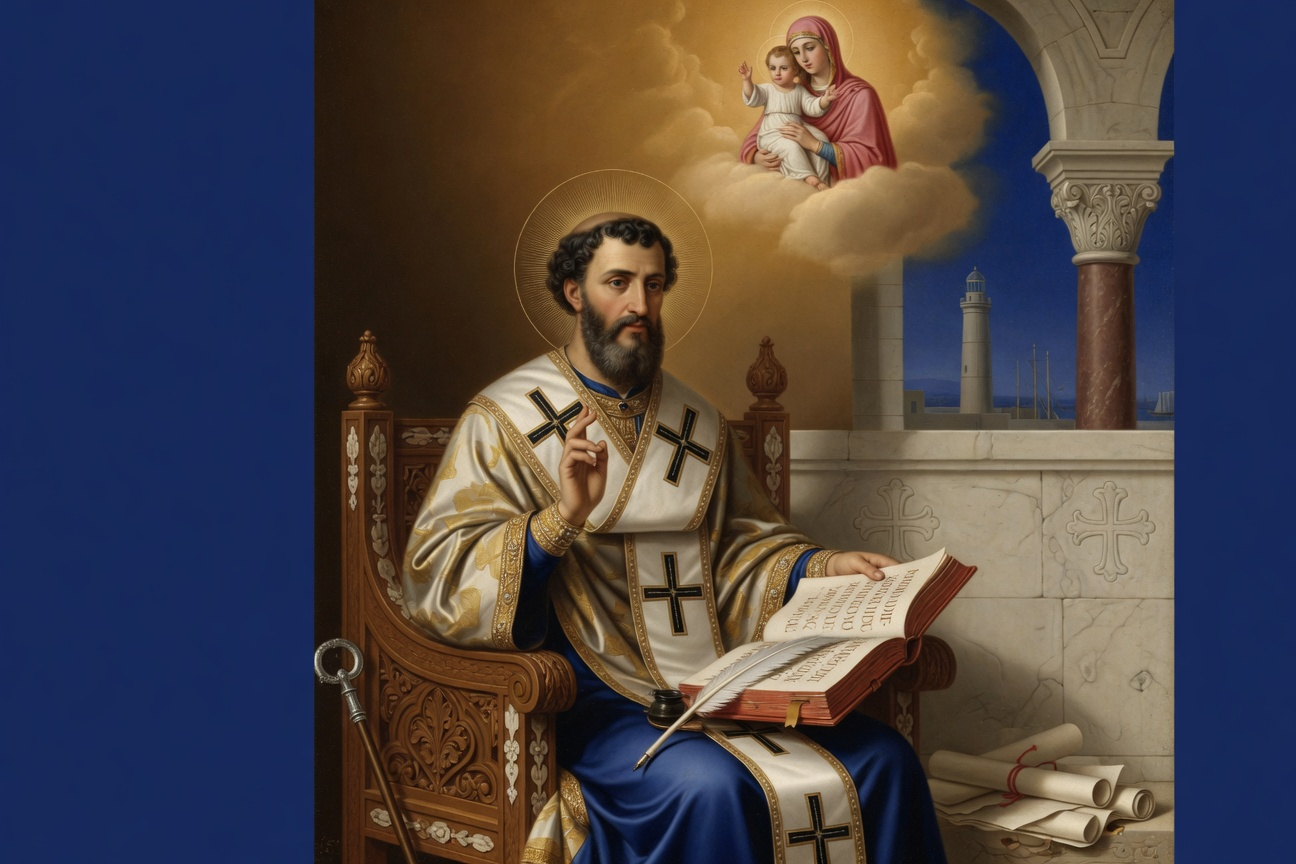
Saint Cyril of Alexandria
DOCTOR OF THE CHURCH
Patriarch of Alexandria, Doctor of the Church
Patriarch of Alexandria in the 5th century, Cyril was the great defender of the dogma of divine motherhood against Nestorius at the Council of Ephesus. Despite beginnings marked by political and religious tensions in Alexandria, he distinguished himself through his immense theological work and his attachment to the tradition of the Fathers. He is recognized as a Doctor of the Church for his writings on the Incarnation and the Trinity.
Guided reading
7 reading sections
SAINT CYRIL, PATRIARCH OF ALEXANDRIA,
DOCTOR OF THE CHURCH
Youth and intellectual formation
Cyril was educated in Alexandria by his uncle, Patriarch Theophilus, dedicating himself to the study of the Scriptures, the tradition of the Fathers, and secular authors.
Alexandria in Egypt and Constantinople vie for the glory of having seen the bir th of him whom the Council of Chalcedon would later call the advocate of the orthodox and celui que le concile de Chalcédoine devait appeler plus tard l'avocat de la foi orthodoxe Church Father who praised Maximian. spotless faith.
Nourished from childhood in the study of the sacred books under the eyes of his uncle T son oncle Théophile Patriarch of Alexandria and opponent of John Chrysostom. heophilus, the famous patriarch of Alexandria who proved to be the cons tant enemy of Sai saint Chrysostome Patriarch of Constantinople whose support caused the exile of Anatolius. nt Chrysostom, Cyril subsequently added to this the study of tradition, and he was always so attached to the doctrine of the ancient Fathers that he taught nothing except according to them, as he himself inform s us. His books Julien l'Apostat Roman emperor and persecutor of Christians. against Julian the Apostate show that he also had a great knowledge of secular authors.
But from a certain point of view, the education of the heart had not been as good as that of the mind. His uncle had inspired in him all his prejudices, all his hatred against Saint John Chrysostom. God, who does not spare the rod for his saints, permitted precisely that Cyril should be, like Saint Chrysostom, the target of the most atrocious calumnies throughout his life.
Civil and Religious Conflicts in Alexandria
His accession to the see of Alexandria was marked by tensions with the Jews, the Novatians, and the governor Orestes, leading to expulsions and urban violence.
The election that, after the death of Theophilus, brought him to the see of Alexandria, was very stormy: once elected, he persisted in the schism of his uncle, whom Rome had excommunicated because of his culpable fury against Saint John Chrysostom. Calamities and disasters did not fail the young patriarch. The capital of Egypt seemed a hotbed of riots and seditions in which his name and person were unjustly involved.
At the beginning of his episcopate, rigorous measures were taken by the political power against the Jews and the Novatians, and both were expelled from Alexandria. Saint Cyril was accused of having pushed for this measure, while in truth the excesses of these sectarians alone were the cause.
First, regarding the Jews, the edicts proclaimed against them at that time prove that their animosity against the Christians reached incredible fury. One day, the whole multitude being gathered at the amphitheater, to prevent collisions between Israelites and Christians, the governor Orestes had a police ordinance read. Some of the bishop's associa le gouverneur Oreste Imperial prefect of Alexandria in conflict with Cyril. tes were there, and among them Hierax, a professor of grammar. As soon as the Jews caught sight of him, they began to shout that he had come to the amphitheater to incite a sedition. Their vociferations lasted a long time and nothing could appease them. The governor had Hierax apprehended and publicly flogged on the stage. He was thus taking revenge on Saint Cyril, whom he resented. At this news, the bishop summoned the leaders of the Jews and signified to them that they must cease molesting the Christians. This energetic attitude of Saint Cyril only redoubled the anger of the children of Israel. A conspiracy was hatched among them with the goal of organizing a general massacre of the Christians. The conspirators chose as a rallying sign a ring of green palm bark that each of them was to wear on their finger. One night, therefore, at a given signal, the cry of "Fire!" was heard in all the streets of the city. It was said that the great church of Alexandria had caught fire. The Christians, leaving their houses, rushed in that direction. But the Jews, lying in ambush along the way, slaughtered all those who did not wear the ring of green bark. At the break of dawn, a horrible massacre was discovered. The authors of the ambush were soon discovered. The Christians ran to the synagogues, which they tore down. Some Israelites were killed and the others driven from the city. The civil governor was deeply irritated by this act of omnipotence on the part of the Christians. He addressed his complaints to the emperor. Saint Cyril wrote on his side, and the chancery of Constantinople found the Jews to be in the wrong, and they did not return to Alexandria. That is not all: the historian Socrates himself, he who so slandered Saint Cyril, informs us that in the small town of Inmestar, located between Antioch and Chalcis, the Jews crucified a Christian child in the middle of the theater and put him to death in torture. A law of Theodosius the Younger was enacted on the occasion of this horrible attack. At all the great Hebrew solemnities, the sons of Israel gave themselves the barbaric pleasure of triumphantly burning the revered image of the cross where Jesus Christ had been immolated by their ancestors. At that time, they were attempting simultaneously in all parts of the empire one of those insurrectional movements of which the conspiracy of Alexandria was only an episode. The beginning of Saint Cyril's episcopate was also marked by the closing of the churches that the Novatians possessed in his episcopal city. This was again a subject of passionate accusations against him: and yet, they were acting by virtue of a prescription of the imperial power that had been in effect for a long time.
The Hypatia Affair
The murder of the philosopher Hypatia by an angry mob tarnished Cyril's reputation, although imperial authority officially cleared him of any direct involvement.
There remains a third accusation with which the memory of Saint Cyril was charged, I mean the murder o f Hypat Hypatia Platonic philosopher of Alexandria murdered by a Christian mob. ia. Hypatia was a young woman of Alexandria whose superior genius had risen above all the sages of her time. She had succeeded the famous Plotinus in the chair of Platonic philosophy. Without restricting herself to the exclusive limits of one school, she had thoroughly studied the various philosophical systems of antiquity and explained them to her listeners. From all points of the world, people flocked to her lessons. The prudence and gravity of Hypatia were equal to her modesty. Statesmen had recourse to her insights; she could without inconvenience profess a public course, for her high virtue and the general respect formed a kind of rampart around her. The governor Orestes called upon her for counsel. Her death was resolved by some men of the people without the true motive of this drama ever being clarified. It was the corporation of the Parabolani—an association la corporation des Parabolani A corporation tasked with the transport of the sick, involved in the murder of Hypatia. formed for the transport of the sick and plague-stricken to the great hospital of Alexandria—that took charge of the execution of this sinister plot. They watched for a favorable moment, and one day as Hypatia was returning home, the Parabolani stopped her chariot, seized her, and dragged her to the portico of a church called the Caesarion. After stripping her of her clothes, they tore her limbs from one another and went to burn her. As the governor of the city, Orestes, was mortally at odds with Saint Cyril, it was claimed that Hypatia had prevented by her influence the reconciliation between the two: the enemies of the bishop accused him of having been involved in this bloody popular execution. But the imperial authority of Constantinople completely discharged the bishop of Alexandria of all accusations brought against him, inspired by political passions, and for that, he had to be innocent twice over, for it is known that at all times temporal authority has not been tender toward spiritual authority. We still have today the rescript of Theodosius the Younger relating to the murder of Hypatia. Rigorous measures were taken against the authors of this attack; the society of the old Parabolani was dissolved, and the society of the new ones placed under the exclusive direction of the patriarch of Alexandria.
Struggle against paganism and miracles
Cyril fought the last pagan strongholds in Egypt, notably in Manutha, by transferring there the relics of Saints Cyrus and Mark.
Saint Cyril had to fight the last remnants of paganism in Egypt. His weapons, whatever may have been said, were not those that kill the body. In this struggle, he employed only prayer and the intercession of the saints. Here is the testimony of a contemporary chronicler: "Two stades from Canopus, there is a small village named Manutha. The pag ans had Manutha Egyptian village converted by Cyril through relics. taken refuge there as in a final asylum. The demon and his evil angels had a fortress there in the heart of Egypt. The efforts of Patriarch Theophilus had failed against the pagans of Manutha. The blessed Cyril was deeply concerned about this situation. One day, as he was asking God in his prayer with tears to inspire him with the best means to triumph over such a long resistance, an angel appeared to him and said: Carry to this village the relics of the martyr Cyrus and the evangelist Mark. — The blessed bishop followed the heavenly counsel. On June 28, 414, the solemn translation of the relics took place in Manutha and was accompanied by numerous miracles. From that day on, the small village was entirely converted to Christianity, and the clemency of Jesus Christ Our Lord continues to work wonders there through the intercession of the holy martyrs."
Reconciliation with Saint John Chrysostom
Under the influence of Isidore of Pelusium and following a vision, Cyril ends the schism with Rome by restoring the memory of John Chrysostom on the diptychs.
However, six years had passed since Saint Cyril had succeeded his uncle, and relations between him and the Pope still remained interrupted. All the holy men in the East groaned deeply at this schism and hastened the moment of reconciliation with their prayers.
This long-desired moment finally arrived.
The contested point, it will be remembered, was the inscription of the name of Saint John Chrysostom on the sacred diptychs. By refusing for so long the wishes of the Roman Church, Cyril paid his tribute to human weakness which, even in the most elevated natures, is subject to grave misunderstandings. In any case, we must not forget that Cyril's mother was the sister of Theophilus: blood could lead his charity astray. In rejecting the memory of John, he believed he was protecting that of his uncle. Accustomed from childhood to honor him as a master, to love him as a father, the respectful affection he bore him prevented him from suspecting the passions of the man in the zeal of the pontiff. Still young, he had attended the assembly known as the Oak, where the assertions of so many bishops must have struck and impressed him against the pastor of Byzantium, falsely represented in his eyes as a heretic, as a man drunk with himself, whose pride trampled underfoot the canons and the respect due to his brothers, and he could not persuade himself that a prelate reproved by his uncle could be anything other than a great culprit.
It therefore took a long time for the truth to pass through this thick layer of prejudice. But God had pity on a noble and pure soul and opened his eyes. It is said that Cyril had a vision in which he seemed to see John who, followed by a numerous procession of saints and casting indignant looks, was preparing to drive him from the Church, while the Mother of Jesus Christ, for whom Saint Cyril nourished the most tender veneration, interceded for him and asked for his pardon. Cyril meditated on this vision and reproached himself for having been scandalized regarding Saint Chrysostom.
The ardent imagination of the Orientals has given a supernatural character to a conversion that seems to have been accomplished without miraculous intervention. But one likes to see under this allegory of the vision the action of the Saints everywhere present in the decisive events of the lives of men and peoples. It was a Saint, indeed, who converted this other Saint.
At that time, the monastery of Pelusium, located on a mountain near Alexandria, had as its abbot the famous priest Isidore. It i s said that he had been a le célèbre prêtre Isidore Egyptian monk, priest, and letter writer of the 5th century. disciple of Saint Chrysostom, and he willingly called him the eye of the Church. Now, not only did Saint Cyril share the unanimous veneration of his contemporaries for the illustrious cenobite Isidore, but he had also entrusted him with the guidance of his soul. In the matter of Chrysostom, Cyril's obstinacy scandalized Isidore. He finally addressed to him a letter as touching as it was bold, in which he said to him: "If I am your father, as you say, I must fear drawing upon myself the punishment of Eli, so terribly chastised for having neglected the correction of his children... Put an end to these quarrels, so that I may not be condemned, and that God may not pronounce against me a frightful judgment. Do not seek any longer the vengeance of a private and domestic injury... Do not make it weigh upon the ever-living Church, etc..."
Cyril felt defeated: truth regained its empire over this upright and pure soul. Moreover, he had no other means of obtaining the much-desired communion of the Roman Church. Having therefore assembled the bishops of his patriarchate, he solemnly inscribed the name of Chrysostom in the diptychs, and, at this price, returned to grace with the Holy See (419).
The conflict against Nestorius and the Council of Ephesus
Cyril becomes the principal adversary of Nestorius, defending the dogma of the divine motherhood of Mary during the Council of Ephesus in 431.
But the capital affair of Saint Cyril's life was the struggle against Nestor ius. Nest Nestorius Condemned patriarch to whom Maximian succeeded. orius, a monk and priest of Antioch, had everything necessary to impress the people, who are always taken in by appearances. He led a retired life, had a penitent and mortified exterior, and joined to some knowledge a great facility for expression; but he hid under this exterior a profound hypocrisy, an unbearable pride, and a false spirit stubborn in his own ideas, which he preferred to the doctrine of the ancient Fathers. The see of Constantinople having become vacant, he was raised to it in 428. He began his episcopate by persecuting with a kind of fury the Arians, the Macedonians, the Manichaeans, and the Quartodecimans, and he ended by driving them from his diocese. He was mistaken if he wished to attract to himself by such conduct the reputation of a zealous pastor: true zeal does not fall into extremes. Moreover, at the time when Nestorius was persecuting with such violence the heretics of whom we have just spoken, he denied, with the Pelagians, the necessity of grace, although he recognized, with the Church, the existence of original sin. He was even seen to communicate with Coelestius and Julian, those two principal defenders of Pelagius, and this after the popes Innocent and Zosimus had condemned them, and the emperor Honorius had driven them from the West. He did not stop there; he dared to preach and have it preached publicly that there are two persons in Jesus Christ, that of God and that of man; that the Word was not hypostatically united to the human nature; that he only took it as a temple where he dwells, and that consequently the Blessed Virgin is not the Mother of God, but only the mother of the man or of Christ. In truth, he later consented to give the Blessed Virgin the quality of Mother of God; but it was only in an improper sense that always destroyed the truth of the Incarnation. These impious novelties excited the indignation of the faithful. The priests attached to the holy doctrine, among others Saint Proclus and Eusebius, later bishop of Dorylaeum, protested in favor of the faith, and vividly represented to Nestorius the horrible scandal he was causing in the Church. They had the sorrow of seeing him despise their remonstrances; then they hesitated no longer and separated themselves from the communion of their archbishop.
However, Saint Cyril received the homilies of Nestorius, and the reading he made of them proved to him more and more that this heresiarch was guilty of all the errors of which he was accused. He wrote to him to try to bring him back to the truth through the ways of gentleness; but Nestorius, who did not like to be contradicted, was sharply stung by this letter, and he replied with the utmost haughtiness. This affair having been brought to Rome, Pope Celestine conv ened a counci pape Célestin Pope who confirmed the election of Maximian. l there to examine the new doctrine. All the Fathers having cried out that Nestorius was a heresiarch, a sentence of excommunication and deposition was pronounced against him; it was sent to Saint Cyril, charging him to have it executed if, within the space of ten days from the day of notification, Nestorius did not publicly retract his errors. Our Saint, for a final warning, wrote him a new letter, at the end of which were twelve anathemas or articles that the archbishop of Constantinople had to subscribe to if he wished to be recognized as orthodox: but the latter refused to obey, and showed himself more obstinate than ever. It was this obstinacy that gave rise to the convocation of the third general council, the opening of whic h took place at Ephesus in 431. Two hundred bishops were present, troisième concile général, dont l'ouverture se fit à Éphèse en 431 Ecumenical council that validated the position of Maximian. and Saint Cyril presided in the name of Pope Celestine. Nestorius refused to appear there, although he was in the city. His doctrine, which was examined in the first session, was condemned there, and after three legal citations, a sentence of deposition was pronounced against him, of which the emperor was informed.
Six days later arrived John of Antioch and fourteen bishops of the East: they had not arrived sooner at Ephesus because they secretly favored the person of Nestorius, believing that he was being accused of errors he did not teach. Instead of joining the Fathers of the council, they excommunicated Saint Cyril and those who took his side. Both sides appealed for the protection of the emperor, who gave orders to arrest Saint Cyril and Nestorius: but the former, although innocent, was more mistreated than the latter; it was even close to him being exiled, so much credit did his enemy have at court. Fortunately, the arrival of the bishops Arcadius and Projectus, and of the priest Philip, all three legates of Pope Saint Celestine, made affairs take a more favorable turn for Saint Cyril. These legates, fully informed of what had been done, approved the conduct of our Saint, declared null the sentence pronounced against him, and confirmed the condemnation of Nestorius. Finally, truth having regained its rights, Saint Cyril was reinstated. The schismatic bishops reconciled with him in 433, subscribed to the condemnation of Nestorius, and gave a clear and orthodox confession of faith. As for Nestorius, he retired to the monastery of Antioch where he had been raised. John, patriarch of that city, had him driven out some time later by the emperor Theodosius, because he did not cease to dogmatize and spread his errors. This heresiarch was relegated to Oasis, in the deserts of Upper Egypt, where he died without having retracted his impious doctrine. Nestorianism survived its author, and it still subsists today in the East.
Spiritual Heritage and Works
Recognized as a Doctor of the Church, Cyril leaves behind an immense body of work centered on the Incarnation, the Eucharist, and the defense of orthodoxy against heresies.
One cannot praise enough the conduct of Saint Cyril in the affair of Nestorius. He first employed the ways of gentleness to win over this heresiarch; but he armed himself with intrepid zeal when he saw him stubbornly attached to his errors. In vain did the cabal stir up persecutions against him; he regarded them as trials that God sent him, and he would have willingly shed his blood for the defense of the Catholic faith. His presence no longer being necessary at Ephesus, he resumed the road to Alexandria, where he arrived on October 30, 431. He applied himself for the rest of his life, with as much care as fervor, to fulfilling the duties of the episcopate, to preserving the precious treasure of the faith in all its purity, and to restoring and cementing the peace that heresy had troubled for several years. He died on June 28, 444. Pope Saint Celestine had conceived the highest esteem for him. He gave him the titles of generous defender of the Church and the faith, of Catholic doctor, and of a truly apostolic man. The Greeks honor him on January 18 and June 9. The Roman Martyrology commemorates him on January 28.
One sees, through the works of Saint Cyril, that he had a great devotion to the mystery of the Incarnation. He had no less for the divine Eucharist; hence that zeal with which he so often insists on the effects that this august Sacrament produces in those who receive it worthily. "It heals," he says, "the spiritual maladies of our souls; it strengthens us against temptations; it dampens the ardors of concupiscence, it incorporates us into Jesus Christ." The holy doctor also honored the Blessed Virgin in a very particular way. Nothing is more energetic than what he says of her glorious prerogatives. But let us listen to him speak himself. "I salute you, Mary, Mother of God, venerable treasure of the whole universe, lamp that is never extinguished, brilliant crown of virginity, scepter of sound doctrine... I salute you, you who, in your virginal womb, have enclosed the immense and the incomprehensible; you by whom the Holy Trinity is glorified and adored, you by whom the precious cross of the Savior is exalted throughout the earth; you by whom heaven triumphs, the angels rejoice, the demons are put to flight, the tempter is vanquished, the guilty creature is raised to heaven, the knowledge of the truth is established on the ruins of idolatry; you by whom the faithful obtain baptism, and are anointed with the oil of joy; by whom all the churches of the world have been founded, and the nations brought to penance; you finally by whom the only Son of God, who is the light of the world, has enlightened those who were sitting in the shadows of death... Is there a man who can worthily praise the incomparable Mary?"
It has been said that Saint Cyril went to form himself in piety in Jerusalem and that he had been a monk of Mount Carmel. We must acknowledge that positive proofs are lacking: but one would like to think so of such a great servant of Mary.
At the time when the Iconoclast Leo the Isaurian declared war on the images of the Saints and their bones, two nuns fleeing the East brought to Rome a large number of relics and among others some fragments of those of Saint Cyril: they were collected at Santa Maria in Campo Marzio.
Saint Cyril is represented seated and blessing: above him in the air is a virgin holding a child Jesus on her breast: this recalls the dogma of the divine maternity and the Incarnation of which he showed himself the intrepid champion; one also sees him with a book on a page of which is written in Greek: *Mother of God*, and with a pen ready to write. This pen is the characteristic attribute of ecclesiastical writers.
Cf. Darros, *Histoire de l'Église*, vol. xii and xiii; the Works of Saint John Chrysostom, French translation, preceded by the life of the Saint, by M. Martin d'Agde, vol. IV, p. 501 et seq., ed. of Bar, 1869; D. Cellier, vol. viii, ed. Vivès; A.A. SS., vol. iii, p. 459 et seq., ed. Palmé; Godescard and other hagiographers.
[APPENDIX: NOTICE ON THE WRITINGS OF SAINT CYRIL.]
The works that remain to us of Saint Cyril are:
1st The treatise on Adoration in Spirit and in Truth, divided into ten books. It is an allegorical and moral explanation of passages detached from the Pentateuch. Saint Cyril did not restrict himself to the order that Moses followed in his narration.
2nd The thirteen books called *Glaphyra*, that is to say profound or elegant, contain an allegorical explanation of the stories reported with more extent in the Pentateuch. The holy doctor chose those that had a more visible relation to Jesus Christ and his Church.
3rd The Commentaries on Isaiah and on the twelve minor Prophets. One finds there an explanation of the letter and the spiritual sense.
4th The Commentary on the Gospel of Saint John. It was divided into twelve books, of which only ten are complete. We have only fragments of the seventh and eighth. Books V, VI, VII and VIII were once missing, Jesse Clichou supplied them in the old Latin edition, according to the writings of other Fathers. There have been authors who cited these supplements as being by Saint Cyril. They would not have fallen into this error if they had read the preface that precedes them. Jean Aubert gave the Greek text of these four books from the manuscripts. To return to the commentary of our Saint, he explains there the literal and spiritual sense of Scripture, and refutes there the Manichaeans and the Eunomians; he also teaches there, in the most formal manner, the doctrine of transubstantiation.
5th The book entitled: *The Treasure*, because of the great number of truths and principles that it contains, is divided into thirty-five titles or sections. Saint Cyril overturns there the impious system of the Arians and proves the divinity of Jesus Christ by Scripture; he also uses the same authority to establish the divinity of the Holy Spirit, in titles 33, 34 and 35.
6th The book on the holy and consubstantial Trinity was composed at the request of Nemesia and Hermias. These are seven discourses in the form of a dialogue, all intended to prove the consubstantiality of the Word. To these dialogues, the holy doctor added two others on the Incarnation, proposing as his main goal to combat the errors of Nestorius, who however was not named, because apparently his heresy had not yet been condemned. Following these dialogues are *scholia* or clarifications on the Incarnation, with a small treatise on the same subject. It is proved there that the Blessed Virgin is truly Mother of God, since Jesus Christ is at once both Son of God and son of man.
7th The three Treatises on the Faith. — Saint Cyril composed them at Ephesus. He marks in the first, addressed to the emperor Theodosius, the different heresies that had arisen until then on the Incarnation, that of Manes, of Cerinthus, of Photinus, of Apollinaris and of Nestorius; then he refutes them one after the other; he applies himself above all to combat the errors of the latter. He addressed the second treatise to the princesses Pulcheria, Arcadia and Marina, sisters of the emperor, who all three had consecrated themselves to the service of God. The Catholic faith is proved there against Nestorius. The third treatise destroys the objections of the heretics.
8th The five Books against Nestorius contain the refutation of the blasphemies contained in the homilies of this heretic. He is however named nowhere, which makes one believe that he had not yet been condemned. The style of this work is clearer and more polished than that of the other polemical writings of Saint Cyril.
9th The two *Anathematisms* against the doctrine of Nestorius. They contain nothing but what is orthodox, and were read at the Council of Ephesus. Some people who misunderstood them, or who took the side of Nestorius, attacked them as favoring the doctrine of the Apollinarists and as contrary to the distinction of the two natures in Jesus Christ. Such was, among others, John of Antioch, who engaged Andrew of Samosata and Theodoret of Cyrus to refute them. Saint Cyril gave a very clear explanation of them, which satisfied the Fathers of the Council of Ephesus.
10th The holy doctor then gave two Apologies for the same *Anathematisms*; one against Andrew of Samosata, and the other against Theodoret of Cyrus. He justified himself, in a third apology addressed to the emperor, from the calumnies spread against his Catholicism.
11th The Book against the Anthropomorphites. Some monks of Egypt, very coarse and very ignorant, to whom it had been said to represent God under a sensible form, and this to facilitate for them the practice of his divine presence, imagined in the end that he had a body like men, whence came their name of Anthropomorphites; they based themselves on what is said that man was created in the image of God. An error as absurd and as monstrous was condemned from its birth by Theophilus. The book of which we speak is preceded by a letter to Calosyrius of Arsinoe. Saint Cyril agrees that man is made in the image of God, but he shows at the same time that this resemblance cannot fall upon the body, God being a spirit who has no sensible form. Thus, says this Father, to be made in the image of God is to be endowed with reason and capable of virtue. He refutes, in the same letter, other monks as little enlightened as the first, who imagined that the Eucharist lost its consecration when it was kept until the next day. He answered in another work to twenty-seven dogmatic questions, which had been proposed to him by the Anthropomorphites.
12th The ten Books against Julian the Apostate. Julian, aided by Maximus and some other pagan philosophers, had composed a work divided into three books against our holy Gospels. Although it contained nothing other than the objections of Celsus, already solidly refuted by Origen and by Eusebius, it did not fail to make an impression on weak minds. It was to stop the evil that Saint Cyril wrote the ten books of which we speak. He dedicated them to Theodosius, which gives reason to believe that he had regained the good graces of this prince. He also sent them to John of Antioch, as a proof of the sincerity of his reconciliation. In the first book, the holy doctor proves the truth of the account of Moses touching the creation; in the second, he makes a parallel of the account of Moses touching the creation, and the extravagances uttered by Pythagoras, Thales, Plato, etc., for whom Julian had a ridiculous admiration. The third book is employed to defend the truth of the story of the serpent that seduced Eve, and of the fall of Adam, a story that is much less incredible than everything Hesiod wrote of the origin of his alleged gods. The goal of the fourth is to establish Providence and to show that it is unworthy of God to have need of subaltern divinities for the government of the universe. The utility of the precepts of the decalogue, the incompatibility of jealousy, anger and other passions with the divine nature, and the unity of the God of the Christians, are the subject of the fifth book. In the sixth, Saint Cyril opposes the virtues of the prophets and other saints to the shameful vices with which the ancient philosophers were not ashamed to soil themselves; he then justifies the custom that Christians had of marking their foreheads and their houses with the sign of the cross, and shows that the cessation of the oracles has for its epoch the coming into this world of Jesus Christ, whose power destroyed the tyranny of the demon. He proves, in the seventh book, that the most famous heroes of paganism were very inferior in virtue to the heroes of Christianity. The eighth and ninth books show that Jesus Christ was predicted by the prophets, and that the two Testaments do not differ as to substance. Finally, Saint Cyril proves, in the last book, that Saint John and the other evangelists bear witness to the divinity of Jesus Christ; he then marks the difference that there is between adoration properly so called, which is due only to God, and the worship that we render to the martyrs.
13th The Homilies on the Passover. It had been settled, in the Council of Nicaea, that the bishop of Alexandria, a city where the study of mathematics and astronomy flourished, would examine with care what day the Passover should be celebrated, and that he would announce it to the neighboring bishops, namely to that of Rome, so that the latter could instruct all the churches of the West. It appears that Saint Cyril was very exact in discharging the commission attached to his see. Possevin had seen the epistles or homilies of this Father, on the Passover, in the Vatican library. There are only twenty-nine printed. Saint Cyril marks in each one the beginning of Lent, the Monday, the Saturday of Holy Week, and Easter Sunday. All these homilies also contain excellent instructions on various points of morality.
14th Several Letters. They all have as their object the affairs of the Church, or the defense of Catholic dogmas. The general councils of Ephesus and Chalcedon adopted the second to Nestorius, and that which is addressed to the Orientals. One finds the sixth among the canons of the Greek church, etc.
It is neither the elegance, nor the choice of thoughts, nor the politeness of the style that make the merit of the writings of Saint Cyril, but the accuracy and the precision with which the holy doctor explains the truths of the faith and especially the mystery of the incarnation. One particularly esteems the Treasure, as well as the books against Nestorius and against Julian the Apostate.
The old Latin translations of Saint Cyril teem with errors. Jean Aubert, canon of Laon, published the works of this Father in Greek and Latin, in Paris, in 1638. There are six folio tomes which usually make seven volumes. Fr. Lupus and Baluze have since given some letters of the holy doctor that had been known neither to Jean Aubert nor to Fr. Labbe.
The most complete edition of the Works of Saint Cyril is that which one finds in the Greek Patrology of M. Migne, from volume LXVIII to volume LXXVII.
Annexes & related entities
Structured data for exploration: events, miracles, quotes, places, attributes, patronages, and important entities cited in the text.
Key Events
- Election to the See of Alexandria after the death of Theophilus
- Expulsion of the Jews and Novatians from Alexandria
- Reconciliation with the Holy See and inclusion of Saint John Chrysostom in the diptychs (419)
- Struggle against the heresy of Nestorius
- Presided over the Council of Ephesus on behalf of Pope Celestine (431)
- Conversion of the village of Manutha by the relics of Saint Cyrus and Saint John
Miracles
- Vision of the Virgin Mary interceding for him with Saint John Chrysostom
- Conversion of Manutha following the translation of relics ordered by an angel
- Spiritual healing of the anchorite regarding the error of Melchizedek
Quotes
-
Hail Mary, Mother of God, venerable treasure of the whole universe, lamp that never goes out, brilliant crown of virginity.
Homily of Saint Cyril