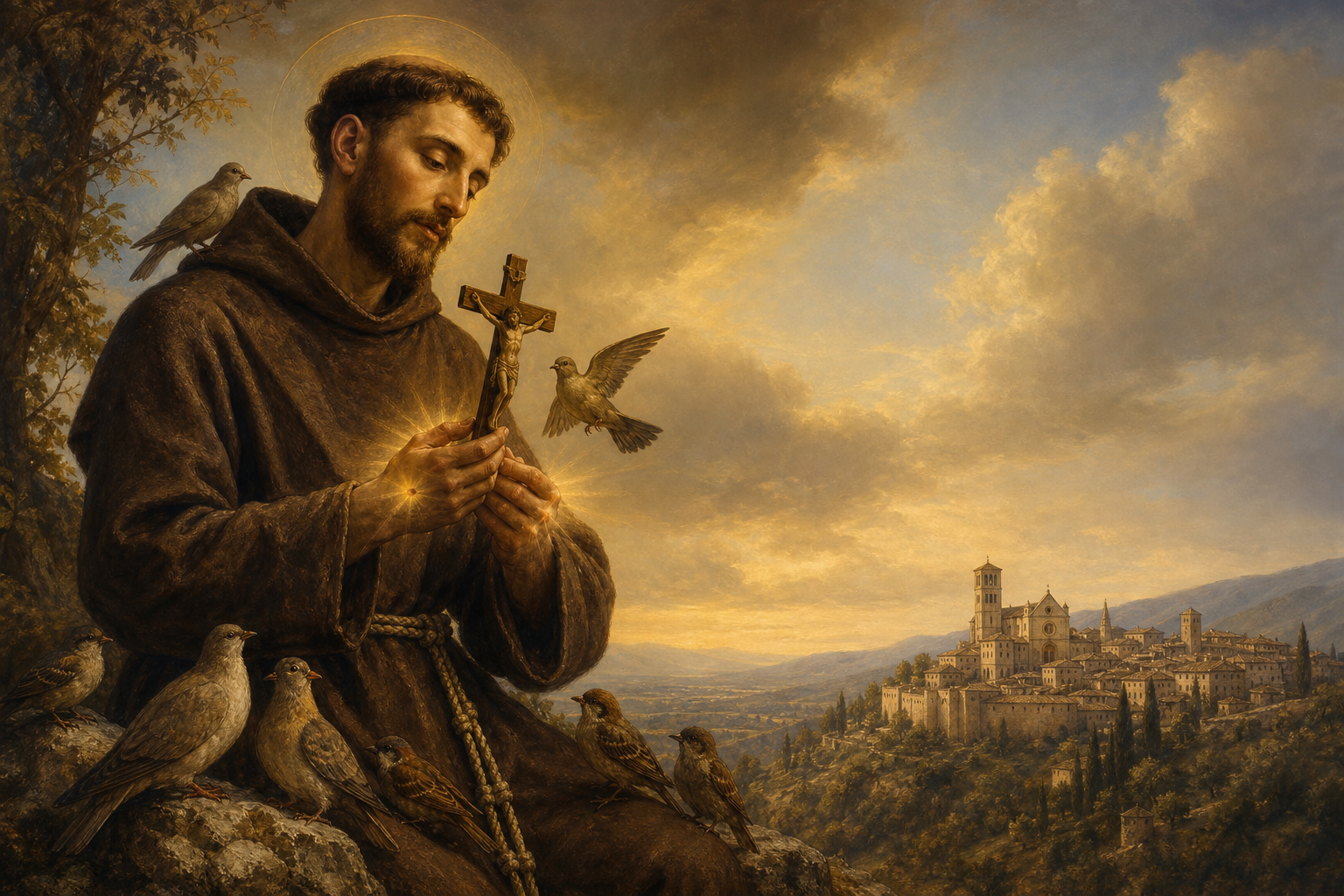
Son of a wealthy merchant of Assisi, Francis renounced his fortune to marry 'Lady Poverty' after a worldly youth. Founder of the Order of Friars Minor, he preached penance, love for creatures, and peace throughout Europe and the Orient. The first saint officially recognized as a stigmatic, he died in 1226, leaving a spiritual legacy based on humility and total detachment.
Guided reading
8 reading sections
ST. FRANCIS OF ASSISI, CONFESSOR,
Initial Landmarks
The text opens the life of Francis with chronological markers, a biblical citation, and a spiritual tone centered on poverty.
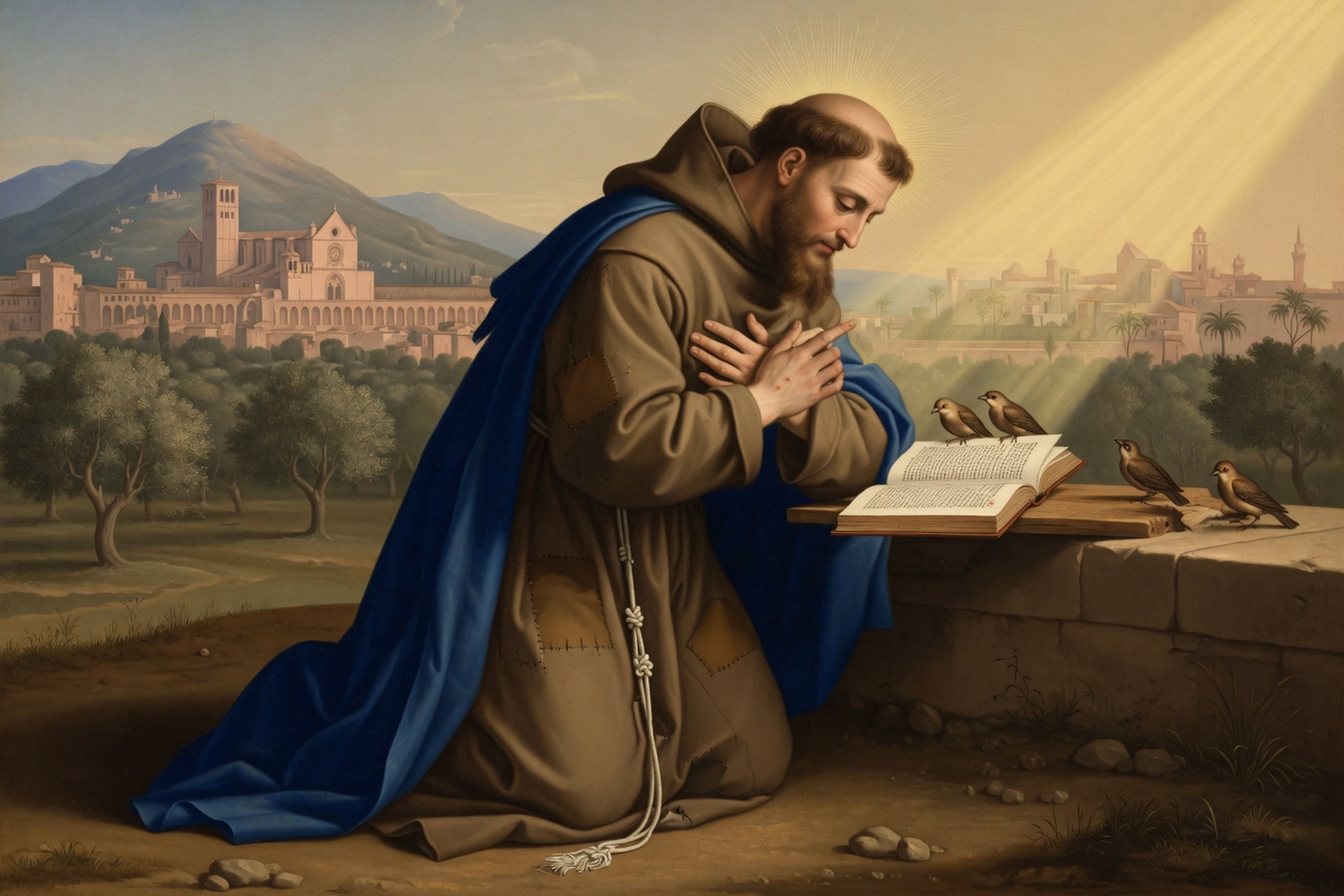
1182-1226. — Popes: Lucius III; Honorius III. — Emperors of Germany: Frederick I, Barbarossa; Frederick II.
Ego mendicus sum et pauper.
Ps. XL, 18.
Who does not admire the sublime and heavenly folly of Saint Francis of Assisi, which leads him to establish his riches in poverty, his delights in sufferings, his glory in the banner!
Bassant, Panegyrics.
Birth and Youth in Assisi
Francis was born into a merchant family in Assisi. The account emphasizes his generous temperament, his brilliant youth, and the first signs of an inner calling.
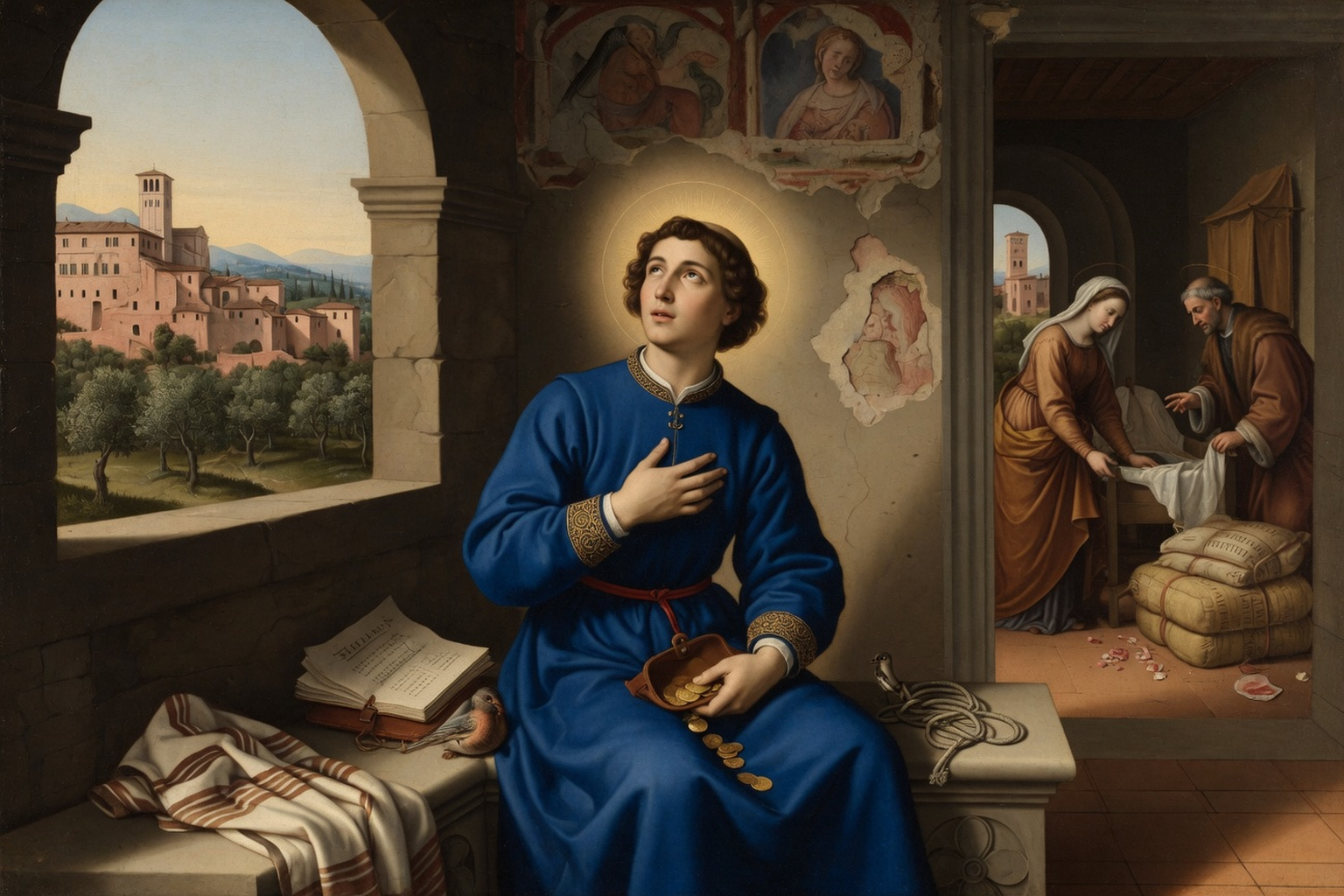
Saint Francis was born i n Assi Assise Site of the arrest of Saint Sabinus. si, a small town in Umbria, Italy, situated in the Apennine mountains, at an equal distance from Rome and Loreto, in the year of grace 1182, under the pontificate of Lucius III and the reign of Frederick Barbarossa. His father, named Pietro di Bernardone, was a wealthy merchant of the same city, who had extensive trade, especially in France: what the nobles did in Italy, without losing their title of nobility for it. His mother, named Pica, was a lady of great virtue, good and pious, who deserved to be the mother of a Saint. When she was about to bring this son into the world, she was long in labor and in inconceivable pain without being able to be delivered. A pilgrim then came to her door to ask for alms, and, when he had received them, he told the one who had brought them to him that, if the lady of the house wished to be delivered, she must be carried into a stable, because her child was to be born on straw. She obeyed this advice, and immediately she gave birth happily. Many believe that this pilgrim was an angel. This stable has since been changed into a chapel under the name of San Francesco il Piccolo, Saint Francis the Little.
Shortly after, they thought of baptizing him, and a second pilgrim offered to hold him at the baptismal font: it was an angel sent from God. He was given the name John. He later changed his name and took that of Francis, either because his father, who was in France at the time of his birth, gave it to him upon his return, in memory of the benevolent welcome he had received in that kingdom; or because he himself wished to bear it out of a singular affection for the French, and because he had learned their language in a very short time; or finally that the ability he had to speak French caused him to be called Francis by those who frequented him in his youth. While he was still at the breast, a third pilgrim came to ask to see him and embrace him; and, having predicted great things of him, he warned that hell was making every effort to cause him to perish: which the demon was forced to admit later in an exorcism.
His education was entirely holy, and his mother did not fail to inspire in him early on a horror of vice and a love of virtue. He was nevertheless prodigal to excess in his youth; he loved the beauty of clothes, appeared willingly with splendor at parties, treated his companions magnificently, and, having a premonition that he would one day be honored by everyone, without knowing how or why, he made every effort to surpass those of his age; but as worldly as he was at that time, he nevertheless always inviolably preserved his chastity. His confessors have testified that he never let himself be carried away by a thought toward a dishonest desire. Moreover, it seemed that, according to the word of Job, mercy had been born and had grown with him. He could not see the poor without being touched with compassion for their misery; and as his father had associated him in his business to have a share in his profits, he liberally distributed to them a part of what came to him from this trade. Above all, he never refused alms to those who asked him for the love of God: this word of the love of God already softened him so much that he could not hear it without being sensibly touched. Being one day extremely busy with a sale, he sent one away without giving him anything; but no sooner had he reflected on it than he ran after him and amply compensated him for the refusal he had made him suffer. He promised God at the same time to give charity, when he had the means, to all those who asked him for his love: which he faithfully observed for the rest of his days.
Moreover, he had such great sweetness and affability that he won the hearts of everyone and was regarded in Assisi as the pearl of youth and as a man who would one day be the glory of his country and the consolation of the whole province. There was especially in the same city an inhabitant who, every time he met him, spread his cloak to serve as a carpet for him, and even knelt before him to show his respect; he said that Francis well deserved this honor, since, in a short time, he would be venerated by the whole Church. However, as this young man, still full of the spirit of the world, only imagined temporal greatness, God wanted to win him through a series of crosses and afflictions: first, He permitted that, in a war between Assisi and Perugia, where he wanted to signal his courage for the defense of his homeland, he was taken prisoner: this captivity lasted a whole year, during which he had much to suffer; but, far from becoming sad and letting himself be cast down by this setback, he himself consoled the companions of his disgrace, always making them hope for a prompt deliverance. Moreover, as soon as he was at liberty, he fell dangerously ill, which forced him to prepare for death; and it was then that he began to reflect on the vanities of his past life and to conceive a horror of them. He did not, however, yet completely abandon the love of cleanliness and the splendor of clothes, with which he had been so filled. As soon as he was restored to health, he dressed elegantly, as was his custom, so as not to lose any of the esteem he had acquired among the young people of his age; but he performed an action that earned him an extraordinary visit from heaven: having left the city, he met a gentleman of good appearance, but poor and very poorly dressed, stripped himself generously of his clothes and gave them to him. The following night, he had a mysterious dream in which he saw a magnificent palace filled with weapons of all kinds marked with the sign of the cross. He immediately asked to whom these riches belonged, and the spirit of God answered him that they were for himself and his soldiers. He was not yet experienced enough to understand the mystery of this prophecy. He therefore imagined, in his passion for glory, that he should become a great captain and win illustrious victories that would make him renowned throughout the world. Also, knowing that Walter of Brienne, assisted by the troops of Pope Innocent and Philip Augustus, King of France, had entered Apulia with a large army to fight the Emperor of Germany, he set out early in the morning to offer him his services. But where are you going, Francis? The militia to which you are called is not corporal, but spiritual; you must fight the demon, the world, and sin, and not men like yourself. Your soldiers will not be armed with spears and swords, but with the spirit of penance and mortification. Also, as soon as he was in Spoleto, Our Lord appeared to him, and, treating him with great familiarity, He said to him: "Francis, which of the two can do you more good, the master or the servant, the rich or the poor?" — "It is certainly the former," replied Francis. — "If that is so," replied Our Lord, "why then do you forsake me, I who am the Master of all things and who possess infinite riches, to attach yourself to a mortal man who has only servitude and poverty for his share?" — "Ah! Lord," said Francis then, "what do you want me to do?" — "Return to your country," added the Son of God; "the vision you have had does not promise you temporal greatness, but spiritual greatness." He obeyed immediately and returned to Assisi, but quite different from what he was before, breathing only contempt for himself, detachment from the world, and love of heavenly goods. Shortly after, he gave a farewell feast to his companions, and while leading them out of the city, he was enraptured in ecstasy and remained motionless in the middle of the road.
Conversion, Poverty, and San Damiano
The encounter with the leper, pilgrimages, prayer before the crucifix of San Damiano, and the break with his father structure his conversion.
From that day on, Francis breathed only for divine things; he applied himself almost no more to his business, and often left the city to taste the sweetness of solitude. Being one day on horseback in the plain below Assisi, he met a leper who caused him such horror that he immediately turned his eyes away so as not to see him, and took his path in another direction. But, remembering then the resolution he had taken to fight in all things the disordered inclinations of his self-love, he stopped short, dismounted, and went to embrace this unfortunate man. He then gave him alms, tried to console him in his disgrace, and then remounted his horse. As soon as he had taken a few steps, he looked behind him to consider him once more; but he saw him no more, although there was neither tree nor house in that plain where he could have hidden. He judged therefore that this leper was the one of whom the prophet Isaiah speaks, who clothed himself with our miseries and our infirmities to heal us of them; and his heart felt an unspeakable joy and consolation. He then became more assiduous in prayer, and his greatest delight was to contemplate the perfections of God and the wounds of Jesus Christ crucified. It was in the fervor of one of these prayers that this lovable Savior appeared to him in the same state in which He was on the tree of the cross, and that He imprinted in his heart these words of the Gospel: "If anyone wishes to come after me, let him deny himself, take up his cross, and follow me." And since this apparition, he had such a vivid feeling of the pains of his Master that he thought of them almost continually, and he did so only while shedding torrents of tears.
Poverty, humility, and charity toward the needy were then his dearest virtues; instead of fleeing from lepers as before, he went to look for them in the hospitals, and having embraced them, he served them with his own hands; instead of being content, as before, with helping beggars with his alms, he assisted and relieved them through all sorts of humiliating ministries, taking off their shoes, putting them to bed, cleaning them, and rendering them a thousand other services. Poor ecclesiastics had the principal share of his charities. He provided them with the means to live, and also provided them with the ornaments necessary for the celebration of the holy mysteries. The ardor of his devotion led him to go to Rome to visit the tombs of the Apostles.
Arrived in the Eternal City, he went to prostrate himself on the pavement of Saint Peter's, before the sacred altar where the body of the fisherman of Galilee rests. Having prayed with much fervor and tears, he rose and saw with pain that the pilgrims left only light alms for the completion and embellishment of the sanctuary. "What!" he exclaimed, "is devotion so cooled? How is it that men do not offer all they have and do not offer themselves, in a place where the precious remains of the Prince of the Apostles rest? How do they not decorate with all possible magnificence this stone upon which Jesus Christ founded his Church?" Saying these words, he took all the money he had on him and threw it with both hands onto the marble of the holy tomb.
Upon leaving the church of Saint Peter, he saw a crowd of poor people waiting for the effects of the mercy of passersby; he had pity on them, and after distributing to them all the money he had, he finally gave his cloak to the one who appeared the most naked and clothed himself in his rags. He remained thus for the rest of the day begging and praying in this humble company. It is thus that he trampled underfoot the pride of the world, and that he rose by degrees to evangelical perfection. The next day, he took the road back to Assisi and returned to the maternal home, breathing the holy joy of penance. It is there that the Lord Jesus Christ, his guide and his reward, awaited him to manifest his vocation more vividly than he had yet done to this day.
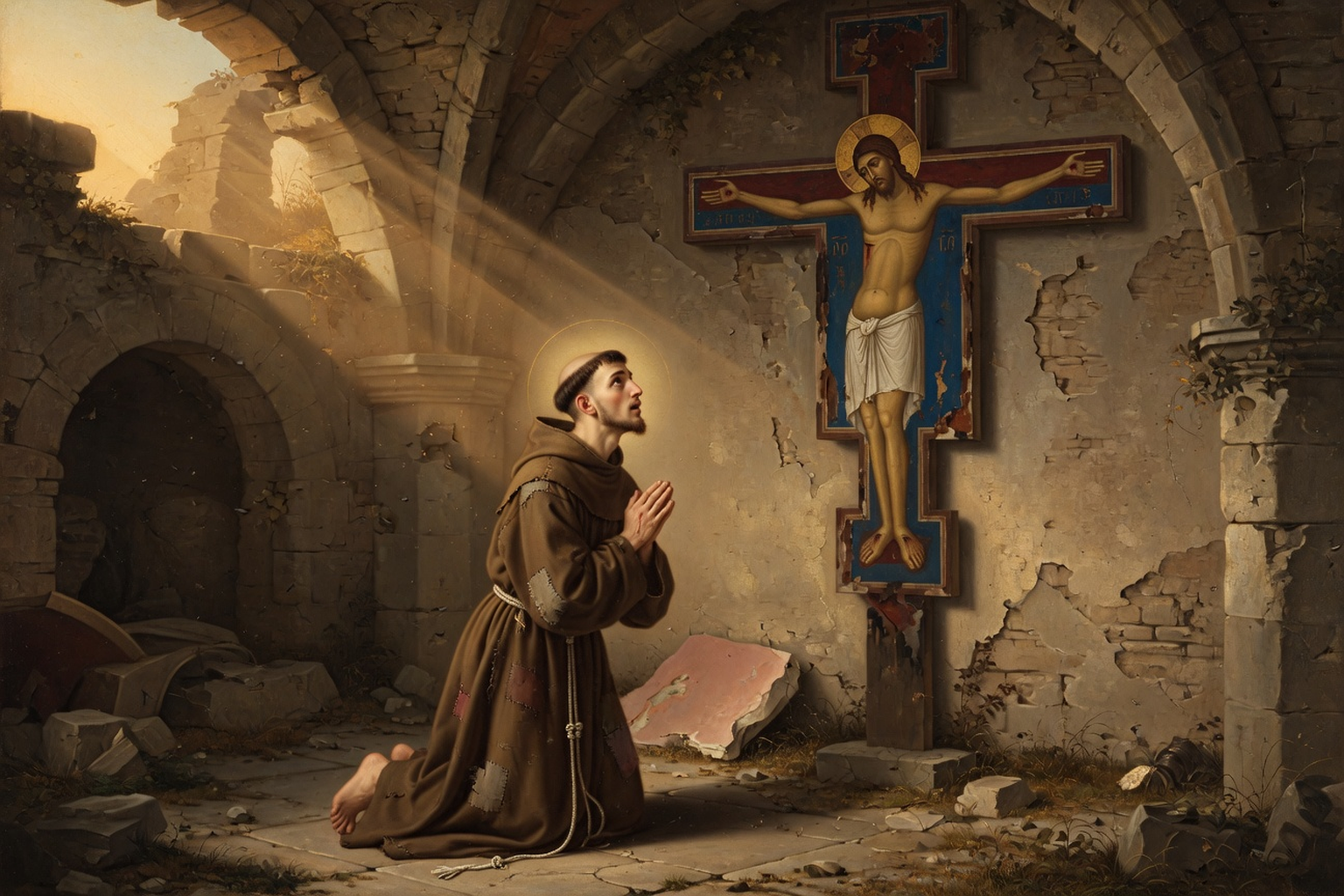
One morning when Francis was meditating in the countryside in the vicinity of Assisi, he entered a poor church dedicated to Saint Damian, so old and so dilapidated that it threatened to collapse. There, prostrate on the stone before a crucifix, he pronounced three times, by a movement of the Holy Spirit, this beautiful and fervent prayer that he often repeated thereafter: "Great God, full of glory, and you my Lord Jesus Christ, I pray you to enlighten me and to dispel the darkness of my mind, to give me a pure faith, a firm hope, and a perfect charity. Grant, O my God, that I may know you so well that in all things I may never act except according to your lights and in conformity with your holy will." He was saying this, and with eyes bathed in tears, he looked with great love at the image of the Savior on the cross, when suddenly a voice coming from the crucifix made him hear these mysterious words three times: "Go, Francis, and repair my house which you see falling into ruins." At this voice from heaven, the holy young man remained motionless, distraught, ravished in a kind of ecstasy where fear mingled with love. Returned to himself, he wondered what was the meaning of this divine call; too humble to believe that God was calling him to repair the spiritual ruins of His Church, he took these words in their material sense, and thought that Christ was inviting him only to restore the old church of Saint Damian.
Immediately, with that prompt and ardent obedience that he put into executing the orders from above, he returned Saint-Damien Small church near Assisi whose restoration marks a decisive stage in the conversion of Francis. to his father's house, took a bundle of rich fabrics, mounted his horse, and rode to Foligno, where he sold the horse and the merchandise. Then he returned on foot to Saint Damian and presented to the priest who served the church the proceeds of this happy business, as Saint Bonaventure calls it. The chaplain, fearing the wrath of the miserly Bernardone, refused, despite the insistence of Francis, to accept such a considerable alms. The Saint then threw this useless gold with contempt onto one of the windows of the sanctuary and obtained only from the poor priest the permission to remain for some time in his dwelling, near this blessed altar where the crucifix had spoken to him.
His father, informed of what was happening, flew into a violent rage and ran to Saint Damian to remove him. But how could he have found the one whom Divine Providence had resolved to keep hidden? The wall of the room where he was softened and sank, and gave him a safe and quiet retreat against the searches of this unnatural father. Then he retired to a nearby cave, where he spent a whole month in continuous prayer and fasting, living more on the bread of tears than on that which he had brought to him in secret by a servant of his house. However, the anointing of grace spreading more and more in his heart, he himself was ashamed of his flight and of hiding like a timid man without courage; thus, all dirty and disfigured as he was, he returned to Assisi, resolved to suffer everything for the glory of Jesus Christ. At his appearance, murmurs, contemptuous laughter, and exclamations of pity resounded from all sides: "He has become mad," they said; and, among the insulters, his former companions in festivities were in the front rank. They were only half wrong: yes, the blessed Francis had become mad, but with the holy and divine madness of the cross, with that madness which confounds human wisdom, which, since the manger and Calvary, royally leads the world, through voluntary suffering and sacrifice, from earth to heaven, from death to eternal life! Deaf to all the clamor, smiling at all the affronts, he answered evil with good, insults with prayer, hatred with love. His father, warned that his son was the object of public ridicule, ran up furious, threw himself on Francis like a wolf on an innocent lamb, overwhelmed him with reproaches and blows, and ordered him to quit these extravagances and to resume his life and his accustomed occupations. But seeing him insensitive to his threats as to his prayers, he locked him under a staircase, in a dark corner of his house, and swore that he would keep him prisoner there as long as he had not promised to change his life. Francis, supported by the voice of Jesus Christ who had revealed his vocation to him, suffered cruelly from afflicting his father and resisting him; but at the same time his soul was filled with a totally celestial joy in thinking that he was expiating the faults of his youth, that he was suffering persecution for justice, and he repeated with rapture this word of Saint Peter: "It is better to obey God than men!"
Taking advantage of the first absence of her husband, his mother, who recognized in him an extraordinary attraction of grace, opened the door of his dungeon and gave him the freedom to go wherever he wanted. The holy young man thanked his mother, blessed God, and returned immediately to the church of Saint Damian, which he had undertaken to repair. His father, upon his return, was extremely irritated by it; but, having found on the window of this church the money that the Saint had thrown there, he calmed down a little. Finally, the Bishop of Assisi re-established the agreement between them. Francis renounced, in the presence of this prelate, all the goods to which he could claim by virtue of his association and the succession of his parents; his father, upon this renunciation, left him master of himself and abandoned him to his own conduct. It was on this occasion that this new poor man of Jesus Christ stripped himself of his clothes, reserving nothing for himself but a hairshirt with which his body was covered, and, having handed them all into the hands of his father, he said to him: "Until now I have called you my father; but, henceforth, I will give this name only to God alone, and I will say to Him much more freely than I did: Our Father who art in heaven, in whom I have placed my treasure and the faith of my hope." The spectators of this scene, seized with deep emotion, wept with pity and admiration. The Bishop himself was so touched by it that he threw himself on Francis's neck and covered his sublime nakedness with his mantle. Then he had the habit of one of his laborers brought to him, and gave it to him. The Saint received it willingly under the title of alms, and, having split it in the form of a cross and having even figured a cross on it with cement, he clothed himself in it as with a precious livery of a poor and humiliated God (1206).
With this habit he left Assisi and went into solitude, to taste more deeply the joy of his sacrifice, and to better hear the voice of his beloved Jesus. While walking, he sang the praises of God in the French language with celestial joy. Passing through a wood, he met thieves who asked him who he was: "I am," he replied, "the herald of the great King." Then, these thieves beat him cruelly and threw him into a ditch full of snow, saying to him mockingly: "Stay there, herald of God." Francis believed he had gained much by being thus outraged and mistreated. As soon as these thieves had withdrawn, he got up and continued his way, singing even louder and with more joy hymns and canticles to the praise of his Creator. Having arrived at a monastery, he asked for charity there, and received it like a simple beggar. From there he came to Gubbio, where one of his friends, who recognized him, gave him a small, very poor tunic, with a leather belt, a staff, and shoes to equip him as a pilgrim and a hermit. He was then twenty-five years old, and he had no other view than to sanctify himself by the practice of humility, patience, poverty, and mercy toward the sick. Thus, he devoted himself to the service of hospitals and the sick; bearing a singular compassion for lepers, he humbly washed their feet, cleaned their ulcers, asked for alms for them, and often embraced them to console them in their pain and encourage them to suffer with constancy. This charity was not without miracles; several were healed by his touch, especially a man from the Duchy of Spoleto who had his whole face eaten away by a hideous cancer that made him horrible to see. "I do not know," said Saint Bonaventure in recalling this trait, "what one should admire more, such a kiss or such a healing!" It is thus that Francis put into practice these words, which the Lord had addressed to him in the divine communications of prayer: "My son, if you want to know my will, you must despise and hate everything that you have loved and desired according to the flesh. Let this new path not frighten you; for if the things that please you must become bitter to you, those that displeased you will appear sweet and pleasant to you."
When he was well founded in humility, remembering the order he had received to repair the church of Saint Damian, he returned to Assisi; and what he had not been able to do while rich, he executed easily in the state of poverty he had embraced. It was not by providing large sums of money from his own wealth, but by begging at the doors of the rich for what was needed to restore this edifice, by working there himself like a laborer, by carrying on his shoulders stone, wood, and cement, and by animating others by his example to such a holy work, by the hope of the eternal reward. Seeing Francis one day overwhelmed under the burden of the stones that he was helping to transport with his hands for the restoration of the church, his brother, named Angelo, said mockingly to one of his friends: "Go ask him to sell you a little of his sweat." — "I do not want to sell my sweat to men," replied Francis simply; "I will sell it more dearly to God." An admirable and profound word which, understood and meditated upon, would greatly diminish the number of slaves of the world, and would increase that of the servants of Jesus Christ! For this divine Savior alone has promised that He would not leave without reward a glass of water given in His name, and He alone is infallible in His promises. The priest of Saint Damian, touched by the fatigue and the destitution of the worker of Jesus Christ, had the thought of preparing a good meal for him to restore his strength when he returned in the evening overwhelmed by the labors of the day. Francis accepted this charity at first; but soon he changed his mind, asked his host not to worry about his food anymore, and, taking a dish, he went to beg from door to door, and sat in the street to eat the coarse leftovers that had been given to him. "For it is thus," he said to himself, "that I must live for the love of Him who was born poor, who lived poorly, who was attached to the cross, and who was placed after his death in another's sepulcher." Such was the way of life that Francis adopted from then on never to leave it again, and it is thus that he finished the year 1206 in prayer, work, and absolute destitution. Thanks to the abundant alms he had collected, he quickly finished the restoration of the church of Saint Damian.
The success of this repair made him also undertake that of the church of Saint Peter, which was a little further from the city of Assisi, and he did not accomplish it with less promptness and happiness. Finally, as he saw that the church of Our Lady of the Angels, called the Portiuncula, was falling into ruins, although it was dedicated in honor of the Mother of God, and that the angels sometimes made their protection felt there; and that for this reason it was deserted and abandoned, he resolved to apply hims elf with th Portioncule Church near Assisi where Clare was carried by the angels. e same zeal to repair it. From the beginning of the year 1208, the chapel found its secular worship again and served once more as a tabernacle for the Holy of Holies, and as a goal of pilgrimage for the piety of the faithful. Saint Bonaventure says that he loved it more than all other places in the world, that he began there with humility the great work of his perfection, that he made admirable progress in virtue there, that he happily finished his life there, and that in dying he recommended it above all things to his children, as a place for which the Blessed Virgin had very special regard.
Being one day in this sanctuary, he heard there, at the Gospel of the Mass, these words of Our Lord to his disciples: "Carry neither gold, nor silver, nor any money in your purse, nor bag, nor two tunics, nor shoes, nor staff." This admirable lesson struck his mind immediately; he took it as pronounced and dictated for himself, and, without delaying for a moment, he threw away his staff, went barefoot, took a rope instead of a belt, gave away his purse and all the money he had, and, contenting himself with a simple tunic, he seriously began the apostolic and evangelical life of which he was to raise the standard in the world. Then, he began to preach penance; which he did with so much fervor and unction that several sinners, touched by his words, were converted and washed in their tears the stains of their past life. Several even renounced the world to embrace the humble state of which he made profession. The first was the blessed Bernard of Quintavalle, one of the richest inhabitants of Assisi: having seen with his own eyes Saint Francis spend the night in prayer in a room where he had asked him to take a little rest, he was so moved by his example that he renounced all his goods at that very hour, and set out to follow him. The second was the blessed Peter of Catane, a canon of the cathedral of the same city, who generously left his benefice to become a poor man of Jesus Christ with him. The third was the Blessed Brother Giles, whom the wise madness of the cross has, since then, raised to such eminent perfection.
At this time, God made known to Francis, through various visions, that He had chosen him to found a great Order that would vigorously fight the flesh, the world, the devil, and sin; which would win illustrious victories over them, would work with happy success for the reformation of the morals of Christians, whose disorder had become extreme, and would carry the light of the faith to the ends of the earth. These assurances animated him to continue his preachings; he sent Bernard with Peter toward Tuscany, and he, with Brother Giles, traveled through the March of Ancona, exhorting with marvelous strength to detachment from the world, to the contempt of pleasures and riches, and to a perfect conversion of heart to God. The number of his children then increased to seven, and shortly after to eleven. They represented with him the sacred college of the twelve Apostles. He said to them, while sending them to preach: "Go announce peace to all men, animate them to penance, which is the only way to obtain the pardon of sins; be assiduous in prayer, patient in adversities, indefatigable in work, modest and reserved in your words, grave and irreprehensible in your actions, and perfectly grateful for the benefits you will receive. Above all, put your trust in God, and hold for certain that nothing will be lacking to you, although you walk without provision and without money." They were not yet called brothers, nor religious, but only the penitents of Assisi, although their blessed Father, to move them a little away from their country, had then transferred them to a poor abandoned hermitage, in a place named Rivo Torto; but when this apostolic man saw the surprising deeds that it pleased the divine goodness to operate through him and through this holy troop of missionaries spread here and there, he wished to see them all gathered, to make of them a body better linked and firmer. He sent neither letters nor messengers for this; but having represented his desires to Jesus Christ, who was the author of them, he saw all these evangelical workers arrive near him, loaded with the trophies they had won over the malice of men and the efforts of hell. Then he composed a Rule for them in simple terms: putting the practice of the Gospel as the unshakeable foundation of all his spiritual edifice, he added only a few constitutions necessary for the establishment of a common life.
The Bishop of Assisi, whom he often consulted in his difficulties, was of the opinion that he should take possessions and rents to make his children subsist, without being obliged to beg for their bread; but he replied to this prelate that he could not resolve to do so at all: "For, if we had property," he told him, "we would need weapons to defend ourselves from thieves; prosecutors and lawyers to support our right against the chicanery of usurpers; servants and maids to make our farms profitable. Judge, if you please, My Lord, what disadvantages we would receive from commerce with persons so far from our institute." Thus, he persisted courageously in the resolution he had taken, to establish his Order on the foundation of evangelical poverty. He then thought of having it approved and confirmed by the Holy See; also, with the unanimous consent of his children, and without providing himself with any recommendation from the prelates or the great lords of his province, he came to Rome to Pope Innocent III, one of the wisest pontiffs who have governed the Church. He had with him the college of his eleven disciples, and he conquered a twelfth in Rieti, who was Angelo Tancredi, a brave gentleman of that city, by telling him only, in the middle of the road where he met him, that he had served the world enough, and that Jesus Christ was calling him to Calvary. In Rome, he lodged at the hospital of Saint Anthony, to receive alms there in the capacity of a poor man and to serve the sick there. A few days later he went to speak to the Pope at the Lateran Palace, in a place called the Mirror, where he was walking; but His Holiness, who then had his mind occupied with several great affairs, did not want to listen to him, and even pushed him away with indignation. This rebuff, far from afflicting and discouraging Francis, filled him on the contrary with joy and hope: he withdrew gently with a profound humility and an angelic modesty, recommending his affair to God, who had inspired it in him. He was not frustrated in his expectation: for, the following night, the Pope, having seen in a dream a small palm tree which, born at his feet, then rose to the height of the tallest trees, knew upon waking that it was the figure of the poor Francis who had presented himself the day before before His Holiness; also, he had him come near him, and, after having listened to him with much benevolence, he promised him to examine his requests and to be favorable to him in what he could.
Birth of the Fraternity
A first community forms around Francis. The narrative follows the emergence of the Friars Minor, their rule, and their first ecclesial recognitions.
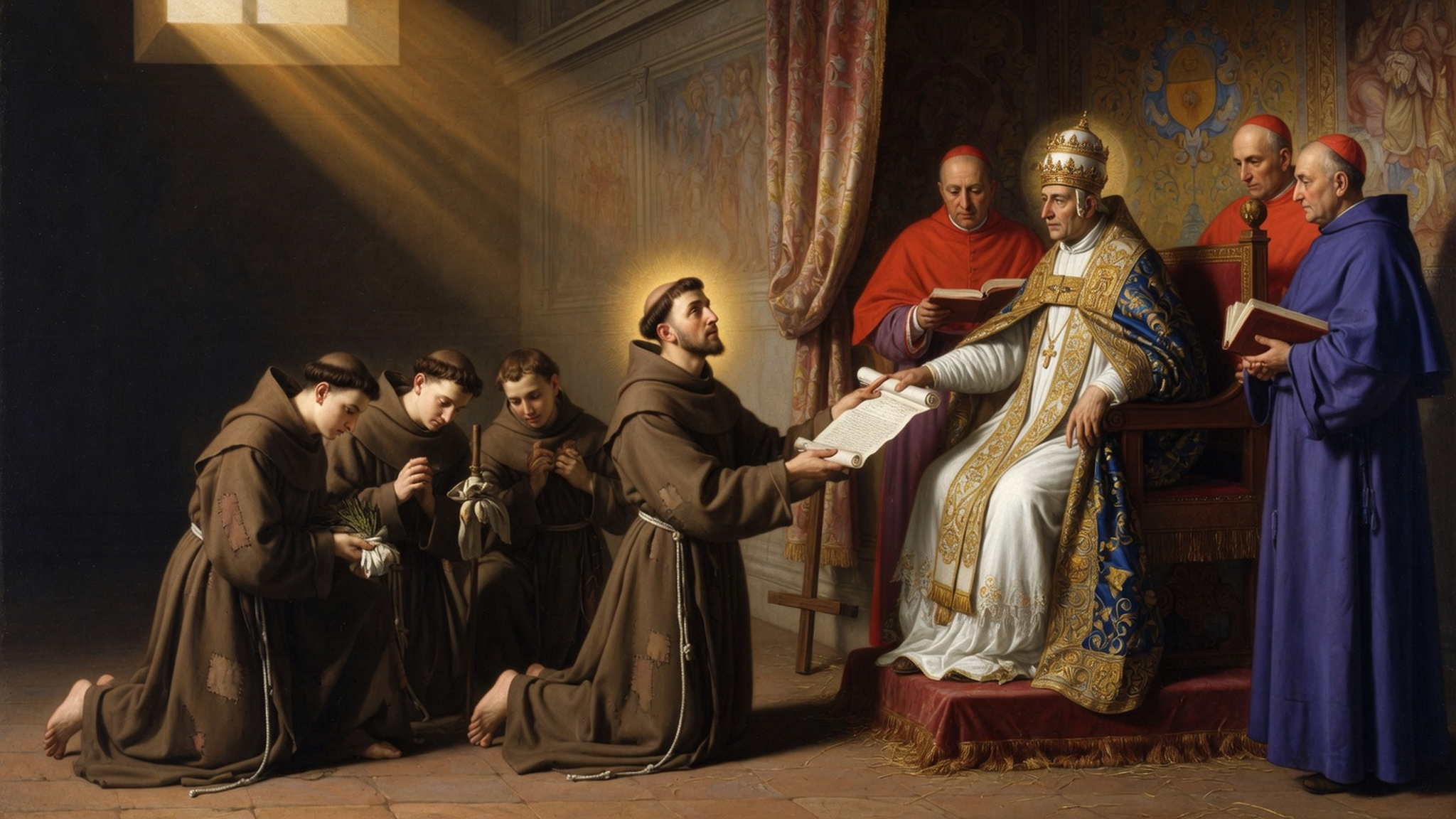
The greatest difficulty he noticed there was the extreme poverty he wished to establish in his Order; but Cardinal John of Saint Paul, Bishop of Sabina, very wisely represented to His Holiness that if this consideration prevented the confirmation of Francis's Rule, it would show that the Gospel was not esteemed, and that there was no respect for the counsels of Jesus Christ. Moreover, the Saint told him very ingeniously that the Congregation for which he was asking for approval, poor as it appeared, having married the King of kings, would take care not to lack what was necessary to feed its children. Thus, the Pope felt inclined to ratify his request once it had been examined by the Sacred Congregation, especially since he recognized that the Saint was the poor man he had seen one night in a dream, supporting on his shoulders the church of Saint John Lateran, which was falling into ruins. A mysterious vision that was accomplished corporally and spiritually: corporally, because this basilica was restored, adorned, and enriched by Popes Nicholas IV, Sixtus IV, and Sixtus V, of the Order of Saint Francis; spiritually, because the Universal Church, figured by this temple, was supported by the examples, prayers, and doctrine of this great Servant of God, and by the labors of an infinity of Martyrs, Doctors, Confessors, and Virgins of the same Order.
After a few days, the Sacred College having said in its report that the Rules and Constitutions of Saint Francis contained nothing but what was holy and conformed to the doctrine of Jesus Christ, the Pope approved them by word of mouth; he also received the profession of the blessed Founder and his twelve children himself, and having established him as the first Minister General of his nascent congregation, he ordained him deacon, also giving his companions power to wear the tonsure and the clerical crown: which some authors explain as the conferring of Minor Orders. Thus, this holy troop left Rome laden with favors and blessings, but with a completely new resolution to wage constant war on their senses and to carry everywhere the spirit of penance and compunction. However, when they arrived at the city of Spoleto, discussing among themselves the means of arriving at perfection, they deliberated whether it would not be more expedient for them to retire into a solitude to occupy themselves entirely with contemplation than to expose themselves to conversation with men, which is full of dangers and easily causes one to lose the spirit of recollection and devotion. Francis consulted the will of God on this matter through a very fervent prayer, accompanied by tears and sighs, and he learned there that his vocation and that of his children was not to dwell in deserts, but to work for the salvation of souls through preaching and other exercises of the apostolic life. He declared to his children what God had made known to him, and, being thus assured of the path they were to take, they all retired together to their old dwelling, near the walls of Assisi.
The poverty of this house cannot be sufficiently admired; it was falling into ruins, and was so small that the brothers could hardly all have their place there; the holy Patriarch had to write their names on the boards to mark for each the place of his retreat. They lived there so poorly that the raw herbs they found in the countryside were delicious dishes for them. Their prayer was more of the spirit than of the lips, because, not yet having church books to sing the canonical hours, all they could do was to pray mentally and recite the Lord's Prayer and some psalms they knew by heart. Their principal book was the Cross of Jesus Christ, which their blessed father had placed in their midst. They studied this great book continually, leafed through it incessantly, learned its divine lessons, and it was from there that they drew those beautiful lights and that divine eloquence, which made them more formidable to the demon and to sinners than the greatest masters of theology. Saint Francis also very often gave them powerful exhortations; he taught them the method of considering and praising God in all His creatures, the reverence they should have for priests, and the submission with which they should receive all the decisions of the Roman Church. He also taught them to prostrate themselves before all churches and all crosses, from as far as they caught sight of them, to honor Jesus Christ in these external representations of the sufferings He had endured for our love.
He took such care of their spiritual advancement that one night, being in Assisi to preach the next day in the cathedral, he appeared to them in their poor dwelling in the form of a globe of light, carried on a chariot of fire; this enlightened them so perfectly that each of them penetrated not only to the depths of his own conscience, but also to the most secret parts of those of all the others; convinced that it was their holy Patriarch who was showing himself to them under this brilliant figure, they recognized at the same time the graces that God had communicated to him for their guidance. We have seen, in the life of Saint Anthony of Padua, that he later appeared again at Arles, in the midst of an assembly of his religious where this blessed Confessor was presiding, to give them his blessing and to animate them to order nothing but for the greatest advantage of regular observance.
Finally, as there were people presenting themselves every day who wished to embrace his institute, seeing that he could not house them in the house where he was, he found himself obliged to look for a larger one. He addressed himself for this to the Bishop of Assisi, begging him to give him a chapel where they could celebrate the divine offices; but the Bishop having none at his disposal then, he had recourse to the Benedictines of Mount Subasio, who gave him the church of Our Lady of the Angels or the Portiuncula, with a small house attached, where the chaplain lived, to serve as their convent. Saint Francis accepted on the condition that neither he nor his Order would be the owners, but only usufructuaries. That is why he did not fail, every year, to send the Benedictines a small basket of fish, as a rent for the inheritance he held from them, and these reverend Fathers gave him in exchange, out of generosity, a jug of oil to have a share in his prayers.
As soon as he was in possession of this church, Our Lord honored him with a visit, accompanied by his most holy Mother and an innumerable multitude of blessed spirits, and promised him, with his protection, a prodigious increase of his nascent congregation. He then sent his children into various regions to continue to announce penance; and they were so many evangelical fishers, who, by the net of their preaching, drew to him a great number of new disciples to help them themselves in the conversion of the world. He also made many conquests on his side, most of which were miraculous; the principal ones who entered his Order were Maurice, Leo, Rufinus, Masseo, Juniper, Illuminatus, Augustine, Stephen, Leonard, Guy, Simon, and Pacificus, who all arrived at eminent holiness. Maurice was of the Order of the Crusaders; he fell dangerously ill and was obliged to go to the hospital. As they were already despairing of his life, Saint Francis sent him a piece of bread dipped in the oil that was burning before Our Lady; and as soon as he had eaten it, he rose in perfect health to embrace the institute of his distinguished benefactor. Pacificus was a famous poet, to whom even Emperor Frederick II had given the name of King of Verses. He went to Saint Francis's sermon, and the force of his inflamed words, joined to the vision of two luminous swords that crossed him from head to foot and from one hand to the other, touched him so much that he despised the vain exercise of poetry to become the faithful imitator of the holy Patriarch. He received from him the name of Pacificus, because of a great gift of gentleness with which his soul was filled, and he was later the first Provincial Minister of France.
These new workers constantly asked for new instructions; but the life of their father was an animated lesson that taught them the exercise of the most excellent virtues. He was so austere that, except for meals at the homes of seculars, which he did only very rarely and very soberly, and only to win them to God, he almost never ate anything cooked and drank only water. Often he mixed ashes into what he ate. The bare earth was his bed; he did not lie down on it, but he slept sitting up, his head only supported on a stone or a piece of wood. His poverty was so extreme that it did not seem possible to be poorer, since, except for the sack with which he was covered and of which he was not even the owner, he possessed nothing in the world. He went himself to beg for his community, and did so in the places where he was best known. One never saw him idle, never moved, never distracted and occupied with the things of the earth, but always in a marvelous activity, gentleness, and devotion. He did not suffer any of his religious to remain doing nothing, and he called those who fled work 'fly brothers'; as for his body, he called it 'Brother Ass'; in fact, he treated it as harshly as one treats donkeys. He was nevertheless an enemy of indiscretions, and did not allow his disciples to perform penances beyond their strength. He recommended that they avoid conversation with women, as a reef where the most spiritual persons often make sad shipwrecks. He exhorted them to a great love for God and for Our Lord Jesus Christ, and to an ardent zeal for the salvation of sinners, sentiments with which he himself was entirely filled.
It would be an infinite thing to follow him into all the places where he carried the seed of the Gospel. He went first to Perugia, where he predicted and then appeased a very cruel war between the nobles and the people; from there he went to Cortona, where, as a reward for a great number of conversions he made there, he was given a convent at the gate of the city. The same was done for him at Arezzo and Florence, where he went after spending all of Lent in continual prayer, and without eating anything but half a small loaf of bread. The miracles he performed in all these cities were so extraordinary that he was looked upon there with no less respect than if he had been an angel descended from heaven. He carried the same blessings to Pisa, to Saint-Médard, to Saint-Gimignano, and to Sarthiane, and he obtained new monasteries everywhere. It was at Sarthiane that the demon appeared to him and solicited him to slacken, telling him that God never forgave those who killed themselves with indiscreet penances; after which he excited in him lascivious thoughts and dishonest movements; but the Saint, taking his iron discipline at that very hour, covered his whole body in blood, and being all covered with wounds, he threw himself in this pitiful state into the midst of the snows, where he remained until these flames of unchastity were entirely extinguished: which made him so victorious over his enemy that he felt no more similar attacks thereafter. The following Lent, he preached in the cathedral of Assisi, and he made the admirable conquest of the glorious Saint Clare, which encloses an infinity of others. He then resolved to go to Syria to work for the conversion of the Saracens, and took the road to Rome to go and ask the Pope for permission. Wonders accompanied him everywhere. At Alviane, he silenced the swallows that were making noise during his preaching, by saying to them only: 'My sisters the swallows, be silent while I preach.' In Rome, he obtained from His Holiness what he wanted, won excellent men to his institute, and founded a monastery of his Order: it is today the famous convent of San Francesco in Ripa. At Ascoli, in the March of Ancona, one of his sermons attracted thirty young men of the most considerable to his poor life.
God, who had inspired him with the thought and desire to go to Syria, did not permit its execution, because the time had not yet come. Francis embarked; but he was soon thrown by a storm into Slavonia, and from there forced to return to Italy. A short time later, he fell ill with a slow fever that reduced him to extreme languor. The Bishop of Assisi, who feared that the Church would lose such a great treasure too soon, had him transported, despite all his reluctance, to his episcopal palace to have him well treated there. One cannot imagine how confused and humiliated Francis was by this treatment. He then called himself only a glutton, a sensualist, and a hypocrite; he told his children that he no longer deserved to bear the name of Friar Minor; he declared himself worthy of all the curses of apostates; finally, he carried his love for abjection to the point of having himself dragged with a rope through the city, to the place of public executions, to tell all the people that he did not deserve the esteem they had for him and the honors they rendered him, seeing that instead of living austerely as he persuaded them he lived, he was delicately fed at the very table of their bishop. Scarcely had he regained a little strength when he set out on the road to go to Spain and from there to Morocco, to work for the conversion of the Miramolin, who was Mahomet the Green. Passing through the cities of Italy, he performed great miracles and countless conversions, and established a crowd of convents. At Foligno, he blessed the house of his host so much that since then, neither fire nor plague has dared to approach it. At Spoleto, he entirely changed the heart of a rich miser who was decrying his Order everywhere, by only having each of his religious say three Paters and three Ave Marias for him. At Terni, he resurrected a young man who had been crushed by the fall of a wall, and predicted that he would one day embrace his institute, which has happened since. In the county of Narni, he restored life to a man who had been drowned for four days, health to a paralytic, and changed water into wine. At Oriesi, he healed a child so deformed that his head touched his feet. What did he not do again at Saint-Gimignano, at Saint-Leo, at Imola, and in all the other cities through which he passed until his entry into France? He was received everywhere as a great prophet. He was offered houses on all sides without his asking for them, and so many people hastened to be among the number of his disciples that they were immediately filled with excellent subjects. His passage through the Dauphiné and Provence was short, and he went as soon as possible into Navarre and Castile. King Alfonso, later grandfather of Saint Louis through Queen Blanche, his daughter, gave him a wonderful welcome and gave him a convent in Burgos, which was the nursery of many others. The Saint finally wished to pass into Africa; but the Spirit of God, who had formerly prevented the apostle Saint Paul from preaching the Gospel in Bithynia, prevented this zealous missionary from carrying the word of life into Morocco, which was unworthy of such a great happiness. He fell ill on the borders of Spain, and during his illness, he received an order from heaven to return to Italy. He first made the pilgrimage to Santiago de Compostela; he had a convent built with a treasure that was found in the ground in a place he had indicated. He established others on his return, both in Portugal and in Castile, in Aragon and in Catalonia, and among others that of Perpignan, which has since become very considerable. Finally, one had to count his prodigies by his steps, and his new establishments by the stays he made on the way. The war of the Albigensians prevented him from stopping in Provence; moreover, the children of Saint Dominic already preaching there with extraordinary zeal and success, he did not judge it appropriate to put the sickle into another's harvest.
His return to Italy, where his absence was deeply regretted, was a true triumph. People came from all sides to meet him. Prodigies accompanied him everywhere. Bread was multiplied for his food and for that of his own, and the power of God confounded in a miraculous way those who slandered him or opposed the progress of his institute. Having made wise regulations in his convent of Our Lady of the Angels, he retired for the first time to Mount Alverna, where Count Orlando, who looked upon him as his father, had given him a dwelling. He was visited there first by the Blessed Virgin accompanied by Saint John the Baptist and Saint John the Evangelist, then by Our Lord Himself, who, having sat on the stone where he ordinarily took his poor meal, revealed to him great secrets, the event of which has since justified the truth. One still sees this stone now surrounded by an iron grille with this inscription: 'The table of Saint Francis, where he had admirable apparitions, and which he consecrated by sprinkling it with oil and saying: This is the altar of God.' An angel also taught him that the cracks he saw in the rocks had been made there at the time of the Passion of Our Lord: which gave him a particular respect and devotion for this holy mountain. He converted there a bandit nicknamed the Wolf, who had committed an infinity of murders and brigandage, and having given him the habit of his Order, he called him Agnello, the lamb, to mark his change from wolf to lamb. He had hardly less affection for the valley at the bottom of Fabriano, called the Poor Valley, than for this mount. He obtained the gift of an ancient abbey, which Benedictine nuns had abandoned, and placed his disciples there; and the great solitude of this place meant that he retired there with a singular joy, to occupy himself with the contemplation of eternal truths. This establishment was followed by many others in the March of Ancona. It was there that he changed, for an hour, the water of a fountain into good wine, in order to relieve the thirst of his workers who were working at his convent of Bonantis. It was there that one of his religious, having made a rash judgment about a poor sick man who was asking for alms and whose merit Francis was exalting, he obliged him to strip off his habit, and in that state, to ask forgiveness of this poor man. It was there that another religious, who had murmured against him, saw him at night in prayer in the corner of a forest, where the Blessed Virgin having appeared to him, caressed him, put her divine child into his hands, and permitted him to embrace and kiss him. It was there that another brother, still a novice, also had the happiness of seeing him honored by the visit of Jesus, Mary, and the two Saint Johns: John the Baptist and the Evangelist.
All these things happened until the year 1215; the Council of Lateran, under Innocent III, having opened, Saint Francis went to Rome to have his Institute approved again. We have said that Pope Innocent III had already approved it; but he had only done so by word of mouth and had not had any bull dispatched, and furthermore, he had only given the Saint and his children the name of Preachers of Penance; so that it was appropriate to have a more authentic approval, as of a new religious Order. We see nothing in this council that marks that this approval was given there; on the contrary, one finds in article 13 a decree which states that one should rather apply oneself to re-esta blishing the Innocent III Pope who commissioned Pierre de Castelnau against the Albigensians. ancient Orders in their first splendor, than to making new ones. But if the Saint did not obtain from the assembly the establishment he wished, it is certain nevertheless that the Fathers, informed of the marvelous fruits that his religious were producing in the world, accepted their work, regarding them as powerful missionaries and brilliant trumpets of the Gospel. Also, since that time, the Order took more growth and made greater progress than ever. It was in this year or thereabouts that the blessed patriarch built the convent now called the Prison of Saint Francis, two miles from Assisi; a name which was given to it because this celestial man often shut himself up there in a general oblivion of all creatures, to renew his fervor there. One sees there his cell similar to a dungeon, his stone bed, his wooden headrest, his crucifix, and some others of his relics, with a fountain that he obtained by his prayers, and whose water is a source of miracles.
Missions and Encounter with the Orient
The brothers disperse, Francis traverses the tensions of his time, and the narrative leads him to the Eastern episode around Damietta.
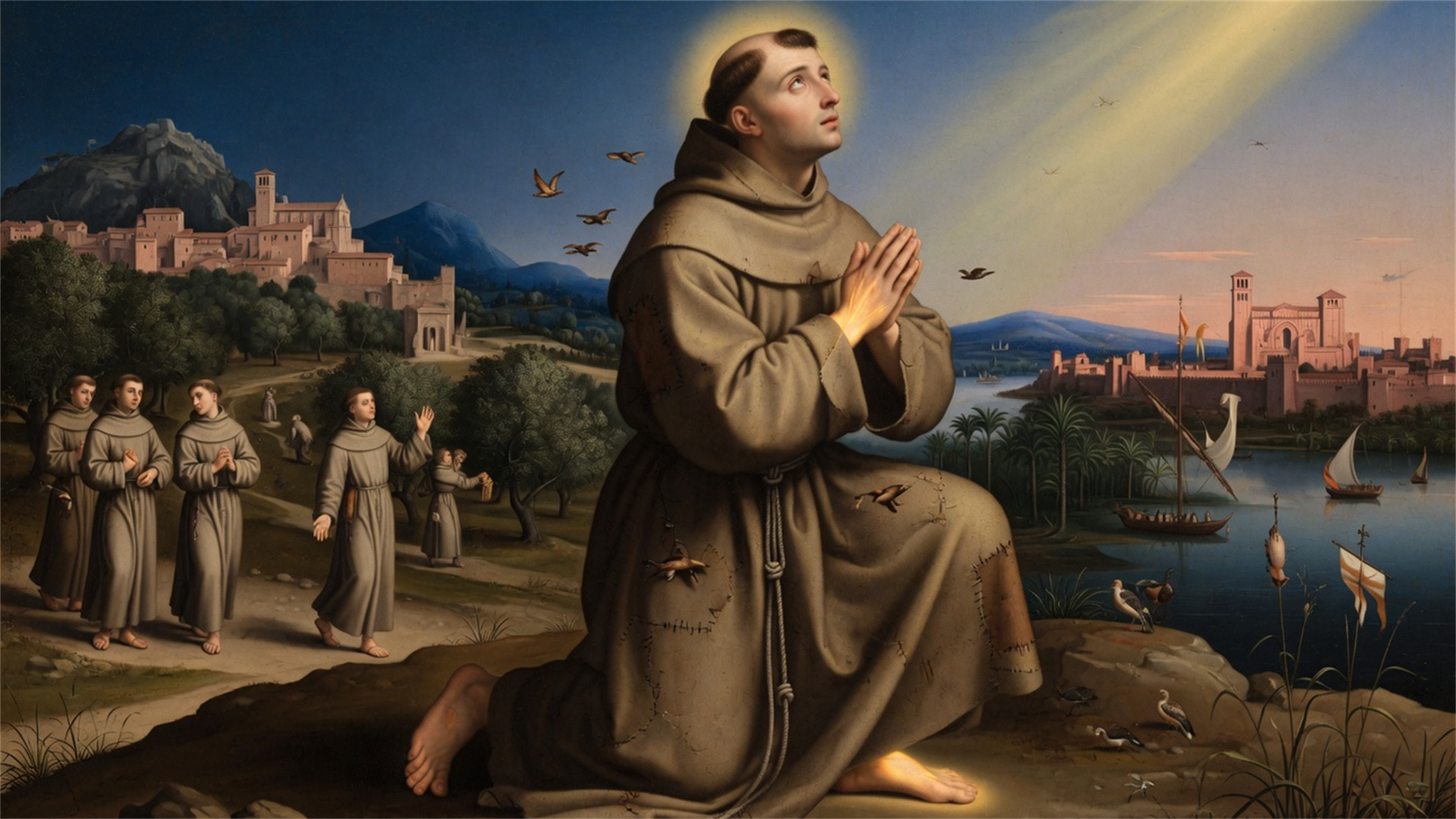
On May 30, 1216, having assembled a large number of his religious, he sent them to preach in France, Spain, England, and Germany, where they established monasteries on all sides that are tangible marks of the success of their preaching. As for him, he made another journey to Rome to pay his respects at the tombs of the blessed Apostles Saint Peter and Saint Paul. It was during this journey that, finding himself near a stream with a piece of hard, black, and moldy bread for his entire meal, he could not sufficiently exalt his happiness, and he testified to Brother Masseo, his companion, that he believed himself richer than the greatest on earth. He then entered a nearby church and asked Jesus Christ with such ardor to give him, as well as his children, the love of holy poverty, that his face seemed to cast flames. He advanced toward Brother Masseo, arms open, heaven in his eyes, called him in a loud voice, communicated to him, by breathing on his face, the spirit that filled him, and, as if beside himself, he burst into inflamed words, a true hymn of love for divine poverty. "Lord Jesus, show me the ways of your most dear poverty! Have pity on me and on my lady Poverty; for I love her with such ardor that I cannot find rest without her, and you know, O my God, that it is you who gave me this great love. She is sitting in the dust of the road, and her friends pass before her with contempt. See the abasement of this queen, O Lord Jesus, O you who descended from heaven to earth to make her your bride and to have from her, through her, and in her, perfect children. She was in the humility of your mother's womb; she was in the manger: like a faithful squire, she stood fully armed in the great combat that you fought for our redemption. In your Passion, she alone did not abandon you. Mary, your mother, stopped at the foot of the cross; but poverty climbed with you, she pressed you closer to her bosom. It is she who prepared with love the rough nails that pierced your hands and your feet; and when you were dying of thirst, this attentive bride had gall presented to you. You died in the ardor of her embraces; she did not leave you, O Lord Jesus, she only allowed your body to rest in a stranger's tomb. It is she who warmed you in the depths of the sepulcher and who brought you out glorious. Thus you crowned her in heaven, and you want her to mark the elect with the sign of redemption. Oh! who would not love the lady Poverty above all others! O most poor Jesus! the grace I ask of you is to give me the privilege of poverty. I ardently wish to be enriched with this treasure; I pray that for me and mine it may be proper forever to be able to possess nothing under heaven for the glory of your name, and to subsist during this miserable life only on what will be given to us in alms!"
With such speeches and raptures, they continued their journey and arrived in Rome a few days before the death of Pope Innocent III. The protection granted to Saint Francis and the recognition of his Order have always been considered one of the greatest works of this great pontificate. Two days later, Honorius III ascended the seat of Saint Peter, and Francis found in the new Pope the same protection and the same love. It was during this stay in Rome that the servant of God met for the first time Saint Dominic, poor like him, like him devoted and devoured by the love of souls. As they were both praying in the church of Saint Peter, Jesus Christ appeared to them seated at the right hand of his Father, his face irritated, holding in his hand three flaming darts to exterminate the proud, the avaricious, and the voluptuous. The Blessed Virgin Mary, throwing herself at his feet, asked for mercy for her ungrateful children, presented to the Lord Dominic and Francis, as capable of reforming the world and converting sinners; and the Savior accepted this offering. The next day, in the same church, the two Saints, raising their eyes to one another, recognized each other without ever having seen each other, advanced with the same movement, and stood for a long time embraced without saying anything. Finally, Dominic breaking the silence: "You are my companion and my brother," he said; "we will work in concert. Let us remain united, and no one will be able to prevail against us."
The two great poor men of Jesus Christ, during their short stay in Rome, spoke long and often of divine things, of remedies to bring to souls and nations, and these beggars, despised by the world, divided the conquest of the world. They prayed, they wept together, and Dominic drew from the soul of Francis an even greater love for holy poverty. One shows in the convent of Santa Sabina, on the Aventine Hill, the cell, today transformed into a chapel, which was for entire nights the witness of their celestial effusions. What prayers, what tears, what cries of love rose from this poor cell to the throne of God! The soul of the two Saints seems to fill it still, and the pilgrim cannot enter it without a profound and religious emotion.
Saint Francis left Rome and set out on the road to come to France. Being at the gates of Siena, he stuck his staff into the ground, and, at that very hour, this piece of wood took root and covered itself with flowers and leaves. It later became a great tree that lasted until 1615, when, by dint of having been stripped by pilgrims, it dried up: which forced it to be cut down. Since then, a shoot has been born from its trunk which is preserved with much respect, and which has even been surrounded by an iron grille to prevent passersby from touching it. Cardinal Ugolini, having met our Saint in Florence, strongly dissuaded him from his plan to cross the mountains. Francis felt a great pain, which he deposited lovingly at the feet of the crucified Savior. He sent in his place the brothers Pacificus, Angelus, and Albert of Pisa, and returned to Saint Mary of the Angels, happy to pass in the eyes of the people and his own sons for a man not very wise, changing in his enterprises, whom God put back on his path, but who did not know how to maintain himself there by himself. The event did not take long to prove the accuracy of Cardinal Ugolini's advice. The opposition that all reformers encounter, and which had not been lacking in the work of Francis, stirred up strongly in Rome against his Institute, whose absolute poverty terrified the half-Christians. He was informed of it, and God himself deigned to show him in a mysterious dream the danger, at the same time as the way to avert it. He saw in his sleep a small black hen with dove's feet, which had chicks in such great number that she could not gather them under her wings, so that they played around the hen and remained outside. Upon waking, he understood, in the light of the Holy Spirit, that this hen with dove's feet was himself, a simple and small man, and that, to defend his innumerable family, a more powerful protector was needed. He therefore resolved to return to Rome to ask the Pope to entrust to a cardinal the defense and protection of his Order.
This cardinal protector was already chosen in advance: it was his holy friend, Cardinal Ugolini, Bishop of Ostia, who had left Florence and was back in Rome. He welcomed Francis with his accustomed tenderness, and, to make him well seen by Pope Honorius III and the Sacred College, he strongly exhorted him to preach before this illustrious audience. His Holiness himself wanted to hear him. Francis refused for a long time to mount this first pulpit of the world; but, no longer able to defend himself, he prepared himself carefully, against his custom, to make a sermon that would be worthy of such an august audience. God showed, on this occasion, that he wanted him to be solely his organ. As soon as he had pronounced his theme, he remained mute and no longer remembered what he had studied. The word of the Pope, who exhorted him to fear nothing, was not capable of restoring him; but, when he had publicly accused himself of presumption for having relied too much on his preparations, and, having knelt down, he had abandoned himself to the Spirit of God to say what he would put in his mouth, he made a sermon so powerful and so terrible on penance, that the whole audience was frightened and touched with compunction; and, when he left the pulpit, there was a crowd to kiss the earth where he passed. He had no trouble, after that, in obtaining what he asked, and His Holiness willingly gave him, as protector, the same Cardinal Ugolini, Bishop of Ostia, who was later Pope under the name of Gregory IX.
May 26 of the year 1219 was a great day in the history of the Order of Friars Minor. It was the feast of Pentecost, and the Brothers, arriving from all parts of the world, found themselves gathered at Saint Mary of the Angels to attend the second General Chapter that was to open that day. Their number exceeded five thousand: such had been the marvelous fecundity of the family of Saint Francis. One saw them arriving in groups, young men and old, dressed in the same habit, all barefoot, breathing the joy of poverty, and carrying in them the treasure of divine love: an admirable, peaceful, and conquering army, disarmed and all-powerful, of the poor of Jesus Christ. The monastery of Saint Mary of the Angels, of which Francis and his twelve first disciples had taken possession nine years before, not being able to shelter this immense multitude, huts made of reed mats and straw were set up in the surrounding countryside; it was under these tents, as beautiful as those of the army of Israel, that the army of Saint Francis camped.
Cardinal Ugolini came to preside over the Chapter. He officiated pontifically on the day of Pentecost, and wanted in the evening, like an army general, to visit the ranks of the soldiers of Jesus Christ. He found them gathered in groups of one hundred or sixty, or more or less. They were talking about divine things, their salvation, and the conquest of the world. At this sight, the good cardinal, eyes bathed in tears, said to Francis: "O brother, in truth, here is the camp of the Lord!" And Francis, moved like him, transported with joy, gratitude, and love, raised his eyes and hands toward heaven, and bringing them back to his brothers and his sons, let fall from his heart and his lips lively, short, inflamed words, of which history has preserved some for us: "We have promised great things; we have been promised greater ones; let us keep the ones, let us sigh after the others. Pleasure is short, pain is eternal; sufferings are light, glory is infinite; many are called, few are chosen: all will receive what they have deserved. Above all, O my brothers, let us love the holy Church; let us pray for its exaltation, and let us never abandon poverty. Is it not written:
"Cast your burden on the Lord, and he will sustain you?" It is thus that the father exhorted, consoled, and glorified his children.
Following the word of Francis, the Lord took upon himself the care of feeding these dear poor. They were there five thousand, like those who had once followed Christ in the plains of Judea, destitute of everything like them, but counting like them on Him who had fed these multitudes with five loaves and two fish. One soon saw flocking from the surroundings, knights and peasants, people of the city and the countryside, who brought to the poor of God all the necessary provisions. These aids lasted as long as the Chapter itself, and the charity of those who gave was found as great as the poverty of those who received. A large crowd of people of all classes, young and old, clerics and laymen, had come out of curiosity to contemplate the novelty of this spectacle. In seeing the destitution of the brothers, their simplicity, their complete abandonment to Providence, and their brotherly love, many were touched to tears. "That," they said to themselves, "shows well that the path to heaven is narrow, and that it is difficult for the rich to enter the kingdom of God. We flatter ourselves that we are working out our salvation while enjoying life and taking all our comforts, and these good brothers deprive themselves of everything and still tremble. We would like to die like them, but we do not want to live the same way; one dies, however, as one has lived." And they came, to the number of more than five hundred, to throw themselves at the feet of Francis and ask him to receive them into the number of his brothers.
The conquest of these new disciples, the increase and renewal of fervor, of the spirit of religion and discipline in the old ones, were not the only results of this General Chapter. New and important statutes were made there which finished imprinting on the Order its touching and glorious character. Poverty was recommended in the construction of monasteries, and, thanks to this rule, the Friars Minor always remained in the beautiful while remaining in the simple. It was decided that, every Saturday, a solemn mass would be celebrated in all the monasteries in honor of the Blessed Virgin Mary Immaculate: and, by this decision, the Order of Friars Minor, already a knight of holy poverty, proclaimed itself the herald of the most holy Virgin and the propagator in the world of the great dogma of the Immaculate Conception. It was also decided that in the offices of the Friars Minor there would always be an express mention of Saint Peter and Saint Paul, and thereby, the Order of Saint Francis proclaimed and tightened even more the bonds of absolute devotion and filial love that attached it to the Roman Church, mother and mistress of all Churches.
Finally, the brothers divided the world among themselves to spread the divine Word there and to conquer it for Jesus Christ. The plan for this campaign against Satan was drawn up, which was to last as long as his power, that is to say until the end of time. Pope Honorius III, then in Viterbo, gave the approval of the Holy See to this enterprise. Equipped with this precious passport, the Friars Minor embraced, said goodbye, and dispersed like the Apostles of old, carrying the blessing of their father Francis.
After having dismissed this happy troop, Francis resumed his first plan to go to Syria, persuading himself that he could only gain much, since, if he did not have the happiness of converting the sultan of Egypt with his people, he could hope to be put to death and to win the crown of martyrdom. He took with him eleven religious whom a child designated to him by the spirit of God. His navigation was very happy. He arrived first at the port of Acre, then at that of Damietta, which was then besieged by the Christians. The latter, not having wanted to listen to the prophetic warnings he gave them, fared very badly, and were defeated in a day that cost them much blood. He passed from there to the camp of the Saracens, where, after many outrages and blows that he received from these infidels, having had himself presented to the sultan, he spoke to him with surprising freedom and strength, ev en offer Damiette Egyptian city conquered by Saint Louis. ing to pass through fire to make him see the truth of the Christian religion. Human fear prevented this prince from deferring to the pressing instances he made to him to become a Christian; but he did not mistreat him, and, on the contrary, rendered him many honors. He even gave him permission to preach on his lands and to baptize those he could convert: which Francis and his disciples did with marvelous success, even to the point of receiving Saracens into their Order.
It was then that the demon, ashamed of these advances, incited an Egyptian woman to solicit the holy man to sin. The latter replied that he consented, but that he wanted to prepare a suitable bed himself. He made one with burning coals, put himself on it, and said to her: "Here is the remedy for concupiscence." His body did not burn in the midst of the flames; but the sinner was touched by her fault and the other crimes of her past life: she opened her eyes to the light of faith, and, having embraced Christianity and the profession of continence, she was even the cause of the conversion of a large number of Mohammedans in the city where she lived. The Saint, after several other successes that he had in this country, and especially after an entire convent of Benedictines, in Montenegro, near Antioch, with the abbot and the prior had embraced his Rule, seeing that God did not want to give him the palm of martyrdom, resolved to return to Europe. He took leave beforehand of Sultan Meledin, who had shown him so much friendship, exhorting him again to abjure the errors of Mahomet and to recognize the divinity of Jesus Christ. A pious tradition, and one which does not lack value, reports that these exhortations were not useless, that this prince then took the resolution to do one day what he advised him; that, since then, he was very favorable to the Christians, a friend of truth and justice, merciful toward the poor and far from the vice of impurity; and that finally, being near death, he was visited by two religious whom Saint Francis, who had been in heaven for twelve years already, sent to him, and received from their hands the sacrament of baptism, in the grace of which he expired. This conversion is possible, for nothing is impossible to God; but it is not likely, and the tradition that reports it does not rest on bases certain enough for one to be able to add entire faith to it.
The servant of God, after having preached to the crusaders and laid the foundations of his Order in these unfortunate lands, returned to Italy, where he was received like an angel from heaven: incredible honors were paid to him in Venice, Padua, Bergamo, Cremona, Bologna, and in all the other cities where he passed. He also performed great miracles there and established new convents where there were none. He changed the corrupted water of a well into very good water, in Cremona, jointly with Saint Dominic; he healed an epileptic and a child who had lost an eye in Bologna. But these miracles are nothing in comparison to the reconciliation he managed between two gentlemen ready to cut each other's throats. Finding the building of his convent in Bologna too sumptuous, he wanted to have it torn down to redo a poorer one, and he would have done it effectively, without Cardinal Ugolini, who pointed out to him that this monastery, being intended for the infirm, should have more extent and convenience than the others. This is what this great friend of poverty has done on many other occasions; when one resisted him on this point, he did not enter the convent, and, by his distance, he deprived it of his blessing. From Bologna, he went to the desert of Camaldoli, where he spent thirty days in the cell of Saint Romuald, which is now called Saint Francis, and had this pious cardinal, who had a singular veneration for his merit, perform the exercises there. He then came to his convents in the Duchy of Spoleto, where he saw with his own eyes the laxity that Brother Elias, his vicar general, had introduced into his Order by a false prudence that was not according to the spirit of God, but according to the spirit of the world. God then made him know, by an admirable vision of a statue, similar to that of Nebuchadnezzar, the abuses and disorders that were being introduced into his Congregation by this wisdom of the flesh. He groaned over it for a long time before the divine Majesty, and after having given a severe reprimand to this vicar, and having made him ridiculous by putting on himself the fine habit that he had had made for himself, and rejecting it with contempt, he deposed him from his office.
Final Years and Stigmata
The final years are marked by the Rule, the closeness of Clare, retirement, the stigmata, and the saint's death.
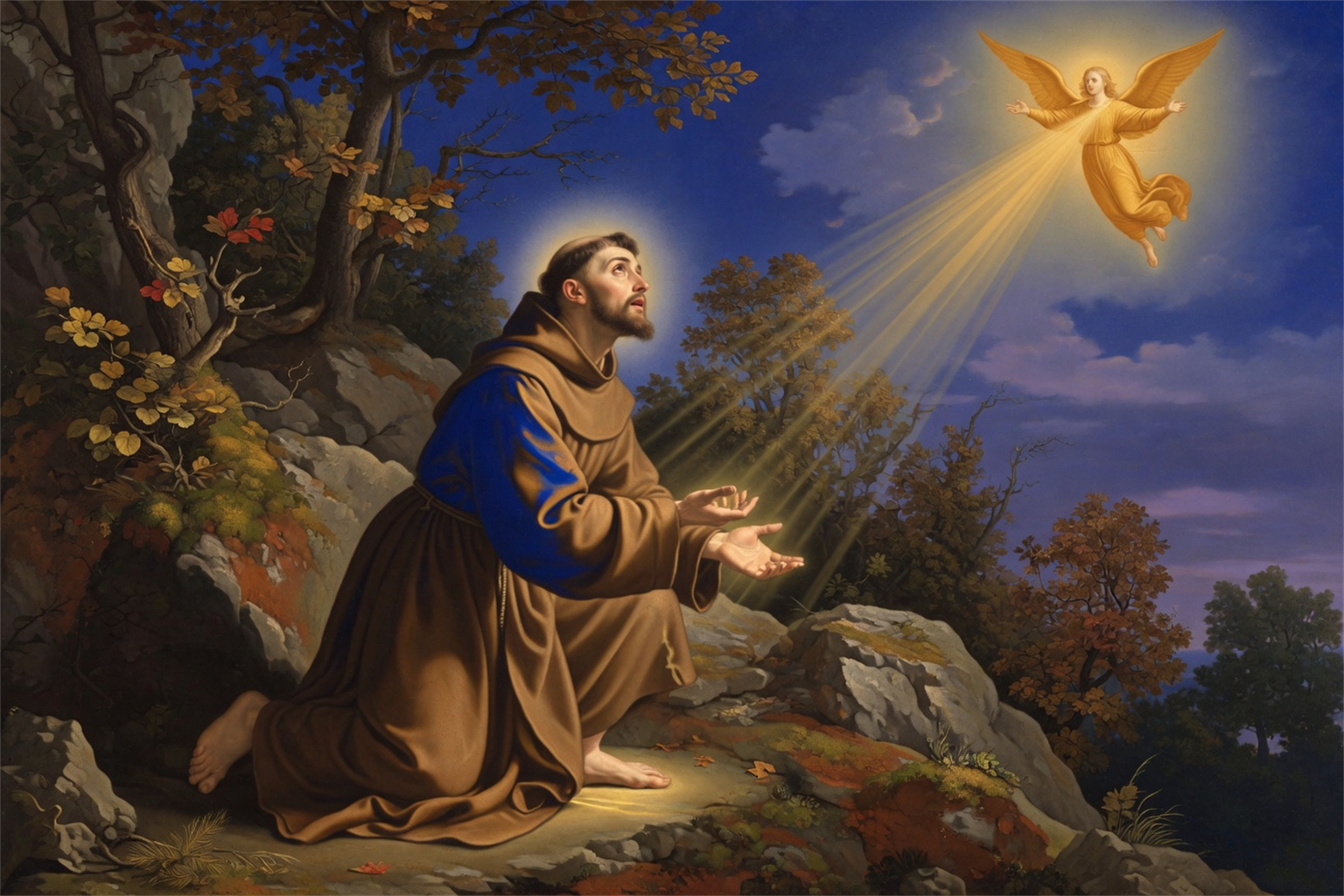
His humility led him at the same time to resign his position as General, in order to invest Brother Peter of Cataneo, before whom he knelt to protest his obedience. This did not, however, prevent the religious from still recognizing him as the General, or rather as an extraordinary superior, above the provincials and the General, and they called him by excellence the Father, as one who was not only the founder but also the support and soul of this nascent Congregation. Indeed, he always exercised toward it the office of leader, physician, and father. How severe he was toward those he found guilty of property, or who wanted to have furniture and books for their own use! What aversion he showed against those great theologians and learned preachers who, under this pretext, wanted to be considered and have exemptions, or who neglected the spirit of penance and prayer! He was not an enemy of study, as some of those proud men imputed to him, and he showed it well by the joy he felt when the great Alexander of Hales entered his Order and when he ordered Saint Anthony of Padua to teach holy doctrine to the brothers; but he was an enemy of that science which puffs up, especially since God had made him know that it would be through the pride of undevout scholars that his Order would fall into decadence and lose the spirit of humility and simplicity which was its entire strength. He often said that one is mistaken in attributing the conversion of sinners to those eloquent preachers who speak only by study, and who do nothing of what they preach to others; but that these prodigious movements of grace should be attributed to the prayers, tears, and holy life of a great number of simple people, who draw this blessing from heaven. His discernment of spirits was marvelous. He recognized those of his brothers who would persevere in their profession, those who would renounce it through apostasy, and even those to whom God would show mercy, or who would die miserably in their obstinacy: the terrible predictions he made about them always had their effect. He wrote to the General, Peter of Cataneo, who was making his visitations, a letter admirable for how it instructed him in all the duties of a good superior, and especially in the union he had to make of justice and mercy, to forgive the penitents and to repress the audacity and rebellion of the proud.
This General died; as the miraculous help that was continually received at his tomb, at Our Lady of the Angels, caused great alms to be given there, which altered the spirit of poverty, Francis addressed him directly and ordered him to cease performing miracles. This holy man obeyed immediately, and it was recognized, upon opening his sepulcher to transport him elsewhere, that he had knelt to receive this command. Who would have said that our Saint would have put in his place this famous Brother Elias, whom he had deposed from his vicariate, and whose haughty and presumptuous spirit was unbearable to him? He did it nevertheless by an express order of God, whose ways are always straight and holy, although the secret of them is impenetrable to us; and not only did he make him General, but he placed himself at his feet and kissed his hand as his legitimate superior. He then had the thought of retiring into a solitude; but the Holy Spirit made him know that He wanted him to continue his preaching; as, indeed, he did with more success than he had ever had. What is admirable is that he often preached to the animals themselves, such as birds, fish, and lambs, showing them the obligations they had to God, and how just it was that they should praise a Creator so good and so magnificent; and these creatures, deprived of reason, not only listened to him attentively, but also testified, by their movements, the joy they had in hearing him, then, after the sermon, they used the means that nature had given them to bless and praise the Lord.
He always had new subjects of joy as well as of affliction and sorrow. It was an unspeakable happiness for him to learn, sometimes of the martyrdom of some of his own who had carried the faith into infidel lands, sometimes of the pure, holy, and miracle-bright life of some others, who filled the whole world with the odor of their virtues; but he had incredible pain to see the relaxation of many others who, supported by the authority of Elias, the General, who was a strong spirit, sought only to alter that extreme poverty which he wanted his own to profess. Our Lord consoled him in this affliction, assuring him that there would always be in his Order persons zealous for observance, in consideration of whom He would love him singularly, and that He would be its protector until the end of time.
It was around this time that he obtained the famous indulgence of the Portiuncula, of which we have spoken in the discourse on the feast of Our Lady of the Angels; having come to dine with Saint Clare, at her insistence, he gave a discourse so elevated and so mysterious that all those present and he himself fell into ecstasy; the place where they were appeared all on fire: which attracted the inhabitants of Assisi. Thus, this meal was entirely spiritual, and only the soul took its nourishm ent there. Th sainte Claire Disciple of Francis of Assisi and founder of the Franciscan female branch. e one he had shortly after, in the refectory with Brother Elias, was quite different; this General, not being able to suffer that the Saint had placed near him two very simple religious, in preference to the fine geniuses and scholars who were in the community, murmured about it within himself, and said that this good man was destroying the Order by rejecting the clever people to favor the base and groveling souls; but the Saint, who saw distinctly everything he wanted in his spirit, told him, in a dreadful tone, that it was he himself who was the destroyer of the Company by his pride; but that God would not leave him without punishment, because he would be an apostate and would die in the deplorable state of his apostasy. The event has shown the truth of this prediction; for Elias left the habit, and, having joined the Emperor Frederick, excommunicated by the Church, he died outside the religion; God nevertheless showed him mercy, giving him then the spirit of penance, in consideration of the prayers that Saint Francis had made for him during the course of his life.
It had already been a long time since this blessed Patriarch, wanting to be useful to everyone, had instituted his Third Order for secular persons who, without leaving the legitimate engagements of their state, would want to lead in the world a life more pure and more perfect than that of the common Christian. He received into it at all times men, women, and virgins of great merit, and it is well known that this Third Order has become a nursery of Saints. In the year 1222, he placed in it Matthew de Rubeis, of the house of the Orsini, and, embracing his son, he predicted to him that he would one day be Pope, as he was under the name of Nicholas III. Wherever he turned, it was nothing but wonders. He changed the thorns where Saint Benedict had rolled into roses of marvelous beauty and scent. At Gaeta, a ship came of its own accord to pull him from a crowd of people who were suffocating him on the shore, and then served as a pulpit for him to preach. In the same place and in the surroundings, he resurrected three dead people; and, having rolled himself on very prickly thorns to extinguish an immodest movement he had felt in his body, he took away forever from these thorns that had covered him in blood the faculty of pricking. At Bari, he lay on a burning brazier to drive away an immodest woman whom the Emperor Frederick had sent to test his chastity. At Mount Gargano, which he visited with incredible devotion for the love he bore to the Archangel Saint Michael, he caused a spring of living water to flow in a dry place incapable of having one. At Gubbio, he tamed a wolf to show the inhabitants that their hardness and impenitence made them worse than wolves. He also performed in various places a quantity of wonders on trees, rendering fertile those that were sterile, and sterile those that were fertile; making some grow and preventing the growth of others, or making them produce leaves, flowers, and fruits in winter.
After so many wonders, Our Lord commanded him to make a new Rule, shorter and better ordered than the first. He retired for this to the convent of Monte Colombo, where, after a fast of forty days on bread and water, being all filled with celestial lights, he dictated to one of his companions the ordinances that the Holy Spirit placed in his mouth. It was with this new law that he descended from the mountain like another Moses: he brought it to his convent, and placed it in the hands of General Elias to have it published and observed throughout the Order. The latter, finding it too austere, did not want it to be promulgated; but not daring to resist the blessed founder directly, he pretended to have lost it. Then the Saint returned a second time to the mountain, and Our Lord, continuing His favors toward him, placed the same rule, word for word, in his mouth, to dictate it and have it written. The General, having been notified, assembled several superiors of his faction, and, with this troop of cowardly provincials and guardians, he came to find him to declare that they would not receive the rule he wanted to give them. But they were surprised to hear the voice of Jesus Christ Himself who said to him in their presence, these distinct words: "Francis, this rule is not your work, but Mine; I intend that it be kept to the letter, to the letter, to the letter, without gloss, without gloss. If some do not want to keep it, let them be rejected from the Company as difficult, mutinous, scandalous, and incorrigible. I know the capacity of man, and I know the graces and help I want to give him." These superiors, seized with fear and dread, fell to the ground and did not dare to open their mouths. The Saint raised them up and sent them away in peace; then he followed them, his face all shining with light from the conversation he had had with God. He still found resistance when he had the ordinance read not to possess anything either in common or in particular; but having returned a third time to the divine oracle, he learned that the Brothers, possessing nothing, would nevertheless lack nothing, because they would have for their fund the inexhaustible treasure of divine Providence. This caused this rule to be finally accepted, and that it was subsequently approved and confirmed by a bull of Pope Honorius III, on November 29, 1223.
Cardinal Brancaleone pressed our Saint so hard in Rome to stay a few days with him, that after much resistance he was obliged to consent to be lodged in an abandoned tower of his palace; but God, who wanted to remove him entirely from the court of the great, permitted the demon to beat him outrageously from the very first night he lodged there. He left therefore the next day, with the blessing of the Pope, to go and spend the feast of Christmas in his convent of Greccio. It was near this convent that, having had a stable and a manger made, with the figure of the child Jesus, and having had an ox and an ass brought there to represent the mystery of His birth, he also set up an altar there where the midnight mass was said. He served as deacon at this mass, and then preached on the ineffable greatness of this child, in the presence of an infinity of people who had rushed there. He often called Him in his sermon the Child of Bethlehem, and merited, by the fervor of this devotion, that this lovable Savior, appearing to him in a sensible form, permitted him to embrace Him and gave him a thousand kisses. A chapel was later built at the place where this stable was, which was extremely frequented by pilgrims.
As soon as he was back in Assisi, Saint Clare and all her religious begged him to give them a rule as he had given one to his religious. He retired for this into a solitude with Cardinal Ugolini, protector of his Order, to receive the lights of heaven. He then dictated this rule by inspiration of God, and this cardinal made no difficulty about being his secretary for such a holy thing and writing it under him. All the religious received it with marvelous submission and fervor. However, the Saint was a long time without wanting to allow his religious to take charge of their conduct: and he gave them as visitor an excellent servant of God, of the Order of Cîteaux, called Father Ambrose. He feared the disorders that arise from the too great frequency of parlors and grilles, and he believed he could not sufficiently turn his children away from a reef that has been so damaging to very spiritual persons; but, later, he was forced, by the cardinal protector, to suffer that Father Philippe Lelong, of his Order, succeed Father Ambrose in the superiorship of the convent of Saint-Damien.
This would be the place to speak of his second retreat to Mount Alvernia, of the Lent he fasted there in honor of Saint Michael, and of the sacred stigmata of Jesus Christ crucified that he received by the impression of a seraph all ardent and all luminous, at his feet, at his hands, and at his side; but we have already spoken of it amply on September 17. His return to Mount Alvernia was honored by several miracles, and one saw a cross of light that walked before him to signify that he had become all ardor and all light, and a man entirely consecrated to the cross of Jesus. He nevertheless comm itted a Alverne Famous site of the Franciscan Order where Conrad stayed. n imperfection: having gone to knock at the door of the cell of Brothe r Bernard stigmates Mystical marks of the Passion of Christ received by the saint. of Quintavalle, who was in a very high contemplation of divine truths, and the latter not having answered him, he felt some trouble in himself. But Our Lord rebuked him for it immediately, asking him if it was reasonable that this holy man should leave his Creator, with whom he had the honor of conversing familiarly, to speak to a little creature like him. This reprimand touched him so hard that, to punish himself for his fault, he later forced Brother Bernard to put his foot on his throat, treating himself as proud, arrogant, and a miserable worm of the earth.
The tears that flowed continually from his eyes had made him blind; but, blind as he was, he did not cease to have himself led or carried into the towns and villages around to preach penance there. In the two years that he survived the impression of the stigmata, he was overwhelmed by incredible illnesses and pains. But, at the height of his pains, he would have ecstasies and raptures that carried him in spirit up to heaven. He also gave continual blessings to God, praising Him in His infinite perfections and in all His creatures, as in the sun, the moon, the fire, the air, the water, the earth, the cold and the heat, which he called his brothers and sisters. Our Lord, for His part, consoled him, sometimes by apparitions full of love, sometimes by celestial music, sometimes by giving him infallible assurances, and of which he could in no way doubt, that he was of the number of the predestined, sometimes by marking for him precisely the time and hour of his death. His great illnesses, and especially his pain in the eyes, which was unbearable, obliged his children to lead him to Rieti, where the Pope was with his cardinals, in order to have him seen by the doctors who followed the court. He was everywhere received with extraordinary acclamations, and the Pope himself took a particular care of his healing. When a cautery was applied behind his ear, which was done at the convent of Monte Colombo, having prayed his brother fire (that is what he called it) to be favorable to him, he felt no pain. His patience gave admiration to the doctors and surgeons, and he paid them with miracles for the trouble they took to visit him. A doctor having told him that, the gable of his house separating from the body of the building, he feared its ruin, he had him take some of his hair to put in the cracks; and this means was so effective that the gable rejoined at that very hour to the roofs and walls from which it had separated. Moreover, this admirable man, who did not heal himself, often healed other sick people. He healed among others a beneficiary named Gideon, afflicted with a horrible paralysis that had deformed all his limbs; and, as he was a libertine, he converted him at the same time; but he told him that, if he returned to his disorders, he would be surprised by sudden death to be precipitated into hell: which actually happened; for, having resumed his former life, he was killed under the ruins of the house where he was sleeping. He also did a thousand other actions of charity; often he sent his cloak, his tunic, and his bread to the poor whom he knew to be in need; he reconciled enemies, appeased quarrels ignited between cities, families, and private individuals; and above all he re-established in Assisi the peace that a great dispute between the governor and the bishop, each supported by a strong party, had entirely ruined. He predicted to many what was to happen to them, in order to encourage some by the hope of divine mercy, and to humble others by the sight of the punishments that were destined for them. He explained to the doctors the most difficult passages of Scripture, and made them see, by his discourses full of wisdom, that his ignorance was more enlightened than all their science, however deep they thought it to be.
As the news of the approach of his death spread everywhere, each city wished to be the blessed place where this star would eclipse itself on earth to go and shine in heaven; but the city of Assisi won out over all the others. He was brought there with a good guard, for fear that this treasure would be taken away by the neighboring cities. Being in his convent of the Portiuncula, he gave admirable instructions to his children touching poverty and trust in divine Providence, the manner of behaving in the establishment and construction of new convents, the form of receiving and instructing novices, and many other points important to his religion; he also instructed Saint Clare and her daughters very excellently by letters full of the spirit of God. Finally, after having given them all his blessing, he prepared himself for this last hour which was to be the first of his eternal felicity. He therefore received the sacraments with a devotion worthy of the greatness of his law and of the respect he had for these life-giving sources of the salvation of men. Then, wanting to die in the last excess of poverty, he took off his habit, got out of his bed, and lay on the earth, in order to be able to say with Job: "I came out naked from my mother's womb and I will return there naked." He had only his left hand on the wound in his side, in order to hide it from the eyes of those present. Then, the one who was serving as guardian presented him with an old robe and a cord, as alms, and commanded him to receive them in a spirit of obedience: he received them immediately and permitted them to clothe him with them; but he begged his brothers that after his death they leave him for some time naked on the floor, to imitate more exactly the sovereign poverty of his Savior expiring on the cross. One cannot express the joy he had in finishing his life in a destitution so perfect and so universal. Moreover, Our Lord consoled him admirably by the new assurances He gave him, that he was going to enjoy His presence for an eternity. His children were melting into tears around his bed. He gave them the last farewell with these words: "Goodbye, my dear children, remain constantly in the fear of God. You are going to be tested by great temptations; be firm in your good resolutions: I abandon you to the mercy of the Lord, toward whom I am going." Then, having had read to him the Gospel of Saint John which begins with these words: *Ante diem festum paschæ*, he recited Psalm CXLII, and at these words, with which he finished: "Bring my soul out of prison to give praise to your name; the just wait for me until you reward me for my labors," he lowered his head gently, closed his eyes, and rendered his spirit to God. It was Saturday, October 4, 1226, the forty-fifth year of his age, the twenty-first of his conversion, and the nineteenth from the beginning of his Order.
At the same hour, several people had a revelation of his happiness and even saw him ascend into heaven. His body having been placed naked on the earth according to his desire, it appeared so beautiful and so shining that one would never have said that it was this body that he had rendered black, dry, and disfigured by the rigor of his penances; it also exhaled an admirable odor that perfumed the whole place. A Roman lady, named Jacqueline of Settisoli, brought, by the order of an angel, a new habit to cover him. She had been very affectionate to him during his life, and had received great graces through his instructions and through the intercession of his prayers; she then had the satisfaction of seeing the wounds that the seraph had imprinted on him. Many other people saw them too.
The church of Assisi, the first Gothic monument of Italy, is built on the cross and offers, in its lower part, the mysterious figure of the Tau imprinted on the forehead of Saint Francis. It is divided into a lower church and an upper church: the lower church represents Francis suffering both in soul and in body; the upper church is the symbol of Francis eternally glorified in heaven. — One sees at the Louvre a beautiful painting by Giotto, representing the stigmatization of Saint Francis. In the predella, there are three truly marvelous compartments, one of which represents Francis preaching to the little birds. — He is also represented: 1st receiving the child Jesus from the hands of the Virgin; 2nd in ecstasy, seated, his hands resting on a skull; 3rd receiving a cross from the hands of the child Jesus; 4th seated on the ground, holding a crucifix between his two hands; 5th kneeling, holding the child Jesus in his arms; 6th distributing the cords of his Order to various people; 7th having his feet and hands pierced with large nails. Near him a sheep, image of Jesus Christ or of gentleness; 8th in ecstasy, supported by angels; 9th placed on the clouds; 10th preaching to brothers; 11th giving his hand to a wolf who presents his paw to him, to recall an episode of his life; 12th holding two branches of flowers; 13th kneeling, meditating; 14th dying: he is lying in his cell, and near him are three religious who are assisting him.
Cult, relics and writings
After the death of Francis, the text describes the veneration of his body, his canonization, his writings, and the early Franciscan memory.
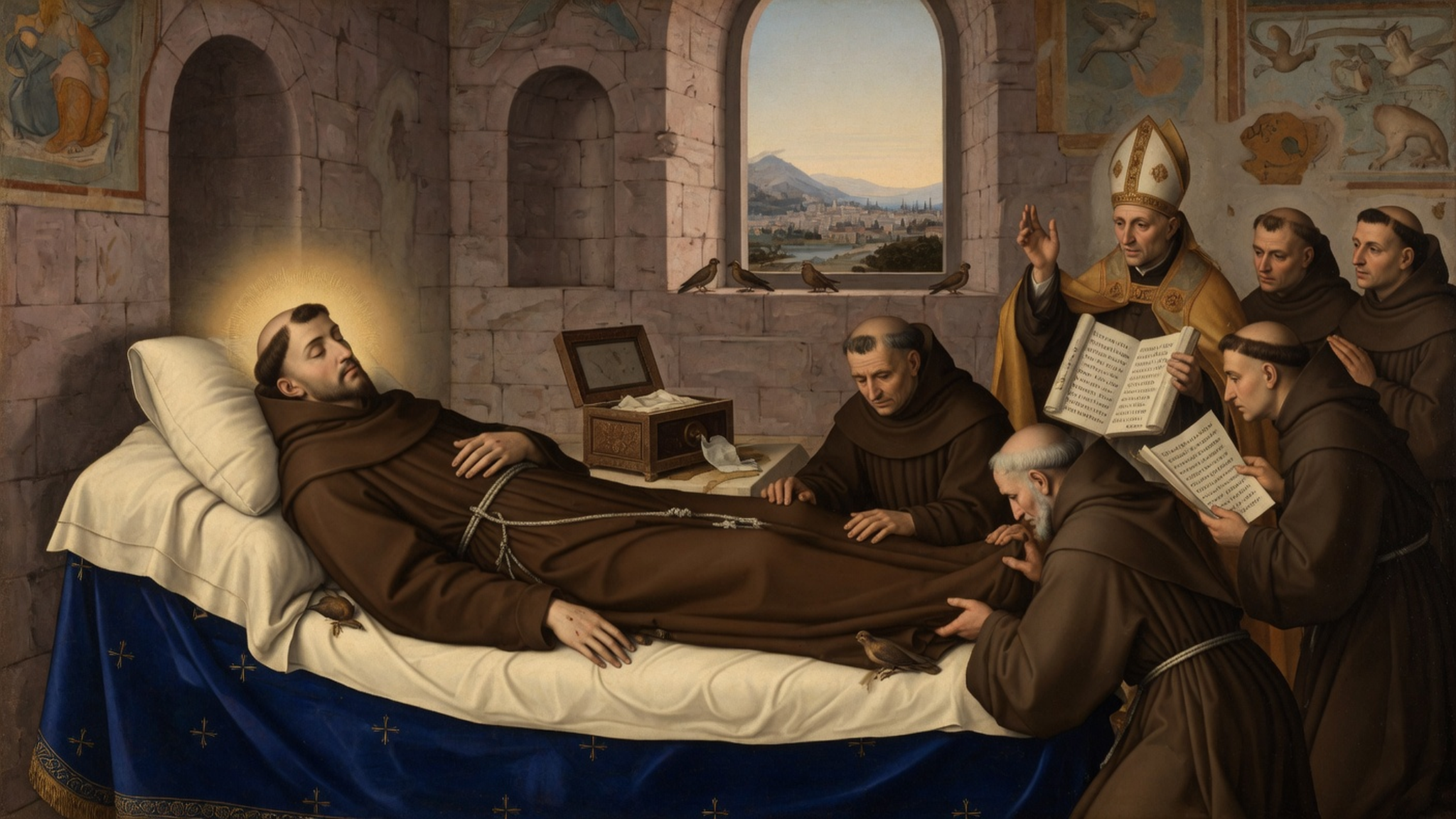
## CULT AND RELICS. — WRITINGS. — ORDER OF SAINT FRANCIS.
The religious, having washed and embalmed the body, clothed it in a new tunic open at the side of the heart, and exposed it on rich carpets to the veneration of the faithful. His heart and entrails were removed and deposited in the church of Saint Mary of the Angels. His body was then carried, amidst burning torches, the singing of psalms and canticles which made a truly celestial melody, to the convent of Saint Damian, which was that of Saint Clare, so that this holy lady and all her nuns might have the happiness and consolation of seeing these wounds which were the astonishment of the whole world. Saint Clare tried to pull the nail from one hand, but she could get nothing but blood which flowed from the wound she had disturbed; from there, the principal inhabitants of Assisi, having taken this precious burden upon themselves, transported it with incredible pomp to the church of Saint George, these pious citizens being unable to suffer that it should remain outside, exposed to the insults and enterprises of the neighboring towns. So many miracles occurred at his tomb thereafter that, two years later, on July 7, 1228, Gregory IX, who had been the protector of his Order, solemnly canonized him in Assisi. This Pope did not doubt the wounds of his feet and hands, having seen them himself uncovered in the familiar conversations he had had with him. He only doubted the wound in the side and what was said, that it was like a pleasantly half-open mouth, and that blood sometimes came out of it; but the Saint removed this doubt from him by appearing to him, showing him this same wound, and making a small stream of blood flow in his presence. His Holiness filled a vial with it.
Immediately after the canonization, a magnificent church was begun in his honor, in a place called the Hill of Hell, which he had chosen out of humility as the place of his burial, because it was the place where it was customary to execute criminals; and, when the lower church was completed, his sacred body was transported there on May 26, 1230; it was hidden in a crypt to ensure its possession more securely. The entire church, with the adjoining monastery, was completely finished and consecrated by Pope Innocent IV in 1243. The monastery was called from that day the Negro-Convento, the sacred convent par excellence, and the church received the title of papal chapel. Here is the account of its discovery in 1818, as we find it in a memoir presented to Pope Pius VII by the Reverend Father Donis, Minister General of the Order of Conventual Friars Minor.
The state of the body of Saint Francis of Assisi and the place that contained it had been for six centuries problems which, after having exercised the pens of several writers, had not been solved. It was known that, in 1230, this holy body had been taken by the inhabitants of Assisi at the moment it was being transferred to the new church built in honor of the servant of God on the Hill of Hell, near that city: and from that moment it had not been possible to know the precise location of his tomb. A tradition, quite generally spread among the Franciscans, made them believe that the body of their holy founder was enclosed in an underground church located on this hill. This tradition, not being supported by any solid foundation, had been contested several times, and the dispute had even been serious enough to force Pope Paul V to forbid any search for the body of Saint Francis. This prohibition was all the more wise as there was no certain notion of the underground church where it was claimed he had been deposited, nor the means to penetrate it. However, a certain person had, in 1818, the temerity to affirm that he was buried in this church, and was bold enough to give false indications on how to descend into it. The tone of assurance with which he spoke inspired some confidence, and Father Denis, Minister General of the Conventual Friars Minor who served the church of Saint Francis, obtained from Pope Pius VII permission to undertake excavations in the lower church to discover the place that was indicated. The work, which was done secretly, began during the night of October 5, 1818. The first efforts were fruitless; it was soon acquired that there was no underground church, and that the assertions of the person we have spoken of had nothing in common with the truth. However, the desire to discover the holy body made the work continue in another part of the church. It was thought better to succeed by digging under the steps of the high altar. This time the hope was not deceived; first a very narrow hole was found, the bottom of which was filled with a cement so hard that it could only be removed with incredible difficulty. Deeper down, two walls were encountered which led to the discovery of two stones placed one on top of the other and which seemed to have been placed intentionally in this place. These stones having been broken, a third was found whose position announced that it covered an empty space. This one was pierced with caution, and through the opening an iron grate was seen. With the help of a light, the interior of this grate was illuminated, which presented a human skeleton lying in a stone coffin. The religious who directed the excavations did not doubt that it was the body of Saint Francis, and their joy was as great as their efforts had been painful, for it was only after fifty-two nights of stubborn work that they obtained this happy result. The discovery took place on the night of December 12, 1818; and at that very moment those who were present felt a very sweet odor which exhaled from the interior of the grate.
The first care of the guardian of the convent of Saint Francis was to inform his superior general, who resides in Rome, of the happy outcome of the enterprise; the latter in turn made it known to the Sovereign Pontiff Pius VII, who, having first ordered that the holy body be left in the situation in which it was found, immediately appointed a commission composed of the bishops of Assisi, Nocera, Spoleto, Perugia, and Foligno, to make a legal examination and verify its authenticity; for as much as the Church shows veneration for the precious remains of the friends of God, so much does it take precautions to present only true relics to the piety of the faithful. The Holy Father hastened to address to these prelates, on January 8, 1819, apostolic letters by which he told them that, desiring to know what this discovery offers of certainty, he trusts in their good faith and accuracy to verify the identity of the holy body; he even wants each of them to communicate his particular opinion to him. Faithful to fulfilling the intentions of the head of the Church, the five bishops met without delay in Assisi, and began the inquiries they were charged to make. They were not content to question the religious and the workers who had contributed to discovering the coffin; after having required the oath from them, they called various professors who taught physics and chemistry in the colleges of the neighboring cities. There had been found with the skeleton the remains of a coarsely woven habit, some small balls which seemed to be beads of a rosary, remains of a cord, and eight coins of the 13th century; these objects were submitted to the examination of the professors who also gave their opinion on the crystallization with which several of the bones were covered. Doctors and surgeons were also heard: and, from the inspection of the skeleton, they judged that it must be that of a man of middle age and of mediocre stature.
Having thus taken all the means that prudence indicated to know the truth well, the five bishops addressed their report to the Sovereign Pontiff, who, in his turn, appointed a commission to examine the procedure. This commission, composed of cardinals and other grave personages, having pronounced itself in the most favorable manner, Pius VII, after an examination he made himself of the cause, finally gave, on September 5, 1822, apostolic letters, in the form of a brief, to declare authentically that the body found under the high altar of the basilica of Saint Francis in Assisi is truly that of this holy patriarch. He reports there summarily the manner in which these holy relics were discovered, the precautions he ordered to be taken so as not to be led into error, and he blesses the Father of all consolation, "filled," he adds, "with the lively hope that the invention of this precious body will be for us a new and singular pledge of a very special protection of this great Saint, in such difficult times." The Sovereign Pontiff then orders that this precious deposit be kept intact in the place where it was found, and wants a monument to be raised in this very place to the glory of Saint Francis. The intentions of Pius VII have been fulfilled: a marble mausoleum now covers the vault where the body of the servant of God rests in its ancient coffin. Only a few relics were extracted from it by the order of the same Pontiff, to be sent to the Emperor of Austria Francis II, who had them exposed to public veneration. The filial piety of the Franciscans towards their holy founder and the respect of the inhabitants of Assisi for their illustrious fellow citizen did not feel limited to a simple monument. They dug around the tomb, in the living rock, deep enough to obtain the space necessary for a church that was established there and which has the shape of a Greek cross. The tomb of the Saint is in the middle; it is surmounted by a small dome, enriched with precious marble columns and gilded bronze ornaments; in front of the monument is the high altar, two others are placed at the ends of the transepts. A large light well, which rises to the ground, gives this underground church the appropriate light; it is covered with various marbles that embellish it; immediately above is the lower church of the convent, and above this the upper or higher church, a vast and beautiful basilica, which is rich in precious paintings.
While the Church was proceeding with wise slowness to the recognition of the body of Saint Francis, the Lord manifested by wonders the authenticity of these precious remains. A Dominican nun, named Sister Marie-Louise, afflicted with a tumor on her left knee, from which she suffered greatly, and for the healing of which no remedy had been used, was, in the month of January 1819, suddenly delivered from this infirmity, by the application she made of a cloth that had touched the reliquary of Saint Francis. She and four of her companions, questioned legally, by the order of the bishop of Foligno, attested to the truth of this sudden healing.
"Joseph Natalini, a muleteer, living in Assisi, had been tormented for four years by rheumatism which, in the course of the months of January and February 1813, became so violent that he was kept in bed during all this time, without being able to move. These pains were even greater in 1819, at the same period, and the remedies that a doctor had indicated to him could not provide him any relief. A pious woman engaged Natalini to have himself carried to the church of Saint Francis. He consented, and found himself there at the moment when the bishops were sealing the iron grate which enclosed the holy body. The stone which had covered the coffin was deposited in the church; Natalini lay on this stone and claimed with confidence the help of Saint Francis; at the same instant all his pains ceased, he got up perfectly healed and returned in full health to his home. This is the legal deposition he made before the bishop of Assisi on the following July 5; a deposition which was confirmed by that of his doctor and two other witnesses.
Pope Leo XII, by his decree of June 22, 1824, ordered that in the future the entire Order of Saint Francis would celebrate every year, on December 12, with the rite of a major double, the feast of the invention of the body of its holy patriarch."
Many written documents of Saint Francis have reached us: these are letters, discourses, ascetic treatises, conversations, thoughts, short observations, poems, and less authentic pieces. They were gathered and published by Jean de la Haye, *S. Francisci Opera*, Prædonti, 1739, in-fol. His poems are also found in the collection entitled: *Rime di diversi antichi autori Toscani*, Venezia, 1731, in-8°. They have been very often reprinted. It was contested that they are all by Saint Francis. In any case, the most famous of these canticles, that of the Sun, is incontestably his.
The Order of Saint Francis received great privileges from several Popes, and notably from the bull *Mare Magnum*, published by Sixtus IV in 1474. Leo X extended these privileges, in 1519, to all the other mendicant Orders.
The first Order of Saint Francis, which has given the church forty-five cardinals and five Popes: Nicholas IV, Alexander V, Sixtus IV, Sixtus V, Clement XIV, is divided into *Conventual* religious and religious of the *Observance*. The origin of the Conventuals goes back to the time of Elias; shortly after the death of our Saint, they obtained from their generals, and then from the Popes, permission to receive rents and foundations. They were called Conventuals, because they lived in large convents, whereas those who followed the Rule in all its purity lived in hermitages or in low and poor houses; and it was this zeal for the Rule that made them called *Observantines* or Fathers of the *Regular Observance*. This name was mainly given to those who followed the reform established to their primitive institute, and of which Saint Bernardine of Siena was the author in 1419.
The reforms of this Order having multiplied, Leo X, in 1517, reduced them all to one, under the denomination of Reformed Franciscans, and permitted each to have its own general.
Franciscan Family and Posterity
The end of the text expands the life of Francis to the history of the Franciscan branches, the Poor Clares, and the Third Order.
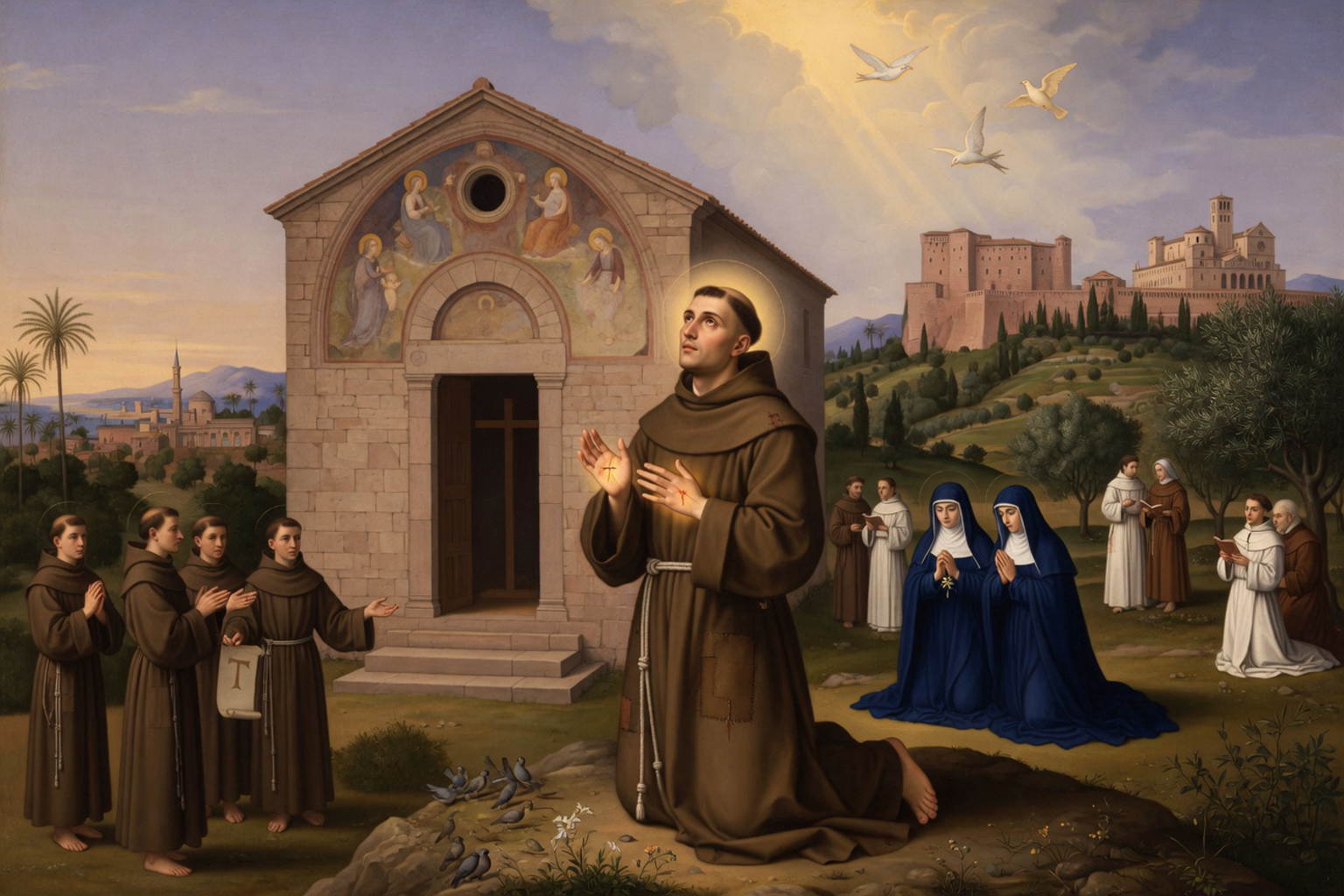
The Observants of France were called Cordeliers, from the cord that hangs from their belt.
Among the Observants, some stricter reforms have been maintained, despite the union made by Leo X, or have been established since. These are called Observants of the Strict Observance. Among them, one distinguishes the Discalced Franciscans of Spain, regarding whom one may consult the life of Saint Peter of Alcantara; they are called Reformed Franciscans in Italy. They form a distinct congregation, which is especially flourishing in Spain. They have several convents in Italy, one of which is in Rome on the Palatine Hill. They have some in Mexico, in the Philippine Islands, etc.
The reform known as the Recollects was established in Spain in the year 1509, by Father Jean de Guadalupe; it was received in Italy in 1525, and in France in 1584. The name Recollects was given to these religious because they lived in solitary convents and made a more special profession of the practice of retreat and recollection.
The Capuchin reform was established in Tuscany in 1523, by Matteo da Bascio. It cannot, as some authors have done, be attributed to Bernardino Ochino, who did not enter the Order until 1534. The latter became a famous preacher and was elected General of his Order; but he later apostatized and embraced Lutheranism. He preached polygamy through his speeches and his example, and died miserably in Poland, after having made himself the object of public indignation through the horrible corruption of his morals.
The Capuchins have a patch on the back of their habit, as Saint Francis recommends in his testament. They wear long beards, whereas Saint Francis, according to Wadding, Philippe, etc., wore his extremely short. The Capuchin reform was approved by Clement VII in 1523. The Capuchins and the Recollects wear a brown habit; but that of the Conventual Franciscans is black. The convent of Assisi, where Saint Francis is buried, belongs to the Conventuals.
The Second Order of Saint Francis is that of the Poor Clares, regarding whom one may consult the life of Saint Clare. Saint Isa Clarisses Contemplative religious order founded by Saint Clare, to which Catherine belongs. belle, sister of Saint Louis, having obtained from Pope Urban IV, in 1263, permission to assign fixed revenues to the religious of Saint Clare, whom she had established at Longchamp, near Paris, the name Urbanists was given to those who received the bull of the Sovereign Pontiff. The others were called Poor Clares. Blessed Colette of Corbie introduced an austere reform in several houses of the latter.
The Capuchin Poor Clare reform was begun in Naples, in 1538, by the venerable Mother Maria Lorenza Longo. The Duchess of Mercœur established them in Paris in 1602.
The convent of Ave Maria in Paris was of the Third Order of Saint Francis; but the religious who composed it having renounced thei r revenues in 1 troisième Ordre Franciscan branch intended for the faithful living the spirit of Francis outside of the First Order. 485, they embraced the reform of Saint Clare, and they surpass in austerity all other reforms of the same Order.
The religious of the Immaculate Conception of the Holy Virgin were founded in Toledo, in 1484, by the venerable Beatrice of Silva, and Pope Innocent VII approved their institute in 1489. The famous Cardinal Ximenes, who was himself a Franciscan, united them to the Poor Clares, whose Rule they adopted, but with certain mitigations. Pope Julius II gave, in 1511, a particular Rule to the Conceptionists, while still leaving them incorporated with the Poor Clares.
The Third Order of Saint Francis was instituted by the Saint himself in 1221, at Poggibonsi, in Tuscany, and at Caruncio, in the valley of Spedée. It was for persons of both sexes engaged in the world and even in marriage, who subjected themselves to certain practices of piety compatible with their state, but none of which obligated under pain of sin. These exercises were only rules of conduct that entailed neither vow nor obligation. The Dominicans, Augustinians, Carmelites, Minims, and Servites imitated this Institute. After the death of Saint Francis, several persons of this Third Order gathered in community at different times and in different places; they kept the enclosure and made solemn vows of poverty, chastity, and obedience. They regard as their founder Saint Elizabeth of Hungary, Duchess of Thuringia, who died in 1231. This Institute contains persons of both sexes, who are divided into several branches, some of which are dedicated to the service of the sick in hospitals.
The religious called in Flanders Grey Sisters formerly wore a grey habit; they have abandoned this color in some places to substitute white, black, or dark blue. In some houses, they make solemn religious vows; but commonly, they hold to the simple vows of poverty, obedience, and chastity.
The religious of this Third Order, who are called Penitents, were instituted in Foligno, in 1397, by Blessed Angela, Countess of Civitella, and they are very numerous. There is in the Low Countries a reform of this institute, which takes the name of Recollectines.
The religious of the Third Order of Saint Francis, who dedicated themselves to the service of the insane and other sick people, for the most part make only the simple vows of chastity, poverty, and obedience to the bishops in the dioceses where they are established, adding to them that of serving the sick. They observe the Third Rule of Saint Francis and live in hospitals or in societies they call families. Such are, in Spain, the Infirmarian Minims, also named Obregons, from Bernardino Obregón, a gentleman of Madrid, who was their founder, and in Flanders, the Bons-Fieux or Bons-Fils, whom five pious merchants founded in Armentières, Lille, etc.
There are in some places religious called Penitents of the Third Order, who occupy themselves with the instruction of the people and other functions of the ministry, like the Friars Minor. Among them, one distinguishes the congregation called Piepus. It was instituted by Vincent Bossart, a Parisian, in 1595. The first members of this congregation were the seculars of the Third Order, of both sexes, who assembled together. Their first monastery was erected at Francouville, a village situated between Paris and Pontoise. The second, from which they took their name, is in a place named Piepus, in the Faubourg Saint-Antoine, in Paris. They have more than sixty monasteries in France which form four provinces.
The Friars Minor had considerable establishments in England. Saint Francis sent there, in 1219, Angelo of Pisa with eight others of his religious. They all arrived in Dover in 1220 and founded a convent in Canterbury; shortly after, they founded another in Northampton, which became very famous. The one they had in London, near Newgate, was founded in 1306 by Queen Margaret, second wife of Edward I. There was a magnificent library that had been given to the religious, in 1429, by Sir Richard Whittington, then Mayor of London. When the monasteries were destroyed, the one we are speaking of was turned into a hospital where four hundred children called Bluecoat children are raised.
The Franciscans had about eighty convents in England, independently of those of women of their Order, which, according to Tanner, were not very numerous. The principal house of the Poor Clares was near Aldgate; it was built by Blanche, Queen of Navarre, and by Edmund, her husband, who was the son of Henry III, brother of Edward I, and Earl of Lancaster, Leicester, and Derby. These Poor Clares were of the number of those called Urbanists. Besides the name Poor Clares, they were also given that of Minoresses. Their convents were called Minories. At the time of the destruction of the monasteries, the one of the Poor Clares in question here was changed into an armory. Its name has remained to the part of the city where it was, and it has been given to the new buildings that extend to the countryside.
If one wishes to know well the flourishing state enjoyed by the Franciscans in England, and the number of great men their Order produced there, one can see the good history of the English province of these religious; Father Davenport, in his Supplém. historiæ provincie Anglicanae, and Stevens, Monasticon Anglic. vol. 1, p. 39 et seq.
This ancient province was re-established by Father Jean Jennings, who laid the foundations of the famous Franciscan convent in Douai, around the year 1617. Of all the religious of this Order who have revived in themselves the spirit of Saint Francis in these latter times, few have equaled the venerable Father Paul of Saint Magdalene, or Henri Béart, as one can be convinced by reading his life and his pious writings. He died in London for the faith, on April 17, 1643.
According to Fathers Hélyot and Chaippe, there are more than seven thousand Franciscan convents of the First and Third Orders, and nearly one hundred and twenty thousand religious in these houses. The same authors count, including all the branches of the Second and Third Orders, more than nine thousand Franciscan monasteries, and twenty-eight to thirty thousand religious women subject to the superiors of the Order of Saint Francis, independently of those who are subject to diocesan bishops. Their number was much more considerable before the destruction of the monasteries in England and in the northern kingdoms. Sabellicus counted, in 1350, fifteen hundred Franciscan houses, and ninety thousand religious.
The office of General in the Order of Saint Francis was formerly perpetual; but it has been given only for six years since 1500.
The revolution of 1792 having involved in the same ruin the throne, the altars, and the religious institutions, the Franciscans shared the fate of all the French clergy. All hope of re-establishment seemed lost, when suddenly, in 1849, the Very Reverend Father of Loretto, Minister General of the Order of Saint Francis, believed that the favorable moment to act had arrived, and he cast his eyes on Father Brother Joseph Aréso, a missionary of the province of Navarre (Spain), who at that time was in Egypt, and ordered him to leave for France in the capacity of Commissary of the Holy Land, enjoining him at the same time in a patent letter to work for the re-establishment of the Order in that country. Father Aréso, upon arriving in France, went directly to Saint-Palais, a small town in the Basses-Pyrénées, where he bought a bourgeois house and had a chapel built there. He then brought from Italy two emigrated Spanish Fathers, Father Brother Jean Obiéta and Father Brother Joseph Isaguieré, both missionaries of the college of Zarauz, in the province of Guipuscoa (Spain). He successively called to him three other Spanish Fathers of the province of Aragon, who were in the diocese of Rouen, the principal of whom is Father Brother Roch Claramunt. Finally, Father Emmanuel Bécvidé, with another, came to join him from the province of Guipuscoa.
While work was being done on the house of Saint-Palais for its new destination, that is to say, to become a college of Franciscan missionaries, Father Aréso reported on his mission to the Very Reverend Father, Minister General, who sent him the authorization that our Holy Father the Pope had granted for the canonical erection of the said establishment as well as the patent of Provincial Commissary for all of France, which took place on June 12, 1851.
The convent of Saint-Palais, by its position near the borders of Spain, could hardly become the headquarters of a nascent province and of as vast an extent as France, nor attract subjects to it; Father Aréso, leaving the college of Franciscan missionaries of Saint-Palais under the direction of the Reverend Father Joseph Isaguieré, who had been named guardian, came to Paris to find resources and protectors there, in order to continue his foundations. Many obstacles opposed his projects. After eight months of running about and fatigue, he found a person who knew immediately that his work was very important for religion in France and for French influence in the Orient, and especially in Palestine, and that it was in the interest of this nation to admit the Franciscans into its midst and to protect them. Father Aréso, strongly supported by this person, presented himself to the Ministry of Foreign Affairs and to that of Worship. He found there minds well disposed to make his enterprise succeed, under the double aspect of its influence in the Orient and the spiritual good that would result for France itself. From that moment everything changed face and opinion became favorable to his projects.
A few days later, M. Poujoulat, former representative and author of several excellent works, who had made the trip to Palestine, gave a speech in favor of the re-establishment of the Franciscans in France, a speech that was distributed in several thousand copies. In the meantime, Father Aréso made known to a large number of members of the French episcopate the motive for his arrival in France and the desire he had to found convents of his Order there, in order to have subjects to evangelize in France, to send them beyond the seas, especially to Palestine for the guarding of the Holy Places. All those to whom he addressed himself, cardinals, archbishops, and bishops, answered him in the most flattering and encouraging manner.
Mgr de Salinis, Bishop of Amiens, invited Father Aréso to come and establish himself in his episcopal city. Father Aréso bought in Amiens itself, to serve as a novitiate, a house that belonged to the missionaries of the Holy Heart of Mary, situated at 52 Faubourg de Noyon. He brought from Saint-Palais Father Brother Roch Claramunt with a novice; several other religious also came to join him. The 25th of the month of August of the year 1852 was destined for the installation of the Franciscans in Amiens. This solemnity was performed by His Eminence Cardinal Wiseman, Archbishop of Westminster, who had just arrived in that city.
Two years later, a new house of the Franciscans was founded in Limoges.
We have used, to complete this biography, the Life of Saint Francis of Assisi, by M. Chavin de Malan; the Popular History of the Saint, by Count Anatole de Ségur; the Franciscan Year, and the Franciscan Annals; the Analecta Ordinis pontificii; Godescord; the Encyclopedic Dictionary of Catholic Theology, by Goschler, and the Dictionary of Religious Orders, published by Abbé Migne.
Annexes & related entities
Structured data for exploration: events, miracles, quotes, places, attributes, patronages, and important entities cited in the text.
Key Events
- Born in Assisi in 1182
- One-year captivity in Perugia
- Renunciation of paternal goods before the Bishop of Assisi in 1206
- Restoration of the churches of San Damiano and the Porziuncola
- Approval of the Rule by Innocent III
- Meeting with Saint Dominic in Rome
- Mission to Syria and meeting with Sultan al-Kamil
- Stigmatization on Mount La Verna
- Died at the Porziuncola in 1226
- Canonization by Gregory IX in 1228
Miracles
- Preaching to the birds
- Taming of the wolf of Gubbio
- Changing water into wine at Bonantis
- Healing of lepers and paralytics
- Miraculous stigmata
Quotes
-
Ego mendicus sum et pauper.
Psalm 29:18 (cited as an epigraph) -
I am the herald of the great King.
Response to the robbers in the woods -
Lord Jesus, show me the ways of your most dear poverty!
Prayer in Rome