Blessed Charlemagne
KING OF THE FRANKS AND EMPEROR OF THE WEST
King of the Franks and Emperor of the West
King of the Franks and later Emperor of the West, Charlemagne dedicated his reign to the expansion of the Christian faith and the protection of the Holy See. A great legislator and patron of the arts, he unified a large part of Europe before his death in 814. His cult, though not formally canonized by Rome, is widely tolerated and celebrated in France and Germany.
Guided reading
8 reading sections
BLESSED CHARLEMAGNE,
KING OF THE FRANKS AND EMPEROR OF THE WEST
Legitimacy of the cult
The text justifies Charlemagne's presence in hagiography through the Holy See's tolerance of his ancient cult in France and Germany, despite an irregular canonization.
To establish human societies, God willed these two hands: the Pope and the Emperor. In agreement, these hands can do all good; opposed, they are powerless against all evil.
Without the Emperor, the Pope is but an immortal martyr; without the Pope, the Emperor is but a god of pretensions, an idol often recast.
L. Veuilloy, Parfums de Rome, ch. 23.
Although the canonization of Charle magne was n Charlemagne Emperor of the Franks and uncle of Saint Folquin. ot performed in the ordinary forms of the Roman Church, nevertheless the cult rendered to him in France and Germany, whether by dedicating churches in his honor, by inserting him into Martyrologies, or by consecrating an office to him in Breviaries, without the Holy See finding fault with it, obliges us to give him a place in this collection to satisfy the piety of the peoples who have such veneration for his memory.
Accession to the throne
Son of Pepin the Short, Charlemagne succeeded his father in 768 and became absolute monarch of the Franks after the death of his brother Carloman in 771.
He was the son of Pepi Pépin King of the Franks whose accession to the throne was supported by Burchard. n, King of France, and grandson of the invincib le Charles Mar Charles-Martel Mayor of the palace, possible ancestor of the saint. tel. Never was there seen in a prince more beautiful dispositions for arms, letters, and piety: of intrepid courage in military expeditions, of an admirable vivacity of mind for the sciences, he was capable, through his great heart, of the most generous and beautiful devotion to the cause of God and that of men. After the death of the king his father, he succeeded to his states, with Carloman, his brother, on November 9, 768. As soon as he had ascended the throne, he gave fine marks of his bravery, for he began his reign with the defeat of Hunald, son and successor of Waiofar, who was renewing the war in Aquitaine, and with that of Lupus, Duke of the Gascons, whom he made his tributaries; his brother Carloman having died at Samoussy, on December 4 in the year 771, Charles took possession of his kingdom and remained absolute monarch of the Franks. He saw himself thereby more in a position to oppose the rebels and to reduce the enemies of the Church.
Expansion of the Empire
The narrative enumerates the military victories against the Lombards, the Saxons, the Saracens, and various peoples of Central Europe, extending the borders from the Ebro to the Vistula.
It would require large volumes to recount his victories and conquests, wherever his courage, justice, piety, and zeal for religion compelled him to carry his arms, for God favored him in all the wars he undertook. In the one he waged beyond the Alps, he entirely destroyed the kingdom of the Lombards, which had existed for two hundred years, through the capture of Desiderius, the last of their kings; he defeated and pushed back the Greeks to the depths of Calabria, and finally received the oath of fidelity from the Romans who gave themselves to him. Thus, from the Alps to lower Calabria, the other extremity of Italy, Charlemagne was absolutely the master, as well as in the islands and kingdoms of Corsica and Sardinia.
On the other hand, in frequent and famous expeditions that he made in Germany against the Saxons, who were so often rebellious, and the other peoples who had allied against him, he subjugated all these vast regions that lie between the Rhine and the Vistula, the Baltic Sea and the Danube; he submitted to the laws of his empire Bavaria, Austria, Hungary, as far as the Tisza, Dacia, Croatia, Carinthia, Friuli, and even pushed his conquests, after having defeated the Huns or Avars, to the borders of Bulgaria and Thrace.
Finally, carrying his arms toward the West, he waged war beyond the Pyrenees against the Saracens, and conquered from them all the kingdoms and provinces that lie between the Ebro and the Mountains, the Ocean, the Mediterranean, along with the Balearic Islands.
Zeal for Christendom
The author asserts that Charlemagne's wars were not motivated by ambition but by the desire to convert pagans and protect the papacy.
One must not imagine that ambition, so common to conquerors, was the spirit that animated our Saint in these great expeditions. The desire to extend the boundaries of his monarchy played the smallest part in all his noble exploits. Nor was it the title of Augustus and Emperor, which he later received, since he was so little moved by it that he first refused it out of heroic humility, and protested, after his coronation, that had he known the Pope's design, he would not have gone to church that day, even though it was Christmas Day. It was therefore a more elevated motive that drove Charlemagne to these glorious enterprises. He knew that idolatry still reigned in Germany, among the Saxons; he wished to bring them to receive the Catholic faith: thus he is called their Apostle. Pope Adrian complained of the perse cutions he pape Adrien Pope who approved the mission of Hildegrin in Saxony. suffered from the Lombards; he made it a matter of religion to deliver him from these tyrants. The Saracens, sworn enemies of the Church, occupied almost all of Spain: his zeal led him to employ his arms to exterminate them. Finally, if he led his troops into Italy so many times, it was only to assist Pope Adrian, of whom we have just spoken, or to go as a pilgrim to the tombs of the apostles Saint Peter and Saint Paul, to whom he had a most singular devotion, as appears by the great gifts he made to their churches, in gold, silver, and precious stones; or to avenge the injuries done to Leo III, to whom some Romans, with horrible cruelty, had wanted to put out his eyes and cut out his Léon III Pope who presented the relics of Hippolytus to Charlemagne. tongue. In a word, he never went beyond the borders of his empire except to extend the Christian religion at the same time; and he only crossed the Mountains for the benefit of the Holy See and to enrich the Church with a good portion of the spoils of the Lombards and the Greeks, raising it from the lowliness of its initial poverty to that degree of temporal grandeur from which its enemies try to make it fall, because they know that it is the best condition for its independence and its spiritual prosperity.
The learned and sober prince
Description of his personal virtues: dietary sobriety, taste for the sciences, founding of universities, and collaboration with the scholar Alcuin.
If we wished to descend from Charlemagne's military virtues into the detail of all his moral virtues, it would be to undertake an entire work, and not a collection of his finest deeds; I shall therefore content myself with saying that he was a prince who could not endure luxury, and that his moderation appeared even in his clothing, although his magnificence was otherwise very great when it concerned the good or the glory of his States. He was extremely sober in his drinking and eating, considering that a life spent in delights is not only contrary to the laws of Christianity, but also unworthy of a heroic courage which delicacy is capable of enervating. During his meals, he had history read to him, or books of science, or some book by Saint Augustine, particularly the City of God. He was eloquent, and his love for the sciences is well enough known by the University of Paris and the others he founded. He also attracted scholars to France, and, among others, he brought Alcuin from England, the most learned man of his time, to serve as hi Alcuin Famous abbot under whom Aldric began his monastic life. s tutor. To be convinced of the erudition of our prince, one need only read the beautiful laws that he drafted himself, under the title of Capitularies.
Ecclesial action and miracles
Charlemagne founded numerous churches, including Aachen, gathered relics of apostles, and benefited from heavenly favors and apparitions of saints.
But, among all his virtues, the one that shone most brightly and which serves as the hallmark of his holiness is his piety and his zeal for the splendor of the Church. We have already said that this was the soul of all his enterprises, and that his principal design was to establish or re-establish divine worship everywhere. He made the journey to Rome four times out of devotion, and, according to some authors, he went to Saint-Jacques, in Galicia, in a spirit of penance, and it can be said that it is he who brought this famous pilgrimage to the great luster in which we see it today. During his conquests, he took great care to seek out distinguished relics in the places his arms took; among others, the bodies of six Apostles are cited, namely: Saint Simon, Saint Jude, Saint Philip, the two Saint Jameses, and Saint Barnabas, along with the head of Saint Bartholomew, in addition to an infinity of others of several Martyrs, which he had transported to France and deposited in the basilica of Saint-Saturnin, in Toulouse; he valued these precious treasures more than all the riches of the peoples he subjugated. He liberally distributed to the temples the ornaments and sacred vessels necessary for the service of the altars. He had up to 27 churches built, the principal one being that of Notre-Dame in A Aix-la-Chapelle Imperial residence where Lioba was summoned by the queen. achen, not to mention those that were ruined and which he had repaired. It is he who founded and so prodigiously enriched all the bishoprics and all the abbeys of Germany. He restored ecclesiastical chant, which had been so neglected that it had entirely fallen from that holy harmony which brings devotion into the hearts of the faithful. In view of this, it is not surprising that this distinguished piety earned him so many extraordinary favors from heaven; indeed, several Saints often appeared to him to converse with him familiarly as if he had already been of their company: one notes, among others, Saint Salvius, Bishop of Angoulême, whose relics he had placed in a beautiful reliquary, and Saint Suitbert, whom he had canonized by Leo III; one may also add to these apparitions that of two blessed spirits, who, striking terror into the Saxon army, forced them to take flight and abandon the siege of Fritzlar, which they had undertaken during Charlemagne's absence. Finally, it is recounted that, while waging war against this people, he obtained water through his prayers during a great drought, to refresh his army which had been without it for three days.
Beneficence and the struggle against heresy
The sovereign displayed international charity and convened the Council of Frankfurt to condemn the Adoptionism of Elipandus and Felix of Urgel.
The piety of our Saint appeared not only through the great zeal he had for the glory and majesty of material temples, but also through the care he took for spiritual temples, which are the poor, whether by founding hospitals to shelter them or by distributing alms to them sufficient for their subsistence; and, as if the vast provinces of his kingdoms did not contain enough wretches to make them feel the effects of his charity, he sent prodigious sums of money to Syria, Egypt, Jerusalem, Alexandria, and Carthage to assist the needy there. And in order to extend his liberality beyond the grave, he assigned, by his will, great assets to be distributed to the poor. He even ordered that his library be sold, and that the proceeds be used to assist them in their needs; and, to show the love he bore them, he willed, by that same testament, that of four great tables, three of silver and one of gold, the silver one that was the heaviest, and upon which, by an admirable artifice, the world was represented in three great circles, and the gold one, be divided between them and his heirs, according to the disposition he made of them; as for the other two silver tables, he bequeathed to the Basilica of Saint Peter in Rome the one upon which was the description of the city of Constantinople; and the other, upon which was the figure of Rome, to the Bishop of Ravenna.
During the reign of Charlemagne, several heresies arose, for which he procured condemnation through the assembly of several councils. The most famous of all was that of Frankfurt, where Theophylact and Stephen, legates of Pope Adrian I, presided; the errors of Elipandus, Archbishop of Toledo, and Felix, Bishop of Urgel, concerning the filiation of Jesus Christ, were proscribed there by the bishops of France, Italy, and Germany, who were present by order of our blessed prince, who thus employed all his care for the strengthening of the Catholic faith in his states.
End of life and liturgical cult
Charlemagne died in 814 in Aachen. His body was later elevated by Frederick Barbarossa, and his cult is maintained locally under the title of Blessed.
What is admirable in the life of our Blessed one is that, in the midst of his great and important occupations, he was as disciplined in his exercises of piety as a religious in his cloister: he regularly attended the divine office, both in the evening and at night, unless some indisposition prevented him; he said his prayers with such devotion that he inspired those who saw him: it appears that, when he made his will, four years before his death, he was thinking of abdicating the imperial crown, so that, no longer burdened by the weight of earthly affairs, he might occupy himself only with those of his salvation.
Finally, our great monarch, after having worked so usefully for religion, so often supported the authority of the Popes, defended the Church, overthrown idolatry, and dissipated heresy, fell ill in Aachen; he knew immediately, by the violence of Aix-la-Chapelle Imperial residence where Lioba was summoned by the queen. the fever which was followed by pleurisy, that his hour was near; that is why he used the little time that remained to him to prepare for this final passage: and after having received the Sacraments with extraordinary fervor, he holily rendered his soul to his Creator in the year 814, in the seventy-second year of his age, and the forty-seventh of his reign.
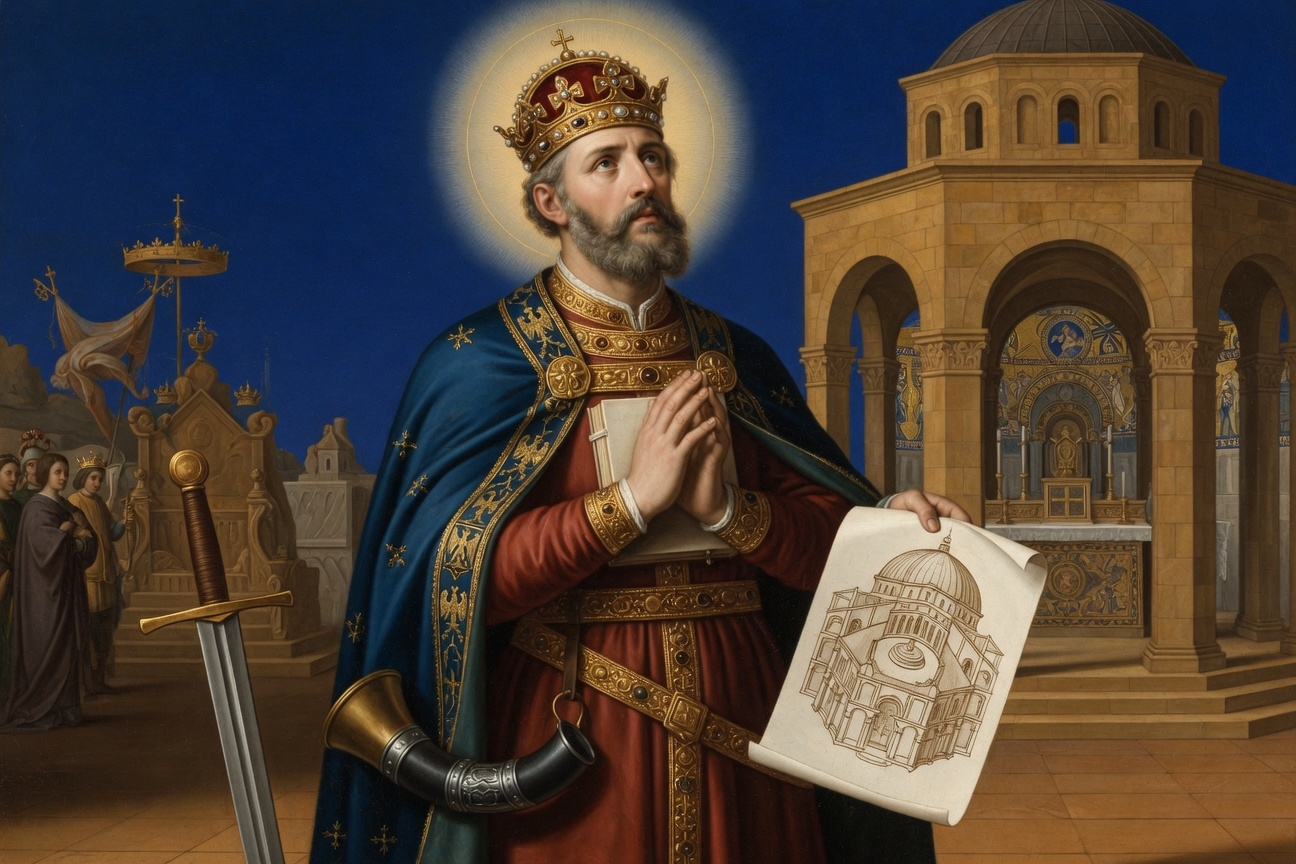
Blessed Charlemagne is depicted crowned and holding in his hand the plan of his chapel of Aachen in which he wished to be buried.
[APPENDIX: CULT AND RELICS.]
His body was solemnly buried in the cathedral he had built, and three hundred and fifty-one years later, it was raised from the earth through the care of Frederick I, surnamed Barbarossa, and his head was transferred to Osnabrück.
Regarding the cult rendered to Charlemagne, here is what Dom Guéranger tells us in his *Liturgical Year*.
To the gracious memory of the sweet martyr Agnes, a great number of churches, especially in Germany, associate today (January 28) the imposing memory of the pious Charlemagne. The respect of the peoples was already prepared in favor of the holiness of Charlemagne when Frederick Barbarossa had the decree of his canonization rendered by the antipope Paschal III in 1168; that is why the Apostolic See, without wishing to approve an irregular procedure, nor to restart it in due form, since it was never asked to do so, has felt it necessary to respect this cult in all the places where it was established.
In our churches of France, we have no scruples about giving the title of saint and honoring as such a considerable number of bishops on whose holiness no decree has been rendered by anyone and whose cult has never gone beyond the limits of their dioceses; the numerous churches that have honored, for nearly seven centuries, the memory of the great emperor Charlemagne, content themselves, out of respect for the Roman Martyrology, where his name is not read, with celebrating him under the title of *Blessed*. — To cite but one example, a church is still dedicated to him in the former diocese of Sarlat, in Périgord.
Before the time of the Reformation, the name of the blessed Charlemagne was found on the calendar of a great number of our churches in France; the Breviaries of Reims and Rouen are the only ones that have preserved it today. More than thirty churches in Germany still celebrate the feast of the great emperor today; his dear church of Aachen keeps his body and exposes it to the veneration of the people... It is kept in a gilded silver shrine. One of his arms is in a separate reliquary. One finds in the thickness of the bones of this arm the proof of what authors recount regarding the great height and physical strength of the great emperor. In the treasury of the same church is also his hunting horn, and in a gallery, the stone seat on which he was seated in his tomb.
It is known that it was on this seat that the emperors of Germany were installed on the day of their coronation.
The University of Paris chose him as its patron in 1661.
Several Martyrologies of France, Germany, and Flanders make mention of Saint Charlemagne on January 28. Ferrarius did not forget him in his supplement of *Saints* who are not in the Roman Martyrology, nor did Usuard, nor Melan. We have drawn what we have said about him in this collection from Eginhard, who was his chancellor and who became a religious of the Order of Saint B Eginhard Secretary to Charlemagne, translator of relics to Germany. enedict after the death of his master, and from other memoirs that Bellandus reports in the second volume of the *Acta Sanctorum*, where one can see some miracles that were performed through the merits of our holy king. On the life of Saint Charlemagne, one can also consult what was written by the blessed Notker, a monk of Saint Gall, in the 14th century.
Annexes & related entities
Structured data for exploration: events, miracles, quotes, places, attributes, patronages, and important entities cited in the text.
Key Events
- Succession to the throne with his brother Carloman in 768
- Absolute monarch of the Franks in 771
- Destruction of the Lombard Kingdom
- Imperial coronation on Christmas Day
- Foundation of the University of Paris
- Died in Aachen in 814
Miracles
- Apparitions of saints (Saint Salvius, Saint Suitbert)
- Miraculous gushing of water for his thirsty army
- Intervention of blessed spirits putting the Saxons to flight at Fritzlar
Quotes
-
Without the Emperor, the Pope is but an immortal martyr; without the Pope, the Emperor is but a god of pretensions.
L. Veuillot, Parfums de Rome