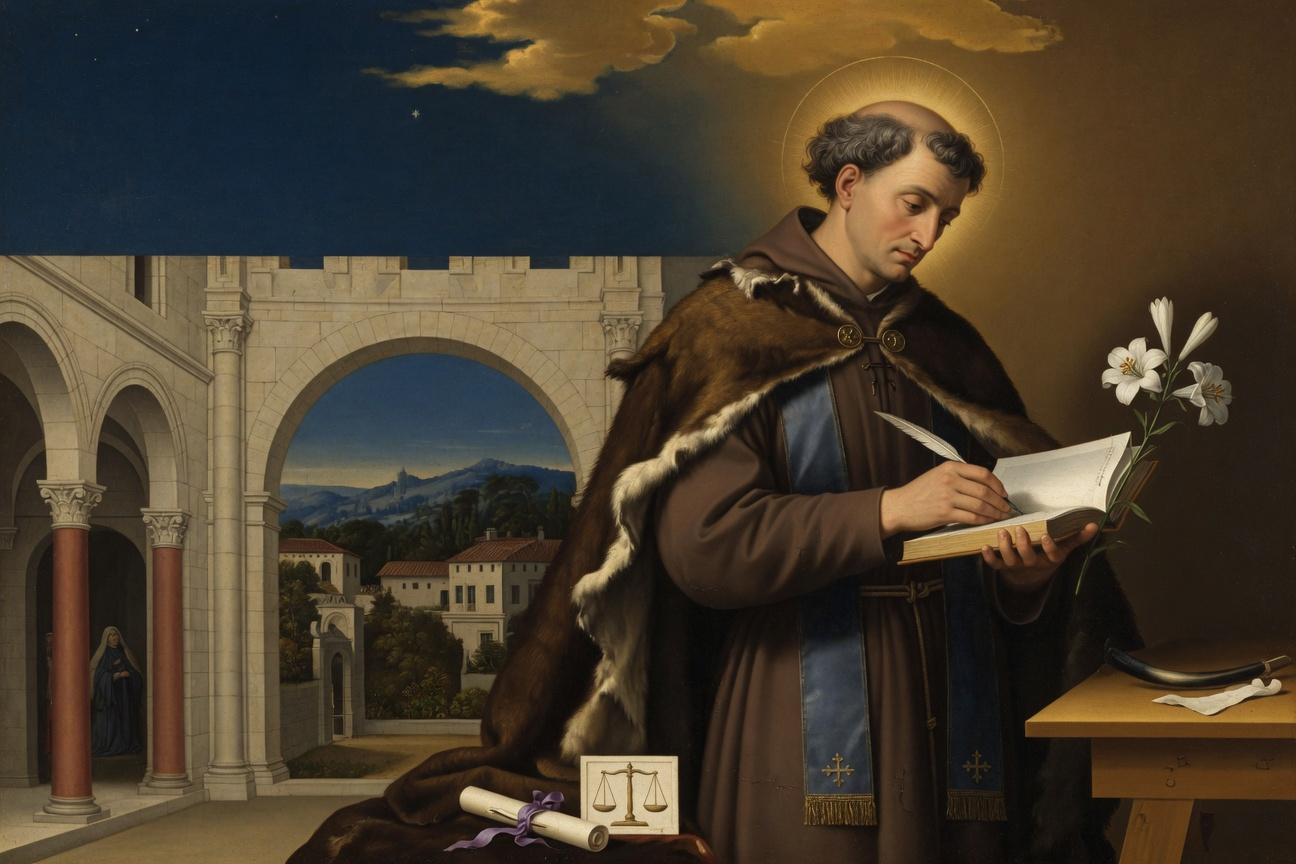
An Aquitanian magistrate of noble lineage, Sulpicius Severus left the world upon the death of his wife to become a fervent disciple of Saint Martin of Tours. A celebrated historian nicknamed the 'Christian Sallust', he dedicated his life to prayer, poverty, and writing about the virtues of his master. After a brief doctrinal lapse, he imposed a penitential silence upon himself until his death around 420.
Guided reading
8 reading sections
SAINT SULPICIUS SEVERUS, DISCIPLE OF SAINT MARTIN
Origins and renunciation of the world
Coming from an illustrious family of Aquitaine and a brilliant magistrate, Sulpice-Sévère left his career and his riches after the premature death of his wife to devote himself to the solitary life.
Circa 420. — Pope: Saint Boniface I. — King of the Franks: Pharamond.
The historian of Saint Marti n, Sulpice-Sév Sulpice-Sévère Historian, priest, and disciple of Saint Martin of Tours. ère, was a great man by his birth, his knowledge, and his Christian humility. Saint Paulinus of No Saint Paulin de Nole Friend and spiritual disciple of Amandus, whose writings are a major source. la speaks of him as a priest adorned with the most remarkable virtues. A native of Aquitaine Aquitaine Duchy ruled by Walfre. , he was in his youth one of the glories of the magistracy, and he counted several Roman consuls in his family. A future of glory and happiness was opening before him, when, painfully struck in his dearest affections by the death of his young wife, he resolved to leave the world, where he was happy and honored, to live in solitude.
Disciple of Saint Martin
Drawn by the renown of the Bishop of Tours, he traveled to Marmoutier where he became a fervent disciple of Saint Martin, struck by his humility and holiness.
The renown of S aint Martin saint Martin Saint whose relics were honored by missionaries in Tours. had reached him; some even claim that he was converted by the preaching of the holy Bishop of Tours. Be that as it may, he came to find him at Marmoutier to witnes s his virt Marmoutier Abbey founded by Martin near Tours. ues, to ask for his counsel, and also, it seems, with the secret design of making known through his writings the holiness of the great bishop, should it match the height of his reputation. Saint Martin welcomed the young gentleman with great kindness; he received him at his table, presented him with water to wash his hands, and in the evening, he himself wished to wash his feet. Sulpicius, touched by such profound humility, already subjugated by such great holiness, could not resist, and from that moment on, his mind and heart underwent, with the docility of a child, the influence of the holy bishop's virtues. Their conversation turned to the vanity of the world and the advantages of leaving it to follow Jesus Christ. In support of his words, Saint Martin cited the example of Paulinus, who had just abandoned great honors and immense riches to embrace, in all their rigor, the evangelical counsels. Sulpicius responded with eagerness to the exhortations of the great bishop, and later he formed a holy friendship with the one he had proposed to him as a model. They entered into relations and mutually encouraged one another in virtue and the contempt of the world. But this affection never surpassed that which he had vowed to Saint Martin. He returned constantly to Marmoutier to see him, to hear him, and he became one of his most fervent and dearest disciples.
Visions and mourning of his master
Sulpicius Severus receives a heavenly vision of Saint Martin at the moment of his death, confirming his deep spiritual bond with the bishop whose passing he mourns bitterly.
During these numerous visits he came to know Saint Clarus, that most noble child, as he calls him, whom Saint Martin loved with such a deep and pure love.
He recounts that, being one day plunged into one of those half-slumbers in which one feels oneself sleeping, Saint Martin appeared to him, dressed in a white robe, his face radiant and his eyes shining with an unusual brightness. The holy bishop, he says, held in his hand and presented to me, while smiling, the book that I wrote about him. I embraced his knees, and, according to my custom, I asked for his blessing. I then felt his hand rest gently upon my head... I heard the solemn words of the blessing, and, as he traced upon his lips the sign of the cross that was habitual to him, he disappeared and, before me, he was taken up to heaven. Shortly after, I saw the holy priest Clarus, his disciple, who had died a few days earlier, advancing along the same path as his master. I wished to follow them, and, as I made efforts to ascend with them, I awoke.
Sulpicius had barely awakened when two monks, arriving from Tours, were introduced into his presence and announced to him the death of Saint Martin. "Tears immediately came to my eyes," he wrote to Aurelius, "and at the hour in which I write to you, I am still weeping bitterly."
The historian of Saint Martin
Retired to his master's cell, he wrote the 'Life of Saint Martin', a work of immense success that spread the saint's fame as far as the East.
Upon the death of the Bishop of Tours, he requested as a great favor the permission to inhabit his cell. He remained there for five years, in prayer and solitude, finishing the writing of the life of his master and friend.
We know what success this lif e of Saint Martin o vie de saint Martin Hagiographic poem in four books. btained. It was soon known even in the solitudes of the East, and Saint Paulinus, who made it known in Rome, where it was read with pious avidity, wrote to Sulpicius: "Your discourses, as chaste as they are eloquent, clearly show that you are the unleavened bread of Christ, and it would never have been given to you to write so worthily of Saint Martin, had your heart not rendered your lips worthy of celebrating his praises."
In writing, the pious author had not proposed to attract the gaze of men and call for their praise. He wished, as he says with amiable frankness, to show that the Christian must seek eternal life rather than an immortal memory. And it is neither by writing, nor by fighting, nor by philosophizing that one reaches this goal, but by a holy life.
Monastic life and friendship with Paulinus of Nola
He founded a monastery on his lands in Aquitaine and maintained a spiritual and affectionate correspondence with Saint Paulinus of Nola, exchanging advice and ascetic gifts.
Saint Paulinus, Bishop of Nola, strongly urged Sulpicius Severus to come and live with him. Twice, the humble priest had prepared everything for his departure, and twice illness had stood in the way. An exchange of correspondence then took place between the two friends. Nothing is as sweet and affectionate as these pious conversations. One sees in them their mutual tenderness and the purity of their hearts, always eager to make new sacrifices and to acquire new virtues. Paulinus, full of admiration for the merits of Sulpicius, took pleasure in recalling them, and he thus found a way to humble himself by comparing himself to his friend who, "after having been the admiration of the bar and having won the palms of eloquence, suddenly shook off the yoke of sin and broke the fatal chains of flesh and blood."
Saint Sulpicius had, in fact, grown in the practice of renunciation and in the love of poverty. He had sold all his goods and given the proceeds to the poor. He had reserved for himself a small piece of land where he established a monastery. Retired in this solitude, he received the poor and travelers, and he took pleasure in the company of a few disciples whom he had gathered into a community on the model of that of Marmoutier. They all led a penitent and mortified life; their clothes were made of animal skins, their hair was shorn, and they applied themselves to weakening their bodies through fasting and vigils, in order to give more vigor and energy to their souls. Sulpicius yielded to none of his disciples in these peaceful and arduous struggles for perfection.
He wrote to Paulinus to initiate him into all the customs practiced in this small monastery, and one day he sent him one of his disciples, named Victor, who had completed his novitiate in religious life at Tours. He had charged him to deliver a hairshirt to the holy bishop. Paulinus did not want to be outdone in generosity by his friend, and he returned to him a woolen tunic that had been woven by Saint Melania. "The day I received this garment," he wrote, "I destined it for you. I wanted, however, to wear it before sending it to you, in order to diminish its roughness... It also seemed to me that by using a garment that I regarded as yours, I would have some share in the blessings that you receive from heaven and that I could truly say that I was clothed in your garment."
Such were the exchanges that friendship suggested to these two saints! Another time, Saint Sulpicius chose a cook for his friend, and he announced it to him in a graceful and charming jest: "I have learned," he said, "that all the cooks have refused to serve you. — They undoubtedly disdain preparing meager stews. — I am sending you, from my kitchen, a young boy very skilled at cooking beans, at seasoning some herbs with vinegar, and at preparing aromatic plants.
"I give him to you with his faults and his qualities, not as a slave, but as a son... I would have liked to serve you myself in his place: take note of my good will and grant me a remembrance in the midst of your blessed meals."
Saint Sulpicius had kept such a sweet memory and such a tender affection for his master in the spiritual life that every year he returned, from the depths of Aquitaine, to visit the sepulcher of Saint Martin and the places he had sanctified.
Fall and Penance
At the end of his life, he briefly strayed into the heresy of the Millenarians or the Pelagians, but repented immediately and imposed upon himself a perpetual silence as a sign of expiation.
Such a constant and affectionate fidelity to the memory of the holy bishop did not prevent Sulpicius from falling int o the heresy of the Mil hérésie des Millénaires Heterodox doctrine into which Sulpicius Severus briefly fell. lenarians, some say the Pelagians. He was then advanced in age. His humility and divine grace preserved him from obstinacy; he soon recognized his error, wept over it bitterly, and condemned himself to silence until the end of his life, wishing thus to expiate the fault he had committed through his speech. He thus proved that all things work together for the good of those who love God: through his penance, he rose to a higher degree of virtue and in this way merited a more brilliant crown.
Death and literary legacy
He died around 420, leaving behind a historical and epistolary body of work whose stylistic elegance earned him the nickname of 'Christian Sallust'.
In the season of lilies, Sulpicius Severus was accustomed to gathering a few and hanging them on the walls of the cell he had chosen for his tomb. After his death, his disciples respected one of these lilies that he had placed there himself. It was already crumbling into dust when, on the anniversary of his funeral, its stem was suddenly seen to straighten, and its white corolla began to bloom as it did on the most beautiful mornings of summer.
Saint Sulpicius died around the year 420. He composed several works full of unction, which everywhere breathe the holiness of their author. His style is pure and elegant; in reading it, one feels that the study he had made in his youth of the authors of the Augustan age was not useless to him. Besides the Life of Saint Martin, he wrote a Sacred History from the origin of the world until the year 400 of Jesus Christ. He also composed Three Dialogues, of which the first two treat the virtues of Saint Martin, and the last the wonders of the solitaries of the East. We also possess some Letters whose piety and grace will long make us regret the loss of the others. The elegance and precision that reign in all his writings have caused him to be nicknamed th e Christian Sallu Salluste chrétien Historian, priest, and disciple of Saint Martin of Tours. st.
Cult and historical distinctions
The text analyzes the historical confusion between the historian and the bishop of Bourges, while defending the legitimacy of the cult rendered to Sulpicius Severus by the Church of Tours.
For a long time, the historian of Saint Martin was confused with Saint Sulpicius the Severe, Archbishop of Bourges. The monks of Marmoutier themselves made only one person of these two Saints in their liturgical office. This is not the case, however, and our Sulpicius was never invested with the episcopal character. This is the opinion of Cardinal Baronius, which has prevailed everywhere today.
Another question may arise here: did Sulpicius Severus legitimately obtain the honors that the Church renders to the Saints? We shall not say here with Dom Martenne that if the bishop of Bourges obtained a public cult, it is "perhaps because the actions and virtues of the disciple of Saint Martin were attributed to him"; but we wish to prove that, from time immemorial, Sulpicius Severus has been honored as a saint by the church of Tours. Guibert, abbot of Gembloux, near Namur, who died in 1208, wrote his life, and after recounting his fall into heresy, his repentance and his penance, he adds: "Who then could doubt, I do not say his salvation, but his holiness, without at the same time doubting the mercy of Jesus Christ?" And he shows him in his solitude, expiating in silence and through his tears his moment of wandering and error. Tested in the crucible by the fire of his love, he says, purified by the abundance of his tears, he was completely washed of his sin, for he became whiter than snow. This tree, which had borne so many excellent fruits, was for an instant overturned by the wind of heresy, but it did not remain on the ground, and God, blowing upon it again, raised it up; it fell at last, laden with new fruits, and it has remained where it fell.
"If you do not believe my testimony," he continues, "believe at least the inhabitants of the holy monastery of Marmoutier. Each year, in fact, they solemnly celebrate his feast. I myself have attended it several times on January 29. Let the belief of such a great church be respected as it deserves, and let the iniquity that would take away from our Saint the glory and beauty that the Lord has given him, close its mouth."
Du Saussay's martyrology expresses itself thus on January 29: "The same day, in Aquitaine, at the village of Primlau, feast of Saint Severus -Sulpic Primlau Town in Aquitaine associated with the saint's cult. ius, priest and confessor, remarkable for his doctrine and his holiness. He wrote in a very pure style the actions of Saint Martin, whom he brought to life no less by his actions than by his pen. He honored poverty in an admirable manner; of profound humility, he deserved that Saint Paulinus of Nola should make a magnificent eulogy of his brilliant qualities and of the rule of life he had traced for himself."
Pierre des Noëls and Godescard also place him among the number of the Saints.
Dom Martenne says: "If we had no other proofs of the holiness of Sulpicius Severus than the close union he had with Saint Martin and with Saint Paulinus, bishop of Nola, we could not doubt that he was one of the greatest saints of his time."
The editions of the Roman martyrology of 1594 and 1630 confuse the historian of Saint Martin with the archbishop of Bourges. Here is how they express themselves: "At Bourges, feast of Saint Sulpicius-Severus, bishop, disciple of Saint Martin, remarkable for his virtues and his knowledge."
When Pope Urban VIII had the martyrology reprinted in 1630, he did not allow this error to remain, and he had only these words erased: *disciple of Saint Martin*.
It is therefore the archbishop of Bourges, known by the name of Sulpicius the Severe, that the Roman Church intends solely to honor on the date of January 29. By the fact of this suppression, was Sulpicius Severus really stripped of the honors rendered to the saints? We do not think so. Indeed, in his breviary, printed in 1685, Mgr Amelot, archbishop of Tours, nonetheless continues to keep the feast of Saint Sulpicius-Severus on January 29; but in the legend there is no longer any confusion, the Saint is honored as *confessor non pontiff*.
Could one not conclude from this fact that the Pope, by cutting out these words: *disciple of Saint Martin*, which were found following the name of the holy bishop of Bourges, simply wished to rectify a historical error, and that he in no way intended to deprive the historian and disciple of Saint Martin of the honors that the Church of Tours rendered to him? This supposition, which Benedict XIV appears to favor in his *Treatise on Canonization*, seems moreover the only possible justification for the archbishop of Tours, maintaining in his liturgical books the tradition of his Church which had honored Saint Sulpicius-Severus with a special cult for more than five centuries.
Be that as it may, we can with full assurance follow the examples of humility, renunciation, and piety of the disciple of Saint Martin, and we shall ourselves be able to arrive in this way at an eminent degree of holiness. Let us conclude therefore that it is important for us above all to imitate him, and let us say, in ending this short dissertation, with the Bollandists: What we have said is sufficient so that we are not accused of having wished to steal from Sulpicius-Severus the heavenly honors, and also so that we are not reproached for rendering them to him if he has no right to them.
Abbé Rolland, *Alms, from the thoughts of the Brothers of the Christian Schools of Tours*.
Annexes & related entities
Structured data for exploration: events, miracles, quotes, places, attributes, patronages, and important entities cited in the text.
Key Events
- Career in the magistracy in Aquitaine
- Retirement from the world after his wife's death
- Meeting and conversion with Saint Martin at Marmoutier
- Sold his possessions for the poor and founded a monastery
- Writing of the Life of Saint Martin
- Episode of temporary adherence to the Millenarian or Pelagian heresy
- Condemned to perpetual silence as penance
Miracles
- Apparition of Saint Martin announcing his death
- Miraculous blooming of a withered lily on his tomb on the anniversary of his funeral
Quotes
-
The Christian must seek eternal life rather than an immortal memory.
Sulpicius Severus (reported statement)