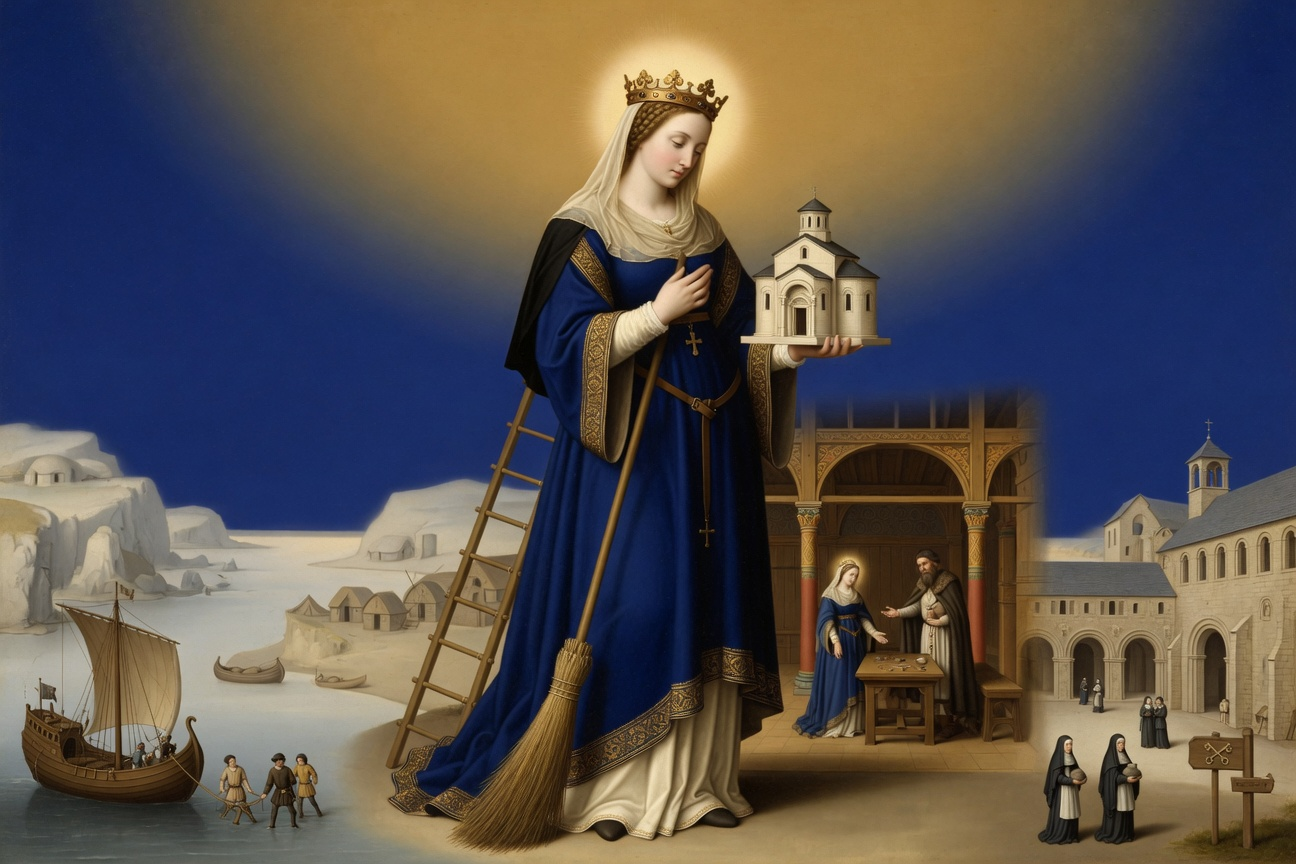
An English princess sold as a slave to the Frankish court, Bathild became the wife of Clovis II and regent of the kingdom. She distinguished herself through her piety, the abolition of unjust taxes, and the founding of numerous monasteries, including that of Chelles. She ended her days humbly as a simple nun in her abbey.
Guided reading
7 reading sections
SAINT BATHILD, QUEEN OF FRANCE
From slavery to the throne
An English princess reduced to slavery, Bathilde was purchased by Erchinoald before marrying King Clovis II thanks to her exceptional virtues.
There was at the court of the King of France, Clovis II, a young and beautiful slave, whose virtues, even more than her physical charms, attracted attention and won all hearts. She was the daughter of the King of England and was named Bath ilde. Ab Bathilde Queen of the Franks who confirmed the election of Audebert. ducted from the coast by pirates who took her to France, she had been sold to Erchinoald, on e of the f Erchinoald Son of Gertrude and mayor of the palace. avorites of Clovis II, and later Mayor of the Palace. Her master first employed her in the most menial tasks; but having become a widower, and struck by the admirable qualities that shone in this young slave, he wished to marry her. Bathilde replied that she desired to have no other spouse than Jesus Christ, and as the master insisted more each day, the pious child hid in a safe retreat, from which she did not emerge until the day after Erchinoald's second marriage.
The latter, increasingly touched by the rare virtues of his slave, willingly forgave her refusal and henceforth felt for her only a purely paternal affection, which allowed Bathilde to hold at the court of the King of France the rank assigned to her by her birth. Clovis, then seventeen years old, could not, either, resist the graces and virtues of the young Englishwoman; he wished to make her his wife.
— I am your slave, replied Bathilde, and, willingly or by force, I must submit to your will.
— A slave, the king told her, cannot sit on the throne of France. I declare you free, and also free to refuse my hand.
— Thank you! my lord, the young girl replied, thank you for the grace you grant me and the honor you are willing to bestow upon me; but the freedom you return to me places me once again under the guardianship of my father, and I cannot accept your offers except with the consent of the King of England.
Now, among the advisors of the young Clovis II was Count Rigobert, older by fifteen to twenty years than his sovereign, whose confidence and affection he held; the very man who was to be the father of Saint Berthe of Blangy. Rigobert was, literally, what one might call an accomplished man: a good Christian, a devoted subject, prudent in counsel, and valiant in war. The king charged him to go to England and negotiate his marriage with Bathilde. The count discharged this delicate mission to the complete satisfaction of the various parties. He obtained for his king an accomplished wife, and he endowed France with a great queen and a great saint.
A Pious and Protective Queen
Mother of three kings, Bathilde distinguished herself by her humility, her support for the clergy, and her numerous church foundations under the counsel of Saint Eligius.
Some time after the marriage, Bathilde felt that she would be a mother, and fearing that she might give birth to a daughter and that the kingdom might thus fall into the distaff side, she experienced vivid and poignant anxieties; having comm unicated t saint Éloi Founder of the monastery and spiritual advisor to Saint Aurea. hem to Saint Eligius, Bishop of Noyon, he reassured her by announcing that she would bring a son into the world, and even told her that he wished to be his godfather: he was indeed, and named him Clotaire. This son was followed by two others, Childeric and Thierry; all three were kings of France. Such a notable change in status, which would have dazzled any other spirit less grounded in humility, nevertheless caused no alteration in her virtues. She rendered to each what was due, from the king, her husband, to the child of the poorest widow in the kingdom, of whom she made a profession of being the protector and advocate. No other agent was needed at court for the affairs of the clergy; and we see in history that there were, in her time, more churches and monasteries built than had been seen until then. The affairs of the court did not prevent her from enjoying the purest delights of devotion in a great rest of spirit and a perfect quietude of all the faculties of her soul; there was no day that she did not employ some hours in prayer, and her prayer was always accompanied by a great abundance of tears; so that the time of the king's life served as a preparation for the solitude she was to embrace some time after his death. She foresaw that it was very near, because the king was weakening every day without any appearance of recovery. Thus he died soon after, bearing this testimony to the virtue of the queen, that not only had she done for him everything in her power, but that she had even surpassed everything one could imagine.
The Regency and Social Reforms
Having become regent, she fought against simony, abolished the poll tax, and forbade the sale of Christian slaves, ensuring the prosperity of the kingdom.
This death, as well as everything that happened afterward, had been predicted to her by Saint Eligius; in accordance with this prediction, she was declared regent; in this capacity, she divided France and Austrasia between her children, the kings. Clotaire was seated on the royal throne of his ancestors; Childeric, his brother, was crowned king of Austrasia, and Theuderic, the third, was declared king of Burgundy. After this, she worked on the reformation of the abuses that were ruining the kingdom, and she began fortunately with the punishment of the Simoniacs. To this end, she issued an edict by which it was forbidden for prelates to receive anything for the conferring of holy orders, nor for any episcopal function. Then she abolished forever that personal tax, which is called the poll tax, by which everyone was taxed per head: this unjust and cruel tax led the French to renounce marriage or to sell their children, because they saw fiscal exactions grow with their number. She also forbade the barbaric custom that still existed in France of selling Christian slaves to foreigners. She even redeemed many of these unfortunates with her own funds. In this way, France enjoyed great happiness during her regency and under the gentle laws of her government; thus, the people gave her a thousand blessings and rendered her extraordinary honors.
The holiness and virtues of Bathilde did not shield her from the malice of the wicked: God permitted it, to offer in her to the French an admirable example of patience and gentleness, and to prepare in heaven for his humble servant a more brilliant crown. Calumny went so far as to attempt to make her innocence and purity suspect: it only served to highlight the noble heart of Bathilde, and her indifference to the esteem of men. But Bathilde was more sensitive to the misfortunes caused in the states of her son the king by the perfidious administration of Ebroin; the persecutions that this bloodthirsty minis Ebroïn Mayor of the palace responsible for the death of Saint Rambert. ter exercised against the holiest bishops, and above all, the violent death of Saint Annemund, Bishop of Lyon, made her shed many tears. Having been accused of having lent a hand to this crime, she needed her energy, her faith, and the grace of the Lord to emerge victorious from this painful ordeal.
The Monastic Work
She founded great abbeys such as Corbie and Chelles, and supported numerous monasteries through her munificence, including in Rome.
Nevertheless, this admirable queen, who held the kingdom of heaven even more in her heart than that of France, always meditated on her retirement, in order to place herself in the freedom of the children of God, and to live in the rest of some holy solitude; but she was held back by the young age of her children, to whom she first wished to secure the crown. Thus, awaiting the time to be able to enjoy this happiness, she occupied herself entirely with the service of the Church, adorned the altars, and established the worship of God in various places. It was then that several houses for religious women were founded, such as the abbeys of Corbie, Jumièges, Luxeuil, Jouarre, Sainte-Fare, and Fontenelles, eternal witnesses of her piety; and there are few of the ancient monasteries that once rose around Paris that did not recognize her as their founder, or at the very least their benefactor. The city of Rome was not deprived of her munificence, for she sent people there expressly to offer prayers on her behalf in the church of Saint Peter and Saint Paul, with gifts worthy of her greatness and her devotion. But this charity, which was received by foreigners with admiration, spread even more abundantly over the Franks, particularly the Parisians; so that it seemed that money multiplied in the hands of this holy princess, and that, while she emptied the coffers of savings to fill those of God, which are the poor, God Himself seemed to want to exhaust His own to shower France with blessings. The holy queen, working thus to enrich or to found religious houses in the kingdom, also wished to have one built for herself, so that she might be able to retire there when she was relieved of her regency. For, ever since Saint Eligius had predicted the death of her husband, and had subsequently warned her that her life and that of her children would not be of long duration, which was further confirmed to her by Saint Wandrille, abbot of Fontenelles; from that time on, I say, she imprinted so strongly in her heart the contempt for the vanities of the world, that she breathed only for a sweet retirement, where, living with the angels, she could draw closer and closer to her sovereign good. To this end, she had a search made in the vicinity of Paris for a place suitable for the execution of her design: "Go," she said, "seek me a place from which one can contemplate the sky without any hindrance, in order to build a monastery there." The earth seemed too low to her, and the air of the court too thick to be able to consider at her ease the beauty of the firmament and to contemplate there the delights of the other life. They went then and searched; and, finally, they found a place quite suitable for Bathilde's design: it was a small hill above the Marne, four leagues from Paris, a little beyond Lagny. She had already had a house built there near a chapel dedicated to Saint Gregory, but she wanted this small building to be changed into a large monastery, which was later named Chelles, for the reason we shall state hereafter; and the whole was ex ecuted Chelles Monastery founded by Balthild where Bertilla served as abbess. in a short time, according to her intention. The house was well endowed; several villages and several forests were annexed to it for the maintenance of the nuns whom the queen intended to place there. And so that nothing would be lacking for such a just design, she had the three kings, her children, sign its foundation with their own hand and authorize it with their seal. And as if all these assurances of the earth were not yet effective enough to confirm it, she implored, in addition, the testimony of heaven, having added at the bottom of the contract terrible threats and great imprecations, in the name of the most holy Trinity, against those who would wish, in the centuries to come, to bring change and alteration to it.
Retirement from the World
After securing the crown for her sons, she retired to the Abbey of Chelles to live in humility and service to the poorest.
Everything being thus arranged, the holy princess brought from the Abbey of Jouarre a very virtuous nun named Berthi lle, to b Berthille First abbess of Chelles, who came from Jouarre. e the mother and superior of the daughters who would present themselves at this new monastery. Her greatest desire was to be the first to take the habit there; but the common interest of the State, and the obligation to assist her son, who, because of his youth, was not capable of governing the monarchy alone, kept her at court for some time longer. Finally, affairs having changed, and her presence being no longer necessary, nor even desired by most of the great men of the kingdom, she took advantage of the opportunity and resolutely asked for permission to retire. She felt all the more drawn to this pious project because Saint Eligius, who had just passed away and was already enjoying glory, warned her in a vision, up to three times, that it was time for her to lay aside her gilding, her rings, and all the other marks of her grandeur and sovereignty: she followed this advice with a very willing heart, and used all her riches to help the poor and to have a reliquary cast to enclose the body of the same Saint Eligius, her spiritual father.
After having thus set all things in order, and the affairs of France permitting, Bathilde left Paris never to return, and left the Franks, who had enjoyed a flourishing peace during the years of her beautiful regency, in extreme sorrow at her retirement. The whole court followed her from Paris to the place of her solitude, where she entered as if into a paradise of delights; and she was received there to be, by the holiness of her life, the eternal glory of this new house. Historians do not agree on the time of this retirement: some say it was after the death of her first two sons, Clotaire and Childeric, and during the reign of Theuderic, who was the third; and others, that it was during the lifetime of the same Clotaire, as the life of Saint Eligius, written by Saint Ouen, seems to indicate.
The first thing the holy Queen did after she entered the monastery was to assure these good nuns that she had so renounced the world and all its vanities that her stay in their cloister would in no way be inconvenient to them; that their silence would not be interrupted, nor their solitude disturbed, and that the hours of prayer and the divine office would receive no prejudice, for she had put her affairs in such good order that their door would not be beaten by too many visits, nor their parlor occupied by useless conversations. This assurance perfectly calmed these holy souls, who at first feared that the presence of the Queen in their cloister would stifle their nascent devotion. Learning of the design of this virtuous princess, their fears immediately changed into perfect joy; and their spirits being pacified, they opened their hearts to affection and love toward their charitable mistress. Bathilde, to prove by deeds what she promised in words, did not blush, Queen though she was, to place herself after the last of the novices, and to recognize herself as the least of all. Certainly, it was a thing worthy of astonishment to see a queen of France and the mother of three kings have no more care than to be the smallest in the house of God; to be humbly submissive to the superior and to receive the commands from her mouth as the oracles of Jesus Christ himself. She considered all the sisters as so many Saints, and sought only the occasions to render them service; which she did with an admirable complaisance and as if she had been born their subject, and that all her rest had depended on their satisfaction. Once, when she was asked what pleasure she had in serving these daughters, she replied very wisely: "Alas! my dearest sisters, when I remember that my Lord Jesus Christ, the King of kings and the sovereign Lord of the universe, said in his Gospel that he came to serve and not to be served, and that I see him washing the feet of his disciples, among whom I discover a traitor, I no longer know where I should place myself, and it seems to me that the greatest happiness that can happen to me is to be trampled under the feet of everyone." Words, certainly, worthy of a great princess and a great nun, for there are two things that kings and sovereigns never learn elsewhere than on Calvary and at the school of the Cross: To obey and to serve; because they come into the world receiving the homage of their subjects, and when they grow, they enjoy the fruit of their labors and their services. Only those who learn the lesson of Jesus Christ, who, being God, lowered himself to raise us up, practice both in excellence.
This incomparable Queen served the nuns of the house and the sick in the infirmary with feelings of such profound humility that if the nuns had forgotten who she was, she would never have remembered it herself. Her mouth was closed to speaking of her past greatness, as well as of the failings of others; if she happened to allude to failings, it was to excuse them: her contempt was for herself, her praises for her neighbor, her services for those who needed them, her will for the superior, and her heart for God.
As for her prayer and the order she observed in it, her confessor had the direction of it; but she kept the hours of silence very religiously, and spent part of the day in meditation; the rest was for the reading of spiritual books and for interior recollection in her cell, in order to consider attentively what she had been, what she was at that time, and what she would be one day. Thus her heart never felt swollen by the memory of past greatness, but all her care was to set it ablaze with the flames of the pure love of God. This charity then spread to her neighbor, and made her so helpful to the sick that she had acquired a particular talent for relieving them. She was very careful to obtain what was necessary for them, and very often her affection revealed their feelings to her and made her know better what they desired or what was suitable for them than they knew themselves. God had given her, besides this, a marvelous sweetness of speech, and put such benign thoughts into her mind, to make the greatest difficulties easy, that her discourses carried the honey of consolation into the hearts of her sisters, when, being tempted by the enemy, they found disgust in their vocation or boredom in the exercises of the spiritual life.
The vision of the ladder and the passing
A mystical vision of a golden ladder announces her approaching death; she passed away in 680 after an illness endured with patience.
Such were the exercises of the blessed Bathilde, until it pleased God to call her to Him to give her an immortal crown, in reward for the one she had despised for His love. She had a brilliant omen of this happiness: as she was one day in the sweetness of her meditation, she saw a golden ladder that had its foot placed on the altar of the Blessed Virgin before which she was praying, and from there reached up to heaven; a great multitude of angels climbed the steps of this ladder, without any descending, and she herself was raised by the angels and invited to follow them. This vision occurred in the presence of some other nuns who trembled that this omen might be true; but Bathilde was filled with joy when the Spirit of God made her know that it was a warning of her approaching death, and an invitation to enter soon into eternal life. Then her devotion drew tears of love and sweetness from her, while her sisters were on the contrary heartbroken with grief, believing they had already lost her. Having returned to herself, she begged them to say nothing of what they had seen; but if their mouths kept the secret, their eyes could not keep it, and their tears made known without speaking what they did not wish to say. And from there came the name of Chelles, which this abbey bears, as if to say Ladder.
Her illness began with a pain in the bowels, which made her suffer with such violence that it was a kind of martyrdom; it was not, however, complaints that gave knowledge of her ailment, for her mouth never opened to complain, and if she received consolations amidst her pains, it was heaven that sent them to her. One only remarked these words in the strongest attacks of her malady: "O good Jesus! I thank you for the great mercy that you show to this vile creature, in giving her some small thing to suffer. Alas! he who looks at you all torn and stretched upon such a hard cross, can he have a mouth, a heart, and a soul to complain?"
She was nurturing a little girl, named Radegonde, whom she had held at the baptismal font, and she loved her as tenderly as if she had given birth to her. This child fell ill at the same time the Sa int took Radegonde Queen of the Franks and founder of the Sainte-Croix monastery in Poitiers. to her bed. Bathilde, believing that this little creature would be happier if she died than if she remained in the world, prayed to God that it might be His good pleasure to withdraw her, so that she could, before dying herself, place her in the tomb and see her among the choirs of Virgins. She was heard: the young girl gave up her spirit in the arms of her royal protectress, and she was honored as a Saint in the same abbey.
All things being thus accomplished, Saint Bathilde saw well that the hour had come to depart from this world to go to God; that is why, in the presence of the ecclesiastics who had administered the last sacraments to her, and of some nuns who were assisting her, she armed herself with the sign of the cross, and, raising her eyes to heaven, she sent her beautiful soul there towards the end of January, in the year of Our Lord 680.
Cult, miracles, and posterity
Her relics, kept at Chelles, have been the site of numerous miracles over the centuries, notably during their translation by Louis the Pious.
## CHURCH AND MONASTERY OF CHELLES, RELICS AND CULT.
Two hundred years later, the Emperor Louis the Pious wished to go himself to Chelles to honor the tomb of Saint Bathilde and to have her precious relics transferred from the small church of the Holy Cross to that of the Blessed Virgin. Her body was found whole and without any mark of corruption. The news of this wonder being carried to Paris, the whole court was called to witness it, and almost all the people of that city were at Chelles, to see more glory in this monastery than there was in the vast extent of its walls. A very old nun of the house, having long been deprived of the use of her limbs, was carried to the sepulcher of the Saint, where, after having said her prayer, she found herself perfectly healthy, rose to her feet, and cried out, saying: "O good Jesus, I am healed! O Saint Bathilde, I give you thanks for having restored my life to me!"
The abbess begged the Bishop of Paris, Erchenrad, to come to Chelles to arrange the relics that everyone wanted to take away, and to make a report of the miracles that were taking place there. Meanwhile, a man named Baudran, who had never had the use of his legs and walked only on his knees, having learned what was happening and wishing to participate in the benefits of the Saint, had himself carried to the church; having said his prayer there, he felt healed and began to walk before everyone. History also records that demons were cast out of the bodies of the possessed and that all sorts of other miracles were performed at her tomb.
The bishop having arrived, and all things being arranged according to his order, he had the holy body transported with honor and ordered it to be enclosed in a shrine. Before 93, it rested on the high altar of the abbey, having at its sides, on one hand, Saint Genesius, Bishop of Lyon, her sumenier; and, on the other, Saint Berthille, first abbess of this monastery, besides her little goddaughter Radegonde, whom God had taken from this world at her earnest prayer, as has been said; but her holy head had been set apart in a silver reliquary.
In the year 1631, this shrine of Saint Bathilde having been lowered and opened for some solemn occasion, six nuns of the same abbey, tormented for three years by strange convulsions, were all, in a moment, delivered when the relics of this holy queen were applied to them; this fact being recognized as a true miracle, Jean-François de Gondy, first Archbishop of Paris, consented to its publication and gave permission to the nuns to make a memorial of it in the divine office on the same day that this wonder occurred, that is to say, July 3.
Information provided by M. Torchet, parish priest of Chelles (August 30, 1862). — I. Monastery. — Of the monastery of Chelles, once so famous and so vast, there remain today only a few ruins that have undergone many transformations: 1° The abbatial pavilion serving as a dwelling for the owner of the greater part of the immense convent enclosure. No remarkable architecture. — Cut stone from bottom to top without style. — Nothing inside worthy of note, except for some remains of decorations; 2° Some portions of the old construction built for the nuns' cells, and currently occupied by several inhabitants of the town; finally 3° The farm, with its remarkable dovecote, containing two thousand chambers and its immense buildings which make it a model farm.
II. Church. — There has never been a church or chapel in Chelles under the name of Saint Bathilde. There were formerly three churches in Chelles: Saint-André, first parish; Saint-Georges, second parish, served by the Benedictines attached to the abbey; third, Notre-Dame, originally Sainte-Croix, built on the tomb of Saint Bathilde, the abbey church. The latter was the admiration of all connoisseurs; today, not one stone remains upon another. A few years ago, some vestiges could still be seen: an inn had been built in part of the sanctuary; the demolition hammer finished its work; everything has disappeared to make way, this year, for an elegant town hall. Saint-Georges has also been destroyed; there remains as a parish church only the church of Saint-André, located at the end of the town on a mound. The choir and the sanctuary of the high altar and the chapel of the Blessed Virgin are from the 17th century; the chapel of Saint-Roch is from the 13th and the three naves from the 17th, semicircular arches resting on round pillars.
III. Relics. — The relics of Saint Bathilde are kept with great veneration; they were saved from revolutionary furies by the piety of the people of Chelles. When the republican Vandals pillaged the monastery, the inhabitants flocked to the abbey church, seized the relics, and transported them to the church of Saint-André. This church was in turn a revolutionary club and a hayloft: but woe to anyone who would have dared to lay a sacrilegious hand on the shrine! We possess the entire body of Saint Bathilde, except for some portions extracted at different times and kept religiously in the chapel of Pius IX, in Rome, in the cathedral of Meaux, and in the abbey church of Jouarre.
IV. Cult. — Saint Bathilde is honored at Chelles with religious respect. Her feast is celebrated, by privilege and according to the abbey calendar, on January 30, while, in the diocese as in Rome, the feast is on the 26th of the same month. The influx of the faithful is very considerable; the sick invoke the blessed Saint Bathilde; novenas are made to her. The fountain, which provides water to all private individuals, is called the fountain of Saint Bathilde; it is located right in the center of the town. It is said that Saint Bathilde made it flow by miracle, by striking the ground with a wand. This fountain has never dried up; in a great drought, to clean it, twelve men were put to work: they could only succeed in lowering the water level by three inches. It had to be abandoned.
The second Sunday of July, a solemn procession of the relics is held, both of Saint Bathilde and of the other saints. It is the festival of the town.
The church of Corbie possessed several relics of Saint Bathilde, but they disappeared during the Revolution. Some unimportant ones are kept at Bray-sur-Somme and at Mailly.
Besides Father Giry, whom we have reproduced in large part because of that tone of sweet piety which is as if incarnated in his style and which it is impossible to appropriate, we have borrowed various fragments from the following works: Life of Saint Berthe of Blonçy, by the Rev. Bion, priest of Mercy; Lives of the Saints of Beaunais, by the Abbé Sabatier; Life of Saint Léger, by Dom Pitra.
Annexes & related entities
Structured data for exploration: events, miracles, quotes, places, attributes, patronages, and important entities cited in the text.
Key Events
- Abduction by pirates on the coast of England
- Sold as a slave to Erchinoald, Mayor of the Palace
- Marriage to King Clovis II
- Regency of the Kingdom of France upon the death of Clovis II
- Abolition of the head tax and prohibition of the sale of Christian slaves
- Retirement to the monastery of Chelles
- Vision of a golden ladder ascending to heaven
Miracles
- Vision of a golden ladder ascending to heaven
- Miraculous source (Saint Bathilde's fountain) sprung from the ground
- Healings of paralytics and demoniacs at her tomb
- Body found intact two hundred years after her death
Quotes
-
I am your slave, and, whether I like it or not, I must submit to your will.
Reply to Clovis II -
Go, find me a place from which one can contemplate the sky without any hindrance, in order to build a monastery there.
Foundation charter of Chelles