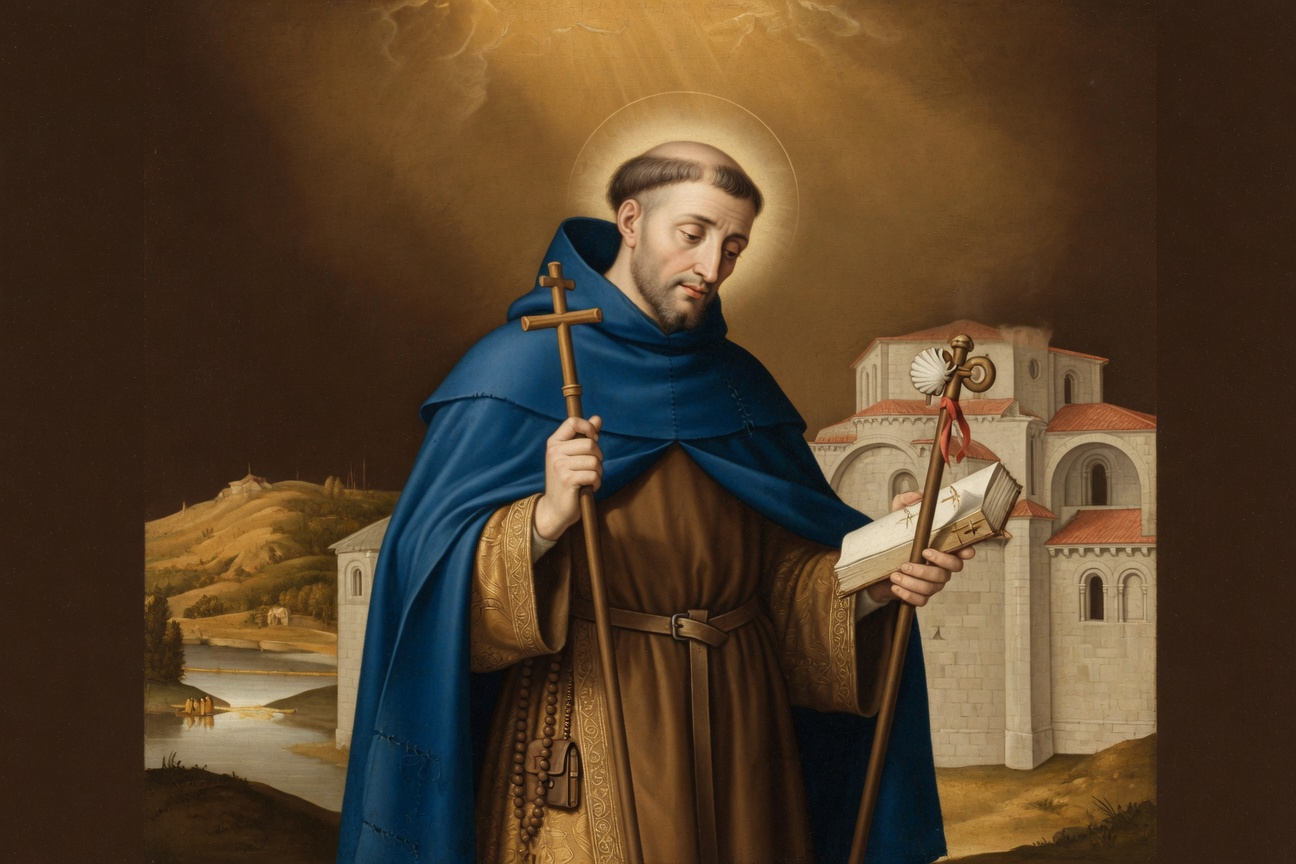
Saint Aleaume
Elesme
Monk of La Chaise-Dieu, Abbot of Saint-Jean de Burgos
A nobleman from Poitou in the 11th century, Aleaume renounced his possessions to become a monk at La Chaise-Dieu after a rigorous pilgrimage to Rome. Called to Spain by King Alfonso VI, he distinguished himself through miracles, notably crossing the Tagus River, and founded a monastery in Burgos of which he became the patron saint.
Guided reading
7 reading sections
SAINT ALEAUME
MONK OF LA CHAISE-DIEU, ABBOT OF SAINT-JEAN DE BURGOS, IN SPAIN
Youth and Renunciation
Son of a lord from Poitou, Aleaume abandons his possessions and rank to lead a life as a beggar on his way to Rome.
Saint Aleaume, who lived in the 11th century, was the son of a lord o f Loud Loudun Birthplace of the saint. un, in Poitou. His parents applied him from his tenderest years to studies and soon to arms. After their death, he distributed all his goods to the poor, left his country secretly, accompanied by only one valet, and, having entered the lands of Auvergne, he took the habit of his servant, gave him his own along with what he could have to reward him, and continued his journey by begging for his bread. He proposed to go to Rome Rome Birthplace of Maximian. .
Pilgrimage and meeting with Robert
In Issoire, he met Robert of La Chaise-Dieu, who guided him toward a rigorous asceticism during his three-year pilgrimage to Rome.
In Issoire, he received from the B. Robert Founder of the Abbey of La Chaise-Dieu. Blessed Robert, first abbot of La Chaise-Dieu, fine instructions on how to properly regulate his life and promised him that he would retire to his monastery as soon as he returned. Robert having explained to him that the journey to Rome was often merely a pretext for dissipation or a goal of curiosity, our Saint, to be sure of performing it as a true pilgrim, subjected himself to the harshest austerities. The bare earth was his bed, a stone his bolster, and alms his food; he refused the money offered to him, so as not to have occasion to think of the morrow. He spent three years on this journey, during which he often remained several days without eating, continually visiting churches and holy places, and his entirely innocent life was often followed by miracles upon the sick, whom he healed in the name of Jesus. He caused a serpent to emerge from the body of a man, into which it had slipped while he slept with his mouth open; he restored health to a woman who had a disease in her breasts that was regarded as incurable.
Entry into La Chaise-Dieu
Upon returning from Rome, he became a Benedictine monk at La Chaise-Dieu, where he distinguished himself by his humility and his role as master of novices.
Upon his return from Rome, he went str aight to La Ch la Chaise-Dieu Benedictine abbey that received the territory of Sainte-Gemme. aise-Dieu. His austerities and the fatigues of the journey had so disfigured him that Robert was for some time unable to recognize him. When he finally saw that it was the blessed pilgrim whom he had met and blessed in Issoire, he embraced him with tenderness and veneration as a martyr of penance and clothed hi m in the habit of Sai habit de Saint-Benoît Religious order occupying the monastery of Honnecourt. nt Benedict. Aleaume was soon regarded in the monastery as a model of humility, mortification, and obedience. He discharged with holiness the office of master of novices that was conferred upon him.
Priesthood and miracles from afar
Ordained a priest, he refused to serve under a simoniacal bishop and performed miraculous healings, notably for the Queen of England.
It was necessary to do violence to his humility for him to receive the priesthood; but having learned that the Bishop of Cle rmont (probably Éti Étienne de Polignac Bishop of Clermont accused of simony. enne de Polignac), who had ordained him, was interdicted by the P ope for simonie Buying or selling of spiritual goods, a major struggle of the saint. simony, he abstained from all priestly functions until the successor of that prelate had rehabilitated him. I leave to others the task of deciding whether he accepted the office of abbot, and whom he might have succeeded. These are controversial points. What is certain is that the fame of his holiness flew as far as foreign lands. The Queen of England, attacked by an incurable disease, sent to beg him to send her bread blessed by his hand. She obtained some, and scarcely had she tasted it when she was cured: there remained enough for her to heal a great number of sick people in her kingdom. Aleaume performed many other miracles, sometimes changing water into wine, healing fevers with bread that he had blessed. Some slanderers having wished to forge calumnies to blacken his innocence, they were miraculously punished for it.
Mission in Spain
Called by King Alfonso VI, he miraculously crosses the Tagus and settles in Burgos to found a monastery and a hospital.
Alfonso VI, Alphonse VI King who invited Aleaume to Spain. King of Castile and Leon, hearing of the heroic virtues of this great religious, desired to see him; he had his wife, Queen Constance, write t o him, who begg reine Constance Wife of Alfonso VI who requested the saint's arrival. ed Aleaume to come and purge Spain of the errors of Mahometanism, and to populate it with good religious capable of re-establishing the worship of God there. The Saint, submitting to the will of God, undertook this journey. Arriving in Spain, he went to find the King, who was commanding his army on the banks of the Tagus, in Portugal. This prince did not know how to cross the river, because of the flooding, and yet it was necessary to do so to fight the enemies. Saint Aleaume, to give courage to this Catholic army, recited verse 8 of Psalm 19: 'Some trust in chariots, and some in horses: but we will remember the name of the Lord our God.' Then he mounted his donkey and crossed first, traversing the river in spite of the depth and the rapidity of the waves. All the rest of the army followed him without a single person perishing. The King, delighted with ease and admiration, threw himself at the feet of the Saint, kissed them, and begged him to choose a retreat in his kingdom. Aleaume having accepted, Alfonso built him a convent in the suburbs of the city of Burgos Burgos Place of the saint's healing, baptism, and burial. whi ch he dedicated to Saint John the Evangelist, couvent qu'il dédia à saint Jean l'Évangéliste Monastery founded by Aleaume in Spain. with a hospital to lodge the pilgrims of Saint James, which our Saint served from then on with his own hands. He finished the rest of his days there in prayers, abstinences, and good works, accompanied by an infinite number of miracles. Several people embraced the Rule of Saint Benedict under him, and wanted him to be the abbot of their monastery, which depended on that of La Chaise-Dieu until 1436, at which time it was dismembered from it to be united to that of Saint Benedict of Valladolid. Saint Aleaume died as holily as he had lived, around the year 1100. His body was buried in the church of the monastery of Saint John. But in the year 1480, it was transported outside the city of Burgos, to a parish church called by his name, Saint-Elesme, where devotion attracts a large crowd. The city of Burgos has chosen this Saint as its patron, and it celebrates his feast every year, on January 30, with great solemnity.
Death and cult in Burgos
He died around 1100 and became the patron saint of Burgos, where his relics were transferred in 1480 to a church bearing his name.
The axe placed in his hand announces that he helpe d Saint Robe saint Robert Founder of the Abbey of La Chaise-Dieu. rt of La Chaise-Dieu clear the forests, which little by little gave way to the subsequent constructions of the monastery.
Iconography and work
The axe, his iconographic attribute, recalls his participation in the clearing of forests with Saint Robert.
The axe placed in his hand signifies that he helped Saint Robert of La Chaise-Dieu to clear the forests, which little by little gave way to the subsequent constructions of the monastery.
Annexes & related entities
Structured data for exploration: events, miracles, quotes, places, attributes, patronages, and important entities cited in the text.