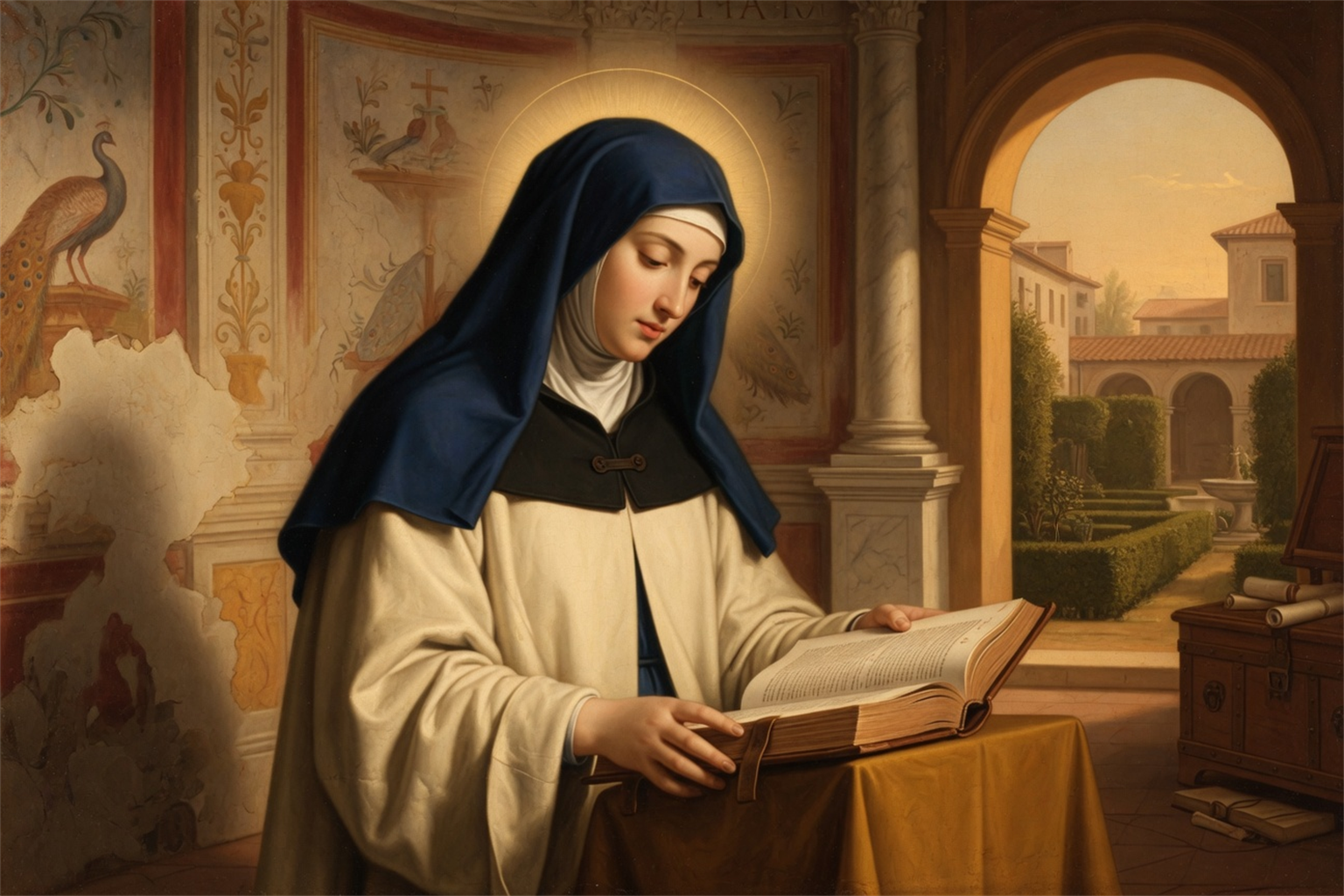
An illustrious Roman lady of the 4th century, Saint Marcella dedicated her widowhood to the study of the Scriptures under the guidance of Saint Jerome. She was the first to introduce female religious life in Rome, transforming her home into a monastery. She died in 410, shortly after the sack of Rome by the Goths, after being mistreated by the soldiers.
Guided reading
7 reading sections
SAINT MARCELLA, WIDOW
Youth and refusal of remarriage
Coming from an illustrious Roman family, Marcella became a widow at a very young age and refused to marry the magistrate Cerealis in order to dedicate herself to God.
Saint Marcella, Sainte Marcelle Mother of Saint Potamiena, martyred with her. whom the great Saint Jerome calls "the model of widowhood and holiness for the Romans," was born in Rom e to Rome Birthplace of Maximian. a family so illustrious that it recognized only consuls, proconsuls, and provincial governors as its ancestors; yet she increased this nobility when she chose to forget it to follow Jesus Christ in perfect humility and evangelical poverty. Having lost her father, and soon after her husband, with whom she lived for only seven months, she remained a widow in the flower of her youth and beauty, amidst the abundance of goods and the splendor of a great fortune, but even more enriched by a virtue that had no equal. Cerealis, who was then in possession of the hi ghest Céréal Roman magistrate who wished to marry Marcella after she was widowed. magistracy of the empire, sought to marry her because, in addition to his offices which made him significant, he had wealth and influence; but as he was already advanced in age, to win her over, he said that he did not wish to consider her so much as his wife as his daughter and the heiress of all his goods. Albina, Marcella's mother, agreed and begged her dau ghter Albine Mother of Saint Melania the Younger. to consent because of the support she hoped for from a man of such standing; but Marcella would never listen to this proposal, saying that even if she were not resolved to dedicate her widowhood to God, and if she had the desire to marry, she would rather choose a man than wealth.
Cerealis sent word to her that old men could live a long time and that young people could die suddenly. Marcella cleverly replied that those who are young may die, but that old men cannot live long; thus she broke off these negotiations and closed her door to others.
Study of the Scriptures and mentorship of Saint Jerome
Marcella leads a life of modesty in Rome and becomes an expert in the Scriptures under the guidance of Saint Jerome, of whom she becomes the recognized interpreter.
She lived with such conduct and modesty in the city of Rome that no one ever dared to open their mouth to slander her; and, had anyone done so, they would not have been believed, nor even listened to. She was the mirror of Christian widows; the candor of her soul and her works served as a lesson to ladies of her station, and she was the first to teach them by her example how to confound the enemies of devotion through their modesty. Her clothes were simple, and she used them only to protect her body from the harshness of the seasons, having renounced jewels and precious ornaments, the price of which she had used for the nourishment of the poor. She never wished to see any man, of whatever quality he might be, except in the presence of several people. She always had in her service widows and maidens of irreproachable life, because she knew that mistresses bear all the blame when their servants commit some fault. She never tired of reading, meditating, and studying the Holy Scripture; and she had an extreme desire to live according to the laws prescribed to us therein, believing that those who observe exactly what God commands in the Holy Bible deserve that He should reveal to them its true understanding. Saint Jerome, having come to Rome with Saint Epiphanius a Saint Jérôme Father of the Church and author of the original biography of Saint Asella. nd Saint Paulinus, although he avoided the company of ladies of the court, was nevertheless so often solicited by this virtuous widow and pressed by so many diverse means to explain to her the difficult passages of the Holy Scripture, that he could not refuse her this service. Every time he saw her, she proposed new difficulties to him in order to have the solution, and used several means to better understand the clarifications he gave her; in this way, she became so enlightened that, when Saint Jerome left Rome to retire to Jerusalem, she remained as the interpreter of what she had learned from this great doctor of the Church. When any difficulty arose regarding an obscure passage of Scripture, recourse was had to Marcella's explanation: she fulfilled this with such modesty that, without attributing what she said to her own sufficiency, she attributed all the honor to Saint Jerome or to other authors, knowing very well the doctrine of Saint Paul, that it does not belong to a woman to teach, but only to learn.
Asceticism and solitary life
She practiced rigorous fasting, avoided worldliness, and retired to a country house to live in solitude and obedience.
Her fasts, according to Saint Jerome, were regulated; she did not eat meat, yet she drank a little wine because of the weakness of her stomach and other infirmities to which she was subject, but she diluted it so well that it no longer tasted of anything. Her visits to other ladies were very rare, so as not to see in their homes what she had despised in her own person. She went to the churches of the holy Apostles and Martyrs, but secretly and at hours when she was sure to meet few or no people there. And to live more in solitude, she left Rome and retired to one of her country houses. Her obedience toward her mother was always very great; she forced her own inclinations for her sake in order to accommodate her own, and, through an admirable compliance, she left her the mistress of all her great wealth, so that she could dispose of it in favor of her relatives, although her own views were quite different.
Introduction of religious life in Rome
Inspired by Saint Athanasius's accounts of the monks of Egypt, she was the first Roman noblewoman to take the veil and found communities.
There was at that time no lady in Rome who knew the excellence of the religious profession: on the contrary, persons of rank held the name of religious in contempt. But Marcella, after having learned from Saint A thanasius the saint Athanase Patriarch of Alexandria, defender of orthodoxy against Arianism. way of life of Saint Anthony and the heavenly conversation of the Virgins and widows who were sanctified in the Thebaid under th Thébaïde Region of Upper Egypt where Athanasia retired. e guidance of Saint Pachomius, embraced this kind of life with such affection that she took the religious habit, not being ashamed to make a profession of a thing that was pleasing to Jesus Christ. She was the first in Rome to be veiled; afterwards, she was imitated by many ladies, and a great number of religious houses were founded to serve as a retreat for virgins who wished to embrace piety; so that what, previously, was esteemed little honorable, was then held to be glorious and regarded with veneration: the glory for this is due to Saint Marcella, having been the guide and mistress of widows and having excited by her example the Roman ladies to embrace this life.
The Sack of Rome and the Trials
During the capture of Rome by Alaric in 410, Marcella was mistreated by the Goths but managed to protect her companion Principia.
The heroic virtue of this generous widow appeared marvelously in the dreadful ruin of Rome, when God permitted that city to fall into the hands of its enemies: they reduced to ashes the glory of this illustrious city and took away the liberty of her who, formerly, had brought the whole earth into servitude; Alaric, King of the Goths, having besieged and taken it by assault, put it to fire and sword and executed against it all that a victorious and irritated prince can do in a city he has entered with sword in hand and rage in his heart.
Some insolent soldiers having entered the house of Marcella to plunder it, she received them peacefully and without astonishment. They asked her where she had hidden her riches: she declared to them, by showing them her poor habit, that she had with a very good heart chosen to be poor for the love of Jesus Christ. She was beaten and whipped by these barbarians, who did not believe her; but she had no resentment for the blows they gave her. She threw herself at their feet to beg them with tears to leave her a young girl named Principia, her companion, to whom Saint Jerom e dedicat Principia Companion and disciple of Saint Marcella, witness to her sufferings during the Sack of Rome. ed the life of our Saint, and who had been an eyewitness to it; she feared that this girl might suffer in her youth what her advanced age no longer made her fear. God softened the hardened hearts of these soldiers, and pity found some place among the bloody swords of these pagans, for they led them both to the church of Saint Paul; they did not know if it was to give them life or to p ut them in the tomb, église de Saint-Paul Place of refuge for Marcella and Principia during the Sack of Rome. but when they saw that these barbarians left them in liberty in that place, they were extremely consoled and gave thanks to their sovereign Lord Jesus Christ for the care He had taken of their persons. Captivity did not make her poorer than she was before; for she was already so poor that she had no bread to eat; but, moreover, she was so filled and so satiated with Jesus Christ that she did not feel hunger, and she could say with truth: "I came out naked from my mother's womb, I shall return there with the same nakedness; nothing has happened to me but what it pleased God: may His name be blessed!"
Death of Marcella and the legacy of Principia
Marcella died peacefully shortly after the sack of Rome; her disciple Principia continued her work of piety until her own death around 418.
A few days later, the most illustrious widow Saint Marcella, still full of vigor, peacefully rendered her soul to Our Lord in the year 410, leaving Principia the heiress of her poverty. While she was in her agony, she smiled at the tears of Principia, her good conscience bearing witness to her past life and filling her with hope for the goods of the future life which she awaited through the mercy of her Redeemer.
Principia then lived alone, under the gaze and in the presence of God, who kept her as the apple of His eye, and showered her with all His favors. She continued the way of life of her holy mistress, becoming in her turn a model for her companions, and amassing all her treasures in heaven. Ripe for the reward, she departed from this earth to ascend to the abode of the elect, on January 24, around the year 418.
Hagiographic sources and the struggle against Origenism
The writings of Saint Jerome testify to her holiness and her crucial role in denouncing the heresies contained in the work of Origen.
The sixteenth letter of Saint Jerome to Principia revolves entirely around the holiness and emotion of the illustrious Marcella. In his other writings, the great doctor never ceases to name Marcella without being able to praise her enough. A disciple of Saint Athanasius, not ocularly for the practice of religious life, but for the purity of faith, when the work of Origen Periarchon Major theological and philosophical treatise by Origen. , *Periarchon*, translated by Rufinus, had been introduced to Rome, she was the first to discover the heresies it concealed and to pursue their condemnation with her and formulated. — See also *Annales of Baronius*.
Annexes & related entities
Structured data for exploration: events, miracles, quotes, places, attributes, patronages, and important entities cited in the text.
Key Events
- Seven-month marriage followed by early widowhood
- Refusal of marriage to the magistrate Cerealis
- Meeting and study of the Holy Scripture with Saint Jerome
- First woman in Rome to take the religious habit and be veiled
- Pillage of her house by Alaric's Goths in 410
- Denunciation of the heresies of Origen in the work Periarchon
Quotes
-
Naked I came from my mother's womb, and naked I shall return there; nothing has happened to me but what it pleased God: blessed be his name!
Saint Marcella (quoting Job)