Saint Peter Nolasco
FOUNDER OF THE ORDER OF MERCY
Founder of the Order of Mercy
Born in the Lauraguais region, Peter Nolasco founded the Order of Mercy in Barcelona, dedicated to the redemption of Christians held captive by the Moors. Under the protection of King James of Aragon and inspired by a vision of the Virgin, he devoted his life and wealth to liberating hundreds of slaves in Africa and Spain. He died in Barcelona in 1256 after a life of heroic charity and miracles.
Guided reading
8 reading sections
SAINT PETER NOLASCO,
FOUNDER OF THE ORDER OF MERCY
Origins and Youth
Peter Nolasco was born in the Lauragais region into an illustrious family and manifested an exceptional compassion for the poor from a very early age.
Mercy gives a compassionate heart for misery, drives all hardness from the heart, and floods the heart with an admirable sweetness. Saint Anthony of Padua, Serm. xxii, after Trinity. This is one of those illustrious founders of a congregation that France has given to the Church. He was born in the Lauragais region, in the diocese of Saint-Papoul, in a place called Mas des Saintes Puelles, near Castelnaudary, today in the diocese of Carcassonne, to one of the most illustrious families in all that province. The place called today Le Mas-Saintes-Puelles was called Recaud before three young girls from Toulouse, fleeing persecution, saw fit to take refuge there. Thus, until the introduction of the Roman rite (1854) at Mas-Saintes-Puelles, these words were sung from an office specially approved for this parish by J. B. Marie de Maillé de la Tour Landry, the last bishop of Saint-Papoul: Raise your festive canticles to the heavens, O people of Récoud! Is it not truly just to rejoice, and does not the whole Church rejoice on this day when it celebrates the triumph of one of those men whom Scripture calls men of mercy? While still young, Peter Nolasco always showed that he was born for mercy, and that this virtue had been given to him as a companion from the very first moment of his existence; he could hardly look at a poor person without shedding tears of compassion. His father, who was named Nolasco, having died, he remained, at the age of fifteen, under the guidance of his mother. She would have very much wished, for the relief of her old age, to see him take a path suitable to his station. But God, who was calling him to greater things, put into his mind a strong thought never to attach himself to any mortal creature. However, the young Peter joined the retinue of Simon, Count of Montfort, general of the Catholic crusade against the Albigensians. Simon de Montfort won the famous battle of Muret against the counts of Toulouse, Foix, and Comminges, and Peter, King of Aragon: the latter was killed there, and his son James was taken prisoner. The victor, who had been a friend Jacques King of Aragon who supported and participated in the foundation of the order. of Peter of Aragon, was touched by the misfortune of his son, who was six years old; he took the greatest care of him, entrusted his education to Peter Nolasco, and sent them both to Spain.
Vocation and early commitments
After serving Simon de Montfort, he became the tutor to the future King James I of Aragon and settled in Barcelona, where he began to ransom Christian slaves.
The Saint was then only twenty-five years old; he lived at the court of Aragon, in Barcelona, with all the regularity of a religious. He discharged his noble duties with the greatest zeal, inspiring in the young king piety toward God and His Church, and a love of justice and truth. As for himself, far from the pleasures of the court, he lived in retirement in a residence that the king had given him, in the parish of Saint-Paul, after having naturalized him and incorporated him into the nobility of Catalonia. He devoted to prayer, the study of the Holy Scriptures, and the exercises of penance the time he was not obliged to spend with the person of the king. He had four hours of prayer set aside, namely: two by day and two by night. Furthermore, he felt so deeply moved with compassion for the poor Christians who, having fallen by some misfortune into the hands of the infidels, groaned under such miserable servitude, that he would have willingly rendered himself a slave to deliver one of them. But Sa int Raymond of Penyafort h saint Raymond de Pennafort Master General of the Dominican Order. aving made him moderate this great fervor, he believed he should at least contribute as much as he could with his own goods and through collections among his best friends to such a religious design. With the goal of succeeding better in this, he engaged some acquaintances to form a holy alliance under the name of the Congregation of the Blessed Virgin, to work for the redemption of slaves and to form a fund of alms that would serve this purpose. However, such happy beginnings were not exempt from the slanders of the world, which is accustomed to thwarting the holiest enterprises of the servants of God. But He who had given the first thought of it to the generous Peter wished to strengthen him further in it through a heavenly vision he had during prayer; for it seemed to him that he saw an olive tree laden with flowers and fruits in the middle of the courtyard of a royal house, and two venerable old men who commanded him to sit at the foot of this tree in order to guard it. He believed that this related to the small congregation he had already established in the king's court and which he desired to extend throughout Christendom. Indeed, this was the true interpretation of this vision.
Foundation of the Order of Mercy
Following a vision of the Virgin Mary shared with the king and Saint Raymond of Pennafort, Peter officially founded the Order of Our Lady of Mercy in 1218.
Another time, on the feast day of Saint Peter in Chains, the Blessed Virgin Mary appeared to him during the night and in the greatest fervor of his prayer, to tell him that it was God's good pleasure that he should work for the establishment of a congregation, which would be employed in the deliverance of captives, under the title of Our Lady of Mercy, and which would make a profession of withdrawing the faithful, who were slaves, from the hands of the barbarians. Peter, astonished by this vision, took the boldness to speak to Her whom he saw and to say to her: "Who are you, to know so well the secrets of God? And who am I, to fulfill such a great mission?" The Virgin answered him: "I am Mary, Mother of God, who bore the first Redeemer of the world, and who wishes to have among Christians a new family that would perform in some way the same office for the love of my Son in favor of their captive brothers." Immediately Peter, all transported with joy, went to the palace to inform the king of what had happened; but he was even more consoled when he learned that this prince had been favored at the same hour with a similar vision, as had Saint Raymond of Pennafort, of the Order of Saint Dominic.
The king having called Bérenger de La Palu, Bishop of Barcelona, and the principal members of his council, it was decided that on the day of Saint Lawrence, the religious habit would be given to Nolasque, so that he might be as the first stone of this great edifice. It was therefore on this prescribed day that the king, followed by Saint Raymond, our Saint, the entire court, and the aldermen of the city, went to the church of Santa Creu i Santa Eulàlia, the cathedral of Barcelona, where the bishop with the clergy received him at the door, singing the Te Deum, and celebrated the pontifical mass. After the Gospel, Saint Raymond mounted the pulpit and made known to the people the will of God, revealed to the king, to Nolas que, and to him, concerning the Ordre de Notre-Dame-de-la-Merci Religious and military order dedicated to the ransom of Christian captives. institution of the Order of Our Lady of Mercy for the redemption of captives; and after the offering, the king and Saint Raymond presented the new founder to the bishop, who, having blessed the white robe, the scapular, and the other parts of the new religious habit, vested the blessed Peter in them in the presence of all the people, and with him two lords from among those who had been his first associates in collecting alms destined for the slaves. They made the solemn vows of religion and added a fourth, by which they obligated themselves to pledge their goods and their own persons, when it would be necessary, for the deliverance of prisoners; and this is what distinguishes this Order from others. The king, in testimony of his benevolence, presented him with his arms, which are or with four pales gules, and the bishop in turn asked that he be permitted to add those of the cathedral church, which are a silver cross of Saint John of Jerusalem, on a field gules; so that the royal arms being, by this means, united with those of the religion, would be more in conformity with the spirit of the Institute. At the end of the mass, the king took the new religious and his two companions, and, followed by the bishop, Saint Raymond, the nobility, and the aldermen of the city, he led them to his palace, where he put them in possession of a part of the buildings that were to serve as their first lodging: their successors enjoyed them thereafter.
Redemption missions and miracles
He led expeditions to Valencia and Granada to free hundreds of captives and assisted the king in the reconquest of Valencia, which was marked by celestial signs.
God, continuing to pour His blessings upon this new Order, drew to it day by day several notable persons, who, from being slaves of the world, became redeemers of captives: and, as the number of religious began to grow, the blessed Peter asked the king for permission to choose some place in the city to build a monastery; the church of Saint Eulalia, on the seashore, was the most suitable place that could be found.
However, the King of Aragon, diminishing nothing of th e affection roi d'Aragon King of Aragon who supported and participated in the foundation of the order. he had always held for his governor, had an apartment made for him near the convent of Mercy, which would serve as his ordinary residence. Thus, the virtue of this good religious was more powerful in drawing the king from his palace to the monastery than the king's influence was in bringing the religious from the cloister to the court. Although this prince, in fact, desired that he keep him company on the journey he was to make to celebrate his wedding in the city of Agreda, it was not possible to make him abandon his cell. But it is noted that what he had refused out of modesty, he accepted another time out of charity: quarrels between Dom Nugier Sanchez, the king's first cousin, and Dom Guillaume de Moncada, Viscount of Béarn, had so divided Aragon and ignited such a great war that the king himself, who was to be the judge of these disputes, was in danger of his person through the artifice and violence of the two parties. As each of them wanted to have the Saint on his side, he came to the king; and, having received a commission from His Majesty, he went to find the leaders of the two factions and negotiated this matter so prudently that he satisfied everyone and at the same time provided for the relief of the people. Furthermore, the king being like a prisoner for three weeks in the castle of Zaragoza, the blessed Peter went there, and, after having long solicited God through his prayers, he handled the matter with such skill that the king received the satisfaction he desired and was able to return to Barcelona.
After having given these proofs of attachment to his prince, he took leave of him to go on a pilgrimage to Our Lady of Montserrat; and, in order to satisfy his devotion more secretly, he went to Manresa, as if he had no intention of passing through Barcelona; and, being there, he put himself in the state he desired and made the journey barefoot, after which he returned to his monastery. As soon as he arrived, he assembled his religious and represented to them that it was not enough for the perfection of their Order to redeem some captives, as they were doing, without leaving the lands subject to Christian princes, but that it was also necessary to travel into infidel lands, in order to withdraw the lambs from the jaws of the wolves and to deliver the Christians, their brothers, from the hand of their enemies. As they could not all go together, they proceeded to the election of those who would first make this journey, and who, for this reason, were called *Redeemers*.
He himself was named, so that, so to speak, he might break the ice and pave the way for the others. And, regarding this election as a command from heaven, he prepared himself for it with the diligence and devotion that one can imagine. He therefore undertook this journey with the resolution not to employ for the redemption of the faithful only the funds that had been collected, but also his blood and his life.
He went first to the kingdom of Valencia, occu royaume de Valence Place of Ismidon's early studies. pied at that time by the Saracens: far from finding there the contempt that his humility had led him to hope for, he received only honor; that is why, after having executed his design with almost all the advantage and ease he could desire, he returned immediately to Barcelona, bringing back in a humble triumph a large number of poor innocents whom misfortune had reduced to servitude. He was no sooner back than he made a new collection and left a second time to go to the kingdom of Granada. He withdrew from the hands of the infidels, in these two expeditions, about four hundred slaves. If his charity filled the captives with consolation, it caused no less astonishment to the Barbarians to whom he generously preached the Christian truths and the mysteries of our religion. It is undoubtedly because of this great zeal that God gave such a blessing to his labors that he accomplished with wonderful ease everything he undertook.
Nolasque would have liked to continue his charitable functions; but, as the King of Aragon had undertaken the conquest of Valencia from the Saracens, after having taken the island of Majorca from them in the year 1228, the prohibition of trade and the acts of hostility on both sides forced the Fathers to interrupt this pious exercise for some years.
However, this did not fail to be advantageous to the redemption of the captives, whether by the frequent and signal victories that the King of Aragon won over the infidels, or by the foundation of several monasteries of Mercy that he erected in the lands conquered from the enemies. The most famous of all was founded when, having won a great victory over Zaen, King of the Moors of Valencia, from which followed the taking of the mountain of Unéza, the king sent word to the blessed Peter, who was in Barcelona, to come and find him with diligence. And, as soon as he arrived, he gave his Order the castle of Unéza, in recognition of the victory that it had pleased God to let him win over these infidels, and had a monastery and a church built there in honor of Our Lady: indeed, before the success of his arms at the intercession of Mary, it was just that he should consecrate to her the glory of his conquests by erecting these illustrious trophies to her.
While they were working on the foundations of this new church, which is called in Spain Saint Mary del Puche, because of the place, a thing worthy of note happened: for four Saturdays, one saw appearing at night seven lights as bright as stars, which, descending from heaven at seven different times, went to hide under the earth at the very place where they were digging the foundations. They took notice of it and, by digging further, they found a bell of prodigious size, in which there was a very beautiful image of Our Lady. The blessed Peter received it in his arms as a rich gift from heaven and had an altar set up for it at the same place where it was found; and God has worked numerous miracles there from that time on.
This celestial favor gave the holy man reason to exhort the king to pursue the siege of Valencia; and, although the council was of a contrary opinion, nevertheless the prince trusted in the words of Nolasque, who promised him success on behalf of God. He continued the siege and finally took the city with the help of heaven and the arms of the French nobility who came, without being summoned, to offer him their services in such a holy enterprise, where the glory of God and the interest of the Christian religion were at stake.
The Ordeal of Algiers
During a mission in Africa, he is imprisoned by pirates after attempting to save a noble lady, before miraculously returning to the Spanish coast.
The king's first action, after entering the city, was to have the great mosque consecrated by the Bishop of Narbonne as a cathedral church under the title of Saint Andrew, and to give the religious of the Order of Mercy another mosque, which became the church and monastery of the Order. Our Saint arranged this house and, after placing it in the hands of a few religious, he returned to Barcelona; he was not there long before making preparations for a third voyage for a new redemption. As he had found among the Moors of Granada and Valencia more gentleness than he desired to satisfy his humility, he resolved to head toward Africa, and went to land at Algiers, a coast long forgotten b y Eur Alger City associated with the liturgical source of the text. opean sailors, but since then much frequented by the Fathers of Mercy.
He went to seek the faithful captives in the dungeons of the Turks, with more care and joy than the most avaricious seek gold in the bowels of the earth or pearls at the bottom of the sea. But, while he was working to deliver the slaves, the Turks strove to take prisoner those who were free. A pirate, returning from his raid, arrived in Algiers with a frigate full of Christian passengers, among whom was a Catalan lady named Teresa de Vibaure: she was a person of high quality, accompanied by one of her brothers with whom she was returning from Rome to receive from His Holiness the conclusion of a dispute she had with the King of Aragon. When the pirate arrived at the port, the extraordinary howls of these starving wolves made the Father judge well that they had made some new catch: that is why he went there promptly, and, discovering these poor prisoners, he approached them in order to mingle his tears with their sighs and to soften their pain by showing them the sorrow he felt for them, and by offering to each of them his freedom and his life for their deliverance. But when he caught sight of Teresa, whom he had seen a few years earlier in prosperity, he promised her every kind of assistance, and immediately went to negotiate the ransom of all these captives with the pirate who had brought them. The latter, not knowing the status of his slaves, left them at a modest price and, having received payment, placed them in the hands of the Father. A sailor having discovered the status of this lady and her brother, the pirate chief seized them again; and, as if he had been deceived by the Father, he treated him injuriously and even threatened to put him to death. Saint Peter, to stop the noise, increased the ransom; and, because he did not have the means to pay, he obtained time to send to Spain to seek the necessary sum, on condition that the slaves would be placed in a safe place and that he would have the freedom to visit them. He wrote to the King of Aragon, and the captives also wrote to their relatives; but the delay in receiving a response and the inconveniences of servitude, unbearable to delicate persons, led them to seek their freedom without the Father's knowledge; and a local Jew took them away secretly one night and had them cross over to Spain a few days later.
The next day, the pirates, no longer finding the best of their loot, seized the blessed Father, without further information, loaded him with insults and blows, put him in a dungeon, and brought him to justice as a thief, a seducer, a forger, and the sole author of the slaves' escape. The cadi or judge, finding no proof against him, did not dare to condemn him; but he, desiring to suffer and fearing that some ill-treatment might be done to the other captives, offered himself to be a slave in place of the fugitives or those they might choose, while the religious who was in his company would go to seek the ransom in Spain. The pirate, greedy and artful, wanting to have money and to take revenge, preferred to keep the religious as a pledge whom the Father intended for this voyage and wanted him to set out to sea himself to go and seek the ransom for the others. He had two boats called tartanes put to sea: in one, which was leaking on all sides, he had the Father embark, with orders to the sailors, as soon as they were in the open sea, to abandon him without sails or rudder, and that upon their return they should pretend that the storm had lost the ship where the Christian was. His order was executed, but not with the success he intended, because God wished to protect from shipwreck the one who was going only under the guidance of His grace. The storm that the Turks had chosen to exercise their fury ceased: calm returned. God Himself served as a guide to the tartane, and the Father, making a mast of his body and a sail of his cloak, with the favor of a favorable wind, crossed the sea and arrived in a few hours at the coast and finally at the port of Valencia, to the great astonishment of a multitude of people who saw him land.
As soon as he had disembarked, he went to give thanks to God in the church of Our Lady del Puche, of which we have spoken above; he was followed there by all the people, who gave a thousand praises to God for the wonder of this success and who immediately gave great alms to release as soon as possible the religious and the rest of the Christian captives in Algiers; they were soon ransomed and brought to Valencia, where this blessed Father awaited them and received them with tenderness that cannot be expressed in words. The religious of Barcelona, having learned of the admirable return of their holy Father, sent to beg him to come and console them with his presence, which was very necessary to them: he went there; but, if he gave them this consolation, he also received much from seeing the zeal they had to sacrifice themselves entirely to works of charity and to seek the occasion of martyrdom. Some time later, he assembled the leaders of the Order to resign from the office of redeemer, which had been imposed upon him, and to proceed to the election of another who would worthily fulfill this function: the lot fell on Father Guillaume Bas. He wanted at the same time to renounce also the office of General to live the rest of his days as a simple religious; but, whatever reason he alleged to have his design accepted, no one would consent to it. All he could do through his prayers and tears was to finally obtain the election of a Vicar General who would relieve him in his visitations and other labors of the Order; and this was Father Pierre d'Amour. Thus Nolasque, seeing himself a little freer, applied himself with new zeal to the humblest ministries of the community and resumed the first exercises of the novitiate. Among other things, he took great pleasure in distributing alms to the poor at the door of the monastery, because, during this time, he had the means to share with them spiritual alms and to exhort them to patience and the love of God.
Mystical Life and Humility
Favored by visions of Saint Peter and endowed with the gift of prophecy, he refused honors and withdrew into the humblest tasks of his monastery.
He was often favored with heavenly visions through which Our Lord made known to him the progress of his Order and the best way to lead his religious. One Saturday, as he was attending the evening benediction in the church with the others, he was observing all his religious, and as it seemed to him that their number was small, he was quite enraptured, beside himself, and said in an intelligible voice accompanied by sighs and tears: "How! Lord, will you be stingy toward your mother, being so liberal toward all your creatures? O Lord, if it is my insufficiency that causes the source of your graces to dry up, erase this useless servant from the book of life and give children to the divine Mary." Then, a voice was heard in the church that pronounced these words: "Fear not, little flock, for it has pleased your Father to give you his kingdom." These words filled those present with astonishment and the Saint with gladness, and he soon had the consolation of seeing this promise fulfilled by the increase of religious and monasteries that were founded in several places in Christendom.
He had always had an extreme desire to make the journey to Rome to offer his vows at the sepulcher of Saint Peter, the prince of the Apostles, to whom he was very devoted, because he bore his name. This devotion was renewed and even increased after the establishment of his Order, and he resolved to make the journey barefoot. One day, therefore, as he was meditating on this undertaking, he heard a voice that said to him three times: "Peter, since you have not come to see me, I come to visit you." And immediately he perceived the prince of the Apostles in the same state as he was when he was crucified, who said to him: "Peter, not all the good desires of the just must be fulfilled in this life: I wished to have my head downward at my death, to make it known that superiors must turn their spirit and their thought to the needs of their inferiors, in imitation of my master, who, before dying, brought his head to my feet in order to wash them."
Since this vision, not a day passed without him performing some particular devotion to Saint Peter; thus he would command a religious to bind him to a cross that was at the head of his bed, and he would spend entire hours in the same posture in which he had seen that apostle. This he practiced for a long time, until his spiritual father, noticing that this mortification was causing notable prejudice to his health, forbade him to continue it. He had a strong inclination for solitude; that is why he would have liked to spend the rest of his days in the desert of Montserrat with the other hermits who lived there, but he was dissuaded by Saint Raymond, his confessor, who assured him that God was calling him to something else: this advice from his spiritual father was confirmed by a voice that said to him: "Peter, lift your eyes and look"; and he saw people of all kinds of conditions who were entering paradise.
He was so humble that at the bottom of his letters he would call himself sometimes Peter Nolasco, useless servant; sometimes the sweepings of the world; other times true nothingness. And when it was pointed out to him that these titles seemed ridiculous, or at least not very decent for his dignity, he replied that since signatures were invented to express who we are, he qualified himself as he wished to be esteemed by others.
God had favored him with the spirit of prophecy to know things to come, those that were present and hidden; for he predicted, as we have seen, the happy success of the siege of Valencia to Don James, King of Aragon, and he recognized that two men, who presented themselves to him under the pretext of asking for the habit of his Order, were assassins who came with the design of taking his life.
Meeting with Saint Louis and passing
After meeting the King of France, Louis IX, he died in Barcelona on Christmas night in 1256, exhausted by his austerities and his advanced age.
He was honored not only by the kings of Aragon and Spain, but also by the great Sai nt Louis, K saint Louis King of France whose chaplain was Thomas Hélye. ing of France, who, hearing of his miraculous actions and his exemplary life, wished to see him and made his desire known to him. The Saint took the opportunity to come and kiss his hands when this prince, to stop the progress of Raymond, the last Count of Toulouse, made a journey to Languedoc around the year 1243. The King received him with great demonstrations of joy and kept him for some time at his court, where he shared with him the designs he had for the service of God and particularly concerning the freedom of the Christians who were suffering in the Holy Land under the yoke of the infidels. He even contracted a special friendship with him, and maintained it thereafter through letters he often wrote to him, recommending his States and his person to his prayers and those of the religious of his Order. Finally, this most holy king held the virtues and merits of Saint Peter Nolasco in such high esteem that, seeing himself on the point of crossing with his armies into the lands of the infidels, he begged him, for the love of God, to be part of the expedition and to follow him in the conquest he hoped to make of Palestine.
Our Saint was already very old and very infirm: nevertheless, as if the thought of this enterprise, which he believed would be very glorious, had given him new strength, he got out of bed and began to prepare for his journey, putting the necessary order to the affairs of his monastery during his absence. But the efforts of old age cannot be of long duration, especially in a body that great austerities have broken no less than age. His zeal and extreme ardor served only to make him fall into a greater weakness; so that, feeling himself failing every day, he was forced with pain to return to bed and contented himself with letting the King of France know of his good will and the little strength he had to carry it out.
As the day of the Savior's birth approached, when the faithful conceive the most sentiments of joy, the pains of his illness redoubled: he showed a particular joy, being delighted to take part in the sufferings of the infant Jesus lying in the manger. And, although the doctors were not of the opinion that he should leave his cell to go to the church, he nevertheless managed to be in his place in the choir, without knowing how he had been carried there. The service finished, he got up all by himself and went to his cell as if he had never had any infirmities; but, as soon as he was there, his convulsions returned, and the religious, having put him back on his bed, begged him to tell them how he had been transported; he replied that one must praise God, Father of mercy and of all consolation, and his holy Mother, protectress of the Order, and that this was all he could say.
The infirmity he felt that Christmas night greatly advanced the last day of his life. Recognizing then that his end was near, he begged that they give him the holy Viaticum. When he saw that it was being brought to him, devotion provided him with new strength; and, jumping from his bed, he left his room, dragged himself on his knees until he arrived at the feet of the one who held the Blessed Sacrament in his hand; and there, repeating these words often with a great transport of fervor: "Whence comes this honor to me that my Lord should come to me?" he fell from weakness. The religious, taking him in their arms, put him back in his bed, where he received with admirable testimonies of sweetness and interior consolation the precious body of his God. Then, having all the brothers called, he told them that he had two favors to ask of them: one, to forgive him for the bad example he had given them and his negligence in the government of the Order; the other, that they elect a general in his place, so that he could die with the merit of obedience. The religious, preferring in this extremity his consolation to the custom of the regular Orders, consented to his desire, persuaded that he would name the one he judged most fit to sustain this charge; then he declared and assured that Brother Guillaume Bas was the one whom heaven destined for the leadership of the Order.
The religious, deferring to the nomination of their holy patriarch, immediately rendered to the new general the first acts of obedience. When the Saint saw himself relieved of this burden and had only to think of the affair of his salvation, he applied himself entirely to the exercises of devotion; sometimes he conversed with God and with the most holy Virgin; sometimes he spoke to the prince of the Apostles, other times to his guardian angel, and his colloquies were accompanied by the tears of perfect contrition and followed by ecstasies that made him appear as if he had given up the ghost. Once, among others, reciting the 50th Psalm, *Miserere mei Deus*, etc., having arrived at these words: *Asperges me, Domine*: — "Yes, Lord, your mercy will wash me in the salutary bath of your blood, and I shall become whiter than snow," he remained so long out of himself that he was held for dead, until finally he resumed his prayer and continued the movements of his fervor. The King of Aragon wrote him letters during this last illness, and the Bishop of Barcelona came to see him and gave him his pastoral blessing. Then the good father, looking at his children around his bed, and lifting his eyes and hands to heaven, gave them his, which was followed by a pleasant odor that perfumed the whole room. Finally, arming himself with the salutary sign of the holy cross, he expired in their presence, on Christmas night of the year 1256, aged fifty-nine, or sixty-six, according to various authors. His body was buried in the ordinary burial place of the religious, as he had ordered; but, eighty-seven years later, in the year 1343, it was raised by order of the Pope and transported to a chapel dedicated to the Most Holy Sacrament of the altar, where the Christian people, in honoring his precious remains, have often received from God extraordinary graces which have been held for miracles.
Cult and Posterity
His cult was extended to the universal Church in the 17th century, while his order spread throughout Europe and the Americas.
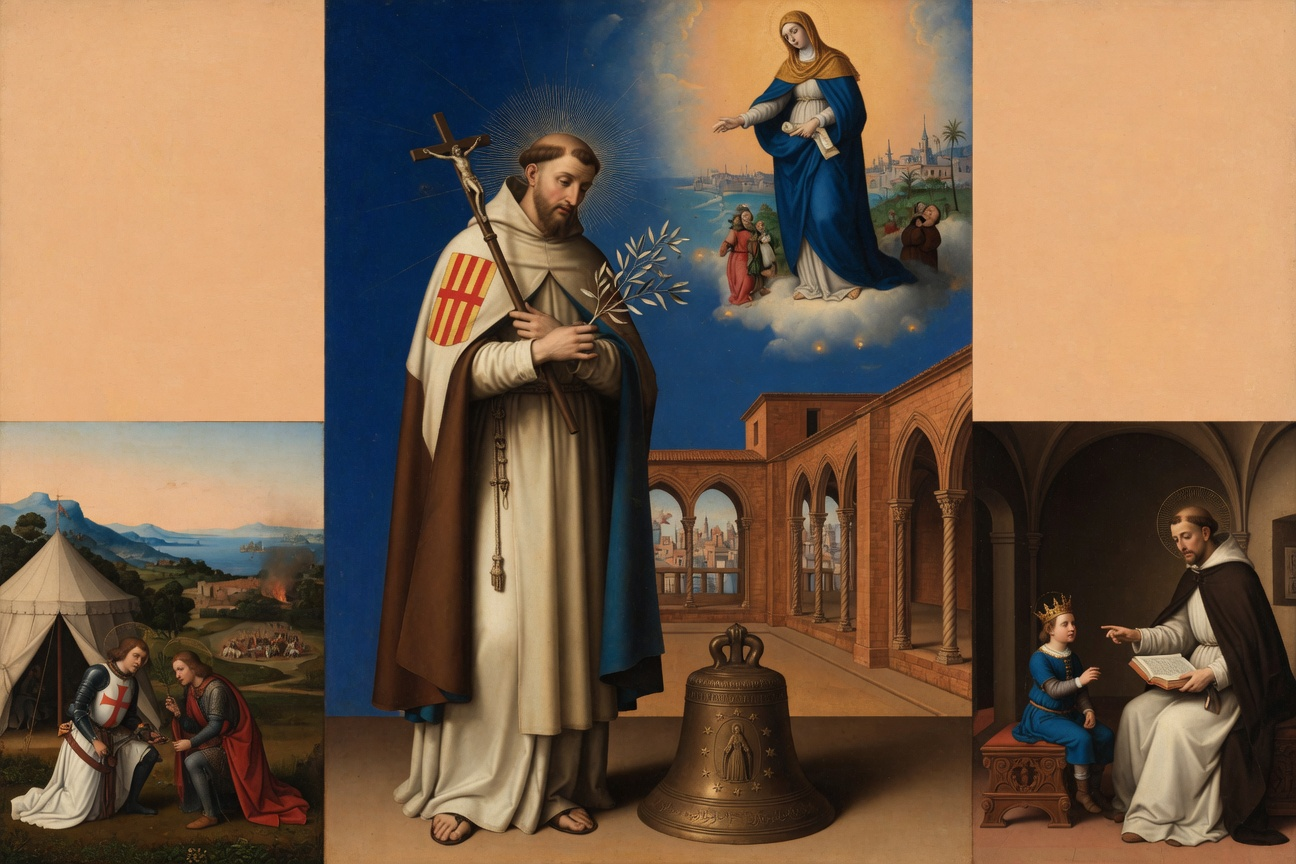
Here is how Saint Peter Nolasco has been represented: Angels carry him to the choir so that he may attend the office with his brothers; this implies that the Saint was old. — Placed beside him, as is the case with all the saints of the Order of Mercy, are the coats of arms of Aragon, or rather of Catalonia, which the Spanish call the four bloody bars of Aragon: these four bars are surmounted by the white cross of the Order. Regarding the four bloody bars of Aragon, some heraldists claim that after a great battle, one of our Carolingian emperors came upon the French Marquis of Catalonia, who was gravely wounded in the action, and that by dipping his hand in the warrior's blood, he traced four red lines on the shield, saying: These shall henceforth be your arms. As for the concession of the Aragonese coat of arms granted to the religious of Mercy, it is explained by the affection of James I, of whom Saint Peter had been the tutor. — He is placed with an olive branch in his hands, a symbol of his mission of peace between Christians and Muslims: it must be admitted, however, that this attribute is not sufficiently characteristic. — He is often painted accompanied by prisoners delivered by him: dungeons and dark posterns, chains and galleys may appear here. — At his feet is a bell in which one sees an image of Our Lady, and upon which descends a luminous trail sown with seven stars: this recalls the foundation of Our Lady of Mercy near Valencia. We have recounted the fact in the life of the Saint. — He holds in his hand a cross with a long staff: this cross is quite often given to founders of religious Orders who, not being abbots, do not have the right to carry a crozier. — By this same title of founder of an Order, one may place a crucifix in one hand and a flag in the other, the latter being the symbol of recruitment. — The Blessed Virgin hands the scapular of Our Lady of Mercy to Peter Nolasco. — Saint Peter Nolasco is naturally the patron of his Order: he is particularly honored in Barcelona.
## CULT OF SAINT PETER NOLASCO.
In 1628, Pope Urban VIII permitted the religious of Mercy to solemnize his feast on Jan uary 29, by reci pape Urbain VIII Pope who beatified Josaphat. ting the divine office and celebrating Mass in his honor. Following this permission, several cathedral churches in Spain inserted it into their calendar and ordered the office and solemn Mass. Since then, Pope Alexander VII had him placed with great praise in the Roman Martyrology and extended the office and solemnity to the whole Church. And Clement X, being petitioned by the Queen of France, Maria Theresa of Austria, commanded that this office be a double. It was transferred from the 29th to the 31st of January, which is now his proper day.
The diocese of Carcassonne celebrates this feast under the major double rite, and Mas-Saintes-Puelles, deprived since the dark days of the French Revolution of a community of the Order of Mercy, nonetheless celebrates every year, on January 31, with all possible pomp, the solemnity of the one whom the office particular to this parish called Saint Peter Nolasco, son of the church of Mas-Saintes-Puelles, and the entire population visits more especially on this day the ruins of the castle of our blessed one. Finally, as if to follow in the footsteps of Pope Clement VI, in 1343, Mgr de la Bouillerie, Bishop of Carcassonne, willed that on January 31, the parish of Mas-Saintes-Puelles should celebrate at the same time the feast of the Perpetual Adoration of the Most Blessed Sacrament and that of Saint Peter Nolasco.
The Rev. Fr. François Zomel, General of the Order of Mercy and a very learned theologian, wrote the life of this saintly founder in Latin. Subsequently, others composed it in French, Italian, and Spanish; and those who wrote the history of the Church of his time spoke of him with great honor. The Martyrology of Spain reports things very worthy of being read by scholars. To conclude, I add that it is true that for a very long time it was doubted whether Saint Peter Nolasco had been a priest; but the reasons reported by the Rev. Fr. Marc Salomon, General of this Order and appointed to a bishopric, are entirely convincing to persuade that he was, and that he celebrated his first Mass in the city of Murcia, when the King, James, drove the Mohammedans from it.
His Order spread throughout all the provinces of Spain and is established in the best cities of Italy. There have been few houses in France. These religious were the first priests to have gone to the island of Saint-Domingue, to Peru, and to Mexico; they were among the most zealous in announcing the Gospel and working for the conversion of the Indians; besides the convents they possess in Brazil, they had up to eight flourishing provinces in the other parts of America, with a large number of parishes. One cannot state the number of captives that these holy REDEEMERS have drawn from irons, of shaken Christians they have supported, fortified, and animated to martyrdom, of idolaters they have enlightened with the light of the Gospel, and of sinners they have converted. As their institute obliged them continually to place themselves at the mercy of the Turks and Barbarians, many of them suffered great torments and were even martyred for the name of Jesus Christ. Many also rendered themselves illustrious by their doctrine and were raised to very considerable prelacies. Finally, this same Order was notably increased in the 15th century by the erection of a congregation of Discalced of both sexes, who, in a large number of convents in Spain, Italy, and Sicily, had as their goal, like the Fathers of Mercy, to redeem enslaved Christians.
Annexes & related entities
Structured data for exploration: events, miracles, quotes, places, attributes, patronages, and important entities cited in the text.
Key Events
- Involvement in the crusade against the Albigensians with Simon de Montfort
- Education of the young King James of Aragon in Barcelona
- Vision of the Virgin Mary requesting the foundation of an order for the ransom of captives
- Foundation of the Order of Our Lady of Mercy on the feast of Saint Lawrence
- Redemption voyages to Valencia, Granada, and Algiers
- Miracle of the sea crossing on a rudderless tartane
- Resigned from his duties to end his life as a simple religious
Miracles
- Crossing the sea from Algiers to Valencia in a boat without sails or a rudder, using his cloak as a sail
- Miraculous discovery of a bell containing an image of the Virgin under seven celestial lights
- Visions of the Virgin Mary and the Apostle Saint Peter
- Miraculous transport by angels to the church choir
Quotes
-
I am Mary, Mother of God... who wishes to have among Christians a new family that performs in some way the same office for the love of my Son in favor of their captive brothers
Vision of the Blessed Virgin -
Peter, since you have not come to see me, I come to visit you
Vision of Saint Peter