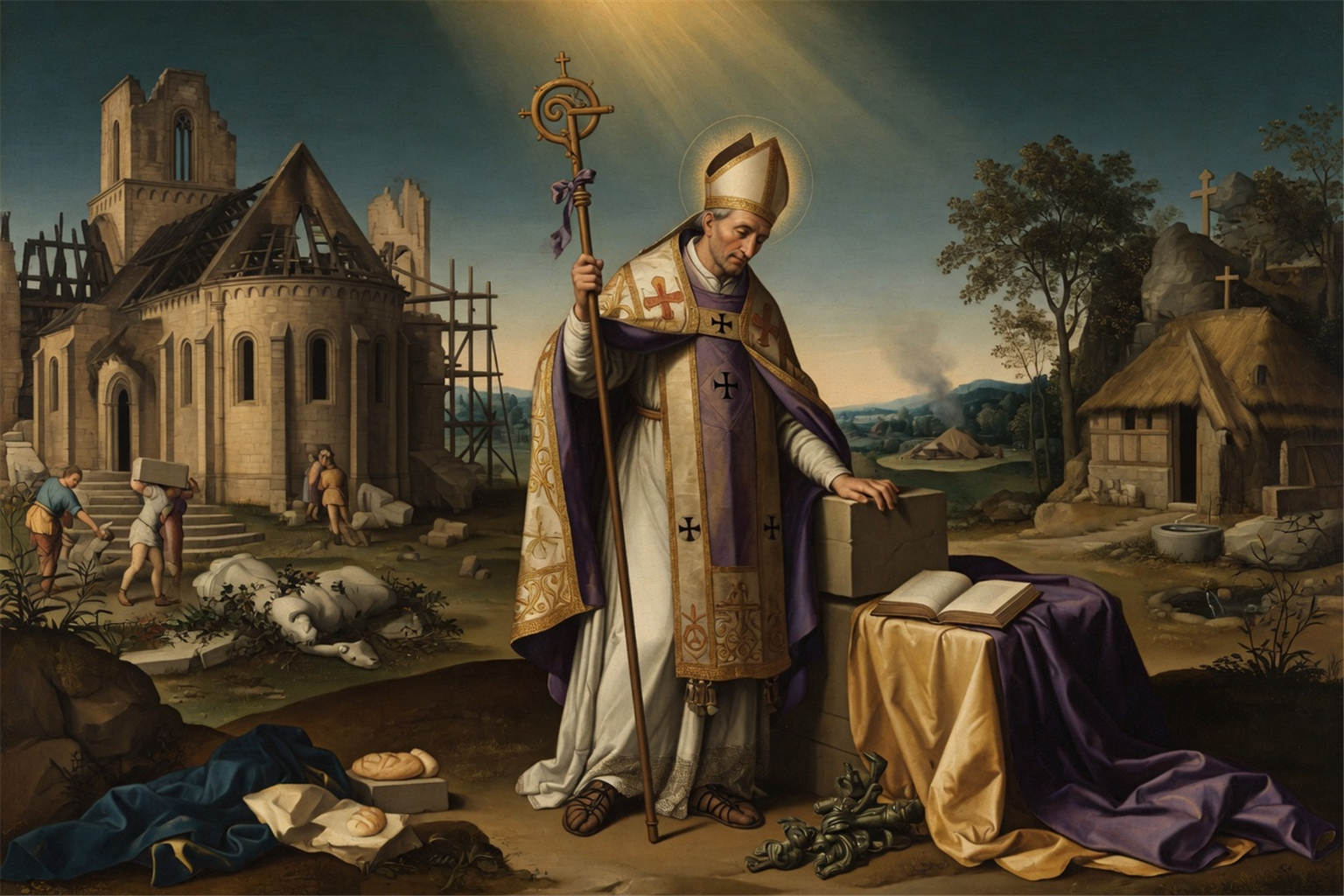
Bishop of Évreux in the 5th century, Gaud restored his church devastated by wars before retiring to the solitude of Scicy to end his days as a hermit. He died in 491 after having fought against idolatry and served the poor. His relics, discovered in the 12th century at Saint-Pair, are the object of great veneration in Normandy.
Guided reading
6 reading sections
SAINT GAUD, BISHOP OF ÉVREUX (491).
Youth and vocation
Born in Evreux, Gaud grew up in the faith and prayed at the tomb of Saint Taurin, nurturing the plan to restore the local Church devastated by wars.
Gaud or Walde Gaud ou Walde Bishop of Évreux in the 5th century and hermit. , as some write, born in Evreux to v irtuou Évreux Episcopal see of Aquilin and the site of his primary ministry. s parents, was carefully raised by them in the Christian faith. After the death of Saint Taurin, apostle of saint Taurin First bishop of Évreux whose relics were rediscovered by Landulph. the Eburovices, this church, due to the fury of wars, remained for a long time deprived of a bishop. However, Gaud often came to pray at the tomb of the Saint. There he conceived the ardent desire to restore the church and to propagate the religion.
Restoration of the Diocese of Évreux
Taking advantage of a political lull under Count Egidius, Gaud requested the Archbishop of Rouen to appoint a new pastor for Évreux.
Thus, when the unrest caused by the war began to subside, and Count Egidius had brought some comte Egidius Roman count who restored tranquility to the Gauls. tranquility to the Gauls through the defeat of the Goths, our Saint made every effort so that the faithful, whom the devastation of the countryside and the terror of the barbarians had scattered, would return to the city and reunite with the few priests or clerics who had remained there. Then, joining himself with some citizens, he went to Germain, Archbishop of Rouen, who had, three yea Germain, archevêque de Rouen Archbishop of Rouen who consecrated Saint Gaud. rs earlier, subscribed to the first Council of Tou rs, and he urged him to premier concile de Tours Council attended by Germanus of Rouen. be willing, in his capacity as metropolitan, to provide a pastor for a church that had been deprived of one for so long.
Episcopate and consecration
Gaud is consecrated Bishop of Evreux by Germain of Rouen, surrounded by the bishops of Coutances and Séez, thus officially succeeding Saint Taurin.
Moved by the prayers of Gaud, and noticing in his speech and in his whole person a certain character of holiness, the archbishop convened a meeting of bishops at Evreux, where, after mature deliberation, he named, with the common suffrage of the people and the clergy, Gaud as successor to Saint Taurin, and having solemnly consecrated him with the assistance of Erepticius, Bishop of Coutances, and of Sigisbond, Bishop of Séez, he had him seated on the episcopal throne.
Ministry, miracles, and retirement
After an episcopate marked by the struggle against idolatry and the care of the poor, Gaud passed his office to Maronion to withdraw into solitude.
Having become bishop, Gaud showed himself on every occasion powerful in words and deeds, and, through his miracles, his doctrine, and his good works, acquired sovereign authority among the people; he used it to extinguish the remnants of idolatry, build churches, and sustain the poor until his most extreme old age. But the Franks having brought back war, the pious prelate, who was broken by his labors, fearing he could no longer bear the burden of the episcopate, had the priest Maronion, whose virtue he knew well , elected and o prêtre Maronion Successor of Saint Gaud to the bishopric of Évreux. rdained in his place. This done, it is reported that he chose for himself a retreat on the slope of a hill, only four miles from the city, to satisfy the desire of the people, whom he would have afflicted by moving further away. There still exists in the same place a chapel named Saint-Marie-de-Gaud.
Eremitic life at Scicy and passing
He joined the hermits of the forest of Scicy, including Saint Pair, and died there in 491 after a life of good works.
But because of the multitude of visitors who came to find him there, he went to the country of Coutances and settled in the solitude of Scicy solitude de Scicy Hermetic retreat site near Granville. , near Granville, an important seaport of this region. This solitude was then inhabited by several hermits, such as Saint Pair, Saint Sen saint Pair Bishop of Avranches. ior, Saint Arouste, and Saint Scubillon. Shortly after, he rested there in a holy death, full of years and good works, on the 31st of January 491. His body was discovered for the first time in the year 1131, accompanied by miracles, in the parish church of Saint-Pair, with this inscription: Here rests the blessed Gaud, Bishop of Evreux, which had been engraved on his tomb by Richard, Bishop of Coutances. He had been buried in the oratory of Saint-Pair or Paterne, with whom he had worked for the conversion of the idolaters. Finally, in the year 1664, on the 11th of November, Eustache, Bishop of Coutances, solemnly performed the elevation of his relics. Three canons of Evreux, dep levée de ses reliques Mortal remains of the saint preserved in Saint-Pair and Évreux. uted by the chapter, attended this solemnity. They were given a bone from the leg of the holy bishop to be brought to their church, where it is honored to this day with great respect.
Cult and translation of relics
His relics were discovered in 1131 and were the subject of several translations between Coutances and Évreux until the 18th century.
Godescard adds that, in 1760, M. Lefebvre du Quesnoy, Bishop of Coutances, gave an entire bone from the arm of the same Saint to the parish church of Augnigny, in the diocese of Évreux, in memory of having received episcopal unction there in 1750.
Proper of Évreux. — See the Supplement for more details on the relics.
Annexes & related entities
Structured data for exploration: events, miracles, quotes, places, attributes, patronages, and important entities cited in the text.
Key Events
- Restoration of the church of Évreux after the Gothic wars
- Episcopal consecration by Germain of Rouen
- Struggle against idolatry and construction of churches
- Resignation from his episcopal see in favor of Maronion
- Retreat in the solitude of Scicy
- Died in 491
- Discovery of relics in 1131
- Translation of relics in 1664 and 1760
Miracles
- Miracles during the discovery of his body in 1131
- Miracles during his lifetime (not detailed)
Quotes
-
Here lies the blessed Gaud, Bishop of Évreux
Funerary inscription engraved by Richard, Bishop of Coutances