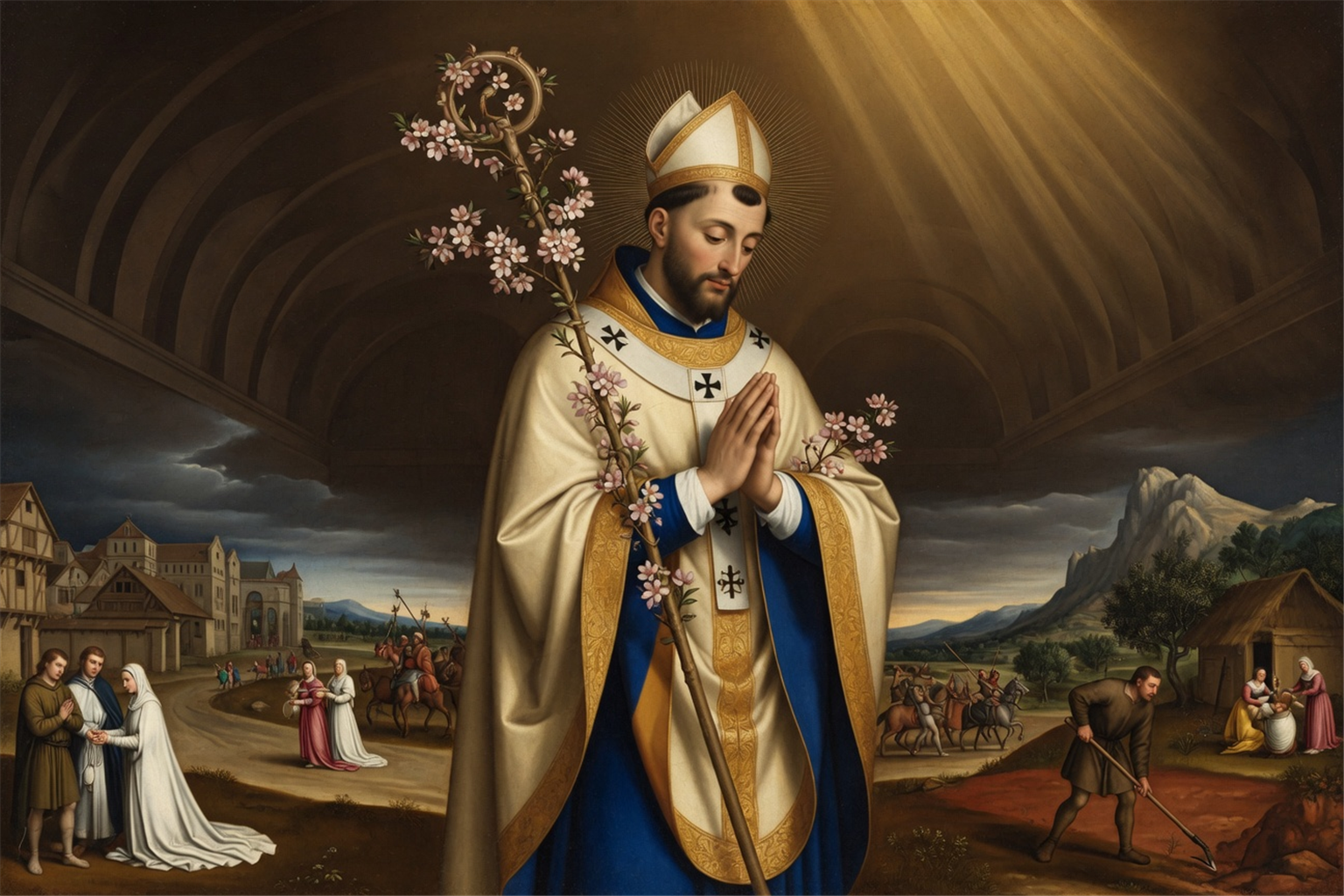
Born in Reims, Paul first lived as a humble plowman near Saint-Remy after fleeing barbarian invasions with his wife, with whom he maintained virginity. Elected Bishop of Trois-Châteaux by a miracle of his rod which flowered instantly, he governed his diocese with holiness for forty years. He is famous for having confounded a dishonest creditor by making his predecessor speak from his tomb.
Guided reading
6 reading sections
SAINT PAUL, BISHOP OF TROIS-CHÂTEAUX
Origins and hidden life
Born in Reims, Paul led a pious youth and entered into a chaste marriage before fleeing the barbarian invasions toward the south of France.
Died at the beginning of the 5th century.
Filles qui non habuit animi sui tristitium. Happy is he who is not sad in his soul. Eccl., XIV, 2.
Born in Reims, in Champagne, to Christian and God-fearing parents, P aul Paul Bishop of Saint-Paul-Trois-Châteaux in the 5th century, formerly a plowman. gave early signs of his future holiness. He never gave himself entirely to the amusements of his age; he was humble and obedient; he relieved the misery of the poor "according to his small power"; he carefully avoided the company of libertines, and, like Job, he renewed each day the pact he had made with his eyes, to look at nothing that could ignite his passions. Married at the age of eighteen to a noble girl, "this chaste Joseph made his spouse consent to live with him in an entire and perpetual virginity." An irruption of barbarians having cast terror into their country, "our two young doves, to avoid the cruelty of these vultures," took flight, and formed the plan to withdraw into some solitude. They arrived in Lyon, under the guidance of Providence, embarked on the Rhône, with their mother who had followed them, and headed toward the city of Arles. Finding no place there sufficiently deserted, they withdrew to a mountain near Saint-Remy, where one can still see today a church that bears the name of o Saint-Remy Place of retreat and work for Paul before his election. ur saint Paul.
The Episcopal Election
Living as a simple laborer near Saint-Remy, Paul is designated Bishop of Trois-Châteaux by a miracle involving the blossoming of his wooden staff.
It was there that Paul lived "unknown to men, known only to God and His angels." To earn his living, as well as that of his wife and mother, he was obliged to cultivate a field as a hired servant. He thought he would bury his life in this obscure retreat, but God had disposed otherwise. One day, as he was driving his plow at the foot of the mountain, a group of envoys approached him in the name of the city of Troi s-Châteaux, wh Trois-Châteaux Episcopal see of the saint. ere several pious people had known of his virtues through revelation. They asked him his name. "My name is Paul," he replied with simplicity. — "Then you are the one we are looking for. — And why do you seek me? — To inform you that the people and the clergy of our church have chosen you as their bishop. — Me! For their bishop? Go, my friends, go; I am not the Paul you are looking for. Do you not see that I am but a poor laborer? — We know what you are, but we also know that God destines you to become our chief pastor. It is you whom we desire: we want no other." Paul could not believe his ears: like Abdolonymus, surprised in his garden, which he was weeding near Sidon, by the envoys of Parmenion, who offered him a crown and a throne in the name of Alexander. Smiling at the alleged mistake of the envoys, he took the dry and arid staff he used to drive his oxen, and cried out as he thrust it into the earth: "Do you see this staff? When it produces leaves and flowers, I will believe you, I will accept the offer you make me." God took him at his word; instantly the staff was covered with greenery and flowers. This miracle filled the envoys with joy, and Paul with astonishment, who adored the divine will, and, struck with awe, accepted out of obedience what he had refused out of humility.
Ministry and Public Life
Consecrated bishop, he participated in the Council of Valence in 374 and distinguished himself by his charity and doctrinal authority.
Informed of the event, his virtuous wife blessed the Lord and retired to a monastery in Arles, where she died in the odor of sanctity. As for him, he was received as if in triumph in the city of Trois-Châteaux. He allowed himself, trembling, to be consecrated priest and bishop. He spent the following night in prayer and tears to obtain from God the remission of his sins, and an angel came to announce to him that they were forgiven. This holy bishop did immense good for his people through his instructions, and above all by his examples of modesty, faith, and charity. He took part in the Council of concile de Valence (374) Council held in 374 in which Paul participated. Valence (374), which restored ecclesiastical discipline in that province. One reads his name among the other Fathers of the council, at the end of the canons they drew up there, and of the synodal letter they wrote to the clergy of Fréjus Accepte Bishop-elect of Fréjus mentioned in the acts of the council. , regarding Accepte, the bishop-elect of that city.
The testimony from beyond the grave
Paul confounds a dishonest creditor by making his predecessor Torquatus speak from his sepulcher.
Upon his return from this council, he confounded with a striking miracle the deceit of a Jew who claimed from him a sum of money lent, he said, to Torqua Torquat Predecessor of Paul on the see of Saint-Paul-Trois-Châteaux. tus, our Saint's predecessor, and not repaid. To discover the truth, he began to pray, and, full of that faith of which one need only a grain to move mountains, he approached the tomb of Saint Torquatus, vested in his pontifical robes, touched it with his pastoral staff, and commanded him, in the name of God, to say whether he had paid the Jew or not: a voice answered from the depths of the sepulcher that the Jew had been paid. Everyone cried out at the miracle, and it was possible to distinguish perfidy from loyalty.
Death and liturgical heritage
After forty years of episcopate, he died in the 5th century; his cult remains alive through the aiguillado procession.
This holy bishop governed his church for nearly forty years, and died at the beginning of the 5th century. His holy relics have disappeared, taken away, some say in 1535, by the Count of Lamarche, others in 1561, by the Huguenots. It was at the same period, probably, that the miraculous rod which had blossomed at the election of Saint Paul and which was religiously preserved at Saint-Remy disappeared.
Saint Paul is the patron of the church and the former diocese of Trois-Châteaux. In this city, every year, on February 4th, the day of our Saint's feast, a rod, called in this country aiguillado, surrounded by ribbons, greenery, and almond blossoms, or any other flowers w hen those aiguillado A miraculously flowering rod, carried in procession. are lacking, is carried solemnly in the procession, in memory of the miracle that we have recounted.
Sources
The account is based on the work of Abbé Nadal concerning the history of Valence.
For this life, we have followed and sometimes reproduced the Hagiological History of Valence, by M. l 'abbé Nadal. l'abbé Nadal Author of the biography of the diocese of Valençais.
Annexes & related entities
Structured data for exploration: events, miracles, quotes, places, attributes, patronages, and important entities cited in the text.
Key Events
- Marriage at 18 and vow of perpetual virginity
- Fled from the barbarians towards Arles and Saint-Remy
- Life as a plowman at the foot of a mountain
- Miracle of the flowering rod confirming his episcopal election
- Participation in the Council of Valence in 374
- Miracle at the tomb of Saint Torquatus against the deceit of a Jew
- Governed his church for nearly forty years
Miracles
- Instant blooming of a dry rod stuck into the ground
- Voice emerging from the tomb of Saint Torquatus to testify to a repayment
- Apparition of an angel announcing the forgiveness of his sins
Quotes
-
Do you see this rod? When it produces leaves and flowers, I will believe you, I will accept the offer you make me
Tradition reported by Abbé Nadal