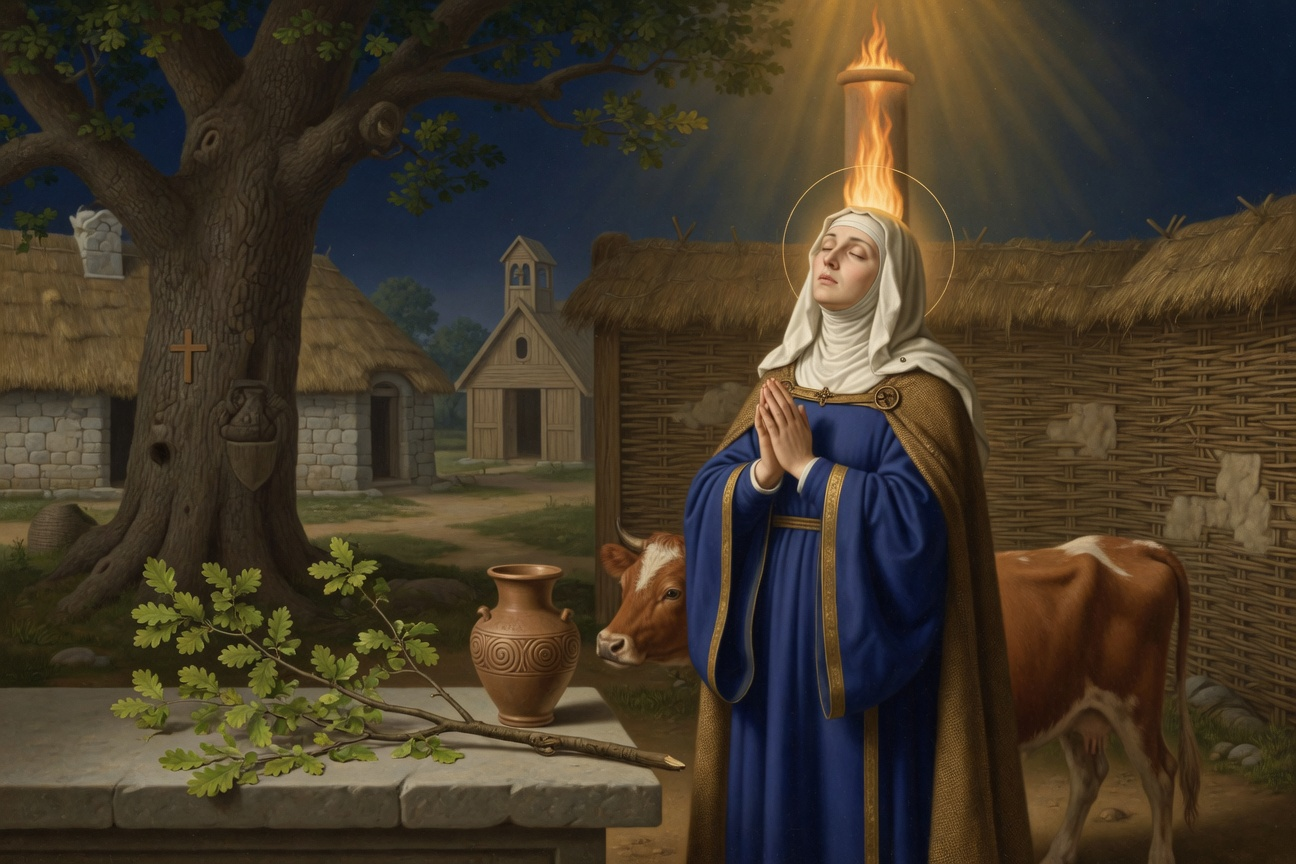
Saint Brigid, nicknamed the Thaumaturge, is the patron saint of Ireland along with Saint Patrick. Founder of the monastery of Kildare in the 6th century, she is famous for her many miracles, her charity towards the poor, and her defense of virginity. She died in 523 after dedicating her life to the expansion of monastic life in Ireland.
Guided reading
8 reading sections
SAINT BRIGID, NICKNAMED THE THAUMATURGE,
VIRGIN IN IRELAND
Origins and youth
Brigid was born in Ireland from an illegitimate union between the lord Dubthach and a slave, before being raised in the Christian faith.
It belongs only to God, says Job, to make pure vessels from an impure material. It is He alone who can cause, when it pleases Him, thorns to produce grapes and thistles to bear figs; and it is He alone who, by rising above nature and common rules, can give a bad tree the strength to sometimes bear good fruit. I say this regarding Saint Brigid, whose virginity Our Lord knew how to preserve enti rely pure, alth sainte Brigitte Irish saint of the 6th century, founder of the monastery of Kildare. ough she was born in the infamies and impurities of her father's adultery with a slave. This infidelity of Dubthach (for that is what this Irish lord was called) so deeply touched t he hear Duptace Irish lord and father of Saint Brigid. t of his legitimate wife that, imitating the ancient Sarah, the mother of all believers, she gave her husband no rest until he had cast out this servant, even though two holy prelates had assured him that she carried a Saint in her womb.
Indeed, the banished slave gave birth to a daughter who was named Brigid at baptism, which her father took care to have administered to her to make her an adopted daughter of Jesus Christ. She was entrusted to a Christian woman who took care to raise her in the fear of God and the love of virginity. Some time later, Dubthach, seeing that his daughter was advancing in age and wisdom, had her come to his house, where she made herself very lovable through the rare virtues with which her soul was filled and which she manifested outwardly. She was humble, peaceful, and obedient; and above all, it seemed that compassion for the poor had come out with her from her mother's womb, because she used all sorts of inventions to do them good.
Vocation and Renunciation
To preserve her consecrated virginity, Brigid obtains through prayer a physical deformity that drives away her suitors.
These admirable virtues were enhanced by a perfectly regular beauty that easily captivated the hearts of all who looked upon her; this is why she was sought after by various parties. But Brigid, who had already consecrated herself by vow to Jesus Christ, the Spouse of virgins, noticing that this eagerness shown to marry her proceeded from nothing other than herself and that rare beauty which shone upon her face, prayed to Our Lord to make her so ugly that no one would think of her anymore. Her prayer was answered, and, through the loss of an eye, the holy maiden remained so deformed that there was no longer anyone who spoke of marrying her: which obliged her father to allow her to enter a monastery and become a nun as she had desired.
Religious Profession
During her taking of the veil by Bishop Mel, miraculous signs confirm her holiness and her beauty is restored to her.
Her entry into religious life was made remarkable by three signal favors she received from heaven: Bishop Malchille, or Mel, a former disciple of Saint Patric saint Patrice Evangelizer of Ireland and spiritual master of Guigner. k, apostle of Ireland, who gave her the veil, perceived a column of fire above her head; when Brigid bowed her head to kiss the footstool of the altar, the wood, though dry and already old, turned green again at her touch; finally, at the same instant, her eye was healed, and her face regained its former beauty, to which Our Lord added a new radiance, not wishing that she who had desired for His love to lose the beauty of her body, in order to preserve the purity of her soul, should remain with the slightest bodily deformity.
Foundation of Kildare
Brigid founded the monastery of Kildare (Kill-Dara), which became the center of a vast monastic network and an episcopal city.
Three young girls, friends of hers, had followed Brigid into retreat. They built cells for themselves in a large oak tree, which were later called Kill-Dara or Cells of Kill-Dara Site of the foundation of Brigid's principal monastery. the Oak, 8 leagues from Dublin, and they adopted a costume different from that of the other nuns in the country. It was like a holy nursery that gave birth to a great number of monasteries in Ireland, all of which recognize Saint Brigid as their mother and founder. The reputation of her holiness and her miracles made Kildare so famous and so frequented that the large number of buildings constructed, even during her lifetime, around the monastery formed a town there that later became significant enough for the metropolitan see of the province to be transferred there.
The supervision she had to exercise over a large number of religious houses obliged her to make frequent journeys, which occupied a great part of her life and were always of such great utility that one can say that each of her steps was marked by the foundation of some new monastery.
Cycle of Miracles
The saint performed numerous wonders: healings of lepers, the blind, and the mute, and protection against slander.
This pious virgin had received from God the gift of miracles to a high degree, and she performed so many that Cardinal Baron ius writes that h cardinal Baronius Church historian who inserted the saint into the Roman Martyrology. e read at the monastery of Saint Cecilia, beyond the Tiber, in Rome, an old manuscript that contained twenty-four chapters of them. We shall report only two or three that will allow one to judge the others.
Two lepers appealed to the Saint to be healed. She prayed to God for them, and, making the sign of the cross over a little water, she commanded them to wash one another: the first, after having been washed, feeling himself healed, was so delighted with his health that, for fear of losing it, he would never render the same service to his companion. But, in punishment for his ingratitude, he saw himself immediately covered with the same leprosy, and his companion was perfectly healed by the sole prayer of Saint Brigid, who seemed to hold in her hands the keys of health and sickness.
A blind girl, named Darie, prayed to the Saint to bestow a blessing upon her eyes, and by this means she recovered her sight; but being subsequently enlightened by a higher light, and recognizing that all that is seen by the eyes of the body is but an encumbrance to the soul, she returned to her benefactress to pray that she restore her former blindness; and instantly her eyes, which had been opened at the supplication of Saint Brigid, closed again at her prayer.
Another girl, twelve years of age, who was mute from birth, was brought by her mother to Saint Brigid. The Saint took her by the hand and asked her if she would not like, for the love of Jesus Christ, to keep perpetual virginity: and as the mother represented to her the inability of her daughter to speak, the Saint replied to her: "Nevertheless, I shall not let her go until she has answered me." Then the mute girl, loosening her tongue, promised her to remain a virgin all her life with the grace of God; and, from then on, the use of speech remained always free to her.
A wicked woman, having given birth to a boy, said loudly to excuse her crime that she had had him by the bishop called Broon, who was a holy man, also a disciple of Saint Patrick. This slander was reported to Saint Brigid, and the miserable woman brazenly maintained her lie in her presence and that of the same Saint Patrick; but the Saint, making the sign of the cross on the mouth of this infamous woman, caused her tongue to swell in such a way that she could not speak; and, doing the same on the tongue of the child, she loosened it, and he said distinctly, after Saint Brigid had commanded him to do so, that the bishop was not his father, but rather a poor man of the common people. Thus the truth was discovered, the honor of the bishop preserved, and glory rendered to God, protector of innocence.
She performed many other wonders by the sign of the cross. It was by this means that she drove demons from human bodies, and that she restrained persons whom she saw in danger of being lost. A surprising thing is told on this subject: the daughter of a gentleman having secretly stolen away from her father's house on the very day of her wedding, to take refuge in the monastery of Brigid, this father mounted his horse, followed by a good escort, to take his daughter away by force; but the Saint, having perceived him, made the sign of the cross on the ground, and instantly the men and the horses became immobile like statues, until the father, recognizing his fault, permitted his daughter to execute her vow and to remain in religion.
Death and burial
Brigid died in 523 and was buried in Kildare, before her remains underwent multiple translations.
The little that we have just said is sufficient, it seems to us, to show clearly what the merits of this great Saint are. The time of her reward having arrived, after having happily finished her course, she had a revelation of the day of her passing, of which she gave notice to a good girl whom she had raised in the fear and love of God, marking for her the day that she would depart from this life, to go and enjoy the chaste embraces of her Spouse in heaven.
She died, according to the most probable opinion, in her first monastery in Ireland, on a Wednesday, February 1st, 523.
History of the relics
Her relics, moved to Down Patrick and then dispersed under Henry VIII, are found partially in Lisbon and Cologne.
Her body was buried in Kildare where the nuns, to honor her memory, instituted a perpetual sacred fire called Saint Brigid's fire: which caused the monastery to be given the name House of the Fire. They maintained it there until 1220, at which time the Archbishop of Dublin had it extinguished. The body of the Saint had been removed from there as early as the 9th century, because of the incursions of the Danes , and transp Down Patrick Place where the saint's body was transferred in the 9th century. orted to Down Patrick. The memory of Saint Brigid was not lost in Kildare, although in less than a century, from 835 to 924, the town and the monastery had been sacked five times; but at Down it was forgotten: it took a revelation from God made to Bishop Malachy for the body of Saint Brigid to be found. It was the year 1186: it was discovered deposited with those of Saint Patri ck and Saint saint Colomb Eponymous founder of the island of Iona. Columba in a triple vault, from where it was transferred to the cathedral of the same city. The impi ous Grey, Henri VIII King of England during whose reign miracles at the tomb ceased. under Henry VIII, destroyed the church that contained these relics and scattered them to the wind. The head of Saint Brigid was in Neustadt, in Austria, and was able to escape profanation. It was kept there in the chapel of the imperial castle, until the year 1587 when Rudolf II presented it to the Spanish ambassador, John of Borgia: the latter in turn enriched the Jesuit churc h of Lis Lisbonne Port of departure for missions to the Orient. bon with it. The city of Cologne, which has a parish placed under the patronage of this Saint, boasts of also having some of her relics.
Legacy and Iconography
Patron saint of Ireland, she is traditionally depicted with a cow or near an altar, symbolizing her charity and fervor.
The feast of Saint Brigid has always been celebrated on February 4th, the day of her entry into heaven. It is commonly believed that this was a Wednesday, which can only correspond to the years 506, 517, 523, and 534 for the beginning of the 5th century. The cult of Saint Brigid was once very widespread, not only in Ireland where she holds the first rank among female saints after the Blessed Virgin, but also in Flanders, Germany, and part of France. Her feast was observed throughout the West in the 9th century. Ireland regards her as its patroness, just as Saint Patrick is its patron.
"Wherever Irish monks have penetrated, from Cologne to Seville, churches have risen in her honor, and wherever British emigration spreads today, the name of Brigid marks the woman of Irish race. Eighteen parishes in Ireland still bear the name of Saint Brigid. Deprived by persecution and poverty of the means to build stone monuments, they testify to their unwavering devotion to this dear memory by giving her name to their daughters. A noble and touching tribute from a race always unfortunate and always faithful, which was, like her, enslaved and, like her, Catholic."
There are no vestiges of Saint Brigid's passage on earth, except for a round tower and the ruins of a church said to date from the 6th century. The congregation of sisters or nuns that she founded has disappeared.
All her relics are probably lost.
In her office printed in Paris in 1620, the hymn for First Vespers says: "To testify to her slandered virtue, the dry wood of the altar suddenly turned green at the touch of her virginal hand." It is added that a small branch sprouted from it. She is therefore depicted with her hand on the altar or kneeling on the footstool.
She is also painted kneeling and holding a wide-mouthed vessel; near her is a cow. This attribute alludes to several traits of her life. We shall, however, choose only one circumstance and refer to Surius, under February 4th, for the others where the cow plays some role. Saint Brigid, having become famous for her virtues, one day received a visit from several bishops, but she had nothing with which to entertain them. She commended herse lf to God SAINT SOUR Hermit and founding abbot of Terrasson in the 6th century. and thought to milk the only cow she had three times in the same day: her trust was rewarded, and she drew as much milk as three good dairy cows could have given.
In the parish of Hamay, between Huy and Liège, in Belgium, pilgrimages are made in honor of Saint Brigid for cows. Near Fosses, in the diocese of Namur, peasant women have sticks blessed on February 1st, with which they touch sick cows to heal them.
Annexes & related entities
Structured data for exploration: events, miracles, quotes, places, attributes, patronages, and important entities cited in the text.
Key Events
- Born from an adulterous affair between Duptace and a slave
- Baptism and Christian education
- Vow of virginity and prayer to lose her beauty (loss of an eye)
- Taking of the veil by Bishop Mel
- Miraculous healing of her eye during her profession
- Foundation of the monastery of Kildare (Kill-Dara)
- Travels for the foundation of numerous monasteries in Ireland
Miracles
- The dry wood of the altar turned green again at her touch
- Healing of two lepers with water signed with the cross
- Restoration and removal of sight at the request of Darius
- Healing of a woman mute from birth
- Speech granted to an infant to exonerate Bishop Broon
- Immobilization of men and horses
- Miraculous milking of a cow producing the milk of three animals
Quotes
-
However, I will not let her go until she has answered me
Saint Brigid to the mother of the mute girl