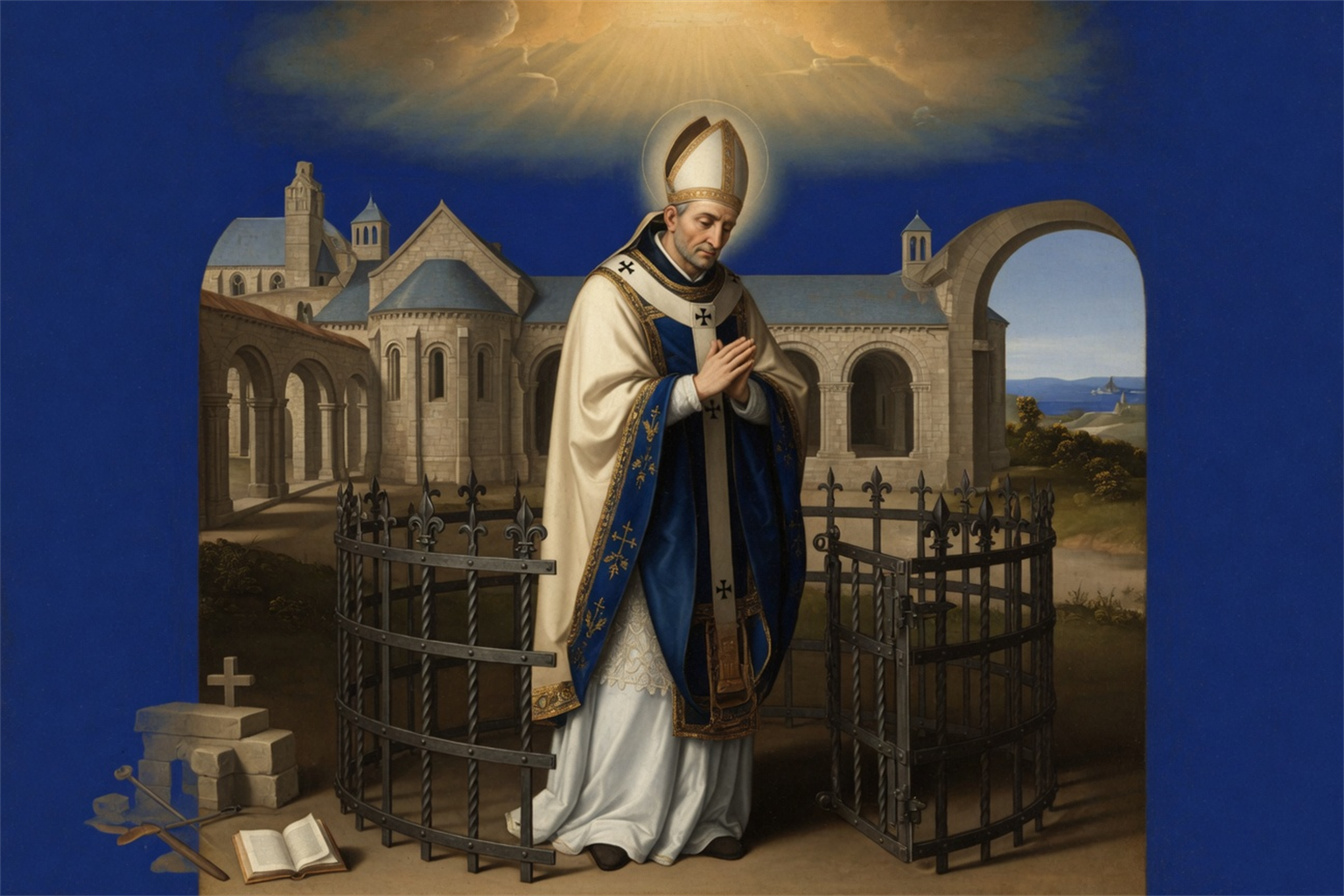
A Cistercian monk trained by Saint Bernard, Jean became abbot of Busay and then bishop of Aleth in 1140. He is the historical founder of the city of Saint-Malo, where he transferred his episcopal see. A great reformer and builder of monasteries, he died in 1170 after thirty years of an episcopate marked by his holiness.
Guided reading
5 reading sections
SAINT JEAN DE LA GRILLE (1170).
Origins and monastic vocation
John was born in Brittany in 1098 and joined the Cistercian Order under the guidance of Saint Bernard in 1121.
The blessed John, surnamed 'of the Grille' because of an iron grille that surrounds his sepulcher, was a Breton, born of parents of modest condition. He was born in the year of our salvation 1098, under the pontificate of Paschal II and the reign of Alan IV, sovereign Duke of Brittany. He studied letters and sciences in his youth and made great progress in them. His studies completed, he resolved to leave the world and become a religious of the Order of Cîteaux, which was then flourishing in holiness and attracting the gaze of all Christendom. He therefore went to find the glorious patriarch Saint Bernar saint Bernard Contemporary and admirer of Guigo. d, who, after testing his perseverance, gave him the habit of his Order in the year 1121. He completed his novitiate and made his profession under the direction of Saint Bernard himself.
Foundations and abbacy
At the request of the Breton nobility and Saint Bernard, John founded the abbeys of Bégard and Busay before becoming Bishop of Aleth.
Around that time, the Count of Penthièvre, Stephen III, and Havoise, Countess of Guingamp, his wife, desiring to found a monastery of the Order of Cîteaux on their lands, begged Saint B ernard to sen saint Bernard Contemporary and admirer of Guigo. d them religious. Saint Bernard sent them John, who founded the monastery of Bégard, three leagues from Guingamp, in the diocese of Tréguier, in the year 1130. He likewise founded, at the request of Ermengarde of Anjou, widow of Duke Alan IV, and by the orders of Saint Bernard, the monastery of Busay (June 16, 1139), of which he was named abbot. While he was abbot of Busay, he received several letters from Saint Bernard, notably the one which is the 236th in the works of this great Saint. Having governed this monastery for fourteen years, an d the Aleth Former episcopal see located near the present-day Saint-Malo. 36th Bishop of Aleth, in Brittany, named Benedict, having died, John was elected in his place, to the great displeasure of his religious, and was consecrated in the year 1140.
Transfer of the See to Saint-Malo
In 1141, John transferred the episcopal see from Aleth to the island of Aaron, thus founding the city of Saint-Malo.
As early as the year 1141, seeing that the island of Aaron was beginning to become populated and to expand, he transferred the see of his bishopric there, abandoning the ancient city of Aleth, today Quidaleth, and he named Saint-Malo City in Brittany where some of the relics are kept. the new city Saint-Malo. Saint-Malo immediately obtained from Duke Conan all the privileges of the city of Aleth, and others still which were granted to it at the prayer of the holy prelate.
Diplomatic missions and reforms
John defends his rights in Rome, reforms the monastery of Saint-Méen, and participates in the reorganization of Sainte-Geneviève in Paris.
At the request of the same Count Étienne of Penthièvre and his wife, he also founded the monastery of Sainte-Croix-de-Guingamp, and placed there regular canons of Saint Augustine. The monks of Marmoutier-les-Tours having brought a lawsuit against him regarding the abbey church of Saint-Malo, which he had chosen for his cathedral, this matter obliged him to undertake two journeys to Rome; the sovereign pontiffs Eugene III and Adrian IV gave him a favorable verdict each time, and confirmed him in the possession of his church. In addition to the works we have just reported, he also received from Pope Lucius the difficult commission of bringing the monastery of Saint-Méen-de-Gaël back to the strict observance of the Rule of Saint Benedict, and he accomplished this with full success. He also had the church of Sainte-Geneviève, formerly founded by King Clovis in honor of the apostles Peter and Paul, given to the regular canons of Saint-Victor-de-Paris. The Pope entrusted this matter to Suger, Abbot of Saint-Denis. He procured the foundation of the monastery of Saint-Jacques-de-Montfort in his diocese; he placed there again regular canons of Saint Augustine, and, in 1156, he blessed its high altar. Finally, having lived in great holiness and governed his church for the space of thirty years, laden with years, but even more so with merits, he rendered his spirit to God on the first d ay of Léon X Pope who authorized the office of Saint Ozanne. February, in the year of grace 1170. Leo X ordered that his feast be celebrated on that same day with a solemn office (1517).
Death and liturgical recognition
Jean died in 1170 after thirty years of episcopacy; his cult was officially recognized by Pope Leo X in 1517.
Taken from the Lives of the Saints of Brittany-Armorica, by Albert le Grand, of Morvath.
Annexes & related entities
Structured data for exploration: events, miracles, quotes, places, attributes, patronages, and important entities cited in the text.
Key Events
- Born in Brittany in 1098
- Entered the Cistercian Order under Saint Bernard in 1121
- Foundation of the Bégard monastery in 1130
- Appointed Abbot of Busay in 1139
- Election as Bishop of Aleth in 1140
- Transfer of the episcopal see to the island of Aaron (Saint-Malo) in 1141
- Travels to Rome to defend his cathedral before Eugene III and Adrian IV
- Reform of the monastery of Saint-Méen-de-Gaël
- Death in 1170 after 30 years of episcopate