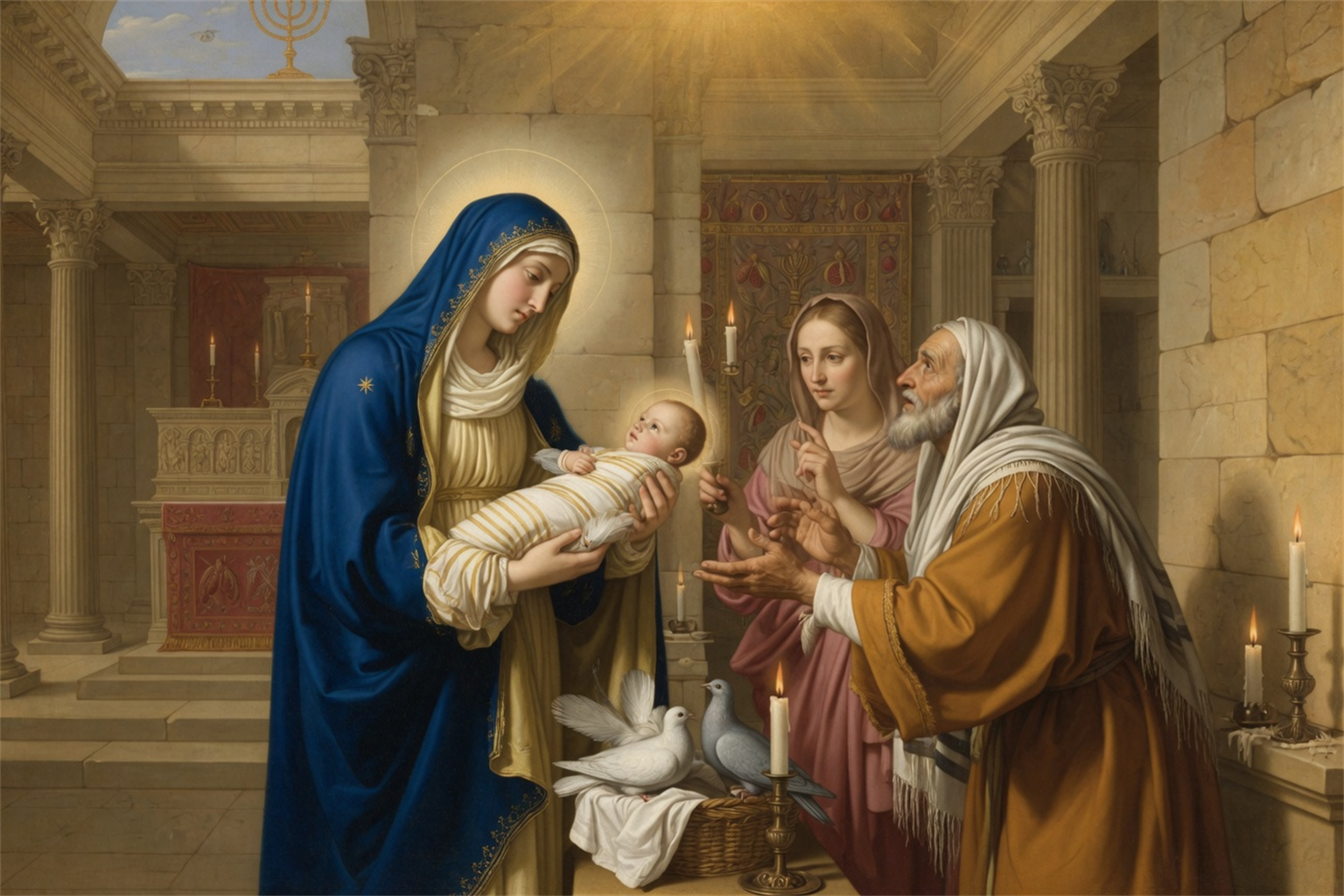
Forty days after the birth of Jesus, the Virgin Mary submitted in humility to the Law of Moses by presenting herself at the Temple in Jerusalem. There, she offered her son to the Lord and met the elder Simeon and the prophetess Anna. This feast, known as Candlemas, celebrates the presentation of the Light of the world.
Guided reading
7 reading sections
THE PURIFICATION OF THE BLESSED VIRGIN
The foundations of the Mosaic Law
Explanation of the two laws of Moses: the purification of women after childbirth after forty days and the redemption of the firstborn males.
For the understanding of the adorable mysteries that the holy Church reveres on this day, it is necessary to remember two laws that God gave to His people through Moses, and which the evangelist Saint Luke did not fail to mention in his Gospel. The first of these laws is set forth in Leviticus, chapter 12: it is said there that a woman who ha s brought a child into the world, whethe la femme qui aura mis un enfant au monde Mother of Jesus, who appeared to Bertrand. r boy or girl, shall remain for a certain time separated from the company of others as an unclean person; she is forbidden to touch anything holy, or to enter the Temple until the days le Temple Sacred place where the rites of purification and presentation are performed. of purification are accomplished, which are forty days for a male child, and eighty for a girl: this time having expired, she must present herself to a priest, to whom she shall offer for her child a lamb of one year as a holocaust, with a young pigeon or a turtledove; or if, due to her poverty, she cannot offer a lamb, she shall give two turtledoves or two young pigeons.
The second law is written in Exodus, chapter 13; according to this law, God willed that all the firstborn of men and animals be offered to Him; and because God never took pleasure in the blood of men, because His Son was to shed all of His for them, He permitted that the firstborn of men be redeemed for a certain price, which was five shekels for a son, and three for a daughter. According to the terms of these laws, the Blessed Virgin and her divine Son were exempt, it is true, from these legal observances and ceremonies; for the Mother had not conceived by the action of creatures, but by the operation of the Holy Spirit, and her Son was not born according to the ordinary laws of nature, but He had left His mother perfectly virgin after His glorious birth; however, in order to fulfill all justice, and to give us the example of a profound humility and a perfect obedience, this holy Mother and this adorable Son underwent the rigor of these laws for the reasons that we shall state hereafter. This is what was done today, as the text of the Gospel of Saint Luke teaches us, the terms of which are approximately as follows:
The Presentation in the Temple
Mary and Joseph present the Child Jesus at the Temple of Jerusalem, where they meet the elder Simeon.
« The days of the Purification of Mary being accomplished according to the laws of Moses, they carried the child to the Temple to offer him to the Lord, according to what is written in the law: « Every firstborn male child shall be consecrated to the Lord », and to give the price of his redemption, which was according to the text of the same law, a pair of turtledoves or two young pigeons. Now, there was then in Jerus alem a Siméon Righteous man of Jerusalem who received the promise that he would see the Christ before his death. man called Simeon, who was just and fearing God, and waiting for the consolation of Israel; the Holy Spirit, who resided in him, had revealed to him that he would not die without having first seen the Christ of the Lord. He came therefore to the Temple by a divine inspiration, and when the child Jesus was presented by his parents for the fulfillment of the law, he received him into his arms, and blessed God saying: « It is now, Lord, that you will allow your servant to die in peace, according to the word that you have given him, because my eyes have seen your salvation, that which you have prepared in the sight of all nations, to be the light of the Gentiles and the glory of your people Israel ». » Such is in substance the mystery, or rather the mysteries that were
accomplished on this day, and for which the holy Church has established this feast with such solemnity. She has given it several names to signify the various wonders that took place there; let us make some reflections in order to gather the fruits that are attached to it.
Simeon and Anna the Prophetess
A portrait of Simeon, who recognizes the Messiah, and of Anna, a pious widow who announces the redemption of Israel.
The ancients called this solemnity the Feast of Simeon and Anna: of Simeon, because this vene rable old man appea vénérable vieillard Righteous man of Jerusalem who received the promise that he would see the Christ before his death. red there with such majesty, and because he is so highly praised on this occasion in the Gospel as a man fearing God, who was waiting with assurance for the redemption of Israel, who possessed in his heart the Treasure of treasures, namely: the Holy Spirit, and who received from Him, at that moment, the fulfillment of the promise He had made to him long before, not to depart from this mortal life without having had the happiness of seeing with his own eyes the author of immortal life and the Christ of the Lord. But, not only did he see and recognize at his leisure the face of Him whom all the angels admire, but he even embraced and kissed Him a thousand and a thousand times with a tenderness and sweetness that one can rather imagine than express; and, besides these favors, he also performed the office of prophet in this encounter: for, when he received the adorable Jesus into his arms, whom his mother presented to him, he not only penetrated with the eyes of the spirit and recognized the divine Person who was hidden under the limbs of a child, but he also foresaw all that was to happen to Him, and he predicted it to His mother with these words: "This child is destined for the fall and the rising of many in Israel, and to be a sign that will be opposed, and a sword will pierce your own soul too, so that the thoughts of many hearts may be revealed."
It is also said to be the Feast of Anna, bec ause Anne 84-year-old widow present at the Temple during the Presentation. a good widow who bore this name, and who, after having lived seven years with her husband, had spent her life, up to the age of eighty-four, in holy widowhood, also happened, by a marvelous providence, to be in the Temple with the old man Simeon, when Joseph and Mary presented Jesus Christ Joseph Protector of his life and author of his vocation. there. And, as this good old woman could not contain her joy, she began to speak wonders of this same Child to all those she knew to have piety and love for God in their hearts. This is what the Evangelist means by these other terms: "She was waiting for the redemption of Israel."
The Hypapante or the Encounter
Analysis of the Greek name of the feast signifying the encounter between the Law and Grace, and the mystical union between Simeon and Jesus.
The Greeks call this feast Hypa pante, th Hypopantè Greek term meaning 'Meeting', designating the feast in the East. at is to say, encounter, to express that Saint Simeon and Saint Anne met happily on this holy day; which the Church seems to wish to signify in the divine office, by these words which she uses at the invitation of Matins: "Behold, the Lord the Ruler comes into his holy Temple; rejoice, O Sion, and leap for joy, going out to meet your God." Indeed, I note that there took place on this day, not one, but several very happy encounters; first, Joseph and Mary met with Simeon and Anne, in the Temple, having the child Jesus in their midst, and each carrying him in turn. Furthermore, grace and the law were found to concur in this divine mystery; the law having been observed there in all its rigor, and grace having been poured out there abundantly. For a third encounter, one saw there tears mingled with joy, and apprehensions with transports of gladness, through the various predictions of the holy old man to the most holy Virgin, who kept them in her heart for the rest of her life, and shared them with the whole Church through the pen of Saint Luke, faithful writer of these wonders.
Finally, as for Saint Simeon in particular, he has today a union full of consolation with the Child Jesus; for, if this holy old man carries
Jesus the child, Jesus, nevertheless, governs the old man: the old man carries the child in his arms, and the child gives strength to the old man, in order to support himself. The old man embraces the Child, and the Child gives the old man embraces of tenderness and affection. The old man sheds tears of joy on the cheeks of the Child, and the Child lets a loving smile wander on his lips which expands the heart of the old man. The old man presses the Child against his breast, as if he wished to enclose him in his heart, in order to have a new life, and the Child leaps into the heart of the old man to give him a life which is not subject to death. Happy, therefore, the encounter of Simeon and Jesus, of the tears of Simeon with the smiles of Jesus, of the desires of Simeon with the love of Jesus, and finally of the soul of Simeon with the soul of Jesus!
The superiority of the second Temple
The presence of Jesus, Mary, and Joseph confers upon the second Temple a glory superior to that of Solomon's Temple.
This great feast is also called the Presentation of Jesus in the Temple; which is drawn quite evidently from the text of the Gospel, where it is said: "And his parents brought him to Jerusalem to present him to the Lord." And it was then that, according to the prophecy of Hagga i, this Temple which the Jews had Temple que les Juifs avaient bâti Sacred place where the rites of purification and presentation are performed. built since their return from the Babylonian captivity, received incomparably more glory than had ever been received by the one that Solomon had raised with such magnificence. While God had been served in the latter only by men subject to sin, most of whom were indeed sinners and criminals, He was served in the former by pure and innocent souls: by Saint Joseph, who was a just man and God-fearing; by the Blessed Virgin Mary, ever pure and all-immaculate; and finally by Jesus Christ Himself, her only Son, who was the High Priest, according to the order of Melchizedek, and a Pontiff such as we could desire: "Holy, innocent, undefiled, separated from sinners, and made higher than the heavens."
Furthermore, the Temple of Jerusalem received on this day more glory than it had yet received since it was built, because of the offering that was presented there: Jesus Christ the firstborn, the only Son of the Blessed Virgin, who offered Him to His eternal Father: a new oblation that will never have another; a singular offering, and the only one that the eternal Father has ever looked upon with favor among all those that have been made to Him since the world emerged from its nothingness; a gift so excellent that all others, however rare and precious they may be, could not please God if they were not accompanied by it. As, on the contrary, there is nothing, however small it may be, even if it were but a drop of cold water, that is not capable of appeasing the wrath of God, provided it be united to this offering of Jesus made by Our Lady. Thus it is properly on this day that the justice of God moderated its rigor, and that it was appeased by the sweet odor of the sacrifice, no longer of the flesh of goats and bulls, but indeed of the immaculate lamb, which was offered to Him by the all-pure hands of Mary. It was then that this eternal God, to execute the covenant He had made long before with His servant Noah, to no longer send a flood of water to destroy the human race, poured out upon men a flood of fire, in order to set their hearts ablaze with His love; for, on this day, the bow of His covenant appears between the arms of His Mother, as in the clouds of heaven, to mark the abundance of His graces. This is what gave the name to this feast of the Presentation of Jesus in the Temple. This is why, in the divine office, whether at Mass or at the canonical hours, all the words are addressed more expressly to Our Lord, as in the feasts instituted in His honor.
The Humility of the Virgin
Although exempt from all stain, Mary submits to the law out of humility, transforming this rite into a new infusion of grace.
Nevertheless, the title of the Purification of the Virgin has remained as proper and particular to this solemnity, which for this reason is placed among her five greatest feasts. We must undoubtedly seek the reason in these first words of the Gospel: 'When the days of Mary's purification were accomplished.' For although there was never anything to purify in this holy Virgin, who has always been pure and without stain, as her divine Spouse declared himself in the Canticle of Canticles, her humility, however, led her to submit to the ceremonies of the Purification; she did not judge that she should exempt herself from the purification of women, after her Son had not refused the circumcision of men; she is not ashamed to appear as a common woman and to be considered impure, since her Son appears in the midst of men as a sinner. But as it is worthy of God to raise up the humble by the very thing that seems to lower them, He inspired the faithful to give the title of Purification to this feast, to draw the greatness of Mary from her own humiliations. I could still say, without offending the immaculate purity of the same Virgin, to verify more expressly these words of the Evangelist: 'The days of Mary's purification accomplished,' that, when she presented her Son Jesus in the Temple, forty days after bringing Him into the world, this very offering served as a perfect purification for her: a purification, nevertheless, that supposes no sin, since it never found entry into the most holy soul of the Virgin; a purification that implies no defect of nature in this august person, whom the eternal Wisdom had taken pleasure in fashioning as the masterpiece of His hands, creator of all things; a purification that removed no legal or bodily impurity from this divine Mother, who was not included in the terms of the law, for she had remained a virgin in body and spirit, and as perfectly pure and immaculate, after having given birth to Jesus Christ, purity itself, as she was before having conceived Him in her chaste womb. Therefore, these words: 'The days of Mary's purification accomplished,' signify nothing other than a new infusion of grace and interior holiness into the soul of the holy Virgin, who was always purifying and sanctifying herself more and more by the reception of new graces merited by all her actions, and more particularly in this oblation of her Son, of whom, in some way, she deprived herself by offering Him to the eternal Father for the redemption of men. What we have said so far suffices, it seems to us, to make understood the different names and the substance of this mystery; it remains for us now to say a word about its institution.
Origins and liturgical traditions
History of the feast renewed by Justinian in 541 and the introduction of the candle procession by Pope Sergius I.
Its establishment is so ancient that we can trace it back to the first centuries of the Church; nevertheless, as Christians had become somewhat lax, and this feast having fallen into oblivion in many places, it was renewed by the piety of the Em peror Justinian the Elder, l'empereur Justinien l'aîné Byzantine emperor under whose reign Simeon began his religious life. in the year 541, under the pontificate of Vigilius, on the occasion of a plague which, having already depopulated almost all of Egypt and spreading through the various provinces of the Roman Empire, seemed to want to reduce all cities to solitudes. The Emperor, fearing this terrible scourge of God, had recourse to the favor of the Immaculate Virgin Mary, and, placing himself under her protection, he ordered, under severe penalties, upon the advice of the Patriarch and the clergy of Constantinople, that the feast of the Purification be celebrated. This Mother of mercy showed that this feast was very pleasing to her, for the contagious disease ceased immediately throughout the city. Baronius believes that Pope Gelasius instituted this solemnity in Rome to abolish the superstitions and debaucheries of the idolaters, which they called Lupercalia and which they celebrated at the beginning of February. But it is much more probable that he only restored it and that it is much older. One may see on this subject Bollandus, in the Acts of the Saints of this month, and the Rev. Fr. Combeils, of the Order of Saint Dominic, in his Library of the Fathers, where he reports a homily on this feast, by Saint Methodius, Bis hop of Tyre, who Le pape Serge Ier Pope who possibly consecrated Wiron and Plechelm. flourished in the 4th century.
Pope Sergius I, as it appears from the Roman Ordo, added the procession with candles, in order to represent more sensibly the mystery that was accomplished on this day in the temple of Jerusalem, when these four persons, Mary, Joseph, Simeon, and Anna, making as it were a procession, each carried in their turn the child Jesus, who was truly the torch that would enlighten the Gentiles, and the light that would dissipate the darkness of the world. It is for this reason that the Church, which is always guided by the Holy Spirit, ordered in this ceremony the carrying of lighted candles in the procession. This was not only observed, writes the Venerable Bede, on this feast of the Purification of Our Lady, but also on all her other solemnities; from which may have come the practice that is still observed today in the processions of the confraternities established in honor of the Blessed Virgin.
This is what we had to say about the substance of this mystery and the establishment of the feast that the Church celebrates on this day. If anyone desires to see a fuller discourse on this matter, in order to maintain their spirit in devotion, they could not find, in our opinion, anything more suitable than what the Rev. Fr. Louis of Granada has written about it, particularly in a meditation he made expressly on this subject in his Additions to the Memorial, in the book of the Love of God; we refer the reader there so as not to detain them further.
As for the venerable Simeon, the Church celebrates his memory on October 8, and that of Saint Anna, the prophetess, on September 4, as can be seen in the Roman Martyrology.
Annexes & related entities
Structured data for exploration: events, miracles, quotes, places, attributes, patronages, and important entities cited in the text.
Key Events
- Birth of Jesus Christ
- Submission to the law of Purification forty days after childbirth
- Presentation of Jesus at the Temple in Jerusalem
- Meeting with Simeon and Anna the prophetess
- Offering of a pair of turtledoves or two young pigeons
Miracles
- Cessation of the plague in Constantinople in 541 after the institution of the feast
Quotes
-
Now, Lord, you may let your servant go in peace... because my eyes have seen your salvation.
Canticle of Simeon (Saint Luke) -
Yea, a sword shall pierce through thy own soul also, that the thoughts of many hearts may be revealed.
Prophecy of Simeon