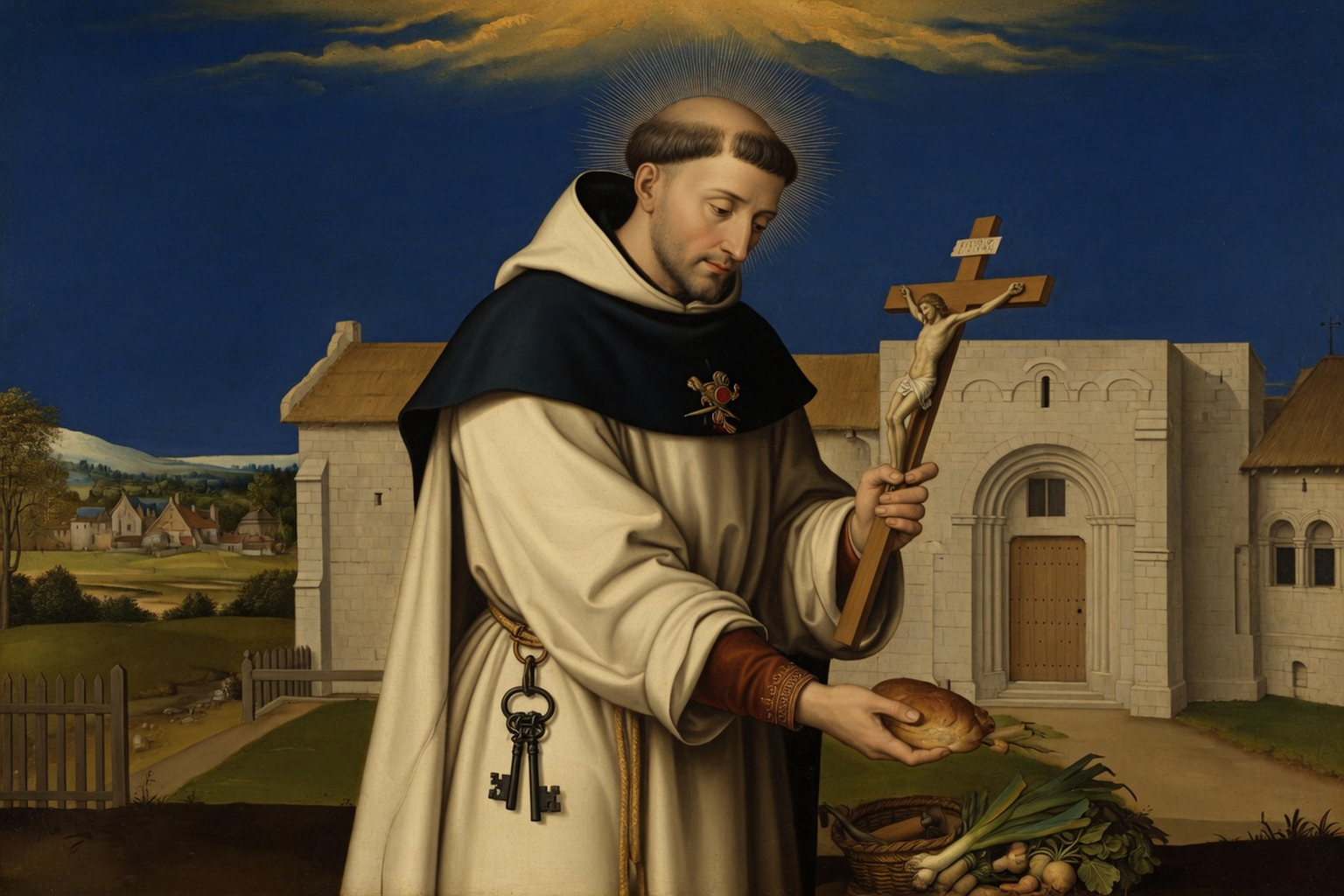
A Carolingian prince and cousin of Charlemagne, Adalard renounced the court to become a monk at Corbie. Despite his desire for obscurity, he became an influential abbot, advisor to kings, and founder of monasteries in Saxony. After an unjust seven-year exile, he died in 826, leaving the image of a learned saint, a humble gardener of God, and a protector of the poor.
Guided reading
8 reading sections
SAINT ADALARD, NINTH ABBOT OF CORBIE
AND CONFESSOR
Illustrious Origins and Conversion
Born around 751 into a princely family linked to the Carolingians, Adalard left Charlemagne's court at the age of twenty to become a gardener monk at Corbie.
751-826. — Popes: Stephen II; Eugene II. — Kings of France: Pepin the Short; Louis the Pious.
In the ground he cultivated, the gardener prince saw the symbol of the soul, which can only produce good fruit through the effort of assiduous labor. He recognized in it the image of the earthly paradise and imagined himself to be the new Adam, subjected by God to the perpetual trial of obedience. (Life of Saint Adalard.)
Two Saints, both learned figures: Saint Paschasius Radbertus, Abbot of Corbie, and Saint Gerald, Abbot of Grand-Sauve in Guyenne, wrote the life of this holy Confessor, and it is from these two sources that we shall draw what we are about to report. They do not distinctly mark the time of his birth, but it is easy to conclude from the sequence of his history that he was born around the year 751, at Huysse, near Oudenaarde, in the current diocese of Ghent. His blood could not have been more illustrious. His father was Bernard, son of Charles Martel, the greatest of our Mayors of the Palace; his uncle was Pepin the Short, first King of France of the second race; and his first cousin was Charlemagne, also King of France and Emperor. The latter brought him to his court and made him Count of the Palace . Altho Adélard Abbot of Corbie and spiritual master of Hildeman. ugh Adalard was still young, he did not fail to fear the corruption of the world. Everything alarmed his conscience. He was especially scandalized that Charlemagne repudiated his wife Hermengarde, daughter of Desiderius, King of the Lombards, to marry Hildegard. After freely expressing his feelings on the matter, he withdrew from the court and became a m onk of Saint Ben abbaye de Corbie Monastery that acquired the relics of Saint Précord. edict at the Abbey of Corbie; he was only twenty years old. The first task he was given was to cultivate the monastery garden, in order to mortify in his heart, through this humble and arduous labor, the inclinations toward pride and softness that he might have inherited from his birth. One cannot believe the abundance of graces he received through the manner in which he performed his duties. All things served as material for him to rise toward God; in the ground he cultivated, he saw the symbol of the soul, which can only produce good fruit through assiduous labor. In a very short time, he acquired a very sublime degree of contemplation, to which his external work posed no obstacle.
Flight to Monte Cassino and return to Corbie
Seeking anonymity at Monte Cassino, he is recalled by Charlemagne and elected abbot of Corbie despite his reluctance.
His status as a prince of the imperial blood caused him to be visited by the greatest in the kingdom; to avoid this importunity, he went to Italy and retired to Monte C mont Cassin Reference monastery for the Benedictine Rule. assino, the head of the entire Order of Saint Benedict. He hoped to be able to hide his birth there and live in obscurity; but an anchorite, having come to ask for hospitality at Monte Cassino, revealed the name and homeland of Adalard; on the other hand, Charlemagne, who keenly felt the loss his State had suffered by the retreat of such a great personage, sent deputies expressly to Monte Cassino to ask for him back and to bring him back to Corbie. It was in vain that Adalard begged the superior of this famous monastery to allow him to flee further away, to some place where he could remain forever unknown; he had to yield to the king's wishes and take, with the deputies, the road to France, where divine Providence destined him for great employments for the service of his Order, the State, and the entire Church. Scarcely had he returned to Corbie when, by the election of the entire monastery, the abbot resigned his office to him. He did everything he could to exempt himself from it: his resistance and his prayers only served to make him judged more worthy of this honor. The great good that this new abbot did, as much by his examples as by his words, filled with a strength, a sweetness, and a grace all celestial, soon showed that this election was an inspiration of divine Providence.
Political Role and the Mission of the Filioque
An advisor to kings, he was sent by the Council of Aachen to Pope Leo III to defend the addition of the Filioque to the Creed.
His devotion was admirable. He was always inwardly recollected, not only in his monastery and in his regular duties, but also during his travels; he maintained silence even while handling the most thorny temporal affairs. When he came to the divine offices, he set aside all thoughts of earthly things so perfectly that he was occupied only with God alone. He possessed the gift of tears to such a high degree that Paschasius asserts he never knew anyone who had such an abundant source. Indeed, they flowed at all times from his eyes, especially during prayer, psalmody, and the hearing of the harmonious chant of the Church. His charity was so extensive that not only his children, but also all the unfortunate had a place in his heart: no one was ever able to complain of having appealed to him in vain; thus he was accustomed to say that it was a mark of avarice to fear giving too much. One day, when the cellarer of the monastery represented to him that the religious were suffering from his profusion, and that what he had given to the poor was necessary for their food, the Saint replied to him, with his ordinary gentleness, that God would provide; and, indeed, provisions were found at the door of the monastery that had been brought there miraculously. His prudence appeared with great brilliance in the wise counsels he gave to Charlemagne and his children, especially to Pepin the Younger, his eldest, King of Italy, of whom he was the prime minister, as well as of his successor and son Bernard; under the reign of the latter, he knew how to appease a violent discord between the cities of Spoleto and Benevento. Adalard was deputed by Charlemagne and by the Council of Aachen, 809, which he had attended, to Pope Leo III, to have approved by the Holy See the addition to the Creed of these two words, filioq pape Léon III Pope who presented the relics of Hippolytus to Charlemagne. ue, intended to express more clearly that the Holy Spirit proceeds at once from the F ather an filioque Theological controversy regarding the procession of the Holy Spirit. d from the Son, as from a single principle.
The Pope conceived such esteem for the probity of our Saint that he never doubted the truth of his words nor the justice of his undertakings, and said to him one day, laughing, that if he were deceived in his person, he could never have confidence in any Frenchman.
The Trial of Exile
Suspected of treason by Louis the Pious after the revolt of Bernard of Italy, he was exiled for seven years on the island of Héro.
But it was not enough that Saint Adalard possessed the first seven beatitudes to an eminent degree; it was necessary that he should also have a share in the eighth, which is to be persecuted for righteousness' sake, so that his virtue might be purified, like gold, in the crucible of tribulation, and that his patience might triumph more gloriously in the midst of storms and afflictions. Pepin, King of Lombardy, had died in 810: he left a son named Bernard, twelve years of age, whom he placed under the guidance of the Saint. A few years later, Bernard, who, as the son of Pepin, the eldest son of Charlemagne (who died in 814), had claims to the imperial crown, took up arms to assert his rights; but he was unfortunate in this war, which cost him both his crown and his life. Louis the Pious, prejudiced Louis le Débonnaire King of the Franks who made Aldric his advisor and commander of the palace. by the poisoned words of certain flatterers, suspected Adalard of having secretly favored the claims of Bernard, his pupil, and condemned him to exile. His entire family, that is to say, two brothers and two sisters whom he had, were included in this unjust decree. Wala, the elder of the two brothers, who was a prince of high standing at court, was relegated to Corbie. Bernaire, the younger, who was a monk there, was exiled to Lérins. Theodrada, one of the sisters, was left in the abbey of Soissons, where she had retired to dedicate her widowhood to God, and Gundrada, the other sister, a very courageous virgin, was sent to that of Poitiers, founded by Saint Radegund; as for the holy abbot, who was the innocent cause of this persecution, the monastery of the island of Héro, in Aquitaine, was assigned as the place of his ba nishment. île d’Héro Place of Adélard's exile in Aquitaine. He departed, not without shedding tears at seeing himself torn from the company of his dear children, but without complaint or murmur, and with a courage that inspired admiration in those who knew how unjust this proceeding against him was.
He remained seven years in exile, with a perfect tranquility of mind and a joy that he could not conceal; it was all the greater because he had finally found, in this solitude, the kind of happiness to which he had long aspired. The abbot of the monastery, far from treating him as an exile or a stranger, always looked upon him as his master, so that the Saint was ashamed of his deference and that of all his monks; thus the only mortification he had on this island was that he did not find there all the hardships that usually accompany exile and disgrace. His satisfaction was so visible that two archbishops one day told the emperor that he had done more for Adalard by sending him to this island than if he had presented him with his crown. He employed all the hours of his leisure, while he stayed there, in conversing continually with God, and in practicing his holy rule; as he was faithful in observing it during his travels, and as he had his hours of prayer and silence on the road just as in the cloister, one can judge that he took advantage of the time of his retreat with incredible care.
Return and foundation of the New Corbie
Recalled in 821, he founded the Abbey of Corvey in Saxony and advocated for rigorous monastic poverty in the face of an abundance of wealth.
At the end of his seven years, in 821, he was recalled; this was a subject of marvelous contentment for his children, and of deep regret for those he was leaving. When he went to see the emperor, he was received with all the testimonies of esteem that his virtue deserved, and this prince showed him so much regret for the injustice he had committed against him, that he was himself obliged to console him. All the exiles were recalled with him: Wala and Gundrade did not wish to leave the religious profession that the occasion of their banishment had led them to embrace. Having resumed the government of his abbey, through the importunity of his brothers, and then that of the State by the absolute will of the prince, he repaired everything that had been done wrong during his exile. He took an active part in the diets of Attigny-sur-Aisne (822) and Compiègne (823). But nevertheless, as if the point of the Rule of Saint Benedict, which exempts the elderly from common austerities because of the weakness of their age, had not been for him, he did not relax in any way the severity of the observance and did not even take the relief that he would have easily granted to the youngest. The credit he had with the Emperor Louis the Pious served him to found in Saxony, near the Weser, a new abbey to which he also gave the name of Corbie, where he establ nouvelle abbaye à laquelle il donna aussi le nom de Corbie Monastery in Saxony, final destination of the relics in 836. ished, with indefatigable zeal, the strict observance of the rule. But when he saw it sufficiently endowed by the liberality of the great of the kingdom, he no longer wanted them to accept the inheritances that were offered to it; he was accustomed to say in this regard, that "the abundance of wealth served to deceive not only the superiors of churches and monasteries, but also individuals, and that it compelled them to engage themselves anew in the world, they who ought to be dead to it; that it was this abundance of temporal goods that obliged the States to extend taxes even to ecclesiastical persons, because, having been too impoverished by their greed, they could no longer subsist without their help." Above all, he forbade his own to ever accept gifts, when they had reason to fear that those who made them might repent of them or that the heirs might be notably inconvenienced by them.
Final moments and funeral
He died in 826 after receiving the last sacraments from Hildeman of Beauvais and was buried in the church of Saint-Pierre in Corbie.
He was so jealous for the perfection of his children that he did not let a week pass without speaking to them individually, nor a day without giving them a general exhortation. This served greatly to make them grow in the love of their state; for it would have been very difficult to confer often with this angel of fire without being set ablaze by him. Finally, the hour of his death, or rather of his reward, having come, he was struck by a violent fever during which he did not pass a single day without hearing Mass or receiving Communion in the oratory of Saint-Martin, to which he had himself carried. Hildeman, Bishop of Beauvais, who had been his disciple, administered the Extreme Unction to him; and Our Lord, not content with having given Himself to him through the sacrament of the Eucharist, wished to show him a sample of the glory he would soon possess by appearing to him in the splendor of His humanity. Then the holy old man pronounced the canticle of Saint Simeon: Nunc dimittis, etc.; and, having remained for some time in deep silence, he finally peacefully rendered his soul at three o'clock in the afternoon, the hour at which Our Lord expired on the cross. This was the second day of January in the year 826, the most probable date. The Bishop of Beauvais buried him with his own hands and performed the ceremony of his funeral. He was interred in the church of Saint-Pierre, which was the principal one of the monastery of Corbie.
Miracles and posterity of the cult
His memory is honored by numerous miracles and a solemn exhumation in 1040, although the Revolution damaged his shrine.
His memory was held in blessing in the hearts of his children; but God willed to make it shine forth through great wonders. A wealthy pilgrim was held fast at his tomb, unable to leave, until he had promised to have a more magnificent one built. A paralytic woman, completely deformed, was healed there in an instant while the monks were chanting Matins; other sick people also recovered perfect health there. Pope John XX having permitted the exhumation of his body, the solemnity was performed in the year 1040 by Drogon, Bishop of Thérouanne; and on the day of this ceremony, a great number of miracles occurred, which were renewed later on two famous occasions when his reliquary was carried in procession, once towards Amiens, and another time into Flanders, during the time of Count Robert, despoiler of the goods of the Abbey of Corbie; one may read this account in full in the *Année bénédictine*.
The cult of Saint Adalard, interrupted at Corbie by the French Revolution, has not been re-established in the abbey church, which has become a parish church: M. Douillet, parish priest of Corbie, who provides us with all this information, has requested authorization from Rome to continue a cult that was once so solemn. (The Proper of the Saints of the abbey bears witness to this.) The Diocese of Ghent, on the other hand, celebrates the memory of Saint Adalard.
There remain at Corbie, of the relics of Saint Adalard, only the skull and a few bone fragments.
As for the buildings, one can still admire the nave of the church and the main gate of the monastery: the rest was demolished, the abbey buildings at the end of the Revolution; the choir and the transept of the church with its spire, only in 1817 and 1818.
A public road, passing through the abbey gate, crosses the entire site of this monument of ancient piety. A street occupies the place of those beautiful cloisters where so many holy figures meditated: how can one see such desolation without having a heartbroken soul? The enclosure, surrounded by its walls, belongs to a private individual who cultivates it.
A word more on the innumerable relics that enriched the Abbey of Corbie and were kept in the apsidal chapel (which was called the Chapel of the Holy Bodies). Although many have disappeared, some very precious ones are still possessed: besides those of Saint Adalard, one can visit a considerable fragment of the True Cross; a Byzantine Holy Face, attributed to Saint Luke; a part of the skull of Saint Anthony; the almost complete remains of Saint Paschasius Radbertus; a finger of Saint Nicholas of Myra; relics of Saint Peter, Apostle; of Saint Mary Magdalene, of Saint Colette, etc.
The Augustine of his century
A polyglot scholar, he trained disciples such as Paschasius Radbertus and Ansgar, leaving his mark on the history of the Romance language.
Saint Adalard was nicknamed the Augustine, the Anthony, and the Jeremiah of his century, to express the various traits of resemblance he shared with these great men. (Alcuin addressed a letter to him under this title: Ep. 107. He calls him his son therein, which led some to believe that Saint Adalard had been a disciple of this famous master.) As he possessed vast knowledge, he was better able than anyone to revive the love of sound studies in his monasteries. He took a keen interest in the progress of sacred letters; and among his disciples are counted Saint Paschasius Radbertus and Saint Ansgar, not to mention many others. Paschasius represents Adalard to us as a very skillful man. He says that he knew how to instruct equally in Latin, in Tudesque (Germanic), and in the vulgar French tongue. From this, one must conclude that the French (Romance) language was already a distinct language at that time. The same is proven by the authority of Nithard, who served in the armies of Louis the Pious, and who wrote the history of the divisions that arose between the children of this prince. In this history, one finds in the Romance language the original oath of the agreement that the two brothers, Charles the Bald, King of France, and Louis, King of Germany, made between them at Strasbourg on February 14, 842, to oppose the enterprises of Emperor Lothair. Abbé Grandidier, Hist. de l'Egl. de Strasbourg, Vol. II, Pièc. justific., no. 116, p. 216 et seq., provided a correct edition of it, with the translation of the same oath into French, German, Latin, the Languedoc dialect, Gascon, the Artois patois, the Alsatian patois, and the Lorraine patois. See the Recueil des Historiens de France, by Duchesne, Vol. II, p. 351; and the Hist. litt. de la France, Vol. V, p. 206.
Most Martyrologies make mention of our Saint. Socius and Hollandus report the lives composed by Saint Paschasius and by Saint Gecard. We have spoken in the course of this narrative of the other sources from which we have drawn: they are, moreover, all summarized in the learned and pious hagiography of Amiens, by Abbé Corblet, which served us most in correcting and completing this biography.
Annexes & related entities
Structured data for exploration: events, miracles, quotes, places, attributes, patronages, and important entities cited in the text.
Key Events
- Born around 751 in Huysse
- Appointed Count of the Palace by Charlemagne
- Entered the monastery of Corbie at the age of 20
- Retreat at Monte Cassino in Italy
- Election as Abbot of Corbie
- Diplomatic mission to Pope Leo III in 809
- Exile on the island of Héro for seven years (814-821)
- Foundation of the new Corbie Abbey in Saxony
- Participation in the diets of Attigny (822) and Compiègne (823)
Miracles
- Miraculous delivery of provisions to the monastery gate
- Apparition of Christ at his deathbed
- Healing of a paralyzed woman at his tomb
- Miraculous immobilization of a pilgrim at his tomb
Quotes
-
It was a mark of avarice to fear giving too much.
Source text -
The abundance of riches served to deceive not only the superiors of churches and monasteries, but also private individuals.
Source text