
Joan of Arc, a simple shepherdess from Domremy, received at the age of thirteen the divine command to deliver France from the English. After having Charles VII crowned in Reims and liberating Orléans, she was captured at Compiègne and sold to the English. Unjustly condemned by an ecclesiastical tribunal, she died at the stake in Rouen in 1431 before being rehabilitated in 1456.
Guided reading
10 reading sections
JOAN OF ARC, THE MAID OF ORLÉANS,
MAID OF DOMREMY
The Kingdom of France in Peril
The text describes the crisis of the Hundred Years' War, marked by the madness of Charles VI and the English domination threatening the throne of Charles VII.
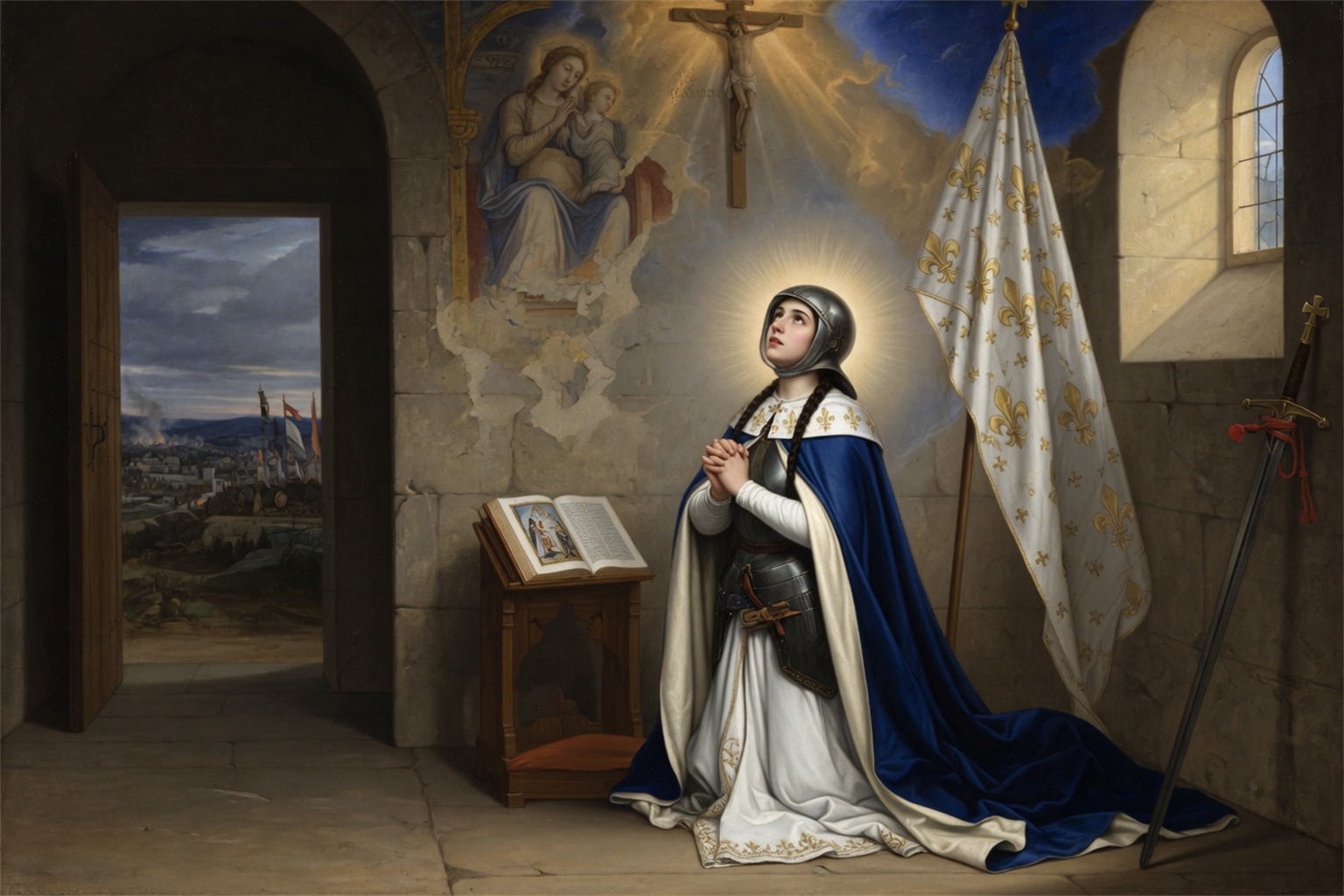
At the time when this heroine appeared, cruel wars were devastating the kingdom of France. A rivalry, often degenerating into enmity, had been established between England and France ever since the French of Normandy, under William the Conqueror, and the French of Anjou, under Henry Plantagenet, had become masters of England. What especially poisoned the evil was the posterity of Philip the Fair. This king had married his daughter Isabella to Edward II, King of England, who left a son, Edward III. The male line of Philip the Fair having quickly died out in France, Edward III claimed this kingdom through his mother. At the head of a powerful army and a numerous fleet, he landed on French soil twice: the first time in 1346, and the second in 1355. The French lost the Battle of Poitiers (1356); King John II was taken prisoner, and Calais surrendered to Edward. Charles V took back almost all his conquests from him; but after his death, which occurred on September 16, 1380, the Dukes of Anjou, Berry, and Burgundy disputed the government of their nephew, the young King Charles VI, and his kingdom. Charles VI fell into madness. The Duke of Burgundy had the Duke of Orleans, the king's brother, assassinated. Civil war broke out between the Armagnacs and the Burgundians. Charles VI, still more or less in a state of madness, gave his daughter Catherine in marriage to the King of England, Henry V, and declared him regent of the kingdom and heir to the crown of France, to the exclusion of any other person of the royal family (May 21, 1420). Upon the death of Charles VI (October 22, 1422), Henry of Lancaster was proclaimed King of England and France. His uncle and guardian, the Duke of Bedford, was named regent of the kingdom of France. For his part, Charles VII, disinherited by his father and having retreated to Bourges, was recognized by a certain number of Frenchmen. His supporters, too few in number, were most often defeated. The Duke of Bedford, wishing to carry his conquests beyond the Loire, came to lay siege to Orleans, which was soon reduced to the brink of collapse. Charles VII, powerless to relieve this city, was thinking of leaving France to take refuge in Spain or Scotland, when an unexpected, unhoped-for help arrived in the person of the heroine Joan of Arc Jeanne d'Arc French heroine and saint, liberator of Orléans. , whose life we are about to recount.
A Pious Childhood in Domremy
Jeanne grew up in a modest and devout family, distinguishing herself by her charity and her assiduous attendance at local churches and chapels.
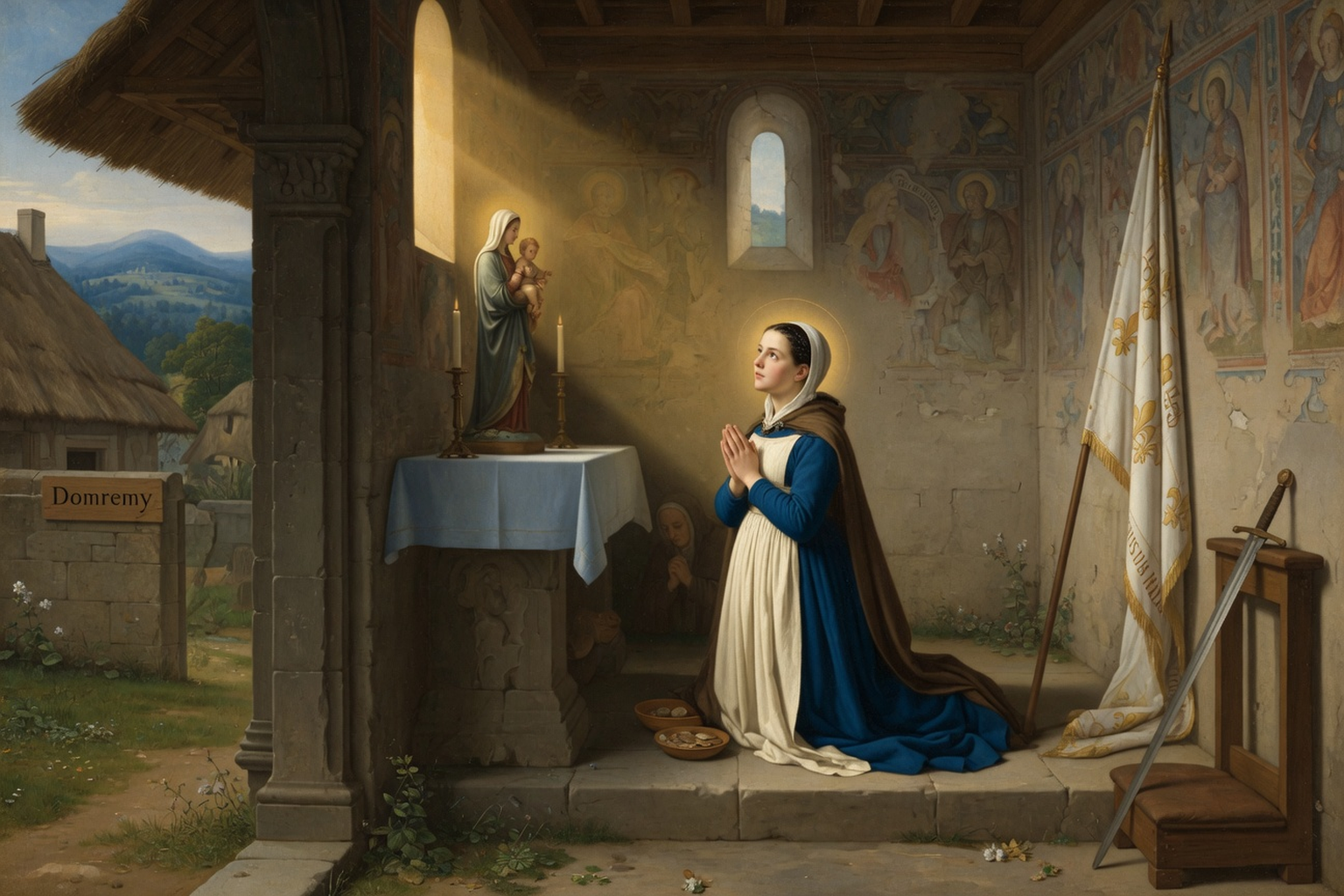
In the former diocese of Toul, later the diocese of Nancy, currently the diocese of Saint-Dié, on the borders of Champagne, Burgundy, and Lorraine, between the towns of Neufchâteau and Vaucouleurs, on the left bank of the Meuse, is the small village of Domremy, where J oan of Domremy Birthplace of Joan of Arc. Arc was born. Her father, Jacques d'Arc, and her mother, Isabelle Romée, were farmers not favored by the gifts of fortune, but pious and honest, who served God with a simple heart and raised their children in work and the fear of the Lord.
Jeanne had three brothers and a sister: but she distinguished herself early on, among the others, by a very special goodness and piety. The reports of more than thirty eyewitnesses of all ranks, heard in the rehabilitation trial, agree that, from her tenderest years, her conduct was pure and irreproachable. According to these authentic testimonies, she was of a very sweet and compassionate heart, simple and without suspicion, although of a prudent and enlightened mind, modest in her words and actions, industrious, humble, timid, and at the same time of unshakable courage in the fulfillment of her duties. In the paternal home, in the fields, in the woods, everywhere God was present in her thoughts; He was her guide in happiness and in misfortune. The house of God was her favorite dwelling, and, whenever she could, morning and evening, she attended divine service there. She often went to confess her faults with great contrition and to nourish herself with the Bread of Life. When she heard the bell calling the people in the fields, if she was too far from the church or if the work was too urgent, she would kneel and pray. She especially loved to speak of God and the Blessed Virgin. While other young girls, after their work, went off frolicking and laughing on the paths, she was found praying in silence in some corner of the church, or kneeling before a cross, her gaze fixed with deep piety on the Savior of men or on the Mother of Sorrows. However, she did not have a somber and sad temperament; on the contrary, she was cheerful and loved to see a joyful face. She was never reproached for having taken advantage of the graces she received or for her piety. She listened with patience to the jokes of her companions about her great devotion, the only thing they found to reproach her for. She herself blamed no one, was kind and affectionate toward everyone, and brought help and consolation wherever she could. A witness recounts that such was her charity for the poor that she did not limit herself to providing them with shelter at her parents' and friends' homes, but that she often lent them her own bed and slept on the ground herself.
Her main occupation was to tend the flocks of her father and some other inhabitants, her neighbors; however, she knew well how to sew and spin, and, still very young, she could already replace her mother in household chores.
One and a half kilometers from the village was a chapel called the Saint-Marie Hermitage, shaded by an old beech tree called the Fairy Tree, or the Ladies' Tree: the young girls and young boys of Domremy and Greux often went there, as if on a pilgrimage, and when they had engaged in some devotional practices there, they would gather under the old beech tree, hang garlands of flowers from its branches, and, through songs and innocent games, amuse themselves under its shade.
Jeanne took no part in the amusements of children her age, but she frequently visited the chapel. Often, leaving her flock under the Fairy Tree to protect it from the heat of the sun, she would go to kneel for entire hours at the feet of the Virgin; at other times, it happened that she would abandon her sheep on the slope of the Bois-Chenu and go down to the chapel to engage in pious meditations. On the most beautiful days, when nature is adorned with all its gifts, she took pleasure in picking the most beautiful flowers of the fields and weaving them into crowns with which she would go to encircle the brow of the Virgin.
Beyond Greux, and three kilometers from Domremy, there was another chapel dedicated to Our Lady of Bermont. Joan of Arc, filled with veneration for all the places that recalled the memory of the Mother of God, went every Saturday to visit this chapel, and there, kneeling before the image of Our Lady, she lit candles and prayed with fervor.
Such was the simple and peaceful conduct of Jeanne among the poor people of her native land, and whoever saw her took an affection for her. Now, this young girl whom all the witnesses of her life praised highly, whom the parish priest and the inhabitants of Domremy regarded as the most accomplished child of that village, and of whom the knight Albert d'Ourches said in court that he had ardently desired that heaven had given him a daughter as perfect; this young girl who, subsequently, excited by her unheard-of deeds the admiration of all the peoples of the West, knew neither how to read nor write, and her poor parents had been able to teach her nothing other than the Lord's Prayer, the Angelic Salutation, and the Apostles' Creed; from which one can recognize how much a simple heart, which has given itself entirely to God and which divine strength fills, is more powerful than all human science and wisdom.
The Call of the Heavenly Voices
At thirteen, Joan receives the first visits from the Archangel Michael, followed by Saint Catherine and Saint Margaret, commanding her to aid the king.
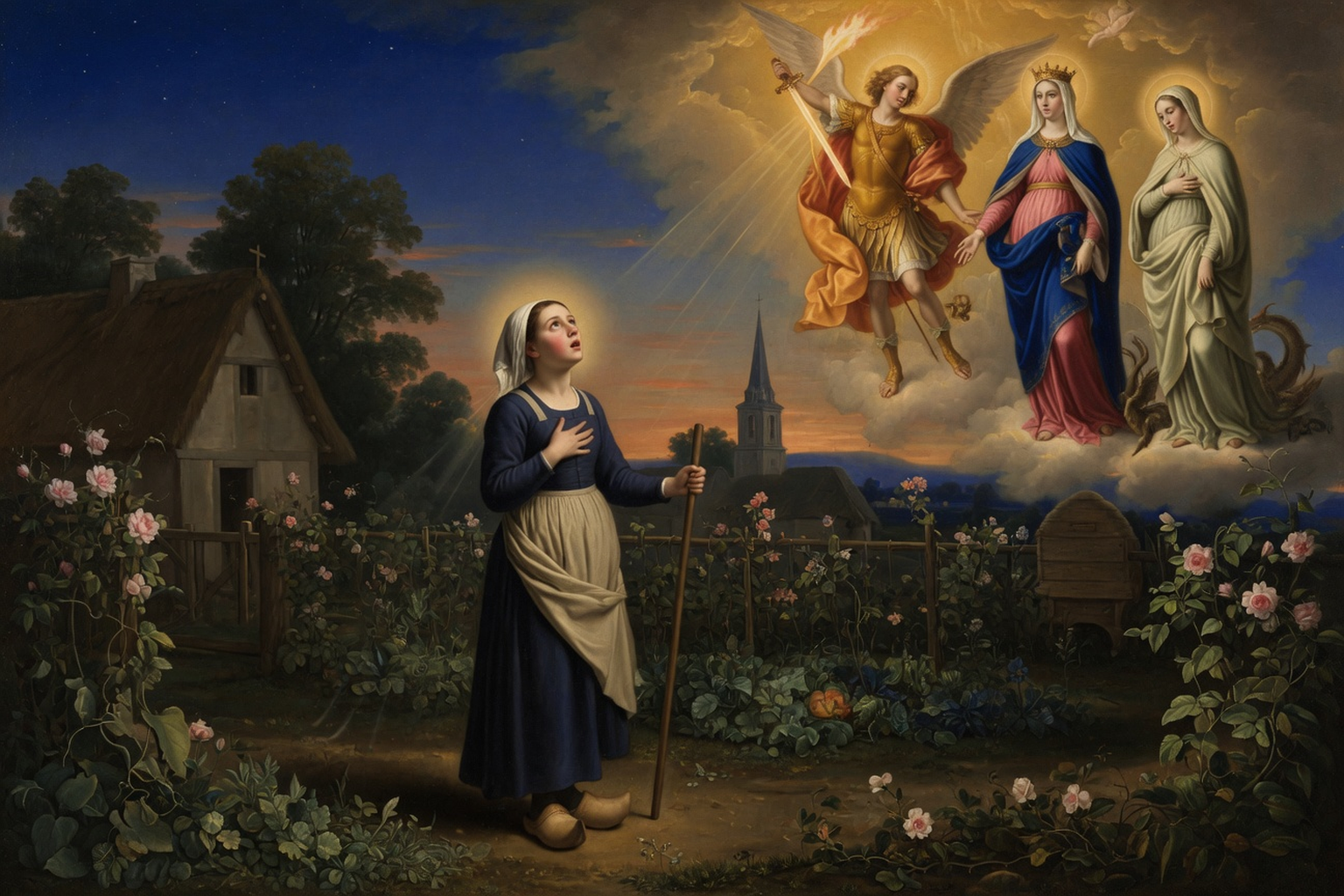
As for her providential mission for the salvation of France, we shall let her speak for herself, limiting ourselves to gathering what she said later on this subject before her judges.
"Everything good that I have done for France," she said, "I have done by the grace and according to the order of God, the King of Heaven, as He revealed it to me through His angels and His Saints, and everything I know, I know solely through divine revelations.
"It was by the order of God that I went to the king, Charles VII, son of King Charles VI. I would have preferred to be torn apart by horses than to go to him without the permission of God, in whose hand are all my actions. Upon Him and no other rested all my hope; everything that His voices commanded me, I did to the best of my ability, according to my strength and my intelligence. These voices commanded me nothing except with the permission and good pleasure of God, and everything I did in obeying them, I believe I did well.
"If I wanted to say everything that God has commanded me, eight days would not be enough. It has now been seven years since the Saints first appeared to me. It was a summer day, around the hour of noon. I was barely thirteen years old, and I was in my father's garden. I heard the voice on the right, from the side of the church; I saw at the same time an apparition surrounded by a great brightness. It had the appearance of a very good and very virtuous man; it wore wings, and was surrounded on all sides by much light and accompanied by the angels of heaven. It was the Archangel Michael. He seeme l'archange Michel Archangel who appeared to Joan to reveal her mission. d to me to have a very respectable voice; but I was still a young child; I was very afraid of this apparition, and I doubted much that it was an angel. It was only after having heard this voice three times that I recognized it as his. He taught me and showed me so many things that finally I firmly believed that it was he. I have seen him, him and the Angels, with my own eyes, as clearly as I see you, my judges, and I believe, with a faith just as firm, what he said and did, as I believe in the Passion and death of Jesus Christ, our Savior; and what leads me to believe it are the good doctrines, the good advice, and the help with which he has always assisted me.
"The angel told me that above all I must be a good child, conduct myself well, and go often to church, and that God would support me. He told me of the great pity that was in the kingdom of France, and how I must hasten to go and aid my king. He also told me that Saint Catherine and Saint Margaret would come to me, and that I must do e sainte Catherine Saint whose voices guide Joan. very thing they comman sainte Marguerite Saint whose voices guide Joan. ded me, because they were sent by God to lead me and help me with their counsel in everything I had to execute.
"Saint Catherine and Saint Margaret then appeared to me, as the angel had predicted. They ordered me to go and find the Sire de Baudricourt, the king's captain at Vaucouleurs, who, in truth, would rebuff me several times, but would eventual sire de Baudricourt Captain of Vaucouleurs who eventually assisted Joan. ly give me men to lead me into the interior of France to Charles VII, after which I would cause the siege of Orléans to be lifted. I answered them that I was only a poor girl who knew neither how to ride nor how to conduct war; they replied that I must boldly carry my banner, that God would assist me, and that I would help my king to recover, despite his enemies, all his kingdom. 'Go in full confidence,' they added, 'and, when you are before your king, a beautiful sign will occur so that he may believe in your mission and give you a good welcome.' They have directed me for seven years and have lent me their support in all my troubles and labors, and now not a day passes that they do not visit me. I have asked them for nothing, except for my expedition, and that God might be pleased to assist the French and protect their city; for myself, I have asked them for no other reward than the salvation of my soul. From the first time I heard their voices, I freely promised God to remain a virgin pure in body and soul, if it were pleasing to Him, and they promised me, in return, to lead me into paradise, as I have prayed them to do."
From Vaucouleurs to Chinon
Despite Baudricourt's initial reluctance, Joan manages to convince gentlemen to escort her to the Dauphin's court.
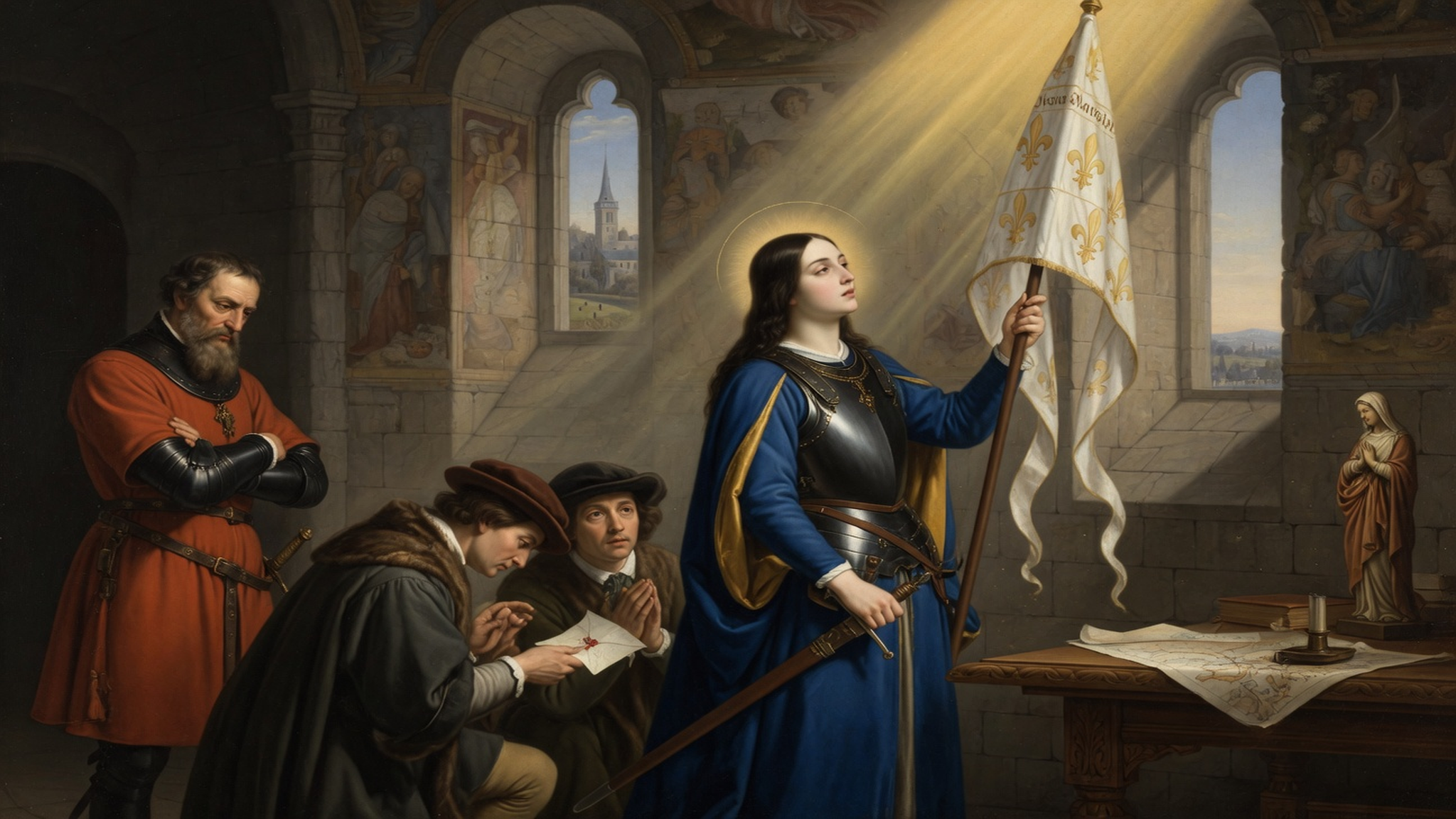
It was in this way that Joan herself recounted the miraculous manner in which God ordered her to take up the sword for her king and her country, and she maintained unswervingly, despite all sufferings and threats, the truth of these apparitions; she even maintained it aloud in the midst of the flames of the stake. God is always admirable in His Saints. We have seen the high priest Onias and the prophet Jeremiah appear to Judas Maccabeus and give him a golden sword for the defense of his people. We have seen angels several times, in the form of horsemen clothed in gold, precede this general into battle, sometimes even escorting him on either side, and protecting him with their weapons. We have seen the Most High, in order to make His power shine forth more brightly, use the arm of a woman, like Judith and Deborah, to strike down the most powerful enemies and bring about the deliverance of the people of Israel. Now, God is always the same. If, therefore, it pleases Him to manifest His power by similar means among Christian peoples, not only is He the master of it, but He would not even be doing anything new.
However, the humble Joan of Arc was alone in the world with her great secret; she had no one to whom she could confide it, and above all she feared, not without reason, opening up to her father. Old Jacques d'Arc had a vague premonition of his daughter's destiny, and that is why Joan was watched very closely by her parents. The years passed by one after the other; the voices of the Saints who urged Joan to rise and go find the king's captain at Vaucouleurs became more and more pressing; but no favorable opportunity presented itself for the execution of her designs; on the contrary, everything seemed to want to oppose it, for precisely at that time a troop of Burgundians spread into the surroundings of Domremy. Jacques d'Arc and his family went to seek asylum in Neufchâteau; but this stay became completely intolerable to poor Joan; for she was even further from Vaucouleurs there, and the thought of helping her king penetrated deeper into her soul with each new misfortune that made the position of the kingdom more desperate; she had no rest day or night, and the anxiety made her quite ill. After four or five days, her parents returned to Domremy. Joan then took the first step to accomplish her mission. She went, with one of her uncles, to find the Sire de Baudricourt at Vaucouleurs; but he, believing her to be mad, at first refused to see her, saying that she should be taken back to her father so that she might be well slapped. However, by dint of perseverance, she succeeded in being introduced to him, and, instructed by her voices, she recognized him immediately in the midst of all his entourage. She told him that she came on behalf of her Lord, to whom the kingdom of France belonged, and not to the Dauphin; but that this Lord was willing to give the kingdom into the keeping of the Dauphin, and that she would lead him to Reims to have him anointed and crowned there. The Sire de Baudricourt having then asked her who her Lord was: "The King of Heaven," repli ed Jo Reims Site of the baptism of Clovis. an. But it was in vain that she spoke, she could not persuade him.
Joan of Arc left this interview very distressed; however, she remained in Vaucouleurs, awaiting a more favorable outcome and seeking her consolation in God. She had settled with a wheelwright whose wife had taken a great liking to the pious and virtuous young girl. Joan's piety was the admiration of the whole town; she spent the day in church in fervent prayer, she confessed and received communion frequently, she fasted with austerity, and she always continued to say that she had to go to the noble Dauphin to have him anointed at Reims. Little by little, so much assurance and holiness began to persuade the people of the town and the surrounding area. The Sire de Baudricourt, shaken by all that he heard, came to see Joan with the parish priest; and there, locked up with her, the priest, holding his holy stole, adjured her, if she were evil, to depart from them. She crawled on her knees to come and adore the cross; nothing in her showed either fear or embarrassment. Shortly after, a gentleman highly regarded in the country, Jean de Novelompont, nicknamed de Metz, met her: "Well!" he said to her, "what are you doing here, dear child? Can anything else happen except that the king be driven from the kingdom and that we become English?" — "Ah!" she said, "the Sire de Baudricourt cares nothing for me or my words: however, I must be with the king before mid-Lent, even if I have to wear my legs down to my knees; for no one in the world, neither kings, nor dukes, nor even the daughter of the King of Scotland can reconquer the kingdom of Charles VII. He has no other help but me, although I would have done better to spin at home with my poor mother, such things not being my business. But I must leave and accomplish my mission, because my Lord wills it." — "And who is your Lord?" resumed the gentleman. — "It is God!" she replied. The Sire de Novelompont felt persuaded; he swore to her immediately, by his faith, with his hand in hers, to lead her to the king, under the guidance of God. Another gentleman, a friend of the Sire de Baudricourt, named Bertrand de Poulingy, also let himself be touched, and believed, like the whole region, that this poor girl was led by the spirit of the Lord. He resolved to lead her to the king with the Sire de Novelompont, and they prepared for this journey.
As fame published more and more the wonders of Joan's devotion and her visions, the Sire de Baudricourt finally consented to send her to the king. The friends she had in Vaucouleurs provided her with great eagerness with everything necessary to equip her. The voices had long ago ordered her to take a man's clothing to go among the men of war; they had one made for her, with a chaperon; she put on boots and attached spurs. A horse was bought for her; Sire Robert gave her a sword, then received the oath that Jean de Novelompont and Bertrand de Poulengy made between his hands to lead her faithfully to the king. While the whole town in great emotion gathered to see her leave: "Go," the Sire de Baudricourt said to her, "and come what may." It was a difficult undertaking to travel one hundred and fifty leagues of country, through forests and rivers, when all the roads were occupied by the English and the Burgundians, by brigands and looters. But Joan left full of courage and confidence, on February 13, 1429, well persuaded that the almighty God, who was her guide, would at the same time be her defense. No anxiety preoccupied her; moreover, it was she who gave courage to her companions when they lacked it, and, when they asked her anxiously if she was quite sure of fulfilling her promises: "Fear nothing," she answered them, "all this is ordered to me, and my brothers of paradise tell me what I must do." Throughout the journey she conducted herself like a saint; and so her companions were soon seized with a respectful fear before her as before a superior being. In the morning, when she awoke, her first thought was to invoke the protection of God by making the sign of the cross. Often she said to the people of the escort: "If it were possible, we would do well to hear Mass." They, for fear of being surprised by the enemy, only acceded twice to the ardent desire of the young girl, and she submitted without a murmur. In a word, they saw in her only what improves and edifies man and makes him blush for himself, and they never noticed anything that was in the least blameworthy.
The Recognition of the Dauphin
At Chinon, Joan miraculously identifies Charles VII and successfully undergoes a thorough theological examination at Poitiers.
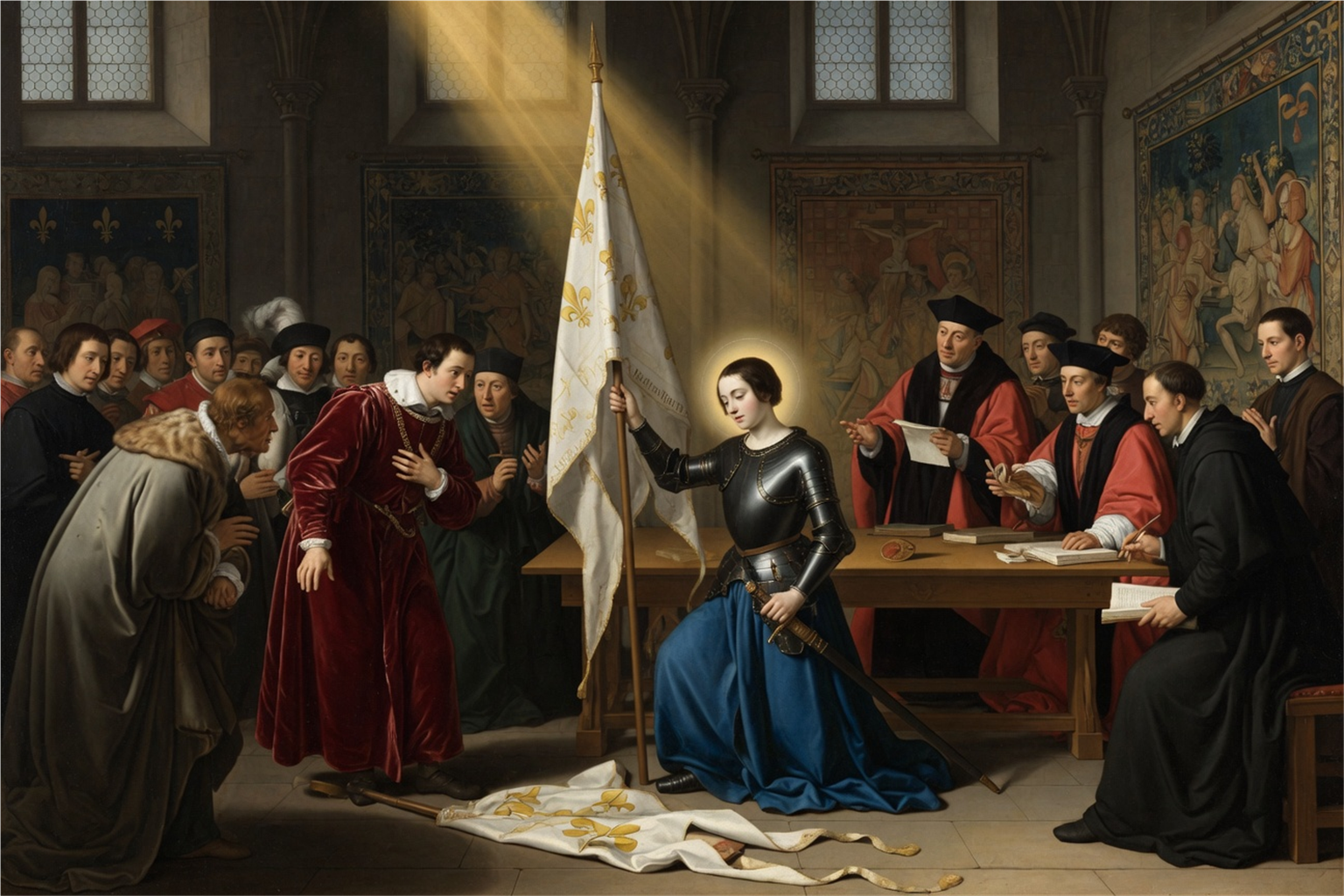
After eleven days of travel, Joan and her escort arrived safely at Fierbois, which is only six leagues from Chinon, where the king held his court. Now, there was there, under the invocation of Saint Catherine, a very frequented place of pilgrimage. Joan, now at the end of her journey, gave herself entirely to the ardent piety of her heart, and heard three masses one after another in one morning in the church of her heavenly protectress. She had a letter written to the king to tell him that she had come from afar to his aid, and that she knew many good things for him. Soon she received permission to come to Chinon. There, as at Vaucouleurs, she began to astonish all who saw her, by her words, by the holiness of her life, by the fervor of her prayers, during which one often saw her shed tears. She received communion frequently, she fasted with severity. The principal lords of the court, who came to visit the marvelous young girl, were moved by her deep piety, her humble affability, her manners at once open, simple and prudent, and her unshakable confidence in her mission. Thus, it was believed that she was enlightened by God, as she herself said.
After three days of consultation, the king finally consented to see her. Joan of Arc was introduced by the Count of Vendôme. The entire court, more than three hundred knights, members of the most noble families of France, the first dignitaries of the crown, were there magnificently dressed. The king, dressed very simply, stood aside, wanting to see if the Maid would recognize the one to whom she claimed to be sent by God. Joan of Arc, calm and without being in the least disconcerted, advanced into the midst of all this pomp, straight toward the king. She who had seen the glorious and radiant figure of the princes of heaven, she now came to bring aid to a prince of the earth who was humiliated and broken. Joan was then seventeen years old; simple and modest, she spoke little; but, as soon as it concerned her divine mission, her speech was abundant, powerful and inspired, like that of a prophetess. The features of her face were fine and had the expression of a piety that was gentle and full of confidence in God. In a word, according to an eyewitness, something divine shone in her whole person. She greeted the king humbly, and said to him: "God give you a happy life, noble Dauphin!" — "I am not the Dauphin," replied Charles; "here he is," he said, pointing to one of the assistants. "By my God," she replied, "it is Charles King of France reconciled with the Duke of Burgundy. you who are the gentle Dauphin, and no other." Then, Charles having questioned her about her name and her plans: "My name is Joan the Maid," she replied, "and I am sent by God here to bring you aid, you, gentle sire, and your kingdom; and the King of heaven commands you through my voice to have yourself anointed and crowned in the city of Reims, and you will become the vicar of the King of heaven, as every true king of France must be." Then the king took her aside and spoke with her for a long time in a low voice; he seemed to take pleasure in what she said, and his face became joyful as he listened to her. In this conversation, she revealed to the king a secret that only he and God could know. The king no longer doubted that this young girl, who read the future and knew the most secret thoughts of the heart, was inspired by a particular spirit; only, he did not know if it was a heavenly spirit or a diabolical spirit. Consequently, before entrusting her with an army, as she requested, he wanted to consult the most distinguished and learned men of the kingdom in this regard. A great and solemn assembly of doctors, professors, and bachelors, versed in the Holy Scriptures and in civil and ecclesiastical law, was convened at Poitiers, under the presidency of the Archbishop of Reims, for the purpose of examining the doctrine and faith of this young girl who claimed to be sent by God to restore the king to his power. Joan did not let herself be embarrassed; to all their reasons, to all their questions, to all their subtleties, she opposed such solid and beautiful answers that they shook their heads, saying that a scholar would not speak better. Then, coming to her divine mission, when she told them how the angels and the Saints had appeared to her in the fields where she tended her flock and had spoken to her of the great pity that was in the kingdom of France; how upon that she had wept, and how the Saints had ordered her to go find the Sire de Baudricourt and had promised to lead her safely on her dangerous journey toward the king; when she explained all that, it was with such enthusiasm, elevation, and dignity that the scholars were astonished to hear a simple and ignorant shepherdess say such marvelous things, and answer in such a skillful and wise manner to all the questions and all the doubts.
Those whom the king had charged with examining Joan had her slightest words and actions spied upon by women they had placed near her; but all the reports of these agreed in praising her; they could say nothing else of her, except that she led an entirely Christian life and that one never saw her idle. Her excellent hostess also recounted to her praise how every day, after dinner, she would kneel and spend part of the day, and even the night, in prayer, or how she often withdrew into a small room to attend to her exercises of piety. The famous Aeneas Sylvius, who ascended the pontifical throne under the name of Pius II, less than thirty years after the death of Joan of Arc, gave the following testimony about her in his history: "The Dauphin, fearing to be deceived, had Joan examined by his confessor, the Bishop of Castres, a theologian of eminent learning, and entrusted her to the supervision of noble ladies. When she was ques tioned Pie II Contemporary pope who praised the virtues of Joan. about her faith, she gave only answers in conformity with the Christian religion, and, when her morals were scrutinized, one found in her only a virginal purity and the most severe honesty. The examination lasted several days, and one discovered in her nothing feigned, no ruse nor any lie." Such were the numerous and hard trials to which Joan was subjected before obtaining from her king the permission to appear before the enemy, at the head of the French chivalry, to accomplish the will of God.
The Deliverance of Orléans
Equipped with her armor and banner, Joan leads the French army to victory, lifting the siege of Orléans despite being wounded.
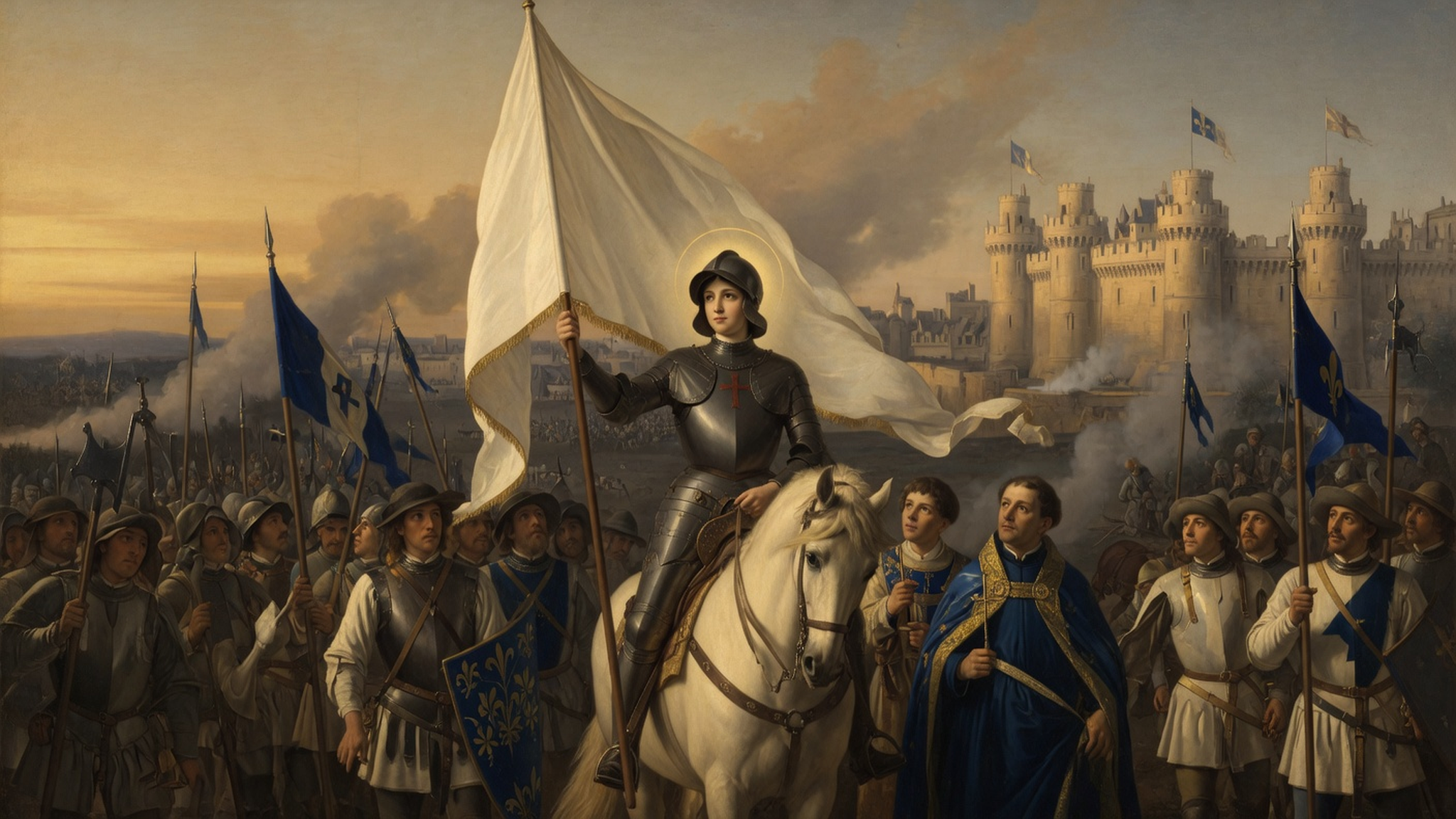
Then the Duke of Alençon received the King's order to march toward Blois before the Maid, in order to organize a convoy of provisions and forces to escort it; the Maid herself was then to lead the convoy. During these preparations, Joan was equipped as was fitting for an army commander at that time; she received from the King her armor and her retinue, and from God her sword and her banner. It was her Saints who announced to her how, in the church of Sainte-Catherine de Fierbois, there was a sword bu ried for her near the altar. épée enterrée près de l'autel Sword miraculously discovered in the church of Saint Catherine. She confessed to the King only after much insistence, as a secret, that the existence of this sword had been revealed to her by her heavenly voices; for she never let the graces of which she was the object be seen. She also had a banner made such as Saint Catherine and Saint Margaret had shown her: it was a white standard, sown with fleurs-de-lis, on which was depicted the Savior of men, seated on His throne in the clouds of heaven, holding a globe in His hand. Two angels were in adoration, and one of them carried a lily branch; on the other side, one could read these words: Jhesus, Maria.
Before taking leave of the King, Joan wonderfully confirmed her divine mission; she told Charles VII how her Saints had revealed to her that she would be wounded while delivering Orléans, but that her wound would not prevent her from accomplishing her work. This prediction was realized.
As she had a horror of the impiety and crimes in the midst of which the men of war lived, she wanted above all to put an end to this way of life. She exhorted them urgently to reconcile themselves with God, wanting only pure hands pleasing to heaven to help her accomplish her divine mission. On April 28, Joan left Blois, preceded by her banner before which the priests sang the Veni, Creator, and followed by the entire army and an immense convoy of provisions. Her plan was to approach Orléans by the right bank of the Loire; but it was precisely on that side that the English had entrenched themselves most strongly. Abusing her ignorance, therefore, the army leaders led her through the Sologne, which is on the left bank, in the hope of finding less resistance there. This hope was well-founded, but the result was that, upon arriving opposite Orléans, the convoy and its escort were separated from it by the entire width of the Loire. As for crossing the bridge, it was not to be thought of; the English had made themselves masters of it; a formidable fortress, supported by other bastilles, defended its access and commanded it entirely. Nothing would have been easier for the army leaders than to foresee this obstacle and its consequences. Joan of Arc, whom they had not wanted to listen to at first, was then their only resource. Her first thought had been to throw herself resolutely onto the bridgehead, or at least to attack one of the bastilles raised in front. But, seeing that they would not decide to do so, she consented to go up the river to the leagues above the city to find a more convenient and safer place for embarkation. Only, boats were needed, and the boats could only come from Orléans, by going up the river in the eyes of the enemy. Her skill, joined to the goodwill of the inhabitants, managed to gather a sufficient number to embark the oxen, the sheep, the entire convoy of provisions, and a few hundred soldiers. This was not done without incredible difficulties, and even then, the greater part of the troops had to take the road back to Blois, where alone there was a bridge over the Loire. Joan felt an extreme reluctance to separate from them; but finally, upon the insistence of Dunois and the express promise that the army would come to join her without delay, she took her place on the boats. While the townspeople made a sortie against the English of the Saint-Loup bastille, the only one they had on that side, in order to keep them occupied, Joan entered the city with her convoy of provisions and brought abundance back to it.
Joan, armed at all points, mounted on a white horse, with her white banner before her, made her entry into the city and headed straight for the cathedral to give thanks to God. The people followed her in a crowd with great respect and greeted her with joyful acclamations; then she addressed sweet and benevolent words to those around her, exhorting them to have confidence in God and promising them the end of all their ills if they had a firm faith and a true hope. The courage of the inhabitants of Orléans grew from day to day with their confidence in the virgin sent by God. In the council, she prevailed, by courage, by experience, by the accuracy and speed of her judgment, over the best knights, and, at the same time, she was humble, pious, and pure like a saint who has renounced the world. All bowed before her elevation when she exalted the goodness and magnificence of God, and before her humility when she spoke of herself. Her benevolence and gentleness subjugated the fiercest hearts; her ardent piety moved the people deeply when, at the moment the priest raised the holy host, her cheeks were flooded with tears; she always spoke of God and the Holy Virgin and exhorted everyone to sincere repentance. What was most astonishing was her extraordinary activity and the countless labors to which she devoted herself; for from morning until evening she was on horseback and under arms. Often, throughout the day, she ate only a piece of bread and drank only a little wine mixed with water. One did not know where she drew all her strength, or rather one saw clearly that it came to her from God.
The approach of the army from Blois having been signaled, Joan, with all the knights in the city, advanced to meet it, and the English, as if struck with stupor, remained shut up and motionless in their entrenchments. In less than eight days, Joan launched an assault on most of their bastilles, which were successively either taken or reduced to surrender. Many enemies perished in these combats; many were taken prisoner. At the attack on the fort that commanded the bridge of the Loire, the struggle was most intense. Joan, seeing that the French were beginning to lose heart and falter, took a ladder, placed it against the rampart, and climbed it first. At that very moment, an arrow struck her between the neck and the shoulder; she fell into the ditch. She was immediately carried away and disarmed; the arrow protruded nearly half a foot from behind. Pain and fear seized her; she began to weep; but after praying for a moment, she had a vision of her two Saints, and she felt consoled. Listening only to her courage, she pulled the iron from the wound; but as her blood escaped in abundance, she had her wound bandaged. This event should not have shaken the confidence one had in Joan, since she herself, from the morning, had predicted that she would be wounded that day. However, as soon as the combatants no longer saw her in their midst, their courage faltered. Joan, hearing the retreat sounded, immediately forgot her sufferings; she remounted her horse and, her banner in hand, rushed toward the ditch, shouting with all her might: "Forward, forward, all is yours!" At this voice, they returned to the assault, the leaders like the last of the soldiers paying with their persons. The English, seeing the Maid again on the edge of the ditch, when they believed her half-dead from her wound, were troubled and filled with terror. The people of Orléans having had a beam placed on the broken arch of the bridge, the English then found themselves between two assaults and were forced to abandon the boulevard and retreat into the Tournelles bastille; but the drawbridge that communicated with it was broken, and a large number of English knights perished in the waters. They thus entered the bastille without further combat; the bridge was hastily re-established with planks, and the Maid, just as she had announced, re-entered the city by the bridge amidst indescribable enthusiasm. The bells rang all night, and the Te Deum was sung in thanksgiving.
But what seemed more surprising is that the English on the right bank had not made the slightest sign of helping the Tournelles bastille, nor of attacking the city while it was stripped of its best defenders. During the night, and to the sound of the rejoicings of Orléans, the Earl of Suffolk, Lord Talbot, and the other English leaders gathered in council and resolved to lift the siege. At the break of day, they drew up all their men in battle array as far as the ditches of the city, and there they seemed to offer combat to the French. At this sight, the captains who were in Orléans went out, and several of them would undoubtedly have liked to accept this challenge; but the Maid, whom her wound kept in bed, rose immediately, put on that light armor made of iron mail called a jaseron, and ran to the gates of the city. The French were already putting themselves in order to fight, but she forbade them to attack. "For the love and honor of the holy Sunday, do not attack them first, and do not ask them for anything; for it is the good pleasure and the will of God that one allows them to go, if they wish to leave; if they assail you, defend yourselves boldly; you will be the masters." The English having begun to make their retreat in good order, their standards unfurled: "Let them go," said Joan of Arc; "Messire does not want us to fight today; you will have them another time."
The enemy having thus lifted the siege of Orléans, just as Joan had predicted, an exhortation was made to the people, then a solemn procession through the streets and on the ramparts of the delivered city, and finally a funeral service for the souls of those who had succumbed. The procession, the service, and the sermon, instituted on May 8, 1429, by Joan, by the noblest knights of France, and by the priests and townspeople of Orléans, have taken place every year since, at the same time, in memory of the deliverance of the city, which, after a siege of seven months, was snatched in a few days from the greatest distress by a young girl of eighteen, when already one despaired of all human help. The day after the deliverance of Orléans, May 9, 1429, Joan came to find the King at Loches and urged him to leave without delay to go and be crowned at Reims; she said to him: "I will last only a year and hardly more; one must try to use this year well." However, nothing was decided; many captains and advisors were of the opinion that it was necessary to attack the English in Normandy, where their greatest power was, in order to drive them from the kingdom, while by marching toward Champagne, one left the whole country of France around Paris and Orléans free to them. Joan gave as her reasons that, immediately after the coronation, the power of the enemies would always be diminishing, and that her voices had told her so. So many delays grieved her greatly. Finally, one day when the King was holding council with the Bishop of Castres, his confessor, and Robert le Masson, Sire de Trèves, the Maid came to knock gently at the door. The King, knowing it was she, had her enter; she embraced his knees: "Noble Dauphin," she said, "do not hold such long councils, come and receive your worthy coronation at Reims. I am being urged greatly to lead you there." The Bishop of Castres saw clearly that she wanted to speak of her visions. "Joan," he said, "can you not declare before the King the manner in which your council spoke to you?" — "Yes," added the King, "will you not tell us?" — "Ah! I see," she replied with a little embarrassment, "you are thinking of the voice that I heard concerning your coronation; well! I will tell you: I put myself in prayer, in my accustomed manner, and I complained that you did not want to believe what I was saying; then the voice came, and said: Go, go, my daughter, I will be at your aid, go! When this voice comes to me, I feel wonderfully rejoiced, and I would like that to last forever." Speaking thus, the Maid had such an air of being inspired, and what she had just accomplished gave her inspiration so much authority, that the King let himself be won over. But before leaving for Reims, he wanted them to retake from the English all the strongholds they occupied between the Loire and the Seine, on the roads from Orléans to Paris. Joan hastened to accept this condition.
The Coronation and the Loire Campaign
After a series of military victories, Joan leads Charles VII to Reims for his solemn coronation, fulfilling her primary mission.
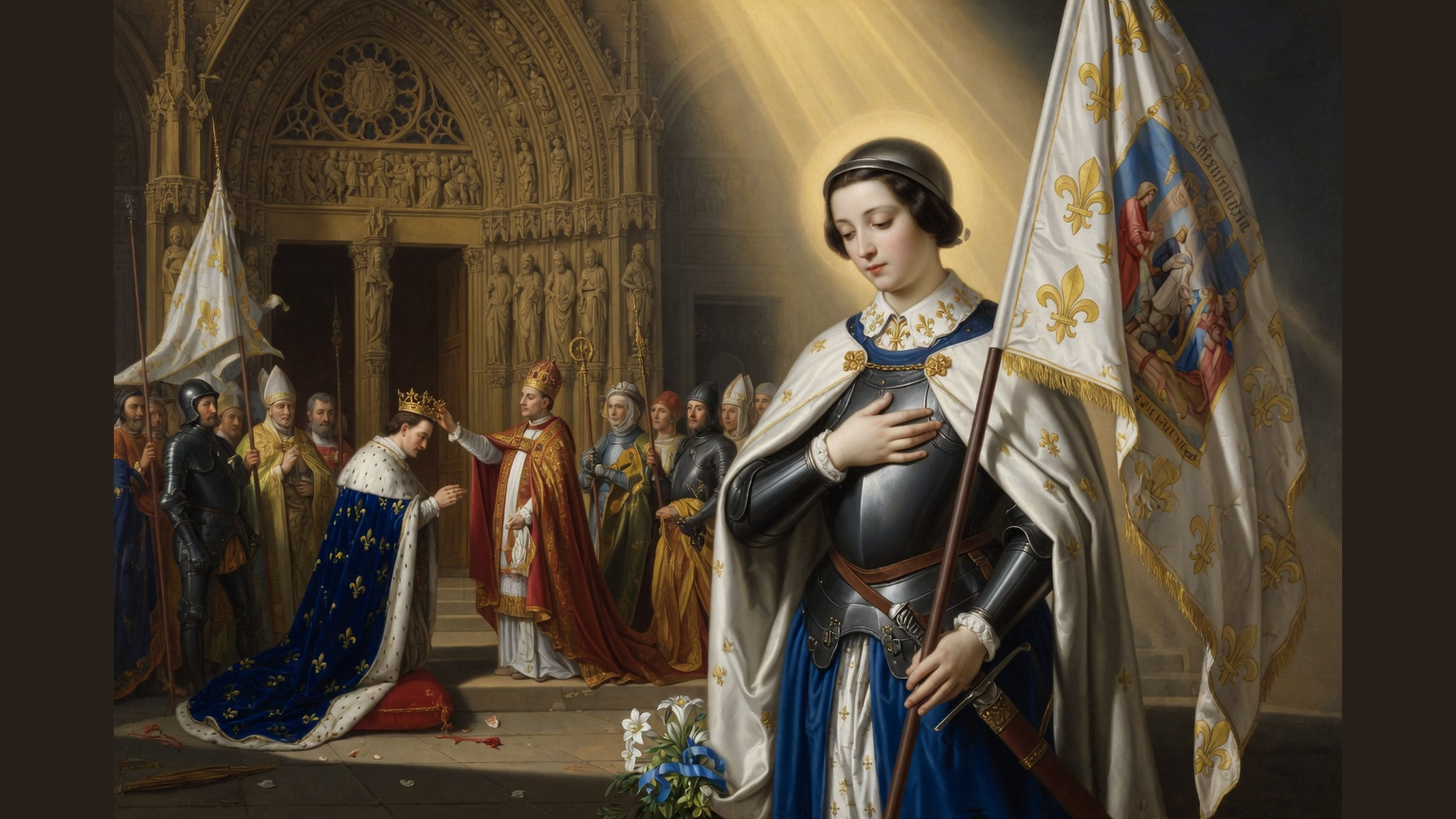
The enthusiasm inspired by the Maid's victories, and her fame which flew from mouth to mouth, attracted to her banner a crowd of French knights eager to share in her glory. These troops needed a leader: the Duke of Alençon, of royal blood, recently released from English prisons at the cost of the hardest sacrifices, requested command of the small army, and the King granted it to him, placing the Maid beside him, whose advice he was to follow in all things. Their first effort was directed at Jargeau. The Earl of Suffolk had left the city and had drawn up his troops in battle formation; the French were not expecting it; they arrived in poor order. Attacked immediately, confusion spread among them. The day already seemed lost; but Joan of Arc did not lose heart; she took her standard and was the first to move forward against the English; they, unable to withstand the shock, retreated into Jargeau. A breach having been made, the assault began, which was terrible. Joan, her standard in hand, had a ladder placed where the defense seemed most fierce, and climbed boldly. A large stone, rolled from the top of the wall, fell on her head, shattered on her helmet, and knocked her into the ditch. She was thought dead; but she rose again at the same moment. "Up, up, friends," she cried; "our Lord has condemned the English; at this hour they are ours." All, carried away by her bravery, rushed after her, and the city was taken.
From Jargeau, the Maid returned to Orléans where she did not let herself be stopped by the expressions of affection from the inhabitants. Two days later, the army advanced towards Meung, which was secured in passing; from there they came to Beaugency, which did not hold, the English having immediately retreated into the castle, from where they were soon expelled. Everything yielded to the arms of the Maid; the English were in terror, and the Duke of Bedford, writing to England, attributed her successes to the evil spirit and witchcraft. In a bloody battle fought not far from Patay, the English were comp letely defeated. The effect of this day was bataille sanglante livrée non loin de Patay Decisive victory for French troops led by Joan of Arc. immense: the English were drawn out. The whole country rose against them, and they were forced to evacuate Mont-Pipeau, Saint-Sigismond, Sully, and generally all the small posts they still occupied. Successes so marked and so rapid were a new proof of the Maid's mission and gave more weight to her urgings to go to Reims. It was no longer just the people who acclaimed her; the army, especially since the battle of Patay, saw in her the one who was predestined to lead it to victory, and the hearts as well as the confidence of the captains were hers. Carried along by this movement, the King finally decided to leave for Reims. He had gathered at Gien a small army of twelve thousand combatants; he placed himself at its head on June 28. Auxerre was the first city to refuse him passage; but for fear of seeing the place taken by assault, the inhabitants requested a sort of neutrality which was granted to them, on the condition that they would provide the King's troops with provisions. From there, they marched on Troyes. The city was summoned to surrender and refused. But the name of the Maid and the wonders told of her so frightened the inhabitants and even the garrison that they asked to capitulate. Châlons offered no resistance to the King; the bishop and the principal bourgeois came to meet him to present their submission. The Maid promised the King that it would be the same for Reims. Indeed, the garrison, composed of six hundred men, did not wait for the royal army, so that the inhabitants were able to go out without fear to meet the King, with all the demonstrations of sincere joy and complete submission.
The entry into Reims was magnificent. Joan of Arc, clad in her armor, and holding her standard in one hand and the sword of Fierbois in the other, walked behind the King. An old tapestry, preserved in the cathedral of Reims, still offered, before the Revolution, the picture of this memorable triumphal entry. The ceremony of the coronation of Charles VII took place on July 17, 1429. Joan stood near the altar, carrying her standard; and when after the coronation she threw herself on her knees before the King, and kissed his feet while weeping, no one could hold back their tears while listening to the words she said: "Gentle King, now is executed the pleasure of God, who willed that you should come to Reims to receive your worthy coronation, to show that you are the true King, and the one to whom the kingdom must belong." As her mission was fulfilled, she then asked for permission to retire; but the King, the princes, and the leaders of the army made such urgent requests that she consented to remain. She would therefore continue to fight with fidelity and courage, but without receiving any more the supernatural lights that never failed her to fulfill the two objects of her primary mission, to deliver Orléans and to lead Charles VII to Reims. Another career opens before her, a career of suffering and martyrdom, the end of which is a coronation, no longer at Reims, but in heaven.
Captivity and Betrayal
Captured at Compiègne, Joan is sold to the English by the Duke of Burgundy and handed over to the ecclesiastical tribunal presided over by Bishop Cauchon.
From Reims, King Charles VII marched on Paris. As he approached, the populations of the towns and countryside received him with ever-greater joy; but eyes were fixed particularly on the Maid; it was admirable, indeed, to see her riding with such a gentle and humble air, and at the same time so courageous, like a tutelary angel of the kingdom. When she saw this great joy of the people, tears flowed from her eyes, and she said to the Archbishop of Reims, who was at her side: "Here is a good people, and I have not yet seen any other people who have rejoiced so much at the coming of such a noble king. Would to God that I were happy enough, when I finish my days, to be buried in this land!" — "O Jehanne! in what place do you hope to die?" the Archbishop asked her with emotion. "Where it pleases God," she replied; "for I am sure of neither the time nor the place. And would to God, my Creator, that I could now leave, abandoning arms, and go to serve my father and mother by guarding their sheep, with my sister and my brothers, who would have great joy in seeing me again!" While saying these words, she raised her eyes to heaven. Never, according to the testimony of Dunois, had the lords who saw and heard her at that moment understood so well that she came from God.
Contemporary monuments show what a high opinion Europe had of the virtue of Joan of Arc; according to the unanimous deposition of more than fifty eyewitnesses, this singular esteem was only just; for, on the fields of battle, at the court of her king, among the poor and the afflicted, in her days of happiness as in her days of misfortune, she always remained the humble and pious shepherdess. The graces bestowed upon her, according to the same witnesses, only made her more ardent in the service of God and in the frequenting of the sacraments. For herself she desired nothing, except that God might have pity on her poor soul. However pious and holy her life was, and although no one could discover in her the slightest fault, she never confessed without weeping for her sins. She never killed a single enemy in combat, for she did not wish to shed blood; it was enough for her to carry her banner before all the others. That is why she did not use her sword; most often she defended herself with her lance and with a small battle-axe that she carried at her belt. As long as she was on campaign, she went every morning, at the break of day, to the nearest church, and for half an hour she had all the priests who followed the army called by the ringing of bells, so that they might celebrate divine service. She knelt in their midst while they sang a hymn in honor of the holy Virgin. Her confessor was charged with indicating to her all the convents of his Order near which she passed, and one day she had the particular joy of receiving communion in one of these houses with poor children.
Out of respect for her divine mission, Joan took every care to ward off even the slightest suspicion; that is why, after sunset, she no longer spoke to any man. She always slept surrounded by women, or, preferably still, by young girls. When that was impossible, or when she had to spend the night in the open air, she lay down armed from head to toe. During her stay in Bourges, she very much wished to attend Matins; but, not wanting to go alone in the streets so early, she urgently begged her hostess to accompany her. Jean d'Aulon, who, because of his service, was always near her, often said that he did not think there was a woman on earth more chaste. Often, in the middle of the night, when she thought everyone was asleep, she would rise quietly and pray on her knees for the prosperity of the king and the kingdom. Filled with the premonition of her approaching end, she often said to her confessor: "If I am soon to die, tell the king, our master, on my behalf, that it may please him to raise chapels where the Lord may be invoked for the soul of those who have succumbed in the defense of the kingdom." It was on the ramparts of the city of Melun that Joan had an apparition where her Saints announced her coming captivity. They told her that before the feast of Saint John she would fall into the hands of the enemies; that this was quite inevitable; that she should not be frightened by it, but, on the contrary, accept with gratitude this cross from the hand of God, who would also give her the strength to bear it. Joan begged her beloved Saints to ask God for her that He might be willing to spare her the pains of a long imprisonment, that He might make her die on the spot and admit her into His holy paradise; but the Saints revealed nothing to her in this regard; they told her neither the place nor the hour when she would fall into the power of the enemy, and they only recommended that she be patient and resigned.
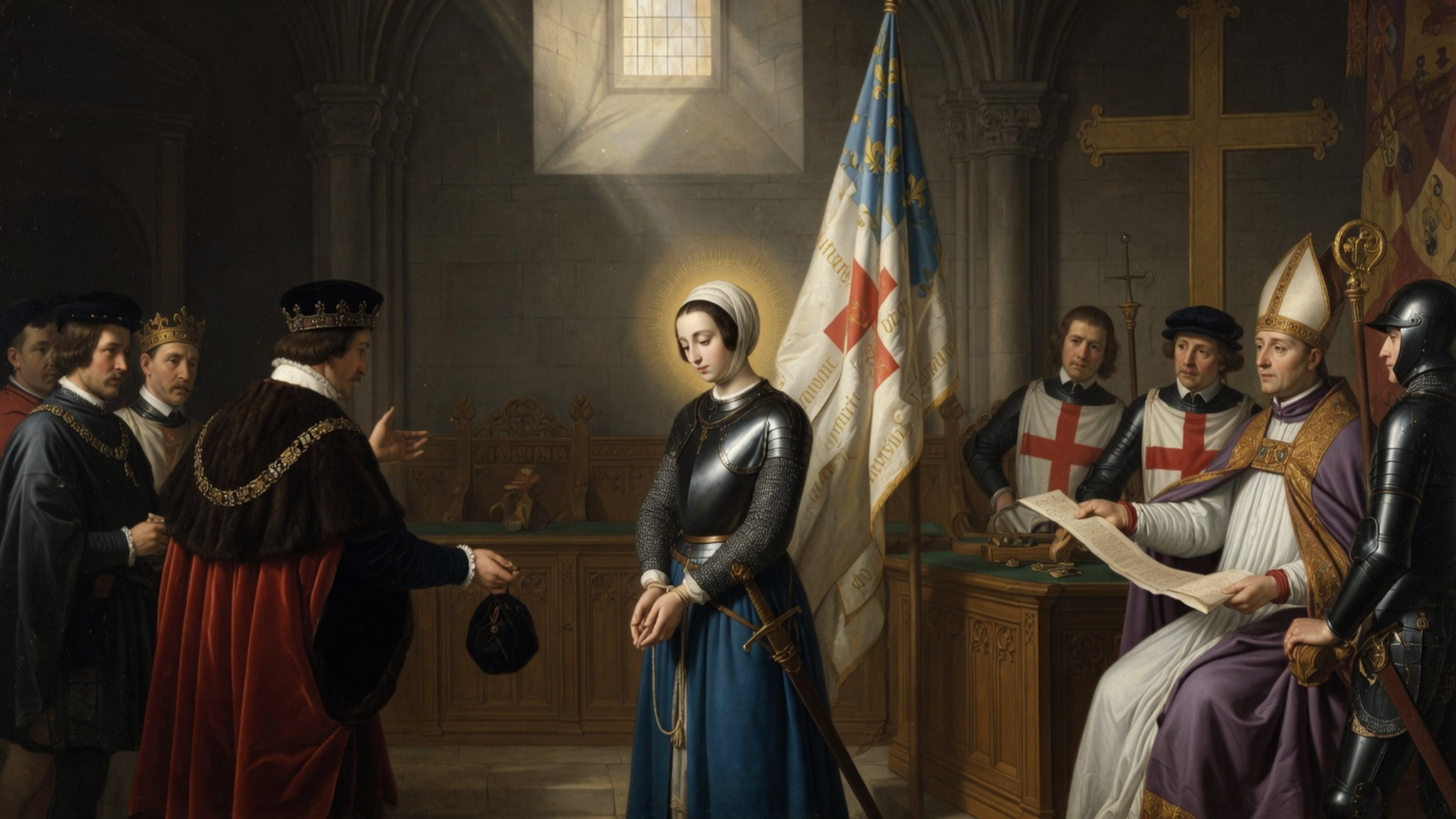
From that time on, the Saints renewed for her almost every day the prediction of the misfortune that was approaching; but Joan did not want to say anything about it to the captains, and from then on she followed their orders in all things; for she had fallen under the hand of God like a victim, and she did not want by her advice to lead others into the destiny toward which she was walking with a tranquil resignation. Finally, on May 23, 1430, before the bridge of Compiègne, after prodigies of valor, Joan of Arc fell into the hands of her bitter enemies. This misfortune happened fifteen months after her entry into Chinon, one year after the deliverance of Orléans, and ten months after she had had Charles VII crowned in the cathedral of Reims. Thus was accomplished the prediction she had made, and which has been attested by the Duke of Alençon: "I will last only a year, or hardly more; that is why see to it that you use this year well." Disarmed and in chains, Joan of Arc still inspired a profound terror in the English. The English government of France saw no other remedy for this fear than the legal defamation and execution of Joan as a heretic and witch. Now, Joan's heresy was to have beaten the English.
As early as May 26, 1430, three days after the Maid had been taken, the vicar general of the inquisitor for the English part of France, Brother Martin Billon, wrote to the Duke of Burgundy to claim her as accused of several errors, in order to examine her before the doctors of the University of Paris. This University itself addressed a similar letter to the Duke of Burgundy so that the young captive would be brought before an ecclesiastical tribunal as suspected of magic and sorcery. The Duke of Burgundy and Jean de Luxembourg sold the Maid to her enemies as dearly as they would have sold a king of France: this blood bargain was concluded on October 20, 1430, for ten thousand francs. The intermediary for this deal was the Bishop of Beauvais, the wretched Cauchon. From a recently ennobled family, he had become Bishop of Beauvais through the credit of the Duke of Burgundy. There was some reason for this. At the Council of Constance, Cauchon had defended, against Chancellor Gerson, the murder of the Duke of Orleans, assassinated by the Duke 's father. It was an attraction to murder. l'évêque de Beauvais, le misérable Cauchon Bishop of Beauvais and chief judge at the condemnation trial of Joan of Arc. But, Joan of Arc having restored courage to the French armies, the city of Beauvais had returned to the obedience of the legitimate king and had dismissed Bishop Cauchon, as a declared partisan of the enemies of the country. One senses how much such a man must have loved Joan of Arc and how fit he was to be her judge.
The Trial of Iniquity at Rouen
Imprisoned under cruel conditions, Joan faces trap-filled interrogations, firmly maintaining the divine origin of her voices.
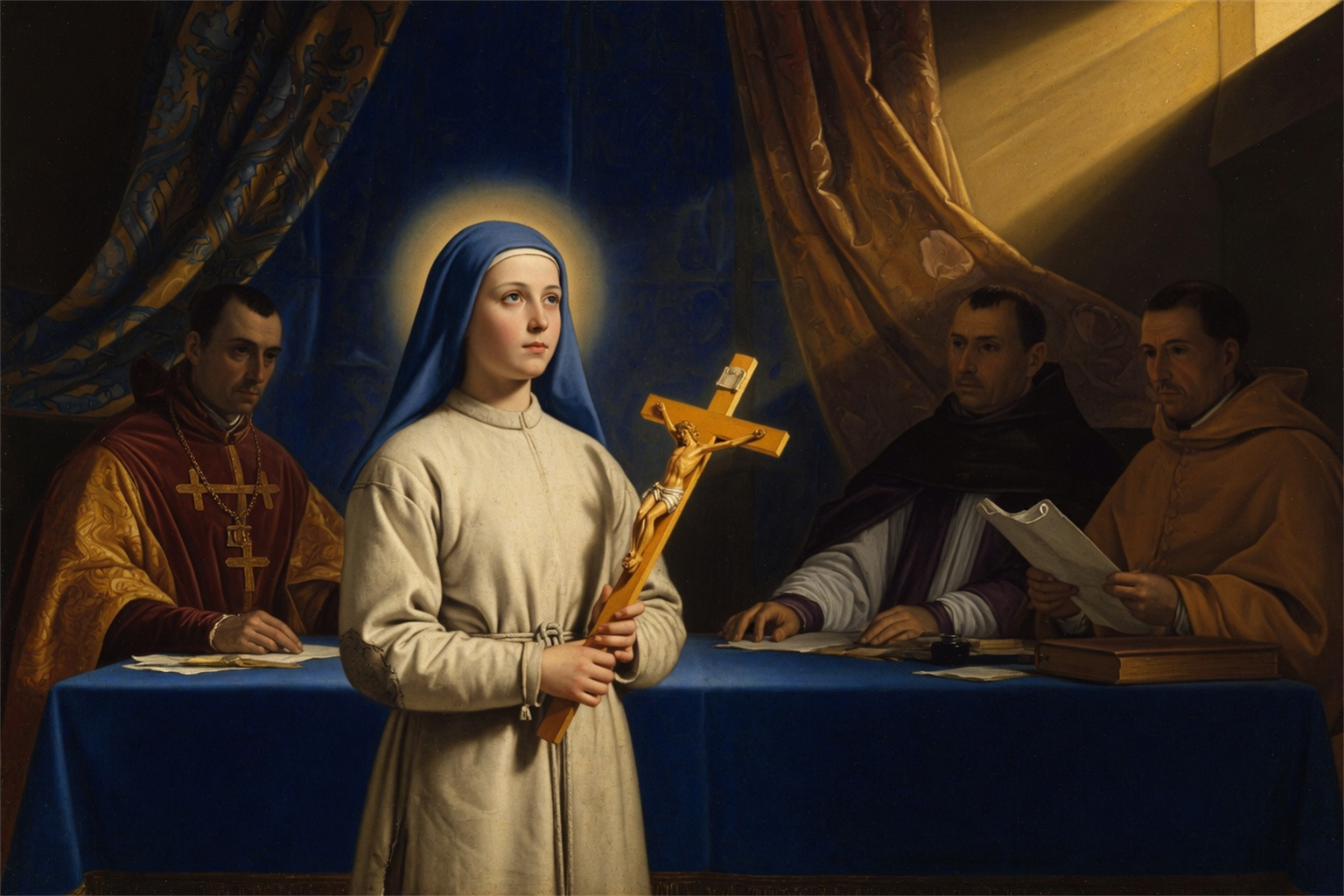
After Joan the Maid had been dragged from one prison to another for six months, and had shown herself everywhere to be equally pure and pious, she was locked in the tower of the castle of Rou en. T Rouen Norman city where Simeon stayed and founded a monastery. he King of England and the great men of his council were gathered in that city. On January 3, 1431, Cauchon was authorized, in the name of Henry VI, to begin the examination of the charges weighing against the Maid. These charges were that she had, in an impious manner and contrary to divine law, worn men's clothing and committed murders with weapons in hand; that she had presented herself to the simplicity of the people as sent by God and initiated into the secrets of Providence; finally, that she was suspected of many other dangerous errors and guilty acts against the divine majesty. If she were not convicted of these crimes, the King reserved the right to take her back.
However, poor Joan, imprisoned in the great tower of Rouen, found herself in a dreadful situation. The locksmith Etienne Castillon reported before several witnesses that he had been ordered to make an iron cage for her, that she was cramped in it, tied by the neck, feet, and hands, and that she had been confined there from her arrival at the castle of Rouen until the opening of the trial brought against her. Later, during the day, her feet were held by iron stocks, which were themselves attached by a strong chain, and by means of a padlock, to a large piece of wood. At night, she was shackled by the legs with two pairs of iron chains, and tied very tightly to a chain passing through the feet of her bed, attached to a large piece of wood and locked with a key, so that she could not move from her place. Furthermore, a second chain held her then by the middle of her body. Such was her situation, according to the deposition of several eyewitnesses. But what she had to suffer even more was from her guards, English soldiers of the worst kind. These wretches took pleasure in insulting and tormenting her in every way; they did not even leave her rest during the night; often also they sought to do her violence. It is for this reason that she could not resolve to leave her men's clothing, despite all the exhortations and threats of her judges; which was later counted against her as guilty obstinacy and a great crime. However, in the midst of all this mistreatment, she did not lose patience, and, according to the report of a witness, her language was full of wisdom and moderation.
For his part, Bishop Cauchon, who falsely claimed to be the ordinary judge of Joan, given that the place where she had been captured was part of the territory of the diocese of Noyon, convened, on January 9, 1431, an assembly of nine doctors and licentiates. These agreed to conduct a new investigation, as the information that Cauchon had placed before their eyes seemed insufficient to them. They then pointed out to him that since the Maid was to be judged by an ecclesiastical tribunal, it was appropriate that she be transferred to a Church prison. Cauchon replied that he would not consent to it, for fear of displeasing the English; a word which alone stripped him of the right to judge, had he even had it until then. Joan claimed her right several times; but Cauchon did not worry about the doctors or her, and left the unfortunate woman prey to the cruelest treatments in an unjust prison. She found consolation only with her Saints, who assisted and comforted her all the more faithfully as she was more abandoned by men. The new information gathered on Joan's conduct in her native land, being all in her favor, Cauchon took care to keep secret, for the clerks affirmed having never seen anything of it. The Bishop of Beauvais did not blush to employ for his odious designs an ecclesiastic named Nicolas l'Oiseleur. This wretch slipped into Joan of Arc's dungeon, told her that he was also from Lorraine, a faithful partisan of the King, and a prisoner of war like her. When he had succeeded in gaining her con Nicolas l'Oiseleur Treacherous priest who spied on Joan in prison. fidence, Cauchon led two notaries into a room adjoining the prison, and to which an opening had been made from which one could hear everything without being seen. Nicolas l'Oiseleur came to find Joan, and then the traitor asked her a host of insidious questions about her revelations. Cauchon wanted the notaries to take note of Joan's answers; but one of them refused his ministry to these indignities, saying that it was not permitted to begin a trial in this manner. This did not prevent the unfortunate Maid from granting such confidence to l'Oiseleur that she took him for her confessor and usually communicated with him before appearing before her judges.
It was very important to the Bishop of Beauvais to put the greatest number of people possible among the judges; those who refused to be part of the tribunal were forced to do so by strength. The vice-inquisitor, le Maistre, a weak man without character, said to one of the witnesses: "I see well that one must judge according to the will of the English or prepare for death." One acted the same way, through violence or threats, with most of those who, in this iniquitous affair, stained their hands with the blood of innocence. The Bishop of Demetriade was therefore well-founded in affirming later under oath, during the revision of the trial, that none of those who had participated in this abominable affair had acted in full freedom. Things being thus prepared, Joan was summoned to appear, on February 21, 1431, for the first time, before her judges. From that day to March 17, she was interrogated seventeen times. Now, according to the declarations of a large number of witnesses, the tribunal was instituted, not to seek and let the truth be spoken, but rather to pursue and destroy an innocent person under the appearance of justice. The English and Cauchon, with his cronies, wanting at all costs to satisfy their malice and their vengeance, did not recoil before any means, however unjust and vile it might be. When their ruses did not succeed in ensnaring the victim, they sought to frighten and torment her through their violence, so that the unfortunate woman, in a moment of despair, would testify against herself and submit to the judgment of iniquity; but the Maid, strong in her good right, broke the nets of their abominable perfidy and endured her pains with heroic patience. In the first interrogations there were fifty to sixty assessors; but little by little the sessions took place only before a small number of people, in the prisoner's cell, and almost in secret. After having tormented her with questions in the morning for three or four hours, and having hounded and pursued her like a wild beast, they used her very answers to ask her new, insidious questions in the afternoon.
They did not even allow the poor prisoner to go to church to seek consolation and strength, and to relieve her oppressed heart at the foot of the altars. From the beginning, they forbade her from attending the holy sacrifice because of her alleged crimes and the men's clothing she wore. The apparitor Jean Massieu led her from the prison to the tribunal; on the way was the castle chapel. "Is the body of Jesus Christ there?" asked Joan, and, upon the affirmative answer, she made her prayer each time; but this supreme consolation was also forbidden to her shortly after. Not content with harassing and embarrassing the Maid with difficult and trap-filled questions, Cauchon and his cronies did everything to determine the clerks to falsify the accused's answers. These constantly refused to write anything other than what she said; but the unworthy bishop succeeded at least once in having one of the Maid's answers omitted, about which she complained, crying out: "Alas! You write what is against me, and you do not want to write what is for me."
Abandoned by her friends and delivered to her mortal enemies, surrounded by traps on all sides, tormented by threats and mistreatment in a harsh prison, excluded from the consolations of the Church, without counsel and without assistance, having constantly before her eyes the flames of the stake whose glow was projected onto every question, Joan had the last and hardest of battles to sustain. However, the simple young girl, who had learned from her parents only the Pater, the Ave, and the Credo, fixed a firm and tranquil gaze on her enemies, and more than once she made them lower their eyes and filled them with confusion, by tearing apart all at once the web of their perfidy and appearing to them in all the brilliance of her innocence. If recently the bravest knights had admired her heroic courage in the midst of battles, she showed an even greater one now that, loaded with irons and in the face of a horrible death, she attested to her enemies themselves the truth of her divine mission, and prophesied to this tribunal, ready to condemn her in the name of the King of England, the complete fall of English power in France and the triumph of the national cause. In these supreme moments she remained attached with unwavering love and fidelity to her King, whose ingratitude abandoned her, and she endured without impatience, as without hatred, the injustices and cruelties of her executioners. The holy voices told her that she must speak boldly to her judges; she followed this advice, and fear remained far from her heart. "In truth, she is a good and honest woman!" said one of the English lords, seized with admiration upon hearing her speak. And yet, with this heroic courage, she was still the humble, naive, and pious shepherdess who, at the first moment of pain, wept bitterly over her cruel destiny and did not want to believe it. She nonetheless continued to maintain the truth of the divine apparitions of her Saints, and she said how each day they still consoled, strengthened, and advised her in her prison, and that, without their assistance, she would have long since succumbed under the weight of her woes.
But never was the rectitude of her judgment better manifested than in the most difficult questions. Her answers were at once precise, clear, brief, without any affectation, and always going straight to the point; they had nothing that carried a character of sickly exaltation, daydreaming, or uncertainty; on the contrary, they were imbued with a courageous, firm spirit, full of pity and entirely penetrated by the justice of her cause. The Bishop of Demetriade, who attended the interrogations as an assessor, later certified that the Maid's answers were so excellent that he regarded them as inspired from above. Her upright and courageous sense was so little disturbed by the dangers that surrounded her on all sides that often her presence of mind and the sureness of her memory were an object of astonishment; she remembered with exactitude and repeated by heart her previous answers. They questioned her in a perfidious manner about everything that her enemies had spread of wicked and odious about her, in order, no doubt, to declare her unworthy of supernatural graces and visions if she confessed herself guilty on any point. One day they asked her: "Do you know if you are in a state of grace?" Joan astonished her judges with these simple words: "If I am not in a state of grace, may God deign to put me there! If I am, may He wish to keep me there! For I would be the most miserable of creatures, and I would rather die, if I knew myself to be out of the state of grace and the love of God." When they questioned her on the way she asked for counsel and help from her Saints, she replied: "I implore them in the following manner: Very sweet Lord, in honor of your holy passion, if you love me, reveal to me what I must answer to these priests; as for my men's clothing, I know very well that I put them on by your order, but I do not know if I should take them off; that is why deign to instruct me on this point." Such was the invocation she addressed to God in her distress, and yet they strove to present her as an impious witch, who had evoked the infernal powers.
We are going to see how her accusers and her judges never showed themselves to be anything but her enemies, and enemies of the vilest kind. Cauchon first summoned Joan to choose from the assembly one or more counselors who could lend her their assistance; but she thanked him, declaring that she did not want to separate herself from the counsel of God. Bitter experience had taught her too well how little her enemies worried about counseling and assisting her. The entire accusation, drafted in the most wicked manner by her most mortal enemies, provided new proof of this. What strikes one most in this document is that it produces no regular testimony against the Maid, and that it accumulates the most serious incriminations without making the slightest mention of the accused's virtues. For nearly two years she had walked in the eyes of the whole world; she had commanded an army of ten or twelve thousand men; she had been in contact with thousands of people; she had had to overcome the fascination of the highest fortune as well as the sufferings and despair of the most extreme misfortune, and yet her relentless persecutors could find no witness against her. Certainly, this is a greater proof in favor of her spotless virtue than all the testimonies produced later to rehabilitate her. The greater part of the accusation is borrowed from the words of the Maid, but travestied and mutilated, or amplified and explained according to the convenience of the prosecutor. The latter, starting from the principle "that the Maid's assertion regarding her divine mission and her visions was an imposture, or a prestige of the demon, or a work of witchcraft," everything that related to it formed from then on an endless series of the blackest crimes. Thus Joan constantly replied to each of these articles, "that she denied as false a part of the facts they contained; that, as for the rest, she referred to her previous declarations, and finally, as for the odious consequences they wanted to draw from them, she appealed to God, her sovereign King and Lord, whose will she had executed in all things." She was summoned several times to submit, she and her entire cause, to the judgment of the Church; now, her judges understanding by that their own judgment, she always gave them an evasive answer on this point. As the Council of Basel was then assembled, she replied, when she was summoned again to make her submission: "Oh! If there are some of ours at the council, I will go there willingly and I will submit to what it decides. I ask that I be taken to the Holy Father; I do not submit to the judgment of my enemies." Thereupon Bishop Cauchon began to shout: "Be silent, by the devil!" and he told the clerk that he was careful not to write the submission she had made to the general council of Basel. It is thus that, sold body and soul to the English, he repelled, in the most outrageous manner, the appeal of oppressed innocence to the Pope and the council.
The judges reduced the entire trial to twelve articles, which were supposed to form an extract of their interrogations and to contain only irrefutably established facts. But there, Joan's history was travestied in the most perfidious manner; not a word was said of her pious conduct, of her spotless reputation, of the good testimony that all the people with whom she had had contact rendered to her, and of the pure and holy life she had led in the midst of the camps: the act ended by accusing Joan of having refused to submit to the Church, she whose appeal to the Pope and the council had been rejected! Founded rectifications having been proposed on these articles, it was resolved to adopt them. However, as this would have easily overturned the whole scaffolding of the trial, they had recourse to the ordinary means, they suppressed them; but the imposture was so manifest that one of the notaries added a small note to the acts where he said "that the twelve articles were not exactly drafted, and that they differed, at least in part, from the declarations that had been made; that they had had to be rectified for this reason, and that it had, in fact, been decided to add and subtract several things, but that the changes had not taken place." What the clerk of the tribunal said about the twelve articles in a note, one of the greatest canonists of the 15th century demonstrates in an express consultation. The author is Theodore de Lellis, auditor of the tribunal of the Rota. Here is how this learned canonist summarizes his judgment at first: "Touching the twelve articles drawn from the confessions of Joan the Maid and intended by her judges to be addressed to others, it is evident, for whoever peruses the trial and the confessions of the said Joan, that they were drafted probably with little uprightness and sincerity; for one gathers there everything that seems to charge the said Joan, while these same things, compared to the other confessions, do not seem so strange and can be explained in a good sense, by the comparison of everything she said. This demonstrated, it will be clear enough that the consultants, having followed the example of the fact, were deceived in the consultation." Theodore de Lellis justifies his way of seeing by the comparative examination of the articles with the minutes of the interrogations, with the doctrine of Scripture and the Fathers, and with the principles of good theology. In particular, he finds good the reasons that Joan alleged for wearing men's clothing in the state in which she found herself, especially in prison; he even cites in support the example of the holy virgin Marina, who, according to her father's advice, lived her whole life in a monastery under men's clothing and whose sex was only known at death.
These twelve articles formed the body of the offense according to which the chapter of Rouen and the University of Paris condemned the Maid: however, both faculties reserved the definitive judgment of this affair to the Pope and the Council, as the Maid herself requested. Joan's enemies, fearing that the voice of the people would condemn them as murderers, did everything to tear from her a retraction of her errors and an admission of her alleged crimes. On May 24, 1431, Joan of Arc was led to the cemetery; the executioner was ready and the stake was prepared. An immense multitude of people was all around. Summoned to abjure what was contained in a written paper that was presented to her, Joan cried out: "I have already answered what concerns the submission to the Church in relation to my actions and my words; I consent that my answers be sent to Rome and I submit to them; but I affirm at the same time that I have done nothing but by the orders of God." Then, they asked her positively if she submitted to the doctors. She replied once again: "I refer myself to God and to our Holy Father the Pope," thus persisting solemnly in her appeal to the head of the Church. To this sacred appeal of innocence to the vicar of Jesus Christ, the unworthy prelate replied dryly that one could not go and fetch the Pope, who was too far away, that the bishops were judges in their dioceses, and that thus it was necessary that she refer herself to her mother the holy Church and that she hold to everything that clerks and skilled people had said and decided about her speeches and her actions; that is to say that Cauchon, trampling underfoot the supreme authority of the Pope and the general council, gave himself and himself alone for the universal Church. Summoned three times to answer this tyrannical pretension, Joan of Arc refused three times with unwavering firmness. Then Cauchon began to read the sentence of condemnation prepared since the day before, and, despite what had just happened, despite Joan's appeal to the Holy See, he had the audacity to pronounce these words: "Furthermore, you have, with an obstinate spirit and with perseverance, expressly refused several times to submit yourself to our Holy Father the Pope and to the general council." One would think that iniquity cannot go further; what follows is proof of the contrary.
In this terrible moment, where death by fire threatened Joan of Arc, they pressed her from all sides to give in; she replied that she had done nothing wrong, that she believed the twelve articles of faith and the creed and the ten precepts of the Decalogue. She added that she referred herself to the court of Rome and wanted to believe everything that the holy Church believed. Notwithstanding this declaration, they pressed her more and more to retract. The apparitor, Jean Massieu, then presented her to sign a schedule which contained the promise to no longer wear men's clothing, nor weapons, nor short hair and other things of lesser importance; but Joan replied to all the urgings: "Let this schedule be seen by the clerks and by the Church into whose hands I must be put, and if they give me advice to sign it and to do the things that are told to me, I will do it willingly." Finally, threatened to end her days by fire if she did not sign, she ended up consenting to make a mark in the form of a cross at the bottom of the schedule, because she did not know how to write. But then took place a turn of judicial deceit such as one sees few in history, if indeed one sees any. Instead of the document of which we have just spoken, they made her sign another which made the heroine of Orleans make the most cowardly, the lowest, the most absurd confessions, such as having adored and invoked demons, having falsely feigned to have had revelations, and at the same time to have believed in them foolishly and lightly. After this infamous substitution, Cauchon gave a reading of a judgment which condemned Joan to perpetual prison. She asked to be led, as she had been promised, to an ecclesiastical prison; but the Bishop of Beauvais cried out: "Take her back to the place where you took her." Poor Joan, thus forgotten and abandoned, was more miserable than ever, for her Saints reprimanded her strongly, in their apparitions, for having yielded to fear. That is why she resolved heroically to sustain her divine mission and to walk with resignation in the path where God wanted to lead her. Her women's clothes were no longer safe enough to protect her against her guards who wanted to do her violence. She complained of having been tormented, beaten, and dragged by the hair. She was more tightly chained than before and treated with more harshness. They omitted nothing to throw her into despair. Finally, seeing that they could not succeed in making her violate the promise she had made to keep the clothes of her sex, they took them from her during her sleep, and they left her only the man's habit. When the Bishop of Beauvais and his assessors appeared in the prison, Joan wanted to excuse herself; but the bishop, without wanting to listen to her excuses, without letting the outrages that had been done to her and the necessity in which she had been placed to change clothes be put into the minutes, without stopping at her just complaints, told her that he saw well that she still held to her illusions. He then began to speak to her about her apparitions and asked her if she had seen them again. Joan replied with heroic firmness, without fearing the consequences of her words: "Yes, the Saints have appeared to me again, and God has made me know through them the great pity of the abjuration that I have made to save my life. The two Saints had indeed told me on the scaffold to answer boldly to this false preacher, who accused me of what I have never done; they reproached me for my fault." Then she affirmed more than ever that she believed that her voices came from God; that she had not understood at all what abjuration was; that she had signed only for fear of the fire; that she would rather die than remain chained; that the only thing she could do was to wear the woman's habit. That was enough, she was lost. Farewell! "It is done!" cried the traitor to the English and to the Earl of Warwick, who were waiting for her upon leaving the prison.
The Stake and Posthumous Rehabilitation
Joan dies at the stake in Rouen while invoking Jesus; her trial is annulled twenty-five years later, proclaiming her innocence.
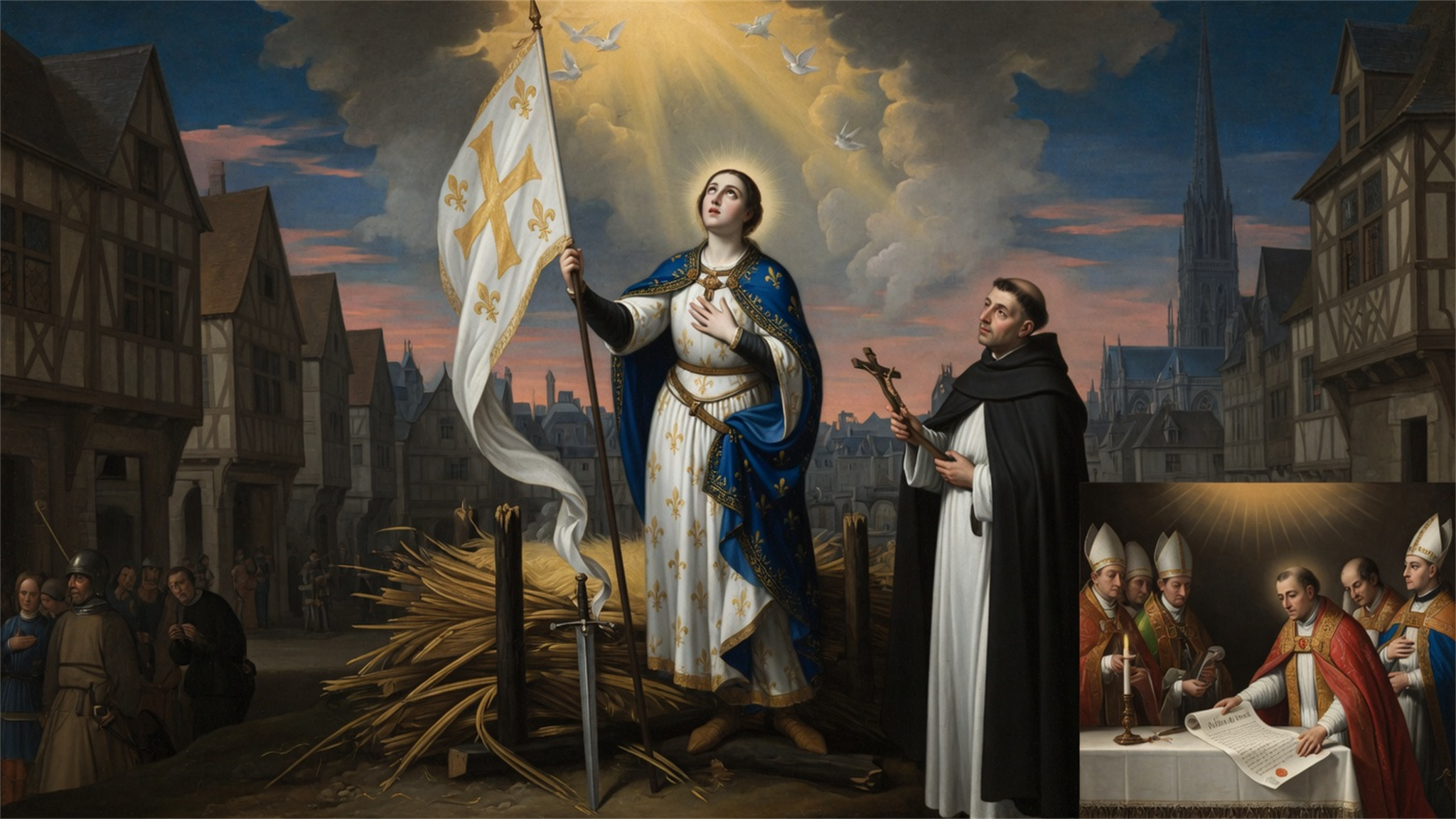
Now that the victim was bound and ready to be immolated, Cauchon sent to her, the next day at daybreak, Brother Martin l'Advenu, to announce her imminent death and to exhort her to repentance and to the confession of what were called her crimes. When the Brother had made known to her the horrible death she was to suffer that very day, the soul of Joan, so great and courageous, was at first seized with terror; she burst into groans and sobs. "Alas!" she cried, "am I to be treated so horribly and cruelly that my body, which is clean and whole, which was never corrupted, must today be consumed and rendered to ashes! Ah! I would rather be beheaded seven times than be burned in this way. Alas! if I had been in the ecclesiastical prison, to which I had submitted, and had been guarded by the people of the Church, not by my enemies and adversaries, it would not have befallen me so miserably as it has. Oh! I appeal to God, the great Judge, against the wrongs and grievances done to me." But, as soon as the first pain had thus been exhaled, and the Brother had given her some consolation, the pure radiance of her holy soul, submissive to God, shone through her tears like the sun emerging from the storms and clouds of the night. From then on, her spirit, detaching itself from the cares of the earth, turned solely toward God; she wept no more except to implore divine mercy in favor of a repentant sinner about to appear before the sovereign Judge. She confessed to Brother l'Advenu and asked with extreme ardor for Holy Communion, which had been refused to her most urgent requests for so long. The Brother, not knowing if he could grant her request, informed Bishop Cauchon, who consulted with several doctors and had it answered to give her communion and everything she desired. By this, the judges were actually absolving the Maid, and acknowledging themselves guilty by allowing the priest to absolve her of the faults for which they were on the point of excommunicating her. If the priest's absolution was valid and Joan worthy to receive the divine body of Our Lord, they could no longer exclude her from the Church as tainted with heresy. The adorable body of Jesus Christ was therefore brought with great pomp to the condemned, and those who accompanied it sang the litanies of the dying, saying at each response: "Pray for her!" Joan received communion for the last time from the hands of the Brother, with the humblest piety and shedding many tears.
The guilty Cauchon, having also come to visit her, heard his own condemnation from the very mouth of the condemned. When the Maid saw him enter, she addressed these simple and penetrating words to him: "Bishop, I die through you." He began to make remonstrances to her, saying: "Ah! Joan, have patience; you are dying because you did not keep what you had promised and because you have returned to your first sorcery." The poor Maid replied to this unworthy minister: "Alas! if you had put me in the prisons of the Church and delivered me into the hands of competent and suitable ecclesiastical jailers, this would not have happened. That is why I appeal from you before God." At this moment, Joan caught sight of one of the assessors, Pierre Morice, and said to him: "Ah! Master Pierre, where shall I be today?" — "Do you not have good hope in God?" he replied. — "Yes," she answered; "God helping, I hope to go to paradise." At nine o'clock in the morning, Joan climbed into the executioner's lugubrious cart. At her sides sat Brother Martin l'Advenu and Brother Isambart, who had more than once demanded, but in vain, justice in the trial. Eight hundred English, armed with axes, spears, and swords, marched around. On the way, she prayed so devoutly, and lamented with such sweetness, that no Frenchman could hold back his tears. Suddenly a priest pushed through the crowd, reached the cart, and climbed in. It was Nicolas l'Oiseleur, the Judas who had soiled his priestly garment with the blood of innocence: with a contrite heart, he came to ask Joan for forgiveness for his treachery.
Arrived at the Old Market, the place of the execution, Joan cried out: "Rouen! Rouen! is it here that I must die?" The place of execution was already crowded with the mob. Three scaffolds had been erected there, one for the judges, the second for the prelates and men of distinction, the third, near the stake, for Joan of Arc. They first gave her a sermon to reproach her for her relapse; she heard it with patience and great calm. "Joan, go in peace; the Church can no longer defend you and delivers you into the hands of the secular power." Such were the last words of the preacher. After that, instead of reading the act of abjuration, Cauchon exhorted the Maid to think of her eternal salvation, to stir up in the depths of her soul a true repentance for her faults, and above all to follow the advice of the two Dominican Friars who had been given to her to assist her. Without waiting for this advice, Joan had thrown herself on her knees, and was fervently invoking the mercy of God and the assistance of all the Saints. She particularly implored the help of her dear Saints, who had until then faithfully accompanied her in all her ways. In the name of the dying Savior, she also begged, with complete humility, all those present, of whatever state and from whatever side they might be, to forgive her for the trouble she might ever have caused them, just as, for her part, she forgave them all the injustices committed against her. Then she asked everyone for the help of their prayers, and that the priests present would be willing to do her the charity of saying a mass for the rest of her soul.
At this supreme moment, where, as a reward for her faithful services, she was on her knees on the stake, she said aloud before the people "that what she had done, whether it were good or evil, should not be laid to the account of the king." She had dedicated to him the fruit and the glory of her victories, and desired for herself only outrages and sufferings. Thus spoke the Maid in her final moments. She asked for forgiveness from those who had done her such a horrible injustice, from those who had tormented her soul and martyred her body. These great and beautiful words pierced all hearts like a sharp sword, and her enemies as well as her friends, and the judges themselves, began to weep and sob. It was the most magnificent victory she had ever won. Joan prayed thus for half an hour; then the damned soul of the English, Cauchon, spoke again and declared "that, in view of what had been established, this woman had never abandoned her errors and her horrible crimes; that she had hidden herself through diabolical malice under a false appearance of change and penance, by perjuring the holy name of God, by falling into blasphemies even more damnable than the previous ones, which rendered her obstinate, relapsed into heresy, and unworthy of the grace and communion of the Church, which had been mercifully granted to her by the last sentence; that consequently, after having considered everything and heard the mature deliberation of several skilled persons, he and his colleague had rendered the final sentence." This sentence is, like the first, addressed to the person of the accused. After having imputed to her all the crimes we have just heard, he concluded as follows: "That is why we, being on our tribunal, declare you relapsed and heretical by our own sentence; we pronounce that you are a rotten member, and, as such, so that you do not corrupt others, we declare you rejected and cut off from the Church, and we deliver you to the secular power, praying it to moderate its judgment toward you, by sparing you death and the mutilation of limbs. And, if you show true feelings of repentance, the sacrament of Penance will be administered to you."
Thus, even in their final sentence, two judges declared heretical and relapsed, hypocritical and impenitent, rejected and cut off from the Church, a person whom they had just admitted to Holy Communion! In truth, iniquity has lied to itself. According to the ancient principle that the ecclesiastical power must not shed blood, Joan was from then on abandoned to the secular authority to undergo her punishment. It is thus that two French ecclesiastics sold to England, like the two iniquitous judges of Babylon sold to their criminal passion, condemned Joan of Arc very unjustly, despite her innocence, despite her appeal to the Pope and the council; but the English themselves barbarously murdered her, since they made her undergo the penalty of fire without any form of trial or condemnation on their part.
Joan asked for a cross to strengthen herself in this final struggle; a compassionate Englishman hastened to make one for her out of wood and give it to her. She took it very respectfully, fixed it in her dress on her chest, and did not cease to cover it with kisses and tears, while imploring the assistance of the divine Redeemer, who also died, himself, innocently on the cross. Then she prayed that they would bring her the cross from the nearby church and that they would keep it constantly held up before her eyes, so that she could look until death at the image of the crucified Savior. When a priest from that church had brought it to her, she held it embraced for a long time with a singular fervor and while recommending herself to the mercy of God and the help of the archangel Saint Michael and her guide Saint Catherine. But the English found the time long, and immediately, without any form or sign of trial, they sent her to the fire by saying to the executioner: "Do your office." At that instant they seized her; she embraced the cross one last time and walked toward the stake where English men-at-arms dragged her with fury.
When Joan had arrived at the foot of the stake, they encircled her head with an ignominious miter; on it were written these words: "Heretic, relapsed, apostate, idolater." On a board suspended before the scaffold one could read in the French of the time: "Jehanne, who has called herself the Maid, liar, pernicious, abuser of the people, superstitious diviner, blasphemer of God, disbeliever of the faith of Jesus Christ, boaster, idolater, cruel, dissolute, invoker of devils, schismatic and heretic." Then Joan climbed onto the stake, where she was tied to a post. Beside her stood the good Dominican Friar Martin l'Advenu, her confessor. Already the flames were leaping up, and the Brother remained in the same place, solely occupied with the soul of which God had made him the guardian; but Joan, although threatened and surrounded herself by the fire, watched over him; she conjured him to descend from the stake. "Stay down below," she said to him; "raise the cross before me, that I may see it while dying, and say pious words to me until the end." At this instant, Cauchon approached her one more time. Joan said these last words to him: "I die through you." As for her revelations, she never wanted to revoke them and persisted in them until the end. According to the deposition of Brother Martin l'Advenu, always, until the end of her life, she maintained and asserted "that the voices she had had were from God, and that, whatever she had done, she had done by order of God, and did not believe that by the said voices she had been deceived." Also, with the deep feeling she had of her innocence and the iniquity of her judges, she cried out while casting a painful look around her: "Ah! Rouen! I have great fear that you will have to suffer for my death!" All those who heard the Maid, in the midst of the flames, protest her innocence, and who saw her, barely nineteen years old, in the flower of her life, endure with such heroic courage this horrible death, all, friends and enemies, were seized with immense compassion.
When the executioner had lit the combustible materials and Joan saw the flame rise, she cried out in a loud voice: "Jesus!" But the stake was so high that the fire rose only with difficulty and slowly around the unfortunate woman. When the smoke and flames surrounded the Maid on all sides, she asked again that they throw holy water on her; then she invoked one last time the help of the archangel Michael and the other Saints, and thanked God for all the graces with which He had filled her. Finally, the fire having approached her body, she bowed her dying head while crying out in a voice loud enough and intelligible enough to be heard by all those present: "Jesus! Jesus! Jesus!" This name, with which in expiring she said goodbye to the earth and greeted heaven, pierced even the hardest hearts. It was May 30, 1431. Near the stake stood an Englishman who, in his fierce hatred, had sworn to carry with his own hands wood to burn the cursed enemy of his country; at the moment when he was about to fulfill his cruel oath, he heard the last cry of the victim. His senses abandoned him immediately; he thought he saw a white dove rising from the flames toward the heavens, and, struck with terror, he fell to the ground unconscious. Many others recounted having seen the name of Jesus written in the midst of the flames.
When Joan was dead, the English had the fire pushed aside for some time, so that the people would be well assured that she was no longer of this world and that one would not say that she had escaped in a miraculous manner. However, a marvelous event occurred; whatever quantity of oil, sulfur, and coal the executioner heaped on the heart and entrails of the Maid, the fire did not succeed in consuming these parts of her body. This has been attested under the faith of an oath by the executioner himself, who was astonished by it to the highest point as if by a miracle. Consequently, the cardinal of England ordered the heart, the ashes, and everything that remained of Joan to be thrown into the Seine, so that nothing of her might remain that could be an object of veneration.
Such was the death of the Maid of Orléans; thus perished she who had sacrificed herself for France. Although cowardly servants of the Church, betraying her as Judas betrayed the Lord, had delivered her to death, she nonetheless remained faithful to the Church with an unalterable confidence and did not impute to it the faults of its unworthy ministers. Likewise, she did not detach herself from her homeland, although French judges traitorous to their homeland and to their duty had condemned her, and, despite the ingratitude of her king, she remained unshakeably attached to him, and it is thus that she was superhuman and heavenly in her death as in her life. As for those who had taken part in her death, the people loaded them with curses. Cauchon was afraid; as early as June 12, 1431, only thirteen days after the death of Joan, he solicited for himself and his accomplices, and obtained from the king of England letters patent which forbade citing them, on this subject, neither before the Pope nor before the Council. This fear alone of seeing their procedure examined and judged by the superior authority is a peremptory proof against them. But God, the supreme Judge, had taken it upon Himself to punish those who thought they would escape all human justice.
Cauchon died suddenly in the hands of his barber; Jean le Maistre disappeared from among men without anyone being able to know what had become of him; Joseph d'Estivet was found dead on a dunghill before Rouen; L'Oiseleur died a sudden death in a church in Basel; Nicolas Midy, who had preached before the execution, was carried off by leprosy; the Duke of Bedford died of grief and shame in this same castle of Rouen, where Joan had been imprisoned; and Henry VI, in whose name the Maid was immolated, saw himself dethroned twice, spent the greater part of his life in captivity, and perished massacred. Thus died those to whom Joan had said: "You will not do to me what you threaten me with, without experiencing damage in your body and in your soul." What she had prophesied to the English with such courage in irons, already having the death of the stake before her eyes, namely the ruin of their power in France, was entirely accomplished.
The justice that had been refused to Joan of Arc during her life was to be granted to her after her death. The inquiry ordered by King Charles was conducted with such conscience and such severe impartiality that there was no one, not even among the most bitter enemies of the Maid, who dared to attack it. The first hearing of the witnesses took place in Rouen, in the year 1449, by order of the king. In 1455, Pope Callixtus III addressed to the archbishop of Reims, to the bishops of Paris and Coutances, as well as to the Inquisitor, a Brief in which he charged them to examine the trial, to listen to both parties, and to pronounce according to law and justice. The depositions, one hundred and forty-four in number, preserved to this day, come from the noble st princes, the pape Calixte III Pope who ordered the revision of Joan's trial. most famous captains, and the bravest knights of France, as well as from the poor peasants of Domremy. The gathered acts were submitted to the leading scholars and jurists by the judges themselves, who, having added a council of doctors, then examined the whole affair again and pronounced after mature deliberation. The iniquity of the entire trial became manifest to their eyes; they saw everything that had been omitted, falsified, retracted, and added; how they had frightened the accused by threats and violence, and how they had mistreated her in every way without observing any of the simplest rules of justice. Thus they declared that this whole trial was null. As for the apparitions of the Maid, they decided that, if one relied on the signs that must accompany such revelations to be judged true, those of Joan were of such a nature that there were no legitimate motives to reject them. Her pious and irreproachable life, her vow of virginity faithfully kept, the extreme misfortune of France, which had such great need of the help of God, were all reasons to believe in the reality of her apparitions and the truth of her divine mission. Furthermore, her predictions about future things and things humanly impossible to foresee had been accomplished in such a way that they could not have been invented. Finally, she had really submitted to the Church, and the abjuration she had made had been torn from her by deception. On July 7, 1456, in a solemn assembly, the archbishop of Reims pronounced the sentence of rehabilitation; he declared that the twelve articles which formed the basis of the first trial, being false, slanderous, fraudulently arranged, and contrary to the declarations of the accused herself, were quashed by justice as null and void.
This piece of the condemnation trial thus judged and forever proscribed, of an instruction of which it was the sole basis, it still remained to pronounce on the two judgments rendered against Joan, that is to say on the very substance of the affair. This is what the judges did by a second decree whose tenor follows:
"Seen everything that is in the trial; seen mainly the two judgments rendered against Joan of Arc, of which the first is qualified as a judgment of grace, because it condemns her to perpetual imprisonment; the other, a judgment of relapse, because it condemns her as relapsed;
"Considering: 1° the quality of the judges; 2° the manner in which Joan was detained; 3° the recusations of her judges; 4° her submissions to the Church; 5° the appeals and requisitions multiplied by which she submitted her actions and her speeches to the Pope and the Holy See, and very insistently requested several times that the trial be sent in its entirety to the Pope; 6° considered that the abjuration inserted in the trial is false, that the one that took place was the effect of deceit, that it was torn away by fear in the presence of the executioner and the stake, and consequently tortuous and unforeseen, and that moreover it was not understood by Joan of Arc;
"Seen finally the treatises of the prelates and doctors of divine and human law, all concluding to the injustice and nullity of the trial;
"Everything considered, and having only God in view, the judges pronounce that the trial, the abjuration, and the two judgments rendered against Joan contain the most manifest deceit, slander, and iniquity, with errors of law and fact; and, consequently, the whole is declared null and invalid, as well as everything that followed from it, and, as far as necessary, is quashed and annulled, as having neither force nor virtue. Consequently, Joan is declared to have incurred no note or stain of infamy, from which in any event she is entirely washed and discharged."
The remainder of the operative part concerns the reparations due to the memory of an innocent accused, condemned and executed unjustly; here is what they consist of:
"1° The judgment that is rendered will be solemnly published in the city of Rouen; 2° there will be made in addition two solemn processions: the first at the Saint-Ouen square, where the scene of the false abjuration took place; the second, the next day, at the very place where, by a cruel and horrible execution, the flames suffocated and burned Joan of Arc; 3° there will be a public preaching in both places; 4° a cross will be placed at the place of the execution, in perpetual memory; 5° finally, there will be made in all the cities of the kingdom, and in all the remarkable places that the judges themselves will judge appropriate to determine, a notable publication of the judgment that has intervened, so that it may be remembered in future times."
After such a solemn rehabilitation, let us now listen to Pope Pius II, a contemporary of Joan of Arc, who speaks only with admiration of this holy girl. Having recounted her marvelous life, and noted that in her trial nothing had been established against her faith, nothing that appeared worthy of punishment, he exclaims: "Thus perished Joan, an astonishing and admirable virgin, who restored the kingdom of France, almost ruined and beaten down, and inflicted on the English so many defeats; who, having become a leader of warriors, kept her modesty unstained in the midst of soldiers, and was never the object of defamatory remarks."
The virgin of Domremy receives from all sides a cult of admiration and gratitude. May we soon see the Church crown with the highest of earthly rewards a set of virtues so heroic and a career so marvelous! Already they are petitioning in Rome for the introduction of her cause for beatification.
Annexes & related entities
Structured data for exploration: events, miracles, quotes, places, attributes, patronages, and important entities cited in the text.
Key Events
- First apparitions at the age of 13 in her father's garden
- Departure from Vaucouleurs on February 13, 1429
- Liberation of Orléans in May 1429
- Coronation of Charles VII at Reims on July 17, 1429
- Captured at Compiègne on May 23, 1430
- Execution at the stake in Rouen on May 30, 1431
- Solemn rehabilitation on July 7, 1456
Miracles
- Recognition of King Charles VII hidden among his courtiers
- Revelation of a secret known only to God and the King
- Miraculous discovery of the sword of Fierbois behind the altar
- Heart and entrails remained intact after the stake
Quotes
-
Jesus! Jesus! Jesus!
Last words at the stake -
Bishop, I die because of you.
Words addressed to Cauchon