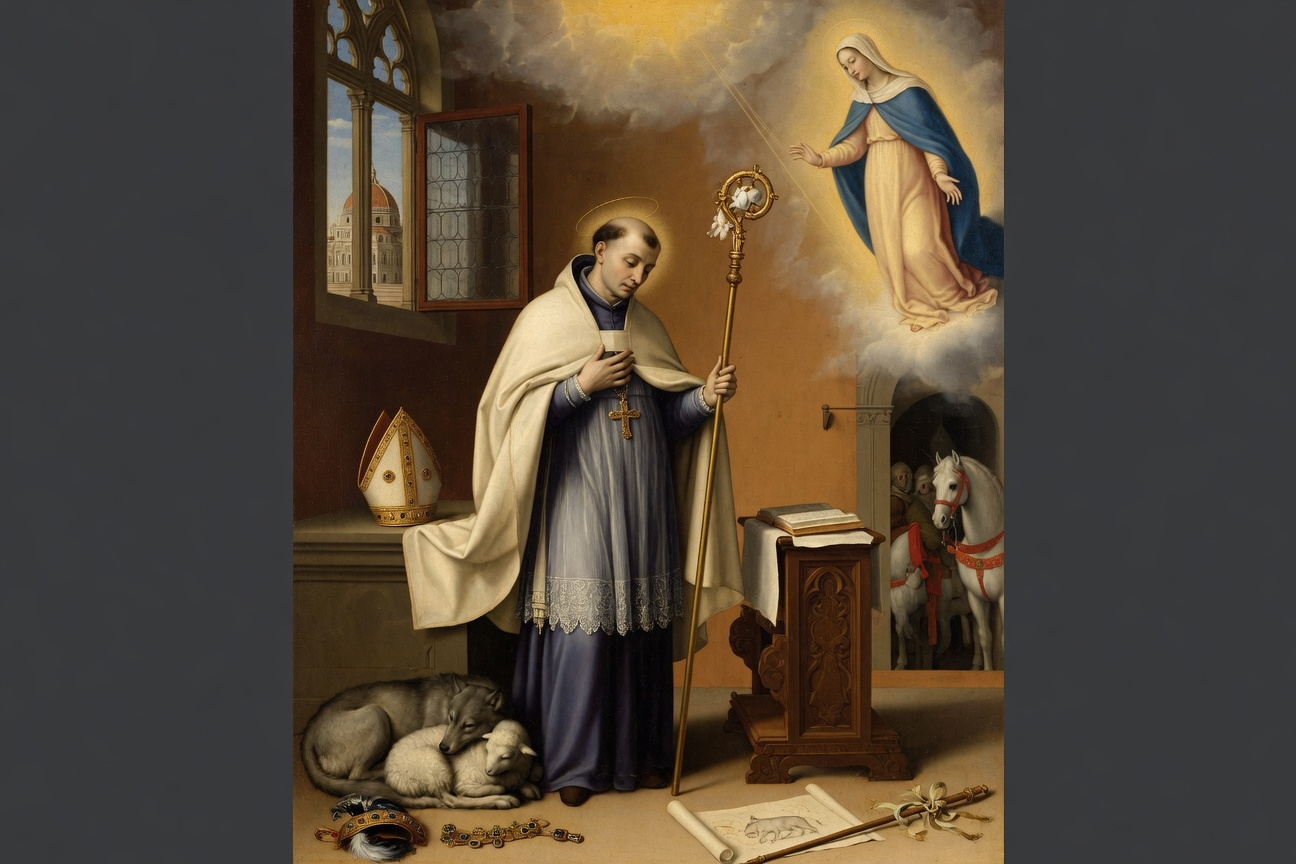
Born into the noble Corsini family in Florence, Andrew initially led a life of debauchery before converting and entering the Carmelite Order, fulfilling his mother's prophetic dream in which a wolf became a lamb. As Bishop of Fiesole, he distinguished himself by his profound humility, his love for the poor, and his talents as a peacemaker. He died in 1373 after being warned of his end by a vision of the Virgin Mary.
Guided reading
8 reading sections
SAINT ANDREW CORSINI, RELIGIOUS,
BISHOP OF FIESOLE
Youth and parental vow
Andrew was born in Florence into the noble Corsini family, the fruit of a vow made by his parents to the Virgin Mary, despite a youth marked by libertinism.
The best remedy against illnesses is recourse to God and the use of the sacraments. This is a fruit of grace rather than nature, since it was obtained through the power of prayer. His father was named Nicholas, and his mother Peregrina, both of the noble and ancient Corsini family in Florence. They lived for a long time in their marriage without feeling the effects of divine blessing; having heard a preacher recall these words from Exodus: 'Do not delay to offer to God the tithes and the first fruits,' they promised God to consecrate to Him the first of their children, if He would grant them one. They made this vow without each other's knowledge in the church of the Carmelites, before an image of the Blessed Virgin known as Our Lady of the People. Upon returning home, they communicated to each other what each had promised, and kneeling down, they renewed their promise together. The Mother of God, whose happy fruitfulness brought salvation to the world, granted their prayers. A child was given to them whom they named Andrew, because he came into the wo rld o André Carmelite friar and Bishop of Fiesole in the 14th century. n the feast of Saint Andrew. His mother had a dream the day before she gave birth to him; it seemed to her that she had brought forth a wolf cub, which, having retreated into the church, had immediately changed into a lamb. And as she did not understand at the time what this dream meant, she was troubled by it for a long time. His pious parents took great care to raise him in virtue and to advance him in the sciences, as a child already consecrated to the service of the Virgin. But he hardly responded to their desires; for, leaving the path of piety, he threw himself into libertinism. He stirred up quarrels at every moment, lost respect for his father and mother, mocked what they said to him, and spent all his time at games, in academies, and hunting; in a word, he thought only of indulging in pleasure, without concerning himself with his salvation: so that he showed, through sad effects, the weakness of nature, and how much it is inclined to evil when it is not powerfully restrained by the fear of God.
Conversion and entry into the Carmel
Touched by the account of a prophetic dream of his mother, Andrew converted and entered the Order of Carmelites in 1318.
However, one day when he seemed to be at the lowest degree of his debauchery, having treated his mother in an outrageous manner, this woman revealed to him the dream she had had concerning him: "You are assuredly," she said to him, "this wolf of which I dreamed before giving birth to you." Andrew, astonished by these words, like a man waking from a deep sleep, begged his mother to tell him of what wolf and what dream she wished to speak. Then, she recounted the vow that his father and she had made to dedicate their firstborn to the service of God and his most holy Mother; how, when she carried him in her womb, she had dreamed that she would bring into the world a wolf, which had entered the church where it had immediately changed
VIES DES SAINTS. — TOME II 17 form, and had become a lamb; she added that she recognized now by his works that he was this wolf, but that she hoped to see him, in time, gentler than a lamb, since he was born, not to serve men, but to be consecrated to the service of the divine Mary. These words of Pélérine had such efficacy on Andrew that he repented and asked her for forgiveness; all night he thought of the blessed Virgin.
The next day he entered early into the church of the Carmelites, and, prostrate before the image of Our Carmes Religious order for which Albert wrote the primitive rule. Lady of the People, he made this prayer: "Glorious Virgin Mary, here is the devouring wolf full of iniquities who addresses his humble prayers to you: as you gave birth to the spotless lamb whose blood redeemed and purified us, grant that he may purify me in such a way and so change my cruel wolf-like nature, that I may become a docile lamb, to be immolated to him and to serve you in your most holy Order." He persevered in this prayer until the ninth hour, his face bathed in tears. Then he rose and went to ask the superior of the monastery, who was the provincial of the Carmelites in Tuscany, to receive him among them. The provincial replied: "Tell me, my son, whence comes this will, since you are of noble race and lack nothing?" Andrew said to him: "It is the work of the Lord and of my parents, who made a vow to consecrate me forever in this place to the honor of the blessed Virgin." — "Wait a few moments," replied the provincial, "in a little while I will give you an answer." Immediately he notified his parents and assembled his religious. The father and mother of Andrew, who did not know what had become of him, had great joy at this news; they hurried to the church, where the mother cried out: "Behold my son who, from a wolf, has become a lamb." Andrew Corsini thus received the Carmelite habit in the year 1318, with the blessing of his father and his mother.
Religious life and temptations
The young novice demonstrates exemplary humility, triumphing over the mockery of his relatives and the temptations of the devil.
To test the constancy of the young novice, he was assigned the lowliest offices, such as sweeping the house, guarding the door, serving at table, and washing dishes in the kitchen. Andrew regarded all this as a glory. He devoted himself above all to silence and prayer. Mocked by several of his relatives and his former companions of pleasure, he bore it with patience and without saying a word. One day, while Andrew was guarding the door during his brothers' dinner, someone came and knocked with great insistence. Andrew, looking through the small window, saw a well-dressed person, accompanied by several servants, who said to him in an imperious voice: "Open quickly, for I am one of your relatives, and I do not intend for you to remain with these beggars; and it is also the will of your father and mother, who have promised you as a husband to a very beautiful girl." Andrew replied: "I do not intend to open, because I have been ordered by obedience to open to no one without permission: I do not believe that you are one of my relatives, for I have never seen you; and if I serve these humble brothers here, Jesus Christ himself became man to serve us; I do not believe either that it is the will of my father and mother that I leave here, for it is they who vowed me here to God, to the Virgin, a service in which I rejoice supremely; I believe on the contrary that you are a relative of the devil." The other replied: "I beg you, Andrew, open for me for a moment, so that I may speak with you about certain things, for the prior will not see it." Andrew retorted: "And even if the prior did not see it, there is God above him, who searches hearts and from whom no one can hide. It is for the love of Him that I guard the door, so that He may guard me Himself and be my help." While speaking thus, Andrew armed himself with the sign of the cross. Immediately the tempter, who was none other than the evil spirit, disappeared like a foul flash of lightning. Andrew gave thanks to God for this victory: he became stronger and more perfect because of it.
Having made his profession after a year, with the blessing of all the religious and his parents, he redoubled his fervor in the practice of virtues, particularly humility. His joy was to serve the poor and the sick, remembering this word of the Lord: "What you have done to the least of mine, you have done to me." He never missed the holy hours: night and day, he was the first in the choir; he never resisted the command of his superiors; the more he was commanded, the more joy he had. So as not to lose a moment, he was assiduous in the study of sacred letters. One day he asked the provincial, as a very great grace, to go to the cross every Friday. On that day he would take the discipline until he bled, and then, with a basket hanging from his neck, he would go into the main street, in the midst of the nobles and his relatives, to beg for bread and alms. His relatives, convinced that this was done to shame them, were indignant, and recommended that everyone mock him and insult him. He, on the contrary, went away quite joyful, saying to himself: My Lord Jesus Christ, being insulted, did not insult; being overwhelmed with sufferings, he did not become irritated. Andrew fled the company of women and light words. His recreation was the garden and the solitude of his room; his paradise was the church, the tree of life the crucifix, the holy land the Virgin Mary. He was of extraordinary abstinence and austerity; besides the fasts of the Church and the Order, he fasted on bread and water on Mondays, Wednesdays, Fridays, and Saturdays for the love of the Mother of God. He tamed his flesh with a very harsh hair shirt, with which he always slept on straw.
Priesthood and miracles
Ordained a priest in 1328, he manifested gifts of healing and prophecy, notably with his uncle John.
Uniting the study of letters with that of virtue, he became as good a preacher as he was an excellent religious, and showed himself as powerful in works as in words.
One of his relatives was tormented by a leg ailment that was eating away at his flesh. To distract himself from his pains, he indulged in gambling, and his house was a meeting place for gamblers. One Friday, as Andrew had gone out to beg for alms, he went to find him and said: "My uncle John, do you wish to be healed?" John replied: "Go away, beggar, you think you are mocking me." Andrew retorted: "Do not be troubled, my uncle; but if you wish to be healed, agree to my advice." John, having returned to more humble sentiments, then said: "I will do whatever you wish, provided it is possible." Andrew said: "If you wish to be healed, I want you to abstain from gambling for seven days, to fast for six of them, and for seven days to say seven Paters and seven Aves, with the Salve Regina, and I promise that the glorious Virgin will obtain your healing from her Son." Although John was an undevout man, nevertheless, hearing this lamb and seeing his simplicity, he took it upon himself to promise to do all this, and he did so indeed, quitting gambling, praying, and fasting. On the seventh day, which was Saturday, Andrew went to ask him how he was doing. John replied: "You are truly a friend of God, I am no longer in pain; I can walk like a young man, whereas previously I was always bedridden." Andrew said to him: "Let us go to the convent," and they came before the image of the Blessed Virgin, and prayed there together on their knees. After the prayer, Andrew said: "My uncle, untie your leg now, for it is entirely healed." Indeed, instead of being eaten away to the bone, the flesh was like that of a young child. From then on, John became entirely pious and devout, never ceasing to give thanks to God and the Blessed Virgin.
Andrew was ordained a priest in the year 1328. His parents had already arranged everything for the celebration of his first Mass, which they intended to make very august; but the humble religious disconcerted all their plans. He withdrew to a small convent seven miles from Florence, where, without being known by anyone, he offered to God the first fruits of his priesthood, with extraordinary recollection and devotion. Immediately after communion, the Blessed Virgin appeared to him, saying: "You are my servant, I have chosen you, and I will be glorified in you." Andrew only became more humble.
Studies and responsibilities
After studies in Paris and a stay in Avignon, he became prior in Florence where his holiness was recognized by all.
Some time later, his superiors sent him to Paris, whe re he Paris Place of birth, ministry, and death of the saint. completed his course of studies, and then he returned to Italy; passing through Avignon, he found there Pierre Corsin Pierre Corsini Parent of Andrea, Bishop of Volterra and future cardinal. i, Bishop of Volterra, his relative, who was later made a cardinal by Pope Urban V. He stayed there a few days with him and restored sight to a blind man who was begging at the door of a church. Upon returning to Florence, he healed a religious of his Order who was suffering from dropsy. Through these miracles, the holiness of Father Andrew was little by little manifested; but God made it even more brilliant through the gift of prophecy; for, having been asked by one of his friends to be godfather to his son, as he held the child in his arms during the ceremony, he began to weep: the child's father asked him the cause, and the Saint replied, after being strongly pressed: "I weep because this child is born for his own perdition and for the ruin of his house." And this indeed came to pass, because this unfortunate man conspired against his homeland and was executed by the hands of an executioner, and all those of his lineage were infamously deprived of the offices and dignities of the city. After his journey, he was elected prior of the convent of Florence. He discharged this duty so well, to the satisfaction of everyone, that he was judged worthy of holding more considerable ones; the occasion for this presented itself, although long after, in the following manner:
Episcopacy in Fiesole
Elected Bishop of Fiesole by divine intervention, he continued a life of extreme austerity and charity toward the poor.
The city of Fiesole, a league from Florence, at that time very beautiful and very rich, but presently ruined, having lost it s bish évêque Carmelite friar and Bishop of Fiesole in the 14th century. op, the clergy elected Father Andrew in his place by common consent. This choice having come to his knowledge, he fled so secretly to the Charterhouse of Florence that the canons, despairing of finding him, began to think of electing another. But divine Providence had already chosen the one whom men had named and who was hiding for fear of being a bishop: when they were on the point of collecting votes to elect another, a child of about three years old, entering the assembly despite the electors, said aloud: "God has chosen Andrew as prelate; he is in prayer at the Charterhouse, you will find him there." This oracle prevented them from proceeding further. At the same time, a young child, dressed in white, appeared to the Saint while he was saying his prayers, and said these words to him: "Do not fear, Andrew, because I will be your guardian, and Mary will be in all things your help and your protectress." The Saint set out on the road to go where God was calling him, and, meeting those who were coming to look for him, he went with them to the church, to the great contentment of all the people.
The episcopacy did not make him diminish his mortifications at all; on the contrary, he declared a new war on his body and increased his austerities; for, not content with always wearing a hair shirt on his back, he also took an iron belt, and each day, after having recited the seven penitential Psalms, he disciplined himself until he bled while saying the litanies. His bed was made of vine branches. He was so economical with his time that he did not give a moment of the day to recreation, so as not to steal it from more important and serious actions. He spoke to women as little as he could, and never lent an ear to flatterers. He had had all his life a heart very tender and very easily touched with compassion for the miseries of others; that is why he had a list made of the poor, and particularly of the shamefaced poor, in order to assist them all secretly. God let him know that He accepted his charity and his alms, because, during the famine, having one day given to the poor all the bread that was in his dwelling, as new beggars arrived from time to time, he was miraculously provided with a great quantity of bread to distribute to these starving people. In imitation of Our Lord, who is the sovereign Master of humility, he washed the feet of the poor every Thursday, in which he took extraordinary pleasure. One day a poor man presented himself with legs full of ulcers; he did not want to allow the Saint to touch them; but Andrew finally prevailed despite his resistance, and, scarcely had he finished wiping them, than the poor man found himself entirely healed.
Diplomatic Mission and Death
Sent as nuncio to Bologna by Urban V, he died in 1373 after receiving the announcement of his end from the Virgin Mary.
If he took such care to treat the bodies, there is no doubt that he had even more to feed and sustain the souls: it is in this that his charity could be called victorious and triumphant; for it gave him inventions to renew friendships and to appease all kinds of dissensions. Thus, Pope Urban V cast his eyes upon him to send him as n uncio to Bolo pape Urbain V Reforming pope of French origin, 200th pope of the Catholic Church. gna, which was full of factions. Andrew very fortuna tely ap Bologne City of birth and return after the Blessed's conversion. peased the spirits, rallying the nobility with the people through a knot of peace and mutual charity, and procuring for them by this means the happiness of public tranquility; which filled all this famous city with joy. Besides the care he had to provide for the needs of the souls and bodies of his flock, as being the spiritual temples of Jesus Christ, he also worked to repair the material temples, and had his cathedral church, which was threatening to fall into ruin, rebuilt. Finally, having reached the age of seventy-one, as he was celebrating High Mass on Christmas night, the most holy Virgin appeared to him and warned him that, on the day of the Kings, he would depart from this world to enter the celestial Jerusalem, in order to see face to face there that adorable Master whom he had served with such fidelity. These most agreeable tidings having wonderfully expanded his heart, he celebrated the other two masses of this holy feast with such interior joy that it shone upon his face: he appeared no less rosy than that of a man in full health, although ordinarily he was very pale and livid, because of his austerities. The very next day, the fever took him; which he made known to one of his friends, named Guy, a canon of his church, assuring him that he would soon go to the house of God. He put the best order possible to the affairs of his bishopric, and, on the day of the Epiphany, having had the Psalter brought to him, he recited with those present the three creeds: that of the Apostles, that of Nicaea, and that which is called Saint Athanasius'; then, although the sun had not yet risen, it was as bright in his room as if it had been noon. Finally the Saint, devoutly saying this verse of the canticle of Saint Simeon: "Now, Lord, you let your servant go in peace according to your word," peacefully rendered his blessed soul on January 6, the year 1373, being seventy-two years old, the thirteenth of his episcopate.
Cult and canonization
Canonized in 1629 by Urban VIII, his cult is particularly honored by the Corsini family and Pope Clement XII.
Since his death, God has often manifested the glory of his soul, either through miracles performed at his tomb or through victories that the Florentines obtained through his intercession. As a result of these wonders, the Holy See had been petitioned several times to proceed with his canonization, so that he was already considered a Saint as early as the time of Eugene IV, who permitted a solemn feast to be celebrated in his honor in the church o f Mount Florence City where Julie served as a maid. Carmel in Florence and throughout the diocese of Fiesole; but finally, after seve ral petitions, P pape Urbain VIII Pope who beatified Josaphat. ope Urban VIII issued the solemn decree of his canonization on April 22, 1629. His feast day was transferred to February 4. — Po pape Clément XII Pope who canonized Catherine in 1727. pe Clement XII, who was of the same family, and the Marquis of Corsini, his nephew, magnificently adorned the chapel where the body of our Saint is kept, in a beautiful white marble tomb. This chapel is in the Carmelite church of Florence. The same Pope also had a magnif icent chapel built a Saint-Jean de Latran Cathedral of Rome where Clement XII had a chapel built for the saint. t Saint John Lateran, worthy of the first church in the world, which he dedicated under the invocation of Saint Andrew Corsini and where he wished to be buried. The church of Saint John Lateran is the Pope's parish church, and consequently the cathedral of Christendom.
4° He is often represented holding his crosier; near him lie on the ground the wolf and the lamb seen by his mother in a dream; 2° He is saying Mass, and the Blessed Virgin appears to him to announce that Jesus Christ awaits him in heaven on the day of the Epiphany; 3° He appears above a battlefield, carried either by clouds or by a white palfrey. This manner recalls his miraculous intervention in a victorious battle fought by the Florentines against the inhabitants of Picinino. — Stefano della Bella depicted his canonization in a series of twenty-one plates.
His life is best written in the first volume of Surius, who drew it from a manuscript of the abbey of Bougeval; it is from there, and from another manuscript in the Vatican Library published by the Rev. Fr. Dominic of Jesus Mary, of the Discalced Carmelites, that we have drawn the little we have just said. Bellandus reports both on January 15.
Annexes & related entities
Structured data for exploration: events, miracles, quotes, places, attributes, patronages, and important entities cited in the text.
Key Events
- Born in Florence following a vow made by his parents
- Entered the Carmelite Order in 1318 after a dissipated youth
- Priestly ordination in 1328
- Studies in Paris and trip to Avignon
- Election as Bishop of Fiesole
- Nuncio mission to Bologna to appease factions
- Died on the feast of the Epiphany 1373
- Solemn canonization in 1629 by Urban VIII
Miracles
- Healing of his uncle Jean's leg ulcer
- Restoration of sight to a blind man in Avignon
- Healing of a dropsical religious in Florence
- Multiplication of bread for the poor during a famine
- Instant healing of a poor man's ulcers during the washing of the feet
- Miraculous intervention during a battle of the Florentines
Quotes
-
Here is the devouring wolf, full of iniquity, who addresses his humble prayers to you... grant that I may become a docile lamb.
Prayer of Andrew before the image of Our Lady of the People -
God has chosen Andrew as prelate; he is in prayer at the Charterhouse, you will find him there.
Words of a three-year-old child during the episcopal election