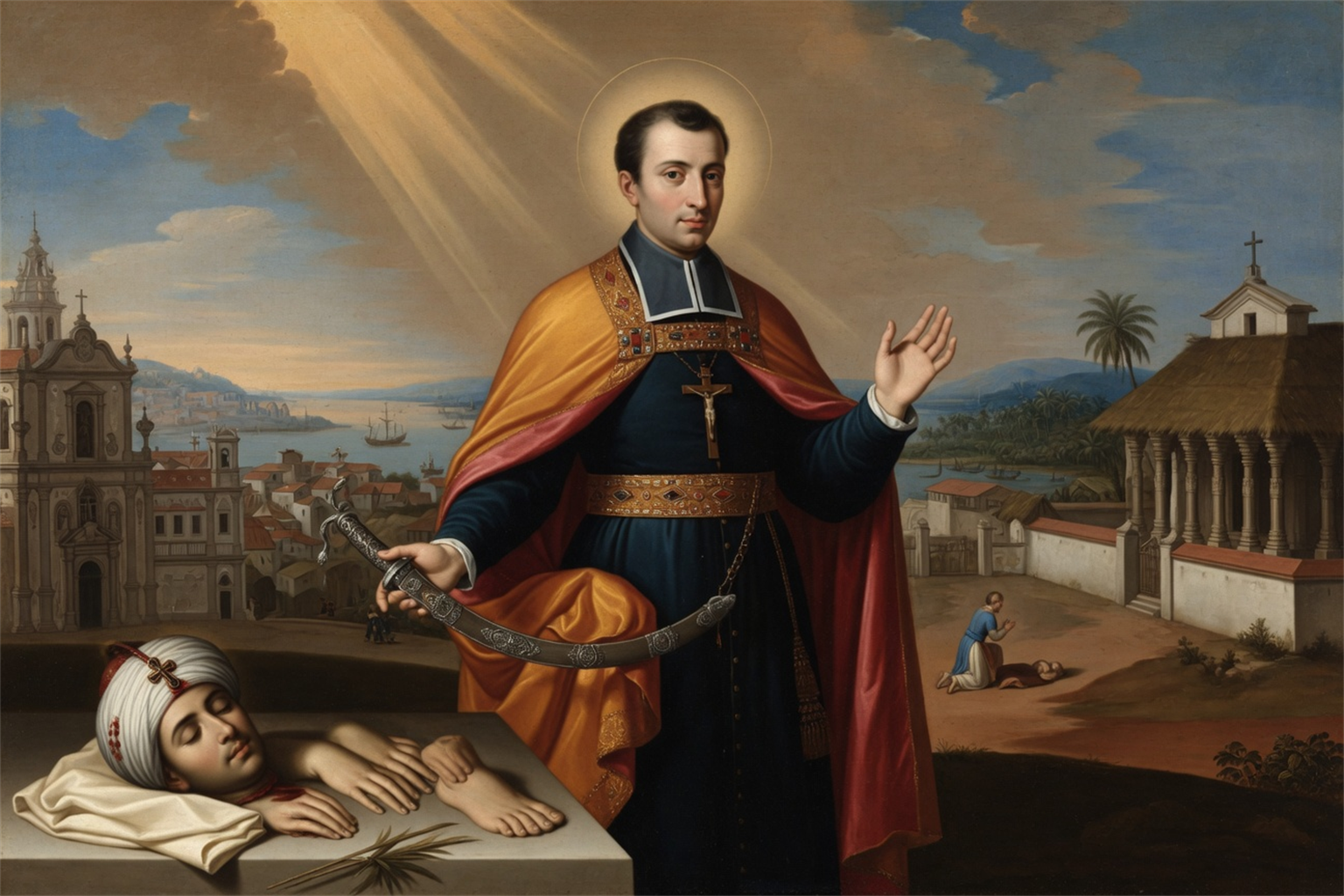
A 17th-century Portuguese Jesuit, John de Britto dedicated his life to the evangelization of India, adopting local customs to convert thousands in Madurai. Despite persecution by the Brahmins and opposition from the court of Lisbon, which sought to keep him, he returned to Marava where he was arrested. He died a martyr by beheading on February 4, 1693, after converting Prince Thadiyathevan.
Guided reading
8 reading sections
BLESSED JOHN DE BRITTO, MARTYR
Youth and Portuguese Vocation
Born in Lisbon in 1647 into the nobility, John de Britto became a page at court before entering the Jesuit novitiate following a miraculous recovery attributed to Saint Francis Xavier.
Born in Lisbon on March 1, 1647, to one of the most noble families of Portuga l, John de Bri Jean de Britto Portuguese Jesuit missionary and martyr in India. tto showed, from his childhood, inclinations and qualities that foreshadowed the designs God had for him: a character both gentle and firm, a generous heart, he took pleasure only in serious things and the practices of religion. His virtue, at the age of nine, was already strong enough to face the dangers of the court, when he was introduced there as a page to Dom Pedro, son of John IV. He shared the literary studies of the Infante with other young gentlemen, and he distinguished himself among his companions as much by his successes as by his piety. While the others were only concerned with the honors of their position, he already aspired to the apostolic life and nourished himself on the accounts of the missionaries' labors. Full of admiration for those of Saint Francis Xavier, he conceived a tender devotion for him, which the Lord rewarded with miraculous favors. Having fallen dangerously ill, he asked for his recovery from his patron saint, and promised him that he would wear the habit of the Society of Jes us for one year if Compagnie de Jésus Religious order to which Peter Canisius belonged. he regained his health. He obtained this favor and fulfilled his promise. At the end of the year, he laid aside these holy garments, but he kept the desire to take them up again never to leave them. Indeed, as soon as he reached the age to fulfill his resolution, he began to set aside all the obstacles that his family and the court opposed to him, and, on December 17, 1662, he entered the novitiate of Lisbon.
Victorious over the world, John de Britto thought only of imbuing himself with the spirit of Jesus Christ and taking advantage of the means he found in his new state to form himself in evangelical perfection. He walked with such great strides in this path that he was for all his brothers a model of charity, humility, obedience, and fervor.
Departure for the Missions of the Orient
After his studies, he embarked for the Indies in 1673, caring for the sick during a grueling crossing before reaching Goa.
His virtue did not falter during the studies to which he was applied after the trials of the novitiate: on the contrary, they provided new fuel for his zeal; he devoted himself to them with ardor to draw from them all the resources he would one day employ in the exercise of the apostolic ministry. Thanks to such holy intentions, to his talents, to his aptitude, and to his application, he made surprising progress in the courses of belles-lettres, philosophy, and theology. He had not yet finished the latter when he executed the plan he had long formed to devote himself to the salvation of the Indians. His family, his relatives, and the court piled up difficulties to prevent him from leaving his homeland; but, by dint of constancy and energy, he managed to overcome them; and on March 25, 1673, he embarked for the Indies with twenty-seven of his confreres, who were to share his labors.
The navigation was at first very fortunate; but upon arriving at the equator, the vessel was, so to speak, chained by a calm of several days. The passengers could not resist this atmosphere of fire: soon the ship offered nothing but a frightful spectacle of the dead and the dying. John de Britto, recovered among the first, devoted all his strength to the service of the sick; he displayed toward them a charity so generous that it earned him the title of New Xavier. However, as care was not enough for so many ills, he invoked the help of heaven through the intercession of the Apostle of the Indies. Immediately a favorable wind arose, and the ship, resuming its course, arrived at the port of Goa, after havin g e Goa Place of transfer of the apostle's relics by the Portuguese. ndured a terrible storm at the Cape of Good Hope, from which the prayer of our Blessed one also snatched it.
The first care of the missionaries, upon landing in Goa, was to go and thank Saint Francis Xavier at his tomb for the protection he had granted them, and to pray that he might obtain for them the zeal with which he himself had been animated. This was above all the wish of Fr. de Britto. He did not delay in showing that he was animated by the same spirit as his illustrious patron: while waiting for the moment to enter his mission, he exercised his zeal in the city of Goa, among the most miserable and abandoned classes of society. The labors to which he then devoted himself often exhausted his strength, but they inflamed his courage and increased in him the desire to endure even greater ones. He was to find them in the Malabar mission.
The Apostolate in Madurai
He established himself in the Madurai mission, adopting local customs and the lifestyle of the Rajahs to evangelize despite the hostility of the Brahmins.
The Society of Jesus had established several missions in the peninsula on this side of the Ganges, which were divided into two provinces. The first embraced the missions of Mysore, Agra, the Mughal Empire, Tibet, and, later, that of the Carnatic. In the second were included the missions of Ceylon, Mylapore, Bisnagar, Golconda, Bengal, Madurai, Travancore, Zancovin, and the Christendom of Saint Thomas. It was in the Madurai mission that Fr. de Britto exercised his zeal.
In this country, even more than in other regions of the Indies, the missionaries encountered serious obstacles in the customs of the Indians, in the horror they felt for the Pranguis, that is to say, the Europeans; in the attachment they had for their traditions, their usages, their superstitions; in the mutual antipathies of the castes; in the powerful jealousy of the Brahmins, who formed the first; in the burning heat of the climate, in the political troubles, and the internecine wars that continually devastated the country. To overcome all these obstacles, the missionaries condemned themselves to the most cruel privations: in accordance with the advice of Saint Paul, they made themselves all things to all men to win all this world to Jesus Christ; they adopted the usages and legitimate customs of the Indians; they incorporated themselves into the castes and submitted to their laws in order to bring them to those of the Gospel. Thus, Fr. de Britto entered the middle class of the Rajahs and presented himself to the peoples of Madurai with the title and costume of Pandavam-Souami.
His Madurai mission extended over the entire kingdom of that name, as well as those of Vellore, Gingee, Tanjore, and Marava. The kings of these various states were then waging a bitter war, and enemy bands spread havoc, disorder, pillage, and death everywhere. The scourges of famine, plague, and floods were often added to the scourge of war to devastate this unfortunate country.
It was in the midst of these obstacles and many others that the missionaries had succeeded in founding numerous Christian communities; Fr. de Britto also had to struggle against the same difficulties to maintain the work of his confreres. However great the dangers were, they did not equal his zeal. After having, as it were, tested it in the Christendom of Colei, where he established an admirable fervor, he was placed in charge of all the Christian communities included in the district of Tattouvantcheri, and soon after, of those in the northern districts. In both, he displayed superhuman courage, tireless ardor, and boundless charity: continually occupied with visiting them, instructing them, and distributing to them the aids of religion, he was found especially among the most afflicted and the most miserable; day and night, all his time and all his strength were devoted to them: often he was obliged to gather entire tribes driven out by war, and to create for them, in the woods or on deserted mountains, a new homeland where he provided for their temporal necessities as well as their spiritual needs. For them, he suffered hunger, thirst, and the inclemencies of the weather, crossed rivers by swimming, struggled against the powerful and implacable hatred of the Brahmins, faced the persecutions of tyrants, and exposed himself to the blows of assassins charged with taking his life. The Lord delivered him from the dangers that surrounded him on all sides, as well as from the deadly illnesses that his excessive fatigue often caused him; but He discharged His wrath upon the enemies of His servant: some perished in overflowing rivers, others were consumed with their dwellings by fire from heaven; several found death in the very ambushes they had laid for the holy missionary. Such terrible punishments, the continual miracles that Fr. de Britto performed, and the even more surprising wonders of his zeal, gave his ministry a marvelous efficacy: entire tribes of pagans converted to the Gospel and formed new Christian communities that rivaled the old ones in fervor.
Mission Superior and First Trials
Appointed superior in 1682, he faced political anarchy and violent persecution in the Marava, where he was captured and tortured before being banished.
The superiors of Fr. de Britto, struck by his successes as much as by his qualities and his holiness, entrusted him in 1682 with the government of the entire Madurai mission. The man of God found consolation for the honor of this charge only in the difficulty of fulfilling it. It was indeed to condemn him to the most cruel sufferings and unheard-of labors. Never had the Lord subjected the Madurai mission to harsher trials, and it required nothing less than a new Xavier to sustain it in such circumstances. The kingdoms it comprised were prey to a frightful anarchy: the wars of the preceding years had broken many heads and crowns; rebellious vassals or bold brigands fought over these remnants; some seized a city, others made themselves masters of a fortress, all extorted the people and ravaged the countryside. In the favor of this disorder, bands of brigands formed everywhere, offering their services to various parties and paying themselves through pillage. The Brahmins, those implacable enemies of the Christians, took advantage of the general confusion to satisfy their hatred; and as they exercised great influence over the populations, the leaders of all parties and all bands hastened to lend themselves to their vengeance to obtain their support. The neophytes were therefore, throughout the extent of the mission, slandered, denounced, ruined, chased, and pursued. Persecution broke out now in one Christian community, now in another, often in entire districts. Although Fr. de Britto was admirably seconded by several of his confreres, he always flew to where the danger was greatest and the needs most pressing: he sustained the courage of his children by his presence, revived their faith, raised their hopes, reminded them of the teachings of our religion, strengthened them in the sacraments and the ceremonies of worship, and gave them rules of conduct without ceasing to provide them with aid. Sometimes he obtained for them, through his prudence, the favors of the governors, whom he enlightened regarding the impostures of the Brahmins; but, more often, he had to share with them the cruelties with which pagan fanaticism overwhelmed them, and he could give them no other consolation than that which he himself felt at the sight of their constancy. Such was, in a few words, the conduct of this great man during the four years his charge lasted. We cannot enter into the details here: they can be read in his history; it will suffice for us to recall briefly the horrible torments he underwent in the Marava in the last year of his administration. In 1669, a bloody persecution had almost annihilated the Christianity of the Marava kingdom : the Marava Kingdom where the saint suffered martyrdom. neophytes who had escaped death or exile had taken refuge in the woods or in neighboring Christian communities; but later they had returned little by little to their country; they practiced their religion there in secret, transmitted it to their children, and prudently extended the knowledge of it around them. The Missionaries of Madurai followed with attention the rebirth and progress of religion in the Marava; they often went to the borders of this State, maintained relations with the Christians there, and sent them skilled catechists who brought them, on their behalf, teachings and rules of conduct. Through these holy industries and others suggested by charity, the Christianity of the Marava was reconstituted insensibly and finally became so numerous that the Brahmins, frightened, undertook to renew the persecution of 1669. Fr. de Britto, having been warned, ran to the aid of his children, fully resolved to share their sufferings if he could not spare them. He entered the Marava on May 5, 1686. He penetrated into the woods where numerous neophytes, under the direction of their catechists, were engaged in their religious duties, and into other secluded places where they sheltered their worship. He devoted his days and nights to exercising the functions of the ministry in their favor. He endured privations and unheard-of fatigues, but he was rewarded by prodigious successes. Besides the thousands of Christians he admitted to the sacraments of penance and the Eucharist, he had the joy of giving to the Church, in two months, two thousand and seventy more children.
Despite the precautions the Christians took to hide the Father's presence among them from the Brahmins, their eagerness to profit from his care and his pains revealed their secret. The Brahmins therefore set out in search of the missionary and alerted all the authorities of the country. Fr. de Britto, thus tracked, did not take long to fall into the hands of his enemies. He was going to carry the benefits of his zeal from one Christian community to another with two catechists and four neophytes when they were met and seized by a detachment of the troops of Kumara-Pillai, commander-general of the Marava armies, who was returning from an expiatory ceremony. These soldiers, excited by their own fanaticism and by the desire to please their leader, threw themselves with savage brutality upon their prisoners, overwhelmed them with outrages and blows, and then dragged them to Mangalam, where Kumara-Pillai was. The latter, far from repressing this insolent soldiery, seemed to want to compete with them in coarseness and barbarity. After having greeted Fr. de Britto and his companions with insults and threats, he had them chained in the public square and delivered them, throughout the night, to his soldiers and the populace, who made them suffer inhumane treatment. Kumara-Pillai was even more cruel than his ministers: the next day, as the confessors of the faith did not cease to praise Jesus Christ instead of denying Him, he bruised them with blows, had them thrown several times, hands and feet bound, into a pool of dirty water, where they were left until they were about to be suffocated, then they were locked in a kind of den, where they received no other relief than the testimony of their conscience and the help of grace. The following day, Kumara-Pillai had the same torments renewed upon them, and even crueler ones. He then had them dragged in his wake to Kalaiyarkoil and, from there, to Pagany, where he condemned them to new tortures. Fr. de Britto had the largest share. By order of Kumara-Pillai, he was stripped to the waist and stretched under the heat of the sun on a flat rock, but one sown on its surface with sharp asperities. Then eight executioners, armed with sticks and rope whips, discharged their instruments with redoubled blows upon his body, already all covered with wounds. When the executioners felt their arms tired, they began to trample their victim, as if to crush him under their feet. They left him almost lifeless, exposed to the heat of a burning sun. Finally, they dragged him by the hair and arms into a dungeon. The other confessors underwent various kinds of torments; but Silvei-Mayagan, the principal catechist of Fr. de Britto, had the same fate as his master: they discharged such violent rattan blows upon his head that one of his eyes, torn from its socket, hung on his cheek. He was dragged in this state into the prison of Fr. de Britto Silvei-Mayagan Principal catechist of John de Britto, miraculously healed. who, upon seeing him enter, held out his arms to him, pressed him to his heart, kissed his wounds respectfully, put his eye back in its place, and healed him by the virtue of the sign of the cross.
This miracle did not change the dispositions of Kumara-Pillai regarding the confessors of the faith: defeated by their constancy, he condemned them to be impaled, after having had their hands and feet cut off. But he did not dare to execute his sentence before having obtained confirmation from the king of the Marava. While he awaited it, he subjected his victims every day to refined cruelties. The confessors, animated by Fr. de Britto, offered all their sufferings to God to merit the martyrdom that was promised to them. They sang together the praises of the Savior, whom they had not ceased to bless in their trials, and called with all their eyes for the death that was to reunite them, in heaven, to the choir of martyrs. This was above all the wish of our Blessed one, whose great soul aspired only to suffer for the love and glory of his divine Master. But the Lord, who destined him for new sacrifices, contented himself this time with those he had just offered Him. The king of the Marava did not ratify the sentence of his minister; he limited himself, after having heard the confessors, to forbidding them henceforth from entering his States. As for Kumara-Pillai, accused later of having conspired against his sovereign, he underwent the torture to which he had condemned them.
Diplomatic return to Europe
Recalled to Portugal for mission affairs, he refused the honors and bishoprics offered by King Peter II in order to return to his neophytes.
Fr. de Britto, freed from his chains, went to the college of Topa to restore his exhausted strength and await the opportunity to return to the Christian communities, in the midst of which he had found such terrible trials. He was already preparing to re-enter the Marava, when the Father Provincial sent him to Europe for the affairs of the missions of the Indies. The holy missionary, no less obedient than zealous, resigned himself to the will of his superior, without losing the hope of one day seizing the palm of martyrdom. He left accompanied by the wishes and admiration of his collaborators: "Fr. de Britto," one of them wrote at the time, "is truly an apostle, an extraordinary genius in every respect. Since I entered this mission with him, he has multiplied its Christian communities and faithful. He only used his powers as superior to relieve others; he always reserved the most arduous tasks for himself. What activity! What zeal! He faced all perils to save souls and extend the kingdom of Jesus Christ, for the love of whom he was taken several times and condemned to frightful torments. As for me, I will never have enough affection in my heart to worthily recognize the obligations and favors that I owe to this illustrious missionary, to this great apostle of our time."
These testimonies of veneration, Fr. de Britto received not only from his collaborators, but also from all those who knew him. In Portugal, where his labors, his enterprises, his miracles, and his sufferings had become known, he was welcomed with holy enthusiasm: everywhere people vied for the happiness of seeing and hearing him; the court envied his presence to his relatives; his family constantly claimed him; the bishops wanted him to go and bless and edify their people; the universities aspired to the same favor; the monasteries, all the religious communities asked in their turn to attend the Mass and the exhortations of a Saint; entire populations crowded his path to receive his blessing.
Insensible to such honorable eagerness, Fr. de Britto was concerned only with the interests of the glory of God: he went where he believed he could procure it; he granted the world only the duties that religion itself forbade him to refuse. Moreover, wherever he found himself, he always remembered that he was a missionary of Madurai: his dear Indians were more present in his thoughts than the people who surrounded him. He took only one meal a day; rice, vegetables, and water made up all his food; a board or a bear skin spread on the hard ground served as his bed; finally, he maintained in his habits all the privations to which the missionaries of Madurai condemned themselves. When he was asked why he did not take advantage of his stay in Portugal to restore his strength, or to acquire new ones: "What!" he replied, "my brothers endure in Madurai the labors of the apostolic ministry, the fatigues of travel, the burden of the day and the heat; they sacrifice their health, their life, to the glory of Jesus Christ; my neophytes themselves, my children, brave persecutions: and I, a cowardly soldier, would abandon myself here to the pains of idleness! What would the great Xavier say? What would Saint Ignatius, my father, say? What would Jesus, my leader and my master, say; if, content to have touched the edges of the chalice with the tip of my lips, I did not aspire to the happiness of drinking it to the dregs?"
Full of these thoughts, Fr. de Britto was only consoled for being separated from his mission by the services he rendered to it in Europe. He did indeed render it very great ones during his stay in Portugal: he recruited numerous and generous workers for it; he collected temporal aid for his neophytes; he settled disputes that hindered the zeal of the missionaries. As soon as he had thus secured the interests of his mission and finished the business that had called him to Europe, he prepared to return to the Indies. Peter II, who had resolved to entrust him with the education of his son, used all kinds of means to keep him in Portugal, but nothing could stop Fr. de Britto. He finally left for the Indies on April 8, 1690, accom panied by Pierre II King of Portugal and former fellow student of the saint. twenty-five of his confreres, who had solicited this favor.
The conversion of Prince Tériadéven
Upon returning to India, he converted Prince Tériadéven, which provoked the fury of the King of Marava, whose niece was one of the wives dismissed by the prince.
Not everyone, unfortunately, was to reach the end of the journey: two died on the way, victims of the epidemic that broke out on the ship. On this occasion, Fr. de Britto renewed those wonders of zeal and devotion that he had performed on his first voyage. His strength could not suffice for the efforts of his charity: exhausted by fatigue, he was himself struck by the scourge, and soon the illness reduced him to the brink of death. As the captain and the ship's officers were deeply worried about his fate: "Please," the man of God said to them, "give all your care to my companions, who have a greater need of it; do not worry about me: my neophytes are waiting for me; many catechumens wish to receive baptism from my hands, God will not allow me to die far from them." Indeed, Fr. de Britto recovered his health, and he was able to arrive safe and sound in Goa.
Far from taking the rest he needed there, he gave himself over to the ardor of his zeal, while waiting for the moment to return to his mission. However, the esteem of his sovereign almost tore him away from his apostolic labors. Convinced that he could not entrust the education of the Infant to a more skillful master, Peter II acted in Rome to have Fr. de Britto return to Portugal. He finally yielded to the observations of the Father General; but, to give some satisfaction to his regrets, he undertook to have the holy missionary raised to the archiepiscopal see of Amangalam or Cranganore. All these attempts failed before the self-denial of Fr. de Britto. Martyrdom had more attraction for him than the dignities of the Church; the desire to suffer it, which had pressed him to return to the Indies, also pressed him to return to the mission of Madurai.
But, before returning him to his neophytes, God inspired the superiors with the thought of charging him to visit all the residences of the province of Malabar, as if He had wished to place before the eyes of the missionaries one last time the one who was the model for all and whose sacrifice He was soon to accept. Fr. de Britto fulfilled this mission to the great satisfaction of God and men. "Despite the disorders and civil wars that continued to desolate this unfortunate country," says one of his historians, "he visited all its Christian communities, received the blessings of the neophytes, showered them with his own, revived their faith and their fervor; he communicated his courage to the missionaries; and soon all the missions of Malabar were inflamed with the sacred fire that consumed his heart. This extraordinary movement drew the pagans themselves: they came in crowds to ask Fr. de Britto for the teachings of the faith and the Sacrament of Baptism."
However, the zeal of the man of God constantly aspired to other labors and greater sufferings; the crown of martyrdom always tempted his holy ambition. He was in a hurry to go and seize it again in Marava. Moreover, Frs. de Mello and Joseph de Carvalho, who, during his absence, had devoted their care to this mission, had just succumbed to the persecutions and mistreatment of the Brahmins, and their death left it without help. Fr. de Britto therefore returned to Marava on May 27, 1691, despite the fanaticism of the Brahmins, who also favored the troubles of war in this kingdom. He traveled successively through several Christian communities, welcoming the neophytes who flocked to him, conferring baptism on thousands of catechumens, instructing the pagans whom grace brought to him in great numbers. When, after two or three weeks, he had conferred baptism on five or six hundred catechumens, heard the confessions of fifteen hundred to two thousand neophytes, that is to say as many as presented themselves, and distributed his teachings and advice to all, he hastened to go and seek the same labors in other localities. "Such was the stir caused by his name," says the same historian, "that the neophytes and the infidels, numbering several thousands, without waiting for him to have reached the goal of his journey, often stopped him in the open country and asked him for religious instruction, or baptism, or the other sacraments. Fr. de Britto would then suspend his march, raise an altar in the open air, set up a hut, and, for several days and nights in a row, he would satisfy the pious desires of this multitude."
Such successes inflamed the anger of the Brahmins: they sowed a thousand traps in the footsteps of Fr. de Britto, plotted his death, and set agents in pursuit of him charged with executing their project. The man of God, thus hunted by so many enemies bent on his destruction, took refuge sometimes in the forests, sometimes in some isolated Christian community, where he spent the night and day confessing the neophytes, instructing and baptizing the catechumens or the pagans brought to him by intrepid catechists. Finally, he established himself on the borders of Marava, in the independent principality of Mouni, whose sovereign, although an idolater, allowed him to stay. From there, he often made apostolic excursions into the interior of the country, toward the Christian communities too far away to go to Mouni to seek the benefits of his zeal. His ministry was everywhere so successful that he increased this church by a very large number of new faithful. Fr. Bouchet, so moderate in his assessments, did not dare, in his legal deposition, to calculate the conversions brought about by our Blessed one: "I only know," he said, "as a missionary neighboring Marava, that, on this last occasion, the virtuous John de Britto gave himself so much to the preaching of the Gospel and the conversion of the Gentiles, that he baptized several thousands of them. I do not know any missionary who has won more souls for God and the Church." Fr. Bouchet had, however, known Frs. André Freyre, Louis de Mello, and François Laynez, who had each converted fifteen to twenty-five thousand idolaters. He himself had baptized more than thirty thousand. All the witnesses called to testify to this fact affirmed that one could not count the number of those whom Fr. de Britto, since his return to Marava, regenerated in the waters of baptism. Often, it happened to him, as to Saint Francis Xavier, that his arms, weighed down by weariness, could no longer move at the will of his zeal; the catechists then supported them with their hands so that they could suffice for the administration of this sacrament.
So many labors finally earned Fr. de Britto the crown of martyrdom, for which he had been sighing for so long. Not far from Mouni was the principality of Giroupullei, where Tériadéven, whose family had been dispossessed of the throne of Marava by Ranganádadéven, consoled himself for t his unjust Tériadéven Indian prince converted by John de Britto. usurpation with the affection that the people held for him. This prince, struck by what he learned of Fr. de Britto, conceived the desire to know a religion preached by such a holy man. He was strengthened in his resolution, first by the lessons of a catechist, then by a miraculous healing that the latter performed on him by invoking the name of the God of the Christians. Fr. de Britto, pressed by the entreaties of Tériadéven, went to him, examined him on his religious instruction, on the motives of his conversion, and admitted him to baptism, after having engaged him to keep only the wife he had married first. Among the dismissed wives was the niece of Ranganádadéven, tyrant of Marava. Full of fury, she ran to Ramanadabouvam, the capital of the kingdom, to ignite, against the holy Missiona Ranganádadéven King of Marava who ordered the arrest of the saint. ry, that of her uncle and the fanaticism of the Brahmins. She succeeded all too well.
Arrest and Martyrdom
Arrested by royal troops, he was taken to Oriyur where he was beheaded on February 4, 1693, after having prayed at the site of his execution.
Ranganadadevan, irritated by the insult offered to his niece, summoned Teriadadevan and severely reproached him for his conduct. But he was bolder against Fr. de Britto; he gave orders to arrest him, to lead him in chains to the capital, and to burn all the Christian communities in the vicinity of Mouni. Fr. de Britto, who had expected the tyrant's orders, had already taken measures to shelter his neophytes. As for himself, he went to meet Ranganadadevan's henchmen, who showered him with blows and insults, chained him with two catechists and a Christian Brahmin, and dragged them with rattan canes to the town of Anoumandacouri. Fr. de Britto was covered in wounds, dust, and blood: instead of giving him time to breathe, the executioners exposed him in the public square to the insults of a brutal populace, of which he was the plaything for the rest of the day and throughout the night: they spat in his face, tore his clothes, and rained punches and blows from sticks upon his head and his entire body. The man of God found so much consolation in the midst of his torments that he refused the means of escape offered to him by one of his catechists who had rushed to his aid.
The next day, he was led with the same inhumanity to Ramanadabouvam, where he was thrown into a narrow prison while awaiting the return of the tyrant, who was then absent from his capital. During this time, Fr. de Britto and his companions prepared for their sacrifice through acts of sublime piety. Their prison constantly resounded with the praises of the Lord or the prayers they addressed to Him. Sometimes the man of God, transported with happiness at the thought of martyrdom, would cry out as if beside himself: "O my Savior and my God! You were seized for me on a Friday; I have been seized for your cause on a Friday; crown your favors, and grant that, as you died for me on the tree of the cross, I may also give my life for you, but in such a way that my body, torn to pieces, may serve as food for the birds of the air or for ferocious beasts, for it does not deserve the honors of burial." We shall soon see that the Lord heard his prayer.
Meanwhile, Prince Teriadadevan and the principal catechists of Father de Britto, having rushed to Ramanadabouvam at the news of his arrest, took active measures to obtain the release of their common master. But the holy missionary, having been informed of this, addressed letters to them in which he urgently implored them not to deprive him, through an indiscreet attachment, of the happiness of dying for the faith. He also wrote to the other missionaries and the Christian communities, begging them to ask the Lord for the grace of martyrdom for him.
His wishes were finally to be satisfied. Ranganadadevan, having returned to his capital, was immediately surrounded by the priests of the false gods who, through atrocious calumnies, strove to inflame his anger against the man of God. They were confounded by Prince Teriadadevan; but the king nonetheless associated himself with their anger to satisfy his resentment and avenge his niece and his gods. He had Father de Britto and his companions appear before his tribunal, set up in the neighboring plain and surrounded by a formidable military display. At the sight of the holy missionary, he broke out against him and against the Christian law in invectives, imprecations, and blasphemies: he only questioned him to insult him and to justify the sentence he was determined to pass against him. He was about to have him put to death when Teriadadevan stepped forward to reproach him for such an unjust condemnation and to make him fear the consequences.
Teriadadevan was loved by the troops and by the whole nation. The tyrant dared neither to punish nor to contradict him: as if he wished to give him some satisfaction, he publicly commuted the death penalty to that of exile and assigned to Father de Britto the town of Oriyur, situated on the Pambarou River, on the borders of the Marava, as his place of residence. But he then sent to his brother, Oureiardevan, governor of that province, the secret order to put the servant of God to death. He contented himself with sending the other prisoners back to their dungeon, from which Teriadadevan had them released as free men a few days later.
As for Father de Britto, he was led by a platoon of soldier Oréiour Place of the saint's execution. s to Oriyur, the supposed place of his exile, but in reality, the theater of his sacrifice. He did not doubt it, and this conviction inspired in him a happiness and an encouragement that astonished his guards. He arrived at Oriyur on January 31, 1693.
Oureiardevan, less cruel than his brother, conceived so much esteem and veneration for the holy missionary during the conversations he had with him that he was inclined to set him free. But Couroumpapoullei, his prime minister, a man of ferocious character and a fanatical pagan, threatened him with the king's anger if he did not carry out his orders. Finally, on February 4, Ash Wednesday, the weak Oureiardevan abandoned the holy confessor to his prime minister.
"Father de Britto," says one of his historians, "had foreseen it; perhaps God had even revealed this outcome to him; for, without any outside advice, on the night of February 3 to 4, he carefully wrapped his whole body in a fine cloth, so that, as he told two Christian captains who asked him the reason, he would be ready to leave at the first signal, and that, when they stripped him to cut off his head, he would be in a decent state. Thus, when, toward the middle of the day, the satellites came to take the Saint from his prison, he presented himself to them with a smiling face and said to them: 'Here I am, I am quite ready.' He went out immediately and walked toward the place of execution as if toward the fulfillment of his desires.
"A thousand paces from the town, on the banks of the Pambarou, rose an eminence that overlooked the river and the plain: it was there that the servant of God was to offer his sacrifice. Upon arriving, he asked the leader of the troop for permission to withdraw a little to the side to commit his soul into the hands of his God. He immediately fell to his knees, and, with his face turned toward the East, he remained as if rapt in ecstasy.
"Meanwhile, an innumerable multitude surrounded the mound: a little further away was a group of neophytes who had wanted to follow their Father to the end of his career. All, pagans and Christians, had their eyes fixed on the man of God, and, united in the same feeling of admiration, they all seemed to respect the martyr's prayer with an immense silence.
"During this time, the executioner charged with carrying out the sentence arrived on the mound, a scimitar in his hand. He was seen to hesitate at the sight of Father de Britto in ecstasy. Not daring to interrupt him in his prayer, he mechanically took a stone and sharpened the edge of his weapon. However, an envoy from the minister came to urge him to fulfill his orders. Father de Britto then made the sign of the cross, stood up, and, his face resplendent with divine joy, he advanced toward the executioner, embraced him affectionately, and said to him: 'My friend, I have prayed to my God; I have done on my part what I had to do; now execute the order that has been given to you.' Saying these words, he knelt down, greeted once more with his gaze the heaven where his soul was soon to fly, and presented his head to the executioner; the latter, with an unsteady hand, struck it off with repeated blows of the scimitar. Then, according to the order he had received, he cut off the martyr's feet and hands, tied them, along with the head, to the belt of the torso, and hung them all together at the top of the post planted for this purpose on the hill.
"At the sight of these venerable remains, a general shudder ran through the spectators: the almost silent multitude gradually drifted away; the pagans, under the impression of an admiration mixed with stupor, asked themselves what this religion could be that inspired such heroism in its disciples, and the Christians congratulated themselves on professing a law which, published on Calvary, is still sealed with the blood of its apostles."
Recognition and Cult
His death strengthened the faith of local Christians, and the Church officially recognized his holiness through beatification in 1833.
This was also the sentiment inspired throughout the mission by the news of Father de Britto's martyrdom: it inflamed the zeal of the missionaries, strengthened the neophytes in their faith, and brought back a multitude of infidels. The name of the martyr became an object of veneration for all: he was invoked in families, and people went to pray at his tomb. And the Lord, who wished to glorify the memory of his servant, granted numerous and striking miracles through his intercession. This is why the Church, seconding the will of heaven, had these testimonies of the holiness of Fr. Jean de Britto examined; and, on the 21st of the month of August 1833, she solemnly offered him, through the voice of her head, to the respect and imitation of her children.
Blessed Jean de Britto has been depicted preaching to Negroes; but these are imaginary Negroes: none exist on the peninsula of the Ganges; to be truthful, one would have to reproduce the type of the country.
This beautiful account was sent to us by the Rev. Fr. Prat, of the Society of Jesus.
Annexes & related entities
Structured data for exploration: events, miracles, quotes, places, attributes, patronages, and important entities cited in the text.
Key Events
- Born in Lisbon on March 1, 1647
- Entered the novitiate of the Society of Jesus on December 17, 1662
- Departure for the Indies on March 25, 1673
- Appointed superior of the Madurai mission in 1682
- Return to Europe for mission affairs in 1687
- Second departure for the Indies on April 8, 1690
- Baptism of Prince Tériadéven
- Martyrdom by beheading at Oriyur on February 4, 1693
Miracles
- Miraculous healing of the child John de Britto through the intercession of Saint Francis Xavier
- Cessation of a dead calm at sea through prayer
- Calming of a storm at the Cape of Good Hope
- Healing of the eye of the catechist Silvei-Mayagan by a sign of the cross
- Miraculous healing of Prince Tériadéven through the invocation of the name of God
Quotes
-
Prædicatio dicitur quasi prædiva actio.
Collector (Introduction to the text) -
My friend, I have prayed to my God; I have done on my part what I had to do, now carry out the order that has been given to you.
Words to the executioner before his death