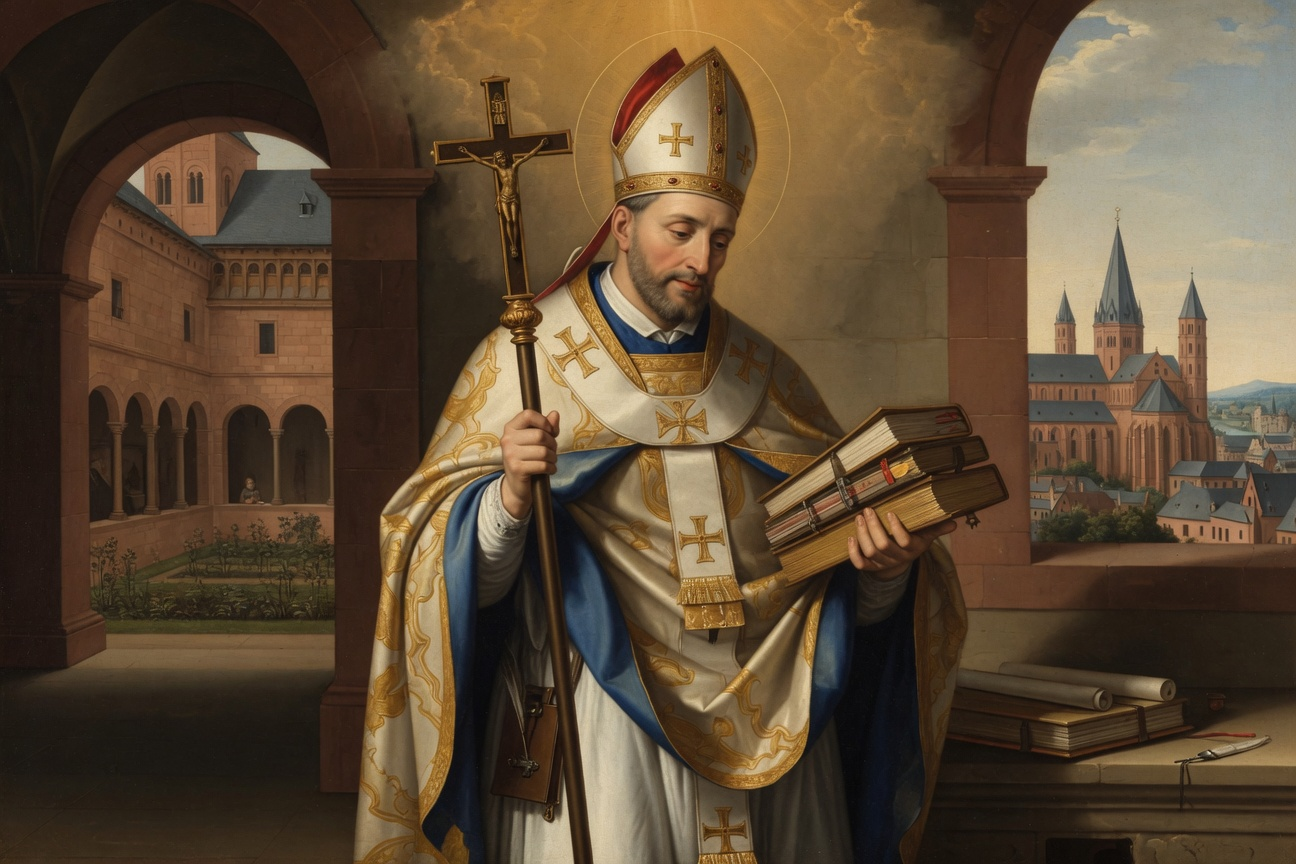
A monk of Fulda and disciple of Alcuin, Rabanus Maurus was one of the greatest scholars of the Carolingian era. Having become Abbot of Fulda and later Archbishop of Mainz, he distinguished himself through his immense literary work, his zeal for ecclesiastical discipline, and his charity toward the poor. He is honored as a Doctor of the Church in Germany.
Guided reading
6 reading sections
SAINT RABANUS MAURUS, ARCHBISHOP OF MAINZ
Youth and formation
Born in Mainz around 776, Raban Maur was educated at the Abbey of Fulda before perfecting his studies in Tours under the direction of Alcuin.
Raban Raban Abbot of Fulda and Archbishop of Mainz, builder of the church of Wigbert. , who received the nicknam e Maur Alcuin Famous abbot under whom Aldric began his monastic life. from his master Alcuin, was a native of Mainz, Mayence Site of the assassination of Emperor Alexander Severus. as he himself declares in his epitaph. He was born around the year 776, of noble parents, as is further proven by the epitaph he wrote for his brother Tutin. He was raised in the Abbey of Fulda, alre abbaye de Fulde Benedictine monastery where Raban was raised and served as abbot. ady so famous at that time, and made great progress in virtue as well as in the sciences. He studied the holy books night and day. It was there that he drew that piety and that sense of divine things which spreads over all his works a brilliance and an unction that cannot be mistaken.
Our Saint had a great devotion to the cross; and he felt deeply moved when thinking of the inexpressible sufferings of our Savior. His humility was very great; he called himself the vilest servant of the servants of God, a useless servant, the most miserable of men. The verses he dedicated to Pope Gregory IV prove his respect for the Apostolic Se pape Grégoire IV Pope who instituted the feast of All Saints in France in 837. e; one cannot admire enough his love for the doctrine of the Catholic Church and his inviolable attachment to its dogmas. Here is the testimony he gives of himself in this regard: "I flatter myself," he says, "that by the grace of God I have defended the Catholic faith in all its points and that I have advanced nothing that was of my own invention, but that, supported by the authority of the Fathers, I have followed the footsteps of Cyprian, Hilary, Ambrose, Jerome, Augustine, Gregory, John of Damascus, Cassiodorus, and the others."
In the prologue of his book on the Cross, he exclaims with holy enthusi livre de la Croix A famous figured poem by Rabanus Maurus. asm: "As long as I shall be in this miserable body, guide me, O Jesus, in the true path of the Catholic faith."
To this spirit of piety, Raban joined continuous study; and he rose thereby to the highest degree of knowledge that it was permitted to attain at that time. Saint Odilo, Abbot of Cluny, gives him a fine eulogy by saying: "Raban is very well-versed in the profane sciences; he is Catholic in his faith, and full of experience in the spiritual life."
After being ordained a deacon, he was sent to Tours in the year 802, by Rutgar, Bishop of Fulda, to contin ue hi Tours Place of retirement for Clotilde near the tomb of Saint Martin. s education there under the eyes of the great Alcuin.
Teaching and Leadership at Fulda
Having become head of the school at Fulda, he developed the library and trained numerous disciples before being ordained a priest in 814.
He did not remain long at Tours. Having returned to Fulda, he was placed in charge of the school in that city, and contributed greatly through the brilliance of his virtue and his erudition to the reputation of that fine institution. He protected the sciences with all his power: but what he did that was most useful was to found a rich library for the professors of that school.
Raban trained a great number of disciples distinguished by their knowledg e. The most famo Walafrid Strabon Famous disciple of Rabanus Maurus. us are: Walafrid Strabo, Servatus Lupus, his biographer, Rudolph, Otfried, and several others. He himself did not teach the liberal arts; but he chose for these duties the most skilled men, while reserving for himself those of dispensing the immense treasures of the Holy Scriptures. Belles-lettres were taught by the monk Candidus, who, complaining one day to Raban that his occupations did not leave him time to study Scripture, received from the pious doctor this reply: "I too was once invested with this charge; which did not prevent me from composing, with the assistance of God, the book of the Praise of the Cross."
Raban was promoted to the priesthood by Haistulf, Archbishop of Mainz, as he says himself in a letter that he wrote to that prelate. He was ordained in the month of December, in the year 814.
Abbotship and Influence
Elected abbot of Fulda in 822 after a pilgrimage to Jerusalem, he brought prosperity to the monastery and became an influential advisor to the Carolingian princes.
Around this time, unfortunate dissensions arose in the abbey of Fulda between the monks and Abbot Rutgar, who treated them with harshness and ill temper. Raban addressed a poem to him in which he sought to bring him back to gentler sentiments; but it was without success. The matter was brought before Charlemagne, and, after his death, before the Emperor Louis, who ordered the nomination of a new abbot. The choice fell upon Eigil, who soon restored peace to the convent. During these troubles, Raban undertook a journey to Jerusalem, upon his return from which he was named abbot, in the year 822, Eigil having held this dignity for five years. Under Raban's direction, the convent of Fulda saw the number o couvent de Fulde Benedictine monastery where Raban was raised and served as abbot. f its religious increase at the same time as the esteem it enjoyed; and the exemplary conduct of its monks was celebrated throughout the Frankish empire. The name of the abbot spread throughout Gaul and Italy; scholars and persons of distinction from all regions flocked to see him, and one considered oneself fortunate to obtain a place in his friendship. Princes and noblemen entrusted him with the education of their sons, because, both in terms of religion and in terms of the sciences, they believed they could expect everything from such a great master.
Constantly occupied with the means of raising divine worship to the highest degree of perfection and maintaining the discipline of the Church in all its severity, he himself wished to serve as an example to his monks in prayer and fasting. He also showed a particular zeal for the temple of God; he erected thirty churches or chapels within the extent of his abbey and enriched them with a great number of relics.
He conducted himself with such wisdom and prudence in the disputes that had arisen between Louis the Pious and his sons, that he gained th e confidence of bot Louis le Débonnaire Son of Charlemagne, whose accession to the throne was predicted by Alcuin. h parties and made himself, in a way, the instrument of their reconciliation. After writing a letter to console this prince, who had been so unjustly stripped of his crown, he composed a treatise on the respect that children owe to their parents and that subjects owe to their prince, which he concludes, however, by exhorting the emperor to show clemency toward his sons and their partisans.
Episcopate in Mainz
After a brief retirement, he was appointed Archbishop of Mainz in 847, where he led an ascetic life and presided over several important councils.
In 842, two years after the death of this prince, he voluntarily resigned from his dignity as abbot, which he had exercised for twenty years, in order to be able to devote himself with more leisure to the reading and meditation of the Holy Scriptures. He retired to the mountain of Saint-Pierre, located in the vicinity of Fulda, where he found the solitude he sought, and where he could devote all his time to piety and the sciences. But he was soon obliged to leave his dear solitude to enter a new career that he had not prepared himself to pursue. After the death of Otgar, Archbishop of Mainz, he w as call Mayence Site of the assassination of Emperor Alexander Severus. ed to this see in the year 847. It was in vain that he pleaded the infirmities that his assiduous studies had brought upon him; the general interest of the Church forced him to yield and accept the episcopal dignity. He thereby imposed upon himself new duties, even more arduous labors, without relaxing in any way the exercises of penance to which he was accustomed. He did not eat meat and did not drink wine, although he was of a very delicate constitution and poor health.
Three months after his consecration, which took place in 847 towards the end of June, in the cathedral of Mainz, in the presence of Louis, King of Germany, he held a council at the abbey of Saint-Alban, where he took very wise measures for the reform of morals and the maintenance of ecclesiastical discipline, but mainly for the preservation of the goods of the Church, the true motive that had provoked this synod. The following year, he convened a new council against the monk Gottschalk, on the su Gotescalc Monk whose doctrines were condemned at the Council of Quierzy. bject of predestination, on which he wrote a work that he dedicated to Noting, Bishop of Brescia (according to others of Verona), in Lombardy; and, after having condemned his doctrine, he sent him back to Hincmar, Archbishop of Reims, in whose diocese he had been ordained.
Charity and End of Life
He distinguished himself by his great charity during the famine of 850 and died at Winkel in 856, leaving behind an immense theological body of work.
The year 850, which was marked by a great famine, provided him with a new opportunity to display his charity. During this entire time of affliction, he stayed a t Wink Winkel Place of death of Rabanus Maurus in the Rheingau. el, in the Rheingau, where he fed more than three hundred poor people every day, not counting those to whom he ordinarily gave food at his table.
In the year 852, a new council was convened in Mainz by the order of Louis, which was presided over by Raban, and attended by the bishops and abbots of East Francia, Bavaria, and Saxony. Several canonical questions were discussed there.
The literary and pastoral occupations to which our Saint constantly devoted himself had long since taken a toll on his health; he finally succumbed on the fourth day of February, at Winkel, after having made the rays Winkel Place of death of Rabanus Maurus in the Rheingau. of his virtue and his knowledge shine throughout almost the entire extent of the Church. He was buried at the monastery of Sain t Alban, near Mainz, in monastère de Saint-Alban Initial burial site in Mainz. the chapel of Saints Martin and Boniface. When in 1515, the first year of his episcopate, Archbishop Albert visited this chapel and found there the holy bodies of ten bishops of Mainz, to whom the honor due to them was not being rendered, he sent, with the consent of the canons of that city and of the Apostolic See, the body of Saint Raban to Halle, in Saxony, where he was solemnly in terre Halle Place of the transfer of relics in 1515. d in the church of Saint Maurice. This great archbishop was never universally honored in the Church with the title of Saint; it is only in Germany that this honor was rendered to him, and principally in the archbishopric of Mainz, whose Martyrology qualifies him as a Doctor of the Church. His name is therefore not found in the Roman Martyrology, but it is in several Martyrologies of Germany.
Literary Heritage
A prolific author nicknamed the 'Preceptor of Germany', he left behind biblical commentaries, treatises on grammar, and poems such as the Veni Creator.
## WRITINGS OF SAINT RABAN MAUR.
The complete works of Saint Raban Maur were published in six folio volumes. Cologne, 1627. Here is an overview:
1° The book of Grammar, extracted from Priscian the Grammarian, who wrote around the year 535. 2° A work entitled de Un iverso, wri de Universo Encyclopedia in twenty-two books. tten around the year 844. It is divided into twenty-two books, and contains little more than definitions of names and words relating to Holy Scripture. It is addressed to Emperor Louis. 3° Two books on the Praise of the Cross, com Eloge de la Croix A famous figured poem by Rabanus Maurus. posed at the request of his master Alcuin. They were printed separately, in Pforzheim, in 1501, and in Augsburg, in 1605. This work enjoyed a great reputation in its time; it is full of bizarre ideas and offers little utility. 4° Commentaries on Scripture, which are strictly only a compilation of those of the ancients. A portion was printed in Cologne in 1532. The work was composed of thirty books.
5° Homilies on several points of Christian morality, on the feasts of the year, etc., etc. 6° Treatise on the allegories of Scripture. 7° Treatise on the institution of clerics and the ceremonies of the Church or divine offices, divided into three books. This is one of Raban Maur's most important works. 8° Treatise on the holy Orders, the sacraments, and priestly vestments; then three books on ecclesiastical discipline. These two works treat almost the same subject as the previous one. 9° A book on the vision of God, purity of heart, and the manner of doing penance. These are only extracts of what the author had read in the Fathers. 10° A Penitential, distributed into forty chapters, and composed of the canons of councils and the decrees of the Fathers. 11° Treatise on marriage between relatives, and on magicians. 12° On the soul and the virtues. 13° A martyrology, written around the year 845, which Canisius was the first to have printed. Mabillon inserted the prologue in his Analect., page 419, from a manuscript in the library of Saint-Gall. 14° Miscellaneous poems, in three parts; published following those of Fortunatus, by Father Brouwer, in Mainz, 1617, in-4°. One also finds a collection of these poems in Baluze, I. 4, Miscell. One also sees there the Veni Creator, which has led some to believe that Raban was its author. 15° The book on the invention of languages, from Hebrew to German, printed by Goldast, with remarks on the parts of the human body, in his volume II, Rerum Allemansarum, Francof. 1606. The works named until now are the only ones found in the Cologne edition of which we spoke above, and which is due to the care of Colvenère, chancellor of the University of Douai. 16° Several Letters, which often contain important things on dogma, discipline, canon law, etc. 17° Treatise on different questions of the Old and New Testament, both against the Jews and against infidels or Judaizing heretics: it is a collection of passages taken from the Fathers and the holy books. Dom Martène published it from an ancient manuscript of the abbey of Saint-Serge d'Angers. In his Anecd., t. v, p. 401, Schunk says: « It is doubtful that this book is by Raban ». 18° A treatise on chorepiscopi, published by Baluze at the end of the Concordia Sacerdotii et Imperii, by Pierre de Marca, and of the collection of councils by Fr. Labbe, t. VIII. Baluze added another work by Raban, entitled: On the respect that children must have for their fathers, and subjects for their princes. 19° The book of vices and virtues, printed in Antwerp, in 1560, in a collection of ancient rites of the Church, by Wolfgang Lazius. 20° Discourse on suffering, printed by Dom Bernard Pez, from a manuscript about three centuries old, from the abbey of Maulk, Anecd., t. IV, part. 2, p. 8. — One finds there the hymn Gloria, laus, honor, without indication of author, which, as is known, is none other than Theodulf of Orleans, who died in 821, after having produced several capitularies, as well as various other works in verse and prose, of which Fr. Sirmond published an edition in 1646. See Opera Sirmondi. Venetiis, 1728, t. II. 21° A treatise on Computus or calculation, which Baluze had printed, t. 1st, Miscell., p. 1, and Præfat. in I. 1 Miscell. 22° A treatise against those who fight the rule of Saint Benedict, printed by Dom Mabillon, Annal. Ben., t. II, append., p. 726, from an ancient manuscript of the abbey of Molh. 23° A Latin-German Glossary on the books of the Old and New Testament. Jean Georges d'Eckard inserted it in the third volume of rebus Francie Orient. See Lambecius, Bibl. t. 2, c. v, p. 415, 416 and 952. 24° Some other writings which are lost. Various works have also been attributed to him which are not his, such as the Treatise on the sacrament of the Eucharist, printed in Cologne in 1551, which is by Paschasius Radbertus; a book of Revelations cited by Possevin; the Ordinary Gloss on all of Scripture, which is by Walafrid Strabo: a treatise on the Mysteries of the Mass; another on the divine Offices, and a Dictionary of mystical meanings. The treatise on the Antichrist, attributed sometimes to Saint Augustine, sometimes to Alcuin, and printed among the works of Raban, is by neither of them, but by Adson, monk and later abbot of Moutier-en-Der. Raban shows much wit and erudition in his works. Born with great talents for all sorts of sciences, there were few that he did not undertake to cultivate, and he did so with success. Although one finds in his writings some places that need explanation, his style is nevertheless simple, clear, natural and concise; he writes less well in verse than in prose; he even let slip some errors against prosody, which, in those centuries, is not surprising. See Cave, Hist., Lettre, t. II, p. 36; Dom Cellier, Hist. des aut. eccl., t. XVIII, p. 755; Dom Rivet, Hist. lit. de la France, t. v; and Richard Simon, Critique de Dupin, t. 1st, p. 202; Cont. de Godesc.
Annexes & related entities
Structured data for exploration: events, miracles, quotes, places, attributes, patronages, and important entities cited in the text.
Key Events
- Born around 776 in Mainz
- Education at the Abbey of Fulda
- Studies in Tours under Alcuin in 802
- Priestly ordination in 814
- Appointed Abbot of Fulda in 822
- Resigned from his position as abbot in 842 for solitude
- Election to the Archbishopric of Mainz in 847
- Presided over several councils in Mainz
- Relief for the poor during the famine of 850
Quotes
-
As long as I am in this miserable body, guide me, O Jesus, in the true path of the Catholic faith.
Prologue to the Book of the Cross -
I flatter myself that by the grace of God I have defended the Catholic faith in all its points and that I have put forward nothing that was of my own invention.
Personal testimony