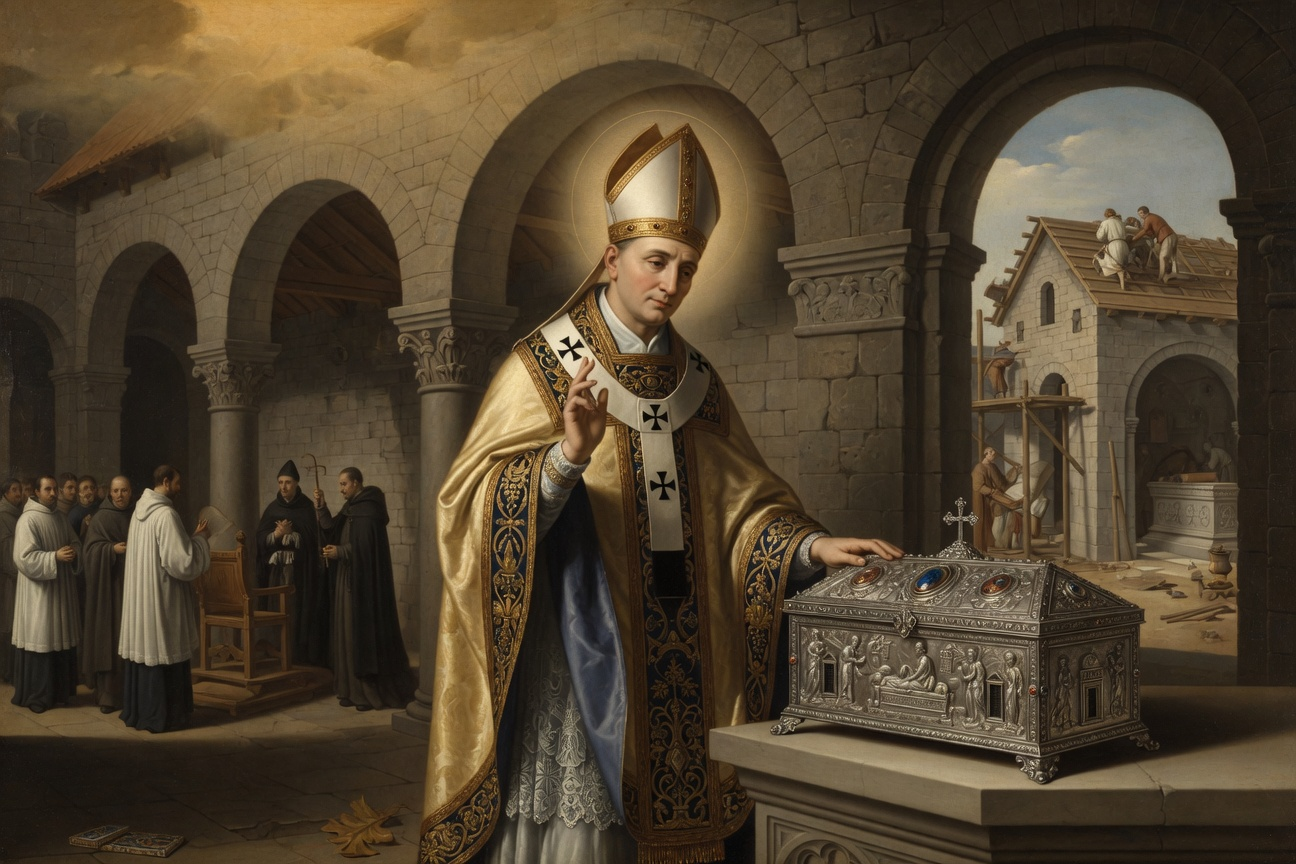
Tenth bishop of Troyes in the 6th century, Vincent was a zealous pontiff who canonized Saint Aventinus and had a chapel built in his honor. He lived during the reign of Childebert I and was buried near Saint Aventinus, although his tomb was destroyed during the French Revolution.
Guided reading
3 reading sections
SAINT VINCENT OF TROYES (536).
Episcopacy and devotion to Saint Aventinus
Vincent, the tenth bishop of Troyes in the 6th century, distinguished himself by his religious zeal and his particular devotion to Saint Aventinus, whom he canonized.
Vincent, the tenth bishop of Troy Vincent, dixième évêque de Troyes Successor of Saint Camelian. es, donned the pontifical mitre around the year 526. He was a pontiff after God's own heart. He showed great zeal for the cult of the Saints; he honored in particula r Saint Avent saint Aventin Hermit and founder of the monastery of Isles-Aumont, mentor of Saint Phal. inus, a discip le of Sain saint Loup Cell companion of Ausilius at Lérins. t Lupus and Saint Cam saint Camélien Successor of Saint Lupus at Troyes. elianus, and canonized him. He had a chapel built not far from the walls of the city of Troyes, on the site of his tomb, and wished to be buried there himself, as has already been recounted in the life of Saint Aventinus.
Historical context and fate of the relics
A contemporary of King Childebert I, his relics were partially preserved in a silver reliquary before the destruction of his tomb during the Revolution.
He flourished under Childebert I, Childebert Ier King of the Franks who supported the saint. King of France France Country concerned by the revelations and threats of divine punishment. , around the year 526. One of his ribs, contained in a small silver reliquary bearing an inscription in Gothic letters, was found among the relics of Saint Aventin. The rest of his body remained in his tomb, which was destroyed during the Revolution at the sa Révolution Period during which the saint's relics were hidden and lost. me time as the church of Saint-Aventin.
Sources
The account is based on the Old Proper of Troyes, a liturgical document printed in the 17th century.
Old Proper of Troyes, P Ancien Propre de Troyes Liturgical work from 1648 serving as a source. rinted in 1648.
Annexes & related entities
Structured data for exploration: events, miracles, quotes, places, attributes, patronages, and important entities cited in the text.
Key Events
- Election as tenth bishop of Troyes around 526
- Canonization of Saint Aventinus
- Construction of a chapel over the tomb of Saint Aventin
- Died in 536