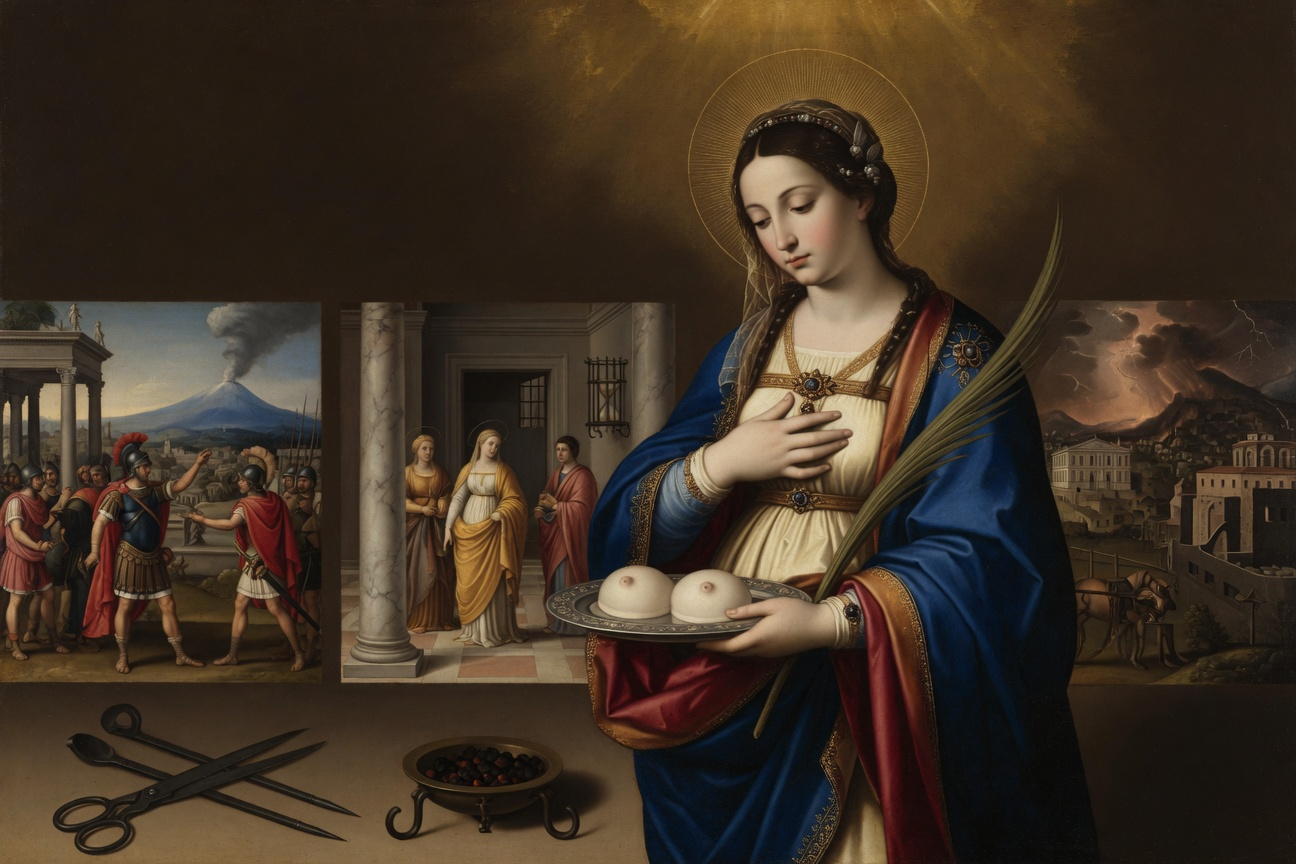
A young noblewoman from Sicily, Agatha refuses the advances of the consul Quintianus to remain faithful to Christ. After enduring atrocious tortures, including the excision of her breasts, she is miraculously healed by the apostle Peter in prison. She eventually dies after being rolled on burning coals, while an earthquake shakes the city of Catania.
Guided reading
10 reading sections
SAINT AGATHA, VIRGIN AND MARTYR
Liturgical Importance
Saint Agatha occupies a place of honor in the Roman liturgy, her name having been cited in the Canon of the Mass for centuries.
At Mass, immediately after the elevation, the priest recites a prayer in which he asks God to make us partakers in the glory of the Apostles and Martyrs... In this prayer, several Saints are named, among others Saint Ag atha. To be j sainte Agathe Patron saint of the monastery of Crépy. udged worthy of the honor the Church pays her by repeating her name at so many Masses, for so many centuries, her holiness must have been very great and very extraordinary.
The finger of God is here! This glory comes from God! Let us glorify God in His Saints!
Origins and arrest
Coming from a noble family of Sicily, Agatha is coveted by the consul Quintianus who, faced with her refusal, delivers her to a corrupt woman named Aphrodisia.
Palermo and Catania, two famous cities of Sicily, dispute the honor of having given birth to Saint Agatha. But, whatever the place of her birth, it is certain that the city of Catania was watered with her blood. The reputation for holiness that she enjoyed having reached the ears of Quintianus, a consular figure of the pro Quintianus Consul of Sicily and persecutor of Agatha. vince of Sicily, he sought every opportunity to approach her. As his heart was open to all crimes, he allowed himself to be agitated by all evil passions. Desiring therefore to extend his fame, in order to acquire the glory of the century, he ordered that the servant of God, who was from an illustrious family, be seized. He would have liked to persuade the people that, despite the obscurity of her origin, he nevertheless had enough influence and power to subjugate the hearts of the most qualified persons. Addicted to a licentious life, he counted on the sight of this virgin, who was of great beauty, to satisfy the concupiscence of his eyes; his avarice coveted the riches of the servant of God; finally, he was an idolater and a slave to demons. Thus, in the impious ardor that consumed him, he could not bear to hear the name of Christ uttered.
He therefore gave orders to his apparitors to seize the person of Agatha, and had her delivered to a woman named Aphrodisia, who had in her house nine daughters as corrupt as she was and Aphrodise Woman tasked with corrupting Agatha. worthy of their mother. The design of this infamous magistrate was that these unworthy creatures would pervert the heart of the virgin whom he had the infamy to abandon to them for thirty days. They, for their part, hoped to tear this pure soul from her resolution, by employing sometimes the promise of pleasures, sometimes terrible threats.
Agatha said to them: "My soul has been strengthened and founded in Christ; your words are but wind, your promises but a stormy rain, your threats resemble a river; but this wind, this rain, this river, may rage against the foundations of my house: it will not be able to fall, because it is seated on the firm rock."
Repeating these words every day, she shed tears and prayed; and, just as one who, being parched with thirst, in the midst of the heat of the sun, sighs for the gushing fountains; so did she desire to reach the crown of martyrdom and suffer all kinds of torments for the name of Jesus Christ.
Seeing then that the virgin remained unshakable in her resolution, Aphrodisia went to find Quintianus, and said to him: "It would be easier to soften rocks and give iron the flexibility of lead than to remove the Christian sentiment from the soul of this young girl. My daughters and I have taken turns with her, day and night, without respite, and we have been able to do nothing, except to contribute to strengthening her spirit even more in the purpose she has formed. I have offered her precious stones and the most brilliant ornaments, garments woven with gold; I have promised her houses and lands near the city; I have displayed before her eyes all the luxury of the most varied furnishings; I have placed at her disposal numerous servants of both sexes, and of all ages; but she has made no more account of all this pomp than of the earth she treads underfoot."
Interrogation and first tortures
Agatha affirms her faith and Christian nobility before Quintianus. She undergoes the rack and the mutilation of her breasts.
Quintianus, transported with anger, had the virgin brought to his audience; and sitting on his tribunal, he began in these terms: "What is your condition?" The blessed Agatha replied: "I am of free condition, and even of noble extraction, as all my kin can attest." — "If you are of such a noble and illustrious family, why then do you manifest in your conduct the baseness of a servile condition?" — "Being a servant of Christ, I am in that of servile condition." — "If you were of a noble and distinguished family, would you lower yourself to take the title of servant?" — "The sovereign nobility is to be engaged in the service of Christ." — "What then! Do we have no part in nobility, we who despise the service of Christ and who observe the worship of the gods?" — "Your nobility has degenerated into a servitude so profound that it not only makes you slaves of sin, but also subjects you to wood and stone." — "All the blasphemies that your senseless mouth dares to utter will receive the punishment due to your insolence. Tell us, however, before coming to the torments, why you despise the worship of the gods?" — "Do not call them gods, but demons; yes, those whose effigy you cast in bronze, and whose figures you gild in marble or plaster are none other than demons." — "Choose one of two things, and take the side you wish: either to incur various kinds of tortures with the evildoers, if you persist in your folly; or, if you are wise and truly noble, to sacrifice, as nature itself invites you, to the all-powerful gods, whom their divinity obliges us to recognize and adore." — "Take care that your wife does not become like your goddess Venus, and you like your god Jupiter." A few words later, Quintianus ordered that she be slapped, and said to her: "Do not dare to let your rash tongue spread in injurious words towards your judge." — "You have just said that their own divinity demonstrates that your gods are worthy of being honored; well then! Let your wife be like Venus, and you like Jupiter; so that you may be counted among the number of your gods." — "It seems that you have decided to endure all kinds of torments, since you begin again to attack me with new insults." — "I am astonished to see that with all your prudence you have allowed yourself to fall into such folly as to call gods those beings whose traces you do not want your wife to follow, and whose way of life you are so afraid to embrace yourself, that you take as an insult the proposal made to you. Agree with me that if they are true gods, I have wished you a good, by wishing that your life were similar to that which history attributes to them. If, on the contrary, you hold their resemblance in horror, you are of my opinion. Say then that they are so perverse and so impure, that when one wants to curse someone, one only has to wish them to be as they were in their execrable life." — "What need have I of all this flow of words? Sacrifice to the gods, or I will have you die by various kinds of tortures." — "If you order me to be delivered to the beasts, they will soften at the mere name of Jesus Christ; if you use fire, the angels will spread over me from the height of heaven a salutary dew; if you threaten me with rods and blows, I have within me the Holy Spirit, who will make me despise all your tortures." At these words, Quintianus shaking his head with fury, commanded that the virgin be locked in a dark dungeon, and said to her: "Think of yourself and retrace your steps, if you want to avoid horrible torments, which will tear your body to shreds." — "It is for you, minister of Satan, to repent, if you want to avoid eternal torments." — Quintianus ordered her to be led immediately to prison, because these public invectives covered him with confusion. Agatha, filled with joy and all glorious for the honor done to her, entered the prison as if into the hall of a feast to which she had been invited; and trembling with gladness, she recommended to the Lord through her prayers the combat she was about to sustain. The next day, the impious Quintianus had the virgin appear at his tribunal, and said to her: "What resolution have you taken regarding your salvation?" — "My salvation is Christ." — "How long, unhappy one, will you persist in your vain resolution? Deny Christ and begin to adore the gods; consider your youth at last, and do not let yourself be consumed by a cruel death." — "You, rather, renounce your gods who are only stone and wood, and adore your Creator, the true God who created you. If you despise him, you will be subjected to the most rigorous pains and eternal flames." Quintianus, transported with fury, ordered that she be tied to the rack, and that she be tormented there. During the torture, he said to her: "Leave your resolution there, so that we can consider the preservation of your life." — "I experience, in the midst of these torments, as much delight as a man could feel to whom one announces happy news, or who sees again a person long desired, or finally who discovers a rich treasure; I too delight in the midst of these torments of an instant. The wheat cannot be put into the granary, if its ear has not been strongly beaten and reduced to straw; so it is with my soul; it cannot enter the paradise of the Lord, with the palm of martyrdom, until you have first delivered my body to the ingenious fury of your executioners." At these words, Quintianus, seized with anger, ordered that her breast be cut off, after having torn it. Agatha said to him: "Impious, cruel and barbaric tyrant, are you not ashamed to mutilate in a woman what you sucked in your mother? But I keep intact within me the spiritual breasts, where I draw the nourishment of my soul, and which I have consecrated from my childhood to the Lord Jesus Christ."
Apparition of Saint Peter
In her prison, the apostle Peter appears to her in the guise of an old man and miraculously heals all her wounds.
Quintianus had her taken back to prison. He gave orders that no physician should be allowed to visit her, and expressly forbade anyone from providing her with bread or water. While she was locked in the prison, around the middle of the night, an old man preceded by a child c arrying a to un vieillard Apostle mentioned for the setting of the procession date. rch appeared to her in the guise of a physician; and, having various medicines in his hand, he said to her: "You have suffered cruel torments in your body by the order of this foolish magistrate; but you have subjected him to even more cruel tortures through your wise answers. He has had your breast tormented and mutilated; but he shall see his opulence turned into gall, and his soul plunged eternally into bitterness. However, as I was present while you suffered all these evils, I saw that your wound can still be healed." Then the blessed Agatha said to him: "I have never provided my body with bodily medicine; and it would be shameful for me to desist now from that trust in God which I have always kept within me from my earliest youth." "Like you," replied the venerable old man, "I am a Christian; but I also know medicine. I pray you to fear nothing from me." Agatha replied to him: "Ah! What fear could I have of you? You are advanced in age, and you count many more years than mine. Moreover, my whole body is so torn that the wounds with which it is covered take away from my soul the possibility of experiencing any feeling whatsoever for which I might have to blush. But I thank you, lord and father, for having deigned to extend your solicitude to me: know, however, that no remedies made by human hands shall ever approach my body." "And why," replied the old man, "do you not want me to heal you?" "Because," answered Agatha, "I have my Savior Jesus Christ who heals all evils with his word; a single word from his mouth restores all things. It is he, if he so wills, who can restore my health." The old man replied with a smile: "And it is he himself who sent me to you; for I am his Apostle. Know, therefore, that it is in his name that you are going to recover your health." Scarcely had he finished these words when he suddenly disappeared.
Then Agatha, having pro strated he son Apôtre Apostle mentioned for the setting of the procession date. rself, addressed this prayer to God: "I give you thanks, Lord Jesus Christ, for having remembered me and for having sent me your Apostle who has comforted me and raised my courage." When she had finished her prayer, having looked at all the wounds on her body, she recognized that all her limbs were sound, and that her breast had been restored. Throughout the night, the prison was filled with such a brilliant light that the jailers, seized with terror, took flight, leaving the doors open. The people who were detained in the same prison told the blessed Agatha to take advantage of the freedom that was offered to her. But the virgin replied: "Far be it from me to go and lose my crown and be a cause of tribulation for the guards! With the help of my Lord Jesus Christ, I shall persevere in the confession of him who has healed and consoled me."
Final torments and death
After being rolled over burning coals, an earthquake strikes Catania. Agatha dies in prison after a final prayer.
Four days later, Quintianus had the virgin appear again before his tribunal and said to her: "How long will you have the madness to go against the decrees of the invincible princes? Sacrifice to the gods, otherwise know that you are reserved for torments even more cruel than the previous ones." Agatha replied: "All your words are senseless, vain, and iniquitous; your orders defile the very air that transmits them. That is why you are a wretch, devoid of sense and intelligence. For what other than a madman ever thought to call for help from a stone, instead of addressing the supreme and true God who has deigned to heal all these wounds you have inflicted upon me, even to restoring my breast to its original integrity." — "Eh! Who is the one who healed you?" — "It is Christ, the Son of God." — "What! Do you still dare to name your Christ?" — "My lips confess Christ, and my heart will not cease to invoke Him." — "I shall see shortly if your Christ will come to heal you."
Immediately he ordered the prison to be strewn with fragments of broken pots and burning coals to be added, then to strip Agatha of her clothes and roll her on this bed of pain. Scarcely had this barbaric execution begun when suddenly the place was shaken; a section of the wall detached and crushed under its ruins the judge's counselor, named Silvanus, and another of his friends, named Falconius, at whose persuasion Quintianus was committing so many crimes. The entire city of Catania was itself shaken by a violent earthquake. Frightened inhabitants ran to the judge's praetorium, shouting with great tumult that the torments with which this iniquitous magistrate was afflicting the servant of God were the cause that put all the citizens in danger of perishing. Quintianus took flight, fearing both the earthquake and the sedition of the people. He therefore immediately had the virgin taken back to prison and went to take refuge in a remote room of the praetorium, leaving the people at the gates of the city.
Agatha, having returned to the prison, stretched out her hands toward God and said: "Lord, who created me and kept me since my childhood, who gave me from the flower of my age a virtue superior to my sex; who removed from my heart the love of the world and withdrew my body from corruption; You who made me victorious over the torments of the executioner and made me despise iron, fire, and chains; who finally granted me, in the midst of these tortures, courage and patience, I beseech You to receive my soul at this moment; for it is time to withdraw from this world to be introduced into the bosom of Your mercy." After this prayer, she let out a great cry and gave up her spirit, in the presence of a numerous assembly.
Angelic Burial
A mysterious young man, identified as an angel, places a marble inscription in her tomb during her funeral.
At this news, pious faithful rushed in haste, then they took her body and placed it in a brand-new sarcophagus. Now, while she was being buried with aromatics, and this precious deposit was being placed in the tomb with great care, a young man suddenly appeared, dressed in rich silk garments, and having in his train a procession of more than a hundred children all radiant with beauty and adorned in magnificent clothing. Until that hour, no one had seen this young man in the city of Catania; he was never seen there again, and no one could say they had known him before. He entered the place where the virgin's body was being embalmed, and placed near the head a marble tablet on which were inscribed these words: *Holy soul, devoted, honor of God, protection of the fatherland*. He placed, we say, this inscription in the sepulcher and near the head of the martyr, and remained there until the tomb had been closed with the greatest care. But when the stone that was to cover it had been laid, the young man disappeared; and, as we have said, from that moment he was seen no more, and nothing more was heard of him in all of Sicily. That is why we thought it was the virgin's Angel. Those who had seen the inscription spoke of it, and this fact made a vivid impression on the inhabitants of Sicily. The Jews themselves, as well as the Gentiles, shared with the Christians the veneration that the latter had for the tomb of Agatha.
In the meantime, Quintianus, accompanied by his guard, set out to go and make an inventory of the virgin's possessions, and to imprison all those of her family; but, by a just judgment of God, he perished in the waters. As he was crossing a river on a boat, two of his horses began to neigh at each other and to become agitated; one of them threw itself upon Quintianus and bit him; the other, with a kick, knocked him into the river; and his corpse could not be found. This event further increased the fear and veneration that was already held for the blessed Agatha; and no one since has dared to disturb her family.
Protection against Mount Etna
The veil of the saint is used several times by the inhabitants of Catania to stop the lava flows of the Etna volcano.
But, in order that the inscription brought by the angel of the Lord might be fulfilled, the following year, as the anniversary of Agatha's martyrdom approached, Mo unt Etna mont Etna Sicilian volcano whose eruptions are halted by the saint's veil. vomited flames so terrible that the fire, acting with the violence and speed of a torrent, advanced toward the city of Catania, melting the earth and stones that lay in its path. A multitude of pagans descended from the mountain to flee the danger; they went to the tomb of the holy martyr, and having removed the veil that covered it, they held it up against the f voile Relic used to stop the flames of Mount Etna. ire that was advancing toward them; and at that very instant, the flame stopped by divine permission. The eruption of the volcano had begun on the Kalends of February, and it ceased on the Nones, which corresponds to the day on which the virgin was buried: Our Lord Jesus Christ wishing to show that it was in consideration of the merits and prayers of the blessed Agatha that He had delivered these infidels from death and the conflagration.
Since then, this same miracle has been renewed several times, when Mount Etna spread its flames into the plains of Catania. This city would have already been consumed and reduced to ashes several times, had this glorious patroness not preserved it. It is a thing worthy of admiration, and which would find no credence in the minds of men, if it were not considered as an effect of the omnipotence of God, to see on one side rushing, from the highest part of this mountain, straight toward the city, a torrent of fire, wide and deep, and of a substance as thick as lead, or any other molten metal, which devours, by its burning, everything that opposes its course; and, on the other, the clergy and the whole city going out to meet it, in procession, to go and fight this fire, not with weapons, nor with water or anything else, but with the sole protection of Saint Agatha and with her veil, whose mere presence has the power to stop the impetuosity of this torrent; not only the veils that have been on the body of the Saint have this virtue, but also the cotton that has touched it. It is said that, in the year 1537, this river of fire, coming toward the monastery of Saint Nicholas of the Arenas, did not touch it, but went off to ravage two neighboring villages: Nicolosi and Montpellier. As its path was through the vineyard of a poor man, he having placed a little of this cotton in front, on some reeds, the torrent split in two and did no damage to his vineyard, but burned and reduced to ashes everything in the surroundings. It is noted that the mountain threw, this time, such a great quantity of ashes that they flew to an incredible distance; ships that were going from Venice to Sicily were in great danger because of this cloud of ashes, with which they were covered, as written by Thomas Fazello, historian of the events of this island. It is for these wonders that Saint Agatha is so renowned throughout the world. She was so highly revered, immediately after her death, that Saint Lucy, virgin and martyr , went on a sainte Lucie Saint who appeared in a vision to Opportune. pilgrimage to her sepulcher to obtain health for her mother.
Iconography and patronage
Agatha is represented with her breasts on a platter or with pincers. She is invoked for diseases of the breast.
The martyrdom of Saint Agatha provides a great number of subjects for the arts: 1° Saint Peter appears to her in her prison and heals her wounds; 2° Near her is a brazier with irons to burn her on various parts of her body; 3° She is seen delivered to the executioner who holds shears to cut off her breasts; or else she carries them herself on a platter; 4° The inhabitants of Catania run to her tomb to remove the drapery that covers her body and hold it against the flames of Etna. All these circumstances are recalled by the Roman Breviary. — She is represented crowned with flowers in a 9th-century mosaic. — Anthony Van Dyck painted her martyrdom. — An engraving in the Mazarine Library represents her holding a palm and pincers. — Domenichino represented her before the judge and refusing to sacrifice. — Saint Agatha is given the features of a young girl, for she was only twelve or thirteen years old when she was arrested.
Having undergone the excision of both her breasts, it is for this reason that women invoked her, in the Middle Ages, for ailments of the breast. This custom has persisted at Morival, in the diocese of Amiens, where there is a chapel of the Saint.
Relics and historical cult
Her relics are dispersed between Catania, Rome, Constantinople, and several French churches such as Saint-Merry in Paris.
## RELICS OF SAINT AGATHA.
Before the French Revolution, one could see in Paris, in the church of Saint-Merry, one of the severed breasts of this illustrious virgin and martyr; it was enshrined in a rich silver reliquary: the parishioners had obtained it in exchange for the head of their patron, which they gave to the church of Chanseaux, in Brie, as is reported in the collection of Antiquities of the city of Paris.
There are still, in our day, relics of Saint Agatha in the reliquary located above the high altar of the church of Saint-Merry, in Paris. They are also seen at Saint-Paul of Abbeville, at the Ursulines of Amiens, at Corbie, at Mailly, at Morival, at Montreuil (in an ebony frame that served as a pax), etc.
The memory of Saint Agatha has always been held in great veneration in the Church; the Fathers have spoken of her with great praise. Saint Damasus composed a hymn in her honor. Saint Ambrose and Saint Gelasius composed a special preface for the day of her feast. The Lectionary attributed to Saint Jerome mentions her. Saint Augustine also says something about her in his Soliloquies. Finally, the Roman Church composed a proper office for her, to mark the esteem in which it holds her, and inserted her name into the canon of the Mass; it is found in the calendar of Carthage, which dates from the year 530, and in all the martyrologies of the Greeks and Latins. Around the year 560, Pope Symmachus had a church built in her name on the Aurelian Way, near Rome: only a few ruins of it remain. Sai nt Gregory the Great en Saint Grégoire le Grand Pope contemporary to Saint Psalmodius. riched with her relics a church in Rome that he had purged of Arian impiety; this church had been rebuilt in 460 by Ricimer, general of the Western Empire. In 720, Gregory II had a new one erected under the invocation of the same Saint. Clement VIII gave it to the Congregation of Christian Doctrine. Saint Gregory the Great placed relics of Saint Agatha in the church of the monastery of Saint Stephen, located on the island of Capreae, today Capri; but the greater part of this precious treasure remained in Catania until around the year 1040, the time at which it was transferred to Constantinople. It has since been brought back to Catania, as we learn from Maurice, bishop of that city, who wrote the history of this translation which occurred in his time.
Sources and various patronages
Patron saint of Malta, her life is documented by the Bollandists and celebrated by numerous Church Fathers.
The Maltese Maltais Possible place of origin of Publius. , who honor the same Saint as their patroness, were indebted for their salvation to her intercession when the Turks attacked them in 1551.
One will find in Bollandus everything that historians have said beautifully in her honor.
Annexes & related entities
Structured data for exploration: events, miracles, quotes, places, attributes, patronages, and important entities cited in the text.
Key Events
- Arrest by Quintianus
- Handed over to the woman Aphrodisia for thirty days
- Torture on the rack
- Amputation of the breasts
- Apparition of Saint Peter and miraculous healing
- Torture on burning coals and potsherds
- Earthquake in Catania
- Died in prison after a final prayer
Miracles
- Instantaneous healing of wounds and the breast by Saint Peter
- Apparition of an angel placing a marble tablet in her tomb
- Stopping of Etna's lava flows by the exhibition of her veil
- Protection of a vineyard by cotton that had touched her relics
Quotes
-
The sovereign nobility is to be engaged in the service of Christ.
Response to Quintianus -
Impious, cruel, and barbarous tyrant, are you not ashamed to mutilate in a woman that which you sucked from your own mother?
Response during her torture -
Holy soul, devoted, honor of God, protection of the homeland
Inscription on the marble tablet