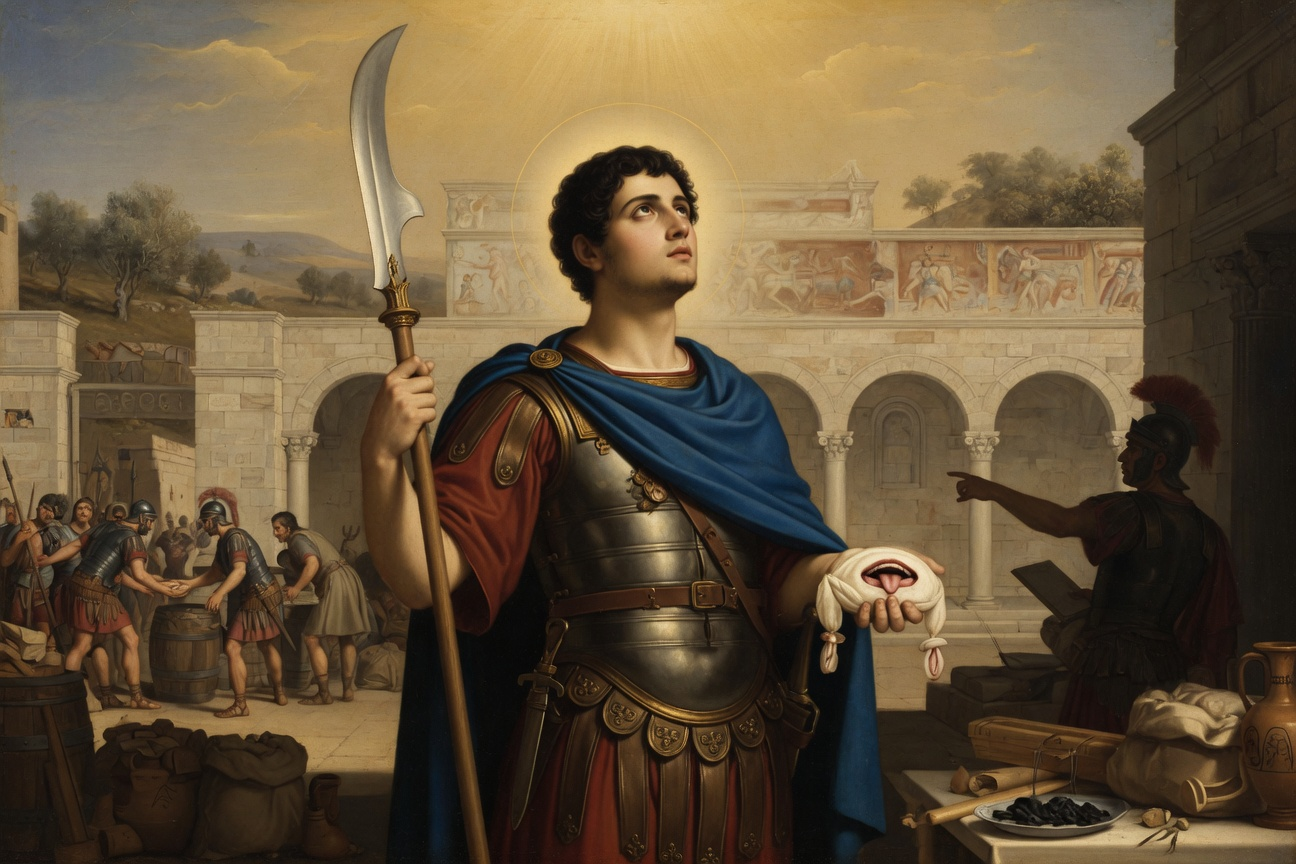
A Christian soldier enlisted in Chios under Emperor Decius, Isidore was denounced by a jealous centurion for his faith. Despite the torture of having his tongue cut out, which caused his judge Numerius to miraculously lose his speech, he remained firm in his faith. He died by beheading, giving thanks to God for his heavenly crown.
Guided reading
4 reading sections
SAINT ISIDORE OF CHIOS, MARTYR
Historical context and vocation
Under the reign of Emperor Decius and the pontificate of Cornelius, Isidore was enlisted as a soldier in Chios, distinguishing himself by his piety and knowledge of the Scriptures.
3rd century — Pope: Saint Cornelius. — Emperor: Decius. Soldiers of the earth are always ready to depart, no matter where they are sent; all the more reason why soldiers of Christ must obey with promptness their general, Jesus Christ. Saint Augustine, On Salvation and Leader. The first year of the reign of Flavius Decius, this emperor having published an edict to levy troops, a ship was seen arriving in Chios bringing the decree relating to this city. Among those who were enlisted was the blessed Isidore, who constantly showed Isidore Roman soldier and Christian martyr on Chios. himself to be a good and valiant soldier in Jesus Christ our Lord. Indeed, when the divine doctrine of our Lord Jesus Christ had been preached to those who were worthy of it, the holy and venerable martyr of Christ had embraced it with eagerness and had practiced it with zeal ever since. And after he had fortified himself in every way by the Holy Scriptures and the commandments of Christ, he felt his soul wonderfully strengthened, his spirit revived, and his very body full of vigor. He also experienced within himself a certain heavenly emulation, thinking of those who had died suffering martyrdom for the Lord; and at the same time, he prepared himself for the trials, threats, and persecutions of the tyrants. He was just, pious, beyond all reproach, in a word, perfect in all things. One perceived in him neither levity nor impropriety; and never did vice, malice, or any of the defects arising from a mind little submissive to God tarnish such a beautiful soul; but his entire conduct was marked by piety, modesty, and honesty.
Denunciation and arrest
The centurion Julius, jealous of Isidore's integrity, takes advantage of the persecution edicts to denounce him to the prefect Numerian as a Christian refusing to sacrifice to idols.
Some time after the publication of the first imperial edict, another was brought forth, under the terms of which all those, whoever they might be, who served the Lord Jesus Christ and who, instead of complying with the orders of the emperors, preferred to obey the commandments of the same Lord Jesus Christ in accordance with the oracles of the prophets, were to be compelled to abandon the religion of Christ and embrace the impious errors of the demons. At that time, newly enlisted soldiers arrived in Chios under the command of a cert ain Nume Numérien Brother of Saint Germanus. rian. Now, the blessed Isidore, whom the Caesars, out of affection for him, had charged with the administration of provisions, distributed with perfect equality the necessities to all those for whom he was responsible; for he was to them like a good father of a family; and as he detested all the errors of paganism, if he were ordered something that was not just and equitable, he took no account of it. Now, a centurion of this army, named Juliu s, dr Jules Roman centurion who denounced Isidore out of envy. iven by madness and envy, like Cain, resolved to accuse the blessed Isidore before Numerian, prefect of the militia, so that he might be deposed from the dignity he held in the army; but he feared that his designs would not be crowned with success. It was not, moreover, that he concerned himself with the well-being of the soldiers: for he was a vile mercenary, and he sought, under the name of centurion, only to plunder those he would have under his command. This centurion, having left the path of truth to abandon himself to falsehood, had descended into the deepest abyss of perversity; and when the edicts of the Emperor Decius against the Christians appeared, he did not blush to honor the idols with prayers and sacrifices.
Julius therefore went to find Numerian and denounced Isidore as not sacrificing to the idols. Numerian commanded him to bring him in.
Julius, immediately mounting a chariot, went off with three other soldiers of a ferocious character, seized Isidore, who was unaware of what was happening, and said to him: "The avenging justice of our gods commands me to do what I am doing at this moment, to punish the profound negligence in which you live toward them. For you must sacrifice to the gods and honor them religiously: so commands the Emperor Decius." The blessed martyr of Christ, Isidore, trembling with the liveliest gladness, prepared as he was for the combat by the grace of the Holy Spirit, replied modestly to Julius: "Yes, let it be so; let us depart cheerfully; the hour of combat has arrived. It is, I confess, with great pleasure that I am going to descend into the arena to fight against Belial, feeling myself filled with the Holy Spirit, all flooded and penetrated by the dew of grace, and enraptured with joy in the expectation of a magnificent crown: it is for this that, without the slightest hesitation and by solid reasoning, I shall accomplish, under the eyes of those who are to come with me, a courageous struggle; so that God, touched by the prayers of His Saints, may give to all those who love Him from the bottom of their hearts, eternal life through Jesus Christ Our Lord."
Interrogation and Tortures
Isidore confesses his faith before Numerius, affirming the immortality of his soul. Despite the removal of his tongue, he continues to glorify Christ while the prefect loses the use of speech.
Isidore was then brought by Julius and his soldiers before the tribunal of Numerius, commander of the militia. As soon as he saw him: "What is your name?" — "Isidore". — "Are you not the one who refuses to obey the edicts of the emperor and to sacrifice to the gods?" — "What virtue or power can these weak and impotent gods have, that I should sacrifice to beings who are nowhere?" — "O indomitable hardness of your perverse soul! How did you dare to use such guilty expressions against the gods? But their anger is ready to fall upon you to punish your audacity: we only fear that, for your words of blasphemy, they might punish us ourselves." — "You may say what you will, your words will cause me no harm. Christ, who created all that exists, and whom all the human race must serve, is quite ready to cut you in half, you, Julius, and your emperor." — "Well! Let us see the judgment of your God, how He will protect you, if you still wish to refuse to sacrifice to our gods." — "It seems to me that I have already acquired the heavenly crown through a glorious victory over the enemies of the Son of God." — "It is in my power to inflict rigorous tortures upon you; but rather, be docile to my advice, and, in accordance with the edicts of our emperor, sacrifice to the gods; otherwise my anger will burst forth against you." — "I will always resist your threats; for you wish to intimidate me, as if you could kill my soul. But it is only upon my body, and in no way upon my soul, that your power can be exercised: my soul, and it alone, lives with an imperishable life. For the rest, do whatever you please; you will never lead me to lose through cowardice the crown of endless joy; for it is for me the pledge of the only true life. Do then, I have told you, do then what you will in your head; I will never drive from my mind nor from my heart Christ, to whom all is subject with fear."
Then Numerius, transported with anger, said to him: "I am going to give the order to cut out this perverse tongue." — "If you have my tongue cut out, you will not persuade me for that, since I adore Jesus Christ, crucified under Pontius Pilate, risen from the dead, and ascended into heaven: no, no; you will never succeed in persuading me to do what He forbids me." The impious Numerius then ordered that his tongue be cut out. The blessed Isidore suffered this torture while mocking the tyrant. But, at the same moment, Numerius, falling to the ground, lost the use of his own tongue. Seeing this, all those who were present were beside themselves at the fall that the commander of the militia had just suffered, and a good number of them believed in the Lord Jesus Christ. After he was lifted from the ground, it was noticed that he was deprived of the use of speech. As for him, he asked by signs that tablets be brought to him, and he wrote this sentence: "The laws of Caesar Decius order that Isidore, who has not wished to obey the laws, nor to sacrifice to the gods, lose his head by the edge of the sword." The blessed martyr of Christ, Isidore, taking the tablets, read the sentence and said: "I thank you, O Lord Jesus Christ, for having found favor before you; I praise you, Lord, you who are the life of my spirit; I glorify you, Lord, who are the soul of my soul and all my strength, you who have given me a tongue beyond all reach."
Execution and burial
Condemned to beheading, Isidore dies giving thanks at the Pit of the Valley. His companion Ammonius ensures his burial and erects a monument to him.
The lictors seized Isidore and led him to the place of execution; he went there leaping with joy, yet like an innocent lamb about to be sacrificed: and just as Isaac once offered gifts to God, so Isidore, by his death endured for Christ, was given as an example to others. When they arrived at the place called the Pit of the Valley, he knelt down, and after making the sign of the cross on all parts of his body, he said: "I bless you, O Father of my Lord Jesus Christ, for having permitted that I be betrayed today, and for having led me to the end of my life. I pray to you, O Lord Jesus Christ, most merciful Savior, not to refuse me the share of your Saints in eternal life." After having prayed thus, he placed his head under the sword, the edge of which took his life.
A certain Ammonius, full of piety and fear of God, who had been the companion o f the ho Ammonius Companion of Isidore who buries his body. ly martyr, aided by some brothers, dug a pit in that very place, deposited the body of the blessed Isidore there with great honors, and had a monument built for him.
Annexes & related entities
Structured data for exploration: events, miracles, quotes, places, attributes, patronages, and important entities cited in the text.
Key Events
- Enlistment in the Roman army at Chios under Emperor Decius
- Appointment to the food administration
- Denounced by the centurion Julius for refusing to sacrifice to idols
- Appearance before Prefect Numerian
- Torture of the cut-out tongue
- Decapitation by the sword
Miracles
- Loss of speech by the judge Numerian after ordering the saint's tongue to be cut out
Quotes
-
It is only upon my body, and in no way upon my soul, that your power can be exercised: my soul, and it alone, lives with an imperishable life.
Source text, dialogue with Numerius