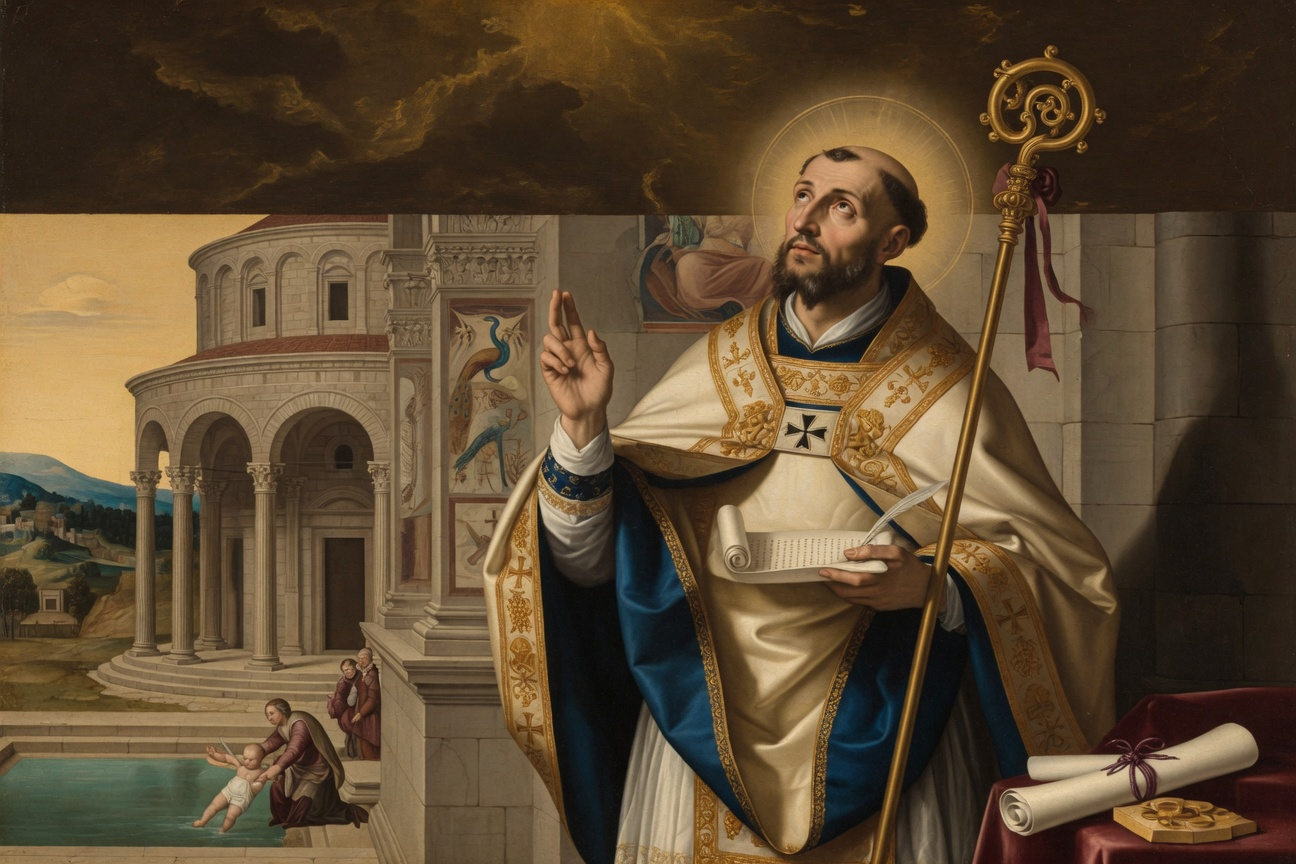
Alcimus Ecditius Avitus, born in Vienne in the mid-5th century, was an illustrious Christian bishop and poet. Coming from a family of saints, he succeeded his father to the see of Vienne and became a bulwark against Arianism among the Burgundians. A great defender of the papacy and author of biblical poems that inspired Milton, he died in 525 after an episcopate marked by his zeal and charity.
Guided reading
9 reading sections
SAINT AVITUS, BISHOP OF VIENNE, IN DAUPHINÉ
Origins and formation
Alcimus Ecditius Avitus was born in Vienne in the middle of the 5th century into a patrician family from Auvergne dedicated to the Church.
This holy pontiff was named Alcimus Ecditius Avitus. He was born, by all appearances, in Vienne Vienne Episcopal see and principal city of the saint's activity. , in the Dauphiné, around the middle of the 5th century (451 or 452). We know from his writings that he belonged to a patrician and senatorial family, originally from Auvergne: he himself sometimes takes the titles of Roman Senator and Catholic Senator.
His parents, after having given birth to four children, bound themselves to perpetual continence; and the head of the family, Isicius or Hesychius, was raised to the episcopal see of Vienne immediately after the death of Saint Mamert. His saint Mamert Archbishop of Vienne healed by Saint Aignan. wife, Audentia, appears to us as the model of Christian mothers. The education she provided to her children was the foundation of that holy life which placed almost all of them upon the altars.
The last of these children was a daughter named Fus cina. O Fuscine Sister of Saint Avitus, consecrated to God. ffered to God at the moment of her birth, she received baptism immediately, and when she had reached the age of twelve, she made a vow of virginity.
It is to this young bride of Jesus Christ that our Saint addressed the last of his poems, in which he traces with as much strength as elegance the happiness and dignity of Virgins.
This work was not initially intended for the public: Saint Avitus was willing to share it with his brother, the Bishop of Valence, but on the condition that he would not make it known to anyone, except to relatives or friends who were sincerely pious.
The very nature of the work sufficiently explains the author's desire on this point: he praises several members of his family who had distinguished themselves by their holiness; on the other hand, he writes especially for a young woman (Fuscina, his sister), consecrated to God, who, in her moments of trial, needed spiritual direction and consolation; the Praise of Chastity is therefore a kind of confidential discourse.
In his humility and his admiration for his sister's virtues, Saint Avitus attributes his own conversion to her.
One must not conclude from this passage that Saint Avitus had ever professed paganism or lived in disorder. At that time, to convert meant to renounce the pleasures of the world to embrace a more perfect state of life; this expression was applied not only to monks and nuns, but also to bishops, priests, deacons, and their former wives, who had become their sisters.
To return to the holy illustrations of Saint Avitus's family, his elder brother—Saint Apollinaris—occupied the see of Valence on the Rhône. His life was fill ed with great dee saint Apollinaire Brother of Saint Avitus and Bishop of Valence. ds, and brilliant miracles were performed for a long time at his tomb. Saint Ado informs us that he was, like Saint Avitus, a great light.
The young Fuscina had a sister who died before her. We know of her only through a letter in which Saint Apollinaris apologizes for not having been able to attend the funeral service that Saint Avitus had celebrated for her in the church of Vienne, and by the latter's response to the Bishop of Valence.
Saint Avitus, who makes known to us several members of his family, leaves us ignorant of the particulars of his own youth. He only informs us, in one of his homilies, that he had received baptism from Saint Mamert, the predecessor of Isicius.
He spent his early years and completed his studies in Vienne, where the rhetorician Sapandus then held a public school. The writings of Saint Avitus himself, and the testimony of the greatest prelates of that era and of the following centuries, prove enough that he achieved great success in the human sciences. But profane studies took nothing away from the gravity of his character, and never turned him away from virtue: he made progress every day in piety, which had never ceased to illustrate his family.
Accession to the See of Vienne
Avitus succeeds his father Isicius around 490, in a context marked by the domination of the Arian Burgundians.
Thus did Providence prepare the young Avitus to become a great bishop and one of the most brilliant lights of the Church of the Gauls. Around the year 490, Isicius having died, our Saint, who was then forty years old, was called to replace him in the government of the diocese of Vienne.
The Burgundians, to whom this city was subject, then had at their head Gun dobad and Gondebaud Uncle of Clotilde, King of the Burgundians, murderer of Chilperic. his brother Godegisel, both partisans of Arianism.
The first of these princes, by the testimony of his contemporaries, was distinguished by high qualities; he had a sharp mind, a brilliant imagination, and much eloquence; he was well instructed in the Catholic religion, and possessed knowledge very rare in a barbarian prince. But the fine qualities of his mind were singularly marred by the vices of his heart: driven by an immoderate and cruel ambition, he put several of his brothers to death; and his character, as weak as it was cunning, kept him in heresy until his death.
Despite the example of the prince, a good number of Germans had remained faithful to the Catholic religion, professed by the Gallo-Roman population: and the acts of a council held under the presidency of Saint Avitus mention the names of twenty-five bishops, all belonging to the kingdom of the Burgundians.
However, Arianism was still very powerful, and Gundobad, despite his knowledge of the true faith, despite his sympathies for the Catholic Church, could never resolve to publicly change his religion, because he feared the Arian people and clergy.
The religious state of other parts of the world was even sadder: in Africa, the Vandals, in Italy, the Ostrogoths, the Visigoths in Spain and in the south of Gaul were engaged in Arianism, and the emperor of Constantinople, Zeno, lent his support to the heresy of Eutyches.
Thus, at the moment when Saint Avitus was called to govern the diocese of Vienne, the powers of the world were everywhere opposed to the religion of Jesus Christ. But soon God would come to renew the face of the earth, and one of the instruments He would use for this work would be the great bishop of Vienne.
Virtues and the Redemption of Captives
Recognized for his humility and eloquence, Avitus distinguished himself through his charity, notably by financing the ransom of prisoners in Italy.
Saint Avitus brought with him to the episcopal see all the qualities of mind and heart that can adorn the episcopate. His apostolic duties, his relations with the prelates and princes of his time, and his entire life show him to be animated by a lively faith, a deep piety, and an ardent zeal for the interests of religion; full of humility, charitable and peaceful, he was constantly dedicated to bringing strayed souls back to God, and to restoring peace and charity in those where hatred and bitterness reigned.
He gave proof on several occasions of his zeal for the redemption of captives; he thus showed himself to be the worthy minister of that Church which has never ceased to work for the liberation of man, in times of barbarism and slavery.
Let us cite a fact reported in the Life of Saint Epiphanius, Bishop of Pavia.
During the wars that the King of the Goths, Theodoric, waged against Odoacer, and notably during the long siege of Ravenna, the last refuge of the King of the Heruli, the Burgundians made frequent incursions into Liguria, devastating the countryside and carrying off a multitude of captives. Consequently, Italy was in desolation; for lack of men, the fields were no longer cultivated. Theodoric therefore sent Saint Epiphanius to Gundobad, with the mission of ransoming the prisoners. But the sum at the Saint's disposal proved insufficient; and the Bishop of Vienne, ardently desiring that all should be set free, generously provided the means to pay their ransom.
Saint Avitus manifested this charity toward captives in several of his letters. Moreover, he reveals the depths of his loving soul through his conduct toward sinners. He tells us himself that he corrected them with gentleness, and that, following the example of his divine Master, he preferred mercy to justice. "The unfortunate sinner," he says, "finds sufficient punishment in his crimes." It was also under the impulse of these same sentiments that he interceded on behalf of a slave who had denied a deposit.
Conduct so full of faith, zeal, and love explains well enough why Saint Avitus was cherished by his brethren and regarded by his contemporaries as the model of pastoral virtues.
His charity alone equaled his humility, and this charity alone could also decide him to resolve the doubtful questions submitted to him by the clergy of Gaul, and to take upon himself a multitude of affairs that he believed were beyond his strength.
However, he was no less distinguished by his talents than by his virtues: this is the unanimous testimony of his contemporaries and later writers. Agobard, Bishop of Lyon, recognizes in him a great penetration of mind, a compelling eloquence, and much unction in the explanation of the Holy Scriptures. Saint Isidore of Seville informs us that he was very well versed in human letters; and, according to the testimony of Ennodius, deacon of Pavia, skill seemed to have chosen him as its favorite sanctuary.
One understands after this these other words of Agobard: "Almost the entire Church of Jesus Christ knows how much Saint Avitus distinguished himself by the orthodoxy of his doctrine and by his eloquence."
Struggle against Arianism and conversion of kings
Avitus congratulates Clovis on his baptism and works for the conversion of Gundobad and his son Sigismund, whom he brings back to Catholicism.
This combination of talents and virtues soon won for Saint Avitus the esteem, confidence, and veneration of two barbarian kings, Clo vis an Clovis First king of the Franks to convert to Catholicism. d Gundobad, although the latter professed Arianism and the former was still an idolater.
In 496, Clovis embraced Christianity, and the Bishop of Vienne wrote him a beautiful letter of congratulation.
The conversion of Gundobad would have fulfilled all the wishes of the holy prelate; therefore, he directed all his efforts toward this goal. For a long time, he had been in intimate contact with the King of the Burgundians; they had frequent discussions together on Catholic dogma and morality.
Saint Avitus himself preserved for us one of these conferences in a letter to Sigismund, son of Gundobad. One sees there that the discussions, often very long, took place before Arian priests, who posed to the illustrious champion of the faith questions that were embarrassing in their subtlety. In reading this letter, one witnesses the battle that truth was waging in the heart of Gundobad; and one is astonished to encounter in this barbarian king a mania for disputation that places him alongside the Greek emperors. It must also be acknowledged that he listened peacefully to the discussion and grasped very well the value of the questions and answers.
Saint Gregory of Tours informs us that at the prince's request, Saint Avitus gathered the passages of Scripture most suited to confound the heresy of Eutyches. Moreover, this great prelate pursued error in all its forms: Eutychianism, Nestorianism, and the deviations of Photinus and Bonosus were in turn the object of his attacks.
It was mainly against Arianism that Saint Avitus directed the forces of his intelligence and the resources of his apostolic zeal. He fought this heresy tirelessly in his writings, in his preaching, and in all his conversations; he did so with great brilliance in the famous Conference held at Lyon in the year 506, before Clovis's first expedition against Burgundy.
If Gundobad did not have the courage to renounce Arianism himself, he nevertheless did not prevent his children from embracing the true Sigismond King of Burgundy to whom Pelade predicted his ruin. religion. Sigismund, his eldest son, took advantage of this freedom to be instructed and to follow the inspirations of his piety: he placed himself in contact with the Bishop of Vienne, to whom he was indebted for his conversion. It was on the advice of Saint Avitus that he undertook to restore the monastery of Agaune or Saint-Maurice in Valais, and this as early as the year 515, one year before the death of Gundobad. However, the church was not completed until 517, at which time it was dedicated with great solemnity in the presence of sixty bishops and a large number of lords. On this occasion, our Saint delivered a homily of which the title and a fragment remain. In it, he congratulates the new king for having preceded all the members of his family in the profession of the Catholic faith, and thanks him for the largesse he had granted to the new establishment.
All the letters of Saint Avitus to Sigismund were written after the conversion of this prince who, not content with having always professed the Catholic religion publicly and in full freedom, wished—when in 517 he replaced Gundobad on the throne—to abjure the heresy again in a more solemn manner. This he did with his two children, Sigeric and Suavegothe, in the presence of the gathered people and clergy. Saint Avitus delivered a homily on this occasion, which the ancients praise highly.
The Councils of Epaunum and Lyon
He presided over the Council of Epaunum in 517 to reform ecclesiastical discipline and combat Arian influence.
This event dealt a death blow to Arianism and decided the conversion of the greater part of the people. The bishops, and especially Saint Avitus, redoubled their efforts to complete a work so happily begun. Among the means that most effectively served their good designs, one must count the provincial synods.
As early as the year 517, the Bishop of Vienne summoned his suffragans for an assembly of this kind; it opened its sessions on September 17 at Epone or Epaunum, a p lace believed to Épone ou Epaunum Site of a famous council presided over by Avitus. be Yenne, on the Rhône, in the diocese of Chambéry. Twenty-five bishops, both from the province of Vienne and from other parts of the kingdom, were present.
He summoned his colleagues to conform, as he said, to the will of the venerable Pope of Rome, in the hope that wise decrees would be enacted to guide the conduct of the clergy.
Indeed, forty canons of discipline were drawn up in this assembly, several of which concern bishops, priests, and deacons, and prove that certain members of the clergy had allowed themselves to be drawn into the customs peculiar to the then-dominant Germanic race.
It was also forbidden to communicate with the Arians, whether at meals or in religious exercises: one sees by this that a great number of Burgundians were still heretics.
Saint Avitus, who presided over the assembly, had the greatest share in the salutary regulations established there. It has even been observed that Canon XXXIII, relating to the use that may be made of temples formerly consecrated to heretical worship, is the almost literal reproduction of a decision given previously by our Saint in a letter to Victurius, Bishop of Grenoble.
The Gallic clergy, revived above all by the care of Avitus, occupied themselves from then on with new zeal in the apostolic ministry; nothing was neglected: neither the conversion of the Arians, nor the instruction of the faithful, nor the reformation of morals, nor finally the repression of scandals caused by the great.
Thus, shortly after the Council of Epone, an ecclesiastical assembly met in Lyon to judge one of the king's highest officers, who was living in incest. Sigismund, taking the defense of his unworthy favorite, subjected the bishops to the punishment they had foreseen: he exiled them all to a place in the Lyonnais named Sardinia, today completely unknown.
Saint Avitus undoubtedly had the glory of attending this council and sharing the exile of his courageous colleagues.
The persecution to which the members of the council were subjected shows what the Catholic clergy had to suffer from the Burgundian kings, even after their conversion.
The Germans, and especially their leaders, despite their contact with the Gallo-Roman population, despite the ever-growing influence of Christian ideas and customs, were very slowly losing the spirit of savage independence they had brought from the forests of the North.
1. Yenne, formerly the capital of the small Lingey, today the chief town of the canton of the arrondissement of Chambéry, is situated on the Rhône, 20 kilometers N.W. of that city. While excavating the soil of this town—which, at the time of Saint Avitus, must have had only one parish, as it does today—a Latin inscription was discovered there in the 18th century bearing these words: Deæ Epanum, which goddess had undoubtedly given her name to the locality. Moreover, Yenne has always been called Ephana in Latin; or, possession by title: no other locality can be named that has constantly borne this name. The French name Yenne is not so far from the Latin that with a little good will one could not derive it from Epanus. We still have an indirect proof that the Council of Epone must have been held at Yenne: it is that Saint Avitus took advantage of his trip to Savoy to go, immediately after the council, to consecrate several churches of this province, which then fell under his see: that, among others, of Annemasse, near Geneva (diocese of Annecy), and that of Tarentaise (Moutiers), rebuilt by Bishop Sanctius, one of the signatories of the council. He specified this in these two circumstances. (Fragments of his speeches have been published by the Genevan Institute.)
Impartiality makes it our duty to mention the reasons that place Epone at Albon (Drôme), an ancient fief of the church of Vienne.
We read in the Mémoires de Trésouw, Nov. 1737, p. 1967, 1675:
"To find the true location of Epone that Saint Avitus calls Parochia Epanuensis, one must 1st find a place that belonged to the church of Vienne; 2nd that this place be in the diocese of Vienne; 3rd that there have been in this place two churches dedicated one to Saint Andrew, the other to Saint Romanus, martyr; 4th it is necessary that this place be proportionate to the distance of the bishops of the kingdom of Burgundy, who had to go to the council. The first, second, and third of these conditions are found in a diploma of Louis the Pious (Cf. Baluse, Act. Vet., t. II, col. 1423). By this diploma, Louis the Pious obliges Count Albon to restore Epone to the church of Vienne..."
Charvet, author of the Annales de la sainte église de Vienne, adopted this opinion and confirmed it by a charter of the church of Vienne, which would characterize the situation of Epone even better. This charter contained the donation that Arlaif and Adoura, his wife, made to the church of Vienne of the goods they had in the Viennois, in the territory of Epone, in the place called Ancyron. Ancyron, said Charvet, is a parish of the diocese of Vienne, in the county of Albon, six leagues from Vienne, not far from the Rhône, and joining that of Saint-Romain d'Albon. Epone has lost its name, and Ancyron has kept its own.
One sees, by the diploma of Louis the Pious, that the true reading of the name of the Council of Epone is Epanuensis. This name was already being corrupted in the time of Charles the Bald, since a charter of this prince bears Ehbsonensis, and it may have happened very naturally, subsequently, that this place was designated by the name of Count Albon, who had restored it to the church of Vienne. Epone was never a city. The cities of the first order were called, among the Flemish, Cisitas; those of the second, Castrum, and the towns, Vicus, a qualification that the diploma gives to Epone. — Cf. Conciles pén. et part., by Mgr Guétin.
Defense of the Holy See
Avitus takes up the defense of Pope Symmachus against the usurper Laurentius, asserting that the Pope cannot be judged by his inferiors.
This insubordination of the Germans was more or less excusable in barbarians who had just embraced the Catholic faith. The Church had to lament much greater evils at the very center of Christendom: while the Bishop of Vienne was working for the conversion of the Burgundians, a schism had broken out in Italy, where it had caused violence and disorders of every kind.
Pope Anastasius having died on November 16, 498, the deacon Symmachus was leg itimatel Symmaque Pope defended by Apollinaris. y elected to succeed him. But influential figures in Rome, who wanted to have the Henotikon of Zeno admitted, managed, through intrigue, to have the anti-pope Laurentius elected. The latter was condemned at the Council of Rome (300). But soon his partisans recalled him, and, to ensure his triumph, they resorted to slander: they accused Symmachus of horrible crimes and demanded his condemnation from Theodoric, King of the Goths, who charged a council to examine the conduct of the Pope. The latter, having submitted to the judgment of his inferiors to avoid the greatest of evils, was absolved in the assembly known as the Synodus Palmaris.
However, the clergy of Gaul, alarmed that the Italian prelates had dared to judge the head of the Church, instead of taking his defense, charged Saint Avitus to protest against this illegal act. The Bishop of Vienne wrote, in fact, to the most distinguished personages of Rome a letter in which he takes up the interests of the good cause and defends with the greatest vigor the election of the legitimate Pope. Saint Avitus addressed his letter to Faustus and Symmachus, who were the leaders of the Senate.
"It would be highly desirable," he told them, "that we could go ourselves to that city which the whole universe venerates, to fulfill our religious and civil duties there; but, since the misfortune of the times makes this journey impossible for us, we would have wished, at least, to meet and thus make known to Your Greatness the unanimous sentiment of all the bishops of Gaul regarding this important matter which concerns us all; the boundaries of our respective provinces, having become impassable, have hindered our desires. I pray, however, that the Senate does not consider this letter as that of a single bishop, for I write to you only in the name of my brothers in Gaul who have given me, by letters, the commission to write to you, and I am only the interpreter of their sentiments.
"We were in great anxiety regarding the Roman Church (anxieties which are very legitimate, since the entire episcopate is shaken when its head is attacked), when we learned of the judgment pronounced by the bishops of Italy in the cause of Pope Symmachus.
"Although this sentence, rendered in a numerous council, is respectable in itself, we cannot hide, however, that the holy Pope Symmachus, pursued before the civil authority, should have found in his co-bishops consolers rather than judges. Moreover, it is not easy to understand how the superior could have been judged by his inferiors. When the Apostle forbids us to receive lightly an accusation against a simple priest, how could one receive one against the Head of the Universal Church? The venerable council understood this, and it is for this reason, no doubt, that, while affirming that neither he nor the most glorious Theodoric had found the crimes reproached to the Pope to be founded, it decides that it must refer to God a cause which it could not (let it be said without offending anyone) take upon itself without temerity.
"As a Roman senator and as a Christian bishop, I conjure you to take as much interest in what concerns the Church as in what concerns the Republic, and, in your city, do not love the See of Peter less than the capital of the world.
"If one has reproaches to make against another bishop, one can examine his cause without difficulty. But, when the Pope of Rome is attacked, the entire episcopate totters.
"You know in the midst of what storms we steer the rudder of the faith. If, like us, you tremble at the sight of the perils that our vessel runs, you must unite with us to defend its pilot. Remember that it is not for the flock to judge the shepherd; the sovereign Judge alone has the right to demand an account of the sheep from the one to whom He has entrusted them. Work, therefore, to restore peace if it is not yet restored."
This letter, of such strong logic and such simple and admirable eloquence, can give an idea of what Saint Avitus thought regarding the primacy of the See of Peter.
Action against the Eastern Schism
In connection with Pope Hormisdas, he worked to put an end to the Acacian schism and restore unity with the Greek Church.
The Bishop of Vienne always maintained the same attachment to the head of the Church: he was the confidant and intimate fri end of Po Hormisdas Pope contemporary with the end of the life of Lautein. pe Hormisdas, successor to Saint Symmachus, and joined him in stifling the schism that had been devastating the Greek Church since the condemnation of Patriarch Acacius.
Hormisdas, who desired peace and union, had sent legates to the East, and had succeeded in detaching the bishops of Dardania, Illyria, and Thrace from the schism. But for a long time, the Eastern Church had felt against the Western Church the stings of that jealousy which led it to the deplorable schism that still endures. The efforts of Hormisdas failed against the perfidy of the Greeks, and he could not restore peace.
Avitus had learned from the Pope himself of the happy dispositions of the bishops who had returned to unity, and of his intention to send new legates to the East.
He was so keenly interested in this matter that, some time later, he sent the priest Alexius and the deacon Venantius to Rome to learn the result of this second embassy. Fearing that his envoys might not be able to reach Rome, he instructed other clerics to go to Ravenna to ask Bishop Peter for the information he desired.
The letter he gave to Alexius and Venantius for the Pope was written in the name of all the bishops of the Viennoise.
The Pope replied to Saint Avitus:
"Dearest brother, we have rejoiced in the Lord to see in the letter you sent us by the priest Alexius and the deacon Venantius, how attached you are to the constitutions of the Apostolic See which condemned the impious Nestorius and Eutyches, and how much interest you take in knowing whether our efforts have produced any result against those heretics who trouble the Eastern Churches."
It was indeed only right that the faithful children of the Church should pray for their mother, while unnatural sons continued to tear at her breast. Finally, the end of the suffering arrived: Emperor Anastasius having died in 518, Justin, his successor, showed himself more loyal and more reasonable; and Patriarch John of Cappadocia managed to stifle the discord. The Bishop of Vienne had undoubtedly contributed in large part to ending the schism. As soon as the happy event was known in the Gauls, he wrote to the Patriarch to express his joy. He urgently recommended to him the maintenance of harmony, so desirable and so necessary, between the two great Churches upon which the eyes of the whole world are fixed.
Times of agitation, such as the one we have just spoken of, are always marked in history by persecutions directed against the defenders of the good cause. While the Greek emperors and ambitious bishops offered scandalous resistance to the decisions of the universal Church, a holy personage, Elias, Patriarch of Jerusalem, remained unshakeably attached to the communion of the Roman pontiff. Deprived of his see for this act of courage, the intrepid confessor had taken the path of exile. He had received several letters from the Bishop of Vienne, like him a defender of the Holy See, and like him also an unshakeable support of the Catholic faith; unfortunately, only one of these letters has reached us: Saint Avitus wrote it to thank the Patriarch for having sent him a fragment of the True Cross.
Death and Posterity
Avitus died in 525 after a life dedicated to his diocese and the production of major theological and poetic works.
From then on, the bishop of Vienne ceased to be involved in the striking events of history.
The support he gave to the Holy See against the antipope Laurentius, and the efforts he made, in concert with Saint Hormisdas, to stifle the religious discords of Constantinople—these were, so to speak, the two great manifestations of his zeal in favor of the universal Church.
Henceforth his activity remained concentrated within the limits of Gaul: he devoted the rest of his days to preaching, to the guidance of the clergy and the faithful, in a word, to the government of his diocese. And certainly, at a time when defeated Arianism was seeking to rise again, and when Germanic customs still resisted the precepts of the Gospel and the voice of the Church, a bishop did not lack opportunities to exercise his zeal.
However, Saint Avitus was so industrious that, in the midst of the occupations inseparable from the episcopate, he still found time to compose works of considerable length. He continued to write homilies admired by his contemporaries, and treatises in which he refuted in detail various errors, and especially Arianism. He even cultivated poetry while bishop, in which he achieved much success; but he always took care to treat serious subjects, worthy of a bishop, and suitable for instructing and edifying.
Saint Avitus—it is a too little-known fact—was the greatest poet of his time.
But he cared so little for literary glory that he would not have published his poems without the repeated urging of some friends. Despite the religious character of his works, he regretted the precious time that he could have, he said, employed more usefully.
Indeed, the cares of his pastoral office left him very little leisure: the esteem in which his wisdom was held and the confidence inspired by his virtue were so great that he was consulted from all sides on points of faith, morals, and discipline.
The tireless pastor often distributed the bread of the divine word to his flock; not content with preaching in Vienne, he frequently did so in other churches, as proven by some titles of his homilies.
Until his last day, he displayed a vigilant zeal, full of humility, energy, and confidence for the interests of the faith; he showed this zeal entirely in one of his letters regarding the African Donatists, who seemed to want to make new partisans in Gaul. He signaled to Saint Stephen of Lyon the first traces of the contagion from overseas.
These schismatics never managed to spread in Gaul.
On the other hand, Arianism was declining every day among the Burgundians, whom Saint Avitus had just so happily brought back to the bosom of the Church.
Finally, death extinguished this great light of the Church of the Gauls, as he is described by Ado, one of his successors. He died full of merits, having reached the age of seventy-three to seventy-four, on February 5, 525, the day on which the Church celebrates his memory.
The Roman Martyrology mentions the eternal birth of Saint Avitus in these terms: "At Vienne, the birth of Saint Avitus, bishop and confessor, whose faith, activity, and admirable doctrine preserved the Gauls from the ravages of the Arian heresy."
Nothing is more beautiful than this testimony!...
He was buried in the church of Saint-Pierre, outside the walls of the city of Vienne.
The Literary and Poetic Work
Considered the greatest poet of his time, his writings on the Creation are said to have inspired Milton's Paradise Lost.
Saint Avitus was not only a holy bishop (this title alone would suffice for his glory), but also a man of genius, a profound theologian, a great poet—the greatest poet of his time.
His lyre was Christian; for him, verse was merely a fortunate form placed at the service of Catholic teaching.
In a letter from Saint Avitus to Euphrasius, Bishop of Clermont, we see the goal pursued by the Christian poet: "If our brother finds in this volume a suitable subject for reading, if only for children, I shall be able to know it through a letter from Your Greatness."
It was therefore for the benefit of the youth that Saint Avitus wished to publish his poetic works.
In the 5th century, paganism, annihilated as a cult, was still influential as a memory; pagan ideas and maxims still dominated a large class of Gallic society, and the teaching of rhetoricians, based solely on ancient classics, presented a real danger for children, which Christian writers strove to stop.
"All education," says Ozanam, "was founded among the ancients, as it remained in the Middle Ages, and with great wisdom, on the exercise of memory and the study of poets. In Greece, one began with Homer, and in the West, with Virgil. But, with Virgil, the pagans and Christians of the 5th century learned by heart, engraved in their memory all the thoughts, all the doctrines, all the images of paganism.
"It is against this paganism that the first Christian poets strive to fight; it is in a spirit of polemic, of controversy, that they write; it is a matter for them of dethroning the false gods from this envied seat that they have been given in the memory and heart of young children, and of seating there a God more worthy of childhood. That is why they strive to retain the Virgilian, classical, pure forms, while casting new ideas into this ancient mold, at the risk of seeing these ideas, penetrating, in a way, the form in which they were received, eventually causing it to burst and breaking the mold."
The poems of Saint Avitus are indeed conceived with the goal of religious propaganda: they are pious readings, manuals for the instruction of youth, as well as works of art.
One notices the same practical intention in the literary compositions of all the Christian writers who appeared in the West at that time.
The Facts of Sacred History: this is the general title of the five poems that have remained to us from Saint Avitus; but he gave each book a particular title.
The crit ics of the 17th century found Les faits de l'Histoire sainte Collection of five biblical poems in heroic verse. in them an ingenious conduct, a vigor of thought, and a beauty of expression worthy of a happier age.
From the 17th century to our days, the poems of Saint Avitus had remained in oblivion: it was not believed that any literary beauty could be found in writings composed during the time of the barbarian invasions.
M. Guizot was the first to draw the attention of minds to this obscure era; in one of his interesting lessons on the History of Civilization in France, he expresses himself thus, speaking of the poems of the Bishop of Vienne:
"The first three, the Creation, Original Sin, and the Judgment of God, form a sort of whole, and can be considered as three cantos of the same poem, which one can, which one must even call, to speak exactly, Paradise Lost. It is not by the subject and the name alone that this work recalls that of Milton; the resemblances are striking in some parts of the general conception and in some of the most important details... The analogy of the two poems is a rather curious literary fact, and that of Saint Avitus deserves the ho Milton English poet whose Paradise Lost is compared to the work of Avitus. nor of being compared closely to that of Milton."
M. Guizot compared some passages of the two poems; this parallel fully justifies his assessment, and even hardly allows one to doubt that Milton was often inspired by the reading of the Latin poet.
Yes, Milton must have known the poems of Saint Avitus: everything seems to prove it; they had been published at the beginning of the 16th century, and Milton's erudition, both classical and theological, was great.
We are far from possessing all the poems of the Bishop of Vienne. The collection that has reached us contains six books or cantos, all in heroic verse.
Canto One. — On the beginning of the world; creation of man; description of paradise; the prohibition.
Canto Two. — On original sin; the temptation; the fall.
Canto Three. — Judgment of God; expulsion from paradise.
Canto Four. — The flood; corruption of the human race; the angel comes to warn Noah, etc.
Canto Five. — Crossing of the Red Sea.
Canto Six. — Praise of chastity; consolation addressed to my sister Fuscina... We spoke of this at the beginning of this life.
La France littéraire mentions ninety-two letters, almost all addressed to the principal figures of his century: Clovis, Gundobad; Anastasius, Emperor of Constantinople; the bishops of Milan, Jerusalem, Arles, etc.
Of the numerous homilies of Saint Avitus, only two remain on the Rogations. They are very remarkable: Dom Martène published a third on the same subject, Thesaur, anecdote, t. v, p. 49; he also published fragments of eight other homilies; the conference against the Arians, printed in volume v of the Spicilegium. The works of Saint Avitus are found in the Library of the Fathers. The learned P. Sirmond published them in 1643, in-4°, with short but judicious notes. The tight manner with which Saint Avitus presses the Arians in some of his letters should make us regret the other works he had composed against these heretics.
His lost writings are innumerable.
There is no contemporary biography of Saint Avitus. Those who have written his life have always borrowed the details from his writings and from contemporary authors. As for us, we have reproduced a part of the notice inserted by M. Bérhélémy in vol. v of the Annales hagiologiques de la France; he had borrowed it himself from the Abbé Partel, who published, in 1559, a learned study on the holy Bishop of Vienne.
Annexes & related entities
Structured data for exploration: events, miracles, quotes, places, attributes, patronages, and important entities cited in the text.
Key Events
- Born around 451 or 452 in Vienne
- Baptism by Saint Mamert
- Elevation to the episcopal see of Vienne around 490
- Letter of congratulation to Clovis on his baptism in 496
- Presided over the Council of Lyon against the Arians in 506
- Conversion of Sigismund, son of Gundobad
- Presided over the Council of Epaone in 517
- Defense of Pope Symmachus against the Synodus Palmaris
- Struggle against the Acacian schism in the East
Miracles
- Miraculous redemption of captives in Liguria through his generosity
Quotes
-
If one has reproaches to make against another bishop, one may examine his case without difficulty. But when the Pope of Rome is attacked, the entire episcopate totters.
Letter to the Roman Senate -
The wretched sinner finds sufficient punishment in his crimes.
Writings of Saint Avitus