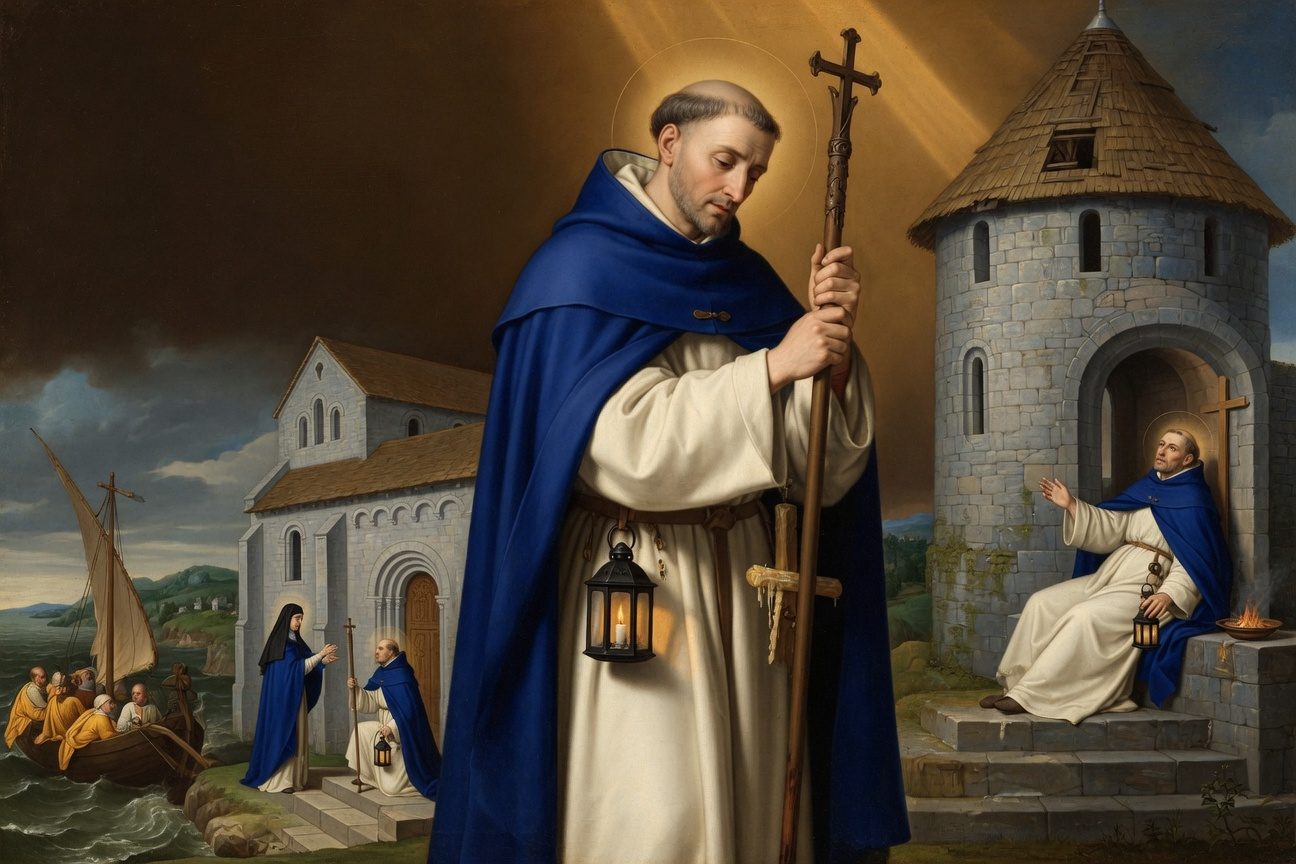
An Irish monk who became a recluse in Soissons in the 8th century, Saint Voué lived a life of asceticism and charity near the Abbey of Notre-Dame. After a nine-year exile caused by slander, he returned to perform numerous miracles, particularly against demons and fires. He is traditionally invoked to protect buildings from fire through his sacred staff.
Guided reading
6 reading sections
SAINT WODOEL OR VOUÉ
Origins and arrival in Soissons
Originally from Ireland, Voué arrived in Gaul with his companion Magnebert and joined the Saint-Pierre community in Soissons under the authority of Abbess Hildegarde.
The reclus e Vo Voué Irish recluse who settled in Soissons in the 8th century. ué, originally from Ir Irlande Place of intellectual and spiritual formation for saints. eland, is one of the best-known heroes of the Soissons traditions.
He came to Gaul at a time when migrations from Scotland and Ireland were so frequent and provided so many pious colonies of solitaries, while also serving as missionaries along the way. He had only one traveling companion named Magnebert. Having stopped at Notre-Dame de Soissons in his capacity as a pi lgrim, h Soissons Birthplace and place of death of Geoffrey. e was so edified by the holy life of the Saint-Pierre community that he asked for and obtained from Abbess Hildegarde permission to be admitte Hildegarde Queen of the Franks and wife of Charlemagne. d. It was perhaps to escape the gaze of his many compatriots who passed through Soissons on their way to pilgrimage in Rome and Palestine that he left the cloister of Saint-Pierre and went to live as a recluse in a cell fashioned in a tower called the Saint-Benoît tower, and later th e Saint-Voué tower. tour de Saint-Benoît Place of the saint's reclusion in Soissons. It was located near the city wall and opposite the abbey gate. Later, a gate was built near this tower, which also took the name of Saint-Voué. He led an angelic life in this obscure retreat. Poor himself, he loved the poor, of whom he was the support and counselor. A very simple incident, but one which gave rise to slander, came to disturb this life so pure and so forgotten. The powerful abbess, whose esteem and friendship he had managed to win, having sent him his daily meal on a silver platter, Voué gave it to an unfortunate man who lived near his cell and to whom he often offered the best part of what was brought to him; but the latter, not content with the dinner, took the platter and fled. Hildegarde, angry at this loss, addressed harsh words to Voué who, without answering, prostrated himself at her feet, and, unable to bear these unjust reproaches, resumed his pilgrimage for nine whole years.
Life as a Recluse and Exile
Voué chose to live as a recluse in a tower near the city walls, but went into exile for nine years after being unjustly accused by the abbess following the gift of a silver dish to a poor man.
After many adventures, Voué returned to Soissons, and as he approached the monastery of Notre-Dame, the demon who had been the secret author of his departure was forced to announce his return through the mouth of a servant of the abbey whom he held in his possession and who began to cry out: "Arise, go to meet Voué who is returning to the abbey to cast me out." The abbess and the nuns, having rushed to the noise, received the recluse with great joy. As for him, following the example of Saint Benedict, who had slapped a possessed monk to deliver him, he likewise struck the servant of the abbey, who was immediately abandoned by the demon. To take revenge, the evil spirit set fire to the cell that the holy man had returned to with such joy. As the door was locked from the outside, as was the practice for recluses, the devil began to shout that Voué would perish in the flames before anyone could bring him help. But his good angel delivered him, transported him to an island in the Aisne, and extinguished this i nfern Aisne River flowing through Soissons. al conflagration.
Return and struggle against the demon
Upon his return, he exorcises a servant and survives an arson attack set by the demon, saved by an angel who transports him to an island in the Aisne.
This legendary account became embellished over the centuries. It is reported that in the time of Saint Voué, the demon held great power in the city of Soissons and would carry off the thirteenth person to pass through the Rue d u Mont-Revers. The rue du Mont-Revers Street in Soissons associated with a legend of demonic possession. servant of God, to put an end to this diabolical power, ordered an extraordinary fast and prayers followed by a solemn procession. He then had twelve well-disposed people pass before him in the magical street and followed as the thirteenth. Satan appeared immediately to seize him, but the Saint commanded him with authority to clear the area and retreat to hell. Forced to obey this extraordinary power, the devil begged him not to send him back to that abyss and to grant him a less miserable retreat. Then Voué sent him into the Aisne river, below the Lardier tower. Since then, a priest would go every year to conjure the demon in this tower, where he was supposed to have established his residence, in order to satisfy the desires of the people. All that can be said of these romanticized accounts is that the name of Saint Voué, given to the gate of the Rue du Mont-Revers, was a monument that recalled some important event in the life of the holy recluse.
Soissons urban legends
The saint frees the Rue du Mont-Revers from the grip of the devil, who demanded the sacrifice of one passerby in thirteen, and confines him to the Aisne river.
The monastery of Notre-Dame was also full of memories of facts no less extraordinary attributed to Saint Voué. One day, fire having broken out at the abbey, a nun whom he had cured of fever and toothache ran to warn him. He, without being astonished, gave her his cape to oppose the fire, which was extinguished as soon as this garment was brought near it. The traveler's staff that he had received from the angel and which was kept at the convent under the name of *crossillon de saint Vou crossillon de saint Voué The saint's traveling staff, used against fires. é* (Saint Voué's little crozier), also enjoyed, it was believed, the virtue of extinguishing fire. Thus, when any fire broke out in the city, it was carried there and it extinguished it immediately. It was often used to extinguish fire in the monastery's workshops, even in later times. An abbess, Ma Mme d'Harcourt Abbess of Soissons who testified to a miracle of the crossillon. dame d'Harcourt, recounts that fire having broken out in the chimney of the common warming room with extreme violence, the sign of the cross was made with the said crossillon against the chimney, and that the fire fell in a mass as large as a hogshead, so that those who were present had difficulty protecting themselves from it. It was also the custom that each year, on February 5, the day of the feast of Saint Voué, after high mass, the first sacristan would respectfully take the marvelous staff, and, followed by the second sacristan, with a lantern and a candle in hand, and several nuns reciting psalms and prayers, would walk through the monastery, making the sign of the cross everywhere, and particularly on the chimneys, with this instrument of devotion. Miracles multiplied at Notre-Dame de Soissons through the intercession of Saint Voué. Entering the cloister once to celebrate mass, he met two nuns who were very sad because they had botched the cutting of a high-priced robe that a lord of the court had asked the abbess to have made for him in the convent. The Saint made the sign of the cross over the fabric, which returned to its original form and could be cut again with more precision.
Miracles and relics
Several miracles are attributed to him, notably the control of fires thanks to his cape or his staff (the crossillon), as well as the miraculous restoration of a precious fabric.
Saint Voué died around 700, on February 5th. The nuns of Notre-Dame accompanied the mortal remains of the pious recluse with their tears, which were deposited in the church o f Sainte-Cro Sainte-Croix Initial burial place of the saint. ix.
Death and posterity
Voué died around the year 700 and was buried in the church of Sainte-Croix; he remains invoked as a protector against fires.
Saint Voué is particularly invoked against fires. Cf. Annales du diocèse de Soissons, by Abbé Pêcheur abbé Pêcheur Author of the Annales du diocèse de Soissons. .
Annexes & related entities
Structured data for exploration: events, miracles, quotes, places, attributes, patronages, and important entities cited in the text.
Key Events
- Migration from Ireland to Gaul
- Admission to the Abbey of Notre-Dame de Soissons by Abbess Hildegard
- Retreat as a recluse in the tower of Saint-Benoît
- Nine-year exile following a slander related to a silver dish
- Return to Soissons and exorcism of an abbey servant
- Miraculous deliverance from an arson fire caused by the demon
- Expulsion of the demon from Rue du Mont-Revers
Miracles
- Exorcism of a servant possessed by a blow
- Miraculous transport by an angel to an island in the Aisne to escape the flames
- Expulsion of the demon from Rue du Mont-Revers to the Aisne river
- Extinguishing fires by contact with his cape or his staff (crozier)
- Miraculous repair of a poorly cut piece of fabric
Quotes
-
Rise up, go and meet Voué who is returning to the abbey to drive me out
Words of the possessed person cited in the text