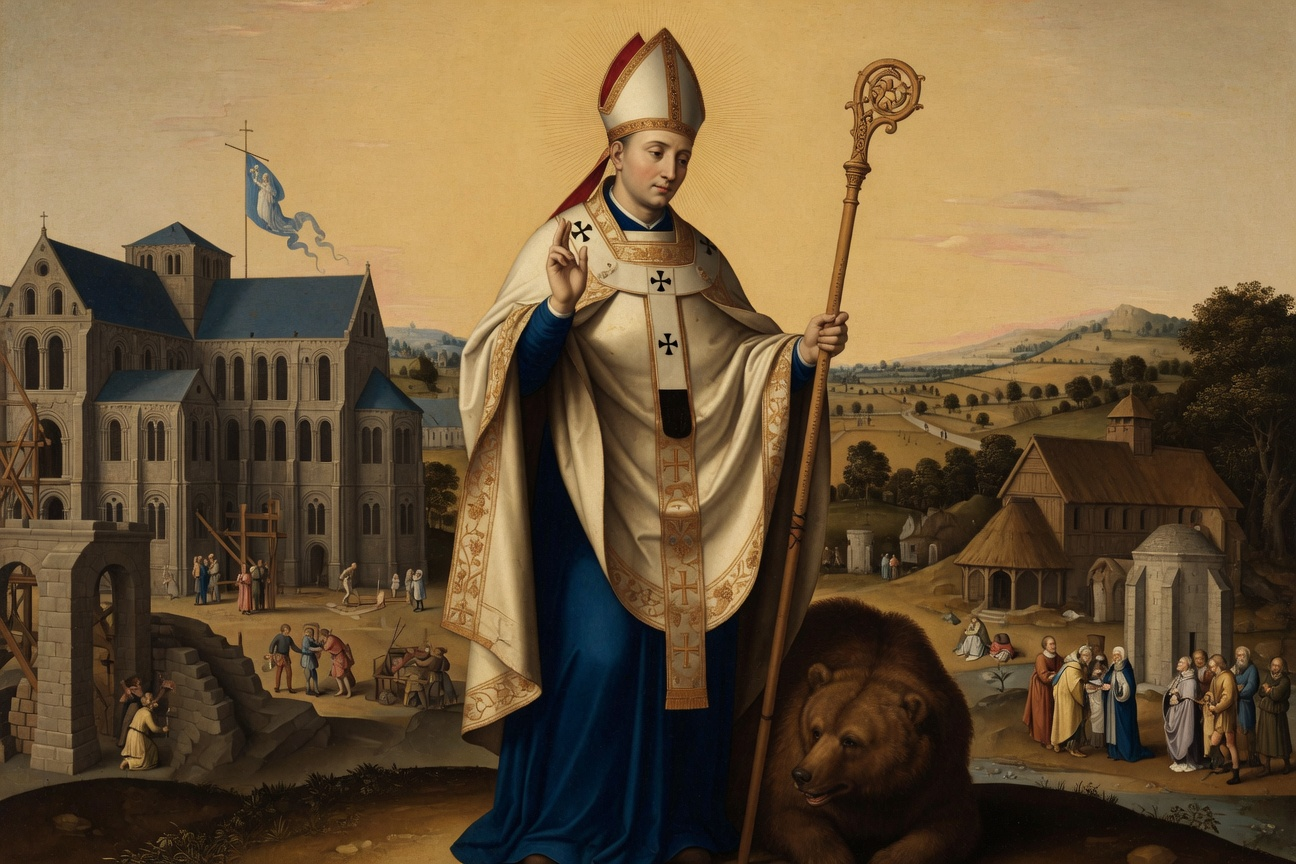
Saint Vaast was the illustrious bishop of Arras and Cambrai and the principal founder of the Christian religion in Artois. After evangelizing the Beauvaisis, he died in the 6th century and his relics were the subject of numerous translations, notably to Beauvais to escape the Normans. His cult remains very vibrant in northern France and in England under the name Foster.
Guided reading
8 reading sections
RELICS OF SAINT VAAST. — SACRED TREASURE OF ARRAS.
Burial and first translation
Saint Vaast was initially buried in a wooden chapel near the Crinchon before being transferred to his cathedral in Arras.
This illustrious bishop had chosen his burial place in a wooden chapel that he had built on the bank of the small river Crinchon, outside the city. It was there that, upon returning from his apostolic journeys, he would go to devote himself, as he once did in Toul, to the contemplation of heavenly things. But the place not having been found magnificent enough for such a great prelate, he was carried into the great church, his cathedral, which he had also had built in honor of Our Lady.
The work of Saint Aubert and the foundation of the abbey
In 666, Saint Aubert carried out the wishes of Vaast after a vision, transferred his relics, and founded a Benedictine abbey in Arras.
It was not until one hundred and twenty-six years later that his final wishes were carried out by Saint Aubert, one of his successors to the see Arras City where Frédéric serves as provost. of Arras. The blessed Vaast, says Alcuin Famous abbot under whom Aldric began his monastic life. Alcuin, appeared to the pontiff, holding in his hand a rod with which he was measuring, next to his small oratory, the site for a basilica. Understanding, through this vision, that Saint Vaast was ordering him to transport his relics to his oratory, Saint Aubert, accompanied by Saint saint Omer Famous predecessor of Folquin at Thérouanne. Omer, bishop of Thérouanne, had them deposited there in 666, with great solemnity. In this same place, he laid the foundations of a Benedictine abbey which was completed by his successor Vindicien, enriched and en dowed by Th Thierry Ier King of Austrasia and Auvergne in the 6th century. euderic I with a vast basilica, and finally ruined, like so many other monuments of the faith of our ancestors, by the demolishers of '93. The abbey church has since been transformed into a cathedral, and still stands in the center of the city of Arras, as if to remind us, says one author, that this pious foundation was its origin and its glory.
The exile of the relics during the Norman invasions
In the 9th century, the relics were taken to Beauvais for safety to escape the Norman invasions, before returning to Arras fifty years later.
Although the Saint's remains came, after his death, to protect the Beauvai Beauvais City and diocese of the saint's origin. sis, which the Pontiff had evangelized and blessed during his lifetime; in the 9th century, the monks of the abbey that bore his name transferred them to Beauvais, to preserve them from the sacrilegious fury of the Normans. Hildeman, Bishop of Beauvais, and the faithful of the city, remembering the benefits that the Blessed one had lavished upon their fathers, received his relics with sentiments of gratitude, veneration, and confidence. For a space of about fifty years, they rested, either in a chapel of the city or in the church of Saint-Étienne, which, until the 18th century, bore his name, along with that of the first martyr. Their presence in Beauvais was marked by several miracles.
After the Norman invasions, the monks of the monastery of Saint-Vaast in Arras came to ask for the body of their patron saint back. "Although Renovat, Bishop of Beauvais," says Godefroy Hermant, "could not without pain deprive himself of the holy relics that were the ornament of the city, he nevertheless returned them to those who had entrusted them to one of his predecessors. His piety led him to accompany the pious procession for a very great part of the way, followed by a multitude of the faithful, mingling their hymns and praises with the canticles of the clergy."
In testimony of their gratitude for the hospitality that the body of Saint Vaast had received in Beauvais, the monks of Arras left some of his precious relics there. Since that time, the cult of the Blessed one was very popular in that region. Several parishes adopted him as their patron; pilgrimages were established in his honor; and, wherever his name was invoked with confidence, Saint Vaast was pleased to give proofs of his intercession before God.
Geographical expansion of the cult
The cult of Saint Vaast spread widely throughout northern France, Belgium, and as far as England under the name Foster.
In northern France, a large number of churches have been dedicated to Saint Vaast. There are twenty-eight parishes in the current diocese of Cambrai that have Saint Vaast as their patron, eight in the diocese of Tournai; even more are found in that of Arras. There is still a church bearing his name in Soissons today.
The English formerly had a great devotion to Saint Vaast, under the name Foster. Camden even claims that it is from this Saint that the Foster family derived its name.
Saint Vaast had his dwelling in Toul Birthplace of the saint and episcopal see. Toul, not far from the cathedral, which was later turned into a church that subsisted until the Revolution, and which Bishop Pihon had erected into a parish in the 11th century. On certain days of the year, the chapter of Toul would go there in procession to make a station.
Modern recognitions and inventories
Several procedures for the recognition of the remains took place between the 17th and 19th centuries, notably by Mgr de La Tour-d'Auvergne.
A portion of the Saint's relics had remained in the cathedral, for as this church had been burned in 1539 and subsequently rebuilt, there was found, around the year 1640, beneath an altar that had been demolished, an arm of Saint Vaast, with a considerable part of his head, and some bones from the rest of the body.
A document preserved in the general archives of the Pas-de-Calais department shows us the religious of Saint-Vaast, proceeding, in the last century, to the recognition of the relics of their patron. The opening of the reliquary took place in the presence of the superiors of the abbey, vested in surplices and other insignia of their dignity. Candles were lit which burned as long as the examination of the bones and the reading of the authentic titles lasted; finally, an act of recognition was drawn up, the very one we have just mentioned.
On De cember 13, 1802, Mgr de L Mgr de La Tour-d'Auvergne Bishop of Amiens who authenticated the relics at the end of the 19th century. a Tour-d'Auvergne, Bishop of Arras, verified that they still possessed the same number of bones that had been recognized before him by the religious of the former abbey of Saint-Vaast of Arras, and that the whole was in conformity with the ancient authentic documents. — On October 31, 1804, and June 10, 1805, a portion of the relics were given to the parish priest of Bailleul and to Notre-Dame de Saint-Omer. Today, a beautiful reliquary, made on the model of that of the great relics of Aachen, contains the greater part of the bones of the holy bishop of Arras.
Description of the Great Reliquary
The monumental reliquary of Saint Vaast features rich iconography including the holy bishops of the region and scenes from the saint's life.
Saint Vaast, being the principal founder of the Christian religion in Artois, was given as an honor guard the images of the most illustrious holy bishops of the current diocese of Arras. It is in this capacity that Saint Diogenes was first placed on this reliquary, with his Greek bishop's vestments, his gesture of blessing in the Oriental manner, and his name written in Greek letters on a single vertical line. Then come Saint Maximus, the traveling bishop, with a pilgrim's staff in his hand, the special patron of Boulogne; Saint Omer, of Thérouanne, with the emblem of the spiritual Church he founded and the child to whom he restored sight; Saint Aubert, of Arras, with Saint Landelin, his disciple; Saint Géry, of Cambrai, trampling underfoot the monster of idolatry that he vanquished; Saint Folquin, of Thérouanne, with the imperial crown and purple robes placed near him, signs of his kinship with Charlemagne and the honors he despised for the service of Jesus Christ. Finally, Saint Buntfride or Buntfrey, of Thérouanne, holds the allegorical vessel of which the great Pope Nicholas sp pape Nicolas Pope who confirmed the titles of Raoul. oke to him when he exhorted him to stand firm amidst the invasions of the Northmen and the ruins of his desolate church, and Saint Vindicien reminds us of other times of struggle and the definitive foundation of the Abbey of Saint-Vaast, which he holds in his hand. All these images adorn the two long sides of the reliquary. On the small sides, one sees, in sculpture, the image of Saint Vaast himself, and that of the Blessed Virgin, patroness, since time immemorial, of the Cathedral of Arras, with the mysterious candle in her hand.
The reliquary of Saint Vaast is entirely constructed according to the style of the 13th century, and even a little of the 12th century, with precious stones, gables, ornate crests, pine cones, etc. It is a graceful monument.
The Sacred Treasure of Arras
Detail of the numerous relics preserved in Arras, including remains of holy apostles and local martyrs.
The other particular churches that possess sacred bones of Saint Vaast are Annexin, near Béthune, Wrogies, Vergies, in the diocese of Amiens, Fouquières-les-Lens, Lattre-Saint-Quentin, the civil hospice of the city of Aire, Morenil, in the diocese of Amiens, the Holy Sepulchre in Saint-Omer, le Pas, Bienvillers-au-Bois, the seminary of Arras, Laventie, Gonnehem, Fruges, Saint-Vaast-la-Mongue, in the diocese of Coutances; the Benedictines of the Blessed Sacrament of Arras, Armentières, in the diocese of Cambrai; Saint-Nicolas of Arras, Saint-Pol, Notre-Dame of Saint-Omer.
The objects worthy of veneration that the city of Arras possesses constitute one of the most important sacred treasures in France. Besides the head of Saint James the Greater, the head of Saint Nicaise of Reims; the body of Saint Vindicien, bishop of Arras; the head of Saint Leger, the rochet worn by Saint Thomas of Canterbury at the moment of his martyrdom, the body of Saint Banulphe and that of his son, bishop of Arras; the relics of several martyrs of the Theban Legion, the notable relics of Saint Willibrord, a veil of the Blessed Virgin, all great and notable relics, of which we speak in their place, the city of Arras possesses at this moment (March 1872) various relics, the nomenclature of which is as follows:
1° In the sacristy of the Cathedral, the following relics are deposited: Two relics of the True Cross; — two bones of Saint Bertin, abbot of Sithiu; — a bone of Saint Vaast. — 2° Of Saint Francis de Sales, ex carne; of Saint Charles Borromeo, ex praecordiis et tela humore imbuto: of Saint Andrew, apostle, ex ossibus; finally small relics of Saint Peter and Saint Paul. — 3° At the chapel of Saint-Louis: a bone of Saint Folquin, bishop of Thérouanne, and two bones of Saint Aubert, bishop of Arras. — 4° At the chapel of Saint-Charles: a relic of Saint Charles, a bone of Saint Firmin, bishop of Amiens, a relic of Saint Vincent de Paul. — 5° At the chapel of Saint-Vaast: a relic of Saint Vaast, a relic of Saint Omer, one of Saint Maxime. These are, as one can see, the three patrons of the three dioceses from which the current diocese of Arras is mainly formed. — 6° At the chapel of Saint-Jérôme: a bone of Saint Isbergue or Giselle, sister of Charlemagne; two fragments of the head of Saint Christine, virgin and martyr. — 7° At the chapel of the Calvary: a bone of Saint Roch. It is also there that the notable relic (a significant part) of the head of the blessed Benoît-Joseph Labre is exposed. — 8° At the chapel of the Good Death: a bone of Saint Flour, martyr; a bone of Saint Vulgan, bishop. — 9° At the chapel of the Sacred Heart: a bone of Saint Kilion, bishop; a bone of Saint Josse, abbot. — 10° In the chapel of the Cloister of the Grand Seminary, two reliquaries similar to the previous ones contain: a bone of Saint Silvio, bishop; a bone of Saint Adrien. — 11° In the new shrine, called of the Miscellaneous Relics, in the chapel of the Bishopric, there are the following relics:
Sancti Tranquilli Martyris; Sancti Caudidi Martyris; SS. Xisti et Aliorum; Pars unius ossis Sancti Stephani Protomartyris; Sancti Wulfranesi Episcopi; Sanctæ Apolloniæ Virginis; Sancti Diemni Apostoli; Sanctæ Berthæ Virginis; Sancti Jacobi-Majoris Apostoli, pars unius ossis magni; Sancti Kitiani Episcopi; Sancti Richerii Abbatis; Sancti Luglii; Sancti Eulogii Abbatis; Sancti Francisci Salesii; Sancti Audomari; Sancti Faustini; Sanctæ Austrobertiae; SS. Felicis et Naboris; SS. Cassieni et Hippolyti; Sancti Coroli; Sancti Clementis Papa Martyris; SS. Cornelii et Cypriani Mart.; SS. Crispici et Crispiniani; Sancti Longini; Sancti Jacobi Martyris; Sancti Mauri Martyris; Sancti Marculli Abbatis; Sanctæ Berthæ; Sancti Judoci; Sancti Martiani Mart.; Sancti Petri Mart.; Sancti Antonii Abb.; Sancti Philippi de Neri; Sancti Camilli; Sanctæ Felicissimæ Virg. et Mart.; os parvum Sancti Joannis-Baptistæ; Sancti Simeonis Abb.; Sancti Laurentii Diac. Mart.; Sancti Maximi Episc.; Sancti Rochi; Sancti Rochi (bis); Sancti Vulgani; Sancti Adalrici; Sancti Martini Tarancisis; Sancti Jacobi-Majoris (bis); de capite Sanctæ Claræ Virg. et Mart.; de Sancto Francisco Xavieris; Sancti Vincentii Mart.; Sanctæ Restitutæ Mart.; Sancti Andreæ Apostoli. — There are also some relics coming from the former abbey of Eaucourt. — 12° Finally, in the two large shrines found in the chapel of the Grand Seminary, there are the following relics:
FIRST RELIQUARY. — Reliquiae Sanctorum et Sanctorum: Pii martyris, Victoris martyris, Vedesti episcopi Atrebatensis, Barnabæ apostoli, Vincentii a Paulo, Capit. unius Virginis e numero XI. M. Virgin., Adriani martyris, Martyr. Gorcom. et aliorum.
SECOND RELIQUARY. — Reliquiae Sanctorum et Sanctorum: Martyrum Legionis Thebaæ, Jucundi martyris, Theodora martyris, Maximi episcopi Boloniæ patroni, Caroli Borromæ, XI. M. Virgin., martyr., Liberati martyris, et aliorum.
There remains, furthermore, in the deposit of the Secretariat, a very large number of relics that have not yet been placed in shrines. They come from ancient abbeys, among others that of Erne, and they are provided with authentications, seals, antique silk, and inscriptions on parchment, according to the various customs of the centuries in which they were visited and recognized. This deposit is in itself a true treasure.
Let us point out in closing a considerable piece of the Holy Candle of Arras, which was saved from the Revolution, and the case that contains it.
Sources and historiography
Presentation of ancient and modern authors who have documented the life of Saint Vaast, notably Alcuin and Van Drival.
The life of Saint Vaast was written at length b y Alcu Alcuin Famous abbot under whom Aldric began his monastic life. in; Surius inserted it into his first volume; Dellandus also reports it along with several others. It is from there and from the authors who have written on the History of France, as well as from the Annals of the Church by Cardinal Barnabus, that we have drawn these details. But, besides historians, Saint Vaast has had poets to sing of him. Toussaint Sailly dedicated a sort of epic to him: Antoine Moyer, a poem entitled: *Ursus seu de rebus sancti Vedesti* (16-12, Paris, 1560). — We have drawn great profit from an excellent brochure by Mr. Van Drival, entitled: *Le Trésor sauvé d'Arras*.
Annexes & related entities
Structured data for exploration: events, miracles, quotes, places, attributes, patronages, and important entities cited in the text.
Key Events
- Evangelization of the Beauvaisis
- Episcopate in Arras and Cambrai
- Construction of a cathedral in honor of Our Lady
- Translation of relics by Saint Aubert in 666
- Transfer of relics to Beauvais in the 9th century to escape the Normans
- Solemn recognition of the relics in 1802
Miracles
- Apparition to Saint Aubert to designate the location of a basilica
- Miracles reported during the resting of the relics in Beauvais
Quotes
-
Ursus seu de rebus sancti Vedesti
Antoine Moyer, 1560