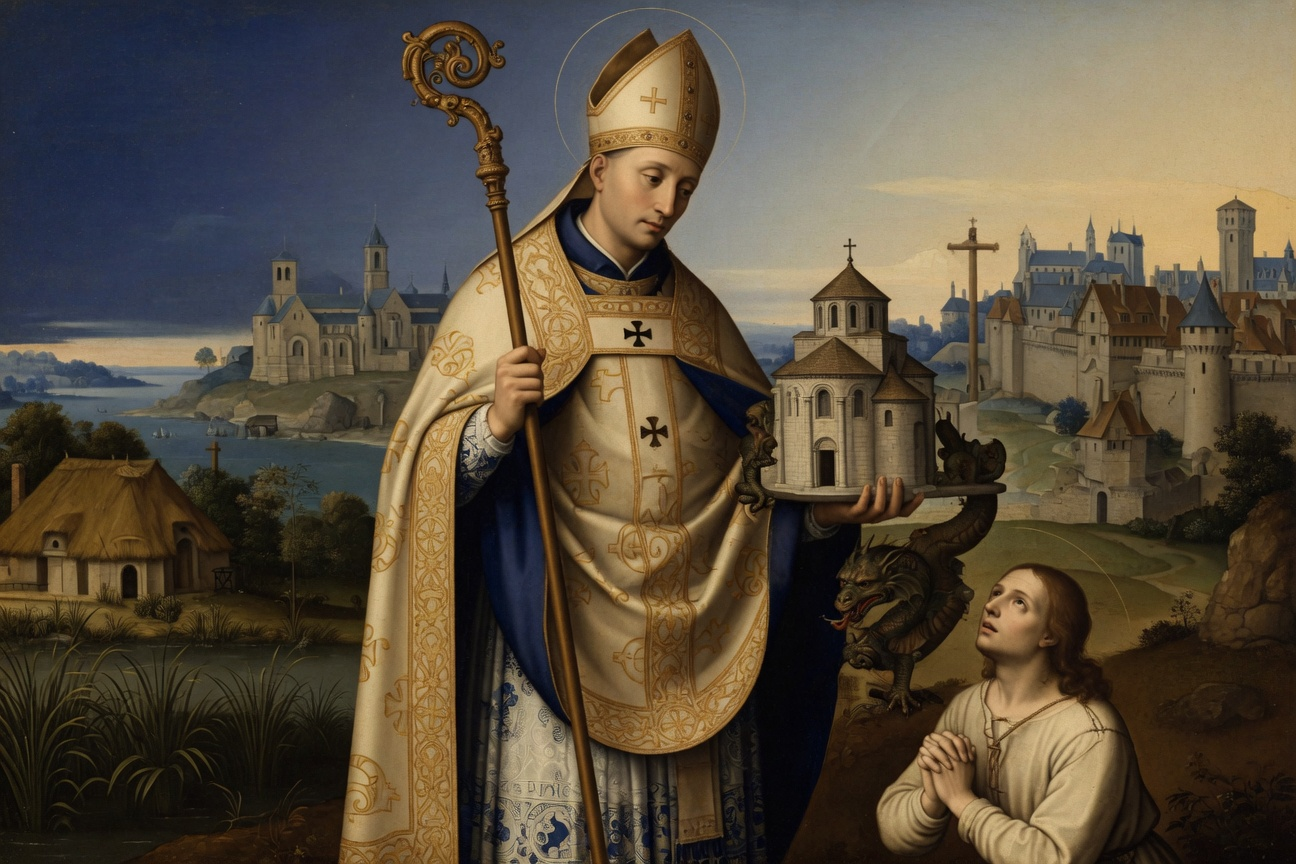
Saint Amand of Maastricht
MISSIONARY AND FOUNDER OF ABBEYS
Bishop of Maastricht, Missionary and Founder of Abbeys
Saint Amand was one of the greatest missionaries of the 7th century, evangelizing Flanders, the Slavic lands, and Vasconia. Bishop of Maastricht and close to the Merovingian kings, he founded numerous monasteries, including that of Elnon where he ended his days. He is famous for his miracles, notably the resurrection of a condemned man in Tournai.
Guided reading
10 reading sections
SAINT AMAND, BISHOP OF MAASTRICHT
MISSIONARY AND FOUNDER OF ABBEYS
Youth and monastic vocation
Born in 594 near Nantes, Amand renounced his noble inheritance to embrace religious life on the island of Ré and then in Tours.
Saint Amand was born on May 7, 594, not far from Nantes, in the territory of Herbauges, a small town that no longer exists and which at that time belonged to Aquitaine and the diocese of Poitiers. His father, Serenus, was duke or governor of the region; his mother was named Amantia. In his father's house, the child received, along with the example of virtues and the love of religion, the knowledge that was given at that time to the sons of noble families. Early on, he felt the desire to consecrate himself to God arise in his heart, and this sentiment, developed with his parents, became so powerful that it led him to leave everything to go and live in solitude. It was toward the island of Ré that he directed his steps: there he met religious men saintly eager to receive him and to render him all the services of the most affectionate charity. The virtue of the young novice was promptly recognized, and God permitted an extraordinary event to manifest it in a striking manner. One day the superior, to test his obedience, charged him with an order whose fulfillment required him to leave the monastery. Suddenly, in a solitary place on the island, Amand perceived a short distance away an enormous serpent. Frightened, he prostrated himself on the ground, addressed his prayer to heaven, then, rising, made the sign of the cross against the monster and ordered it to withdraw to its lair. The animal, obeying his voice, immediately disappeared into the depths of the sea.
Amand soon encountered in his solitude a danger of another nature. His father, informed of the place of his retreat, came to find him there, and endeavored to bring back into the family this only son to whom he wished to leave his goods and his dignities. Seeing his entreaties were useless, he had recourse to threats, and declared to Amand that he would have no part of his inheritance if he did not return with him to the paternal home. "My father," he replied with calm and respect, "there is only one thing that I desire, and that is to serve God: He is my portion and my inheritance. I ask for nothing of the goods that you promise me; permit me only to devote myself entirely to the sacred militia of Jesus Christ." Shortly after, to avoid more pressing solicitations on the part of his parents, he withdrew to the tomb of Saint Martin in Tours. There, prostrated before the shrine that enclosed the relics of this great patron of France, he conjured the Lord never to permit that he return to his native land, but rather that his entire life, consecrated to His service, should pass in the labors, travels, and fatigues of the apostolate.
The Reclusion at Bourges
Under the guidance of Saint Austregisilus, Amand lived for fifteen years as a recluse on the ramparts of Bourges before being ordained a priest.
Amand, having been admitted among the religious of Tours, received the clerical tonsure and took his place among the brothers. But God, who had great designs for him, willed that he should then begin an extraordinary and more immediate preparation for his mission. He made it known to him that he must go to Bourges, to Saint Austregis saint Austrégisile Bishop of Bourges and mentor to Amand. ilus, to learn His will from the mouth of that pontiff. Faithful to the voice of the Lord, Amand did not hesitate for an instant; he departed and arrived at Bourges, where Saint Austregisilus and his disciple, Saint Sulpicius the Pious, received him with joy. Having all consulted the Lord together, it was resolved that Amand, enclosed in a cell on the city ramparts, would lead the life of a recluse there until it pleased God to employ him in the work for which He destined him. In this new and deeper retreat, the life of Saint Amand was consecrated to all the exercises of piety and mortification. Barley bread soaked in water was his ordinary food: and even then, the holy penitent seemed to take it only with regret. Against his innocent flesh was applied a hairshirt that held his body in continual constraint. A few twigs thrown on the bare earth received his tired limbs during the night; everything around him announced poverty, destitution, and suffering. But in the midst of these austerities, the brow of the young recluse shone with the sweetest joy. It was during these fifteen years of retreat and penance that, after having successively received the different orders of the clergy, he was finally ordained a priest. It was also during this time that he had a sort of revelation which the historian of his life reports in these terms: "One day," he says, "Amand was in prayer before the Lord, when suddenly he saw himself surrounded by a great light; then, for the space of an hour, the image of the world seemed to unfold before his eyes with all its magnificence and splendors." God perhaps wished to show him the multitude of idolaters and sinners to whom his word would have to be heard.
The pilgrimage to Rome and the apostolic call
In Rome, a vision of Saint Peter commands Amand to evangelize the Gauls as a regionary bishop.
Saint Amand was about thirty-three years old when God called him to Rome to manifest his vocation to him. He left with only one companion, continuing during this long pilgrimage the holy works he was accustomed to doing. Arrived in Rome, he visited the churches and oratories consecrated to God, the places that recall the memory of the confessors, the torments of the martyrs, and the testimonies of the faith of the first Christians. At the end of the day, he would withdraw to the church of Saint Peter to address his prayer to God. Now, one evening when he had come there according to his custom, while all the faithful were leaving the temple silently and the guards were preparing to close the doors, Amand remained alone, hoping not to be noticed and to be able to satisfy the great desire he had to spend an entire night in this sanctuary. He was kneeling apart, pouring out his soul before the Lord, when one of the doorkeepers saw him, and believing no doubt that it was a man hiding some evil design, forced him, with little respect, to leave the church. This humiliation did not trouble the blessed one; he obeyed immediately, and, prostrating himself before the portal, he continued his prayer. Suddenly he felt as if caught out of himself and surrounded by a brilliant light. Before his eyes appeared a venerable old man, his brow encircled by a halo of glory. Saint Peter, the prince of the Apostles, made himself known to Amand and declared to him the will of heaven. "In the name of God, he shall go to preach the faith in the Gauls and convert a multitude of souls there to Jesus Christ. The harvest is abundant and it grows from day to day; he shall work there as a good and vigilant harvester. As a price for his labors, a great reward is reserved for him in heaven." Amand, astonished, forbidden by these words, submitted fully to the orders of heaven, and took up, with a heart full of joy, the road to France. The needs of the Church, at that time, had made understood the necessity of a certain number of bishops whose functions, all of zeal, were exercised with regard to some regions less favored by the faith. These bishops, who were called regionaries, because they traveled through
Evangelization of Flanders and miracles
Amand evangelizes the region of Ghent and Flanders, performing the resurrection of a condemned man in Tournai to convert the populations.
preaching the Gospel in the regions where their inspiration led them, had no special see or diocese subject to their jurisdiction. It was a similar mission that Saint Amand was entrusted with by King Clotaire II in 628: following his first attempts and initial successes in the apostolate, he received episcopal unction at the hands of Saint Achaire, Bishop of Noyon, and went almost immediately to evangelize the inhabitants of the Ghent regi on. This peo pays de Gand City where Livinus stayed and of which he is the patron saint. ple, still largely given over to the worship of idols, stubbornly repelled those who wished to teach them the faith. It would be impossible to tell all that he had to endure at their hands: the persecutions and violence reached such a point that his companions, regarding the conversion of these barbarians as impossible, withdrew to await better times. Amand remained alone, exposed to all the mistreatment to which he opposed the most heroic patience. "How many times was he not torn, struck, bruised with blows? How many times did the women themselves not throw him into the waters of the Scheldt and the other rivers that water these lands?"
The tireless missionary continued to traverse the vast solitudes of Flanders, Brabant, and the neighboring countries, until the day when a striking miracle, performed in Tournai, opened the eyes of these infidels. While Saint Amand was passing through this city, it happened that Dotton, governor in the name of the King of the Franks, had a man accused of brigandage brought before his tribunal, who was already so overwhelmed by blows from the furious people that he seemed to have only a breath of life left. A threatening cry came from every mouth: "He deserves death, let him be condemned to death." At the moment this scene was taking place in the judgment square, the holy bishop Amand was seen running up. He approached, parted the crowd, and arrived at the foot of the tribunal; he begged the count to grant him the life of the thief. The sentence had just been pronounced. Dotton remained inexorable, and the executioners, seizing the criminal, led him to the gallows where he expired before the eyes of the multitude. As soon as it was over, Amand hastened to take the corpse down from the gibbet and transported it to his dwelling. At a sign he made, his disciples withdrew: he then, prostrating himself on the ground, conjured the Lord to restore this unfortunate man to life. Suddenly the thief, emerging as if from a deep sleep, opened his eyes and found himself in the presence of the holy missionary, to whom he did not know how to express his surprise and happiness. He spent the rest of the night with him. When morning arrived, Saint Amand, calling his disciples, asked them for water, which they hastened to bring, believing it was to wash the body, according to custom, before burying it. But what was their astonishment when, upon entering the room, they saw the dead man of the day before conversing with their master. Amand washed his wounds, which healed immediately; then he invited him to return to his family and to show his gratitude to God through Christian conduct. Scarcely had the news of this miracle spread than, from all sides, the populations flocked to the Saint to ask for baptism. The inhabitants of the Ghent region themselves were promptly instructed in it, and renouncing their old errors, they came to listen with docility to the word of God. In a short time, an admirable change took place throughout the province, and the two monasteries of Ghent and Mont-Blandin did not take long to rise on the spot where statues of false gods had previously appeared. Such were the beginnings of the Christian religion in this region, which became one of the most beautiful appanages of the Church of Jesus Christ.
Conflict and reconciliation with Dagobert
After criticizing the morals of King Dagobert, Amand is exiled before being recalled to baptize the future Saint Sigebert.
It was around this time (630) that Saint Amand, having returned to the interior of France, addressed courageous roi Dagobert King of the Franks petitioned by Sulpicius to annul a tax. remonstrances to King Dagobert regarding the scandals of his conduct. This action had been solicited and prepared by prelates and noble lords of the palace, who groaned at the disorders in which the King of Austrasia was indulging. The prince, at that hour of grace, listened only to the evil suggestions of passion; instead of acknowledging his faults, he became irritated and drove from his kingdom the holy apostle who reproached him for them. Amand, without being moved, withdrew from the palace while lamenting the blindness of princes abandoned to guilty pleasures. Amand took refuge in the states of Charibert, King of Aquitaine. Here occurs the firs t journe Vasconie Region of Saint Amand's evangelization in the Pyrenees. y of Amand to Vasconia or the Basque Country: he was at the monastery of Saint-Sever-Cap-de-Gascogne when the monks informed him that, deep in the gorges of the Pyrenees and on the most inaccessible peaks of these mountains, there camped a separate people, proud and agile in combat, whom one often saw descending into the plain, but whom one rarely reached in their strongholds. This people was in large part idolatrous and believed more in sorcerers, enchanters, and augurs than in God. Amand wished to go and bring the light of the Gospel to this nation, too happy, he said, to find the opportunity to endure martyrdom. This first
Amand, the following reflections: "About two centuries after the first settlements of the Franks in Belgium and the rest of Gaul, a new order of things and persons arose, whose religion was and was to be the primary goal, but from whom police and agriculture received great advantages in return: this was the establishment of the first abbeys in monasteries, of which Saint Amand was the father and founder in our cantons. When he appeared there, he found the soil of this country as wild as its inhabitants. Sandemond, a contemporary and disciple of Saint Amand, who lived in Ghent in the Abbey of Saint-Pierre, established shortly before, speaks to us of it in these terms: *Propter ferocissimum gentis illius usque ad terram infarcunditatem, omnes sacerdotes prædicationi loci illius* (the surroundings of Ghent) *se substraxerunt*. Another writer speaks of it in the same way: *Qui pagus* (Gundensis) *propter ferocissimum gentis et terra infarcunditatem prædonibus derelictus est*. A third attributes to this country only oglers and arros and infertile cespites. — Such was Flanders at that time, this region so populated and so fertile a few centuries later, which, for the beauty of the terrain and the industry of its inhabitants, has long yielded to no portion of the universe, and which Tasso painted for us with colors as suitable as they are beautiful, when speaking of the first crusaders of this nation, whom one saw under the banners of Godfrey of Bouillon, he says: Flanders, the hesitant Flanders was considered in the 7th century an ungrateful and sterile land. Its peoples were savages or brigands; as savages, they had to be civilized; as brigands, they had to be given morals, religion, and virtues.
It is with this double view that the first monasteries were established; it is with this view that kings and peoples did them so much good; and this is so true, the successes of these establishments were so striking, that princes, as Montesquieu remarked in particular regarding Charlemagne, looked upon the immense gifts they made to the churches less as a religious action than as a political dispensation. See *Mémoires de l'Académie de Bruxelles*, vol. II, p. 682.
mission of Saint Amand in Wasconia is little known. One can hardly recall more than this word from his hagiographer: "Like a true apostle of Jesus Christ, he traveled through this vast country, preaching the gospel everywhere, winning souls to God, and often receiving, as the price of his zeal and his labors, insults and outrages."
God having granted an heir to Dagobert, this prince returned to better sentiments and recalled Saint Amand from his exile. The servant of God, immediately leaving the land of the Gascons, went to the court. The king was at his villa in Clichy, near Paris, when the Saint approached him with a modest gravity. Scarcely does Dagobert see him in his presence than, forgetting his royal dignity, or rather yielding to the sentiment that dominates him, he throws himself at his knees and conjures him to forgive the outrage he has done him. Saint Amand, hastening to raise him up, declares to him that this passing error is forgotten and that it has left no memory in his heart. "How I regret," Dagobert continues, "having acted toward you like a madman, and not having followed the wise counsels that your paternal affection inspired in you! Now, I pray you, holy Pontiff, forget this injury entirely, and do not disdain to condescend to the request I am about to make. God has given me a child, although I have not deserved this favor: I have cast my eyes upon you, and have chosen you so that you may purify his soul in the waters of baptism, and that you may serve as his spiritual father. He is my son, he is the heir to my crown, I want him to also become your son, and that by imitating your examples one day, he may become the heir to your virtues." These words throw Amand into great surprise and extreme embarrassment. He begged the king not to require such a ministry of him. "Amand," says one of his biographers, "feared the court of kings, where the firmest virtue is sometimes exposed to bending, and he did not want, he, a devoted fighter for the cause of Jesus Christ, to involve himself in the affairs of the century." Having therefore expressed to the king with respect the motives for his refusal, he withdrew.
Dagobert regretted not having been able to determine the holy apostle to accept this invitation, in which he saw a striking reparation for his fault. Moreover, he ardently desired that this child, upon whom all his hopes rested, be baptized by the hands of a Pontiff whose eminent virtue gave him a kind of assurance that death would not come to snatch him from his tenderness. He made new entreaties, and having called his intimate advisors, Saint Eloi and Saint Ouen, then still simple laymen, he ordered them to go to the holy missionary and to seek by all means to obtain his consent. The two illustrious personages approached Amand with all the veneration that his holiness inspired in them, and conjured him to grant the king the favor he was soliciting. They represented to him that by accepting this charge, he could operate a great good at the palace; that this child, destined to become one day King of the Franks, would greatly advance the work of God through the wise lessons he would receive from his mouth and the virtuous sentiments they would inspire in him. Furthermore, they added, this consent, which will fill Dagobert with joy, will leave you, if you so desire, full liberty to preach the gospel in the kingdom and the neighboring regions. This last word could not fail to make an impression on Amand, especially in the mouths of two men so religious and so powerful at court. He therefore yielded, and immediately the preparations for the ceremony were ordered, to which the king wanted to give an extraordinary magnificence. The city of Orleans was chosen for its celebration; the entire court and a multitude of lords traveled there. Beside Dagobert appeared his brother Aribert, King of Aquitaine; he was to hold the child at the baptismal font with Saint Amand. A grave and contemporary author reports, and others have repeated after him, that at the moment when Saint Amand was finishing one of the prayers of baptism, the child, who was then only thirty or forty days old at most, answered very distinctly *Amen*, which filled all those present with astonishment and admiration. — This marvelous child was to be Saint Sigebert.
His ministry accomplished, Amand moved away from the court and returned to his apostolic labors, leaving a powerful family in joy, a ki ngdom in hope, saint Sigebert King of Austrasia whose body's passage through Lambres serves as a chronological reference point. and a king returned to better sentiments.
Mission to the Slavs and return to Rome
He attempts without success to evangelize the Slavic peoples of the Danube before returning to Rome and founding the monastery of Elnon.
Our holy bishop, who never finished a good work without undertaking a new one, headed shortly thereafter toward the Slavic country, on the banks of the Danube, the Sava, and the Drava. Everything suggests that it was the wars of these peoples against the Franks and the strange and extraordinary rise of Samo, a merchant from Soignies in Hainaut, or from Sens, whom these barbarians had taken as their king, that determined his resolution. Full of confidence in God, he set out through unknown lands, and finally arrived in the midst of a people given over to all the errors and disorders of idolatry. Inflamed with that ardent zeal which only grows in the face of obstacles, he preached Jesus Christ to men for whom this name was entirely foreign. He traveled through their vast plains and their fortified camps which served as their cities; everywhere his voice was heard and his hands spread blessings and benefits in abundance. Despite the efforts of his zeal, Amand could not soften these fierce hearts, whose criminal habits were so opposed to the morality of the Gospel. However, he did not let himself be discouraged by their resistance or by the outrages they heaped upon him; he continued to preach the holy truths to them and strove by all means to win them to God.
Amand had sown; others would later harvest the fruits of his labors. As for him, after having endured with unalterable patience the outrages and mistreatment, he had to abandon these men "whose crimes rendered them unworthy of the favors of heaven"; and it was then that for the second time he went to Rome to the Sovereign Pontiff, to inform him of the works he had performed and to pay his homage to the holy apostles. It was also on this occasion that he placed in various monasteries the slaves he had redeemed and who expressed the desire to embrace the religious life. We see him again procuring in Rome, at the center of Catholicism, books for the instruction of the disciples he had already gathered, particularly at the monastery of Elnon.
To return, Saint Amand embarked near Rome, arrived first at Centumcellae, today Civita-Vecchia, and from there took his direction toward the coasts of France. During this crossing, God manifested in a striking way the power of his servant's prayers. One day when the sailors, gathered on the deck of the ship, were listening to the instructions of the man of God, they perceived an enormous fish, which seemed to be playing on the waves: immediately casting their nets, they seized it, killed it, and invited all the crew to take part in this unexpected feast. But at the moment when the meal was ending, the sky was covered with thick clouds, the sea became rough, the waves rose, the winds roared: a frightful storm broke out, and the ship, tossed here and there by the waves, threatened to be swallowed up at any moment. In the midst of the lamentations wrung from them by the sight of imminent death, the sailors prostrated themselves at the feet of Amand and begged him to pray to God so that they might be delivered from such pressing danger. The missionary consoled all these dejected men. He urged them to rest from the fatigues they had endured and to entrust their fate to Providence. It was night. All stretched out on the deck gave themselves to rest. Amand also slumbered near the rudder, as if he had wanted to take the direction of the ship. Suddenly the holy apostle Peter appeared to his eyes: "Do not fear, Amand," he said to him, "you will not perish, nor those who are with you." Then turning toward the irritated waves, he commanded them and immediately a great calm ensued. Upon waking, the sailors saw that their ship was sailing on a calm sea; in a short time they reached the shore, blessing God who had delivered them from death through the prayers of his servant. The holy apostle, having returned to his monastery of Elnon, continued to evangelize the inhabitants of the neighboring regions.
Episcopate at Maestricht and the struggle against heresy
Appointed Bishop of Maestricht, he struggled against local disorders and the Monothelite heresy with the support of Pope Martin I.
The Bishop of Maestricht, John, surnamed the Lamb, having died around this time (649), Saint Amand was called by the suffrages of the clergy and the people, and by the solicitations of Sigebert, King of Austrasia, to govern this church. The Blessed one resisted for a long time; but finally he had to yield to the will of God, which was clearly manifested, and lead this people among whom he encountered great difficulties. Indeed, in this diocese of Maestricht, so ravaged during the invasions, and where various tribes had settled, one still encountered many customs opposed to the morality of the Gospel. Saint Amand made every effort that could be expected of his zeal to correct the abuses. He succeeded with some; but others remained stubbornly attached to their disorders, despite his prayers and warnings. It was then that he wrote to Pope Saint Martin I to ask him for a rule of conduct. His letter pape saint Martin Ier Martyr pope sent into exile by Constans II. has not reached us; but one can guess what it contained by the very terms of the Sovereign Pontiff's response. The first part gives very wise rules concerning the penalties to be inflicted on clerics who have failed the holiness of their state. But the venerable bishop did not have the pain of inflicting these deserved punishments himself: the Lord took his cause in hand and made it felt that it is not in vain that one rejects the word of His servants. Indeed, at the moment when Saint Amand was withdrawing with some disciples toward regions closer to the sea, to evangelize the still-barbarous peoples of the coast, several plagues fell upon the land of Maestricht, caused great ravages there, and carried off, by a fatal death, those most hardened in evil.
The second part of Saint Martin I's letter contained a response to the requests of Saint Amand concerning the heresy of the Monothelites, which was making much noise in the Catholic world. The Sovereign Po ntiff, after having expo hérésie des monothélites Christological heresy supported by Constans II. sed the artifices of the patriarchs and emperors of Constantinople, charged the Bishop of Maestricht to go himself to the kings of Neustria and Austrasia, Clovis II and Sigebert II, and to convene councils in both kingdoms, so that the decrees issued in Rome in council might be confirmed by the bishops of the Church of France. Saint Amand discharged with zeal the honorable charge that was entrusted to him; but the scarcity of documents does not allow for details on these events.
The bishops having placed in his hands the acts of the various councils of France, he went to present them in their name to the Sovereign Pontiff. This mission met the views of the Blessed one, who wished to obtain from the Holy See the authorization to leave his bishopric of Maestricht to resume his apostolic travels. He made this third journey in the company of Saint Humbert, whom he met on the banks of the Helpre, near the possessions that this servant of God had just acquired through the death of his parents. Amand made known the resolutions taken in the councils held in France, and at the same time expressed his personal desire. The Sovereign Pontiff kindly agreed. Moreover, in order to help him in his evangelical labors, he granted him the priest Landoald and some other servants of God. All together returned to Maestricht, where, by the counsel of Amand, his companions attached themselves to Saint Remacle, who had become his successor to that see, while he went off to continue the course of his apostolic missions.
Monastic foundations and network of saints
Amand collaborated with the great Merovingian families to found numerous monasteries such as Nivelles or Hautmont.
Here begin above all his relations with the families of Pepin of Landen and Saint Mauger. The former, already united in friendship with Saint Amand since the baptism of the young Sigebert, had left his son Grimoald to succeed him, who did not follow in his footsteps and perished with his son, a victim of his own guilty ambition. Shortly before this tragic end, Saint Amand had helped Saint Gertrude, daughter of the blessed Pepin, and Saint Itta, his widow, to found the monastery of Nivelles, which became a source of blessings for the whole country. Almost at the same time, he assisted with Saint Aubert of Cambrai at the consecration of the monastery that Saint Ghislain was completing at La Celle. It was there that, upon hearing the discourses of the two holy bishops, a lord of the region, Mauger, husband of Saint Waltrude, resolved to dedicate himself to God. Having left the world, this noble leude went to found the monastery of Hautmont, where at different times the principal apostles of the region would gather, in the midst of whom Amand would make the holy word heard. It was there that one day the virgin Aldegonde came to present herself to him and to Saint Aubert to receive from their hands the veil of virgins before founding, in the midst of the woods that covered the Sambre, the monastery that gave its origin to the city of Maubeuge.
Second mission in Vasconia and final miracles
At 70 years old, he returned to evangelize the Basques and founded abbeys in the south of France, notably at Nant.
About thirty years had passed since Saint Amand's first mission in Vasconia. The venerable apostle, forgetting the burden of his age (he was 70), thought of visiting his rough disciples in the Pyrenees once more. He could be encouraged in the inspirations of his zeal by the circumstance that Vasconia was then ruled by his grand-nephews, Boggis and Bertrand, recognized as hereditary dukes of Aquitaine and Vasconia. But what determined him was that, according to the learned annalist Mabillon, he was called by the Basques themselves. He therefore came in the year of grace 665. Grace crowned his efforts, and many conversions came to console him for his fatigues and the outrages he endured in more than one encounter. Once, among other times, when the elderly missionary was preaching before the multitude gathered around him, a jester, full of pride and very corrupt in his morals, approached him, and imitating his voice and gestures, sought to provoke the laughter of the spectators. Saint Amand, without being moved by this sacrilegious insolence, forgave in his heart the wretch who did not even know how to respect his white hair, and continued his discourse to the people. But God, to avenge his outraged minister, and at the same time to give a lesson capable of striking these vain and frivolous spirits, punished this audacious man instantly.
In the midst of the crowd that had witnessed his impiety, he suddenly appeared agitated by the most violent transports, uttered frightful cries, rolled on the ground with rage, and expired in the most atrocious pain. This tragic end made a deep impression on all the spectators and converted many who had remained indifferent until then. One cannot doubt that the second mission of Saint Amand among the Basques had the most complete success. For, since then, history no longer speaks of their idolatry. On the contrary, it has only to exalt, from age to age, their invincible firmness in the Catholic faith.
Saint Amand, upon leaving these regions, preached the faith everywhere and confirmed with new miracles the high opinion that everyone held of his virtue. One day he arrived in a city that some authors believe to be Limoges. The bishop of the place welcomed him with respect and rendered him all the duties of hospitality. He himself offered the old man the water and the basin to wash his hands, according to custom; at the same time, he recommended to one of his clerks, who was near him, to keep this water. A few moments later, while the missionary was resting from the fatigues of the journey, the bishop went to take the vessel containing the water and headed toward his cathedral church. There, a poor blind man, well known throughout the city, begged every day. Arriving near him, the bishop said to him: "My son, if you have faith, wet your eyes with this water with which the servant of God, Amand, has washed his hands; I have confidence that by his merits you will recover your sight." The blind man obeyed immediately: he touched his eyes, wetted them, and regained his sight. Instantly, the bishop and the healed blind man burst into joy; the news of this miracle spread through the city, where cries of blessing and gratitude rose from all sides. But the humble wonder-worker had already moved on. He soon appeared on the borders of the ancient province of Bourbonnais, at the place where the city of Saint-Amand is found today. This city owes its origin to a monastery built by the Saint upon his return from Gascony, where he left some of the disciples who had accompanied him.
It is apparently around this time, as indicated by a diploma of Childeric II, dated to the second year of his reign (666), that another abbey was built by Saint Amand, at Nant, in the land of the ancient Ruten i, n Nant Site of the foundation of an abbey in the Rouergue. ear the place where the Dourbie flows into the Tarn, in the diocese of Rodez. A certain Mummole, irritated that the holy missionary had obtained land from the king to build the monastery of Nant, resolved to oppose it. He did not even shrink from the thought of murder. Malefactors, to whom he communicated his design, came to present themselves to Saint Amand with all the testimonies of the deepest respect. They declared to him their intention to show him a suitable place for the location of the monastery he proposed to build. At the same time, they begged him to accompany them, in order to recognize for himself the truth of their words. This project hid a betrayal, and it appears that the Lord revealed it to his servant. However, Amand, committing his fate to Providence, and perhaps also moved by the spirit of God, followed his murderers without showing any distrust. They had already arrived at the top of the hill where they proposed to cut off his head, when suddenly the sky was covered with clouds, the thunder rumbled, lightning flashed, torrents of rain fell, and the thickest darkness spread all around. Struck by these striking testimonies of the justice of God, the assassins threw themselves trembling at the feet of Saint Amand, and conjured him, with tears in their eyes, to spare their lives. The Blessed one, touched himself by all that he saw, prostrated himself face to the ground and begged the Lord to forgive these men for the attack they had meditated. At the same moment, calm returned, the darkness dissipated, and the murderers, struck with admiration and fear, withdrew, asking God for forgiveness for having conceived the horrible project of causing his servant to perish.
Last years at Elnon and legacy
He passed away at the abbey of Elnon in 684 at the age of 84, leaving behind a legacy as a builder and missionary.
After he had arranged all things in this region, and powerfully advanced the work of God, Saint Amand returned to his monaste ry of Elnon, the monastère d'Elnon Monastery founded by Saint Amand where Chrodobald lived. most important of all those he had founded, and where he usually made his home. The oldest authors trace its foundation back to the year 639, that is to say, to the time when the Saint, after the baptism of Sigebert and the happy change of Dagobert, began to enjoy great credit at court. This date also confirms what most chroniclers advance regarding the cession made by this monarch to the missionary bishop of the lands upon which this monastery was built, and the favors and privileges he deigned to grant him. Such has been, moreover, the constant tradition of twelve centuries. "It was then that Amand, a man of great piety, dear to men and to the God of heaven," founded this abbey of Elnon (Saint-Amand), which, in his mind, was to be like a center for the civilization of the entire region, through the knowledge and practice of the Gospel. Dagobert, who knew how to appreciate the advantages his peoples derived from these religious establishments, favored this one above all, as is sufficiently testified by a diploma he granted at that time as a guarantee of the royal donation. Our Blessed one was its first abbot, as all the catalogs indicate. However, he was replaced by his disciples when the needs of the Church and his missions, or other important affairs, called him to various regions.
In addition to the foundations already mentioned, let us recall that of the abbey raised in the territory of Alost, not far from the place where Saint Lievin was martyred, and the abbeys of Renaix, Thourout, Leuze, and Deurn, near Antwerp.
In Antwerp itself, the center of the barbarian tribes of the region, Amand raised a church to maintain in the faith those he had opened to Jesus Christ.
Near Termonde, on the right bank of the Scheldt, a part of the church and a village that surrounds it bear his name. At Condé, at the confluence of the Scheldt and the Haine, stood a monastery under the invocation of the Blessed Virgin, founded, it is said, by Saint Amand; it is there that Saint Vignon, having come to these places from the distant mountains of Scotland, learned to populate the doctrine and morality of the Gospel.
The church of Calloo, near the mouths of the Scheldt, also venerates Saint Amand as its patron and founder.
One remembers the abbey of Nivelles, built by Saint Itta and Saint Gertrude, her daughter: one could also add that of Androe, which Saint Begge, second daughter of Pepin the Venerable and mother of Pepin Heristal, raised on the banks of the Meuse.
Towards the borders of Brabant and the ancient land of the Batavians (Holland), near one of the mouths of this river, one still finds the church of Gertrudenberg or Mount of Gertrude, raised and consecrated by Saint Amand.
At Ardembourg, Saint Amand joined a monastery and a church built by Saint Eloi.
Courtrai, on the Lys, also venerates these two great apostles as its fathers in the faith.
The ancient diocese of Vabres, where, according to tradition and monuments, Saint Amand preached the faith, honored him for a great number of centuries as its patron. The ancient cathedral church, dedicated under his name, still exists. In this region, he is known by the name of Saint Alan.
One could cite other places where Saint Amand preached the faith and founded churches or monasteries, where one believes at least to recognize traces of his passage. The province of Bugey, in particular, has vowed a cult to him since the most remote times and attributes to him the foundation of important monasteries, such as that of Nant, around which the town of Nantua is said to have formed; those of Chézery, Meyria, and Saint-Claude. Strasbourg, Worms, and Mainz glory in having possessed him, perhaps at the time when he was traveling to the land of the Slavs. Spain itself claims that he governed one of its churches for some time. Thus had the reputation of Saint Amand spread far and wide.
Having returned to his monastery of Elnon, never to leave it again, Amand wished to consecrate it solemnly. At his invitation, bishops and abbots hastened to the holy old man, whose soul was filled with the sweetest emotions. The ceremony finished, all gathered in the chapter house, and it is there that in their presence he read his testament, written under his dictation by Baudemond, his disciple and later the historian of his life.
A few years later, Saint Amand peacefully rendered his soul to God, in the midst of his disciples, on February 6, 684: he was then in his eighty-fourth year.
Saint Amand is represented: 1st holding a small church and his crozier; behind him a large dragon that wants to snatch them from him: a figure of the persecutions that hell has stirred up against the Saint; 2nd resurrecting a hanged man; 3rd holding in his hands the irons of the many prisoners he has delivered; 4th carrying a flag, a symbol that, in the arts, is quite willingly granted to missionaries who have enlisted souls under the banner of Jesus Christ.
## RELICS OF SAINT AMAND.
His body was deposited in the oratory of Saint-Pierre, built by his care; but soon the healings and miracles that took place there made this place too narrow for the devotion of the faithful. Therefore, on the gifts of the inhabitants of the region, a more spacious church was raised, into which the bishop of Tournai and Noyon transported the holy body, which was found, after a space of fifteen years, without the slightest trace of corruption. During the invasion of the Normans, the sacred deposit was saved at the abbey of Saint-Germain-des-Prés, in Paris. The monastery of Elnon was invaded by the Barbarians, who massacred the religious while they were singing the praises of God in the church. This abbey having been destroyed again by a fire, on February 11, 1066, the religious, with the permission of the bishops of the province, carried the relics of their patron saint in procession into different regions, to obtain help that would assist them in raising it from its ruins. A great number of miracles were then performed at Cambrai, Coucy, Laon, Chauny, Noyon, and in other places. In 1107, another procession was also made in Brabant, to obtain satisfaction from certain lords who wanted to seize part of the property of the abbey of Elnon. Extraordinary healings were then obtained at Anvaleg-sur-la-Honne, at Saint-Sauveur, at Grammont, Minove, and at Tournai. For us, says the chronicler who reports these facts of which he was a witness, our souls admired even more the healings performed in souls, the hatreds appeased, the enemies reconciled, and the sinners snatched from eternal death.
The abbey of Elnon became so famous over time that a considerable town formed near it, as it is today, where the name of Saint-Amand-les-Eaux, and whose temporal domain belonged to the abbot who created the title of count until the Revolution. The abbey, which had been rebuilt with magnificence in the last century, serves today as a thermal establishment. Saint-Amand is the chief town of the canton (Nord. — 10,000 inhabitants).
The cult of Saint Amand has always been famous, not only in the north of France and Belgium, but also in a multitude of other regions: it was the same in England where he had an office with nine lessons in the Sarum Breviary. We have already said that his name is one of the best known in Bugey, where he is attributed with the foundation of several monasteries. Saint Amand is also venerated in Brittany, where all the dioceses, except that of Quimper, perform his office. In the dioceses of Cambrai, Arras, Tournai, Ghent, Liège, Poitiers, etc., a host of churches or chapels recognize him as their patron.
Saint Amand is also the patron of Erches, where one goes on pilgrimage on the day of his feast (October 26), and of Vieuventers. The Poor Clares of Amiens possess his relics.
*Vie des Saints de Cambrai et d'Arras*, by Abbé Destombes; *les Saints de Bretagne*, by Albert le Grand and Dom Lobineau; *Hagiographie de Belley*, by Mgr Depéry; *Biographie saint-omerienne*, by M. Rainguet; *les Bollandistes*; Father Giry; Abbé Auber, *Hagiographie de Poitiers*; *Saint Amand*, apôtre des Basques, by M. Menjoulet, vicar general of Bayonne; Godescard, Baillet, Rubibacher, Migne, and the *Hagiographie du diocèse d'Amiens*, by Abbé Corhlet.
Annexes & related entities
Structured data for exploration: events, miracles, quotes, places, attributes, patronages, and important entities cited in the text.
Key Events
- Born in 594 near Nantes
- Retreat on the Île de Ré
- Recluse in Bourges for fifteen years
- Vision of Saint Peter in Rome
- Episcopal consecration as regional bishop in 628
- Evangelization of the Ghent region and Flanders
- Exiled by Dagobert I, then recalled to baptize Sigebert
- Missions to the Slavs on the Danube
- Episcopate in Maastricht (649)
- Missions in Vasconia (Basque Country)
- Foundation of Elnon Abbey
Miracles
- Expulsion of a giant serpent into the sea on the Île de Ré
- Resurrection of a thief hanged in Tournai
- Calming of a storm at sea after a vision of Saint Peter
- Healing of a blind man in Limoges with the water from his ablutions
- Divine punishment of a mocking jester in Vasconia
Quotes
-
There is only one thing I desire, and that is to serve God: He is my portion and my inheritance.
Response to his father Serenus