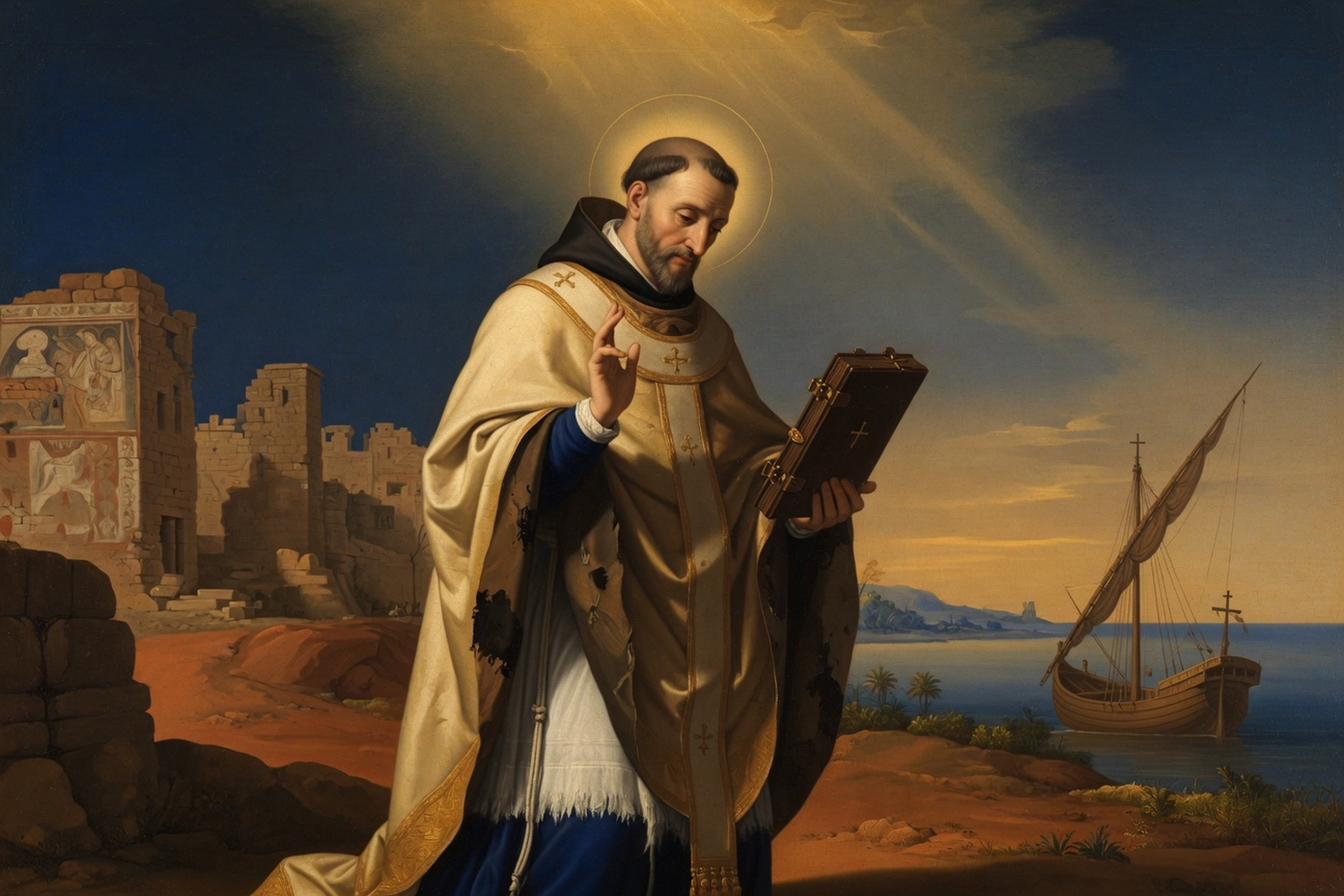
Saint Fulgentius of Ruspe
DOCTOR OF THE CHURCH.
Bishop of Ruspe, Doctor of the Church
Bishop of Ruspe and Doctor of the Church, Fulgentius was a major figure in the Catholic resistance against the Arianism of the Vandals in Africa. After an administrative career, he embraced monastic life and endured eighteen years of exile in Sardinia. Renowned for his erudition and humility, he left behind significant theological treatises before passing away in 533.
Guided reading
8 reading sections
SAINT FULGENTIUS, BISHOP OF RUSPE, IN AFRICA
DOCTOR OF THE CHURCH.
Origins and civil career
Born in 468 into an exiled senatorial family of Carthage, Fulgentius became the general tax collector in Byzacena before renouncing worldly honors.
468-533. — Popes: Saint Simplicius; John II, called Mercury. — Emperors of the East: Leo I, Justinian I.
*Da mihi modo patientiam et postea indulgentiam.*
Lord, grant me patience in this world and show me mercy in the next.
(Prayer familiar to Saint Fulgentius.)
The life of Saint Fulgentius (Fabius Claudius Gordianus Fulgentius), Bishop of Ruspe in Af rica, Ruspe Episcopal see of Saint Fulgentius in North Africa. and one of the most brilliant lights of the Church, was written very elegantly by one of his disciples. The latter, having taken the religious habit in the monastery that the Saint himself had built in Sardinia during his exile, accompanied him thereafter upon his return to Carthage and in his diocese; we shall provide here an abridgment of this life.
Fulgentius was African by birth, of parents who were illustrious according to the world, and Catholic. His grandfather was named Gordian: he was one of those glorious sena tors of Carthage Metropolitan city of Africa, episcopal see of Eugenius. Carthage whom the Arian Gaiseric, King of the Vandals, stripped of all their goods and drove from that city. His father was named Claudius. After the death of Gordian, who had taken refuge in Italy with his family, Fulgentius returned to Africa, accompanied by one of his brothers, and, having recovered a portion of his patrimony, he retired to Telepte, a city in the province of Byzacena; the paternal house that belonged to him in Carthage had been give prêtres ariens Heresy opposed by Columbanus in Italy among the Lombards. n to the Arian priests; he could not obtain its restit ution. I Marianne Mother of Saint Fulgentius, who oversaw his education. t was there that Mariana, his wife, a very wise and very virtuous woman, gave him Fulgentius (468), along with another son, who was named Claudius, after his father. Death soon took the father from the children; but Mariana took great care to raise them in virtue and to have them learn the principles of the finest sciences. Saint Fulgentius, having become very skilled in the Greek and Latin languages in a short time, began early on to assist his mother in the management of the family and in the administration of domestic affairs; which he did with such respect and deference toward her, and with such prudence, modesty, and gentleness, that he was the entire joy of this pious woman, the consolation of her servants, and the example to those with whom he conversed. His merit led to his appointment as general tax collector of Byzacena. But no sooner was he invested with this office than he became disgusted with earthly honors.
The Call to Monastic Life
Inspired by Saint Augustine, he enters the monastery of Bishop Faustus despite his mother's opposition and devotes himself to rigorous asceticism.
The Spirit of God, calling him to greater things, opened his eyes and showed him the vanity of the world and the difference that exists between those who, sowing in the flesh, reap only sensible, corruptible, and fleeting goods, and those who, crucifying their flesh with its vices and lusts, make themselves worthy of spiritual goods that do not perish, but remain in eternity. This light inflamed him with such love for the sovereign good that he resolved to embrace the monastic life. To test its rigor, he gradually detached himself from the company of his fellow patricians and secretly devoted himself to reading, prayer, fasting, and other religious penances and austerities; he was especially stirred in this by reading Saint Augustine's Exposition on Psalm XXXVI. After he had spent some tim e in these exe saint Augustin Cited for his definition of fraternal charity. rcises, he went to find a holy bishop named Faustus, who, having been driven from his see by Huneric, son and successor of Gaiseric, had built a monastery in Byzacena, and begged him with great insistence to receive him into the number of his monks. The bishop at first made difficulties, believing that Fulgentius, noble, wealthy, delicate, and still in the flower of his youth, could not long endure the austerity of his rule. "Go," he said, "go first and learn to lead a life in the world detached from pleasures; is it believable that, having been raised in softness and delights, you could suddenly adapt to the poverty of our way of life, to the coarseness of our clothes, to our vigils and our fasts?" Fulgentius, with eyes lowered, replied modestly: "He who has inspired in me the will to serve Him can well also give me the courage necessary to triumph over my weakness." Faustus, overcome by his prayers, consented to receive him. He was then twenty-two years old. As soon as it was known that Fulgentius had abandoned the world and entered religious life, good people rejoiced and libertines were confused. But Mariana, his mother, seeing herself deprived of his company and unable to bear such a great loss, ran promptly to this Marianne Mother of Saint Fulgentius, who oversaw his education. monastery to withdraw him, hoping that this son, who had always had so much regard and respect for her, would easily yield to her groans and tears. Indeed, it would have been a great temptation for him; but he avoided the danger, refusing to see her or speak to her; the holy bishop Faustus approved this conduct and took this resolution as an omen of the very high holiness to which Fulgentius would one day attain.
Scarcely was he in the novitiate when he became a model of all kinds of virtues. He ate so little that it did not seem sufficient to nourish him. He absolutely forbade himself the use of wine and everything that could flatter the sense of taste; his other austerities corresponded to his abstinence. These mortifications weakened his body so much that he fell into a very dangerous illness. It was believed that the violence of the malady would force him to relax some of his severity toward himself; but he persisted constantly in his initial fervor, saying to those who complained of it that these infirmities did not come from his austerities, but from the will of God, who afflicted him to console him, and mortified him to vivify him; and that it was well known, by a thousand experiences, that a voluptuous life was no less subject to illnesses than the most penitent life. When God had restored his health, he renounced all his goods for the benefit of his mother; he did this both to soften the pain she felt at his retirement, and so that, if his brother Claudius were not dutiful toward her through the reverence he owed her as a son, he would at least be so through the need he would have of her and the hope of one day being her heir.
Persecutions and Pilgrimages
Fleeing Arian persecutions, he co-directs a monastery with Felix, suffers torture, and travels to Sicily and then to Rome in the year 500.
Shortly thereafter, Gondebaud or Gondamond, successor to Huneric, incited such a furious persecution against the Church of Africa that the holy bishop Faustus and his religious were forced to abandon their monastery to find shelter from the storm somewhere. Saint Fulgentius, on the advice of the holy prelate, withdrew to a neighboring monastery, presided over by another holy personage nam ed Fe Félix Priest tasked with carrying the relics and the pope's letter. lix, who had been his friend in the world. Felix was not content to receive him with joy; despite all his resistance, he associated him with his office of abbot and made him his colleague; so that they both governed this holy congregation together; nevertheless, it did not seem that there were two superiors, because their union was so great and their agreement so perfect that one could say they had but one spirit and one will. Felix was in charge of the temporal and Fulgentius of the spiritual.
However, the province having been enveloped by a multitude of barbarians from Numidia who were ravaging it and putting everything to fire and sword, these two holy superiors, accompanied by their religious, moved to another country which history calls the territory of Sicca Veneria, a city of the proconsular province, to establish themselves more peacefully. But, as they carried the light wherever they went, an Arian priest, who preached his impiety in a place called Gabardilla and attracted many people to his false belief, fearing that their holy life and especially the solid and eloquent preaching of Fulgentius would make him lose his credit, set traps for them and seized both of them by artifice. There was then a holy emulation between these two illustrious Confessors, each of them offering himself to the torments to deliver his brother. But this cruel and barbaric priest, who was also named Felix, spared neither one nor the other, and discharged his fury mainly on Fulgentius, who had tried to soften this fierce spirit with a very eloquent remonstrance. After having them beaten with sticks and torn with whips, he had them shaved in ignominy and threw their tattered clothes out of his house. They left it as the Apostles had once left the council of the Pharisees, with great joy at having been judged worthy to suffer something for the cause of Jesus Christ. The news of this action having been brought to Carthage, the Arians themselves, who knew the qualities of nature and grace with which Saint Fulgentius was endowed, were indignant, and their bishop declared that, if he wished to complain, he would make an exemplary punishment of it; but however much they urged Fulgentius on this subject, he could never resolve to do so, saying "that it was not becoming for a Christian to desire vengeance; that to God alone belonged the right to take revenge; that if he sought justice he would lose the merit of his patience, and that finally he could not have recourse to the tribunal of an Arian bishop without offending the Church and scandalizing the faithful." Moreover, Felix and he, recognizing that it was more advantageous for them to be among the Barbarians than among the Arians, resolved to return with the holy religious who had followed them to the province of Byzacena, from where they had departed; and, having arrived near the city called Ididi, on the borders of Mauritania, they built a new house there, where one soon saw the most severe discipline of monastic life shine.
Nevertheless, our Saint, who constantly aspired to a more perfect state, and who ardently desired to be relieved of the function of superior whose burden Felix had imposed upon him, formed the design of withdrawing among the solitaries of Egypt, whose lives and conferences, which he read assiduously, gave him much admiration. Having embarked at Carthage for Alexandria with only one religious, he landed in Sicily. There Eulalius, bishop of Syracuse, soon recognized the merit of Fulgentius, and immediately took him into great affection, even keeping him at his home all winter; he dissuaded him from continuing his journey, pointing out to him "that the country where he was going was separated by a perfidious schism from the communion of Peter, that is to say, from the Roman Church." He also received the same advice from another holy bishop named Rufinian, who, fleeing the persecution of the Vandals, had settled on the small island of Corsica.
He continued his journey to Rome to visit the holy Places and venerate the tombs of the ble ssed Rome Birthplace of Maximian. apostles Saint Peter and Saint Paul. During his stay in this city, as he was passing one day through the square named Palma Aurea, he saw Theodoric, King of Italy, raised on a superbly adorned throne; he was su rrounded Théodoric King of the Ostrogoths and ruler of the West during the time of Gelasius. by the Senate and the most brilliant court, Rome having spared nothing to receive this prince with the greatest magnificence. "Ah!" exclaimed Fulgentius at the sight of this spectacle, "if the earthly Rome is so beautiful, what must the heavenly Jerusalem be! If in this perishable life God surrounds the partisans of vanity with such great splendor, what honor, what glory, what felicity does He then prepare for His Saints in heaven?" This is how the Saints, at the sight of the earthly objects that distract us the most, know how to use them as steps to rise to the thought of heavenly things. This happened towards the end of the year 500, when Theodoric, whose residence was in Ravenna (he had reigned in Italy since 493), made his first entry into Rome. He then left and went to his monastery in Africa. His religious received him with a joy that cannot be expressed, and the laypeople of that country themselves participated in it, each believing that public happiness had returned with him. Shortly after, a noble man named Sylvestre having offered him a property to build another monastery, he accepted it; as soon as the building was completed, several religious gathered there, and he governed them for some years with remarkable prudence and charity. But, as he preferred to obey rather than to command, and as the comforts of this new house, which the piety of Sylvestre had richly provided for, did not agree well with the love he had for poverty and penance, he left it again and withdrew to another, built in the middle of the sea, on a reef where there was a shortage of everything. There he was an admirable example of humility, obedience, devotion, and austerity, submitting himself to the least of the brothers, mortifying his senses, afflicting his body, and living in almost continuous silence and prayer. He made mats and palm parasols, like the other religious. Nevertheless, this retreat was not long, for Faustus, his bishop, at the insistence of the community he had left, ordered him, under pain of disobedience, to return and resume his office of abbot. And, to prevent him from fleeing a third time, he attached him to his diocese by the character of the priesthood.
The Bishop of Ruspe
Consecrated Bishop of Ruspe in 505, he maintained an austere monastic life while reforming his clergy and demonstrating great charity.
This honor was followed by another even greater; for the Catholic bishops remaining in Africa, having resolved among themselves, notwithstanding the prohibitions of the King of the Vandals, to provide prelates to the Churches that had none, eyes were immediately cast upon Fulgentius. It is true that he delayed his promotion somewhat: foreseeing the choice that the neighboring dioceses would make of him, he forestalled them by a very secret flight; as he could not be found at the time of the ordinations, these bishops, to finish this matter before the court was informed of it, were obliged to name and consecrate another. But he could not always avoid this dignity; for, as the church of Ru spe, which was église de Ruspe Episcopal see of Saint Fulgentius in North Africa. one of the most considerable, had not been provided for due to the ambitious pretensions of a certain deacon named Felix, as soon as he had returned to his monastery, believing there was nothing more to fear, he was taken by force to be raised to this episcopal see; and, after having resisted several times out of humility, he was constrained, so as not to oppose the will of God, to allow himself to be consecrated bishop of that city; this was in 505. The deacon of whom we have spoken placed every possible obstacle in the way; but they were useless, God showing that the election of Fulgentius was a particular effect of His Providence upon the desolate Church of Africa. When he was on his seat, far from showing any resentment against this ambitious man, he treated him with all the kindness he could have had for one of his dearest friends, and even prepared him for and promoted him to the order of the priesthood. This generous conduct so won the heart of Felix that he became full of affection for his prelate. And nevertheless God, who is the just avenger of His elect, and who does not want ecclesiastical dignities to be canvassed for, punished him with a temporal penalty, for he died in the same year; and a rich man who had favored him was reduced to very great poverty and frightful misery.
Furthermore, all the people of Ruspe thanked Our Lord infinitely for having given them such a pastor, and there was no one who did not wish to receive communion from his hand at the first solemn and pontifical mass he celebrated. His new dignity did not swell his heart: he changed nothing of his holy customs; for he always had the same sweetness and affability for everyone; the same severity and rigor for himself; the same piety and devotion for God. He did not take the garments of dignity that other bishops wore, but remained in religious simplicity, having only a poor habit and a leather belt that he did not remove day or night. He often walked barefoot; he nourished himself with vegetables, roots, and eggs, without admitting the least seasoning, except for a little oil when old age required it. As for wine, he did not drink it unless his infirmities constrained him to do so; and even then, so little, that if the water with which he mixed it took on the color, it could take neither the smell nor the taste. He spent a great part of the night in prayer and study, compensating by his vigils for the time that the ordinary occupations of his office stole from him during the day. He bore such affection for the religious that he always wanted to have them in his company; and, to this end, he had a monastery built near his cathedral, in a place given to him by Posthumianus, one of the most considerable and pious citizens of the city, and called there the Abbot Felix, his former friend, with the greater part of his community.
Exile and Defense of the Faith in Sardinia
Banished to Sardinia by King Thrasamund, he became the spiritual guide of the exiled bishops and combated Arianism through his theological writings.
When he was thinking only of fulfilling all the duties of a good pastor, the ministers of Thr asamund, o Thrasamond King of the Vandals who exiled Fulgentius to Sardinia. r Thrasimond, King of the Vandals, successor to his brother Guntamund, arrived at Ruspe and took him away to lead him to the island of Sardinia, where this king was relegating him along with more than sixty other bishops of his province. The clerics, monks, and laypeople accompanied him as far as they could, weeping; but he consoled them all with words so powerful that they clearly showed all his joy in suffering persecution for justice. Passing through Carthage, he received great testimonies of respect and affection from all the faithful there. Having arrived in Sardinia, he would have liked to build a monastery; but not having the means, he contented himself with gathering into a community some very pious ecclesiastics, along with the monks who had accompanied him. Two bishops, Illustrius and Januarius, joined him; and this house soon became a public asylum for the whole city of Cagliari, the capital of the island. The afflicted found powerful consolations there; those who were in lawsuits or enmity were immediately brought to agreement and reconciled; those who hungered for the word of God were fully satiated by the preachings and admirable conferences of our Saint. He resolved difficulties regarding the Holy Scripture and cases of conscience, he assisted the poor in their miseries, he won over and converted sinners, he inspired his listeners with contempt for the world and love for that sublime life which has the counsels of the Gospel as its rule; many even left the world to seek a secure port in the religious state. He was also everything to his brother bishops; he counseled them in their doubts, he encouraged them in their fears, he consoled them in their sorrows, he spoke and wrote in their name; and, if any of their Churches needed to be instructed or corrected by letters, it was often he who had the commission.
I will say here, in passing, that Pope Saint Symmachus, having learned of the desolation of the Church of Africa and the misery of its exiled bishops, wrote them a beautiful epistle, which is found among those of his deacon Ennodius, later Bishop of Pavia. It is particularly to you, he told them, that these words of Our Lord are addressed: Fear not, little flock, for it has pleased your Father to give you his kingdom. The sword of the heretics has struck you; but if it serves to strike the dead members of the Church, it also serves to raise its healthy and whole members to heaven. The combat shows who are the soldiers of Jesus Christ. One knows in battle who deserves the triumph. Do not lose heart for having been stripped, by these impious men, of the ornaments of your prelacy. You have, among you, the sovereign priest, the divine victim, who does not rejoice so much in receiving honors as in possessing hearts. The rewards that you await for your illustrious confession are incomparably more advantageous than all the splendor that you could receive from your dignities; one ascends to these dignities by the favor of men, who often give them to those who are least worthy of them; but these rewards are fruits of the grace of God alone. For it is He who has fought and conquered in you, and it is by faith that one draws Him with oneself into the combats. This holy Pope did not content himself with consoling the glorious Confessors by writing to them; but he also sent them relics that they had requested: these were those of the blessed martyrs Nazarius and Romanus. And, as charity extends to bodily needs as well as spiritual ones, following the example of the Pontiffs his predecessors, he sent them from time to time money and clothing to provide for their necessities.
Meanwhile, Thrasamund, seeing the Catholics deprived of the help of their pastor, strove, sometimes by promises and sometimes by threats, to corrupt their faith and draw them to Ariani Thrasamond King of the Vandals who exiled Fulgentius to Sardinia. sm. But as he could never shake their constancy, he had recourse to artifice: he pretended to desire only one thing, which was that they might enlighten his do ubts rega arianisme Heresy opposed by Columbanus in Italy among the Lombards. rding the belief of the Catholics: he persuaded himself that no one would dare to enter into discussion with him, and that thus, remaining victorious, he would discredit our religion and make it pass for a false and ill-founded religion. Many, nevertheless, ventured into the dispute, unable to suffer that this new Goliath should reproach the army of the Lord for having no one to fight him. But as the spirit of heresy is proud, and acts in this only by pretense, he always alleged that he was not satisfied with the answers given to him. Finally, he was told that among the bishops he had exiled to Sardinia, there was one, called Fulgentius, who was very capable of satisfying him and whom none of his doctors could resist. Immediately, he ordered that he be brought to Carthage, not to be instructed by him, for, flattering himself that he would defeat him, he believed that the advantage he would win over a doctor so generally esteemed by all others would give greater weight to his sect. Fulgentius therefore arrived in this royal city, more by a secret view of divine Providence that called him there than by this order of the prince. He was received there by the orthodox as an angel of God; and, in fact, he rendered them the offices of one, for he inspired new vigor in those who were already strong and constant, he fortified the weak, he reassured those who were shaken, and he reconciled with the Church those whom cowardice or interest had separated from it. Thrasamund sent him the notebook of his objections, to which he claimed no one could respond; but the Saint answered them with such force, clarity, and modesty that the king was forced to admire the doctrine, eloquence, and humility of Fulgentius. However, if he was confounded, he was not for that converted. In order to test the capacity of this great bishop further, or rather in order to set a new trap for him, he had another writing of the same nature as the first read before him, and, without giving him a copy, or even allowing him to reread it to grasp the idea and the sequence, he ordered him to answer it as soon as possible and without delay. It was certainly a thing above human strength; but Saint Fulgentius succeeded in it again admirably through the beautiful work he composed on the mystery of the Incarnation, which was the subject of this writing: the Holy Spirit acted in him, and gave him the necessary lights to defend the faith of the Church against the impostures of the heretics. The king was so surprised that he dared not propose anything more. There was only one of his bishops, named Pinta, who undertook to reply to the answers that the Saint had presented; but he only served to increase the triumph of Fulgentius, who immediately closed his mouth with another book that he titled: *Against Pinta*; this book was lost in the passage of time and has not come down to us.
The Arians, unable to suffer the affront that their sect had received in this dispute with Saint Fulgentius, nor the discredit into which it was falling every day, as much by the light of his instructions as by the holiness of his examples, advised the king to send him back to the place of his exile. Thrasamund finally consented, although with regret (520); and, for fear that the people of Carthage might cause some sedition to prevent it, he had him taken away by night and led quietly onto a ship to have him depart before anyone could know anything about it. But God disposed otherwise; for the wind was so contrary that the sailors could not start from the port. Thus, Saint Fulgentius remaining there for several days, almost all the Catholics came to visit him; he had the leisure to confirm them again in the faith of one God in three persons, and even to give communion to a large part of them with his own hand. He also predicted to a holy personage, called Juliat, who was inconsolable at his departure, that the persecution would not last much longer, and that he would see him again soon, peace and liberty being restored to the Church. But at the same time, he begged him to say nothing of it to anyone, assuring him that he only revealed this secret to him because he had compassion for his sorrow. It was undoubtedly his humility that made him make this request, just as it often prevented him from performing miracles or from performing them with display: he did not want them to appear to come from him, for fear of being esteemed by men and receiving vain praises from them. Thus, when he was asked to pray for the sick or for other afflicted personages, he contented himself with saying to God: *You know, Lord, what is more expedient for the salvation of our souls; help us therefore in our bodily necessities in such a way that we do not lose spiritual goods*; and, if it happened that he was heard in favor of those who had asked for his intercession, he attributed it to the merit of their faith and not to the fervor of his prayers. His return to Sardinia caused an unspeakable joy to his brothers. As he brought many religious with him, he thought immediately of building a monastery there, which he did with the permission of Primasius or Brumasius, Bishop of Cagliari, in a convenient place, outside the walls of that city, near the church of Saint Saturninus. His community grew in a short time and numbered more than forty brothers. He did not allow them to have anything of their own, this being strictly forbidden to them by the rule; but he took great care to distribute common things to them according to their different needs, and he wanted the one who received the most, because of his infirmities, to compensate for this abundance with great humility. He made little account of their manual works if he did not see them accompanied by the spirit of devotion; and, on the contrary, he esteemed highly the interior religious who were dead to themselves, although their weakness rendered them incapable of bodily exercises. He often told them that only he deserves the name of religious who has so renounced his own will that he is indifferent to all things and no longer has any other will than that of his superior. Their requests never displeased him, however unreasonable or difficult to grant they might be; but he tried to satisfy them with a wonderful sweetness and openness of heart. Finally, he knew so well how to join mercy to justice that his indulgence was without cowardice, and his severity without indignation as without rigor.
Triumphant Return and Governance
Recalled by King Hilderic in 523, he returned to Carthage and Ruspe, where he participated in important synods and continued his pastoral work.
While Saint Fulgentius was overseeing the conduct of this monastery, the prophecy he had made upon leaving Carth age was Carthage Metropolitan city of Africa, episcopal see of Eugenius. fulfilled; for, Thrasamund having died in 523, his son Hilderic, who succeeded him but possessed none of his perfidy, restored their churches to the Catholics and recalled all the bishops from exile: thus our illustrious Confessor, after eighteen years of banishment, set out with his brethren to return to Africa. When he arrived in Carthage, he found all the people had rushed to the shore to receive him. As soon as he was sighted, acclamations and cries of joy erupted, and everyone pressed forward to have the honor of speaking to him, touching his garments, or being blessed by his hand. Scarcely had they disembarked when the Confessors, followed by an innumerable multitude, went to give thanks to God in the church of Saint Agilaeus. The crowd was so great that a hedge had to be formed around him to prevent him from being suffocated. Although the rain fell with impetuosity, no one abandoned him; on the contrary, several people of quality stripped off their cloaks and made a kind of canopy to cover him. He entered the city with this pomp, where he was received by Boniface, who had been elected bishop there, as a conqueror victorious over heresy. After staying there for some time for the consolation of the faithful, he departed to go to his diocese. All the cities through which he passed received him as their own bishop, or rather as a new Augustine; but this public veneration diminished nothing of his humility; for the more he was exalted, the more he humbled himself. Arrived at Ruspe, he wanted no other palace than the poor monastery he had caused to be built: yet he did not attribute the government of it to himself, but left it entirely to the abbot Felix. He even renounced in writing all rights ov abbé Félix Priest tasked with carrying the relics and the pope's letter. er this house, saying that it was out of friendship and not authority that he made it his dwelling. He took particular care in the reform of his clergy. He did not suffer the sumptuousness of clothing among his ecclesiastics; he did not permit them to occupy themselves with secular and profane affairs, nor to remain idle, nor to be notably absent from the divine offices; and, to remove any pretext for doing so, he had them lodged near the church. He often announced the word of God to his people, and it was with such zeal and unction that his preachings produced the happiest fruits, and especially the change of morals of his listeners. Boniface, Bishop of Carthage, having heard him preach, burst into tears and thanked God for having given such a pastor to His Church. The esteem in which he was held was so general that even foreigners took him as the arbiter of their disputes. In the synods where he was present, he was always considered by the other bishops as the master of all; but far from abusing this deference, he sought for himself only the last rank. In one of these synods (that of Junca in 524), precedence had been attributed to him over one of his brethren named Quodvultdeus, to whom this regulation caused distress: our Saint, seeing this, renounced his right in the following synod (that of Sufetula held the same year), and prayed the bishops to find it good that he take his place only after that prelate.
Final retreat and passing
After a final retreat on the island of Cercina, he died in Ruspe on January 1, 533, after seventy days of illness.
Finally, after having spent seven years in these exercises until the year 532, foreseeing that his end was near, he wished to prepare for it through a more secluded life. He therefore slipped away from his clergy and hi s people and w île de Circine Island of the final retreat of Fulgentius. ent to the island of Cercina, on a rock called Chulmi, where, with a few religious, he devoted himself more than ever to reading, prayer, and the practices of mortification and penance, accompanying all these exercises with an abundance of tears that devotion caused him to shed. He would have well desired to be left to die in this retreat; but the entreaties of his children who, unable to bear his absence, begged him to return, were so great that he was compelled to return to their midst. Some time later, he fell ill and endured such acute pain for seventy days that he moved all who saw him to compassion; but he consoled them himself and often said to God: Lord, grant me patience in this world, and show me mercy in the next: — Domine, da mihi modo patientiam, et postea indulgentiam. The doctors advised him to take a bath to relieve his ailment, but he refused this remedy: Will it be able, he replied, to prevent a mortal man from dying, when he has reached the end of his course? His final hour being near, he had his clergy and his religious called, and, having asked their pardon and given his blessing, he wished them a good shepherd in his place. May the Lord my God, he told them, provide you with a shepherd worthy of Him. He took care to have distributed to the widows, the orphans, the pilgrims, and the other poor, both ecclesiastical and lay, whom he designated by their names, everything that remained in the hands of his steward, down to the last coin. Thus, possessing nothing more in the world, but having his mind still sound, tranquil, and raised to heaven, he died peacefully in the kiss of the Lord, on the 1st of January, in the year of our salvation 533, in the 65th year of his age and the 25th of his episcopate, as he himself said shortly before his death. The next day, he was buried with great pomp in the same city, in a church called Second, which he had enriched with the relics of the Apostles, and where no one had yet been buried.
If, as is believed, it was then against the custom to bury in churches, we have here a great mark of the universal veneration for the virtues of our Saint. We read in the history of his life that Pontianus, a neighboring bishop, learned through a vision that he was enjoying blessed immortality.
Posterity and relics
His legacy is linked to the Order of Saint Augustine; his relics, formerly in Bourges, underwent various translations and profanations.
As Saint Fulgentius only accepted the episcopate on the condition that he could unite the life of a monk with that of a bishop, he has been depicted in the habit of a hermit. — To recall his exile and his numerous flights, he has been depicted on the seashore; near a departing ship; in a grotto preparing to say Mass.
It is the common sentiment that the Order in which he made his profession was t hat of Saint A saint Augustin Cited for his definition of fraternal charity. ugustine; for it is known that this great Doctor had extended it extremely throughout Africa.
Formerly, in Bour ges, th Bourges City where Leopardin received his episcopal blessing. e translation of the relics of Saint Fulgentius was celebrated on May 6th in a church that bore his name.
These holy relics disappeared in 1793, profaned by the revolutionaries after an orgy. The feast of Saint Fulgentius was preserved in the Church of the archiepiscopal seminary, which was formerly an abbey called Moutermoyen. One of his relics is at the convent of Davenescourt (Somme).
His life, of which we have given the summary and which was first dedicated to Felician, his successor, is found in Serius and in Bullandus, on the first day of January. Cardinal Baronius and Godeau, Bishop of Vence, drew from it what they wrote about him in their Annals. All the Martyrologies make mention of him, and especially the new Martyrology of the Saints of Spain, which makes him a native of Toledo, and asserts that his predecessors went to settle in Africa only when the Vandals passed through there.
Annexes & related entities
Structured data for exploration: events, miracles, quotes, places, attributes, patronages, and important entities cited in the text.
Key Events
- Born in Telepte in 468
- Appointed Receiver General of Taxes for Byzacena
- Entered Bishop Faustus's monastery at age 22
- Exile to Sardinia by King Thrasamund
- Theological dispute against the Arians in Carthage
- Return from exile in 523 under King Hilderic
- Died at the age of 65 after 25 years of episcopate
Miracles
- Vision of Bishop Pontian attesting to his blessed immortality
Quotes
-
Domine, da mihi modo patientiam, et postea indulgentiam
Familiar prayer cited in the text