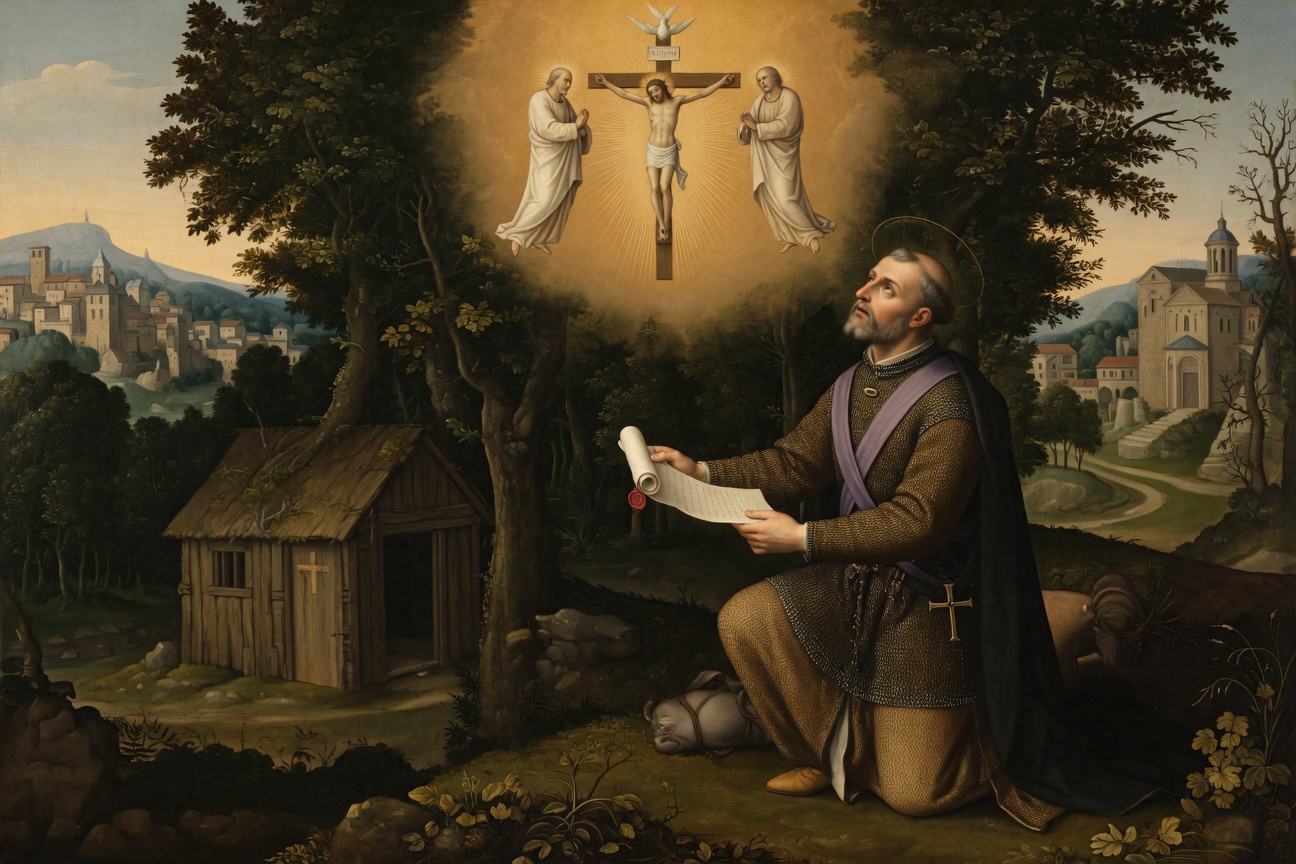
Son of the Viscount of Thiers, Étienne trained in Italy before founding a rigorous hermitage in the forest of Muret in Limousin. Refusing the title of abbot for that of corrector, he established a rule based on the Gospel and absolute poverty. His order, transferred to Grandmont after his death, became one of the most austere of the Middle Ages.
Guided reading
8 reading sections
SAINT ÉTIENNE DE MURET,
FOUNDER OF THE ORDER OF GRANDMONT
Origins and formation in Italy
Stephen was born in Thiers in Auvergne and traveled young to Italy where he was educated by the Archbishop of Benevento before discovering the eremitic life in Calabria.
Saint Stephen, better known by the name of Mu Saint Étienne, plus connu par le nom de Muret Founder of the Order of Grandmont and hermit in Limousin. ret, the place of his solitude, and by that of Grandmont, the first convent of his Order, than by the na Thiers Town where Avitus had a church built. me of Thiers, which was that of his family, was born in the land of Auvergne. His father was named Stephen and was Viscount of Thiers, and his mother was named Candide: both considerable for their worldly goods, but even more commendable for their virtue and piety. After having been long without children, they offered prayers, fasts, and alms to obtain one from the goodness of God, and promised to consecrate to His service the first one He would give them. Their vow was granted, for Candide, some time later, brought into the world a son who was named Stephen, like his father (1046). This child began, from his earliest years, to give evident signs of what he would one day be, finding pleasure from then on only in retreat and silence, in order to better attend to prayer. "God willed that the miracles occurring before the tomb of Saint Nicholas, in Bari, in Calabria, where his relics had been quite recently transferred, should make such a great stir that... the report of them flew as far as Auvergne, which gave the Viscount the desire to go and visit them and to take his son there..." But as he was returning to France, young Stephen having fallen ill in Benevento (1038), he was obliged to leave him there under the guidance of the Archbishop of that city , nam Milon Bishop of Troyes who discovered the saint's body in 992. ed Milon, who was also a native of Auvergne. This prelate willingly kept him by his side, and took a singular pleasure in the education of a young man so well-born; he gave him masters to advance him in the sciences, and he himself was very happy to apply himself sometimes to instructing him; and, to further strengthen his mind, he usually had him attend the judgment of cases that were pleaded in his presence. Finally, according to some, he ordained him deacon, and made him his archdeacon and his official. But as Stephen had a heart naturally inclined toward solitude, he took little pleasure in hearing parties plead. That is why, after having remained some years under the direction of Milon, he traveled as far as Calabria, to visit certain religious of whom he had heard, who led, on earth, a life entirely angelic. He took such a liking to their way of life that he resolved from then on to conform his own to it, as much as God would give him the means. In this resolution, he came to France.
But immediately after his return from Italy, his father had been seized by an illness "which caused him to depart from this world with visible marks of holiness to go and await his son in heaven." His mother had also gone to God, so that he resumed his journey toward Italy without concerning himself with the rich heritage he had inherited.
Stay in Rome and papal approval
After the death of his parents, Stephen studied monastic rules in Rome and obtained from Pope Gregory VII the authorization to found a new institute in France.
His intention was to return to Benevento; but, learning in Rome that the archbishop had died, he stayed with a cardinal (1070) where, through the conversation of some learned persons, he instructed himself very carefully in all the rules and constitutions of the religious houses that were then flourishing in the Church; but not one pleased him as much as the one he had observed in Calabria. This is why, after a stay of four years in Rome, he resolved to come and establish a similar house in France. He obtained permission for it from Pope Saint Gregory VII, pape saint Grégoire VII Pope during whose pontificate Saint Gausbert died. who had a bull dispatched to him by which he granted several great indulgences to those who would embrace this new institute.
The Hermitage of Muret
Stephen settles in the forest of Muret, near Limoges, where he dedicates himself to God through a symbolic vow involving his family ring.
Stephen, satisfied with this happy success, left Rome to go to Auvergne, and having disposed (with the exception of a ring) of all the goods that had fallen to him upon the death of his father and mother, he went away quietly and without the knowledge of his other relatives (1076). To better obtain from God that He might hasten his design, he began his journey with prayer, during which he was caught up in ecstasy; he found himself extremely consoled and strengthened for the pursuit of his enterprise. After having visited several deserts, he finally arrived, by an express providence of God, in the province of Limoges, which was full of forests, and, stopp ing i Muret Town where the saint's relics rest. n that of Muret, which was completely deserted, he chose it as his dwelling for the rest of his life.
He was about thirty years old, and to begin this new life with a sacrifice of himself, he took the ring which was the only possession he had reserved from the inheritance of his parents, and consecrated himself entirely to the service of Jesus Christ, with these words, which he pronounced as he wrote them: "I, Stephen, renounce the devil and all his pomps, and I offer and give myself to God, the Father, the Son, and the Holy Spirit, the only God, true and living in three persons." He sealed this writing with his ring, and placing it on his head, he added: "O most powerful God, who live eternally and reign alone in three persons, I promise to serve you in this hermitage, in the Catholic faith, in sign of which I place this writing on my head and put this ring on my finger, so that at the hour of my death this solemn promise may serve as my defense against my enemies." Then, he addressed the Blessed Virgin in these terms: "Holy Mary, Mother of God, I commend to your Son and to yourself, my soul, my body, and my senses."
Austerities and community life
The saint leads a life of extreme physical rigor and attracts disciples, founding a community based on humility where he refuses the title of abbot.
This vow being made, he resolved never to return to the world, whatever necessity seemed to call him there; but, shutting himself in a narrow cell, he endured there equally the heat of summer and the rigors of winter, for he was no more clothed in one season than in another, and he used a coat of mail as a shirt at all times. His sleep was so light that it was not properly a rest, and yet he regretted the little time that the extreme need of nature forced him to spend on it. His bed resembled more the sepulcher of a dead man than the bed of a living man. It consisted only of two planks driven into the earth, without mattress or straw bed, and even without a blanket. Although his body was exhausted by so many austerities, his courage was no less, and his face always appeared so joyful and so affable that all those who approached him were charmed by his extreme gentleness. Besides the Office of the Breviary, he recited each day psalms, prayers in honor of the Most Holy Trinity and the Blessed Virgin, and for the departed; his fervor was so great that he always did so on his knees and bareheaded, and he often prostrated himself with his face to the ground; he had become quite livid from it, and his skin appeared all calloused on his knees and elbows, and even on his forehead and nose. He also gave much time to contemplation, in which he often remained completely absorbed; it is even said that he spent up to ten days without taking food, so much did the conversation he had with God sustain him: one could say of him as of the apostle Saint Paul, that he lived more in Jesus Christ than in himself.
Furthermore, this interior occupation did not prevent him from satisfying what the love of neighbor demanded of him; although he did everything possible to hide the graces with which he was favored, "nevertheless, as a mirror cannot be placed opposite the sun without reflecting sparks and small rays from it, so he could not so well cover the brilliance of his holy actions that they did not shine in the neighborhood of Muret," so that everyone flocked there to admire his way of life and to receive his blessing. He remained alone the first year; then two disciples joined him, but for a long time they were followed by no one, because the austerity of his rule frightened men. However, the odor of his virtue finally called a great number there, who ranged themselves under him to be led on the path that leads to life. His charity did not permit him to refuse them, but he only received them on the condition that they never give him the name of master, nor of abbot, but only the humble title of corrector. He was the first to perform the vilest tasks of the house: he took his place last at the table, where he ordinarily read the lives of the holy martyrs and anchorites or some other subject of piety.
Prodigious signs and charity
The text reports numerous miracles related to food, thieves, and Stephen's spiritual clairvoyance, as well as his great charity toward the poor.
This way of governing of the holy patriarch was so pleasing to God that He often revealed to him the secret faults of his religious, their distractions in prayer, and the dangers to which some violent temptation exposed them, so that he might assist them in their needs; thus he warned them with a spirit so full of love that he won their hearts. He had a particular gift for leading those he counseled to virtue; whether he was reproving some or consoling others, it was always done in the manner it ought to be, so that his words, in some way like those of God, "never returned empty, but accomplished what He had ordained." If sometimes the effect did not seem to follow so promptly, the Saint, adding prayer to his discourse, soon made them effective. The following example will give us proof of this. A man obstinate in his crime one day attended a sermon by the holy religious, where he spoke of the horror of sin and the strange punishments prepared for it; after the sermon, this obstinate man said to him: "Good man, you may preach all you like, I will not change my way of life for that; pray, if you wish, for others, but for me, I beg you not to think of it, I do not wish to have any part in your prayers." These words chilled the heart of the servant of God, but hoping to gain by his prayers what he had not been able to do by his preaching, he said to his religious: "Let us go and pray for this poor blind man." And a few hours later, this sinner returned, quite different from what he was before, for, throwing himself at the feet of the Saint, he asked his pardon and promised to abandon his sin and never return to it. The prayer of the Saint and his religious was no less effective another time: two thieves had taken the monastery's provider to the depths of the forest; the Saint, having no news of him, said to his religious who were grieving over this absence: "Let us go barefoot to the oratory, and implore the help of the most holy Virgin, because there is no prison so hidden, nor country so distant, from which she cannot send our brother back to us." And indeed, by morning, the same thieves appeared at the gate of the convent with their prisoner; but, what is more admirable, the prisoner was free and unbound, and they were in chains. The holy Father, having confronted them with their fault, gave them his blessing and sent them away. Two other thieves having taken a loaf of bread that some people were sending as alms to the monastery of Muret, they could never break or cut it, because they had said with contempt of the Saint: "That even if God were to show Himself to them, they would not refrain from eating the bread of His servant"; but seeing themselves punished in this way, they sent to ask his pardon, which he granted them with a good heart along with a portion of the same bread. A woman presented him with a loaf of bread that she had made from ears of corn gleaned in her own field; but this bread broke immediately and appeared all bloody, because it was the portion of the poor, ordained by the law of God. Another gave him eggs; but the Saint, learning by a divine light that they were stolen, returned them to the same woman, exhorting her to make restitution.
These examples, which contain as many wonders, are sufficiently evident proofs of the holiness of Stephen. He possessed purity to such a high degree that he never felt in his whole life a single movement contrary to this virtue. Nevertheless, he did not fail to tell his religious that this very thing was a subject of greater fear for him: "Because the virtue of virginity," he said, "is lost by movements of vanity just as well as by dishonest pleasures." The little esteem he had for his own person made him take more pleasure in the company of the poor than in that of the rich; once, after he had spent the whole day with lords who had come to visit him, he wanted to reward the poor throughout the night; and as the religious wanted to dissuade him from it, he gave them this answer: "Now that Jesus Christ is with us, do you want me to withdraw? I will not commit this fault, after having given the day to the great of the world, not to spend at least the night with the poor." His conversation was so pleasant that one can say of it what is said of Wisdom, that it had no bitterness; his reputation, spreading through the country, attracted everyone to him; of this number were two cardinals, Gregory and Peter of Leon, legates of the Pope in France. Having heard in Limoges of this great man of God who was at Muret, they came to visit him in his desert, and remained so charmed by his conversation that both protested they had never had such an edifying talk, and that surely the Holy Spirit spoke through his mouth. Addressing him directly: "Man of God," they said to him, "if you persevere as you have begun, without doubt you will receive a reward equal to the holy Apostles and Martyrs, because you follow their path." Finally, having given him their blessing, they commended themselves to his prayers, and returned very satisfied to Limoges.
Passing and Celestial Recognition
Etienne dies at 80 after 50 years of solitude; his death is accompanied by celestial visions and he is later canonized by Clement III.
Eight days after this solemn visit, the Saint, feeling that the final moment of his life was near, as he had known in prayer, gave notice to his religious, and, to urge them toward perseverance and the exact practice of their holy rule, he gave them this discourse: "My children, I leave you as an inheritance God, in whom, from whom, and by whom all things subsist, for the love of whom you have left everything. If you remain faithful in the path that I have shown you, He will undoubtedly provide you with what you need; remember that I have remained in this solitude for nearly fifty years, some of which were spent in extreme scarcity, and others in great abundance; but, in my scarcity, I lacked nothing, and, in my abundance, I had nothing superfluous; so much so that God behaved equally with me in both of these states. The same thing will happen to you, if you keep well this rule that I leave you and that I have drawn from the Gospel." Four days passed in these exhortations, during which he always sang some devout prayers, "more sweetly than a swan," says the old chronicle, "and with more strength than he had done in his life, showing in this that God continued and increased His graces to him at this hour." On the fifth, feeling himself seized by an extreme pain, which made him know the approach of the hour he had so desired, he had himself carried to the oratory, where, after having fortified himself with the holy Viaticum and Extreme Unction, he closed the eyes of the body to the world to open those of the soul to eternity, while finishing these words: "Lord, I commend my spirit into your hands." It was a Friday; he was eighty years old, and in the fiftieth year of his profession, since which he had remained in the order of deacon, his humility not having permitted him to advance to the priesthood. At the very instant that this holy soul departed from this world, a young boy, sick to the point of death, and who had lost the use of his senses for three days, announced distinctly to his mother that he saw a ladder all brilliant, which, reaching from the monastery of Muret to heaven, appeared loaded with blessed spirits, who said to one another: "Let us go to receive the soul of the blessed Etienne, and let us lead it with us to heaven." To prove that he was telling the truth, he added that the last of these words would also be the last of his life; in effect, he expired immediately. Scarcely had Etienne rendered his beautiful soul to God, when his death was divinely announced at Notre-Dame du Puy, where he was well known. The same news flew at the same time to Tours and to Limoges, which engaged the regular canons of Saint-Augustine, accompanied by a great multitude of people, to go to Muret, to assist at his burial. The porter let them understand that he was not dead, so that the funeral of the Saint could be held peacefully; but the canons insisted, assuring that they had known of his death by revelation.
The religious of Muret notified the two cardinals who had honored him with their visit eight days prior, of this death so precious before God. These prelates were already in the city of Chartres, where, after having highlighted in full assembly the heroic virtues of this man of God, they prayed for his soul; after which they said openly: "We have prayed for him, let us pray to him now that he may be our intercessor before God, because assuredly he reigns with Jesus Christ in heaven." This was a presage of his canonization, performed by Pope Clement III, who ordered that the same honors be rendered to him as are rendered publicly to other Saints.
The Rule of Grandmont
Analysis of the monastic rule in 75 chapters, centered on the Gospel, radical poverty, and obedience, approved by several popes.
## RELICS AND CULT OF SAINT STEPHEN. — HIS WRITINGS.
Trithemius, Yepoz, and Le Mire claimed that Saint Stephen had composed his rule based on that of Saint Benedict. Father Mabillon had also initially adopted this view, *Procl. in part.* 2, sec. 6, *Bened.*; but he later abandoned it, and proved, *Annal. Bened.*, 1, 64, n. 37 and 112, that the holy founder of the Order of Grandmont had followed neither the rule of Saint Benedict nor that of Saint Augustine. This critical point is very well treated in the preface that Dom Martène placed at the head of his collection of ancient writers, vol. vi, no. 20, etc. Helyot, Baillet, and others have maintained without foundation that Saint Stephen never wrote anything, and that the rule which bears his name was nothing other than a compilation of the maxims he inculcated and the various observances he had practiced, a compilation which must have been drafted by one of his successors. If they had delved a little deeper into this matter, they would not have so easily determined to admit such an opinion, and they would have seen that the very passages they cited in their favor were entirely contrary to them. Moreover, Saint Stephen presents himself as the author of the rule that bears his name, and this in several places, *Crol.* c. 9, 11, 14. One may see on this subject the addition made by Father Martène to the annals of the Order of Saint Benedict, vol. vi, 1, 74, no. 91.
The rule of Saint Stephen of Grandmont is divided into seventy-five chapters. It is preceded by a prologue or preface, in which the Saint reminds his disciples that the Gospel is the rule of rules, the origin of all those observed in monasteries, and the true source from which one must draw the means to reach perfection. He recommends to them poverty and obedience, which he says are the foundation of religious life; he forbids them to receive payment for their masses, and to open the door of their oratory to seculars on feast days and Sundays, for fear that they might take the opportunity to miss the services of their parish. He also forbids them all kinds of lawsuits, and the use of meat, even in times of illness. He prescribes rigorous fasts for the greater part of the year, etc. Urban III approved this rule in 1186. It was mitigated by Innocent IV in 1247, and by Clement V in 1309. It was printed in Rouen in 1672.
Besides this rule, there are also several instructions of Saint Stephen, which were collected by his disciples after his death. They were printed in Paris in 1764, with a French translation. The name of Baillet was placed without reason on several copies of this 1714 translation. One admires in these instructions the beauty and fertility of his genius; they also contain excellent things on various points of morality, temptations, vainglory, ambition, the sweetness of the service of God, the necessity of striving for perfection, etc. It could happen that one of the disciples of our Saint made additions to the edifying collection of which we speak. One also finds some maxims of Saint Stephen in the oldest of his lives, entitled: *S. Stephani dicta et facta*. This compilation is authored by Stephen of Liciac.
Translation and Veneration of Relics
Following a conflict with the monks of Ambazac, the disciples transferred the body to Grandmont. The text details the current location of the relics in the Limousin region.
Four months after the death of Saint Stephen, the monks of Ambazac, of the Order of Saint Benedict, claimed Muret as belonging to them. Stephen's disciples, yielding to these unjust claims, withdrew to the desert of Grandmont, which is one league from Muret, taking with them the precious remains of their founder. Hence their name, Grandmontines.
I. — Current state of the relics of Saint Stephen of Muret: 1° The parish of Saint-Sylvestre, canton of Laurière (Haute-Vienne), on whose territory the abbey of Grandmont was located, possesses the head of Saint Ste phen of Muret in a silver bust chef de saint Étienne de Muret Notable relic preserved at San Silvestro. given to this abbey in 1494 by Cardinal Brissonnet, the eleventh abbot of Grandmont; 2° A part of the body of Saint Stephen of Muret is in the church of Ambazac (canton seat, on whose territory the hermitage of Muret is located), in a magnificent Byzantine reliquary, covered in gold and precious stones, where the richness of the design rivals the brilliance of the enamel. One also finds at Ambazac a precious silk dalmatic, given to Saint Stephen of Muret by Empress Matilda, wife of Emperor Henry V;
3° According to an inventory of the relics of the diocese of Limoges from the beginning of this century, one still finds relics of Saint Stephen of Muret at Saint-Pierre of Limoges (where I have venerated them), at Saint-Michel of Limoges, and at Saint-Jouvent (Haute-Vienne);
4° In 1790, a few years after the suppression of the abbey of Grandmont, the abbey's relics were distributed among the various churches of the diocese. Relics of Saint Stephen of Muret were given to the churches of Saint-Michel of Limoges, the chapel of the major seminary, the abbey of La Règle, the Carmelites of Limoges, to the abbots Sicelier and Legros (ibid.), and to the parishes of Saint-Léger-la-Montagne, Razès, Dempierre, Saint-Amand-Magnazeix, Saint-Jouvent, Bessines, Saint-Priest-Ligoure, La Geneytouse, Gianges, Journiac, etc. I do not know if all these relics have been preserved to this day.
II. — Veneration of Saint Stephen of Muret.
His feast is celebrated in the Breviary of Limoges under the double rite on February 9. Before the adoption of the Roman liturgy, his feast was celebrated on February 8, the day of his death.
III. — Current state of the abbey of Grandmont.
Of the ancient and famous abbey, only a few barns or other insignificant structures remain. The buildings and the church (rebuilt a few years before the suppression of the Order) were demolished in 1821; and the materials, taken to Limoges to be used in the construction of the central prison, fulfilled the prophetic words of M. de Maistre: "They will have to build prisons with the ruins of the convents they have destroyed."
The high altar of the church of Grandmont, adorned with a beautiful white marble relief representing the disciples of Emmaus, is today in the church of Saint-Junien (Haute-Vienne).
The name of Saint Stephen of Muret appears in the Martyrology of Ussard, in that of the Saints of the Order of Saint Benedict, and, finally, in the new one of the Saints of France, on February 13, although the Breviary of Limoges, upon which we have based ourselves, celebrates his feast on the 8th of the same month. Regarding the time of his death, the Rev. Fr. Dom Gérard Hier, seventh prior general of Grandmont, says expressly in the life he wrote of this holy Patriarch that it was in the year 1134, although Baronius places it in the year 1136. This life was written by Saint Vincent of Beauvais in his *Historical Mirror*, by Father Gérard Hier, whom we have just mentioned, who pursued the canonization of our Saint, and by Dom Charles Premon, a religious of the same Order. The Rev. Fr. Benoît Genon, a Celestine, did not omit him in his collection of the *Lives of the Holy Fathers of the West*.
Annexes & related entities
Structured data for exploration: events, miracles, quotes, places, attributes, patronages, and important entities cited in the text.
Key Events
- Born in Thiers in 1046
- Journey to Bari and stay in Benevento with Archbishop Milon
- Four-year stay in Rome and obtaining a bull from Gregory VII
- Settled in the desert of Muret in 1076
- Foundation of the Order of Grandmont
- Died at the age of 80 after 50 years of religious life
Miracles
- Vision of a shining ladder ascending to heaven at the hour of his death
- Multiplication or transformation of bread
- Miraculous liberation of a prisoner and shackling of the thieves
- Cessation of posthumous miracles by order of his successor to preserve the monks' solitude
Quotes
-
I, Stephen, renounce the devil and all his pomps, and I offer and give myself to God
Formula of consecration at Muret -
The Gospel is the rule of rules
Prologue of his Rule