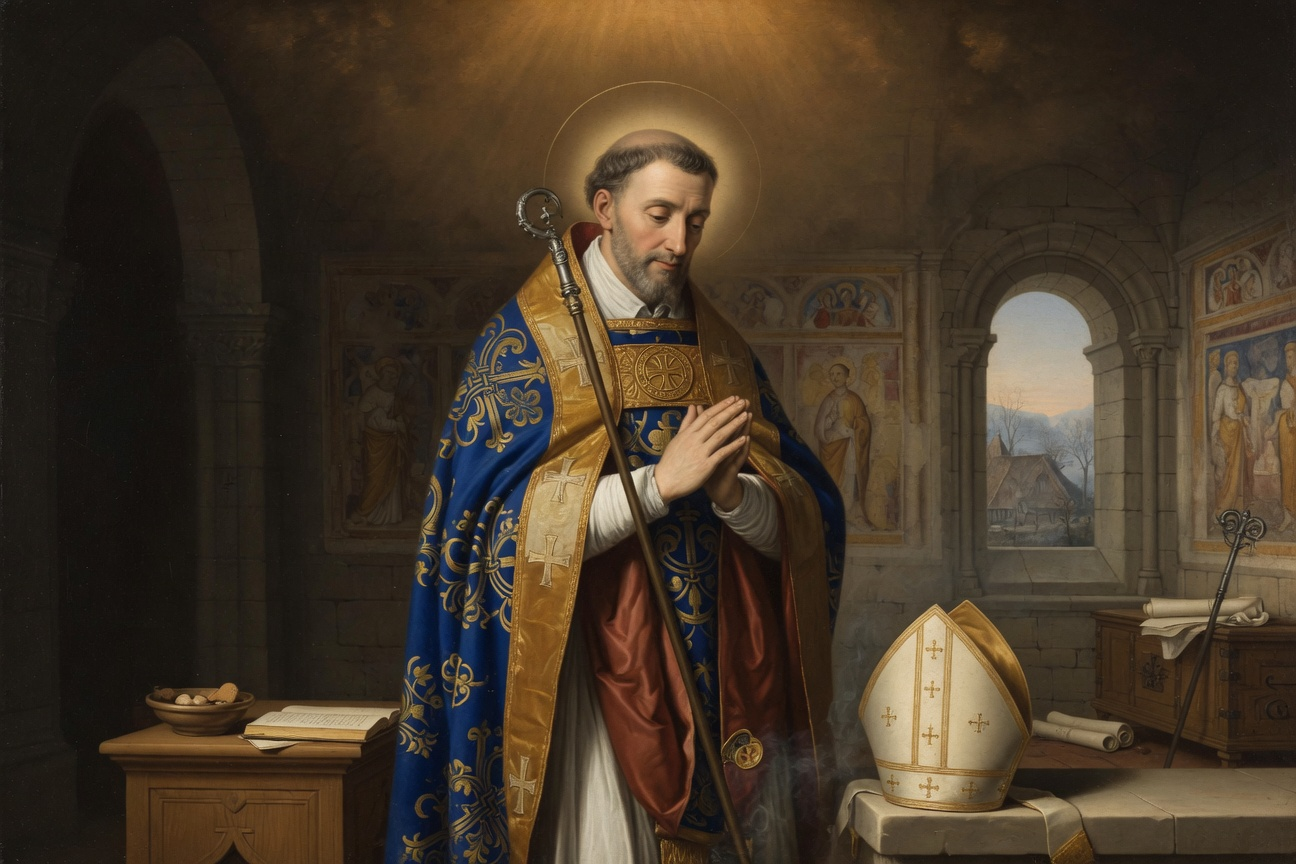
A noble chancellor under the Merovingian kings, Ansbert renounced the world after a virginal marriage with Saint Angadrisma to become a monk at Fontenelle. Having become Archbishop of Rouen, he was a pastor devoted to the poor before being unjustly exiled by Pepin of Herstal to Hainaut. He died in the odor of sanctity in 695, leaving the image of a humble and charitable prelate.
Guided reading
7 reading sections
SAINT ANSBERT, ARCHBISHOP OF ROUEN
CHANCELLOR OF FRANCE
Origins and youth at court
Born in the Vexin to a noble family, Ansbert was educated for worldly life and arms despite his early inclination toward piety.
Saint Ansbert, or Austrebert, was born in a village in the Vexin called Chaussy Birthplace of the saint in the Vexin. Chaussy, near Mantes, during the reign of Clovis II and Queen Saint Bathilde. His father was named Siwin: he was a nobleman, much employed in the armies and in the councils of our kings, where he acquired much glory. As for our Saint, he was touched by God from his tenderest years, and began from then on to despise the vanities of the world, to breathe only for Jesus Christ. After his studies, his father trained him in hunting, and had him take up other amusements proper to the nobility, to make him taste the world: but it was in vain, because he had already set his affections elsewhere.
The virginal marriage with Angadrisma
Forced into marriage with Angadrisma, the couple took a vow of chastity; a miraculous leprosy allowed Angadrisma to consecrate herself to God, freeing Ansbert.
Siwin, who looked only at the fortune and temporal future of his son, sought and found for him an advantageous marriage. He obtained for him the h and of An Angadrème Virgin wife of Saint Ansbert and abbess of Oroër. gadrisma, daughter of Robert, Count of Renty, and chancellor to King Clotaire III. Ansbert and Angadrisma had an equal aversion to marriage: they consented to it only out of obedience, and, after having mutually communicated their design to keep their chastity until death, they had recourse to prayer for this, and prayed to the Father of mercies to inspire them with what they should do. The blessed Angadrisma, in particular, asked Our Lord to send her some ailment that could tarnish her beauty, so that she would no longer be loved by men. Her prayer was answered, and her face immediately appeared covered with a leprosy so hideous that it caused horror to those who looked at her; and despite the remedies of the physicians, this ugliness continued to grow. This accident obliged the parents of Ansbert and Angadrisma to permit their separation, especially after they had learned from the mouth of their daughter that she had vowed her virginity to God before this alliance. Far from being troubled by this resolution, Ansbert was very glad that she who had been destined for him as a companion was the spouse of Jesus Christ. She was the refore led saint Ouen Author of the eulogy and life of Saint Aurea. to Saint Ouen, Archbishop of Rouen and former Chancellor of France, and received from him the blessing and the veil of virgins, to be consecrated to the heavenly Spouse; then, by a marvel of divine power, she recovered her former beauty with such radiance that everyone recognized that Jesus Christ accepted the sacrifice she made of herself. Afterwards, she went to the Beauvaisis, where she became the mother and superior of a monastery called Oroer, near the city of Beauvais, which has since been destroyed by the ravages of war, and whose income remained annexed, until the Revolution, to the chapter of the cathedral of that same city. The famous abbey of Notre-Dame de Saint-Paul had succeeded this ancient monastery.
Renunciation of the world and monastic life
After serving as chancellor, Ansbert joined the Abbey of Fontenelle under the direction of Saint Wandrille and became a priest.
Saint Ansbert, happy to see his vows thus realized, breathed only for a solitary life similar to that of his spouse; nevertheless, he was compelled to remain for some time longer at the court of Clotaire III, for he had been substituted or rather associated with Robert in the office of Keeper of the Seals. But this new dignity in no way changed his disposition, nor his inclination for the religious life, which he considered an asylum, a shelter against the embarrassments of the world and the court: for although he remained there in body, his spirit was always in heaven; and the pleasant sound of the musical instruments he heard at the palace served only to raise his thoughts toward paradise, and to make him often savor, in his heart, Psalm 150, which begins with these words: 'Praise the Lord in his Saints'. Finally, unable to breathe any longer an air as contagious as that of the court of France was then, under the last kings of the first race, he resolved, by a truly extraordinary example, to renounce the world absolutely and to lay down the seals of the chancellery, to become a perfect disciple of Jesus Christ and his holy cross. Being thus enlightened by a strong light of the Holy Spirit, and inflamed with the fire of his divine love, he left the palace secretly, without telling anyone, at the time when Ebroin had just been named Mayor of the Palace, and went to the Abbey of Fontenelle, in the diocese of Rouen, where he knew that the blessed Wandrille led a life entirely bienheureux Vandrille Abbot of Fontenelle and mentor of Erembert. celestial, with a great number of religious. He immediately took the holy habit, and, soon after, he made his vows there, and in a short time became a religious so perfect that Saint Wandrille begged Saint Ouen, Archbishop of Rouen, to ordain him a priest, so that he might be entirely consecrated to the service of the altars: a favor that was granted at that time only to those who were consummate in all kinds of virtues. This dignity did not prevent him from occupying himself with manual labor with the other religious. It is said that one day, going into the fields, he met Prince The prince Thierry King of the Franks who made donations to Saint Condedus. uderic, third son of Clovis II, who was going hunting; he predicted to him that he would be king after his brothers Clotaire and Childeric; as proof of which he assured him that the part of the field where he had had his tent set up that day, although extremely beaten and trodden by feet, would not lose its greenery. The prince replied to this that if God one day placed the crown upon his head, he would make him a bishop, so that the Church might be honored and receive increase through his examples and his doctrine.
Abbot of Fontenelle and social works
Succeeding Lambert, Ansbert leads the abbey with gentleness, founds a hospital for the poor, and establishes a new foundation in the Dauphiné.
However, the blessed Wandrille, after having holily governed the abbey of Fontenelle for twenty years, passed from this life of miseries to a happier one, and left as his successor in his abbey another religious named Lambert. The latter, Lambert Bishop of Lyon who consecrated Audebert. who was a cousin of Saint Angadrisma, and thus allied to Saint Ansbert, lived with him in such good understanding during his government that he consulted him in all his affairs with the same confidence as if he had been his father. Some time later, the Church of Lyon became vacant upon the death of Saint Genesius, former chaplain to Queen Saint Bathilde; King Theuderic, on the advice of Duke Pepin of Herstal, who was Mayor of the Palace and a cousin of Saint Wandrille, nominated Saint Lambert to fill this see, and our Saint was made Abbot of Fontenelle in his place. This nomination filled all the religious with joy, who blessed God for having given them such a good Father. The Saint neglected nothing to properly discharge this duty: his maxim for government was to make himself more loved than feared, persuaded that the most stubborn temperaments yield to gentleness. He divided his care by giving one part to the spiritual, and employing the other in the temporal affairs of the monastery. He had a hospital built to house twelve poor elderly men, in honor of the twelve Apostles, and provided them liberally with everything necessary for their sustenance. He also had two other lodgings made for the poor; he had them live there in groups of eight in each room, and took care that nothing was lacking for their maintenance, on the condition that they attend the divine office night and day, particularly the holy sacrifice of the Mass, in order to pray there for the salvation of the Christian people and for the exaltation of the Catholic Church. Without dwelling in detail on all the virtues of our Saint, we will only report some words from the historian of his life, which encompass them all: "Although he was the superior of the others, he was the humblest of all; he was poor in his clothing, frugal in his living, modest in all his actions, radiant with the serenity of his face and the light of his spirit, admirable for his patience, illustrious for the effects of his charity and for the great alms he gave to the poor. Thus, being adorned with all virtues, he shone like a lamp in the midst of his brothers." Two years after his election, he went to found an abbey in the town of Douzère, in the Dauphiné, and then returned to resume the gov ernment Douzère Place where Ansbert founded an abbey in the Dauphiné. of Fontenelle, which became increasingly flourishing under his administration.
Archbishop of Rouen
Elected by the people and King Theuderic III to succeed Saint Ouen, he distinguished himself by his charity toward the poor and the reform of the churches.
At that same time, Saint Oue saint Ouen Author of the eulogy and life of Saint Aurea. n, Archbishop of Rouen, full of virtues and holy deeds, was called by God to receive the reward of his merits. Saint Ansbert did not fail to be present at his funeral with his religious. After this good office, all the inhabitants of this metropolitan city cast their eyes upon him to place him in the stead of the deceased, and immediately sent deputies to request him from King Theuderi c III, who was roi Thierry III King of the Franks who made donations to Saint Condedus. at his castle of Clichy-les-Paris, where he was holding an assembly of the notables of his kingdom, among whom was Saint Lambert, Archbishop of Lyon. This news was agreeable to the prince, who saw the fulfillment of his prediction: he asked Saint Ansbert to come and meet him, under the pretext of some matter of conscience he wished to communicate to him, because he was his confessor. But the holy abbot, suspecting the matter, absolutely refused to go until the king had assured him, through a second embassy, that nothing would be done against his will regarding the archbishopric of Rouen. Upon this word from Theuderic, Saint Ansbert went to the court, where by the suffrages of all the prelates, the king, and the princes, his election was confirmed: so that, despite his resistance, he was consecrated bishop, in that same palace, by the holy Archbishop of Lyon.
Thus, this humble servant of God began to shine in the Church like a burning light, no longer hidden under a bushel, but placed upon the candlestick. Now, among all the beautiful actions he performed upon his entry into his archiepiscopal city, we shall note only this one: after having celebrated the Holy Mass, he wished to treat all those present, the poor as well as the rich; and, having had two large tables set up, he had all the nobles associated at one, each according to his rank, then he took his place in the middle of the table of the poor, to imitate Him who, being infinitely rich, became poor for our love. He did not only take care of the spiritual temples, I mean the faithful, whom he charitably provided for in everything, both for the body and for the soul, but also of the material temples which are the churches, ordering that the canonical portion which was due to him, in his capacity as archbishop, be used for their repair. He also showed his piety through the authentic privilege he granted to the Abbey of Fontenelle, in the fifth year of his pontificate, exempting it from any jurisdiction other than that of the Sovereign Pontiff; which was approved by fifteen bishops, four abbots, and other persons of consideration.
He also took care of the relics of his predecessor, which he had placed in a rich reliquary and solemnly transferred to the Abbey of Saint-Pierre, which has since borne the name of Saint-Ouen; and the holy archbishop did not forget on this occasion to hold a feast similar to the one he had held on the day of his entry and to observe the same ceremonies there; indeed, he left the table of the rich to sit at the table of the poor, in order to serve them there with his own hands.
Persecution, exile, and end of life
Unjustly accused by Pepin of Heristal, he was exiled to the monastery of Hautmont where he died in 695 after having been recalled from exile.
However, as virtue is always envied and persecution is the touchstone for testing the Saints, God permitted that Saint Ansbert should not be exempt from it. A civil war having arisen among the French princes, Duke Pepin of Heristal, Mayor of Austrasia, duc Pépin d'Héristal Mayor of the palace of the kings of the Franks and protector of Saint Wiron. after various successes, made himself absolute master of both Frances, to the prejudice of King Theuderic, who was forced to yield to force. Some restless and meddlesome spirits accused the holy bishop to Pepin of favoring his enemies Waratto and Gislemar; and this duke, giving them credence too easily, relegated him to the monastery of Hautmont, in Hain aut, on the river Sam monastère de Hautmont Monastery founded by Mauger and governed by Landry. bre.
Our Saint remained for some years in this place of his exile, but he did not remain idle there, for, taking advantage of this occasion which he believed to be fortunate for him, he renewed his first fervors there, that is to say, his fasts, his vigils, his prayers, and his tears which he shed in abundance. The whole neighborhood even felt the effects of his benefits, both through the good examples of his life and through his learned preachings. He also composed, in his retreat, some treatises of piety which have not reached us. He was living thus in peace in the place of his exile, when Prince Pepin, after having recognized his innocence, ordered him to return to his church. But God, who was calling him more happily to the enjoyment of His glory, made him aware of the approach of his death; that is why he sent a humble request to the same prince, to ask him only that he permit his body, after his passing, to be carried to the monastery of Fontenelle, where he had received the religious habit. A few days later, knowing assuredly that his hour had arrived, he called the religious of the monastery to celebrate the sacrifice of the Mass, and, after the holy communion of the body and blood of Jesus Christ, he gave his blessing to those present, and he himself armed himself with the sign of the cross; in this way, without any illness of which we have knowledge, he fell asleep peacefully in the Lord, on February 9, in the year of grace 695, according to Cardinal Baronius, and Bollandus, who has exactly researched the chronology of the abbots of Fontenelle.
Cult and translation of relics
His body, which remained incorrupt, was transferred to Fontenelle amidst numerous miracles before his relics were destroyed in the 16th century.
## RELICS OF SAINT ANSBERT.
The body of this illustrious prelate was transported to his abbey of Fontenelle, as he had desired before his death. Throughout the journey, there was nothing but miracles: demoniacs were delivered, paralytics were healed, and other afflicted persons received relief from their ailments. At Grand-Fresnoy, a woman who had long fallen under the power of Satan approached the coffin of Ansbert with confidence and was delivered. At the very place where she received this favor, the gratitude of the faithful built a chapel under the invocation of the Saint. This sanctuary was visited in the following centuries by numerous pilgrims, because of the miracles that the Lord performed there. But here is the greatest miracle of all, in our opinion: at the end of thirty days, and after a long journey, this same body was found as fresh and as rosy as if it had enjoyed perfect health and had only been asleep; and, furthermore, his arms were marked in several places with the sign of the cross, because he had always carried it, to use the terms of the Bride of the Canticles, as a sacred seal upon his arm and upon his heart. He was therefore finally deposited in the church of Saint-Paul, at Fontenelle, wher église de Saint-Paul, à Fontenelle Abbey where Giraud spent his final days as a reformer and martyr. e the glory of his soul has been sufficiently made known by a great number of miracles, of which it is easy to see the account in his life written by Aigrad, a monk of that same house, and which Surius reports in his first volume. Bollandus enriched it with several notes.
After various translations, the relics of Saint Ansbert were finally given to the abbey of Blandinberg, near Ghent. It was there that in 1579, they were destroyed by the Gueux or Calvinists of Flanders, during the troubles of the Low Countries.
See the life of Saint Angadrisma, wife of Saint Ansbert, on October 14, the day of her feast in Beauvais.
Annexes & related entities
Structured data for exploration: events, miracles, quotes, places, attributes, patronages, and important entities cited in the text.