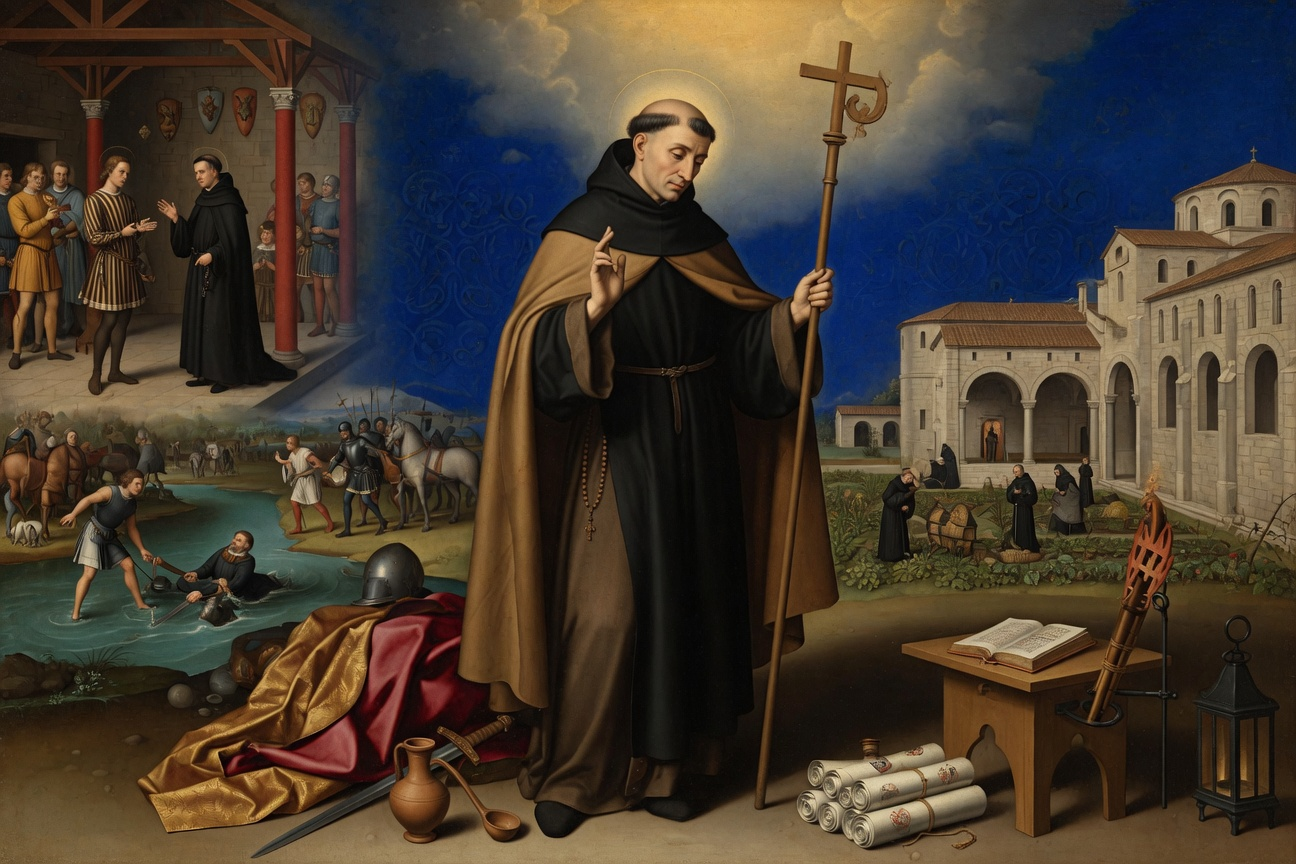
A former nobleman at the court of Pepin the Short and Charlemagne, Benedict of Aniane left a military career for monastic life. Founder of the Abbey of Aniane, he became the great reformer of the Benedictine order under Louis the Pious, imposing a uniformity of rule throughout the Carolingian Empire. He died in 821 at the monastery of Inden after a life of penance and service to the poor.
Guided reading
10 reading sections
SAINT BENEDICT OF ANIANE, ABBOT
Introduction and origins
Presentation of Benedict as a major reformer of the Church, son of the Count of Maguelonne and raised at the court of Pepin the Short.
What is the faithful and prudent steward whom the master sets over his household, to give them their portion of food at the proper time? It is he who is always active, always vigilant.
Luke, XII, 37, 42.
We can assert, without exaggeration, that the holy abbot, whose life we are about to present, was one of the greatest men who ever appeared in the Church; for, if he did not have the glory of being the founder of an Order, because he had embraced a rule already established, that of the great Saint Be grand saint Benoît Author of the monastic rule adopted by Father Muard. nedict, he nevertheless worked as much to procure the glory of God as the very patriarchs of the most famous Orders: indeed, we shall say nothing but the truth when we state that he was the reformer of all the monasteries of France in the 8th and 9th centuries, as well as the founder of a great number of new religious houses, which were the source of several others founded in the following centuries: so that if this holy abbot had the honor of bearing the same name as the great Saint Benedict, first patriarch and founder of the monks of the West, he also had a great share in the qualities of his spirit.
Benedict was born in Languedoc, which was formerly called Gothia, because of the Gothic peoples who then occupied a province in that country. Aigulf, his father, as distinguished by his birth as he was commendable for his valor, possessed the county of Maguelonne, which was so called becaus e of a city that bo comté de Maguelonne County of origin of the family of Benedict. re this name, and which was on the shore of the Mediterranean; it was formerly episcopal, but it is now destroyed. This lord, father of Benedict, gave proofs of his great courage in several important expeditions entrusted to him by King Pepin the Short, who was then reigning; he made himself especially famous in a renowned battle against the Gascons, who were not yet subject to France: they wanted to seize the province that the count was defending; but he withstood their shock with so much firmness and repelled them with so much vigor that he defeated them entirely. The victory he won over them was so complete that it earned him a most singular esteem from the king and all the great men of the kingdom.
Life at Court and Conversion
After a military career under Pepin and Charlemagne, a drowning accident involving his brother prompts him to fulfill his vow of religious life.
The extraordinary favor in which he stood with Pepin gave him enough authority to have his son Benedict received into the rank of young lords who were raised at court, to train them in the exercises of arms and other employments suitable to their birth. Benedict received in this school all the education his father expected, and he learned there everything a person of his rank needed to know; he had a naturally well-formed mind, sound judgment, reasonable conduct, and, the qualities of his body corresponding to those of his mind, made him loved by everyone. The king, to whom his merit was well known, wished to give him proofs of his esteem. When he saw he was of age, he first made him his chief cupbearer; but, having since recognized that he had great aptitude for arms, he gave him employment among his troops. Benedict showed in every encounter that he had no less courage than the count, his father, whose valor and wisdom he imitated.
Charlemagne, son and successor of Pepin, having taken over the government of t he kingdom Charlemagne Emperor of the Franks and uncle of Saint Folquin. in his father's place, was not long in recognizing for himself the distinguished merit of Benedict; thus he did not fail to keep him in his employments and even to destine him for higher dignities. The benevolence, the warm welcome, and the great marks of esteem that this monarch showed to our young hero were powerful motives to prevent him from thinking of anything other than profiting from such great favor; it was easy for him to convince himself that he would infallibly attain the highest fortune; his father's credit with the prince, his personal merit, the offices he already occupied, the friendship of all the lords of the court that he had won over; all this seemed destined to keep Benedict in the world.
But it was at that very time that God, who wanted to make him a great Saint rather than a great captain, touched his heart and made him know the vanity of all the grandeurs of the earth; recognizing day by day that the highest fortune to which one can aspire among the great of the world is always small, since it can be overturned in a moment, either by the caprice of men or by a premature death, he resolved to aspire to a glory less subject to the change of times. He therefore formed the design of abandoning the court and all the hopes he might have had there. He kept his secret to himself, and did not communicate it to his father, who, loving him tenderly, would not have failed to oppose his resolution. God permitted that he should be for the space of three years without finding a way to execute what he had conceived; but, if he remained outwardly and by necessity at court, he always had his mind raised to heaven; he began to exercise himself in the practice of all virtues: he deprived himself of the most innocent pleasures, he spent his nights in prayer, he hardly used wine anymore, he spoke very little, he avoided all dangerous company to preserve greater purity: in a word, no longer counting on the employments of the secular militia, he thought only of fighting under the banner of the Cross. Uncertain of how he would do it, sometimes he thought of going away in the habit of an unknown pilgrim, sometimes he planned to go to some foreign country to lead a poor and abject life; sometimes he persuaded himself, by a motive of charity, that it would be good to practice some lucrative trade to give the fruits he would derive from it to the poor; at other times he thought of going to preach the Gospel to the idolaters.
He was thus forming a host of innocent designs; when an accident determined him entirely to execute what had been inspired in him from heaven: one of his brothers, having imprudently undertaken to swim across the Ticino River, near Pavia, without having well known the dangers, found himself so overcome by the current of the water that he began to perish. Benedict, who was on horseback, and who had charity for everyone, did not want to lack it for his brother; he threw himself, mounted as he was, into this river, and his brother, who was drowning, having taken him by the arm, involved him in a moment in the same peril in which he found himself. The two brothers would have infallibly perished, if the divine Goodness, which had regard for the extreme charity of Benedict, had not favored him with a sufficiently prompt rescue to overcome the violence of the torrent, from the middle of which he withdrew happily, always managing his brother, whom he also brought back to the shore, and whose life he saved in this perilous accident.
Monastic Beginnings at Saint-Seine
Benedict enters the monastery of Saint-Seine in Burgundy, where he practices extreme asceticism and holds the office of cellarer despite being mocked.
Benedict recognized the hand of God upon him on this occasion: he vowed on the spot not to delay any longer in distancing himself from the many dangers in which he found himself entangled in the midst of the world; and, animated by a new fervor, he immediately accomplished what he had promised: he abandoned the court and the fortune to which he could lay claim, and withdrew in secret, without consulting anyone other than a certain religious named Widmar or Guimer, who was blind in body but very enlightened in matters of salvation; this pious solitary even wished to follow him everywhere. Benedict, therefore, accompanied by this true friend and his men, who were still unaware of the purpose of his journey, made a tour of Languedoc, his homeland; but no sooner had he arrived there than, pretending to return to the court as soon as possible to continue his duties, he left with his retinue and his ordinary men, so as not to give his relatives any suspicion of what he was about to do. He took the road to Aachen, where Charlemagne then held his residence; but, having ar rived in Burgundy, at th monastère de Saint-Seine The first monastery where Benedict took the habit. e monastery of Saint-Seine, in the diocese of Langres, from where the river Seine takes its origin, he humbly asked to be received into that house: it was granted to him after he had given proof of his good intentions and the motives that compelled him to leave the world; he then declared his design to his men, rewarded them, and sent them back to his father's lands, bidding them farewell forever; he had his hair cut on the spot and then received the religious habit.
He began at first to weep bitterly for his sins and to do penance for them; he treated his flesh harshly; he lived only on bread and water, and in small quantities, so that if he took food, it was rather to avoid causing his own death than to satisfy his hunger; he looked upon wine as a true poison for him: the bare earth was the place where he took some little rest after long vigils; he spent entire nights in prayer, and quite often he was seen standing, barefoot, on the pavement of the church, in the middle of winter, singing the psalms and thinking of the mercies of God upon him; he had obtained the grace of true compunction, and he possessed the gift of tears to such a degree that he shed them in abundance as soon as he entered into the consideration of either his sins or the last things. He also sometimes spent the nights performing the most arduous and vile functions of the monastery, such as cleaning the shoes of travelers, sweeping, and doing other similar very humiliating things; he wore only worn-out clothes, and when they needed mending, he put patches on them himself, without examining whether the color was the same as that of the habit; he had become so pale and so thin that one would have taken him for a dead or dying man rather than a living one. Such a neglected exterior, such frequent vigils, such extraordinary abstinence, joined to a continual silence, which he would only break out of necessity, gave rise to some of his brothers, who did not at all appreciate his conduct because it condemned their lukewarmness, to pass him off as a madman and a man who was extravagant in his devotions; he was mocked, despised, pointed at, and subjected to other similar outrages, which never shook his patience and never drew any complaint from his mouth; on the contrary, he was delighted to see how his penances and the practices of his charity were interpreted; he increased what could confirm his brothers in their opinion, well content to be treated like Jesus Christ, who, he too, was accused of madness by his relatives at the very moment he was giving proof of his greatest love for men.
The superior of this monastery, who had the spirit of God, did not judge him so; but, recognizing a high wisdom under the veils of an apparent madness, he gave him the office of cellarer; this humble religious, accepting out of obedience what he would undoubtedly have refused if he had been permitted to follow his inclination, discharged this duty well, granting all he could without wounding his conscience, refusing what was asked of him against his duty, never having false complaisance or respect of persons in the distribution of the things entrusted to him, but making humble excuses when he could not satisfy the desires of each one. He took great care to provide for the needs of the poor, for the reception of guests who passed by, and for the needs of the young children who were being formed in piety within the monastery.
Foundation of Aniane
Fleeing election as abbot, he returned to Languedoc to found the monastery of Aniane, which became a model of fervor and poverty.
Benedict had been in this office for nearly six years when the abbot of that house died. So much wisdom, such an expansive spirit, and such great gentleness had been observed in our Saint until then, that even his greatest enemies and those who had despised him the most were moved by themselves to think of electing him as their superior. At the first proposal made to him, he was extremely surprised, unable to imagine that one could think of him for such a dignity; but at the same moment, remembering the Savior's retreat when there was talk of making Him king, he did not hesitate for a moment on the choice he had to make; his humility made him believe that he must in conscience take flight. He therefore left the monastery of Saint-Seine, because he wanted to flee the dignities that he believed were not suitable for him, and returned to Languedoc, on the very lands of the county of Maguelonne, which belonged to his father, and which would have been his own inheritance had he remained in the world: God permitted it thus to give Benedict the opportunity to better succeed in the designs that divine Providence had for him (780). He stopped near a small strea m name Aniane Abbey and center of learning directed by Ardon. d Aniane, which was not far from the Hérault river nor from the church of Saint-Saturnin. He was accompanied in this place by the holy religious Widmar, of whom we have already spoken, and by some other disciples who came day by day to join them; this place was a true school of penance for these solitaries; their occupation was to pray, to work, and to sing praises to God day and night; Benedict, feeling his heart burn with a secret love, groaned incessantly and shed tears in abundance, conjuring heaven to inspire him with the means to procure the glory of his God as much as he had the desire.
He contracted, at this time, a close friendship with three holy personages from the surrounding area, namely: Attilion, Nibridius, and Anianus, who led a very exemplary life, and whom he consulted in his difficulties. He went one day to find Attilion, one of the three, who lived closest to his hermitage, to tell him that he was tempted to leave the place where he was to return under the obedience of the abbot of the monastery from which he had come, "because," he said, "almost all those who come with great fervor to ask me to live poor and solitary are no sooner reduced to leading a regulated life, and to receiving only by weight and measure the things necessary for life, than they ask to return to the world to enjoy their former freedom"; but Attilion, who was very experienced and a great friend of God, made him understand that he should not for that reason abandon the work he had begun, especially since God had made him know that He wished to use him as a torch to spread His light everywhere.
Benedict, who had a docile heart, believed what this holy man told him; he continued his enterprise, and heaven showered him with such great blessings that it soon became necessary to increase the place he inhabited with a large number of cells for those who asked to be received; he was even forced, subsequently, to abandon the valley where he was, because it was too narrow to contain all the applicants who presented themselves: this was an occasion for him to build another monastery elsewhere which was soon completed, although there were almost only his own religious who were the workers; also, no thought was given at all to the rich ornaments of architecture, but only to multiplying the cells that were needed. The holy abbot was the first to carry earth, wood, and stones; everyone followed his example, and yet nothing was omitted in such a great work of all the ordinary duties of regularity; he received the alms that were given to him, but he never wanted to receive donations in writing or by contract that would commit the donors to divest themselves forever of the goods they presented, wishing to leave the benefactors the freedom to take back their gifts whenever they pleased.
The beautiful order, the holiness of life, and the good odor that this monastery spread everywhere produced such great enthusiasm that one saw in a short time a large number of other similar monasteries, filled with holy Solitaries, around that of Benedict: he was recognized everywhere as the first abbot. He was tireless; he provided with unparalleled care for all his houses, both for the spiritual and for the temporal; he visited all his dear disciples from time to time, and he always supported them, as much by his examples as by his discourses, in the harsh labors of the austere life they had embraced.
Charity and Imperial Protection
His charity towards the poor and thieves attracted the esteem of Charlemagne, who financed the construction of a larger monastery.
His charity was not limited to providing for the needs of his own religious, but extended to all the people of the region: during a great famine that occurred in the land, he ordered that the goods of his monastery be shared with the poor, without worrying about the morrow, and he repeated this same act of charity three different times. His detachment was so great, and he concerned himself so little with the goods of this life, that when he was told that something had been stolen from the monastery, he did not want any search to be made. The inhabitants of the country having one day brought him a man whom they had already covered with wounds, because he had stolen several horses during the night that belonged to one of his houses, he first pretended to seize this thief; but this was only to remove him from the hands of the justice with which he was threatened, for the true servant of God, more charitable in this than the Samaritan, immediately had a very experienced surgeon come into his presence, to whom he gave the commission to wash and bandage the man's wounds; then he took care to dispel with his usual gentleness the fear he saw him gripped by; he had him well fed, and, after making him understand, not so much the harm he had done to his house, as the offense he had committed against his God and the wound he had caused to his soul, he sent him away in full liberty.
It is in this same spirit of charity that he did not want anyone to run after a man who, having been well received and well lodged in one of his convents, had taken away everything he could: "Let us leave this man," said the pious abbot, "he loses more than we do on this occasion, since, believing he is making a gain by stealing what is ours, he is making a notable loss by depriving himself of the grace of God." One of his religious also believed one day that he should warn him that he had recognized in the hands of a certain man a horse that had been stolen from them recently, and that, if he wished, it would be returned to him. The Saint, whose charity made him cover the greatest faults of his neighbor, severely reprimanded this religious, telling him that one should not believe evil of one's brother so easily; that this man, whom he was accusing, could have a horse similar to the one they had lost, but that one should not imagine for that reason that it was the same one.
God, whose wise providence knows how to reward a hundredfold those who have no attachment to the earth, inspired at that time Charlemagne, who knew the perfect disinterestedness o f the Saint Charlemagne Emperor of the Franks and uncle of Saint Folquin. , to have a monastery built for him, in which he could receive in full liberty all those who would come to present themselves to lead the monastic life under his guidance: this monarch wanted neither the richness of the material nor the industry of art to be spared in this edifice. At the same time, a magnificent church was built, proportionate to the elevation of the building; all the great men of the kingdom wanted to share with the emperor the glory of having contributed to this work, and this famous monastery became the head of an infinity of others, whether in Languedoc or in the most distant places.
Restoration of the Rule and Sciences
Benedict restores the Rule of Saint Benedict to its original purity and promotes the sacred sciences by training masters and establishing a library.
The pious abbot believed that he could not better show his gratitude to God for so many benefits than by having his monks observe a life entirely heavenly; he undertook to make the first and true rule of the great S aint Benedict flourish again; and as véritable règle du grand saint Benoît Author of the monastic rule adopted by Father Muard. it was somewhat altered and confused, because of several constitutions and mitigations that laxity had introduced into it, he employed all his care to make its purity reborn: for this purpose, he collected all the other rules, and, moreover, he consulted the greatest men of his century on the matter: so that he had the good fortune to recover, in its integrity, this holy rule which has served as a torch to so many illustrious figures in science and holiness; after having put it in order, and having clarified its difficulties, he applied himself to having it observed as exactly as possible. The number of monks having become very considerable, he first established all kinds of officers to properly celebrate the divine service. Then, not unaware of the utility of the sciences, whether for combating heretics or for holily occupying the solitaries, he trained masters in all kinds of disciplines; thus, without altering the exact regularity that attracted the admiration of everyone, he made schools for the humanities, philosophy, theology, and the understanding of the Holy Scriptures flourish in this royal house; he also took care to collect books, which gave him the opportunity to compose a beautiful library: it is thus that this great man found a way to drive out the darkness of ignorance from the province where he was, and that he raised a great number of subjects who subsequently rendered, whether as bishops, or as doctors or missionaries, or as abbots, very considerable services to the Church.
Advisor to Louis the Pious
Louis the Pious called him to his side in Aachen and founded the monastery of Inden for him, making him his advisor and the protector of the oppressed.
The conduct of this great servant of God was so approved by everyone, and his reputation spread so far, that it became a pleasure and a merit for people on all sides to offer him lands and large sums to build monasteries in the provinces; mention is made of twelve principal ones of which he was recognized as the first abbot; everyone desired either to see him, to speak to him, or to help him in his undertakings. Louis the Pious, having l Louis le Débonnaire King of the Franks who made Aldric his advisor and commander of the palace. eft Aquitaine, of which he had been king, to take up the government of the empire in place of Charlemagne, his father, who had died, could not long remain deprived of the presence of Benedict. Having recognized, from his own experience, how useful his advice had been to him, he sent word to him requesting that he move closer to the city of Aachen, where this prince had established the seat of his empire; he first gave him, for this purpose, the monastery of Maur-Munster, in Alsace; but, judging it still too far from his person to have him conveniently when he needed his counsel, he had him build, in a place quite close to his imperial palace, a famous monastery, named Inden, because of t he nearby river that bore this n monastère célèbre, nommé d'Inden Monastery built by Louis the Pious near Aachen where Benedict died. ame.
Benedict took advantage of the monarch's benevolence, not for his own private interests, but to be the mediator and protector of all the people; for, through his intercession, the poor and the afflicted were heard by the prince, who took the time to learn of their needs during the frequent audiences he granted them, and which he accorded to Benedict on their behalf. This emperor found it so good that this holy abbot made himself the defender and protector of widows and orphans that, when he came to the palace, he would anticipate his arrival and go to meet him, pleasantly placing his hand into the robe of this amiable and zealous advocate for the good of the poor, to draw out himself the bundle of petitions that he had come to present in their favor; he would read them on the spot and respond favorably as soon as he could.
The inclination he had to make justice reign everywhere also led him to persuade the emperor to stop the disorder of the seculars, who possessed the goods of the churches and monasteries and who diverted them to profane uses, against the intention of the founders, and to the great scandal of the people; he exposed to him, in detail, the full extent of this disorder, which led this prince to carry out an admirable reform on this point, worthy of his piety.
The remonstrances that this holy abbot made to this monarch always appeared so judicious and so useful to the good of his empire, and his advice on what was appropriate to do was always found to be accompanied by such great sense, that his counsel was never neglected, because one had always fared well from having followed it.
Unification of Western Monasticism
In 817, he presided over an assembly imposing the uniformity of the Benedictine Rule throughout the empire and maintained an intellectual friendship with Alcuin.
The Emperor gave great proof of what we advance to the glory of Benedict when, on the advice of his council, he wished this holy abbot to be in some manner the primary superior of all the monasteries of his states, and that he should work, in this capacity, toward a general reform of everything that needed to be pruned in individual houses: it was to obey the wishes of his prince that he assembled (817) all the superiors of the monasteries of France, and, having thoroughly examined in this general assembly everything that needed to be reformed or established, he created statutes so judicious, so conformable to the true religious life, and so necessary to revive the ancient spirit of the holy solitaries, that they were received and approved by the assembly. Confirmed by the authority of the Emperor, they were published everywhere and strictly observed: it was a thing worthy of admiration to see so many different houses, spread throughout all the provinces, having but one rule, that of Saint Benedict, one way of life, one spirit, the same chant, the same habit, the same weights and measures for bread and wine; in a word, a conformity, or rather a uniformity as perfect as if it were but a single house under a single superior. The success of such an enterprise required a mind as vast as that of the incomparable Benedict and the authority of the Emperor: the matter will not seem incredible if one remembers that we are speaking of the 8th and 9th centuries, when all who were then religious or solitaries claimed to follow the rule of Saint Benedict: everyone, in truth, interpreted and softened it in their own way, but our Saint reduced it to a form that everyone was obliged to approve and follow. The Order of Saint Benedict will be eternally indebted to this holy abbot, not only for the care he took in his time to restore the ancient regularity, but also for the work entitled the Concord of Rules, which he composed and left in writing: in it, he shows what is the true spirit and meaning of the rule of the great patriarch Saint Benedict in relation to the rules of the other Fathers, by comparing them with one another and showing how this rule of Saint Benedict is supported and authorized by all the others whose spirit it contains. This work, which has since been enriched with learned notes by the Reverend Father Hugues Ménard, a Benedictine, is not the only one our Saint composed: others are still attributed to him, such as collections or conferences drawn from the Homilies of the Fathers, suitable for exciting religious to greater perfection, and others similar, which clearly show that this humble abbot not only possessed great virtue and a mind naturally vast and capable of great enterprises, but that he was also learned and a great friend of letters. The schools he established in his monasteries are further proof of this: he took the trouble himself to train the readers; he explained the holy canons of the Church to his religious, he gave them an understanding of the writings of the holy Fathers, he went to explain the meaning of the Holy Scriptures in the monasteries, and provided clear solutions to all the doubts proposed to him. The famous Alcuin, who was the tutor of Charlemagne and the oracle of his time, distinguished the capacity and piety of our Saint so well that h e contracted an Le fameux Alcuin Famous abbot under whom Aldric began his monastic life. inviolable friendship with him, and maintained such a great correspondence of letters with him, especially after he was elected abbot of Saint-Martin of Tours, that one could have composed a large volume from them; history even adds that Alcuin sent him gifts as a testimony of esteem, and that while at his abbey of Saint-Martin, he begged him to send him religious trained by his own hand, as he had sent to so many other prelates who had requested them. For his part, Theodulf, abbot of Fleury and bishop of Orléans, sometimes employed his muse to celebrate the merit and virtues of Benedict. He does not hesitate, in one of his poems, to compare him to Saint Benedict of Monte Cassino. If, indeed, the latter was the creator, the former was the restorer of monastic discipline in the West.
Struggle against heresy and miracles
He fought the Adoptionist heresy of Felix of Urgel and performed various miracles, while overcoming the slanders of the envious at court.
The victories that Benedict won over the heretics of his time are still convincing proofs of the depth, solidity, and integrity of his doctrine. Felix, Bishop of Urgel in Spain, was spreading Félix, évêque d'Urgel Bishop of Urgell, promoter of the Adoptionist heresy. everywhere the venom of a pernicious heresy, which had already infected some provinces of France; he attacked nothing less than the filiation of the divine Word, asserting that Jesus Christ, as a man, was only the adoptive Son of the eternal Fa ther; this was enough to ren Fils adoptif du Père éternel Christological heresy asserting that Jesus is the Son of God only by adoption. ew the most dangerous heresies that the Church had had to fight in previous centuries. Our Saint, joining with the most zealous defenders of the faith of our mysteries, worked with tireless care for the extinction of this evil doctrine; he even undertook, three different times, the long and arduous journey to Spain to go and triumph over the heresy at its source and in its principle, and he contributed not a little to the convocation of the synod held in Urgel itself, the city where the seat of the heretical bishop was, who was condemned there, and whose doctrine was declared rash and entirely contrary to that of the Church. We still have three other councils held, one at Regensburg, another at Frankfurt, and the third at Aachen, which all fulminated anathema against the error of which we speak.
The great zeal that Benedict showed for the interests of the Church in general did not diminish any of the care that his office obliged him to have for all the monasteries of France of which he had been declared the father as well as the reformer. He undertook arduous and long journeys to go and give new strength to his disciples in the profession they had embraced. Several miracles are reported that God performed in his favor during these journeys: the religious of a monastery that was poor were in pain at not being able to give their holy abbot a reception worthy of his merit; God provided for it, making them find fish of extraordinary quality and size in waters where there could naturally be none. Another time, on a similar occasion, poor religious were in affliction at not being able to present any refreshment to this worthy Pastor, overwhelmed with weariness and fatigue: divine Providence, which does not fail in need, made them find excellent wine and in abundance in a vessel where there was none. But these were not the only wonders that happened in the course of the life of this great servant of God: those that we have just reported were pure effects of divine Providence, which provided for the needs of him who was poor, and who had taught his disciples to remain in poverty to follow the counsels of Jesus Christ; but here is what the holy abbot himself did in favor of his neighbor. He stopped, by the virtue of his prayers and his tears, the impetuosity of a
1. Quod fuit Anonmiis Benedictus reuter in orvis, Hoc modo tu in nostris es, Benedictis, lucis. Ut cerebro Ruphoris Samius satus esse putatur, Bic Nord patris in te resorviator opus.
torrent that was going to destroy houses already half-submerged; several times, in fires that threw everyone into consternation, he commanded the fire to suspend its activity and carry its flames elsewhere: he knew, like another Moses, how to kill an enormous quantity of locusts that were beginning to ravage the fruits of the earth. His religious, animated by his spirit, also performed miraculous actions: several possessed people who were brought to them were delivered when they had prayed and kept vigil for this purpose; sick persons received perfect health by the same means; but we refer the reader to the entire history of his life to have a perfect knowledge of all these wonders. We will only add that the holy abbot had received from God a particular gift to penetrate to the bottom of hearts: he brought back several times to their duty, by this means, religious who were on the point of abandoning their vocation, by letting them know that he knew the deplorable disposition in which they were, and he never discovered these kinds of spiritual maladies without immediately bringing the necessary remedy.
These great favors, which Saint Benedict received from heaven, joined to the singular benevolence that one of the greatest monarchs of the earth showed him, did not fail, God permitting it so, to attract to him many envious people, who suffered with difficulty so much prosperity; several ecclesiastics of apparent merit interpreted his innocent intentions very badly: it was published that he was appropriating all the alms that were given to him; they stirred up by secret intrigues the officers and guards of the emperor's palace against him; lords of the court supported the slanders that had been spread; they wanted to surprise the prince and prejudice him against the Saint; so that the party was only waiting to see the one who was its most beautiful ornament chased from the court; false friends even wanted to persuade him to withdraw in secret, without waiting for an exile that they said would be very shameful for him; but Benedict knew well who was the protector of his cause, and God soon showed that He knows how to justify the innocent when He wants; the Saint went to find the emperor as usual, and this wise monarch, who knew how to discern the true from the false, and the good man from the hypocrite, embraced Benedict tenderly in the sight of all the jealous, and, to give him a more evident proof of his benevolence and his esteem on an occasion where one expected to see him exiled, he presented him with a drink from his own hand: which showed the whole party that he whom God protects is sheltered from all the malice of the envious.
Death and literary legacy
Benedict died in 821 at the monastery of Inden; the text lists his major works, including the Concord of Rules, essential to the Benedictine tradition.
It is time to speak of the passing of this great Saint who should never have died, according to the wishes of all peoples. God, who did not wish to leave such a generous soldier without the opportunity to win continual victories, made the painful trials of illness succeed the labors of charity: the Saint was attacked by a fever, and several other infirmities, joined to a great age; he nevertheless cut nothing from all his ordinary mortifications; he sighed incessantly after the heavenly homeland, and he shed a great abundance of tears, in the hope and expectation of being able to reach it; he was often found, either prostrate on the ground, or standing, having his head and arms raised toward heaven, or receiving in his hands the tears that flowed from his eyes, for fear that their too great abundance would soil the pages of the holy Scripture that he had before him; he read, or had read to him, the death of the holy Fathers, to imitate their example in his final moments, as he had tried to imitate their conduct during his life.
VIES DES SAINTS. — TOME II. 39
The emperor, who was still Louis the Pious, wanted to keep h im in his palace, s Louis le Débonnaire King of the Franks who made Aldric his advisor and commander of the palace. ick as he was, to benefit, as long as he could, from the wise counsel he received from him, as much for the good government of his States as for the rest of his own conscience. It was only after a long and familiar conference, in which he showed him all sorts of friendship and gratitude, that he finally permitted his religious to take him away to transport him to the neighboring monastery, so that this worthy and lovable Father could finish his days in the arms of his children.
He had no sooner arrived there than everyone hastened to inquire in what state he was: for, as there was no one who had not conceived a particular esteem and benevolence for him, and as he had been the consolation and counsel of the great and the small, of the rich and the poor, of ecclesiastics and laymen, all the great of the court, the bishops, the abbots, the magistrates and the common people, came to mingle their tears with those of the children and disciples of this worthy father, and their loss was regarded as a loss common to the whole empire. Benedict was grateful for the friendship shown to him in his final moments; but he did not cease to ask often as a favor that he be granted to be alone to converse more freely and more tranquilly with his God. Once, it happened that after having spent three hours in the sweetness of contemplation, although in the midst of the pains of illness, someone came to ask him how he was, he replied that he had never had sweeter moments during his life: I have just, he added, had the happiness of finding myself before my God, in the midst of the choirs of the Saints.
The sentiments of sacred love, with which God favored him then, did not make him forget the ardent desire he had for the salvation and perfection of others: thus he still had letters of instruction dispatched, before dying, for the emperor, from whom he knew the happiness and salvation of the peoples depended, for some of his monasteries, or for other individuals. One sees some of these letters, full of charity, in the history of his life, reported by Bollandus. God permitted him to declare to his religious that, for nearly fifty years that he had the happiness of being in a state of penance, it had never happened to him to eat the piece of bread that he was accustomed to take each day for his nourishment, without first shedding a great abundance of tears before God.
He always recited the divine office regularly, until the very day of his death, and it was after having fulfilled this noble duty that he said a last farewell to his dear children, and that he warned them that he was going to leave them in a moment; saying these words: "You are just, Lord, have regard for your mercy in judging your servant," he left this laborious life to enter into the abode of glory. It is said that the bishop of Maguelonne had a revelation of the loss that the church had just suffered: coming out of the sleep in which he was then, he immediately recounted to those present what had just happened at the monastery of Inden, which was nearly two hundred leagues away from Maguelonne. This great Saint died on February 11 of the year 821. Louis the Pious had a sepulcher given to h im in keeping wit monastère d'Inden Monastery built by Louis the Pious near Aachen where Benedict died. h his merit, in the very place where he died, in the monastery of Inden, since called Saint-Corneille, pope, under whose name our Saint had had the church dedicated. It is there that his holy relics have rested, without anyone since being able to discover them.
Saint Benedict of Aniane is represented: 1st in hermit's costume; 2nd extinguishing a fire: he rendered this service more than once to the populations of his neighborhood.
## WRITINGS OF SAINT BENEDICT OF ANIANE.
We still have from Saint Benedict: 1st a Code of rules that he wrote while a simple monk at Saint-Seine; this code was printed in Rome in 1661, under this title: *Codex regularum, collectus a S. Benedicto Ananio, auctus a Luca Holstenio*, etc.; 2nd a book of Homilies for the use of monks, drawn from the works of the holy Fathers, according to the custom of that time; 3rd a Penitential, printed in the supplements to the capitularies; 4th a Concord of monastic rules. One finds there the text of the rule of Saint Benedict with that of the rules of the other patriarchs of the monastic life. The goal of the author was to show the uniformity of these great men in the exercises they prescribe. Dom Ménard had this concord printed in Paris, in 1638.
We have composed this life on the acts reported by Bollandus, but we have especially used the learned remarks of the R.P. Dom Jean Mabillon, Benedictine, who gathers, in his rich preface to the 4th century of his Order, and in the life of our Saint, all that one can desire to know on this subject.
Annexes & related entities
Structured data for exploration: events, miracles, quotes, places, attributes, patronages, and important entities cited in the text.
Key Events
- Education at the court of Pepin the Short
- Military service under Charlemagne and position as chief cupbearer
- Saved his brother from drowning in the Ticino River
- Entered the monastery of Saint-Seine in Burgundy
- Foundation of the monastery of Aniane in 780
- General reform of the Empire's monasteries in 817
- Struggle against the heresy of Felix of Urgell
Miracles
- Miraculous appearance of fish to feed his guests
- Multiplication of wine in an empty vessel
- Stopping the impetuosity of a torrent through prayer
- Miraculous extinguishing of fires
- Destruction of a swarm of locusts
- Gift of reading hearts
Quotes
-
Let us leave this man, he loses more than we do in this instance, since, believing he is making a gain by stealing what is ours, he suffers a notable loss by depriving himself of the grace of God.
Remarks reported during a theft at the monastery -
You are just, O Lord, have regard for your mercy when judging your servant.
Last words