Saint Ludan
Loudain
Pilgrim
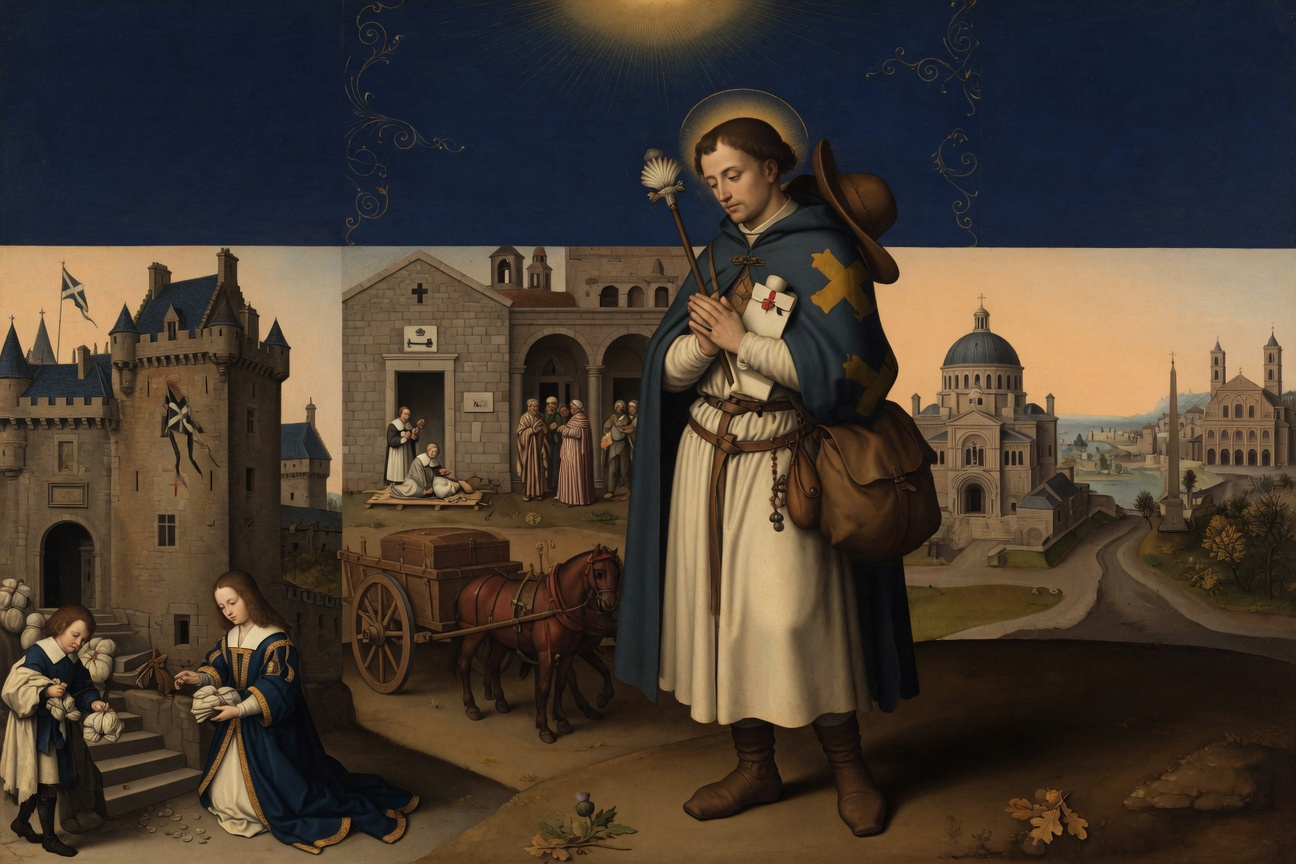
The son of a Scottish duke, Ludan distributed his wealth to the poor and founded a hospital before embarking on a pilgrimage to the Holy Land and Rome. He died of exhaustion in Alsace in 1202, where a miracle designated Saint-Georges church as his burial place. His tomb, although destroyed in 1632, remains a place of devotion.
Guided reading
4 reading sections
SAINT LUDAN OR LOUDAIN, PILGRIM (1202).
Origins and pilgrimage
Son of a Duke of Scotland, Ludan distributed his goods to the poor after the death of his parents to undertake a pilgrimage to the Holy Land and to Rome.
Ludan Ludan Pilgrim of Scottish origin who died in Alsace in the 13th century. was born i n Scot Écosse Birthplace of Saint Wiron. land, of an illustrious family. Having lost his father and mother, he resolved in his heart to follow more closely in the footsteps of Christ. Fearing that if he remained in his homeland he would encounter obstacles to his plan, after distributing his wealth to the poor, he left his kin and departed covered in poor clothing so as not to be recognized. He visited the sepulcher of Christ, the threshold of the holy Apostles, and other holy places. Along the way, he arrived, according to tradition, at the t own of Nordheim, bourg de Nordheim Town in Alsace where the saint died. in Alsace, at the beginning of the 13th century.
Death in Alsace
Arriving in Nordheim in Alsace in the 13th century, he died peacefully after being warned by an angel, leaving behind a writing revealing his identity.
There, weary from the journey, he rested under the shade of a tree, was comforted and relieved by an angel, and warned of the imminence of his death; shortly after, he fell asleep peacefully in the Lord. Immediately his body, deprived of life, spread a very sweet odor far and wide; a note was found on him indicating his name, his birth, his homeland, and his pious life. His holiness, thus known, they hastened to honor him as he was worthy.
The divine choice of burial
A team of horses without a guide designates the church of Saint-George as the burial place, putting an end to a dispute between two parishes.
As there were two parishes in the town on the territory where he had died, each of them wanted to have his body, until someone advised praying to God to make His will known. Then the body of the Blessed one, being placed on a cart and left without a guide, the horse that was pulling it headed by itself to the church of Saint-George. It is in th is church, later enlarg église de Saint-Georges Burial place and site of worship of the saint. ed in his honor, that Saint Ludan is honored amidst a great gathering of local inhabitants and foreigners. Several people, suffering from various illnesses, have experienced his intercession before God.
Heritage and posterity
The text specifies his charitable foundations in Scotland and mentions the destruction and subsequent restoration of his tomb after the Swedish War.
Let us add a few details to these words taken from the *Propre de Strasbourg*: The note found in Saint Ludan's suitcase b saint Ludan Pilgrim of Scottish origin who died in Alsace in the 13th century. ore these words: "I am the son of the noble Hildebod Hildebod Duke of Scotland and father of Saint Ludan. , Duke of Scotland, and I have become a pilgrim for the love of God." After his father's death, he had used his wealth for works of piety and built, among other things, a hospital for foreigners and the infirm of every kind. His tomb was destroyed in the Swedis h War, in 1632; bu guerre des Suédois Conflict during which the saint's tomb was destroyed in 1632. t it has since been restored, and it can still be seen in the church that bears his name.
Annexes & related entities
Structured data for exploration: events, miracles, quotes, places, attributes, patronages, and important entities cited in the text.
Key Events
- Loss of his parents and distribution of his wealth to the poor
- Foundation of a hospital for foreigners and the infirm
- Pilgrimage to Jerusalem (Holy Sepulchre) and Rome (Holy Apostles)
- Arrival in Alsace at the village of Nordheim
- Peaceful death after being comforted by an angel
- Miraculous translation of his body by an unguided horse to the church of Saint-Georges
Miracles
- Apparition of an angel to comfort him before his death
- Sweet odor emanating from his body after his death
- Horse guiding the funeral cart alone to the church chosen by God
Quotes
-
I am the son of the noble Hildebod, Duke of Scotland, and I have become a pilgrim for the love of God
Note found in his suitcase