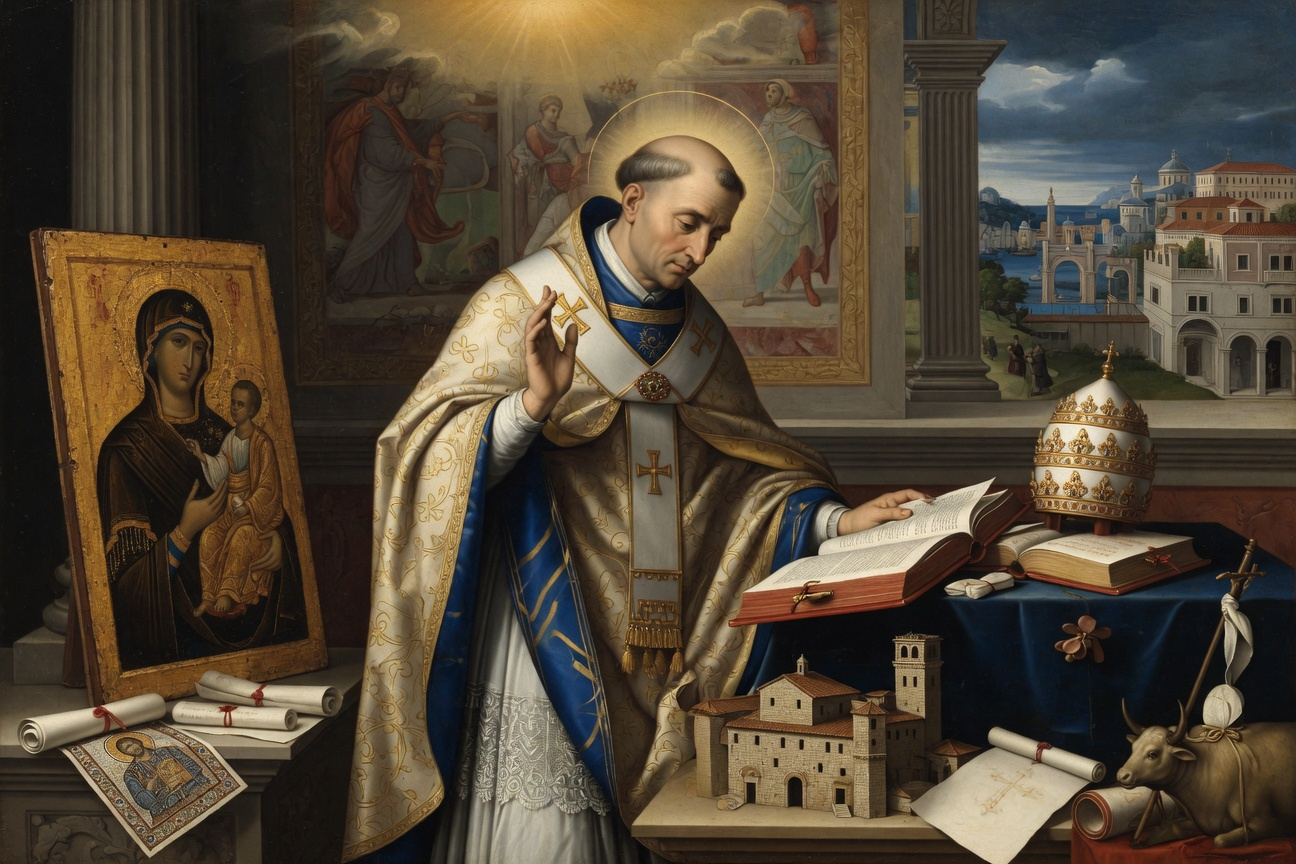
A Roman pope of the 8th century, Gregory II was a staunch defender of holy images against the iconoclast emperor Leo the Isaurian. He restored monastic life in Italy, notably at Monte Cassino, and was the great promoter of the evangelization of Germania by sending Saint Boniface there. His pontificate marked the beginning of Rome's emancipation from the Eastern Empire.
Guided reading
6 reading sections
SAINT GREGORY II, POPE
Origins and ecclesiastical ascent
Born in Rome into a patrician family, Gregory became a Benedictine monk and climbed the ranks of the hierarchy under Sergius I before succeeding Pope Constantine.
Gregory, the second of th Grégoire, deuxième du nom Pope who gave his apostolic mission to Winfrid. at name, was born Rome Birthplace of Maximian. in Rome: his father, who was named Marcellus, transmitted to him with his patrician blood all the traditions of Roman politics. He was a Benedictine monk, sacellarius, and librarian of the Holy Roman Church, when he was raised to the dignity of cardinal deacon by Pope Sergius I, who was particularly fond of him. He joined an eminent holiness to a profound knowledge of Scripture and all ecclesiastical sciences, which he had studied specially in the
patriarchal house or school of the Lateran. He followed Pope Constantine, whom he was to succeed, to Constantinople, and made the Emperor Justinian II, who held him in high esteem, understand all that was irregular in the acts of the Council in Trullo.
He was elected pope forty days after the death of Constantine, his predecessor: he judged the difficult times in which he had come and did not fear them.
The restoration of monastic life
The Pope worked actively for the re-establishment of monastic discipline in Italy, notably by rebuilding the abbey of Monte Cassino with the help of Petronax.
He first began to repair the walls of Rome; but various unfortunate circumstances stopped him in this useful undertaking, so much was Italy tormented by a horrible storm. He worked with more success to re-establish monastic discipline in Italy. A man named Petronax had come to Rome out of piety and had embraced the religious life there: the Pope used him to rebuild the monastery of Monte Cassino, which had been ruine Mont-Cassin A location in Italy where the relics of Saint Scholastica were kept. d by the Lombards about one hundred and forty years earlier. When Petronax, accompanied by some Brothers from the Lateran monastery, arrived at Monte Cassino, he found anchorites living in great simplicity amidst the rubble of the ancient abbey: he joined them to himself, and all together they began again to observe the Benedictine rule in its primitive purity, in the very place where the founder had written it.
Saint Gregory also re-established in Rome the monasteries that were near the church of Saint Paul, which had been reduced to solitude for a long time, and he established monks there to sing the praises of God day and night. He also made a monastery out of a hospital for the elderly that was behind the church of Saint Mary Major, and re-established the monastery of Saint Andrew, known as Barbara, which was so abandoned that not a single monk remained there. Both communities came to sing the office every day and every night in the church of Saint Mary. After the death of Honesta, his mother, the holy Pope gave his own house to God, and built there from the ground up a monastery in honor of Saint Agatha, to which he assigned houses in the city and lands in the countryside. By thus re-establishing the monasteries, especially the monastery of Monte Cassino, this great Pope was founding for the centuries of the Middle Ages not only retreats for piety, but asylums for letters, arts, and sciences. For, during the centuries of the Middle Ages, the monasteries were the only schools in the West. Without t hem and withou Charles Martel Mayor of the palace, possible ancestor of the saint. t the sword of Charles Martel, Europe, enslaved to the Mohammedans, would be, regarding sciences, letters, and arts, where Africa is under the Moors and Bedouins.
The Evangelization of the Germanic Peoples
Gregory II mandates Saint Boniface (Winfrid) and Saint Corbinian to convert and organize the Church in the regions of Bavaria, Thuringia, and Saxony.
England owed its conversion to Rome; Germany owed hers to England. The English continued their pilgrimage to the tomb of the Apostles. Tormented by the fire of zeal that Jesus Christ came to cast upon the earth, and pressed by that passion for the apostolate peculiar to the English, numerous missionary monks trained on the Isle of Saints came to ask for the blessing of the successor of Saint Peter and from there spread into the countries of the North, inaccessible to men of the Latin race, and which attracted all the solicitude of the reigning Pope. Already, in the year 716, he had sent three legates to Bavaria: a bishop, a deacon, and a subdeacon, in order to erect an archbishopric and a bishopric in the land where the populations were converting in crowds, and to provide there for the teaching of Christian doctrine. He consecrated Saint Corbinian bishop, who thereafter fixed his see at Freising, in Bavaria. In the year 718, an Anglo-Saxon monk presented himself before Gregory II, and, drawing from his cloak a letter from his bishop, Daniel of Winchester, he humbly awaited the Pontiff's response. The monk' s name Winfrid Apostle of the Germans and model for Willehald. was Winfrid; he would later be called Boniface. The Pope gave him a commission to go and preach the Gospel to the still-infidel nations of Germany, Thuringia, Frisia, Hesse, and Saxony. The account he rendered of the successes of his first mission engaged Saint Gregory II to recall him to Rome to ordain him bishop with jurisdiction over all the churches he would found. The elect took the episcopal oath: here are some words from this solemn act which founded ecclesiastical law in Germany... "I, Boniface, bishop by the grace of God, promise to you, blessed Peter, prince of the Apostles, and to your vicar the blessed Gregory, as to his successors, by the indivisible Trinity... and by your most sacred body here present, to keep the fidelity and purity of the Catholic faith, and to persevere, with the help of God, in the unity of the same faith upon which, without any doubt, the salvation of all Christians depends... I, Boniface, humble bishop, have written with my own hand this text of my oath, and, depositing it upon the most sacred tomb of Saint Peter, I have made before God, taken as witness and judge, the oath that I promise to observe." In sending Boniface back to the nations of the North, the Sovereign Pontiff gave him the book of the holy canons; he added letters for Charles Martel, for the bishops, and for the Christian people whom he exhorted to give a warm welcome to the delegate of the Holy See; finally for the Thuringian and Saxon idolaters to whom he accredited him as the envoy of God for the sake of their souls.
The Struggle Against Iconoclasm
The Pope firmly opposes Emperor Leo the Isaurian, who orders the destruction of sacred images, provoking a cultural and political schism between Rome and Constantinople.
A letter from Saint Gregory II to Leo the Isaurian, Emperor of Constantinople, stated: "We are leaving for the extremity of the West, toward those who ask for holy baptism. For since I sent bishops and clerics of our Church there, their princes have not yet been able to be brought to let themselves be baptized, because they desire that I be their godfather..." We do not know if the holy Pontiff was able to baptize the princes of whom he speaks, for most of the acts of his glorious pontificate are unknown to us. But what we do know well is that as the light of faith advanced in the West, it withdrew from the East. The reign of Leo the Isaurian, a contemporary of our holy Pope, was not made to stop the deplorable decadence of Asia, Africa, and Greece.
A cattle merchant, then a soldier before becoming emperor, Leo undertook, like Muhammad, to re form Léon Byzantine emperor who initiated the Iconoclastic controversy. religion by the sword. He had first distinguished himself by his courage, and during the first years of his reign, he had inflicted several defeats on the Muslims who had come to insult him even under the walls of Constantinople. But he had been surrounded from his childhood by Jews and bad Christians who altered the purity of his faith. One of these Jews said to him one day in jest, after having blasphemed the image of Our Lord Jesus Christ: "Is it not true that if you were emperor, you would destroy all these impious images?" — "I swear," he replied, "that I would not let a single one remain." The emperor remembered the child's oath. He did not see that by destroying the images, he was only imitating the Muslims, the most cruel enemies of the religion and the empire. The Church, in this circumstance, saved truth, common sense, and Christian art.
Superstition had pushed Leo to proscribe images; pride and the demon of rapacity made him persevere in the disastrous path upon which he had embarked as early as the year 726.
The edict he published to have all the images that adorned the churches removed was presented for the signature of the Patriarch of Constantinople: it was then Saint Germanus, a venerable old man belonging to one of the first famil ies of the em saint Germain Patriarch of Constantinople who opposed the iconoclasm of Leo III. pire. Saint Germanus refused to subscribe: "Christians," he said to the emperor, "do not adore images, they honor them, because they remind them of the memory of the Saints and their virtues." Leo III did not want to understand anything of the bishop's clear and simple observations. He did not, however, go to the last extremities, because the people loved Germanus and the edict against the images had excited a great fermentation in the minds. The bishop took advantage of the respite he was given to support sound doctrine and strengthen the courage of some of his colleagues who feared the emperor's anger. He also wrote to the Pope to inform him of what was happening. Saint Gregory replied at length to congratulate him on his vigor and to explain the Catholic doctrine to him himself. "The honor that the Church renders to images," he said, "passes to the person represented. The name of idols is given to images of that which is not and which has existence only in fables..."
However, the Isaurian grew tired of using only caresses and gentleness. He returned one last time to the charge, enjoined Saint Germanus to adopt his edict, and threatened him with exile, or even death, if he prolonged his resistance. "Remember," the Patriarch said to him, "that you swore at your coronation to change nothing in the tradition of the Church." For all answer, the emperor gave him a slap and had him deposed by the Senate. Germanus, then stripping himself of the pallium or patriarchal mantle, said to the tyrant: "My person is in the power of the prince, but my faith yields only to the decisions of a council." The emperor exiled the octogenarian Pontiff and put a more docile intruder in his place. 730.
Then began the general destruction of the images. Nothing could stop the fanaticism of these new Vandals who were called Iconoclasts. The soldiers of Leo the Isaurian rushed into churches and private houses, breaking st atues, defil Iconoclastes Religious movement rejecting the veneration of images, which caused the persecution of the two saints. ing or tearing up religious images, and massacring those who tried to oppose their violence. The emperor, no less greedy than fanatical, confiscated for his own profit a large number of gold and silver statues, precious vases used for the holy mysteries, and jewels that adorned the images of the Blessed Virgin, so venerated in the empire, and had a large bronze crucifix placed by Constantine the Great under one of the porticos of the imperial palace smashed to pieces. The inhabitants of Constantinople had a great veneration for this crucifix; they became agitated, and women of the people rushed upon the officer who had broken it and massacred him. These women were put to death along with a crowd of Catholics. The martyrs were coated with pitch, several images were piled on their heads to which fire was set, and the charred corpses were thrown to the dogs. The tyrant went further. The famous library of Constantinople was enclosed in a basilica, located between the imperial palace and the church of Hagia Sophia. This basilica, named the Octagon, because of the eight superb porticos through which one entered its enclosure, was the residence of the professors of belles-lettres and theology, paid by the State. Leo the Isaurian wanted these professors to subscribe to his edict. They refused, fighting the emperor's opinion with as much firmness as respect. The latter, furious at not being able to persuade them, resolved to exterminate them, and, more cruel than the fierce Omar, who had been content to deliver the books of the library of Alexandria to the flames, he had the learned professors who refused to share his error burned along with the books and the basilica. Thus was inaugurated the heresy of the Iconoclasts.
Political independence and the Lombard threat
Faced with Byzantine plots and the pressure of the Lombard king Liutprand, the Pope asserts the autonomy of Rome and obtains the peaceful submission of the sovereign at Saint Peter's.
John of Damascus, called on this occasion Chrysorrhoas (golden stream), was also resisting in the East. Gregory II called the whole West to him. Wounded consciences rejected a heresiarch emperor. Leo, irritated above all against the Pope, sought to rid himself of this powerful opponent through a crime.
Marinus, the emperor's squire, was tasked with organizing a conspiracy against the Pontiff. The main conspirators were discovered and punished. The Exarch Paul assembled troops and prepared to take control of Rome, to force the election of another Pope. The Romans, warned of their movements, took up arms; the Florentines, the Lombards of Spoleto, and all the inhabitants of the surrounding areas rushed in, resolved to defend the city. Paul was forced to return to Ravenna.
The Saracens did not cease to trouble Constantinople, where, however, their spirit of opposition and malice was so well served; but the emperor, henceforth less a warrior than a disputant in false theology, was more distressed by the resistance of the Pope than by the progress his enemies were making around the capital.
Two great results, two immense events were being prepared without Leo's knowledge by his senseless obstinacy. There is no doubt that the troubles stirred up in Italy contributed to the independence of the Popes and served the establishment of the empire of the Franks to the detriment of the Greeks.
Cyzicus and transferred to that of Constantinople in 715, sent into exile in 730; died in 733, at the age of ninety-five. In his exile, he often repeated, with Saint Chrysostom: "Even if I should die a thousand times a day and suffer even hell for some time, I would consider all that as nothing, provided that I see Jesus Christ in His glory." Besides the numerous letters he had written during his long career, and of which only three remain to us, relating to the Iconoclasts, he had composed other works which are lost, among others an Apology of Gregory of Nyssa against the Origenists.
The Romans, moreover, in this sort of interregnum, supported the interests of the Pope, which were confounded with their own; for they had everything to fear from the exarchs and the Lombards. These two powers, incited by Leo, nevertheless tried to come to an understanding to occupy Rome. Li utprand c Luitprand King of the Lombards in Italy. ommanded the Lombards and the troops of the exarch, who were astonished to be marching together.
They crowned Mount Marius with their fires and advanced to the foot of the Mausoleum of Hadrian (Castel Sant'Angelo). Gregory went out from Rome, preceded by his clergy: a new Saint Leo, he represented that the misfortunes of the city would be all those of Christendom; that the Saracens, much more than the emperor, would rejoice at the disaster of this metropolis of the worship of Jesus Christ. Gregory moved the king and drew tears from him.
Liutprand prostrated himself at the feet of the Pontiff. The temple of Saint Peter was nearby; Gregory showed the monarch the s acred pla Luitprand King of the Lombards in Italy. ce that contains the tomb of the Apostle.
Liutprand, stunned, walked toward the church, knelt before the confession of the Prince of the Apostles, stripped himself of his royal garments there and deposited them, with his sword belt, his sword, his gold crown, and his silver crown, beside the tomb; he then begged the Pope to forgive his enemies. Gregory pronounced this solemn pardon, and the king took the road back to Pavia.
Wise and learned minds saw clearly all the moral strength that these events brought to the Church. Those devoid of energy, who penetrate nothing of the secrets of Providence and who see only the confused spectacles of submission offered to their eyes, could also themselves be convinced, despite their ignorance, of the necessity of obeying the Sovereign Pontiff, when they had just seen at his feet the most formidable prince of Italy, the one whom everyone regarded as disposed to overthrow the power of Gregory.
End of pontificate and posterity
After fifteen years of a reign marked by the defense of the faith and the structuring of the West, Gregory II died in 731 and was buried in the Vatican.
Leo, in his criminal impetuosity, wrote to him to predict the fate of Pope Martin; but the fatigues of the pontificate and this series of hostilities had destroyed the health of Gregory, who died in 731, on February 10.
The letters of the holy Pope to Leo the Isaurian are full of strength, truth, and that evangelical courage which nothing can shake. One can judge by the following excerpts:
"God is our witness, all the letters that you have written to us, we have communicated to the kings of the West, to reconcile their peace and benevolence toward you; we praised you, we exalted you, in view of the conduct you held then. Thus they received your images, as it is fitting that kings honor kings; but when they learned from Romans, Franks, Vandals, Moors, Goths, and other Westerners who were in Constantinople what you did in their presence to the image of the Savior, they trampled your own images underfoot and tore your face. The Lombards and the Sarmatians have invaded the Pentapolis, occupied Ravenna, and driven out your magistrates. This is what your imprudence has earned you."
"What are our churches," he says in another letter, "if not works of human hands, if not stones, wood, lime, mortar? What makes them ornamental are the paintings that represent to us the stories of Jesus Christ and the Saints. Christians use their goods for this. Fathers and mothers, holding in their arms their little newly baptized children, point out these holy stories to them with their fingers; they show them in the same way to young people and to newly converted Gentiles; thus they edify them and raise their minds and hearts to God. But you, you have turned the simple people away from them, and instead of leading them to thanksgiving and the praises of God, you have thrown them into the neglect of their duties, into frivolous amusements, fables, songs, the sound of lyres and flutes. Listen to our humility, Lord; cease persecuting the Church, follow it as you found it. Dogmas do not concern emperors, but Pontiffs; for we have the mind of Jesus Christ. The constitution of the Church is one thing, that of the world is another."
This pontificate was a reign of wisdom, glory, and courage. Gregory II governed the Church for fifteen years, eight months, and twenty-three days. In four ordinations that he celebrated in the month of Septemb er, and in Grégoire II Pope who gave his apostolic mission to Winfrid. another in the month of June, he created one hundred and fifty bishops, thirty-five priests, and fourteen deacons. Baronius says that he was worthy to be compared to Saint Gregory the Great. He was buried in the Vatican: after him, the See remained vacant for five days.
Various histories of the Church and the Popes.
Annexes & related entities
Structured data for exploration: events, miracles, quotes, places, attributes, patronages, and important entities cited in the text.
Key Events
- Election to the pontificate 40 days after Constantine I
- Restoration of the Abbey of Monte Cassino by Petronax
- Sent Saint Boniface to evangelize Germania
- Struggle against the iconoclast heresy of Emperor Leo the Isaurian
- Diplomatic meeting with the Lombard king Liutprand before Rome
Miracles
- Miraculous conversion and submission of King Liutprand at the gates of Rome
Quotes
-
Christ is my witness: when I contemplate his image, I am seized with compunction and my tears flow like the rain from heaven.
Attributed to Saint Gregory II -
Dogmas do not concern emperors, but Pontiffs; for we have the mind of Jesus Christ.
Letter to Leo the Isaurian