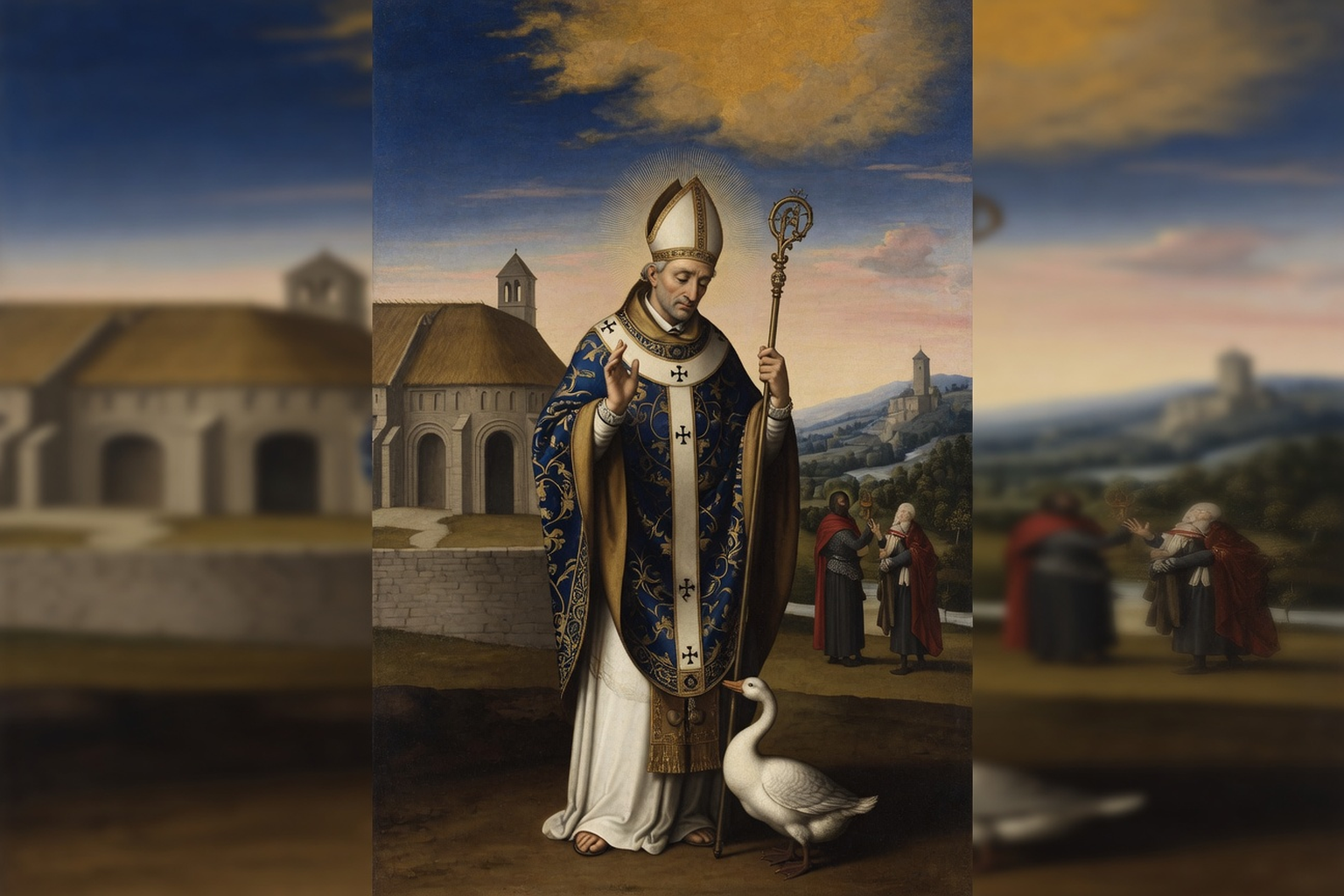
Archbishop of Reims in the 8th century, Rigobert was a model of ecclesiastical discipline and charity. Although he baptized Charles Martel, he was driven from his see by the latter for remaining faithful to royal legitimacy. He ended his life in prayer and poverty at Gernicourt.
Guided reading
8 reading sections
SAINT ROBERT OR RIGOBERT,
ARCHBISHOP OF REIMS
Origins and monastic formation
Born in the 7th century among the Ripuarian Franks, Robert was educated at the Abbey of Orbais where he embraced the Rule of Saint Benedict before becoming abbot.
This prel Ce prélat Archbishop of Reims and confessor, exiled by Charles Martel. ate is all the more admirable for having lived in a time when holiness was rarer, and when the empire of vice was more powerful and widespread, under our last kings of the first race. He was born in the land of the Ripuarian Franks, which later became the Duchy of Jülich, around the middle of the 7th century. His father, named Constantine, was from an ancient Ripuarian family. The name of his mother is not mentioned; only that she was of Frankish race and from the territory of Porçain, at the mouth of the Somme. As they noticed in their son strong inclinations for piety, they had him raised in the Abbey of Orbais, founded by Saint Reolus, Archbishop of Reims, the ir ne Reims Site of the baptism of Clovis. phew. It was in this academy that he became learned in the science of the Saints, and that he formed himself in the exercise of the most heroic virtues. He made his profession o f the Rule of Saint B règle de saint Benoît Religious order occupying the monastery of Honnecourt. enedict there, and kept it with such exactitude that, while still very young, he could serve as an example to the elders. He prayed unceasingly, never spoke without necessity, and joined to an extraordinary prudence and wisdom such great kindness that he easily won the hearts of the people with whom he conversed. These fine qualities were the reason he was raised to the highest offices. He began with the government of the monastery of Orbais, from where he was taken in the year 698 to be consecrated Archbishop of Reims, in the place of Saint Reolus, his first cousin (698).
Episcopacy and reforms in Reims
Consecrated Archbishop of Reims in 698, he distinguished himself by his moral rigor, his pastoral zeal, and the disciplinary and material reform of the cathedral clergy.
As he took up this important office with the spirit of Jesus Christ, it is no wonder that he was singularly loved and revered by everyone. The good cherished him, because they found in him a perfect model, a faithful guide, and a powerful protector; the impious feared him, because they saw well that he had eyes only for justice and that he closed them to all human considerations; this gave him great freedom to rebuke and punish them. His zeal for the sanctification of his people was extreme, and he spared nothing for a work so worthy of episcopal vigilance. He maintained the righteous in goodness, by threatening them with great punishments if they abandoned justice; and he drew sinners to penance, by promising them the mercy of God, and the forgetting of their crimes, if they converted and returned to Him with all their heart. He thus intimidated the former, for fear that they might presume upon themselves, and he encouraged the latter, for fear that they might cast themselves into despair. By this means, he brought back into his fold many stray sheep, and raised to perfection many persons who were content with a common life.
His principal application was to reform the ecclesiastics of his diocese. To this end, he re-established the ordinances of his predecessors concerning the discipline of the clergy, and made, through his vigilance, the chapter of his cathedral one of the most regular that existed then in France. As most of the goods of this chapter were alienated, he took great care to recover them, so that the canons would have a sufficient income for their subsistence, and that poverty would no longer serve as a pretext for them to neglect divine service. He even bought them, with his own money, several estates, and made very useful exchanges in their favor. He assigned them the church of Saint-Bilaire for their burial, established among them a common treasury, and hired servants to provide for all their needs, with such fine economy that, without leaving their cloister, they found everything they could have sought elsewhere.
The miracle of Gernicourt
A friend of Pepin of Herstal, he obtained the estate of Gernicourt, whose boundaries, miraculously traced, remained preserved from inclement weather.
Pepin of Herstal Pépin d'Héristal Mayor of the palace of the kings of the Franks and protector of Saint Wiron. , known as the Fat, who governed France as Mayor of the Palace under the reigns of Clovis III (691), Childebert III (695), and Dagobert III (741), was an intimate friend of this great archbishop and gave him numerous proofs of this on various occasions. One day, when he had come to a country house near Reims, in the village of Gernico urt, to am Gernicourt Site of the miracle of the earth and initial burial place of the saint. use himself with hunting, the Saint, with his customary courtesy, sent him some refreshments and came to greet him. Pepin, wishing to acknowledge this generosity with a considerable gift, urged him to tell him what he desired for himself and for his church, assuring him that it was the most sensitive proof of friendship he could give him. The Saint, to satisfy him, asked for the house where he was then staying, which was not of great value, but entirely to his convenience. Pepin granted it to him very willingly and told him that, in addition, he would give him as much land all around as he could mark out while walking during his afternoon rest. The Saint accepted this gift and immediately traced its limits by walking around the house. A remarkable thing is reported in this regard: the footprints of the man of God remained, it is said, imprinted throughout the circuit; the grass upon which he had walked never withered, neither in winter nor in summer, and this small inheritance, of which he had acquired possession, was so favored by heaven that neither hail nor lightning damaged it. The memory of this is still preserved in that village. It was soon seen that the archbishop, by requesting this place, had no intention of enriching himself, since as soon as he was its master, he gave the property to his church to become part of the episcopal mensa.
Political Conflict and Exile
Faithful to royal legitimacy against Charles Martel, he was driven from his see in favor of the intruder Milo and went into exile in Gascony.
His zeal for the temporal goods of the house of God was nothing in comparison to that which he had for the spiritual. He was a second Saint Paul who embraced, in the vast extent of his charity, the care of all the faithful, particularly his servants, to whom the first rank belongs, according to the rules of justice. He was all things to each of them, and measured himself against their weakness to raise them up more effectively. This conduct was admired by everyone, and it was one of the main reasons that had so strongly convinced Pepin of the extraordinary merit of this great man. He wanted his son, Charles Martel, to receive the quality of a child of God through his ministry: he even entrusted his education to him, hoping that one day he would succeed to the esteem and affection he had for him. But the good intentions of the father were not seconded by the son, and as much as the former had honored him, the latter persecuted him. Here is the reason. After the death of Pepin, which occurred under Dagobert III in 714, this king, and then Chilperic II, his successor, gave the office of Mayor of the Palace to a lord named Ragenfrid at the request of the lords of Neustria; Charles Martel, who claimed it as the son of Pepin of Herstal, made great armaments to put himself in possession of it. The holy archbishop remained faithful to the king, as to his legitimate prince, and, although he had very great obligations to Pepin, although he had baptized and raised his son, he preferred the interests of his conscience to his personal inclinations. When Charles Martel presented himself at the gates of Reims, under the pretext of wanting to say his prayers in the church of Notre Rigobert Archbishop of Reims and confessor, exiled by Charles Martel. -Dame, Rigobert generously refused him entry and replied that since he, Charles, and Ragenfrid, Mayor of Austrasia, were disputing the government, he would only open the gates of the city to the one in whose favor heaven would declare itself through victory. Charles Martel was so offended by this that, having become master of Reims after three battles won against the king and Ragenfrid, he drove Saint Rigobert from his see, without any ecclesiastical judgment, and, by his own authority, had him replaced, to the great scanda l of Milon Bishop of Troyes who discovered the saint's body in 992. the Church, by a man named Milo, very unworthy of this office, and who was still only tonsured. This Milo, son of Saint Lutwin, who died Metropolitan Bishop of Trier on September 29, 713, did not wish to resemble his father except by the title he arrogated to himself as if by right of succession. A mercenary shepherd, he sought in ecclesiastical dignities only the goods that were attached to them.
It was a great sorrow for our Saint to see that his people had a wolf to lead them, instead of a true shepherd; but on the other hand, he had great joy in seeing himself relieved of a burden that had always seemed infinitely formida ble to h Gascogne Site of the assassination of Saint Adalbald. im. He retired to Gascony, waiting for the storm to cease, or for his banishment to end with his life. His ordinary exercise was prayer and the visiting of churches and the relics of the holy Martyrs. Something happened that revealed his merit and his dignity. One day, while he was praying in a place where there were two bells that had been taken from his church, these bells became mute and could no longer produce any sound. The parish priest, quite astonished, addressed the Saint, asked him his name, and where the silence of these bells came from. This encounter forced him to speak, and to inform all those present that these bells belonged to Saint-Pierre of Reims; as proof of the truth, he rang them easily, which was the cause of their restitution; and the eminent virtue of Saint Rigobert continued to make noise in the province.
Retirement and end of life
Refusing a simoniacal compromise to regain his see, he ended his days in poverty and prayer at Gernicourt around 743.
Milon, the usurper of his see, having been charged by Duke Charles with an embassy to Gascony, encountered Saint Rigobert there around the year 732 and proposed that he return to Reims, where he pledged to restore the bishopric to him, on the condition that Rigobert cede to him the lands he possessed from his patrimony. The pious pontiff promised him this at first, but, having returned to Reims, he feared that this agreement was not sufficiently canonical, even though he had only made it to redeem an unjust vexation. He declared to Milon that he had given all his property to his church and that he could no longer dispose of it in favor of another. The intruder bishop therefore did not return his see to him. Rigobert contented himself with asking him for an altar of the Blessed Virgin in the church of Notre-Dame de Reims, so that he might celebrate the holy mysteries there; this alone would suffice for his rest and happiness. Milon, who cared very little for spiritual matters, granted it to him without difficulty, and the holy bishop went to live in the village of Gernicourt (today in the diocese of Soissons), in the country house that Pepin had given him; there he lived poor, solitary, and hated by the minister of state, but highly respected by his people. He often visited the Blessed Virgin in her holy house, relieving his sorrows near her, and asking her for the grace to suffer without murmuring until death. From there he would enter the churches of Saint-Maurice and Saint-Remy, and other places of devotion in the city, spending the day in these exercises of piety, and returning in the evening to his solitude, until Our Lord, who had purified him through such a long series of trials, withdrew him from the world to crown his patience. Authors do not agree on the year of his death; some place it in 773, others in 749; others, in greater number and with more probability, on January 4 of the year 743.
Posthumous cult and iconography
His tomb became a place of miracles, particularly for toothaches; he is traditionally depicted with a goose.
Great funeral honors were paid to him. All the clergy and the people of Reims were present at his burial, and his body was deposited at Gernicourt, in the church of Saint-Pierre, which he had founded, and placed to the right of the high altar, where many miracles subsequently occurred. Notable are the healing of three lame men; that of a blind woman who recovered her sight there, and of several other sick people who returned home in perfect health. Several times during the night, a brilliant light was seen over his tomb, and at the same time, such delightful concerts were heard there that it was easy to see they were formed by angels. A religious man, who had a fluxion in his cheek, sent a clergyman to burn a candle before the relics of the Saint, and he was immediately relieved and found himself in a state to go and pay his respects to such a powerful physician. He is particularly invoked for toothaches. In iconography, Saint Rigobert is represented: 1st, accompanied by a goose. It is claimed that this bird offered itself to him during a journey and followed him faithfully thereafter like a dog; 2nd, addressing remonstrances to Charles Martel.
Translations and posterity
His relics underwent several translations between Reims, Saint-Thierry, and Paris, while his memory remains vivid in Gernicourt.
His holy relics underwent several translations. The first was carried out in the year 864 by Hin Hincmar Archbishop of Reims who oversaw the translation of relics in 864. cmar, one of his successors to the archbishopric of Reims, to the monastery of Saint-Thierry, two leagues from the city, where he continued to perform great miracles. The second took place in the church of Saint-Denys of Reims, which he had consecrated during his prelacy; and, on that day, a blind woman and a deaf man were healed there. He was transported several other times as well. For, as it was necessary to tear down this church of Saint-Denys to build a new wall for the city, he was placed in the church of Notre-Dame: and, shortly after, he was carried to a village in Vermandois, where he was deposited in a church of Saint-Martin. From there he was brought back to the church of Saint-Denys, rebuilt through the care and at the expense of the canons of Reims. Finally, these precious remains were divided: for his reliquary was, before '93, in the cathedral of Reims, and some of his bones were kept in this church of Saint-Denys as well as in the treasury of the cathedral of Paris. In Gernicourt, there is still a very present memory of Saint Rigobert. The green path still exists, there is also a fountain; and in the region, no one remembers having seen hail or storms. The cathedral of Reims formerly possessed many mementos of this holy archbishop: 1° On the high altar, a reliquary or shrine, adorned with gilded silver figures, executed at the expense of Guillaume Fillastre, dean of the church of Reims, and cardinal of the title of Saint-Marc, in 1427 (destroyed since '93); 2° A chapel dedicated to him; 3° A well to which the clergy formerly went in procession.
Documentary Sources
The saint's life is documented by ancient authors such as Flodoard and the Bollandists, confirming his membership in the Benedictine order.
His life was written by a cleric of the church of Reims whose name remains unknown. Surius abridged it, and Bollandus reports it in full. All Martyrologies mark his feast day. Flodoard, Rigobert, Colveniotus, Hugues Menard, and others make mention of him; and the learned nun who composed the Benedictine Year gave him a place among the Saints of her Order. See also Gallia Christ. nom. t. IX, col. 24; M. Anquetil, regular canon of the congr. of Fr., Hist. civ. et pol. de la ville de Reims, t. IV, p. 73.
Annexes & related entities
Structured data for exploration: events, miracles, quotes, places, attributes, patronages, and important entities cited in the text.
Key Events
- Born among the Ripuarian Franks in the mid-7th century
- Education and monastic profession at the Abbey of Orbais
- Consecrated as Archbishop of Reims in 698
- Baptism and education of Charles Martel
- Exile in Gascony following conflict with Charles Martel
- Final retirement in the village of Gernicourt
Miracles
- Indelible footprints marking the boundaries of Gernicourt
- Miraculous protection of lands against hail and lightning
- Bells of Reims fell silent in his presence during his exile
- Healings of the lame, the blind, and the deaf at his tomb
Quotes
-
He would only open the city gates to the one in whose favor heaven would declare itself through victory.
Reply to Charles Martel