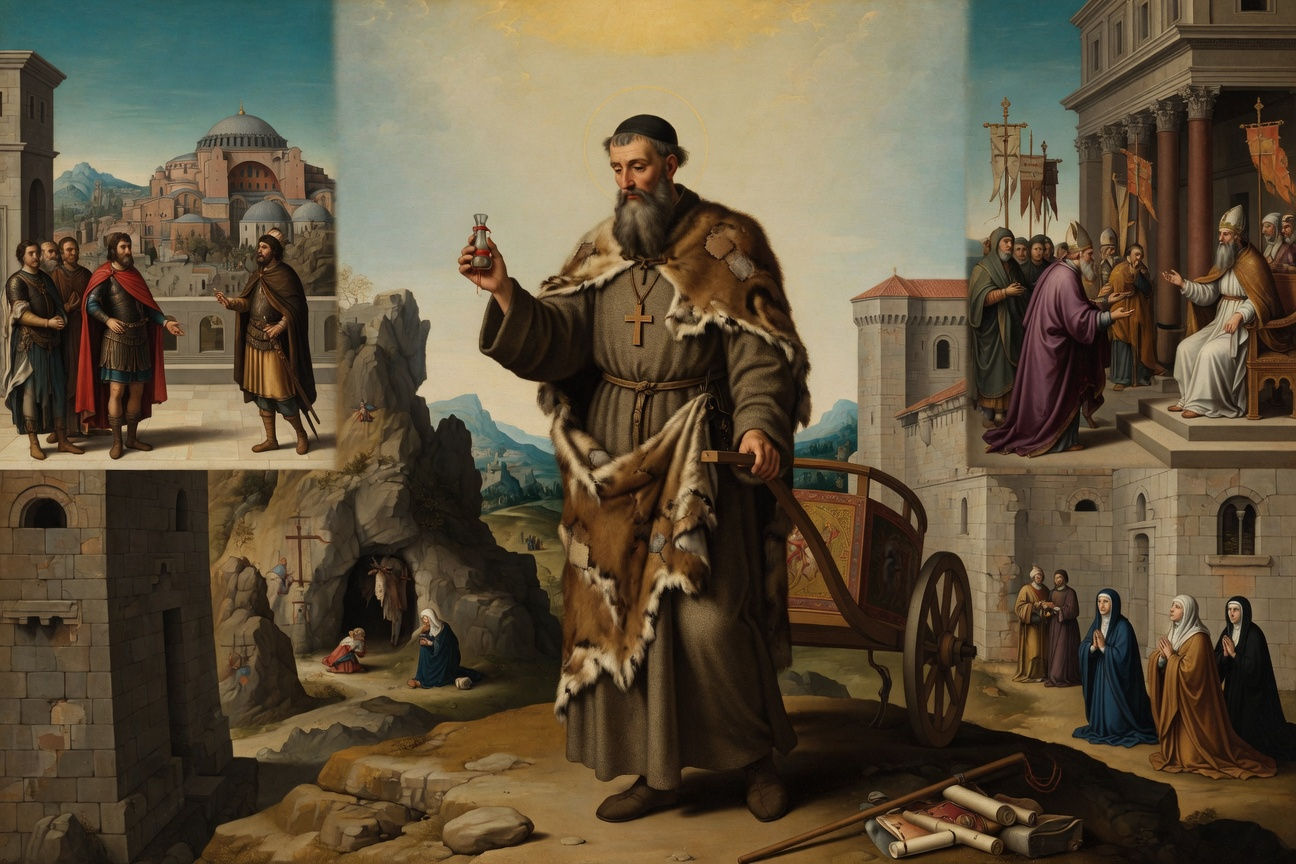
Originally from Syria and a former imperial guard in Constantinople, Auxentius retired to Bithynia to lead a life as a miraculous hermit. Although he fled the world, he was compelled by Emperor Marcian to attend the Council of Chalcedon to combat the heresy of Eutyches. He ended his days on Mount Siope, surrounded by disciples and nuns, famous for his prophecies and healings.
Guided reading
6 reading sections
SAINT AUXENTIUS, ABBOT
Origins and military career
Born in Syria to Persian parents, Auxentius initially led a brilliant career in the imperial guard of Theodosius the Younger while cultivating a deep piety.
Saint Auxenti Saint Auxence 5th-century hermit and abbot, defender of orthodoxy at the Council of Chalcedon. us was a native of Persia, although he was born in Syria, where his father, whose name was Addas, retired during the time of the Emperor Constantius. History tells us nothing of the early years of his life; it only tells us that he made such progress in virtue and in letters that he acquired the reputation of a man of piety, erudition, and science. He earned no less esteem in the profession of arms, which he took up after his studies: and he obtained a rank in the fourth company of the guards of the Emperor Theodosius the Younger.
Eremitic vocation and first miracles
He leaves the army for the ascetic life in Bithynia, imitating Saint John the Baptist. His holiness is revealed through miracles of healing and the discovery of lost objects.
This employment did not prevent him from continuing his devotional exercises, and he fulfilled what he owed to God while doing his duty to his prince. He became acquainted with several virtuous persons, and particularly with a holy reclusive monk named John, who was in the suburbs of Constantinople; he formed a friendship with Anthimus, a worthy priest of admirable life, with whom he spent entire nights keeping vigil and singing hymns and canticles of praise to God in the church of Saint Irene, watering the earth with his tears and nourishing his soul with fasting, prayer, and the word of God. The report of his holiness having spread throughout the city, he withdrew to a rock on the mountain of Oxia, in Bithynia, three and a half leagues from Chalcedon. There, he proposed to imitate the Chalcédoine Place of exile and refuge for Dace and Pope Vigilius. life of Saint John the Baptist in the desert, even to the point of clothing himself in skins after the example of that divine precursor of Jesus. Whatever care he took to remain hidden, he was nevertheless soon known: for young shepherds, who had lost their flocks, and to whom the Saint caused them to be found by miracle, having told the story to their parents, the latter came to see him and built him, on the top of the mountain, a cell where he had himself enclosed in order to attend more easily to prayer.
However, the more the blessed Auxentius strove to hide himself from the eyes of men, the more it seemed that God took pleasure in making his holiness shine forth: as soon as the place of his retreat was discovered, many people had recourse to him, either to receive his instructions, which he gave only through a window, or to ask him for some consolation in their sorrows, or finally to obtain, through his prayers, the healing of their illnesses. They brought him the blind, the lepers, the paralytics, the possessed, and other sick people, and he healed them all, either by making the sign of the cross over them or by applying blessed oil to them. After three days of prayer, he delivered the daughter of a citizen of Castomena, from whom a demon had taken away the use of speech; and he restored sight to a princess of Nicomedia, saying to her these words: "May Jesus Christ, who is the true light, be pleased to enlighten your eyes!"
The Defender of the Faith at the Council
Emperor Marcian summoned him to the Council of Chalcedon to combat the heresy of Eutyches. Auxentius affirmed his adherence to orthodoxy and the dual nature of Christ.
Saint Auxentius had been on this mountain for about ten years when the Emperor M arcian, who had su l'empereur Marcien Advisor to Emperor Valerian. cceeded Theodosius the Younger, assembled a general council in the city of Chalcedon at the req uest of the great Saint Leo; six hundred and concile général dans la ville de Chalcédoine Ecumenical council confirmed by Hilary. thirty bishops came there from all parts of the world to condemn the errors of Eutyches, superior of a monas Eutychès Heresiarch whose errors were condemned by the councils. tery in Constantinople, who confused the two natures in Jesus Christ. The esteem in which Saint Auxentius was held was so great that the Emperor and the prefects sent to beg him to attend the council, with orders to bring him even if he did not wish to come. They did everything they could to persuade him to come; but as he could not be resolved to do so, the religious and ecclesiastics who were deputies ordered a locksmith to break the lock of his cell. He worked at it in vain for the rest of the day, and the next morning they made new efforts to break his window, without being able to succeed. Then the Saint, having had all those present pray to know the will of God, made the sign of the cross, pronounced these three words: *Blessed be the Lord!* told the locksmith to work, and, in a moment, the window was opened without any difficulty. He was found so exhausted by his austerities that, being unable to make him stay on horseback, they had him mount a chariot.
There were nothing but miracles on his way: he delivered several possessed persons, and even animals; this so astonished those who were leading him that they could hardly believe what they saw with their own eyes. The poor of Mount Oxia followed him to the monastery of Phile, bursting into tears for fear of losing him, and kissing his feet out of devotion; no sooner had he arrived there than he cast the demon out of the body of a young man named Isidore, after having said his prayer in the church dedicated to Saint John. The religious, astonished that he had gone several days without eating, wanted to test him: they put baskets full of roots, dates, and other things that the Solitaries eat into his cell, lit a candle, and locked a child in with him to observe him. But, some time later, they found that the candle was still burning without having diminished, and that he had not touched what was in the baskets. Thereupon, they pressed the child to say what the Saint had done during all that time: "I saw," he told them, "while sleeping, a great multitude of people who were praising God with him and a dove that was bringing him food."
But the child died the following day, in punishment for having said what he had witnessed, against the Saint's prohibition.
Some time later, he was transferred from this monastery to that of Saint Hypatius, located in a suburb of Chalcedon; the religious received him there with extreme joy, and placed him, according to his desire, in a cell where one could only speak to him through a grate. The Saint performed so many miracles there that they were forced to leave the monastery doors open because of the great number of people who came from all sides to see him: the superior, who was a holy man, wanted everyone to be received with great charity, whatever the condition of the visitors might be.
The blessed Auxentius could not arrive soon enough for the council; nevertheless, the Emperor, who wished to have its decrees approved by such a great Saint, sent one of his ships to him and begged him to come and meet him. When this prince saw him, he admired and looked with respect at the state to which his mortifications had reduced him, and spoke to him in this way: "I know that you are a true servant of God; that is why you must approve what the holy ecumenical council has ordered, so that you may not be a stone of scandal to those who would refuse to receive it." The Saint replied to him: "Who am I, if not a dead dog? And how do you, Prince, place me in the rank of the doctors of the Church, I who am the last of the flock of Jesus Christ and who have such great need to be instructed by those who are its leaders?" As the Eutychians were maliciously spreading the rumor that the council favored the opinion of Nestorius, the Saint declared to Marcian that he approved it, provided that it had decided nothing contrary to that of Nicaea and that it had defined that Our Lord Jesus Christ had truly become incarnate and had not taken away from the holy Virgin the quality of Mother of God; the Emperor ordered that he be shown the acts of the holy Synod, and Auxentius, after having considered them well, protested that he approved them with all his heart.
Retreat on Mount Siope and preaching
He established himself on Mount Siope where he taught Christian morality, recommending prayer, fasting on Fridays, and respect for workers.
This lover of solitude, instead of returning to the mountain of Oxia, asked to be taken to that of Siope, whose access is even more difficult because of its height. There, a cell was built for him where he had himself enclosed with no other opening than a small window to speak to those who came to him. Then the demons, unable to endure such eminent holiness, employed sometimes violence and sometimes artifices to tempt him and shake his constancy, but it was always in vain: the extraordinary graces he received from God made him invincible. An incredible multitude of people came to find him to hear the pressing exhortations he made to lead souls to the practice of virtues and to divine love. He particularly recommended not going to spectacles, as nothing is more capable of corrupting the purity of the body and soul, and of exciting the most criminal passions. He also taught how one should pray to God; he even gave formulas for it, in order to do so with more fervor. He showed so clearly the vanities of all the things of this world and the beauty of those of the other, that many people renounced the world to consecrate themselves entirely to Jesus Christ. He advised not only to celebrate Sunday, but also Friday: "As the one," he said, "must be spent in joy, because of the Savior's resurrection, and in feasting, through the reception of the divine Eucharist; the other must be sanctified by fasts and prayers, because of His passion." He wished, nevertheless, that in obliging workers to observe Friday, one should not fail to pay them their wages as if they had worked, so that they would lose nothing for having served God that day.
One notes, among those who were touched by the pious discourses of the Saint, one named Basil; it is said that this Basil, having retired to a mountain, in a cell, the demons mistreated him so much that people, who were accustomed to coming to see him to commend themselves to his prayers, believing him dead, took him on a cart to the blessed Auxentius; but the Saint, having brought him back to himself after having called him three times, said to him: "Rise, and receive the power to overthrow the demons, without ever fearing them again." At that very instant he rose, received the adorable body and life-giving blood of Our Lord Jesus Christ, and returned to his cell, where the evil spirits dared not attack him again.
Foundation of a female community
Under his influence, seventy women, including a former lady-in-waiting to Empress Pulcheria, embraced the religious life under his direction.
A noble woman, who had been a lady-in-waiting to Empress Pulcheria, was also so deeply moved by the Saint's exhortations that she did not cease to importune him until he had granted her the religious habit, which consisted of a robe and a large cloak woven with hair. Another woman, of similar status, asked for the same grace: they presented themselves up to the number of seventy, whom the Saint all made religious. After having well tested their vocation, he prescribed certain rules for them to reach perfection, and took care that a church was built a mile from his cell, near which they took up residence; every Sunday and Friday, they would go to find him to receive the salutary instructions he gave them, particularly concerning the preservation of chastity, the way to resist the temptations of the devil, the enormity of the sin of those who succumbed to them, and the happiness of those who remained faithful to Jesus Christ.
Death and posterity
After prophesying the death of Saint Simeon Stylites, Auxentius passed away in 470. His body was entrusted to his nuns, and Mount Siope took his name.
Beyond the great graces that the blessed Auxentius had received from God, and of which we have spoken until this hour, one must not forget to mention the spirit of prophecy that he possessed to an admirable degree. He discovered the most hidden things and marked the place where one would find what was lost. One night, during his Matins, having had a revelation of the death of Saint Sime on Stylites through saint Siméon Stylite The first of the stylites and spiritual mentor to Daniel. the very soul of that Blessed one who appeared to him, he shared this news with a great number of people who were spending the night around his cell singing the praises of God. And it was found that this death had occurred at the very hour he had indicated to them.
Finally, in the year 470, on February 14, Saint Auxentius, laden with merits and years, went to receive in heaven the reward for his labors. His holy body, which the monks of the monastery of Saint Hypatius requested with great insistence, was granted to the nuns of whom we have spoken; they buried him in a place that has since been called the monastery of Saint Auxentius, where a great number of miracles have taken place. — Mount Siope still bears the name of Saint Auxentius today.
The Roman Martyrology commemorates him on this day, as does the Greek Menologion. Metaphrastes, Lipomanus, Surius, and Bollandus report his life written by a contemporary author; there is an ancient manuscript of it in the library on Rue Richelieu in Paris. It is from these writers that we have extracted what we have just said.
Annexes & related entities
Structured data for exploration: events, miracles, quotes, places, attributes, patronages, and important entities cited in the text.
Key Events
- Served in the guard of Emperor Theodosius the Younger
- Retreat on Mount Oxia in Bithynia
- Forced participation in the Council of Chalcedon
- Approval of the council decrees by Emperor Marcian
- Foundation of a monastery for nuns on Mount Siope
- Prophetic revelation of the death of Saint Simeon Stylites
Miracles
- Miraculous recovery of lost herds
- Healing of a princess of Nicomedia
- Miraculous opening of his cell by the sign of the cross
- Multiplication of the light of a candle
- Food brought by a dove
- Stopping a falling stone and a mason in mid-air
Quotes
-
May Jesus Christ, who is the true light, be pleased to enlighten your eyes!
Source text (healing of the princess) -
Who am I, if not a dead dog?
Source text (reply to Emperor Marcian)