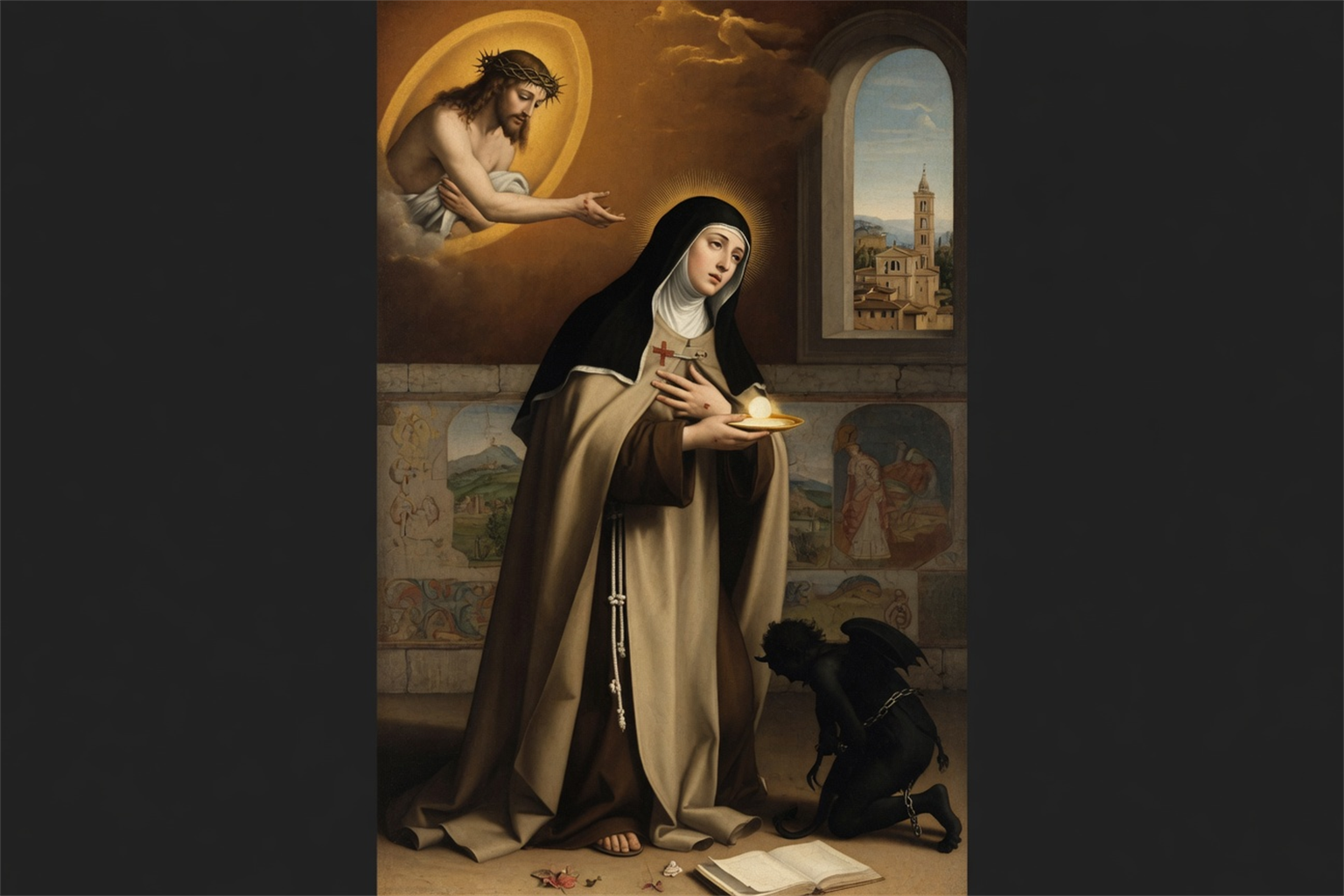
A socialite converted after the loss of her family, Angela of Foligno became a major Franciscan mystic of the 13th century. She is famous for her visions of the Passion and her harsh struggles against demonic temptations. Her writings, dictated to her confessor, constitute a pinnacle of spiritual literature on union with God through the cross.
Guided reading
8 reading sections
BLESSED ANGELA OF FOLIGNO, WIDOW
Origins and worldly life
A native of Foligno, Angela initially led a worldly and sensual life, far from evangelical precepts, before beginning a process of conversion.
We have, in the person of this humble servant of Jesus Christ, such a beautiful model of perfection for women, and especially for widows, that it is surprising that the story of her life has not been made more common. We know that it contains some rather singular things, not all of which are imitable; but this is not a sufficient reason to entirely hide the work of God, and deprive the public of a good that seems to belong to it; one will discover, moreover, in the conduct of this devout servant of the Savior, an infinity of rare examples of patience, charity, humility, and several other virtues that will greatly edify the faithful.
Persons of the female sex, engaged in the burdens of a large family, will be pleased to know that this pious woman was, like them, obliged to respond every day to a thousand different events that occur in life; and those who, in the midst of so much work, come to be deprived of the help of a spouse, upon whom one relies for everything, will be very glad to see the prudent conduct of a widow who, remaining in the world, burdened with the care of several children, yet knew how to find a way, not only to obey faithfully the evangelical precepts, but also to strive for the perfection of the counsels.
Blessed Angela was a native of Foligno, a city in Italy, three or four leagues from Assisi, in the delegation of P erugia, Foligno City where Saint Florent ended his days. in Italian *Perugia* (States of the Church). We know l ittle Assise Site of the arrest of Saint Sabinus. of the years that preced ed the Pérouse City where the saint studied law and began his career before entering the convent there. time of her conversion; besides, should one not count as nothing the days that one does not employ in the service of God and the business of one's salvation? We can nevertheless conjecture, from several places in her writings, that as a young woman, she led a life little in conformity with the rules of the Gospel, and she gives reason to believe that she was very worldly, that she denied nothing to her senses, loving splendor, pleasure, new fashions, and everything that can contribute to maintaining a soft and sensual life; for, having returned from her wanderings, she very often asks God for forgiveness for all her disorders, of which she herself gives a detailed account.
Conversion and first spiritual steps
Married and a mother, she is touched by grace and begins a path of penance marked by the confession of her faults and the fear of judgment.
She embraced the state of marriage, in which she had a large number of children; she then felt, more keenly than ever, the weight of the laborious condition in which she found herself; it was, nevertheless, in the midst of the burdens of her household, that God, by a singular mercy, touched her and gave her the first sentiments of a perfect conversion: He revealed to her the dangers in which she was, in the state of indifference in which she found herself regarding her salvation; she recognized the ugliness of sin, and, reflecting on the disorders of her past life, she was so touched by it that she began to weep for them very bitterly. She recounts, in her life, that God led her through several different degrees, which she calls spiritual steps, to introduce her into the path of penance; speaking of the first step, or the first degree, here is what she says: "I began to make serious considerations on my bad conduct, and God granted me the grace to give me a clear knowledge of my sins, which threw me into a great apprehension of eternal damnation." She planned, at that time, to seek the means to enter into the exercises of a serious penance; she found herself, however, seized by such great confusion at the sight of her sins, that being at first held back by a natural modesty, which she only overcame later, she confessed that she approached the holy Table several times without daring to declare entirely what she had done. She had great remorse of conscience for acting in this way; finally, God made her overcome her weaknesses and her fears, quite common to persons of her sex. She made a vow to heaven to find an enlightened confessor, and took the resolution to overcome all her shame and apprehensions by a general and sincere confession, even of the smallest circumstances of her faults. Having found a wise and prudent director, such as she had asked for, she made an entire and perfect confession to him, and yet she experienced none of those particular sentiments of love that she received later; but only she felt great sorrow and extreme confusion for having offended the divine Majesty.
This disposition lasted for quite a long time, and as long as it continued, she contented herself with exercising herself in the practices of mortification, and with faithfully fulfilling the salutary penance that had been imposed upon her by her confessor, to make satisfaction for her sins; she bore with patience (since God willed it so) being deprived of all sensible consolation; it is in this way that she began to endure the trials of the life that is called purgative, through which one must resolve to pass if one wishes to make oneself worthy in the future of the other favors of heaven.
Progression in Penance
She deepened her contrition through extraordinary mortifications and an intense devotion to the Passion of Christ, culminating in a vow of chastity.
Angela, having been faithful to these first steps of penance, was not long in receiving new graces; for she perceived a ray of light by which she recognized the infinite mercy that God had exercised toward her, by presenting her with the means to escape the abysses of hell, by withdrawing her from the disorders of sin in which she was plunged, to favor her with the grace of penance; this caused her to enter into feelings of such vivid gratitude that she wept for her sins again more bitterly than she had yet done; she studied every day to invent practices of mortification so extraordinary and so little imitable that she did not believe she should make them known to men, so as not to give others occasion to exercise upon themselves rigors that she judged to be suitable only for her.
As she advanced in the painful ways of the cross, she received new strength from heaven, which sustained her in the labors through which divine Wisdom made her pass. She had, at that time, a strong impression that made her understand that by offending God, the creator of all things, she had also offended all creatures; this vision made her heave new sighs toward heaven and increased the knowledge she had of the unhappy consequences of sin. She believed herself so indebted to divine justice that, to have a powerful protection before her judge, she addressed herself to the Blessed Virgin and to several other Saints in whom she had the most confidence, to obtain by their intercession an entire pardon for all her faults. She apostrophized all creatures and even those that were inanimate, of which she said she had made very bad use, and conjured them to forgive her, and to be willing to spare her at the judgment of God.
Her feelings, which proceeded from a heart truly contrite and humbled, attracted and merited for her several extraordinary graces; for she confesses that she received as it were an interior answer which made her understand that she was favorably heard, and that mercy would be shown to her since she asked for it with such tears and perseverance. She received yet another grace after having long asked for it: it was to be able to contemplate assiduously Our Lord Jesus Christ, dead on the cross for our love; she declares, nevertheless, that the considerations she first made on this perfect model were accompanied by great aridity; but, not tiring for that reason of keeping her eyes fixed on the Savior, she delved so well into the depth of his sacred wounds that she merited to discover great wonders there. She knew how the malice of men, in general, had caused Jesus Christ to die on Calvary, and how she had herself contributed in particular to putting him in the deplorable state in which she contemplated him; there was then formed such a great brazier of love and such profound feelings of compunction in her heart that, being one day at the foot of a crucifix, she resolved to strip herself entirely of everything that could be an obstacle to her on the path of perfection; she made at the same time a perfect offering to God of all of herself, and she pronounced the vow to keep chastity inviolably for the rest of her days. In the serious reflections that she did not cease to make on the disorders of her youth, she often accused and condemned all her senses one after the other, for having served her as an instrument to offend her God.
As her greatest desires were at that time directed toward asking for the science of the cross, and to having no other refuge, in her sorrows, than on Calvary, she was instructed from heaven in what she had to do. Here is how she explains it: "God made me know that, if I wanted to keep the path of the cross, I had to detach myself from all creatures and unburden myself of all the cares of the earth, to be freer in this noble enterprise; I knew, moreover, that I had to forgive without any exception all those who had offended me, and that it was very advantageous for me to be deprived of the company of all men, to be distant from my friends and my relatives, to leave all my goods and to die entirely to myself, to be in a state to consecrate myself totally to God."
Liberation from Earthly Ties
After the successive loss of her mother, her husband, and her children, she dedicated herself entirely to God and joined the Third Order of Saint Francis.
"I began, for this purpose, to despise rich fabrics and secular fashions; I abandoned worldly and affected hairstyles; I deprived myself of delicate meats, and I confess, however, that I did not respond without difficulty to the movements of grace, which led me to do all this, but without any taste: for I did not then experience the pleasant impressions of sacred love, which make the most bitter and difficult things sweet and easy, and I still found myself engaged in the necessity of pleasing a husband whom my state obliged me to consider; but it happened by the orders of divine Providence, which conducts everything according to its eternal wisdom, that my mother was taken from this world, and I must confess that, although I did not lack tenderness for her person, nor gratitude for what I owed her, I could not help but notice that she was in some way an obstacle to me in the ways of perfection to which I saw myself called.
"A short time later, it pleased divine Providence again to take my husband and all my children from the earth. The deprivation of so many people, who were otherwise very dear to me, was not, however, very painful to me, especially since I was a little prepared for it by the desire I had conceived to see myself delivered from all the ties of nature, and by the prayers I had made to obtain this grace from God. Since that time, I noticed that my heart was in agreement with the designs of my God for me, and that I no longer had any other will than to make myself perfectly conformed to His."
Blessed Angela, seeing herself thus entirely free from the world, and remembering what Saint Paul says, that she who is truly a widow must hope in God and persevere day and night in prayer, thoug ht only of saint Paul Apostle to whom Saint Rufus attached himself for his missions. pleasing her heavenly Spouse, in whom she placed all her trust; she asked Him, through continual and fervent prayers, that it might please Him to reveal to her what He wished of her so that she could show Him a more perfect love; she assures that she was heard, and that Jesus crucified often made her know all that He had suffered for her salvation, and taught her that it would only be by faithfully imitating the features of His Passion that she could be more perfectly like Him. The grace she received in her new impressions, touching the Passion of the Savior, was so considerable, and she entered into such true feelings of compassion for the suffering Jesus, that she shed very bitter tears, and so burning that they dried the skin of her face, and forced her to use a little cold water to moderate this excess of pain.
Grace, which never remains idle in a heart of which it has once taken possession, inspired her at that time to seek the means to leave the world entirely, to go and practice, in some solitary place, evangelical poverty; she was keenly fought in this design, because she was still young and feared dangerous encounters; but a new help from heaven made her overcome these difficulties, and she decided to suffer, if necessary, hunger, thirst, cold, heat, confusion, and all the greatest inconveniences of life, and even death, to attain the happiness of seeing herself poor and thus giving to Jesus Christ, her master, evident testimonies of her perfect detachment: it is believed that it was about this time that, not being able to leave her relatives or her homeland, as she had so often wished, she embraced the rule of the Third Order of Saint Francis of Assisi, to be in a state to practice more perfectly the humility and poverty, of which one makes a special profession in this Order.
Trials and Spiritual Combats
Angela undergoes harsh demonic assaults and temptations against purity, experiencing a physical and spiritual 'dark night' for two years.
The flames of divine love, growing ever more in her heart, made her conceive a great desire for martyrdom. "I wished," said this generous lover, "that there could be found someone who would deprive me of life, provided it were in hatred of the faith, and to give my God an evident testimony of the love with which I feel my heart is inflamed for Him." She adds, however, that as she believed herself unworthy of the grace of martyrdom, she would have wished to suffer all its pains without receiving its glory; she declares that she could not then imagine a kind of torture, however vile it might be, for which she did not believe herself worthy of some even more shameful death; this made her say, in a sentiment of confidence in divine mercy and contempt for herself: "Lord, even if it were true that You had condemned me to eternal flames for my sins, I would nonetheless not cease to do penance and to reduce myself to the greatest poverty that I could; and, whatever happens to me, I will never cease to remain in Your service."
Although this holy widow received new lights day by day, her heart was nevertheless in suffering, until, asking God one day to grant her some favor so that she might serve Him with more freedom, she was heard. One day, as she was reciting the Lord's Prayer with great fervor, for which she had a singular devotion, she understood so clearly the excess of divine kindness on one hand, and the aby Oraison dominicale Central prayer in Angela's mystical experience. ss of her own unworthiness on the other, that she confesses to having no expression to make known what was inspired in her on this subject. "It was explained to me," she said, "in the depths of my heart, all the words of the Pater, with such clarity, and I pronounced all the words with such contrition and interior recollection, that, although I was plunged into great pain by the memory of my sins, I nevertheless felt elsewhere a great consolation, and I savored something of those celestial sweetnesses which God sometimes shares with His favorites; and I have never found a better way," she continues, "to know well the mercies and kindnesses of God toward men than to recite this Prayer, of which Jesus Christ Himself is the author." False spirituals can here recognize their error when they say, under the pretext of elevation, that one can and even must leave all vocal prayers to listen to the voice of God in a greater silence.
Our blessed disciple of the Cross, walking by such solid paths, made great progress in virtue; she was favored with a gift of extraordinary prayer; she felt such attraction to it that she easily forgot to eat and drink, and would even have fallen into great illusions on this subject if a special light from heaven had not helped her; for she felt herself several times tempted not to think at all of her bodily needs, or to take only very light nourishment, under the pretext of attending more long and more purely to the exercises of contemplation, but she recognized that it was a true temptation of the evil spirit; she therefore exercised herself, but with discretion and after having taken counsel, in an infinity of other harsh exterior penances, without her health being in any way altered, and she even counted as nothing what would have been unbearable to many others.
She said that temporal goods, such as riches and honors, were only like the smallest crumbs of bread falling from God's table; but that crosses were the delicate dishes of this sacred table, and that for this reason they were given to the favorites; she assured that those who suffered much were seated at this table, near the adorable Jesus, that they ate from the same dish and were nourished by the same food: being persuaded of these truths, she once undertook a pilgrimage of forty leagues to obtain the great gift of the cross in poverty.
The fire of sacred love also took such an increase in her heart that, when she heard God spoken of, she entered into tremors of a celestial joy so violent, and of which she was so little mistress, that, even had it cost her her life, she could not have prevented them from appearing outwardly; at the sight of paintings that represented to her something of the Passion of the Savior, she suddenly entered into redoublings of love so vehement, caused by an interior agitation that did not seem natural, that she immediately fell into languor; "whence it comes that her usual companion, wishing to avoid her feeling too frequently these excesses of love or interior joy, whose effects were often produced too much outwardly, was obliged to veil prudently, on certain occasions, the images that represented some traits of the death and passion of the Savior."
These great communications that she received from heaven were only like preparations for the harsh assaults that she had to sustain afterward from the side of hell; for God, who wanted to form in the person of Angela a model of strength and courage, which all persons of her sex could imitate in the austere paths of the supernatural life, gave permission to the powers of darkness to test, as upon another Job, the virtue of His servant. Here is how she speaks of this new disposition: "For fear," she says, "that the number and greatness of the revelations and visions might swell my heart, and that the delights with which I am filled might suggest vain complacencies, God permits that I be tempted and afflicted in an infinity of ways. I am delivered to the malice of several demons, who make me suffer countless torments in all parts of my body, and I do not believe it is possible to give the detail of them in writing; I am never without feeling pain; I suffer a state of perpetual languor; I feel such great weaknesses that I am forced to remain almost always stretched out on a bed; I am overwhelmed by a universal weariness; there is no limb in me that does not have its torment and its particular wound; I am always infirm and dependent on everyone; moreover, although I am forced to remain lying down, I suffer extraordinarily from holding this posture, which is difficult to change, being almost unable to give myself any movement; I cannot take the nourishment that is necessary for me, and besides all the bodily evils, I feel others in the depths of my soul that are much more unbearable."
Indeed, she makes it known that all her passions revolted against herself, that she felt the attacks of several vices that she had overcome, and of several others that she had never known; that she was tempted on all kinds of objects; that the flesh revolted against the spirit, that the senses seemed to overcome reason, and that reason refused to submit to the laws of grace; she imagined she had never known virtue; nothing caused her more pain than to believe herself deprived of the inclination she had once had, she said, for the good; the mere thought of believing herself distant from her God, and of feeling then repugnances for the exercises of piety, caused her a pain so sensible that she shed torrents of very bitter tears, without being able to receive any consolation from anyone; she imagined she had committed crimes for which she would not receive pardon; she saw born within her clouds so thick that she could not distinguish true virtue from that which had only the appearance of it; she wanted to place herself above all the attacks that the demons delivered to her, and to conquer the vices that presented themselves to her mind, and she nevertheless felt a weakness that seemed to belie her great courage.
But what caused her the harshest of all her torments were the frequent and different assaults that she had to endure from the demons against purity, the dearest of her virtues; we will exempt ourselves from reporting the detail here, which one will be able to see in her life that she dictated to her confessor: she assures that the combats she had to sustain were so unbearable to her that she would have preferred to suffer all the diseases and all the kinds of evils that can happen to a human body, and to accept the harshest martyrdoms, than to see herself exposed to such temptations. It pleased the divine Wisdom, however, to leave this faithful lover of the cross in these harsh trials for the space of two years, and the fidelity with which she always behaved, joined to the altogether singular means she used to overcome such continuous and dangerous attacks, gives very evident proofs of the innocence and love of purity that the blessed Angela possessed.
God very often made her know that such impure imaginations and such terrible representations were suggested to her only by the demons; but she remained at other times in such great perplexities and in such painful doubts about her salvation that she did not know what to resolve; being nevertheless a little returned to calm, she understood that, however annoying and painful her trials might be, they were only effects of the wisdom and goodness of God, who makes even the most innocent souls pass through these extraordinarily painful paths, to purify them, like gold, in the crucible of tribulation. "The more a soul," she says, "is afflicted, annihilated, and humiliated in this way, the more it is purified, elevated, and capable of noble divine communications, and the degree of humiliations always makes the degree of elevations." One can see, in the 50th chapter of her Life, with what light, what wisdom, and what experience she describes the utility of these great spiritual combats.
Illuminations and active charity
Favored with mystical visions of the Trinity, she reconciles this interior life with heroic service to lepers and the poor in hospitals.
What happened to the blessed Angela, after such harsh temptations, is clear proof of what she teaches in her writings; for she was subsequently favored with an infinity of lights that dissipated in a very short time all her scruples, all her doubts, and all her troublesome representations, and her heart was filled with such sweet consolations that she soon lost the memory of the bitterness and anguish to which she had so often been reduced.
Indeed, upon leaving Calvary, she was introduced into the cellars of the Spouse; and she was made to taste what was most delicious. She received admirable knowledge concerning the mystery of the Holy Trinity and the pr incipal attrib sainte Trinité Central concept symbolized by the three windows of the tower. utes of God, such as goodness, wisdom, power, justice, love, and several other similar divine perfections. One reads, in her Life, entire chapters on each of these attributes; she was also divinely instructed on a great number of circumstances regarding the person of the most holy Virgin, the Passion of Our Lord Jesus Christ, and the venerable sacrament of the Eucharist; an abridgment does not allow one to report all the beautiful lessons she received from God, which she left to posterity, and which usefully serve as instruction to so many people.
This virtuous widow was not among the number of those persons who, under the pretext of some high contemplation with which they believe they are favored, neglect the exterior works of piety; but, possessing the qualities that the Holy Spirit demands of the strong woman and fulfilling the duties that Saint Paul requires of true widows, she set her hand to work; and, weak and languishing as she was, she did not fail to go and even lead others to the hospitals, to offer her services there, to give alms, and to exhort the poor sick to patience, whose salvation she sought as much as their health: far from believing that her exterior occupations diminished the attraction she had for prayer and that they interrupted the sweet silence of her soul, she declares, on the contrary, that the commerce she had with her God became more intimate and more abundant in her acts of charity. "Let us go," she said to her companion, "let us go to the hospital, perhaps we will have the advantage of finding Our Lord Jesus Christ there in the ranks of the poor"; and God did not fail to reward her confidence and her charity with interior communications and delights that she says she cannot express.
She did not go empty-handed to these places; she knew that the poor only listen well to the lessons of heaven when they receive some small benefit from the hand of those who visit them and exhort them to patience: it is with this sentiment that she always brought them something. One day it happened that she had nothing to give them; but as the love of charity is always ingenious, she thought of inspiring her companions that they had only to give the veils with which they covered their heads and other similar small garments, to have them sold for the benefit of the poor; indeed, having put all this into the hands of the hospital servant, they begged her to go and get the price and to use the money that would come from it immediately to bring some sweetness and some small refreshment to the sick; joining therefore the bread that they had previously begged in the city to what was brought from the market for the price of what they had had sold, they distributed the whole to the sick with incredible joy.
They were not content with giving their goods, they also rendered to the infirm of these poor houses the vilest services, without paying attention to the inconveniences that usually result from them, preferring the offices of charity to their health and their life; they did not want to know the distinction between common diseases and those that were very dangerous; they even faced dangers so as not to fear them; they followed to the letter the advice of the Apostle, who desires that widows exercise hospitality and wash the feet of the Saints, so that one day, after having washed the hands of a leper, whom the disease made dirty and infectious, they had enough courage to drink the water; there is more, for our delicate ears must hear the courageous language of charity: Angela asserts that it seemed to her, on this occasion, to have tasted an admirable liqueur, which she said came from the qualities of this water, all the more so because she had felt in her mouth some small crust fallen from the ulcers and wounds of this leper.
Spiritual Doctrine and Influence
She teaches the importance of vocal prayer and radical humility, influencing great spiritual authors such as Saint Francis de Sales.
These admirable acts of charity make it well known that this holy woman lived in a state of prayer that was not subject to illusion, since good works were its principal foundation. She did not want action to ever be separated from contemplation, and it is for this reason that in the beautiful lessons she left in writing regarding prayer, she speaks so often of a prayer she calls bodily; that is to say, one in which the body is usefully employed to raise the spirit to God and maintain it in fervor. "This prayer," she says, "is accompanied by vocal prayers, genuflections, inclinations, and other similar exterior exercises; I never forget," she continues, "to make use of these practices, because the state of the soul's transformation in God not being continuous, one must use all sorts of means to return to this beautiful union. Divine Wisdom, which does all things with order, weight, and measure, has willed that no one should arrive at performing mental prayer well if one does not also exercise oneself in exterior actions, which help to sustain its fervor. This same Wisdom," our Saint continues, "wants us to fulfill vocal prayers with fidelity, at the time marked for this purpose, unless a great reason exempts us from it. Wishing to pray mentally, I have often experienced that I lost the fruit I expected from it, either because of a certain drowsiness that surprised me, or also by a natural laziness, to which the body ordinarily leads us; but holy exterior postures keep the spirit in the attention suitable for prayer."
This doctrine and these precautions that this faithful servant of Jesus Christ took show how far she was from any deception; she was also extremely distrustful of her own lights: thus she wanted the entire edifice of the interior life to be supported on the knowledge of one's own miseries that one must recognize in oneself, rather than on great elevations which quite often keep souls in presumption. "Visions," she says, "revelations, and other exercises of contemplation are of no use if one does not have the true knowledge of God and of oneself." It is with these sentiments that she perpetually exhorts everyone to meditate on the death and passion of Our Lord Jesus Christ crucified, whom she says is the book of Life, in which one finds all the lessons one could wish for to learn to know oneself well; she proves very clearly that, as the entire life of the Savior was accompanied by poverty, contempt, and pain, it is necessary that we follow him on this path, and that any other way may be suspect.
It is according to these same principles that she speaks so frequently of the virtue of humility, and that she asserts that prayer, which does not presuppose this foundation, will never produce any fruit. One can judge, by contrary reasoning, the solidity and truth of the noble supernatural dispositions of this learned disciple of Jesus Christ, since it is difficult to find a person who has suffered more humiliating things, and who has also humbled herself more than she. I will add to the proofs we have already given, that she said loudly, and believed very sincerely, that she was the most unworthy and the most despicable of all creatures, and that she desired very ardently to be treated as such; she further declares, regarding her writings, that one should not esteem them at all: "I am a blind woman," she says, "and I am not the depositary of truth; regard all my words as being potentially subject to error, and as coming from a person who is filled with malice; censure everything I say very rigorously, believe nothing of what I advance, except insofar as you find it otherwise conformable to the maxims of Jesus Christ, and that my lessons lead you to imitate his virtues." This is how Blessed Angela explains herself, speaking of her works. This doctrine, nevertheless, despised only by its author, has served as a torch to an infinity of great men who have adorned their writings with it, and there are few authors who have treated the states of the spiritual life without citing this learned mistress, who knew by experience what she dictated in her works. Saint Francis de Sales, among others, did not fail to authorize by the testimony of this Saint what he advances when speaking of the painful states of the spiritual life, as one can see especially in Book VII of his Treatise on the Love of God.
Death and Cult
She died in 1309 in Foligno, leaving behind writings dictated to her confessor. Her body is preserved in the Franciscan church.
It is time that we speak of her precious death. This holy widow, seeing herself departing for eternity, gave, for the last time, beautiful instructions to those who had the happiness of assisting her in these final moments; she exhorted them to despise the honors, the offices, and the authority that everyone wants to have over others; she nevertheless made them understand that there was even much more danger in wanting to pass for sufficient and for great doctors in the supernatural ways, as, for example, by speaking often of God, by explaining the Holy Scriptures, and by making it understood that one is greatly occupied with spiritual affairs; it is in this regard that, exhorting those to whom she spoke to occupy themselves only with their nothingness, she cried out as much as her strength allowed her: O unknown nothing! O unknown nothing! In truth, she added, we can never have more beautiful visions, nor acquire higher sciences than to know our nothingness, and to know how to remain with patience and submission in the dungeon of humiliation where God has enclosed us. The day that preceded that of her death, she repeated incessantly these words that she addressed to God: "My Father, I commend my soul and my spirit into your hands." That same day, all the pains, both of the body and of the spirit, with which she had been overwhelmed for a long time, ceased all of a sudden, and she was filled with such sweet joy, and she appeared to enjoy such great rest, that it seemed that she was beginning to enter into the abode of glory; she received the Sacraments in this beautiful disposition. Finally, on January 4 of the year 1309, the day of the Octave of the Innocents, around midnight, she gently rendered her soul to God to go and enjoy the fruit of her labors.
In the images that have been made of Saint Angela, Our Lord Jesus Christ appears to her and invites her to approach Holy Communion, from which her scruples kept her away; she chains the devil who wanted to push her to despair by representing to her her past life.
Her body is preserved in Foligno, in the church of the Franci Foligno City where Saint Florent ended his days. scan Fathers, enclosed in an elegant reliquary.
We have composed this life based on the one she dictated herself to her confessor, containing seventy chapters; Rollandue reported them faithfull y, in his Rollandue Hagiographer who compiled the life of Angela. first volume, after having compared them with the originals.
Annexes & related entities
Structured data for exploration: events, miracles, quotes, places, attributes, patronages, and important entities cited in the text.
Key Events
- Worldly youth in Foligno
- Marriage and birth of many children
- Conversion following an awareness of her sins
- Successive deaths of her mother, husband, and children
- Joined the Third Order of Saint Francis of Assisi
- Forty-league pilgrimage to obtain the gift of the cross
- Two-year period of severe demonic temptations
- Recording of her visions and mystical experiences by her confessor
Miracles
- Sudden healing of all her pains on the eve of her death
- Taste of an admirable liqueur after drinking the water used to wash a leper
Quotes
-
O unknown nothing! O unknown nothing!
Last words reported in the text -
My Father, I commend my soul and my spirit into your hands
Words spoken the day before her death