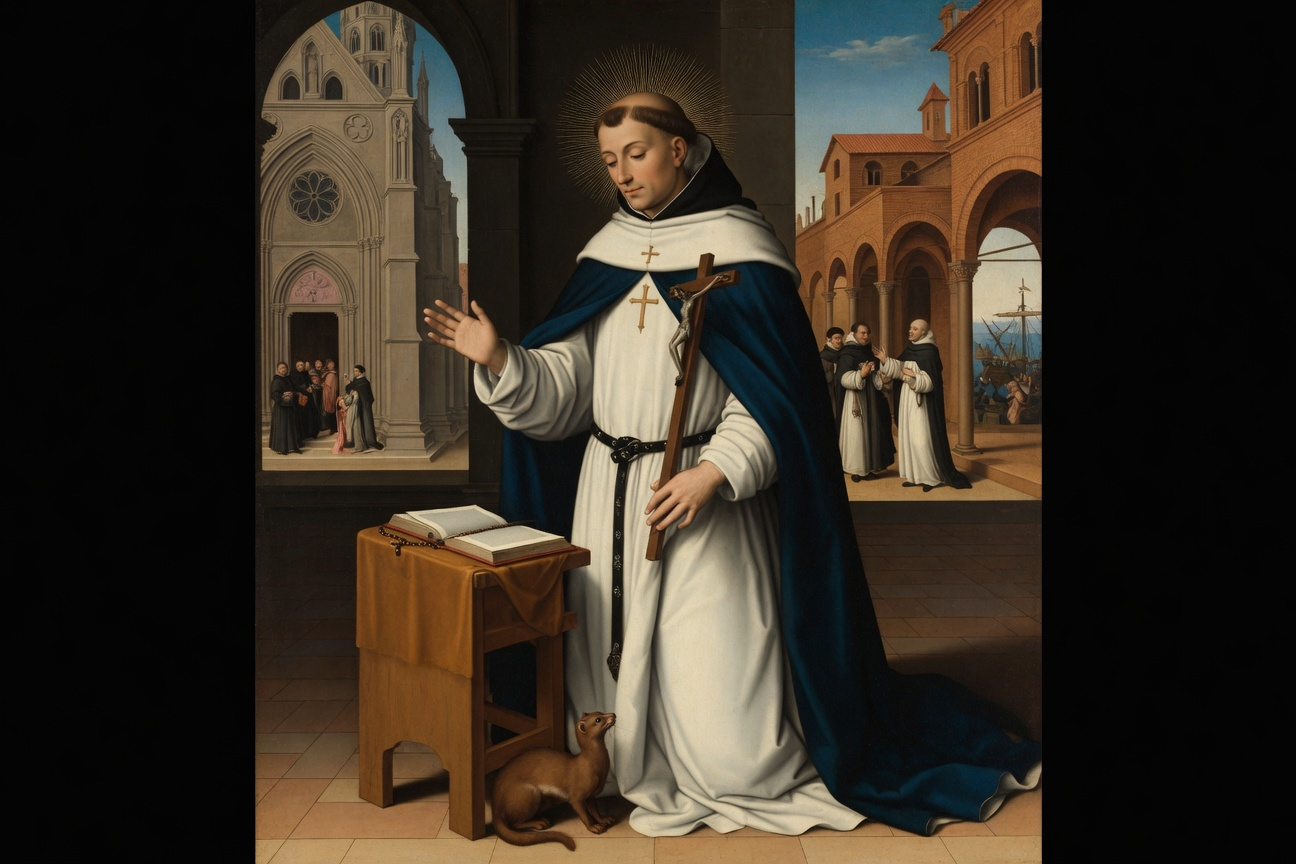
Successor to Saint Dominic as head of the Order of Preachers in the 13th century, Jordan of Saxony was a preacher of exceptional eloquence, attracting thousands of young people to religious life. Renowned for his charity toward the poor and his gentleness toward his brothers, he perished in a shipwreck while returning from the Holy Land in 1237. His cult was officially recognized by the Church in 1826.
Guided reading
8 reading sections
BLESSED JORDAN OF SAXONY, DOMINICAN
Origins and Dominican Vocation
Coming from the Saxon nobility, Jordan studied in Paris where he met Brother Reginald and decided to enter the Order of Preachers with his friend Henry of Cologne.
Just as the life of the body is sustained by the mixture of food and drink, so to develop the life of the soul, one must alternately pass from prayer to the study of the Holy Scriptures. Maxim of the Blessed Jordan, reported by the *Brev. Dom.*
Among the celestial heroes who illustrated the nascent family of Saint Dominic, one must not forget Blessed Jordan. Saxony regards i t as a glory to be h bienheureux Jourdain Successor of Saint Dominic who received Albert into the order. is homeland. He was born in the 13th century, of the family of the Counts of Ebernstein, whose piety equaled their nobility. After beginning his studies in Germany, he came to continue them in Paris. He became skilled in secular sciences and published, from his youth, some works on mathematics. He was no less successful in the study of theology, to which he devoted himself entirely, as to that which satisfied both his mind and his heart. The Order of Saint Dominic, instituted towards the end of the year 1216, had received into its bosom one of the greatest servants of Our Lady, Brother Reginald; he preached with such force that people feared going to his sermons, for fear of letting themselves be won over by the grace that flowed from his lips. Our Blessed, who heard him, was touched and vowed within himself to enter his Order, thinking he had found the sure path of salvation, which he had been seeking for a long time. He wished to procure the same happiness for his inseparable companion, the friend of his soul, Henry of Cologne: both vowed to enter the Ord er of Preachers Henri de Cologne Close friend of Jordan and prior of Cologne. as soon as possible. However, Brother Reginald having died, they deferred their taking of the habit until the time of Lent, and in the interval they won over one of their companions, Brother Leo, who later succeeded Brother Henry in the office of prior. Finally, the day having come when the Church, by the imposition of ashes, warns the faithful of their origin and reminds them that they came from dust and will return to dust, they prepared to fulfill their vow. They all three went to the convent of Saint-Jacques, at the moment when the brothers were singing: *Immutemur habitu*: let us change our habit. Their visit was not expected; but, although unforeseen, it was nonetheless opportune; they stripped off the old man to put on the new, while what they were doing was being sung. At the death of Reginald, a religious had had a marvelous vision; in this same cloister of Saint-Jacques, in Paris, he had seen a very clear spring which, spreading through the squares of the city, and, from there, through all the provinces, purified, watered, and rejoiced everyone, and, always increasing, threw itself into the sea: it was our Blessed. Indeed, he soon succeeded Reginald, preached first in Paris, then throughout the universe, for twenty years, led more than a thousand people into his Order, made himself everywhere pleasing to God, was respectful towards the prelates of the Roman Church, led the clergy and the people to penance, inviting them to enter the kingdom of God, until he finished his earthly course, like a great river into the sea, which was for him the blessed eternity. He had only been a novice for three months when his superiors called him to the first General Chapter of the Order, which was held in Bologna at the feasts of Pentecost 1220. Upon his return to France, he was charged with explaining the Holy Scripture to the young re ligious Bologne City of birth and return after the Blessed's conversion. of the convent of Saint-Jacques, and with announcing the word of God in the capital of the most Christian kingdom. In the second Chapter of his Order, held in Bologna in 1221, he was elected provincial prior of Lombardy, and at the third Chapter which followed the death of Saint Dominic, he was chosen by a unanimous voice to succeed the holy patriarch: he had barely been in the Order for two and a half years. But one cannot put such lights on the candlestick too soon; this one soon illuminated the family of Saint Dominic and the entire Church with the brilliance of the most beautiful virtues.
Succession of Saint Dominic
After teaching in Paris, he was elected provincial of Lombardy and then succeeded Saint Dominic as Master General of the Order in 1222.
He had always had the heart of a father for the poor; no one ever left him empty-handed: he gave to all, but especially to the first person he met. When he was studying theology in Paris, he had risen one night, according to his custom, and had left in haste for the office of the Blessed Virgin at Notre-Dame; fearing to be late, he had taken only his belt and his cloak over his shirt: a poor man appeared and asked him for alms; finding nothing else to give him, he gave him his belt. He was early, instead of being late, as he had feared. Having thus entered the church, he began to pray before a crucifix; as he often raised his eyes to it out of devotion, he saw it surrounded by the belt he had just given to the poor man for the love of the crucified Jesus. When he had entered religious life, this charity became such that he stripped himself more than once in the streets to cover the suffering and naked members of his Savior: for which the brothers were obliged to rebuke him and even to accuse him in a General Chapter.
Charity and Government of the Brethren
Renowned for his great charity towards the poor and his gentleness towards novices and tempted brethren, he favored consolation over severity.
As for the brethren, he was so good to them, not only by sympathizing with their infirmities and providing for their needs with all his power, but also by pardoning human frailty, that he won more of them over by the charms of his gentleness than he corrected by severity, although he knew how to use the latter according to the time, place, and person, having learned it from Him from whom all things are learned. But his tenderness and compassion were mainly for the infirm and the tempted, often consoling them with his presence, reviving them with his words, his examples, his exhortations, and his prayers. It was his custom, upon arriving at a convent, to visit the sick, to invite the novices to his table, and to have those who were tempted come to him for consolation. When he came to Bologna, it happened that the brethren spoke to him of a novice who was tempted to leave the monastery; he had, in the world, led a life so worldly, so delicate, regarding clothes, furniture, food, games, in a word, everything that can flatter the flesh, that he did not know what pain and affliction of spirit were. No illness, no cause for discontent, no effort, except for study, in which he shone greatly; he only fasted on Good Friday; he hardly abstained from meat during the week except for that day, which recalls the suffering of a God deprived of everything, and drenched with gall and vinegar; he had never confessed; of all that is recited in the Church, he knew only the Lord's Prayer. Having come to the convent out of curiosity, he had been received because he had a frankness that knew how to hide nothing; but boredom soon made him regret the world: everything he saw, everything he heard, everything he felt seemed like death to him; he could no longer eat or sleep, and, although he had never been angry in the world, the temptation had made him so irascible that he one day wanted to strike the sub-prior who had brought him into religion. Our Saint, having sent for him, began to console him; after some exhortations, he led him to the altar of the blessed Nicholas, ordered him to kneel and recite the Pater noster, because he knew no other prayer. As for him, placing his hands on the novice's head, he prayed to God with all the fervor of his soul to remove all temptation from him; while he was praying thus, it seemed to the novice that a secret sweetness was entering his soul little by little, and that his heart was no longer the same, and, when the Saint raised his hands above his head, it seemed to him, as he later recounted to the brethren, that two hands that were pressing his heart suddenly abandoned it, and that his soul remained in great tranquility and sweetness; he found himself so consoled, he became so fervent, that he endured, thereafter, great pains, and did several useful things. The Lord had conferred upon the blessed Jordan a special grace for prayer, which no office among his brethren, no fatigue in journeys, no occupation, no solicitude could make him neglect. His habitual manner was to pray on his knees, hands joined, body upright, sometimes seated; he shed so many tears that his eyes became ill; he also gave himself entirely to meditation, whether at the convent or on a journey, and he felt marvelous sweetness therein. On a journey, he was accustomed to devote all his time to prayer and meditation, unless he was reciting the holy office, or had, with his companions, some conversation on useful subjects; yet he had set times for this, and he advised others to do the same; he often separated himself from the brethren: sometimes he sang on the way, in a loud voice and weeping: Jesu, nostra redemptio, or Salve Regina: Jesus our Redemption, or Hail, Holy Queen. Sometimes, completely absorbed by meditations and interior joys, he would lose his way; but he was never seen to be troubled by it, nor to complain, nor to accuse the brethren; on the contrary, he consoled the others when they were troubled by it: "Be tranquil, my brethren," he would say to them; "only one path is worth occupying oneself with: that of heaven." He possessed to a high degree the graces called gratuitous, especially that of miracles.
Miracles and Itinerant Preaching
The text recounts several miracles, including a multiplication of loaves in the Alps and healings in Thuringia, illustrating his holiness while traveling.
Once, while traveling from Lombardy to Germany in the company of two brothers and a secular cleric who later became a brother, he encountered a village named Ursace in the Alps. Here is how he miraculously provided his companions with the necessities in a desert region. Overcome with weariness and dying of hunger, they entered an inn and asked for a table to be set and food to be served; the innkeeper replied: "I have no more bread, for several travelers passed through before you and consumed all the provisions they found here, except for two loaves that I reserved for my family and myself; but what are two loaves for so many people?" The brothers replied: "Serve us what you have, for we are pressed by need." The two small loaves were brought, and the Blessed Jordan, having blessed them, began to give large alms to the poor who had run up from all sides; the host and the brothers, quite worried, said to him: "What are you doing? Have you forgotten that one cannot procure bread here, and that the door was closed on purpose to prevent the poor from entering?" Our Saint, for his only answer, ordered the door to be left wide open, and he continued his alms; he gave each of the poor, who numbered thirty, a portion so abundant that it could have sufficed for all of them together; he himself appeased his hunger as well as that of his three brothers, and what remained was sufficient for the meal of the host and his family, who, at the sight of this miracle, cried out: "This man is truly a Saint." During a trip to Thuringia, he healed a woman of a flux of blood, and, in the village of Aren, a priest abandoned by doctors. Another time, passing through the Alps, he restored the use of an eye to a blacksmith who had lost it through the heat of the fire.
In preaching the word of God, he had such persuasion and warmth that one would find it difficult to find his equal: this prerogative, this special grace that God had given him, did not shine only in his public discourses, but also in his most intimate conversations; wherever he was, with whomever he conversed, he let escape from his mouth, or rather from his heart, words so inflamed, he explained himself with examples so appropriate and effective, he spoke so well to each according to his condition, he adapted himself so much to the taste of each, that everyone thirsted for his word.
He cast the nets of his eloquence especially in the cities where the youth studied; for this purpose, he would go to spend Lent in Paris or Bologna, and, thanks to his zeal, the convents of these two cities resembled hives where new bees entered continually, and from which celestial swarms emerged for other provinces. He was so sure of attracting students to his Order that, upon arriving, he had novice habits prepared in advance, and the success so far exceeded his expectations that one no longer knew where to find habits for the young men who presented themselves. On the day of the Purification, he received an army of students from Paris; many tears were shed that day, for on one side the brothers wept with joy, and the seculars with sorrow, to see the flower of families thus torn from the world. One feast day, after the sermon, he was receiving a student into his Order, and several others were witnesses to the ceremony; addressing this audience, he cried out: "If one of you were going alone to a party, to a great feast, would the others be so careless that none of them would want to accompany him? Well! You see, my friends, that this young man is invited by the authority of God to a great feast: will you let him enter all alone?" Wonderful thing! His word was so powerful that suddenly a student, who until then had not had the slightest idea of entering religious life, stepped forward and said: "Master, I come, at your voice, to join this one, in the name of Jesus Christ"; and both received the habit at the same time. One of his most beautiful conquests was a young German lord, even more remarkable for his innocence than for the nobility of his origin and his riches. His tutor and his fellow students, seeing him about to leave the world at the voice of our Blessed one, made themselves ministers of Satan to tempt him; they did not fear to lock up with him, in his room, a person very beautiful according to the flesh, who, through sensual pleasures, was to divert the soul of the holy young man from his pious design; but he was victorious, or rather it was Our Lord who triumphed in him, and he even later drew his tutor in his wake into the family of Saint Dominic. But his father, rich and powerful, had no other child; informed of his step, he was sad unto death, and came, with a numerous escort, from Germany to Padua, in the firm resolution either to take away his son or to kill the Blessed Jordan. Arriving in this city, he met our Saint, whom he did not know, and asked him, with a face in wrath and a threatening voice, where he could find Master Jordan. He, remembering his God, who said to the Jews: "I am he," also replied with a joyful face and a heart full of humility: "I am Master Jordan." This calm, this sweetness, this frankness, and no doubt also the grace of God that accompanied these words, struck the German lord: he dismounted from his horse, threw himself at the feet of the Blessed one, and confessed to him with tears the evil design he had conceived against him.
Men were not the only ones to let themselves be taken by the charms that God gave to the word of his servant. One day when the brothers were ahead of him on a journey, upon leaving Lausanne, a weasel happened to pass before them; the brothers having stopped around the hole where it had disappeared, the Blessed one, who arrived, said to them: "Why are you stopping here?"—"It is," they said, "that a pretty, a charming little beast has entered this hole." Then, leaning toward the earth, he cried out: "Come out, beautiful little beast, so that we may see you." The latter, coming out immediately to the edge of its hole, raised its little eyes to contemplate the holy man, who made it climb onto one of his hands, and, with the other, caressed it on the head and on the back; it let him do it. Then he said to it: "Now, return to your little house, and may God your Creator be blessed!" It obeyed instantly and disappeared.
The appeal to the student youth
An eloquent preacher, he recruited massively from the university circles of Paris and Bologna, attracting many students and nobles into the Order.
He was so humble that he fled the pomp of the world and all the honors offered to him with great wisdom and prudence. One day as he was approaching Bologna, the whole city, at the news of his arrival, wanted to advance in procession to meet him; but he humbly quickened his pace to elude the crowd, and, circling the city, he arrived, through hidden paths, at the house of the Preaching Friars without being noticed. Having once received a slap from a servant, he immediately offered the other cheek, according to the Savior's counsel. It was especially in the General Chapters that his humility and patience shone forth. One day when he was invited to offer excuses, he replied humbly: "Should one listen to the excuses of a brigand?" Everyone was edified by these words. Pope Gregory IX, who held him in high regard, ha ving kept him fo pape Grégoire IX Pope who attested to the miracles of Bruno. r dinner on a day he was to leave Rome, he could only depart from the city late. Overtaken by night, he asked for hospitality in the place where he had arrived: he was turned away, and he could only find lodging with his companions at the home of a poor woman. She had only straw to offer them; the Blessed one rejoiced in this, saying to those who accompanied him that they were returning to the humble state they professed. When he had lost an eye, following a great illness, he said to the brothers assembled in Chapter: "My brothers, thank God, who has delivered me from an enemy; but pray to Him, if it pleases Him and is useful to me, that He may deign to preserve the other for me."
Humility and Marian devotion
Despite his renown, he maintained a profound humility and an intense devotion to the Virgin Mary, establishing liturgical customs in her honor.
What shall I say of his continuous recollection? His interior life occupied him entirely; external things were to him as if they did not exist, to the point that one could have him take one garment for another without him noticing: as happened one day to a great man of the world, who, out of devotion, obtained from him the laces of his shoes, and, in exchange, made him accept his own; the Blessed one did not see that they were gilded, and he dared to appear thus among the brothers.
He had a singular devotion for Our Lady, the blessed Virgin Mary; he knew that this Star of the Sea had taken it upon herself to direct in particular the vessel of which he was the pilot. Here is an example of the favors he obtained from her:
One night, a brother (it was undoubtedly our Saint), having risen to pray at the foot of his bed, saw the blessed Virgin, accompanied by celestial maidens, crossing the dormitory and sprinkling the brothers and the cells with holy water carried by one of the maidens. While passing before the cell of a certain brother, she did not sprinkle him. He who was a witness to this action ran to throw himself at the feet of Our Lady to say to her: "Pray, tell me who you are, and why you did not sprinkle this brother." She replied: "I am the Mother of God, and I have come to visit these brothers. I did not sprinkle this one, because he is not sufficiently covered; tell him, therefore, to cover himself, for I love your Order with a special love, and what, among other things, is especially pleasing to me, is your habit, whatever you do or say, of beginning and ending it with my praise. Thus, I have obtained from my Son that no one can long remain in your Order in a state of mortal sin, without being covered, repenting, or being cast out, for fear that he might trouble my favorite Order." Saint Dominic and Brother Raon had the same vision; it must be understood that the promise of the holy Virgin concerned the beginnings of the Order while it was still in all the fervor of its origin, but not the time of relaxation. The Blessed one also recounted in a Chapter what a brother full of devotion to the holy Virgin saw, and everyone supposed that he was speaking of himself. At the feast of the Purification, when they began to sing the invitatory *Ecce venit*, this brother saw a beautiful lady advance with her son toward the altar and take her place on a throne prepared for her; from there she looked affectionately at the brothers turned toward the altar, according to custom, and, when they bowed at the *Gloria Patri*, this celestial Queen, taking the hand of her Son, made with that hand the sign of the cross over them and over the whole choir.
Mission to the Holy Land and shipwreck
He died in a shipwreck on February 15, 1237, while returning from the Holy Land. His body, found on the shore, was buried in Ptolemais.
The servant of God had been governing the Order of Preachers with wisdom for fifteen years when the desire to visit the Holy Places, as well as the Dominican convents established in those regions, determined him to set sail. The crossing was fortunate, and he was able to satisfy his piety by traveling through that part of the earth which had the incomparable privilege of being honored by the visible presence of the Savior; he also had the consolation of working there for the conversion of the infidels and the correction of Christian morals. After a few months which he sanctified with all the labor of zeal and the exercises of piety, he thought of returning to Europe and embarked with two brothers and twenty-nine other people. Scarcely had the vessel carrying him moved away from the coast when a horrible storm assailed it and ended by sinking it on February 15, 1237. The Blessed one, his companions, and almost all the passengers perished. The bodies of these holy shipwrecked victims were cast by the sea onto the shore, and each night celestial lights were seen hovering above them. This prodigy attracted the inhabitants of the country; upon approaching, they smelled a fragrance of such strength that those who buried the holy bodies kept traces of it on their hands for ten days; this sweet odor spread much further. The Dominicans of Ptolemais came to collect these precious remains with respect and buried them in their church. This shipwreck was revealed to a brother in Limoges. Our Blessed one appeared to a holy nun of Brabant, named Lutgard, to console her in her dryness and to announce to her that she would soon be called into the bosom of the glory in which he shone with the Prophets and the Apostles. Numerous miracles were performed through his intercession after his death. He has always been honored as Blessed, and Pope Leo XII approved pape Léon XII Pope who proceeded with the beatification of Julian. his cult on May 10, 1826, and permitted the Order of Saint Dominic to celebrate his feast.
Writings and Posterity
Author of a chronicle of the Order and of a spiritual correspondence, notably with Diana d'Andalo, his cult was officially approved in 1826.
## WRITINGS OF BLESSED JORDAN OF SAXONY.
Blessed Jordan had composed some commentaries and sermons which have not reached us. He is also the author of a short chronicle or account of the beginnings of the Order of Preachers. The office of Saint Dominic, which is still sung in the churches of this Order, is attributed to him. In composing it, he wished to satisfy his devotion toward this illustrious patriarch, whom he had loved dearly and whose canonization he procured in 1234.
Fifty-four letters of Blessed Jordan were published in 1866. What is revealed everywhere in his letters is his love for Christian youth, the tenderness of his heart for all the souls he had known and been fond of in the world; it is above all his deep and indissoluble friendship for Henry of Cologne, whom he had met at the schools of Paris and whom he persuaded to enter the ranks of the sons of Saint Dominic at the same time as himself. Henry died very young at the convent of Cologne, barely five years after his entry into religious life. One cannot read anything more touching than the letter in which Jordan exhales his grief on the occasion of this passing; this letter is addressed to Blessed Diana d'Andalo, of Bologna, a spiritual daughter of Saint Domini c and a disti Diane Dandolo Dominican of Bologna and correspondent of Jordan. nguished benefactress of the nascent Order (1225).
The historians of this holy friend of God have preserved for us several of his responses which are very spiritual.
A layman once asked him this question: Master, does the Pater have as much merit in our mouths, we who are laypeople and do not know its value, as in that of the clerics who know what they are saying? As much, Jordan replied to him, as a precious stone which always has its price in the hand of one who does not know what it is worth.
We have drawn this life from Humbert and other authors who can be seen in the *Acta Sanctorum*, Feb., volume II.
Annexes & related entities
Structured data for exploration: events, miracles, quotes, places, attributes, patronages, and important entities cited in the text.
Key Events
- Studies in Paris and meeting with Henry of Cologne
- Entered the Order of Preachers at the Saint-Jacques convent (1220)
- Election as Provincial Prior of Lombardy (1221)
- Succeeds Saint Dominic as Master of the Order (1222)
- Shipwreck off the coast of Palestine (1237)
- Approval of cult by Leo XII in 1826
Miracles
- Multiplication of two loaves of bread to feed thirty poor people and his companions at Ursace
- Healing of a woman of a flow of blood in Thuringia
- Healing of a priest in Aren
- Restoration of a blacksmith's sight in the Alps
- Apparition of a belt given to a poor man on a crucifix
- Posthumous apparition to Saint Lutgard
Quotes
-
Only one path is worth our concern: the path to heaven.
Source text -
The Pater has as much merit in the mouth of a layman as a precious stone, which retains its value even in the hand of one who does not know what it is worth.
Source text