A priest from York sent to Sweden at the request of King Olof Skötkonung, Sigefred became the apostle of Gothia and the first bishop of Växjö. He distinguished himself by his heroic charity in forgiving the murderers of his three nephews. He died around 1002 and was canonized by Adrian IV in 1158.
Guided reading
5 reading sections
SAINT SIGEFRED, COMMONLY SAINT SIPROY,
BISHOP AND APOSTLE OF SWEDEN (1002).
Context and call to mission
After a relapse into idolatry in Sweden, King Olas Scobcong requested missionaries from King Edred of England, who chose the priest Sigefred of York.
Saint Anacharius had preached the Gospel to the Swedes in 630; but these peoples had subsequently fallen back into idolatry. Olas Scobcong, their king, who wished to re-establish the Christian religion in his states, turned to England to obtain missionaries, and begged King Edred to procure some for him. This prince cast his eyes upon a holy priest of York, named S Sigefred Priest of York who became a bishop and apostle to Sweden in the 11th century. igefred, and the success justified the wisdom of the choice.
Evangelization of Gothia
Sigefred founded an episcopal see in Wexiö and traveled through the provinces of Gothia, distinguishing himself by his selflessness and charity.
Sigefred had barely arrived in Sweden when he began to combat paganism with marvelous zeal. He first preached in Wexiö, i n sou Wexiö City in Sweden where Sigfrid founded an episcopal see and was buried. thern Gothia, where he founded an episcopal see; he then traveled through South Gothland, Westrogothia, and several other provinces, all of which he won over to Jesus Christ. Never did a missionary show himself a more faithful imitator of the Apostles. Our Saint possessed a charity and selflessness that caused his ministry to be honored even by the pagans themselves.
The pardon of the murderers
Despite the assassination of his three nephews by idolaters, Sigefred intercedes for the lives of the guilty and refuses any financial compensation.
Here is an act that will prove how far he carried these two virtues. Three of his nephews, whom he had left at Wexiö while he was announcing the Gospel in other provinces, were inhumanely murdered by idolaters. The king, indignant at such a dark deed, which could have dangerous consequences if it remained unpunished, resolved to condemn the murderers to death. The Saint, informed of what was happening, interceded for them and did so with such insistence that he obtained that their lives would be spared. The prince nevertheless condemned them to a large fine for the benefit of Sigefred; but it was not possible to induce the latter to receive anything, even though he was in extreme poverty and had a very pressing need for money to secure the foundation of the new church.
Death, Cult, and Canonization
Dying around 1002, Sigefred was canonized by Pope Adrian IV in 1158 and remains honored as the apostle of Sweden.
Our Saint died around the year 1002, and was buried in the cathedral of Wexiö, where his tomb became famous for a great number of miracles. Pope Adrian IV, who had himself worked with great zeal for the conversion of Norway and several other northern regions, canonized him around the year 1158. The Swedes considered Saint Sigefred the ir apostle as saint Sigefred Priest of York who became a bishop and apostle to Sweden in the 11th century. long as they remained Catholic. Those inhabitants of the country who have kept the true faith still honor him in a special way. One finds in a supplement, printed in Paris around 1832 and containing the offices of the saints of Poland and Sweden, an office of Saint Sigefred, Sigfridus, with proper hymns. In Sweden, his feast is celebrated on February 25; in Milan, it is fixed for the 15th of the same month.
Iconography and symbolism
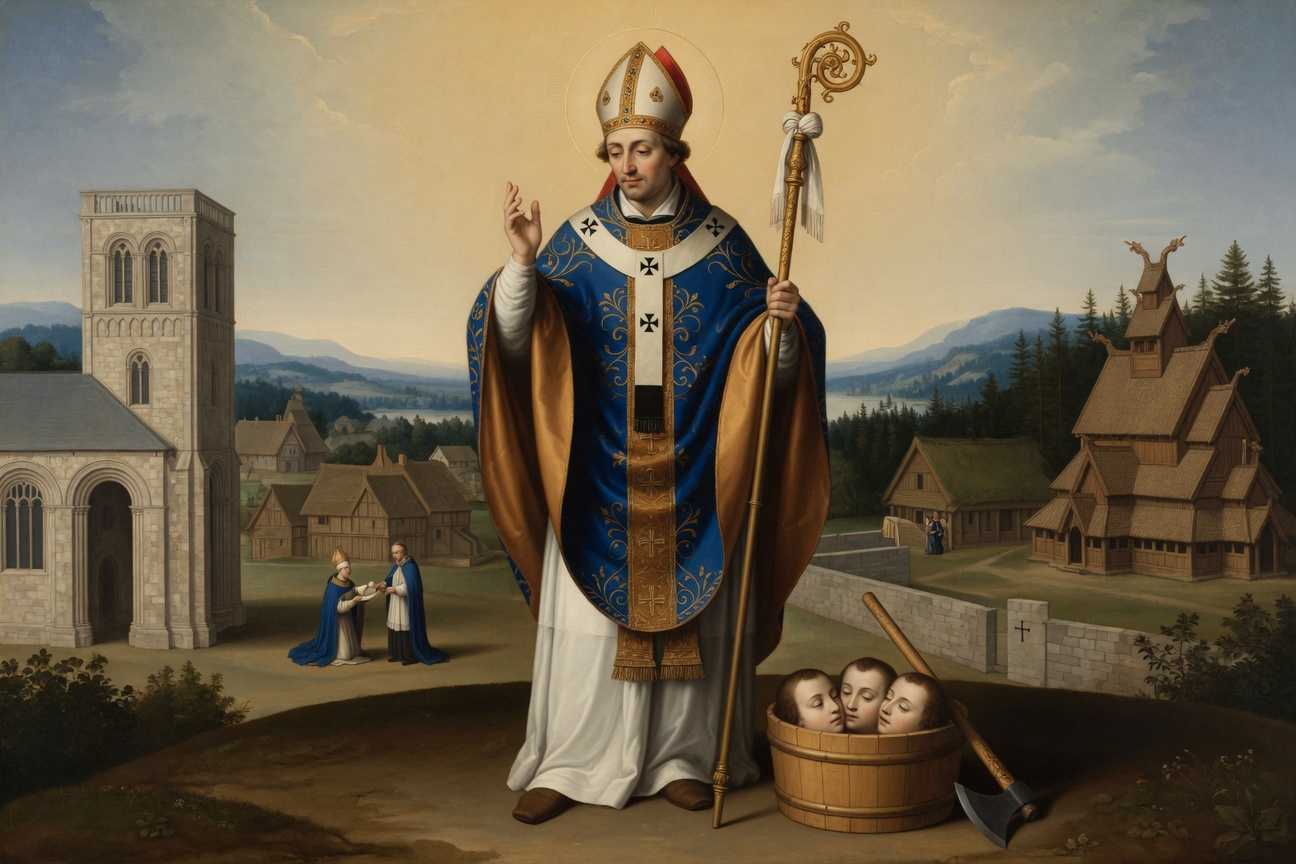
The saint is traditionally depicted with three heads, recalling the martyrdom of his nephews and the miraculous discovery of their remains.
In the ancient calendars of Sweden, February 15 was marked by a crozier and an axe: the crozier indicated Saint Sigefred, and the axe recalled the murder of his three nephews, Unamann, S unamann Unamann Nephew of Sigefred, martyr in Sweden. , and Vina Sunamann Nephew of Sigefred, martyr in Sweden. mann , who ha Vinamann Nephew of Sigefred, martyr in Sweden. d come with him to evangelize Sweden and whose remains he fully recovered: this is why he is depicted carrying three heads. Sometimes these heads are in a tub placed on the bishop's hand. Elsewhere, the Saint sees three heads that speak to him from the bottom of the tomb. This latter manner recalls that the murderers had hidden the bodies of their victims so well that it took a miracle for Saint Sigefred to discover them.
Annexes & related entities
Structured data for exploration: events, miracles, quotes, places, attributes, patronages, and important entities cited in the text.
Key Events
- Priest in York, England
- Called by King Olof Skötkonung to evangelize Sweden
- Foundation of the episcopal see of Växjö
- Evangelization of Gothia and Westrogothia
- Intercession for the murderers of his nephews
- Canonization by Pope Adrian IV around 1158
Miracles
- Miraculous discovery of the hidden bodies of his three nephews
- Heads of the nephews speaking to the Saint from the bottom of the tomb
- Numerous miracles at his tomb in Växjö